In 2002, the US Supreme Court ruled in Republican Party of Minnesota v. White (536 U.S. 765) that states could not prevent judicial candidates from discussing controversial legal and political issues during their campaigns. Such “announcement clauses” were enacted as part of larger judicial codes of conduct under the pretense that discussing such views would make judges partial to particular parties in litigation (Minzner Reference Minzner1999). The decision was immediately controversial. Critics were outraged and continue to castigate the decision, claiming that prohibiting announcement clauses politicizes the judiciary, makes judges dependent upon parties and special interests, and threatens the legitimacy of judges in the eyes of the public through increased politicization (Brennan Center for Justice 2002; Bannon Reference Bannon2016).
But political scientists have been skeptical of critics’ claims. Bonneau, Hall, and Streb published one of the first comprehensive empirical examinations of the decision’s effects (Reference Bonneau, Melinda and Matthew2011). Analyzing a number of important aspects of judicial elections including contestation rates, vote shares, campaign expenditures, and voter participation in both partisan and nonpartisan judicial elections, they found no evidence that the electoral environment for judicial candidates had changed after White. Their findings comport well with other findings on announcement clauses. Peters (Reference Peters2007, Reference Peters2009, Reference Peters2017) has repeatedly found that announcement clauses have had little effect on judicial election returns, as well as finding that announcement clauses and other speech canons did not influence political advertising in those races. Indeed, the literature on White supports the larger research project by some authors seeking to defend judicial elections from various criticisms, including those related to the White decision (Bonneau and Hall Reference Bonneau2009).
Yet there is reason to believe that Bonneau, Hall, and Streb’s research design may have biased their findings. First, they do not distinguish those states with announcement clauses at the time of the ruling from those states without them. Those states without announcement clauses were de jure unaffected by the ruling, and thus one would not expect to find an effect from White on these states. But by simply pooling the data, however, the authors may have diluted the change White had on judicial elections, leading to null results in their analysis. Related scholarship has recognized this potential. Peters (Reference Peters2007, Reference Peters2009, Reference Peters2017) finds that announcement clauses and similar canons decrease the probability of a challenger entering a judicial election. Hall and Bonneau (Reference Hall2013) find that states that made broad changes to their laws governing judicial elections post-White had significantly more voter participation compared to states that made no or only narrowly tailored changes.
Second, the authors do not confront sample selection bias. Much of the analysis in Bonneau, Hall, and Streb (Reference Bonneau, Melinda and Matthew2011) looks only at contested elections, and the previous literature notes that contestation is nonrandom (Bonneau and Hall Reference Bonneau and Melinda2003). This can lead to sample selection bias, which many in the literature confront by using Heckman models (Hall and Bonneau Reference Hall and Chris2006; Peters Reference Peters2007, Reference Peters2009, Reference Peters2017). Bonneau, Hall, and Streb, however, do not confront the issue, potentially biasing their findings. These problems with the authors’ original analyses suggest need for replication, especially since their analysis is the only published analysis that considers the potential effect of White on voter participation both before and after White and the emergence of quality challengers in any time period.
This research note extends Bonneau, Hall, and Streb’s analysis in two important ways. First, the analysis is extended by conditioning the effect of the White decision on whether a state was affected by it, whether a state had an announcement clause at the time of the ruling, or whether a state broadly changed its election rules as a result of the decision (Caufield Reference Caufield2007). Second, much of the analysis is reestimated using a Heckman selection model. In the former case, there are no statistically significant changes in the functions or outcomes of judicial elections post-White. In the latter case, however, there is contradictory evidence concerning voter participation that undermines subsequent research. Overall, however, Bonneau, Hall, and Streb’s original findings are largely robust to a more flexible research design.
Research Design
Much of the research on White and its effects has centered on testing critics’ claims that the decision increased the politicization of judicial elections. The same is true of Bonneau, Hall, and Streb’s original analysis, in which they analyze all contestable state supreme court elections between 1996 and 2008. The first three areas of their analysis focus on the candidates of judicial elections. They test if White influenced whether races were contested and, if so, whether White influenced the emergence of quality candidates, or candidates with previous experience as a judge. The latter fact is particularly important, as those challengers with previous experience in political office have a considerably better chance of winning elections than their unexperienced peers; in the context of congressional elections, it has been said that “the quality of the challenger may be the most important determinant of competition” (Bond, Covington, and Fleisher Reference Bond, Cary and Richard1985, 511; see also Hall and Bonneau 2006). Bonneau, Hall, and Streb also analyze the resulting competition directly by analyzing the vote share of incumbents in contested elections. They find no influence of White in any of these measures of politicization.
Bonneau, Hall, and Streb do not limit their analysis to just the candidates in the campaign, but all participants including activists and the public. They first examine campaign spending in contested races, both total expenditures and per capita, which captures the size and sophistication of the different campaigns in each race. This is important, as many reformers see the rise of campaign spending as clear signs of the increasing politicization of the courts and the decreasing legitimacy of judges (Bannon Reference Bannon2016). Bonneau, Hall, and Streb also examine ballot roll-off, or the percentage of individuals who voted in high-profile races but did not vote in the contested state supreme court elections also on the ballot. Reformers argue that disgust at politicized judicial elections may decrease participation, while newer research argues that increased information available to voters through White would increase participation (Hall and Bonneau Reference Hall2013; see also Hall Reference Hall2015). Again, Bonneau, Hall, and Streb find no influence of White in any of these measures of politicization. More information on all of these variables and how they were collected can be found in the original article.
Using the data from Bonneau, Hall, and Streb’s original article, I replicate their analysis and include a slightly more complicated model specification. Two independent variables are taken directly from the original article. The first is a dichotomous measure of whether the White decision has occurred in the data, where 1 indicates that the White decision is now in effect (i.e., the year is 2003 and beyond) and 0 indicates that the White decision has yet to be made.Footnote 1 Were White to have had an effect, it would have to be after the decision was made. The second is also a dichotomous measure for the format of the election, where 1 indicates a partisan election and 0 indicates a nonpartisan election.
The next two independent variables mean to improve the research design of previous analyses. The first is a dichotomous measure of whether a state had an announcement clause in 2002, where 1 indicates that they did and 0 otherwise. I suggest that if White had an effect, it would be in those states with announcement clauses that were nullified. Additionally, the second new independent variable is also a dichotomous variable in which 1 indicates that a state made broad changes to its laws concerning judicial elections in response to White and 0 otherwise. This variable is derived from Caufield’s (Reference Caufield2007) review of policy responses to White concerning the rules governing judicial elections in each state, with some states making broad changes to laws and other states making minor changes or none at all. The literature suggests that if White had an effect, it would likely be in these states (Hall and Bonneau Reference Hall2013; Peters Reference Peters2017). These two variables enter into separate models as robustness checks.
To test whether the electoral environment post-White changed in those states where the White ruling changed election law, I included an interaction term between the temporal variable tracking when White came into effect and either of the two variables indicating in which states White would have had an effect, depending on the model. These models were estimated in two ways. First, they were estimated using either OLS or logit to replicate the original analysis. Second, all models except the model of contestation were estimated using a Heckman selection model, with contestation serving as the selection mechanism.
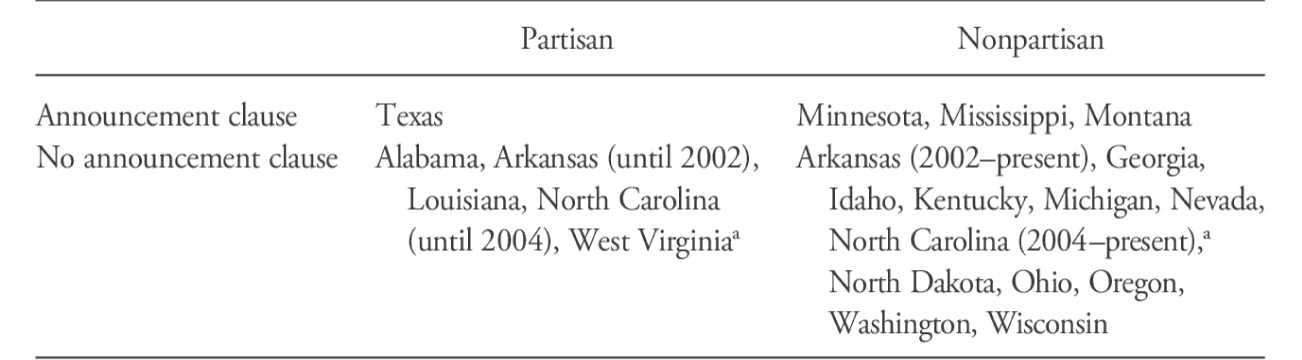
A breakdown of states using contested judicial elections in 2002 is given in table 1. Nineteen states had contested judicial elections over this time period. But of those states, only four—Minnesota, Mississippi, Montana, and Texas—had announcement clauses at the time of the ruling. It is in these states where we should expect to find a change in judicial elections, if they did change. Only Texas had both partisan elections and an announcement clause in 2002, however, which limits our ability to make inferences regarding the differences between partisan states with announcement clauses and nonpartisan states with announcement clauses. A similar problem occurs using a broad interpretation of White, as no states with broad interpretations of White—Georgia, Michigan, Minnesota, and Oregon—had partisan elections in the period of analysis.
States Using Contestable Judicial Elections, by Type and Presence of Announcement Clause in 2002
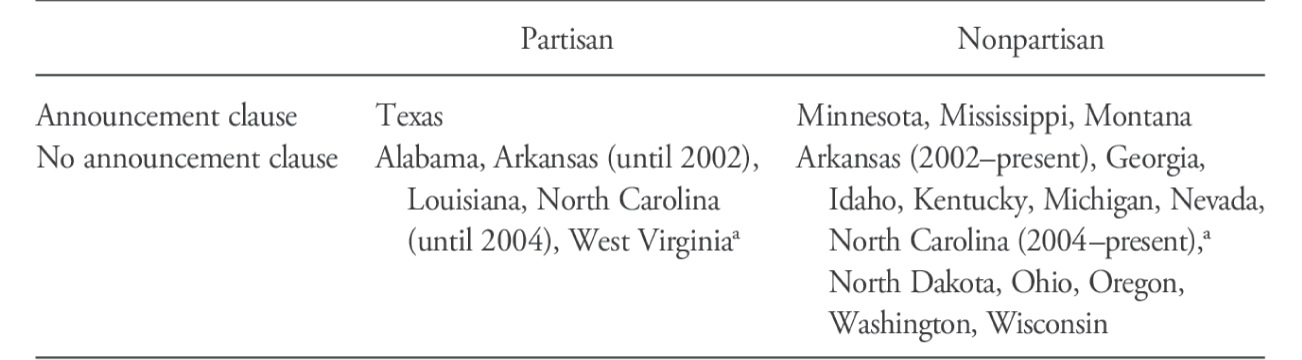
a Both West Virginia and North Carolina eventually switched to the other type of competitive election, but this happened after the end period of the present analysis.
Results
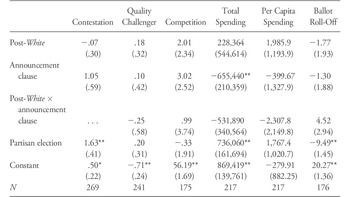
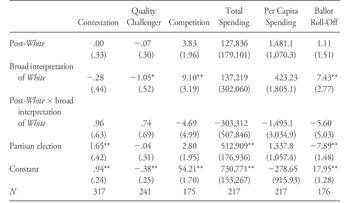
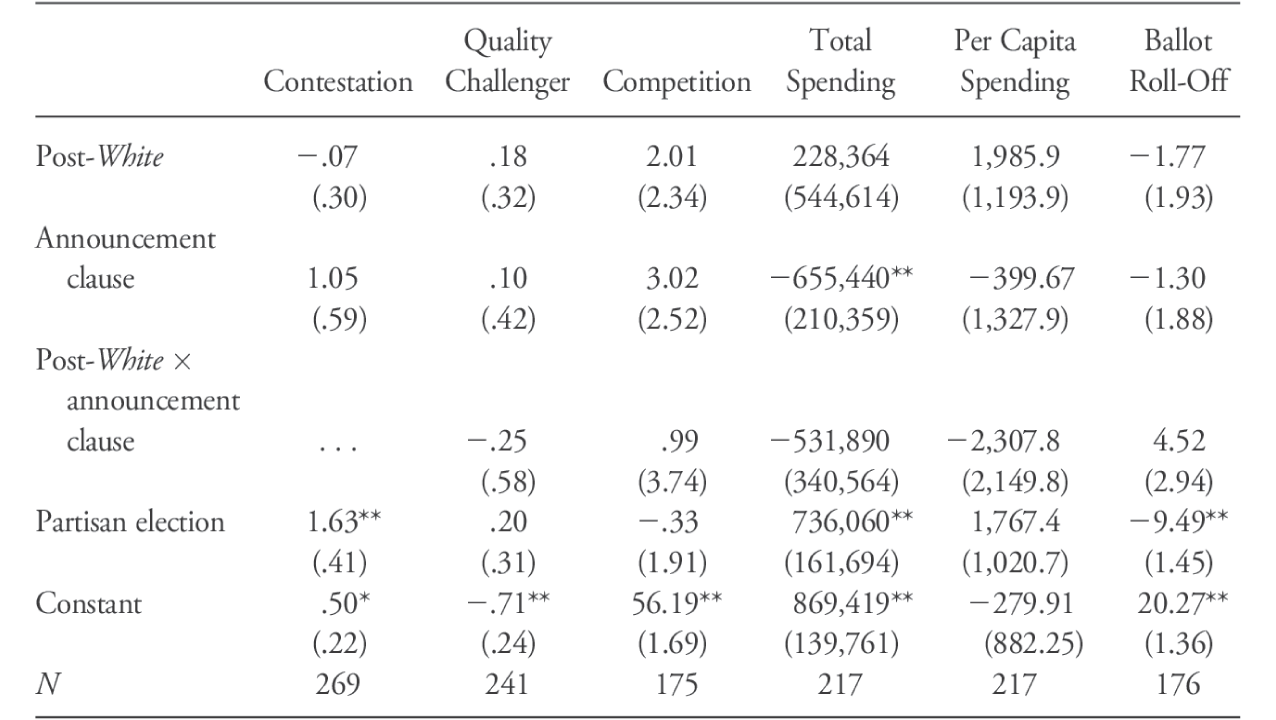
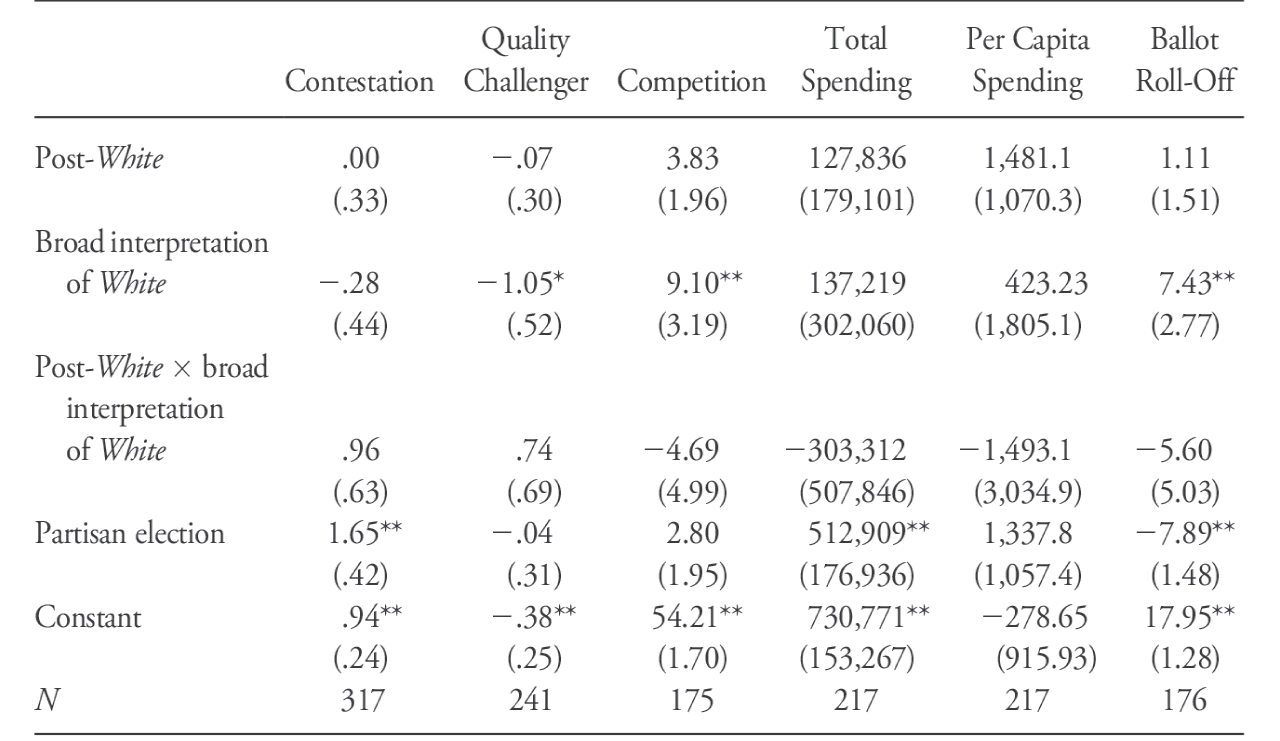
The results of these models with just the interactions are given in tables 2 and 3. Interactions are difficult to interpret, but an interaction term represents the change in either of the variable’s marginal effect when the other variable increases by one unit.Footnote 2 As one can see, there are no statistically significant interaction terms anywhere in the tables. Many scholars, rather than looking at the interaction term, opt to instead look at the total marginal effects and evaluate their statistical significance (Brambor, Clark, and Golder Reference Brambor, Clark and Matt2006). These marginal effects, calculated in the replication file, also reveal that moving from a pre-White to a post-White era never affects any of the features of judicial elections, even in those states that either had announcement clauses in 2002 or in those states that made broad changes to their election laws in response to White.
State Supreme Court Elections Pre- and Post-White, by the Presence of an Announcement Clause in 2002
Note.— Standard errors in parentheses.
* p < .05.
** p < .01.
State Supreme Court Elections Pre- and Post-White, by the Presence of Broad Changes to Judicial Election Law
Note.— Standard errors in parentheses.
* p < .05.
** p < .01.
It should be noted that the model for contestation in table 2 has one fewer coefficient than the other models. This is because all elections before White in states that had announcement clauses were contested, and this lack of variation makes their inclusion in our larger, interactive model inestimable. The observations are dropped to estimate the model, and by doing so, the interaction term is no longer estimable and also dropped. Because there is no variation among states affected by the ruling before and after White, the model is not useful for determining the effect White had on contestation. As an alternative, a t-test is calculated for the difference of means for the affected states before and after White. The test approaches but fails to reach significance in a two-sided test. A one-sided t-test would be statistically significant if one hypothesized that White would lead to a decrease in contestation. As Bonneau, Hall, and Streb review in their original article, however, White was expected to have an increase in political contestation by politicizing the judiciary. Thus, this result does not have a theoretical rationale and is likely the result of random chance.
However, there are a number of suspicious results reported in table 3. The coefficient for those states that had a broad interpretation of White is statistically significant for the models of quality challengers, competition, and ballot roll-off. Given their direction, these coefficients can be interpreted as, before White, states that would have a broad interpretation of White had less politicized judicial elections than other states. In a similar vein, in table 2 the coefficient for those states with an announcement clause is statistically significant for the model of total spending, revealing that those states had less campaign spending before White. Marginal effects calculations, reported in the replication materials, reveal that these effects disappear after the White decision. Going from less politicized elections to normally politicized elections could be evidence that White truly influenced judicial elections.
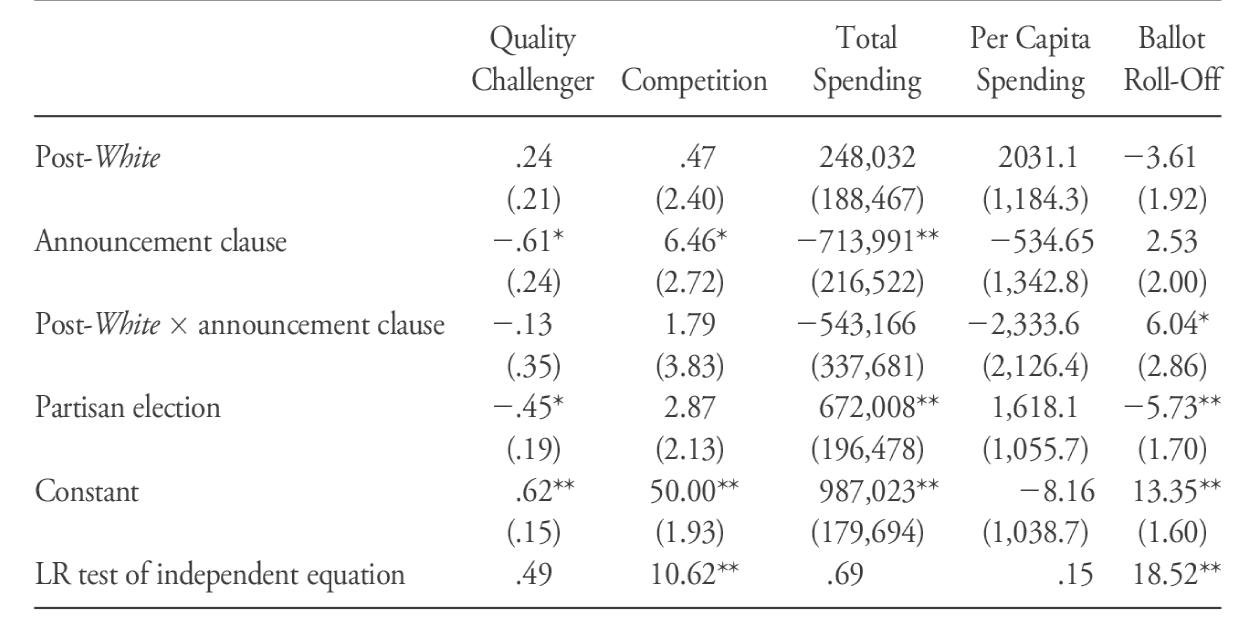
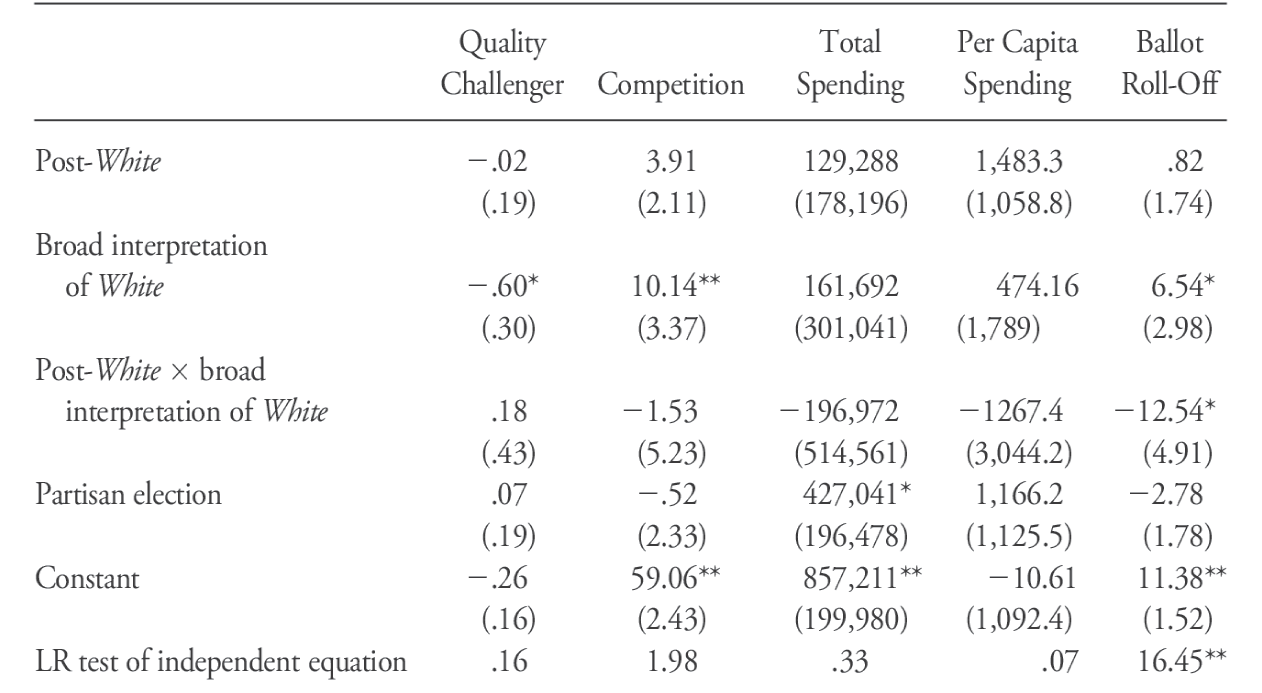
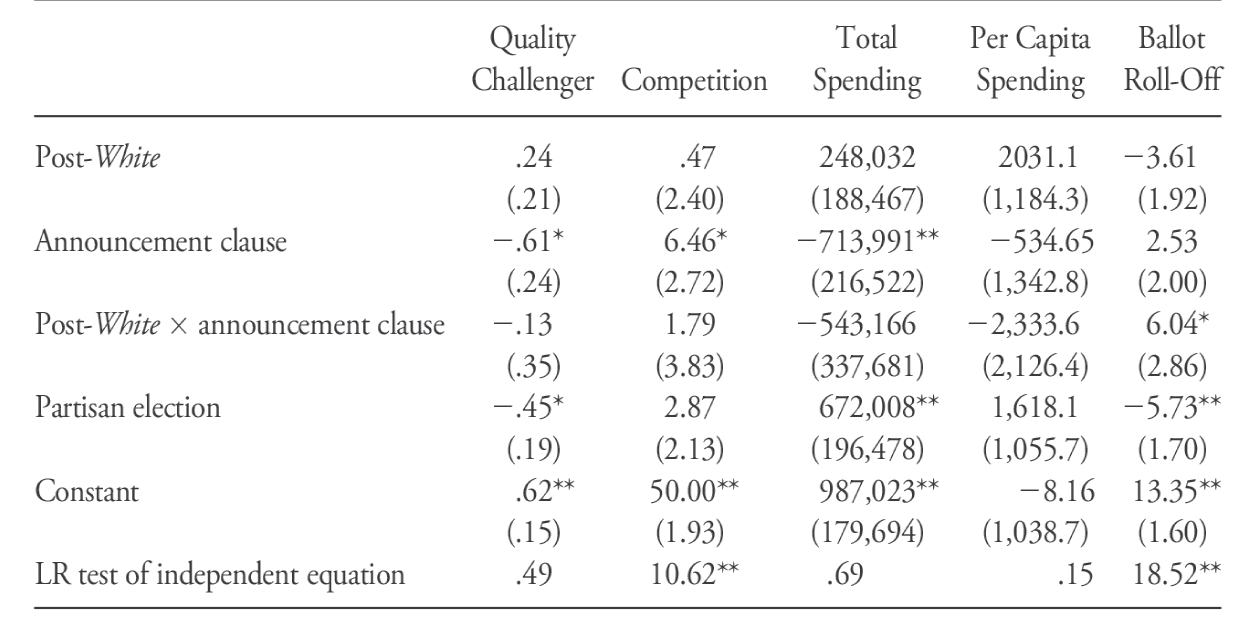
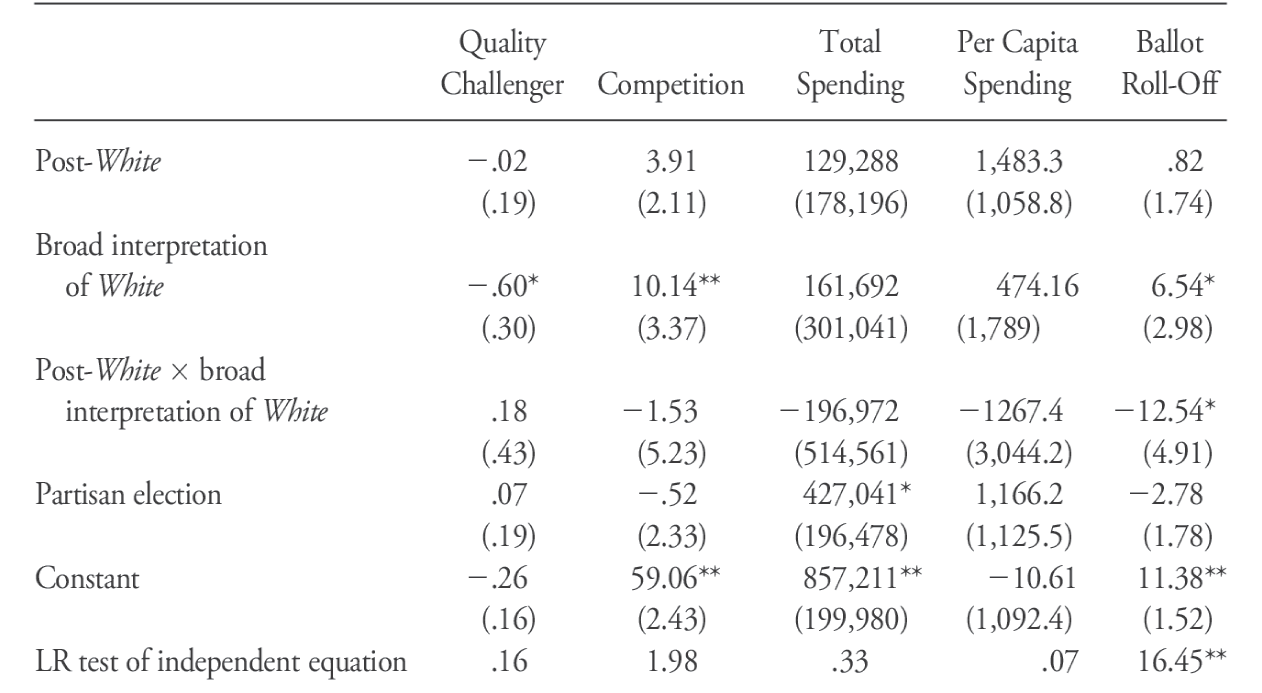
Therefore, I now turn to a reestimation of the models using a Heckman selection model. The results of the second, relevant stage of the analysis are reported in tables 4 and 5. Many of the suspicious results just mentioned are also present now. But many of the coefficients for the interaction term are in the wrong direction, and all but two in the models fail to reach statistical significance. Suspicious or not, White does not seem to have an appreciable effect on most aspects of judicial elections.
Stage 2 of Heckman Models of State Supreme Court Elections Pre- and Post-White, by the Presence of an Announcement Clause in 2002
Note.— Standard errors in parentheses.
* p < .05.
** p < .01.
Stage 2 of Heckman Models of State Supreme Court Elections Pre- and Post-White, by the Presence of Broad Changes to Judicial Election Law
Note.— Standard errors in parentheses.
* p < .05.
** p < .01.
But the models of ballot roll-off now have statistically significant conditional marginal effects, with a striking discrepancy in results. In the model featuring states that made broad changes to election laws after the decision, there is strong evidence to suggest that White increased voter participation in judicial elections. The interactive term in the model is negative and statistically significant, indicating that those states that made broad changes to their election laws increased participation by 13% of the voting public. Indeed, while before White these states had 5% less of their voting public participate, after the decision they had 5% more of the voting public participate. This is strong evidence that is consistent with the findings of Hall and Bonneau (Reference Hall2013).
However, the model featuring states with announcement clauses had contradictory results. The interactive term is statistically significant but positive, indicating those states with announcement clauses saw a 6% decrease in participation by the voting public post-White. While a smaller result than the previous, the result does not comport with established research but instead supports critics’ notions that White resulted in a disaffected voting public. While I could attempt to create a theory that would adequately explain both results in a consistent manner, this would be the result of ad hoc theorizing and is rejected in favor of a franker discussion.
It is entirely possible that one set of the results is by chance and that the true effect of White either increased or decreased political participation. But there is little available evidence to judge which of the results is by chance. Rather, the interpretation of these results that are most consistent with the rest of the analyses is that the true data-generating process contains no relationship and both results are generated by chance. Twenty-two models have been run thus far in the analysis. In expectation, one interaction term would be statistically significant at some point in the analysis; the probability that multiple interaction terms would be statistically significant is also quite high. While I believe this evidence is consistent with the findings of Bonneau, Hall, and Streb, the analysis given by Hall and Bonneau (Reference Hall2013) is now suspect.
Conclusion
This note examined a couple of shortcomings of Bonneau, Hall, and Streb’s (Reference Bonneau, Melinda and Matthew2011) original analysis of the impact of the White decision on judicial elections. Their analysis pools the effect of White across states whether or not the decision had a de jure effect on a state’s election law, either as a result of an announcement clause being nullified or a state opting to further change its code of conduct to be consistent with the ruling. It also does not address sample selection bias in the model. By introducing a control for whether White had an effect on the election laws of a state, I allowed for a narrower impact of White. The analysis largely indicates, however, that even when correcting for these omissions, White does not have an effect. This finding is largely consistent with other evidence that shows these elections have changed little over the decades (Kritzer Reference Kritzer2015). It also provides robustness to most of the original findings that White did not change the political environment of judicial elections, including on the emergence of challengers, campaign spending, and a direct effect on the vote shares of challenged incumbents.
There are two instances in the analysis, however, in which Bonneau, Hall, and Streb’s results do not replicate, both models of voter participation. Unfortunately, the results are contradictory: one model finds that White increased participation, while the other finds it decreased participation. This inconsistency creates problems for subsequent analyses that found those states that broadly interpreted White increased voter participation in judicial elections (Hall and Bonneau Reference Hall2013). Unlike in previous analyses, which relied on the differences in the breadth of White’s interpretation after the decision, this analysis models change in affected states before and after White and should be preferred. White, it seems, truly did not have an effect on judicial elections, even on voter participation.