Poverty is believed to sustain the distribution of particularistic benefits by politicians in return for electoral support. Consistent with modernization theories, economic development, urbanization and the growth of the middle class have all been argued to spur transitions to more policy-based electoral competition.Footnote 1 Many African countries have experienced sustained economic growth in recent decades, with significant urbanization. Ghana is now officially ‘middle income’, and the majority of Ghanaians live in urban areas. While many Ghanaians are poor, the largest metropolitan area, Greater Accra, contains a burgeoning middle class; nearly 80 per cent of families earn over US$4 per day,Footnote 2 and nearly one-quarter of adults in this city of four million have at least some secondary education, English literacy and employment in the formal sector. The city’s middle class is now large enough to swing local election outcomes in Ghana’s highly competitive political system. But despite having a more prosperous population, politics remains predominantly particularistic and patronage based, even in cities like Accra.Footnote 3
I provide an explanation of the persistence of particularistic linkages between politicians and voters in the face of urbanization and economic growth by examining the interaction of voters’ preferences with politicians’ incentives to supply different types of goods to voters. I focus on urban areas, where rising prosperity has been most concentrated. Wealthier urban voters are more likely than poor voters to prefer major universalistic policies over narrow particularistic benefits that can be targeted as patronage. But these preferences do not translate into significant policy-based electoral competition. Instead, there is a lag between forms of political competition and policy preferences in the underlying population.
Due in part to low state capacity, politicians are unable to credibly commit to delivering on campaign promises to voters who want these policies.Footnote 4 This creates short-term incentives to ignore voters’ universalistic policy preferences – even as they become more common – and to avoid wasting campaign effort mobilizing wealthier voters. As a result, voters who want universalistic policies become more likely to abstain from participation, both because they are less likely to be mobilized to turn out and because they are less likely to trust that their preferences will be addressed. Electoral participation remains dominated by poorer voters who are most susceptible to patronage. But the exit of the middle class from the electorate may only perpetuate incentives for politicians to under-supply policy-based competition relative to demand for it in the population.
To address this argument, I combine original survey data, localized census data and qualitative evidence from Greater Accra, the urban area where Ghana’s growing middle class is most concentrated. I measure differences in socio-economic status based on indicators of the probability that a person has escaped basic poverty and has the resources and skills to compete in the modern formal economyFootnote 5 using data on education, literacy and employment. This approach allows for comparisons of the poor and ‘non-poor’; similar to other recent studies on Africa’s middle class, I lack the fine-grained data necessary to distinguish the middle class from the wealthy elite.Footnote 6 Because elites are not significantly represented in my survey data, however, variation in socio-economic status can be reasonably interpreted as a comparison of the middle class and the poor (see below).Footnote 7
Using this data, I find that middle class urban residents are more likely to demand universalistic policies from the government that cannot be targeted as patronage, which is similar to expectations about preferences in existing literature. I also show, however, that urban residents who want these policies are less likely to turn out to vote and more likely to refrain from other forms of participation, which allows politicians to continue winning elections without addressing these policy demands. By combining qualitative evidence with an original survey experiment, I suggest that these voters abstain for two reasons: (1) they are less likely to be mobilized to turn out by politicians that do not believe they can credibly convince middle class voters to support them and (2) voters who want universalistic policies are especially unlikely to believe that politicians can deliver on their campaign promises.
This article makes several contributions. First, while existing work has established an overall negative association between the wealth of populations and patronage-based competition both nationally and sub-nationally,Footnote 8 much less research has examined the process by which contemporary societies transition from one form of competition to another as wealth increases.Footnote 9 By studying a new democracy in flux, which has recently experienced rapid gains in wealth, I zoom in on this process and suggest that having a more prosperous population does not translate directly into new forms of electoral competition if politicians cannot credibly commit to delivering the policies that more prosperous voters want. This implies that the emergence of the dual programmatic–clientelistic linkages now present in many Latin American countriesFootnote 10 cannot be taken for granted in other settings with lower state capacity and larger class-based differences in participation.
My findings reinforce that demand-side changes in voters’ preferences are not enough to spur transitions away from patronage politics without supply-side changes in politicians’ incentives to deliver patronage.Footnote 11 Modernization accounts, such as Inglehart,Footnote 12 argue that as voters become wealthier their preferences should change, which should then change patterns of political competition. While I find differences in voter preferences by socio-economic class that are broadly consistent with these theories, I suggest that these accounts over-predict the political changes that will result because they do not adequately consider politicians’ incentives to respond to these preferences. Although I cannot examine variation over time, my results imply that changes to political competition can lag significantly behind changes to preferences.
I also extend research on class-based turnout differences in Kasara and Suryanarayan to explore reasons why middle class voters often participate less than the poor in many developing countries.Footnote 13 Rather than focusing on tax exposure, I suggest that more proximate mechanisms for class-based differences in turnout may be lower rates of mobilization of middle class voters by patronage-based parties and voters’ disillusionment over unmet policy preferences. This is consistent with evidence from other settings, such as India, where the urban middle class has reportedly also been less likely to turn out because of disillusionment with entrenched patronage practices.Footnote 14
Finally, this study joins a nascent literature considering the political effects of the recent emergence of a sizeable middle class in Africa.Footnote 15 Despite being one of the most significant socio-economic transformations currently occurring across the continent, scholars are only beginning to examine its political implications.
EXISTING LITERATURE
Transitions from Patronage Politics
My argument combines two distinct literatures: research on the factors that explain transitions away from patronage-based politics and research on class-based differences in participation. There is a general expectation in the existing literature that as the middle class emerges and wealth rises, political competition will become less particularistic.Footnote 16 Previous studies expect that this will occur because of changes either to the demand or to the supply of patronage: demand for patronage may decline in the electorate through changes to voter preferences as wealth increases, or the supply of patronage may be constrained by bureaucratic reforms or economic liberalization.Footnote 17
Demand-side explanations for transitions between patronage- and policy-based competition are rooted in the expectation that poorer voters have different preferences from the middle class and wealthy. In most models of distributive politics, the poor are assumed to gain greater marginal utility from the patronage benefits that politicians provide.Footnote 18 Because poor voters more acutely need private goods like food, housing or jobs, as well as club (‘local public’) goods, such as running water and paved roads, they are more susceptible to electoral appeals that strategically target these goods.Footnote 19 Consistent with these preferences, a large body of research establishes that patronage is disproportionately targeted to the poor in new democracies.Footnote 20
The implication is that as the proportion of wealthier voters rises, politicians should place less emphasis on patronage. In some middle-income democracies, robust policy-based, ideologically differentiated competition has emerged alongside clientelism. This has been studied most extensively in Latin America, where many parties woo poor voters with selective transfers, while engaging wealthier voters with policy.Footnote 21 Luna argues that dual appeals are most likely when the poor are segregated from the middle class and rich into separate electoral or administrative districts.Footnote 22 This allows local politicians to specialize in either a particularistic or policy-based appeal without bringing the two into conflict.Footnote 23 In addition, these studies make an implicit assumption that there is high enough state capacity that politicians can credibly commit to implementing their policy platforms. But this is not the case in lower-capacity states that have little previous history of policy-based parties,Footnote 24 as in much of Africa.
Class and Political Participation
A separate literature documents class-based differences in participation. In advanced democracies, the wealthy and middle class are more likely to participate in politics than the poor.Footnote 25 The preferences of the wealthy are then better represented in policy.Footnote 26 But Kasara and Suryanarayan demonstrate that this pattern reverses in developing countries, with wealthier citizens often reporting lower turnout than the poor.Footnote 27
Some research on Africa finds evidence of a similar reversal. Mattes shows that wealthier black South Africans are less likely to turn out than the poor and finds that middle class Zambians do not turn out at higher rates than poor voters.Footnote 28 Croke et al. find that more educated voters are less likely to participate in Zimbabwe. But there has been little theoretical explanation for these results in Africa-specific research beyond Croke et al., who limit their focus to competitive authoritarian regimes, arguing that the better educated do not participate to avoid legitimizing authoritarian rulers.Footnote 29 But I emphasize below that better-educated, middle class voters may find participation futile even in a significantly more democratic context.
Kasara and Suryanarayan explain class-based turnout differences across the developing world by arguing that when the rich are not threatened by taxation in states with low tax capacity and little ideological polarization between parties, they do not need to participate to prevent redistribution.Footnote 30 But while the costs of abstention are lower when wealthier voters are not threatened by taxation, the benefits of participation for the middle class and wealthy are also lower where politics is patronage based. Tax capacity and the presence of patronage-based competition are likely highly correlated across countries, such that some of the variation observed in Kasara and Suryanarayan could be due to incentives created by patronage-based politics. Turnout buying inflates the turnout of the poor through inducements that the rich do not value;Footnote 31 absent other, simultaneous mobilization of middle class voters, turnout disparities could result. Moreover, where parties are engines for patronage distribution, members may join in pursuit of rents rather than ideology.Footnote 32 The reward structure for participation in such an organization is unlikely to be aligned with the goals of middle class voters seeking to advance specific ideologies or policies.
PATRONAGE POLITICS AND PARTICIPATION AS REINFORCING
Consistent with the existing literature, I expect class-based differences in policy preferences. But I argue that politicians will face significant credibility problems in convincing middle class voters with universalistic preferences to support them. As a result, voters with these preferences will face incentives to withdraw from active political participation. Politicians, in turn, continue being able to use predominantly particularistic, patronage-based appeals despite rising wealth. To make this argument, I first describe how socio-economic class relates to preferences and then lay out expectations for how preferences shape politician behavior and voter participation.
Particularistic and Universalistic Preferences
I extend existing work on demand for patronage politics to make clear an implicit distinction between two classes of voter preferences: for particularistic goods or universalistic policies. I define this distinction as whether or not a voter’s preference could potentially be satisfied by a politician providing a targeted patronage benefit. Particularistic goods encompass private goods, targetable as patronage to individuals (for example, cash payments, jobs), and club (local public) goods, which can be geographically targeted as patronage to small communities (for example, local roads, running water access). Demands for universalistic policies instead necessarily affect many other people, with benefits that cannot be isolated to small sets of voters in a clientelistic transaction based on expected voting behavior or ethnicity.Footnote 33 Particularistic resources do not have to be distributed as patronage; they could be distributed programmatically.Footnote 34 But when many people want particularistic benefits from the government, patronage-based appeals remain a viable option for politicians, who can still strategically choose to build support by selectively distributing these benefits to different groups of voters. By contrast, where a large number of voters have universalistic preferences, patronage-based appeals are no longer a viable strategy; these preferences cannot be satisfied by patronage. The extent of particularistic preferences in the electorate thus provides an upper bound on the proportion of voters that could be potentially won over with patronage.
Importantly, this distinction does not depend on voters’ motivations for their preferences. Particularistic and universalistic preferences could both be rooted in pocketbook concerns: a civil servant could ask the government to raise the salaries of civil servants because it directly affects her personal finances, just as a cash handout to pay for her child’s school fees would. If the voter demands cash for her child’s school fees, this preference can be satisfied by a clientelistic politician passing out patronage. But the voter’s demand for a higher wage can only be satisfied by a change to public sector labor policies that will affect many other people.Footnote 35
I expect poorer voters to have stronger preferences for particularistic goods over universalistic policies, consistent with implications of existing theories of distributive politics. This correlation will be somewhat complicated by patterns of local service provision, however. If paved roads and running water, for example, are not available in a particular neighborhood, middle class residents may still demand some particularistic goods from the government. But controlling for variation in service provision, I predict that higher socio-economic status should be positively correlated with demand for universalistic policies.
Implications for Political Competition
If socio-economic status explains preferences, demands placed on politicians should change as wealth in society increases. In a country transitioning to democracy where most voters are initially poor, the politicians who are most successful at first will often be those who can best target patronage benefits to key constituencies and ethnic bases, not those with strong policy commitments. But what happens when there is a subsequent rise in universalistic preferences in the population?
Politicians who have already specialized in patronage-based appeals can respond in two ways: they can diversify their approach and make real policy promises to win over the growing bloc of middle class and wealthy voters, or they can ‘stay the course’ with patronage-based appeals, making only cursory efforts to address universalistic preferences. Each entails costs: the first, the costs of making policy-based appeals credible and restricting the supply of patronage by committing to distribute some benefits universally; the second, the opportunity cost of foregoing votes from those wanting universalistic policies. In urban African settings, the second choice may often be less costly than the first, even as the middle class grows.
Parties that have already specialized in targeting patronage to the poor face a credibility problem when trying to mobilize voters based on policy appeals. This is especially the case in low-capacity states with endemic corruption, where there are challenges to implementing large-scale public policies that voters demand.Footnote 36 Where the state has a long history of failing to deliver on policy promises amid budget crises, corruption, and ethnic or partisan favoritism, voters will initially discount the credibility of universalistic policy promises.Footnote 37 Even if specific leaders are committed, the bureaucracies and other politicians charged with implementing policies often fail to deliver, or target supposedly universalistic benefits as clientelism.Footnote 38 Building credibility about policy proposals requires long-term investments in successful implementation, taking more time than a politician with a short time horizon has. But this credibility is crucial for policy-based appeals to work as an electoral strategy. Patronage goods can be delivered upfront, before the election. But voters must trust politicians to follow through later for major public policies that require longer-term implementation.Footnote 39
As a result, I expect that in settings of low state capacity, few voters will see campaign promises as credible, especially when they are about universalistic policy proposals. The better-educated, more prosperous voters who want these universalistic policies may be those who are most aware of past policy failures and most dissatisfied with the status quo policy environment.Footnote 40 Voters who demand universalistic policies may be those who are least likely to perceive promises about these policies as credible. It is essentially costless for politicians to include rhetoric about large-scale policy proposals in their platforms and manifestos, but this is often cheap talk; the existence of this rhetoric does not mean that voters with universalistic preferences believe it.
In addition to these credibility problems, politicians can face high transaction costs to switching to policy-based appeals because implementation of universalistic policies can require foregoing existing opportunities to deliver patronage. Even if politicians in middle class districts support universalistic policies, they confront a collective action problem: in many policy areas, they cannot act on their own – they need the co-operation of other legislators, bureaucrats, or branches of government who may not face the same incentives.Footnote 41 For example, rural legislators or party leaders may block policies preferred by urban middle class districts unless it does not constrain their own distribution of patronage.
Overall, there is then a higher marginal cost for politicians to engage with more middle class voters through policy than to engage with poorer voters through patronage. Ex ante, if the costs of engaging with these voters were similar, politicians would face a strong incentive to begin catering to the preferences of middle class voters, similar to the Latin American parties in Luna.Footnote 42 Even if middle class voters do not yet form a majority of the electorate, their votes are still very valuable in competitive elections where small swings in vote share determine outcomes. But where the costs of engaging with voters in the growing middle class are significantly higher than those of engaging with the poor, politicians do not have to address their preferences if they can get away with ignoring these voters in the short term.Footnote 43 Politicians might employ surface-level rhetoric about universalistic issues, but they need not focus significant mobilization efforts on the middle class. This becomes electorally problematic if their opponents make credible policy-based appeals and corner support from the middle class. But any opposing politician also faces the same credibility and coordination problems in attempts to mobilize these voters. Moreover, because some middle class voters still want particularistic club goods because of shortcomings in service delivery, as discussed above, a politician can still secure at least some middle class votes by selectively targeting club goods to neighborhoods with poor service provision. As a result, I expect that beyond costless rhetoric, politicians will largely avoid mobilizing voters that it believes are not susceptible to the particularistic appeals it has already specialized in providing.
But a particularly important reason politicians can afford to ‘stay the course’ despite the growth of the middle class may be a lack of participation from voters who want universalistic policies. With few options to chose from that they credibly believe will give them what they want, and weaker mobilization from politicians, these voters may become disillusioned and stop turning out. And if party organizations and other politically active associations are built around the distribution of patronage, voters who do not value patronage benefits may avoid them. Moreover, a large literature shows that an important determinant of turnout is whether politicians mobilize voters (or those in a voter’s surrounding neighborhood) to turn out.Footnote 44 If politicians ignore middle class voters in their campaigns, they may not vote simply because they are not being mobilized to turn out.
This could then create a feedback loop. If voters who want universalistic policies withdraw, the electorate remains more heavily weighted to those preferring particularistic benefits and party organizations remain dominated by those seeking patronage, not policy.Footnote 45 Politicians can continue foregoing costly investments in making their universalistic appeals credible, even as the middle class grows. This may only encourage more of those who want universalistic policies to stay away. This will not cycle indefinitely: a shock, such as an economic crisis, could spark greater turnout, or the middle class may eventually grow so large that politicians have no choice but to include wealthier voters in electoral coalitions. But in the medium term, even if economic growth reduces aggregate preferences for particularistic goods in the population, patronage politics can be ‘sticky’, with the form of political competition lagging well behind changes in preferences in the underlying population.
Why do disaffected voters not organize a new party to offer themselves universalistic policies? Staying home is the lowest-cost response to large collective action problems, particularly if these voters are dispersed across neighborhoods, not already embedded in organizations that provide a framework for collective organization, or cross-cut the main ethnic cleavages in society. An outside entrepreneur with a policy-based appeal could emerge, but this is unlikely in the near future in more institutionalized party systems, such as Ghana, where the barriers to an outside campaign are significant.Footnote 46 Moreover, an outsider faces the same constraints and collective action problems to making credible policy appeals. Ultimately, to the extent that such a credible outside option does emerge, the predicted differences in participation should decline.
THE GHANAIAN CASE
Particularistic Politics in Ghana
Ghana has a competitive presidential system dominated by two parties, the ruling National Democratic Congress (NDC) and the New Patriotic Party (NPP). Recent presidential elections have had razor thin margins. Elections in Greater Accra are also highly competitive. The city serves as a key swing region in presidential elections, and Members of Parliament (MPs) won with less than 55 per cent of the vote in more than half of the metropolitan area’s constituencies in 2012.
Instead of policy platforms, the existing literature shows that vote choice in Ghana is explained by a combination of ethnic voting, including in Greater Accra, and performance voting based on economic conditions or the distribution of particularistic benefits and localized services.Footnote 47 Political competition in urban and rural areas remains centered around the distribution of localized public services and patronage goods, rather than a contest over policy agendas.Footnote 48
On the surface, the NDC and NPP both employ some universalistic rhetoric in their campaigns. Elischer analyzes their manifestos and describes these parties as somewhat programmatic and ideologically differentiated.Footnote 49 But characterizing these parties as programmatic based on their rhetoric is problematic. First, while some policy promises contain ideological content, much of their rhetoric centers on valence issues, such as vague pledges to ‘grow the economy’.Footnote 50 More importantly, even where messaging is more concrete, there are strong reasons for voters to doubt the credibility of the parties’ promises. Policy proposals in manifestos are costless cheap talk, while many of the most prominent promises from each party have been marked by widely known failures of implementation. Major universalistic campaign promises have often been clientelistic as implemented, mired in corruption, never happened or only partially carried out after substantial delay, in line with the difficulties of policy implementation in weak states discussed above.Footnote 51 Moreover, the few major policy issues that the parties have successfully campaigned on and implemented in office have almost exclusively been targeted at providing social assistance to very poor voters – for example, public health insurance and free school meals for impoverished children – and have not been aimed at the emerging urban middle class.
In addition, while there is some rhetoric about a left–right ideological divide between the NDC and NPP, the records of NDC and NPP governments belie any self-proclaimed ideologies; voters are unlikely to have clear expectations that these parties will govern in line with specific programmatic orientations.Footnote 52 Both parties have initiated policies that are at odds with any ideological classification,Footnote 53 and have a history of adopting each other’s proposals – embracing programs upon taking office that they had criticized when in opposition.
Ghana’s Urban Middle Class
Ghana has recently become a majority urban country. The metropolitan area surrounding the capital, Accra, has grown to four million, from 2.8 million in 2000 and 1.4 million in 1984. Annual GDP growth has been as high as 14 per cent (2011) and has remained over 4 per cent throughout the last decade. Gains in wealth have been most significant in the cities, where there is now a vibrant middle class rooted in the private sector economy.Footnote 54 Using individual-level 2010 census data (which does not measure income), 22 per cent of working-age adults in metropolitan Greater Accra are employed in the formal sector, are literate in English (the language of official business), and have some secondary or tertiary education. As discussed below, the combination of these characteristics provides an estimate of the non-poor population. Given the competitiveness of elections, this population is now large enough to swing outcomes in most of the city’s parliamentary races and to determine which presidential candidate wins the Greater Accra region.Footnote 55
Moreover, given recent economic growth, the size of this middle class population is rapidly growing. Formal sector employment in the city rose from 24 per cent of working-age adults in the 2000 census to 30 per cent in 2010 – adding roughly 350,000 new formal sector workers. Adults with some secondary education rose from 32 per cent to 43 per cent over the same period.Footnote 56 But contrary to the cases in Luna,Footnote 57 wealthier and poorer residents are spatially intermixed within the city, living in the same administrative and electoral districts.Footnote 58
DATA AND MEASUREMENT OF KEY CONCEPTS
I examine the implications of my theory by combining data on voters’ preferences and participation with qualitative evidence. Voter-level data is from an original survey of 1,008 residents of Greater Accra conducted in a representative random sample of forty-eight neighborhoods (or sampling clusters) in November–December 2013.Footnote 59 The survey data is supplemented by interviews conducted before and after the 2012 election with forty-seven local party executives and parliamentary candidates in Greater Accra, as well as eleven voter focus groups. Focus groups were conducted in a cross-section of neighborhoods in the metropolitan area, selected non-randomly to produce variation in ethnic diversity and wealth. Participants were then randomly selected within each neighborhood using a random walk procedure.
Coding Preferences
Preferences are measured by adapting an Afrobarometer survey question that asks respondents to list up to three issues that they most want the government to address.Footnote 60 The same question is frequently used to examine policy preferences in Africa.Footnote 61 Enumerators recorded up to three sentence-long responses instead of only coding predefined topics, as in the Afrobarometer. This allowed responses to be subsequently blind-coded as indicating particularistic or universalistic preferences, following the definition described above.
The coding rules count all preferences that could be satisfied through a targeted patronage transfer as particularistic, to produce an upper-bound estimate of the voters who are potentially susceptible to patronage-based appeals. Particularistic preferences are further broken down into preferences for private and club goods. Because respondents gave up to three responses each, these categories are not mutually exclusive. I operationalize universalistic preferences both as an indicator for whether a respondent named any universalistic good among their three responses or as the percentage of their total responses that was universalistic.
Under this coding scheme, preferences for national policies largely overlap with universalistic preferences, as universalistic preferences are by definition not targetable to specific individuals or neighborhoods, and are thus primarily national-level issues. Moreover, as discussed above, this coding scheme is agnostic to respondents’ motivations: whether voters are motivated by pocketbook concerns does not speak to whether their demands can be addressed by patronage from politicians. Finally, the question does not solicit preferences about the preferred mode of distribution. A respondent demanding that the government ‘assist the aged financially’ could want a Social Security-style social assistance program, could be requesting direct assistance from a politician or could be satisfied by either as long as she gets the help. In the first case she cannot be won over with patronage, but in the latter two cases, she could be, so this is coded as a particularistic preference. This is precisely why this coding scheme provides an upper bound on demand for patronage in the electorate.Footnote 62
Measures of Socio-economic Status
I measure the socio-economic status of survey respondents using an index based on whether a respondent has at least some secondary education, is fluent in English and is employed in the formal sector economy. Using indicators of education and employment status is consistent with the approach recommended by Thurlow, Resnick and Ubogu for measuring middle class status in Africa; they argue that these variables, along with measures of housing quality, are highly correlated with the extent to which someone has escaped basic poverty and has the skills to compete in the modern economy.Footnote 63 I adopt this approach in lieu of measures of income or consumption because I did not collect data on these variables, given the difficulty of accurately measuring these on surveys where there is a large informal economy.
This approach primarily distinguishes the poor from the non-poor,Footnote 64 not the middle class from both the poor and elite, as measures of education and employment status are too crude to distinguish the elite from the middle class. But wealthy elites are not well represented in the data; they represent a small fraction of the population to begin with, and are those least likely to consent to face-to-face household survey interviews. Survey enumerators only coded that thirty-five respondents lived in ‘luxury’ or ‘upper-class’ housing, typically associated with being in the elite.Footnote 65 As a result, indicators of higher socio-economic status in my data should significantly overlap with membership in the middle class, such that these can be discussed interchangeably in the analysis.
I code socio-economic status using an index – either the first dimension of a factor analysis of questions on education, literacy and employment or as a count variable of how many of these characteristics each respondent has. All results are robust to either measure; I report the factor index below.Footnote 66 Continuous measures are preferable to a binary classification of middle class and poor, which risks introducing bias from measurement error by mis-assigning respondents to the wrong categories.Footnote 67 My measure assumes only that respondents with more of these characteristics are more likely to be in the middle class. In the Appendix, however, I also conduct robustness tests using a dichotomous measure similar to Thurlow, Resnick and Ubogu that also incorporates a measure of housing quality.Footnote 68 I find identical results. Separately, in all analyses I also control for an index of basic household assets.Footnote 69 The Appendix provides summary statistics for components of the education/employment index.
EMPIRICAL ANALYSIS
Because detailed time-series data on the size of the middle class or voter preferences are not available, I cannot examine how patterns of participation and electoral competition change as the middle class grows. But by focusing on a snapshot of a city where the middle class has been growing, I show patterns that are consistent with the expectations above. This includes evidence that politicians’ approaches are becoming out of sync with preferences in the population, and evidence of the factors that could create this disconnect: politicians’ inability to credibly signal policy commitments to voters and the low turnout of voters with universalistic preferences.
While I expect each of these factors to feed back into each other, I present the analysis in the following order: first, I show that middle class respondents are more likely to prefer universalistic policies. I then show that those who demand universalistic policies are less likely to participate. Next I show that this connection between preferences and participation may exist either because there is little campaign mobilization of middle class voters or because of the low credibility of campaign promises to these voters.
Preferences and Participation
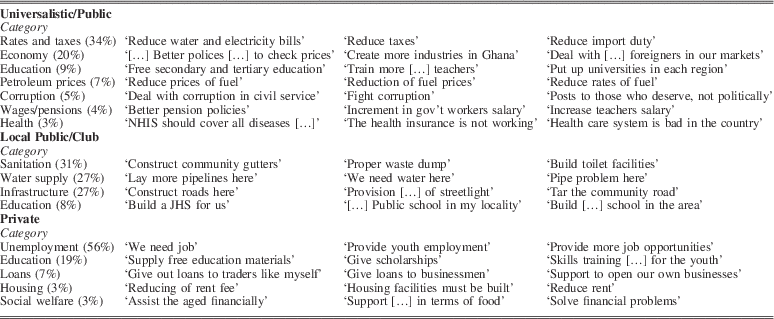
Overall, 55 per cent of respondents named at least one universalistic policy among the three issues they wanted the government to address. Over one-third (36 per cent) named two or three universalistic policies. The most common preferences are presented in Table 1. Higher socio-economic status is a strong predictor of universalistic preferences. Neighborhood-level needs also predict these preferences. I estimate a series of multi-level models following the form:
 $$\eqalignno{ & y_{i} \,{\equals}\,\alpha _{j} {\plus}\beta _{1} EducEmploy_{i} {\plus}\beta _{2} Assets_{i} {\plus}{\bf{X}} _{{\bf{i}} } \delta {\rm {\plus}}{\varepsilon}_{i} \cr & y_{i} \,{\equals}\,\alpha _{j} {\plus}\beta _{1} EducEmploy_{i} {\plus}\beta _{2} Assets_{i} {\plus}\beta _{3} Pop10\,Yrs_{i} {\plus}\beta _{4} NeighWealth_{i} \cr & \quad \quad \,\,\,{\plus}\beta _{5} Water_{j} {\plus}\beta _{6} Road_{j} {\plus}\beta _{7} Density_{j} {\plus}{\bf{X}} _{{\bf{i}} } \delta {\plus}{\varepsilon}_{i} $$
where y i is either an indicator for respondent i naming any universalistic policy among her responses or the percentage of universalistic policies listed by each respondent. Intercepts are partially pooled by the forty-eight sampling clusters j, to account for clustering in the sample.Footnote 70 EducEmploy i is the index of survey questions on literacy, education and formal sector employment, and Assests i is the index of assets. X i is a matrix of individual controls: age, gender, membership in each major ethnic category, an indicator for being Muslim, a measure of the percentage of each respondent’s life lived in the urban area, an indicator for whether the respondent prefers state spending to be targeted to a home region instead of her current neighborhood, and an indicator for moving to the current neighborhood to satisfy preferences for club goods.Footnote 71
Typical Preferences by Category and Topic

Note: within each type (public, club, private), responses were coded into a list of over twenty topics, which correspond to those in the Afrobarometer and Lieberman and McClendon (2013). The most common topics are listed here, with the percentage within each broader type in parentheses. ‘JHS’ is a junior high school (middle school). ‘NHIS’ is the National Health Insurance Scheme. Lightly edited for spelling and length.
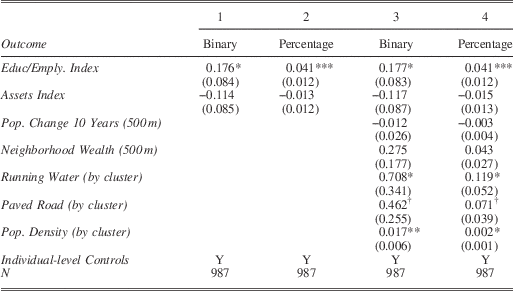
Universalistic Preferences, by Socio-Economic Status and Local Need

Note: Columns 1 and 3 are logistic regression coefficients; Columns 2 and 4 are OLS. Intercepts are partially pooled by sampling cluster, following Gelman and Hill (Reference Gelman and Hill2007). The outcome is either a binary indicator for listing at least one universalistic policy (Columns 1 and 3) or the percentage of total preferences that were universalistic (columns 2 and 4). For readability, population density is scaled as 1,000 s/sq. km. ***p<0.001, **p<0.01, *p<0.05, †p<0.1
The second model adds neighborhood-level predictors: Pop10Yrs i is the percentage change in population around respondent i between 2000 and 2010, to measure the strain on local infrastructure;Footnote 72 NeighWealth i is a factor analysis of census variables measuring neighborhood wealth around respondents (see Appendix); Water j is the percentage of respondents in sampling cluster j reporting that running water is regularly available; Road j is an indicator for whether the largest road in sampling cluster j was paved;Footnote 73 and Density j indicates population density in the census enumeration areas covered by sampling cluster j.Footnote 74
The results are in Table 2. From Column 3, I estimate that a respondent with secondary education, English literacy and formal sector employment is 10.7 percentage points (95 per cent CI: 0.7, 20.6) more likely to list at least one universalistic policy among her preferences than a respondent without these characteristics.Footnote 75
In particular, poorer respondents are especially more likely to demand private goods than middle class respondents.Footnote 76 In Columns 3–4 of Table 2, I find that all respondents are more likely to want universalistic goods when they live in neighborhoods with better service provision. Each of these findings is consistent with expectations from the existing literature: controlling for local service provision, higher socio-economic-status voters will be more likely to have policy demands that cannot be addressed through patronage.
However, respondents who want universalistic policies are less likely to turn out to vote than those who only want particularistic goods. In Table 3, I estimate similar multi-level logistic regressions in which the outcome is turnout in the 2012 election.Footnote 77 The main explanatory variable is either the binary or percentage measure of universalistic preferences.Footnote 78 I include the same controls as above, as well as several additional predictors that may affect the campaign strategies that voters are exposed to: competitiveness in each respondent’s electoral ward,Footnote 79 ethnic fractionalization around each respondent, the neighborhood wealth index and population density. Columns 1, 3 and 5–6 include parliamentary constituency fixed effects to control for baseline differences in campaign strategies across constituencies.
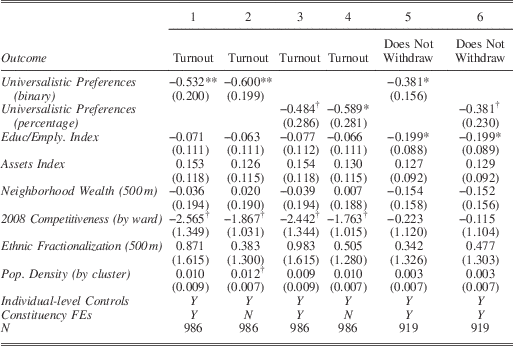
Turnout and Participation, by Universalistic Preferences

Note: the outcome in Columns 1–4 is self-reported turnout in the 2012 presidential and parliamentary elections. The outcome in Columns 5–6 is an indicator for doing only 1 or 0 of the five forms of participation discussed in the text. All models are logistic regressions with intercepts partially pooled by sampling cluster, following Gelman and Hill (Reference Gelman and Hill2007). Constituency fixed effects are included, except in Columns 2 and 4. Additional observations are missing in Columns 5 and 6 because some respondents refused to answer some of the additional participation questions. Note that competitiveness is higher when the competitiveness variable is smaller (absolute difference in vote shares between NPP and NDC), such that there is more participation in places that were more competitive in the last election. ***p<0.001, **p<0.01, *p<0.05, †p<0.1
Simulating from Columns 2 and 4 of Table 3, I find that respondents who list at least one universalistic preference are 7.1 percentage points (95 per cent CI: 2.6, 11.6) less likely to vote, and those who list exclusively universalistic preferences are 7.8 percentage points (95 per cent CI: 0.7, 15.7) less likely to vote, than respondents with only particularistic preferences.Footnote 80
I also identify respondents who have withdrawn from politics in general. I creat an indicator for whether a respondent has done none, or only one, of the following five forms of participation: voted in the 2012 election, is an active member of a party, knows a local party agent, knows or has met with her district assembly member (city councilor), and/or participates in a non-party association (such as a church group, trade association, civil society or neighborhood group) that discusses political issues at least ‘some of the time’.Footnote 81 Over a third (36 per cent) of respondents are what I label ‘minimum participators’, people who have done zero or only one of these activities.Footnote 82 I use this binary indicator as the outcome variable in Columns 5–6 of Table 3.Footnote 83 Respondents who want at least one universalistic policy are 8.5 percentage points (95 per cent CI: 2.4, 14.2) more likely to collectively refrain from these forms of participation than those who only want particularistic goods. In addition, middle class respondents are more likely to abstain from these activities in general. Simulating from Column 5, respondents with English literacy, at least some secondary education and formal sector employment are 10.5 percentage points (95 per cent CI: 0.8, 20.2) more likely to abstain than those without those characteristics. Middle class respondents are also an estimated 7.1 percentage points (95 per cent −0.5, 14.2, p=0.07) less likely to be party members than poor respondents. This means that the membership of local party organizations is almost entirely poor, even in the wealthiest parts of the city. Local party members are the most immediate people to whom politicians in Ghana are accountable, serving as the primary voters who select parliamentary candidates.
Mobilization
There are two reasons that voters with universalistic preferences likely participate less: they are less likely to be mobilized to turn out, and are less likely to believe that politicians will address their preferences. I focus first on mobilization. Ghanaian politicians are well aware of the correlation between class and preferences in Table 2. In interviews, politicians clearly indicate that they are aware that the middle class is growing and that middle class voters have different preferences than the poor. But parliamentary candidates and party agents from both parties described how they use class as a heuristic to determine which voters are convincible, and avoid middle class voters in their main pre-election turnout mobilization efforts because these politicians do not believe they can credibly engage with these voters. As a result, politicians describe campaigns as remaining focused on mobilizing poorer voters through the selective distribution of private and club goods. While it could be the case that it is more logistically difficult for politicians to find and engage with middle class voters, given their busier work schedules and different types of housing, the interview respondents emphasized repeatedly that middle class voters are not disproportionately ignored simply because they are harder to reach, but because politicians find them harder to convince. Their responses align with the theoretical discussion of credibility problems above.
For example, an NPP parliamentary candidate indicated that he realized the middle class had different preferences than the poor, but suggested he lacked the ability to convince middle class voters to support him. When asked about his approach to middle class voters, he said, ‘People are more aware of what they really want than before. Before you could use money to change their minds, but … your money can’t buy most of them now like it used to’. As a result, ‘you don’t convince them [middle class voters] much at all. They know what is going on’. But he argued, ‘the poor people … somebody brings them a big bag of sugar, tomorrow rice – what they eat is what they are thinking about’, and went on to describe efforts to engage with poor voters by distributing particularistic goods.Footnote 84
Another NPP candidate argued: ‘When people have a certain level of education, they are able to clearly understand the issues. I don’t mind whether they support me or they support the NDC, but they have some logical arguments to make their choices. So I really don’t worry about that. My focus is on those … who are susceptible to the deceits of politics … I am focusing my effort in the informal communities’. This candidate was campaigning in the wealthiest constituency in the city, with the greatest ability to focus on middle class voters of any candidate, yet focused on poorer voters.Footnote 85 A local NPP executive made a similar argument about the difficulty of engaging middle class voters: ‘I would say they are politically awakened, so they can discern now more than before. Formerly, people could fool them. But now you cannot fool them … They know exactly what is happening when you come to them, whether you are deceiving them or not … You must be very careful if you are dealing with them’.Footnote 86 An NPP executive emphasized that his party focused instead on poor voters who are more dependent on politicians for access to benefits: ‘Yes, we have them [wealthier voters] … But we don’t normally follow them so much … Most of the people want to see their MP assisting their wards, for example, getting school admissions, getting employment and other things’ – typical benefits delivered in clientelistic exchanges in Ghana.Footnote 87
NDC politicians described similar difficulties campaigning among middle class voters. When discussing differences in campaigning between middle class and poor areas, an NDC activist reported: ‘Somewhere like the zongo and other places where poverty is high, everybody is trying to reach out for [benefits]. They do understand you when you talk. But the residential [neighborhood], when we go there they don’t listen to you … Before you go in they tell you we have made up our mind, we know what we’re doing’.Footnote 88 This indicates a credibility problem in reaching middle class voters who do not want particularistic benefits with campaign messages.
Middle class voters may be particularly unreceptive because politicians usually canvass with a message that does not address their preferences for universalistic policies. While the presidential candidates of each party popularize their national-level policy promises in their major speeches and media appearances, parliamentary candidates and party agents reported that they often downplay these issues when mobilizing turnout before the election, instead focusing on promises of small-scale particularistic goods for specific neighborhoods that voters will find more credible.Footnote 89
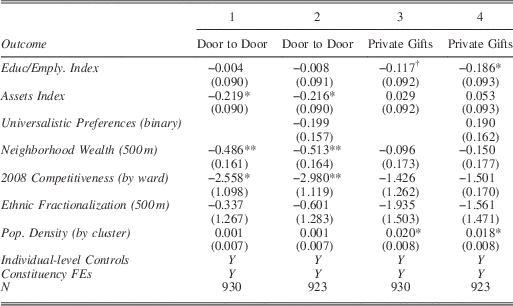
I systematically examine mobilization before the 2012 election by asking respondents about campaign activities in their neighborhoods.Footnote 90 I find less effort from the parties to mobilize turnout among middle class voters, which is consistent with the interviews. In Columns 1–2 of Table 4, the outcome is an indicator for whether a respondent reports that she saw party agents going door to door in her neighborhood before the election. In Columns 3–4 of Table 4, the outcome is an indicator for reporting that she either saw or ‘heard about’ a party distributing private gifts before the election. The models are multi-level logistic regressions with the same predictors as in Table 3.
Campaign Mobilization, by Local Wealth and Socio-Economic Status

Note: the outcome is knowledge of door-to-door campaigning in Columns 1 and 2 and gift distribution in Columns 3 and 4. Logistic regression coefficients with intercepts partially pooled by sampling cluster, following Gelman and Hill (Reference Gelman and Hill2007). For readability, population density is scaled as 1,000 s/sq. km. Additional observations are missing because some respondents refused to answer these two questions. Note that competitiveness is higher when the competitiveness variable is smaller (absolute difference in vote shares between NPP and NDC), such that there is more mobilization in places that were more competitive in the last election. ***p<0.001, **p<0.01, *p<0.05, †p<0.1
I focus on these strategies because they are the main activities used to encourage voter turnout before elections in Ghana.Footnote 91 In interviews with forty-seven parliamentary candidates and party campaign agents, all mentioned door-to-door canvassing as their core voter mobilization activity.Footnote 92 Canvassing is also not a tactic that is inherently only valuable among the poor.Footnote 93 Turnout buying and the distribution of patronage sometimes occurs as politicians canvass door to door, but Brierley and Kramon emphasize that this is not always the case; instead, they show that canvassing also serves as one of the main means by which Ghana’s parties get the word out about their campaign messages to voters. At the national level, Ghana’s parties engage in media-based messaging aimed at voter persuasion, but campaign TV advertising remains in its infancy in Ghana and is not a major means of mobilizing turnout. Importantly, none of the politicians interviewed mentioned broadcast or online media when asked to describe their campaign activities, indicating that this is unlikely to represent a significant alternative channel through which they are separately engaging with middle class voters.
In Table 4, I find that respondents are less likely to report door-to-door mobilization efforts in wealthier neighborhoods, even after controlling for population density, which is consistent with politicians focusing less effort on mobilizing middle class voters. From Column 1, respondents are 10.1 percentage points (95 per cent CI: 3.4, 17.1) less likely to report door-to-door mobilization after increasing local neighborhood wealth by one standard deviation.Footnote 94 Middle-class respondents were also significantly less likely to be exposed to gift giving before the last election, consistent with findings in the existing literature that pre-election gifts are primarily targeted to the poor. From Column 3, respondents who are fluent in English, have some secondary education and are employed in the formal sector are 8.8 percentage points (95 per cent CI: −1.1, 19.2, p=0.07) less likely to report gift distribution than respondents with none of these characteristics. While politicians cannot easily observe individual-level preferences when deciding who to approach, they can observe socio-economic class: they are unlikely to go door to door in middle- or upper-class neighborhoods in the first place, and are unlikely to offer gifts when they do interact with wealthier voters.
In the results above I find that those with universalistic preferences, rather than the middle class in general, are less likely to turn out. But there is a connection between mobilization and these results: voters with universalistic preferences are especially unlikely to turn out to vote when they live in an area that is not subject to campaign mobilization. In an additional model similar to Table 3, Column 4 above, I interact universalistic preferences with the percentage of respondents in each sampling cluster reporting door-to-door mobilization before the election (see Appendix). In sampling clusters with the minimum reported canvassing, respondents who want universalistic policies are dramatically less likely to turn out to vote than those preferring exclusively particularistic goods (28.4 percentage points less likely, 95 per cent CI: 1.5, 56.9). But in areas with the maximum reported mobilization, those with universalistic preferences are not significantly less likely to turn out than other voters (95 per cent CI: −8.7, 13.9).Footnote 95
Credibility of Promises: Survey Experiment
Voters with universalistic preferences are also those least likely to see campaign promises as credible. In the absence of some external pressure pushing them to the polls, these voters may see participation as unlikely to result in desired changes to policy, become disillusioned and stay home. This incredulity about politicians’ promises may be why the politicians interviewed for this study reported that their efforts to convince these voters to support them are often ineffective.
Participants in thirteen focus groups were generally skeptical of campaign promises in the 2012 election. Multiple participants explained that they did not vote due to a lack of trust: they expected corruption and clientelism in the implementation of promised universalistic policies, if they were ever carried out at all. For example, one participant in a middle class neighborhood said of the NPP’s main promise to make secondary school free: ‘they ‘will “chop” [steal] the thing, and the benefits will not be extended to the poor. So its not going to be free at all’.Footnote 96 A woman in another middle class area similarly argued, ‘you can say you will bring free education, but when you win, you will not do it’.Footnote 97 An accountant in the Odorkor neighborhood argued, ‘When they promise, they [MPs] will do some small work within the period that the election is coming on and they will come and clear the gutters and everything … Then after that, you vote, and they are gone. We don’t believe in anything they are telling us’.Footnote 98 A hairdresser in Adenta explained that ‘this [MP candidate] will say this today and then tomorrow he does another thing. The other one too … he says this and then he will not even do anything … The person will go and enjoy it with his or her family … So there is no need for me to vote’.Footnote 99 Instead of trusting these promises, middle class participants emphasized their self-reliance. A statement from a nurse in Dzorwulu is typical: ‘We struggle for ourselves. They [politicians] think about themselves, we also think about ourselves’.Footnote 100 Another middle class participant in Odorkor tied his disillusionment to the fact that he does not want particularistic goods: ‘I’m not looking at the MP to do something for me. I can help myself. But that’s what they’ve [MPs] been doing to get the illiterate people.’Footnote 101
Interviewed politicians recognized this lack of trust. An NDC parliamentary candidate describing his reception while campaigning said, ‘I think there is a collapse of trust in politicians generally … The complaint we usually get is that we’ve voted for this party for 16 years, nothing has come out of it. What are the guarantees that you will be different from the rest?’Footnote 102 An NPP constituency executive noted this distrust and tied it to turnout: ‘People were peeved, because they didn’t get what they expected from us [when NPP was in power] … Some of them didn’t vote at all. A lot of people didn’t vote because they were not happy’.Footnote 103
Others acknowledged that voters did not see policy messages in their platforms as credible. Local executives from both parties complained about how they performed poorly despite having the ‘better message’, accusing the other side of winning by buying votes.Footnote 104 As one NPP activist said after describing his party’s promise about free secondary education: ‘I don’t want to be misleading … The fact is Ghanaians don’t vote on issues. That’s what every politician, that’s what the NDC knows’. Along with many other local activists, he believes that vote choice is instead explained by particularistic preferences, not policy promises.Footnote 105 This sentiment was widely shared in the interviews.
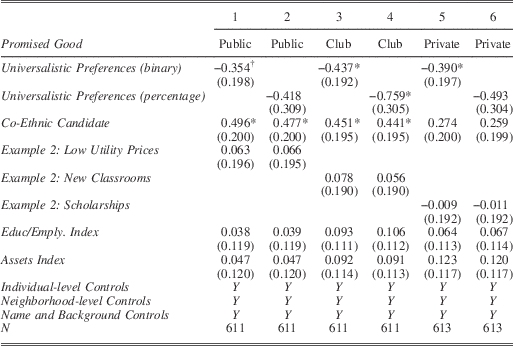
An embedded vignette experiment on the survey allows me to test which voter characteristics explain beliefs about the credibility of campaign promises. Each respondent was read two sets of paired vignettes about hypothetical parliamentary candidates. The candidates in the vignettes randomly varied along three dimensions: their ethnicity, cued via names;Footnote 106 their professional background;Footnote 107 and policies they promised to deliver after the election, selected from two examples each of universalistic, club or private goods.Footnote 108 After being asked to vote in a mock election between the two candidates in each pair, respondents were asked about one randomly selected candidate per pair: ‘Do you think a politician like [NAME] will actually deliver on a promise like [PROMISE]?’. This provides a measure of beliefs about the credibility of promises to deliver the cued policies.
Overall, few respondents saw these promises as credible: only 28.4 per cent of respondents answered ‘yes’, with the lowest rates for the universalistic (27.2 per cent) and private (27.8 per cent) goods, and highest for club goods (30.4 per cent). In Table 5, I analyze responses using similar multi-level models to those above, while also including indicators for each treatment condition as controls, as well as an indicator for whether the promise was made by a co-ethnic of the respondent. I estimate results separately for each type of promise (universalistic, club and private).Footnote 109
Survey Experiment: Credibility of MPs’ Campaign Promises

Note: the outcome is whether a respondent believes the MP in the vignette will actually deliver the cued good after the election. Columns 1–2 are for the public goods treatments (promise: water production or lower utility prices), Columns 3–4 are for the club goods treatments (promise: construct roads or build classrooms) and Columns 5–6 are for the private goods treatments (promise: jobs for the youth or scholarships to families). All models are logistic regressions with intercepts partially pooled by sampling cluster, following Gelman and Hill (Reference Gelman and Hill2007), and include the same individual-level and neighborhood-level controls as in Tables 3 and 4, as well as controls for each additional treatment condition in the experiment: indicators for each possible candidate name (among eight options) and each candidate background (among four options). Two-thirds of the respondent received a prompt about each type of good. ***p<0.001, **p<0.01, *p<0.05, †p<0.1
Consistent with the argument above, respondents who want universalistic policies are the least likely to believe that politicians’ promises are credible. Simulating from Column 1, respondents who only want particularistic goods are 6.4 percentage points (95 per cent CI: −0.9, 13.4, p=0.07) more likely to believe a promise to deliver a universalistic policy than respondents who want at least one universalistic policy. Although those with universalistic preferences are similarly skeptical about promises to deliver particularistic (club, private) as well as universalistic goods, this skepticism creates a particularly important hurdle for politicians seeking to reach these voters through policy-based appeals. Politicians cannot target these policies to voters upfront in the same way they can with particularistic goods;Footnote 110 low credibility poses a significantly greater hurdle to policy-based campaigns than patronage-based campaigns, because policy platforms will only build support if voters trust that they will be implemented over time. But ultimately, the voters with the greatest preferences for universalistic policies – those most likely to support a politician based on her platform – are the least likely to believe in any politician’s promise to deliver these policies. This may only reinforce politicians’ disincentives to engage with these voters based on policy appeals.
CONCLUSION
Accounts of political development rooted in modernization theory often suggest that rising wealth and economic development will lead to better political outcomes in developing countries, including more policy-based electoral competition. But although a growing urban middle class in Ghana has different preferences than the poor, politicians do not believe they can credibly convince these voters to support them. I find instead that politicians largely ignore these voters’ preferences and focus on mobilizing the poor instead. Voters who prefer universalistic policies then differentially abstain from political participation. I argue that this could create a feedback loop in which politicians continue winning elections based almost entirely on particularistic appeals, despite increases in wealth and education that the existing literature suggests should instead lead to the emergence of more policy-based competition.
While this explanation is inductively developed from one case, I expect similar patterns under several conditions in other African democracies where the middle class has also been growing. First, the economy must be sufficiently liberalized such that the middle class is not dependent on state patronage and thus can afford to abstain from participation. Secondly, state capacity to implement major policies should be weak, and there should be little history of ideologically differentiated or class-based parties – both of which create credibility problems for politicians promising universalistic policies. Finally, middle class and poor voters should not be so segregated across electoral units, as they often are in Latin America, that politicians can fully specialize their approaches by district, avoiding trade-offs between patronage and policy-based strategies. Future research can test the theory in other cases where these conditions are likely to apply. In particular, research that employs dynamic time-series data, which is unavailable in this study, and measures how politicians’ activities change (or do not change) as the middle class grows will be able to further illuminate how rising wealth affects political competition in new democracies.