Introduction
This paper reports on the development and initial testing of a new self-report assessment scale, the Person-centered Care Assessment Tool (P-CAT). This tool aims to measure the extent to which staff rate their aged care setting to be person-centered. Person-centered care is a popular concept for describing best practice care for people with dementia, but it is in need of clinically relevant, valid and reliable measurement tools.
The increasing prevalence of dementia supports the need to develop and evaluate best practice models that promote a good quality of life for people with the disease. Caring for people with dementia involves compensating for declining abilities to fulfill basic physical and psychosocial needs (Norberg, Reference Norberg, Wimo, Jönsson, Karlsson and Winblad1998). Including both these dimensions in the care of people with dementia is imperative as high quality care involves both completing tasks and supporting everyday life needs (Sandman et al., Reference Sandman, Edvardsson, Winblad and Gauthier2006). A person-centered approach to care practices for people with dementia is increasingly being regarded as synonymous with best quality care that includes both dimensions of nursing care (Ericson et al., Reference Ericson2001; Slater, Reference Slater2006; Murphy, Reference Murphy2007). Person-centeredness was first described within Rogerian psychotherapy (Rogers, Reference Rogers1961), and was later contextualized into dementia care as a response to “malignant social psychology”, e.g. care-giving relationships which devalue, dehumanize, depersonalize and diminish the person with dementia (Kitwood, Reference Kitwood1997). The core quality of person-centered care is to value and use people's subjective experience of their illness regardless of cognitive ability (McCormack, Reference McCormack2004; Downs et al., Reference Downs, Small, Froggatt, Burns and Winblad2006). A recent literature review described person-centered care as maintaining personhood in spite of declining cognitive ability, striving to take the standpoint of the patient, acknowledging personal experiences of life and relationships, and including the social environment as a therapeutic agent (Edvardsson et al., Reference Edvardsson, Winblad and Sandman2008). Furthermore, person-centered care has been expressed using the equation PCC (person-centered care) = V+I+P+S, where V, I, P and S stand for: valuing people with dementia (V); treating people as individuals (I); looking at the world from the person's perspective (P); creating a positive social environment (S) (Brooker, Reference Brooker2007).
The literature describes several strategies for providing person-centered care. Incorporating biographical knowledge in care is one approach aiming to assist staff in recognizing and treating people with dementia as individuals rather than as patients or tasks (Clarke, Reference Clarke2000). Also, knowing about a patient's earlier life can provide cues about how to interpret behavior and establish individualized care and treatment (Clarke et al., Reference Clarke, Hanson and Ross2003). Reminiscence is another strategy believed to promote person-centeredness. Reminiscence is described as confirming the previous life of people with dementia by sharing autobiographical memories, for example through pictures, music and scrapbooks (Brooker, Reference Brooker2004; Kontos, Reference Kontos2005; Downs et al., Reference Downs, Small, Froggatt, Burns and Winblad2006). Acknowledging the person's interpretation of reality is also described in relation to validation therapy, and this is also believed to promote confidence and well-being (Neal and Barton Wright, Reference Neal and Barton Wright1999). Another strategy for person-centered care is to prioritize the experience of the individual person rather than completing the task at hand (Edvardsson et al., Reference Edvardsson, Sandman and Rasmussen2005). In this way, for example, it becomes more important to make the shower a pleasant experience rather than to accomplish it in the most time-efficient way (Sloane et al., Reference Sloane2004). Consequently, flexibility of routines should be a key consideration in organizing, planning and executing care for people with dementia (Cohen-Mansfield and Bester, Reference Cohen-Mansfield and Bester2006).
Even though the literature consists mostly of explorative and observational studies on strategies for person-centered care, and narrative accounts regarding advantages and disadvantages, some outcome studies on the effects of person-centered care have emerged. A recent cluster randomized trial in which residential sites were randomly assigned to person-centered care, dementia care mapping, or usual care, showed that both person-centred care and dementia care mapping reduced agitation in people with dementia in residential care (Chenoweth et al., Reference Chenoweth, King and Jeon2009). Also, a randomized controlled trial using a person-centered intervention for showering and bathing residents with moderate to severe dementia found that discomfort, agitation and aggression for residents declined significantly in intervention groups compared with controls (Sloane et al., Reference Sloane2004). In addition, the intervention significantly improved the experience of staff (measured by the use of gentleness, verbal support and staff perceptions of confidence and ease) when bathing residents (Hoeffer et al., Reference Hoeffer2006). It has also been shown that, when all other variables were controlled for, significantly fewer neuroleptic medications were given to residents being cared for by staff who had received skills development and training in the delivery of person-centered care (Fossey et al., Reference Fossey2006). Despite the obvious need for both more outcome studies and the replication of existing ones, provision of care that is person-centered should be the ethically responsible approach as it reflects more humanistic care with few reported risks (Edvardsson et al., Reference Edvardsson, Winblad and Sandman2008). While waiting for conclusive knowledge about care efficacy, the burden of proof should fall on those who would advocate anything other that a person-centered approach to care provision.
To date there have been few measurement tools developed for the study of person-centered care and similar concepts, and those that exist have limitations and/or need further testing. Dementia care mapping has been used to assess person-centered dementia care (Brooker, Reference Brooker2005); however, the logic, applicability and usefulness of dementia care mapping as a research tool remains unclear (Chenoweth and Jeon, Reference Chenoweth and Jeon2007; Sloane et al., Reference Sloane2007). Other tools are not specific enough to measure person-centered care in facilities where people with dementia live, as they were developed to measure person-centered care in acute or sub-acute care facilities (e.g. Davis et al., Reference Davis, Byers and Walsh2008: the Patient-Centred Inpatient Scale). A tool aiming to measure person-directed care was recently presented with promising results, but might prove too lengthy for clinical applicability and need further testing (White et al., Reference White, Newton-Curtis and Lyons2008: the Person-Directed Care Measurement Tool). Also, tools assessing the extent to which the climate of health care settings are person-centered (Edvardsson et al., Reference Edvardsson, Koch and Nay2009: Person-Centered Climate Questionnaire) have recently been presented, but these have not been used and evaluated in the context of dementia care. Based on the literature, we identified a need for a short, cost- and time saving tool, easy to apply and complete, which could provide valid and reliable measurements of person-centered care in residential aged care settings for research purposes. The aim of the current study was to construct and evaluate the psychometric properties of the newly developed Person-centered Care Assessment Tool (P-CAT).
Methods
This study employed methods of scale construction to develop the tool and psychometric analyses to evaluate its validity and reliability. Within the construction phase, a 39-item pool was generated from research literature, expert consultations and research interviews with staff, people with dementia and family members. As a next step, the item pool was subjected to item analysis and reduction. Lastly, the dimensionality of the final pool was evaluated using exploratory factor analyses, and psychometric properties were assessed using statistical procedures for estimating validity and reliability. The research complies with the Helsinki Declaration and used implied consent – return of a questionnaire was regarded as proof of informed consent. The independent ethics committees of La Trobe University, Melbourne, Australia and the participating health organizations approved the study.
Phase 1: scale construction
The tool was developed through a rigorous iterative process. First, a review of the literature was undertaken with the objective of summarizing the current knowledge about person-centered care for people with dementia and highlighting areas in need of further research (Edvardsson et al., Reference Edvardsson, Winblad and Sandman2008). This resulted in a first draft of the tool consisting of 44 items that would measure person-centeredness. The original items were a combination of measures of actual practice in long-term aged care as well as staff attitudes and beliefs which either positively or negatively related to how they, and the culture of the facility, perceived a person living with dementia. Draft 1 of the tool was sent out to internationally recognized experts (n = 23) in aging, dementia and person-centered care for consultation and comments. Experts were contacted by email and asked to provide a critique on the preliminary item pool, especially on its content, format and scaling. Received comments included both specific suggestions about each item and general statements about the tool. Suggestions that were made by more than one expert were incorporated into a revision of the tool (Draft 2). Six focus groups were then conducted with staff working in long-term aged care facilities (n = 37); each of these focus groups comprised six participants except for one that had seven. Two focus groups, each of four participants, were conducted with people who had early onset dementia, had experienced respite care and who met regularly for social activities (n = 8). Face-to-face interviews were conducted with seven home carers of people with dementia; on three of these occasions the person with dementia for whom they cared was also interviewed. Phone or face-to-face interviews were conducted with 12 carers of people with dementia who lived in long-term aged care facilities. Carers and people with early onset dementia who took part in the interviews and focus groups responded to an advertisement in the newsletter of Alzheimer's Australia, Victoria inviting people to contact the researchers if they were interested in participating. The focus groups/interviews explored all the items on the draft tool and additional topics such as what the participants perceived person-centered care to be, the meaning of good or poor quality care in long-term facilities; and on what grounds a decision was made about which aged care facility was chosen as a place in which the person with dementia would live. The tool was revised again (Draft 3) to accommodate data from focus groups and interviews. Draft 3 of the tool was sent to another group of national and international experts (n = 12, some of whom had commented on Draft 1 of the tool) who were asked to rank the items out of 5 for relevance as a measure of person-centeredness and also to rate the wording of the items and provide revision suggestions for those items they saw as not being appropriately worded. The tool was revised (Draft 4) according to the results of the final consultation process, resulting in a final draft of 39 items. All items were formulated as statements about the presence of person-centeredness at the facility, and a 5-point Likert-type scale was used for scoring purposes (ranging from 1 = “Disagree completely” to 5 = “Agree completely”).
Phase 2: psychometric evaluation
The final draft was distributed to ten long-term aged care facilities in Victoria, Australia in October 2008. A total of 1045 surveys were distributed. All staff employed at the facility were considered eligible for participation. The unit manager in each facility agreed to distribute questionnaires to all staff, and completed questionnaires were anonymously collected in a sealed box on site or sent directly to the principal investigator. A total number of 220 questionnaires were returned, representing a response rate of 21%. A sub-sample of 26 staff members participated in test-retest evaluation, thus completing the questionnaire twice with a week's interval in between.
Descriptive characteristics (means, standard deviation and frequencies) were calculated for each item in the tool. Validity of the P-CAT was evaluated by content and construct validity, and internal consistency reliability was examined using Cronbach's α coefficient and item-total correlation. Content validation was based on the previously described procedure of literature, stakeholder and expert consultation. Explorative factor analysis was performed to evaluate scale dimensionality and construct validity, and the criterion used to indicate an appropriateness of factor analysis in the sample was a Bartlett's test of sphericity of significance, and a Kaiser-Meyer-Olkin measure of sampling adequacy of ≥ 0.7. The criterion level for acceptable internal consistency reliability was set at α ≥ 0.7, and item-total correlations between 0.3 and 0.8 to ensure moderate correlation and avoid item redundancy. Test-retest reliability was examined through a single measures two-way mixed effects model intra-class correlation (ICC), the Pearson correlation coefficient (r), and the paired t-test (2-tailed, p < 0.05) to verify whether the means at test and retest differed. The criterion level for acceptable test-retest reliability was set at ICC ≥ 0.6, r ≥ 0.6, and p > 0.05. SPSS version 14.0 was used in all statistical analyses.
Results
Sample characteristics
The sample (n = 220) consisted mostly of women (97%), with an average age ± standard deviation of 43 ± 10.7 years (range 18–67), reporting work experiences within aged care of 1–5 years (46%), 6–10 years (23%) and 11 years and more (31%). Participants had the following occupations: personal care workers (58%), enrolled nurses (16%), registered nurses (8%), unit managers (5%), and other (13%). Most of the participants (n = 183, 83%) worked at eight of the ten long-term aged care facilities operated by the same for-profit organization, and a minority (n = 38, 17%) were employed by two other for-profit aged care organizations.
Item analysis and reduction
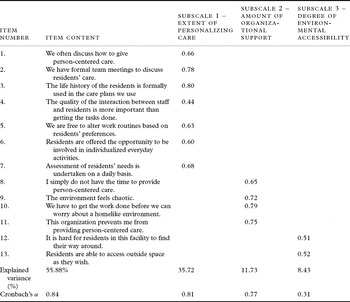
No questionnaires were eliminated due to missing data; however, in eight cases missing data in single items were replaced by the mean score for that item. Bartlett's test of sphericity was significant (3527.0, p < 0.01) and Kaiser-Meyer-Olkin was satisfactory (0.87), thus a factor analysis model was deemed appropriate. Item reduction was thereafter performed using principal component analysis (PCA) with both varimax and oblimin rotation and the results compared. As the two rotations showed little difference, varimax rotation was retained. Kaiser's eigenvalue >1 criterion was used to decide on the number of factors to extract. The initial explorative PCA on the 39-item questionnaire resulted in an unstable ten-factor solution explaining 63% of the variance in data. To identify the strongest items and eliminate those that performed poorly, the following statistical criteria were used as cut-offs for item elimination: low factor loadings (< 0.4) or items loading moderate to high (>0.4) in multiple factors, and/or items with low item-total correlation (<0.3). As shown in Table 1, this stepwise item reduction technique resulted in a final 13-item pool in a stable three-factor rotated solution explaining about 56% of the total variance.
Scale content, factor loadings, total variance explained and Cronbach's α for the final P-CAT (n = 220); loadings >0.4 included.

Scale dimensionality, construct and content validity
Conceptually, all factors showed coherent meanings and seemed internally consistent. The first factor comprised seven items (with loadings between 0.44 and 0.80), all concerned with the extent to which staff personalize the care provided to each resident. The first factor was therefore conceptualized as extent of personalizing care. The second factor consisted of four items (with loadings between 0.65 and 0.79). This factor was defined by the interpretation that all items related to the amount of organizational support perceived for providing person-centered care, and thus factor two was labeled as such. The third factor contained only two items (loadings between 0.51 and 0.52), which were related to environmental factors of person-centered care and were therefore conceptualized as degree of environmental accessibility (Table 1).
Construct validity was estimated as satisfactory as PCA separated the items into the stable three-factor solution explaining nearly 56% of the total variance in the sample. The content validity of the scale was regarded as satisfactory by experts as the scale was deemed to contain items reflecting the dimensions described in the literature as being central aspects of person-centeredness. In conclusion, estimates of content and construct validity for the English version of P-CAT indicates satisfactory psychometric properties of the scale. The questionnaire with its subscales, factor loadings, and Cronbach's α is presented in Table 1.
Internal consistency and test-retest reliability
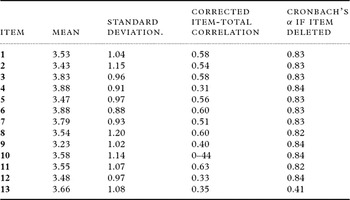
The internal consistency coefficient (Cronbach's α) was satisfactory for the total scale (0.84), and for two of the three subscales (extent of personalizing care 0.81, and amount of organizational support 0.77). The third subscale, degree of environmental accessibility, showed an α value of only 0.31. This value is interpreted as reflecting a smaller amount of variance among the respondents, and also a result of having merely two items constituting the factor. The item-total correlations of the final pool ranged between 0.31 and 0.63, indicating scale homogeneity. Table 2 shows the item performance for the final P-CAT.
Item performance for the final P-CAT (n = 220)

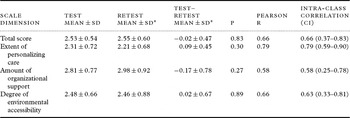
With regard to retest reliability, all p values were greater than 0.05 in the paired t test. This indicates that there were no significant statistical differences between the mean scores at test and retest and supports the test-retest stability of the scale and its subscales. Analyses of test-retest data also show that all the r values of the P-CAT were between 0.7 and 0.9, which signifies that the tool and its subscales have a high concordance between test sessions. The two-way mixed effects model, single measures intra-class correlation was substantial and also supports test-retest reliability. Table 3 shows the p values for each subscale from the paired t tests between test and retest scores, the Pearson r (p < 0.01), and the intra-class correlation coefficients.
Test-retest reliability measures for the P-CAT (n = 26)

SD = standard deviation; CI: = confidence interval.
Discussion
The aim of this study was to construct and evaluate psychometric properties of the Person-centered Care Assessment Tool (P-CAT). The overall results of the study provided support for the psychometric properties of the scale when used in an Australian sample of long-term aged care staff. The tool is primarily intended for use as a research tool to measure the presence of person-centered care in residential aged care facilities as reported by staff.
In terms of content, the dimensionality of the tool reflects the dimensions of person-centered care as described in previous literature. For example, the three first VIPS dimensions (Brooker, Reference Brooker2007) are captured through Subscale One, and valuing staff through Subscale Two, and the last, the social environment, is embraced in Subscale Three. In addition, Subscale One reflects three of the four dimensions of person-centered care as described by Edvardsson and colleagues (Reference Edvardsson, Winblad and Sandman2008), namely maintaining personhood, taking the patient's standpoint and acknowledging personal experience. Also, the fourth dimension social environment as a therapeutic agent is embraced in Subscales Two and Three. The P-CAT also exceeds previous conceptualizations of person-centered care not only by capturing information about ongoing discussions about person-centered care (Item 1), but but also by evaluating whether discussions have been formalized (Item 2), and the extent to which person-centeredness has been operationalized and actually used in care practice (Item 3). The P-CAT can thereby assess whether staff report actual provision of person-centered care, or if it is merely rhetoric from the managing organization. It also highlights the extent to which the unit is bound by routines (Item 5), an aspect of significant importance for person-centered care (Cohen-Mansfield and Bester, Reference Cohen-Mansfield and Bester2006), and it evaluates the degree to which staff prioritize their relationship with patients rather than completing tasks (Item 4) – a central element in person-centered care (Sandman et al., Reference Sandman, Edvardsson, Winblad and Gauthier2006). The P-CAT contributes to existing literature by explicating how elements of the organization (Subscale Two) and the environment (Subscale Three) can support or obstruct person-centered care. Thus, the tool makes it possible to undertake analyses of the relationship between organizational support, environmental accessibility and the extent to which care is personalized, by correlating the subscales. The succinct and concrete statements of the P-CAT make it a clinically applicable research tool, and it makes possible an exploration of person-centeredness in relation to health outcomes, organizational models, characteristics and levels of staffing, degrees of care needs among residents, and impact of interventions.
However, the study has limitations that warrant consideration. The findings represent initial testing. Further psychometric evaluation is needed and invited. The low response rate needs consideration. It is difficult to make any conclusive comments about non-respondents due to the anonymous returns procedure, but anecdotal remarks were made by managers at the participating long-term care facilities about the length of the tool (initially 39-items) and the fact that English was not the first language of many of their staff. Criterion-related validity was not possible to assess as a gold standard scale for the measurement of person-centered care in long-term aged care does not exist. Finally, Subscale Three failed to meet the reliability cut-off of 0.7 for Cronbach's α (0.31). This indicates that some questions remain regarding the dimensionality and internal consistency of this subscale. To conclude, the results are tentative and can be used as a starting point for comprehensively validating the P-CAT further. Additional testing and cross-validation of the findings with new samples are necessary for the process of establishing psychometric properties.
Conflict of interest
None.
Description of authors' roles
D. Edvardsson undertook the literature searches and the data analyses, edited all author contributions and had main responsibility for revisions and drafts of the manuscript. D. Fetherstonhaugh undertook the data collection, participated in the data analysis and contributed to revisions and final drafts of the manuscript. R. Nay contributed to revisions and final drafts of the manuscript. S. Gibson participated in data analysis and contributed to revisions and final drafts of the manuscript.
Acknowledgments
This project has been supported by the Swedish Research Council, Swedish Brain Power Project, Umeå University, La Trobe University, J. O. and J. R. Wicking Trust – Medical and Scientific Research Grants (ANZ Trustees), the Swedish Council for Working Life and Social Research and the Australian Government. The views expressed in this work are the views of its author/s and not necessarily those of the Australian Government.