CHD, the most common congenital defect, affects nearly 40,000 newborns each year in the United States of America.1 Approximately, 25% of these children will require an intervention during the first year of life; hence, caregivers are frequently faced with trying to understand not only the disease process itself but also the prognosis, necessary procedures, and associated outcomes, as well as the common morbidities.1 Although the overall CHD population is diverse, impacting all racial, ethnic, and socio-economic groups,Reference Nembhard, Wang, Loscalzo and Salemi2 disparities exist as related to morbidity and mortality.Reference Nembhard, Pathak and Schocken3,Reference Nembhard, Salemi, Ethen, Fixler, Dimaggio and Canfield4 Clinicians must recognise the challenges faced by caregivers processing new and complex information while caring for a child with complex medical needs, all the while remaining cognisant of the implications within vulnerable populations.
The US Department of Health and Human Services called for improving patient and family education in its Healthy People 2020 campaign: specifically, to “increase the proportion of persons who report their health provider always gave them easy-to-understand instructions about what to do to take care of their illness of health condition.”5 This call is imperative given that approximately 90 million American adults have literacy skills at less than a high school level,Reference Nielsen-Bohlman, Panzer and Kindig6 and evidence suggests that most health information is currently written at a high school reading level or higher.Reference Aaronson, Joshua and Boss7–Reference Taylor, Guirguis and Raney11 Specifically, health literacy is defined as “the degree to which individuals have the capacity to obtain, process, and understand basic health information and services needed to make appropriate health decisions.”Reference Nielsen-Bohlman, Panzer and Kindig6,Reference Weiss, Mays and Martz12,Reference Ratzan, Parker, Selden, Zorn, Ratzan and Parker13 An individual’s health literacy is contingent not only on education but also on socio-economic status, culture, language, and the health-setting in which the information itself is delivered.Reference Nielsen-Bohlman, Panzer and Kindig6 As a result, there is growing recognition within the CHD community that health literacy improvement is necessary.Reference Penny14
The Conquering CHD Guided Questions ToolReference Basken15 (https://www.conqueringchd.org/guided-questions-tool/) is a CHD-specific, standardised caregiver education tool that was created in 2015 with the aim of assisting families with their paediatric cardiology consultations. This tool was co-created by multiple content stakeholders, including caregivers, advocacy experts, and clinicians. However, in its current form, the Guided Questions Tool may not meet the aims of understanding called for by the Healthy People 2020 campaign.5 In particular, the reading level is measured at an eighth-grade reading level based on the Fry Readability ScaleReference Fry16 despite recommendations that healthcare information be written at a sixth-grade level or below.Reference Nielsen-Bohlman, Panzer and Kindig6,17 Thus, this study team revised the original Guided Questions Tool to improve readability and overall efficacy from a health literacy perspective.
The primary aim of the study team was to measure caregiver health literacy scores within the CHD community and evaluate the association of those scores with understanding of the Guided Questions Tool. We hypothesised that low health literacy scores would be associated with decreased understanding of the Guided Questions Tool. We also aimed to determine the association of demographic factors, such as caregiver age and socio-economic status with understanding of the Guided Questions Tool. The secondary aim was to evaluate the understandability and actionability of a revised Guided Questions Tool, written at the sixth-grade level, relative to the original Guided Questions Tool.
Materials and methods
Guided Questions Tool revision
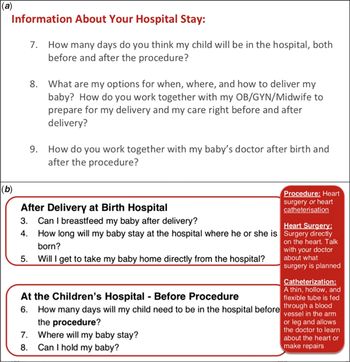
The original Guided Questions Tool was revised by the study author team with attention to the tenants of health literacy using guidance from “toolkits” published by the Agency for Healthcare Research and Quality18 and the Centers for Medicaid and Medicare Services.19 Specifically, the original Guided Questions Tool is composed of 17 labelled “questions” formatted as distinct paragraphs with additional questions embedded in each paragraph (Fig 1a). Consistent with Agency for Healthcare Research and Quality and Centers for Medicaid and Medicare Services recommendations, the revised Guided Questions Tool separated all questions, a total of 37, into a “bulleted” format such that they could each be easily identified individually. These questions were then reorganised into categories defined by “Phase of Care,” included medical jargon was minimised and question length was further truncated with the ultimate aim of creating questions no longer than one line in length (Fig 1b). Where medical jargon was necessary, such as use of the terms “procedure” or “catheterization,” the text was bolded and underlined. These terms were then defined in the margins of the document immediately adjacent to the text. The resulting revised Guided Questions Tool measured at a sixth-grade reading level based again on the Fry Readability Scale.Reference Fry16
(a) Original Guided Questions Tool in truncated format for study administration.Reference Basken15 (b) Revised Guided Questions Tool, showing reorganisation of questions into “Phase of Care,” division of questions itemised into individual bullet points, shortened overall length, removal of jargon, bolded terms when necessary, and co-location of defined terms.

Study population
Phase I of this study took place at the Cincinnati Children’s Hospital Heart Institute Family Camp. Every year, since 2003, Family Camp invites families of children aged 0–21 years affected by CHD or acquired heart disease to Camp Joy in Clarksville, OH20 for 3 days (Friday–Sunday) every May. While participants are largely cared for by Cincinnati Children’s Hospital, Family Camp is open to patients and families from all hospital systems and free of charge to attend. Families do, however, need to provide their own transportation and have the means to be free from other responsibilities, such as employment, for a weekend.
Families were introduced to the study during the Saturday morning education session and all were invited to participate. All caregivers within a family could participate separately as long as they were over the age of 18 years, and the child in their care was aged 0–18 years at the time of study enrolment. Caregivers with limited English proficiency were excluded from participating in the study. In total, 123 camp participants were eligible and approached for inclusion.
Phase II of participant enrollment took place in the paediatric cardiology ambulatory clinic at Cincinnati Children’s Hospital over the course of 4-week period (29 August 2019 to 27 September 2019). Recruitment was limited to those participants present for a follow-up clinic visit and fulfilling the same criteria as Phase I. Recruitment would occur at the beginning of the clinic visit and participation could occur at any time during the course of the visit as time allowed. In total, 58 parent participants were approached for inclusion in the clinic setting.
Documentation of informed consent was obtained from all participants. This study was approved as an exempt study by the Institutional Review Board at Cincinnati Children’s Hospital.
Survey administration
The health literacy of all participants was assessed via a validated screening tool called the “Newest Vital Sign.”Reference Weiss, Mays and Martz12 The Newest Vital Sign requires participants to answer six questions regarding a nutrition label from a container of ice cream. These questions were read aloud by a study team member to participants. Participants were able to view the ice cream label for reference while answering the questions which were recorded by a study team member. There were 3 minutes allotted for this portion of the study. Participants were then asked to complete information related to demographics and their child’s cardiac diagnosis.
Participants were then randomised using a random number sequence generator to independently read either the original Guided Questions Tool or the revised Guided Questions Tool. Prior to study administration, the original Guided Questions Tool and the revised Guided Questions Tool were shortened such that participants received matched length formats. Given that original Guided Questions Tool revision required division of paragraphs and shortening of questions, the formats were not matched based on number of questions rather on number of pages such that each participant had a matched length of content to read. The shortened versions were created to allow for timely study administration. Each version maintained its full-length readability grade level by Fry Readability Scale. After reading the respective version of the Guided Questions Tool, participants were asked to complete an adapted “Patient Education Materials Assessment Tool for Printable Materials”.21 The Patient Education Materials Assessment Tool for Printable Materials is a validated screening tool produced by the Agency for Healthcare Research and Quality to measure understanding and actionability of printed material. Per the Agency for Healthcare Research and Quality, a material is defined as understandable “when consumers of diverse backgrounds and varying levels of health literacy can process and explain key messages” and actionable when the same consumers “can identify what they can do based on the information presented.”22 Adaptation of the Patient Education Materials Assessment Tool for Printable Materials included removing questions that were not applicable to the Guided Questions Tool, such as questions about numbers, graphs, and calculations. This resulted in removal of a total of five questions from the original Patient Education Materials Assessment Tool for Printable Materials. At conclusion of the Patient Education Materials Assessment Tool for Printable Materials, participants were given a space to provide qualitative commentary regarding their study version of the Guided Questions Tool.
Data analysis
All demographic data were gathered and examined for completeness and evidence of missing data. Demographic data included gender, caregiver relationship to patient (parent, legal guardian, and extended family), age, race, primary language, highest degree achieved, household income prior to tax, age of patient (current, at diagnosis, and at first procedure), and type of cardiac condition (congenital/structural, electrophysiologic, and acquired). The range of scores on the Newest Vital Sign screen was collected and examined for data validity and completeness. Newest Vital Sign scores were divided into low (3 or less correct) and high (4–6 correct) performance according to the tool’s validated scoring system.Reference Weiss, Mays and Martz12
Two-sample t-testing was employed to compare understandability and actionability scores between original Guided Questions Tool and revised Guided Questions Tool in both the low and high health literacy groups. When the health literacy score was examined as a continuous variable, a Pearson’s correlation was used to determine if there was any relationship between health literacy and understandability. One-way analysis of variance was used to elucidate if differences in understandability of the Guided Questions Tool existed within the following categories: education level, household income, and caregiver age.
Results
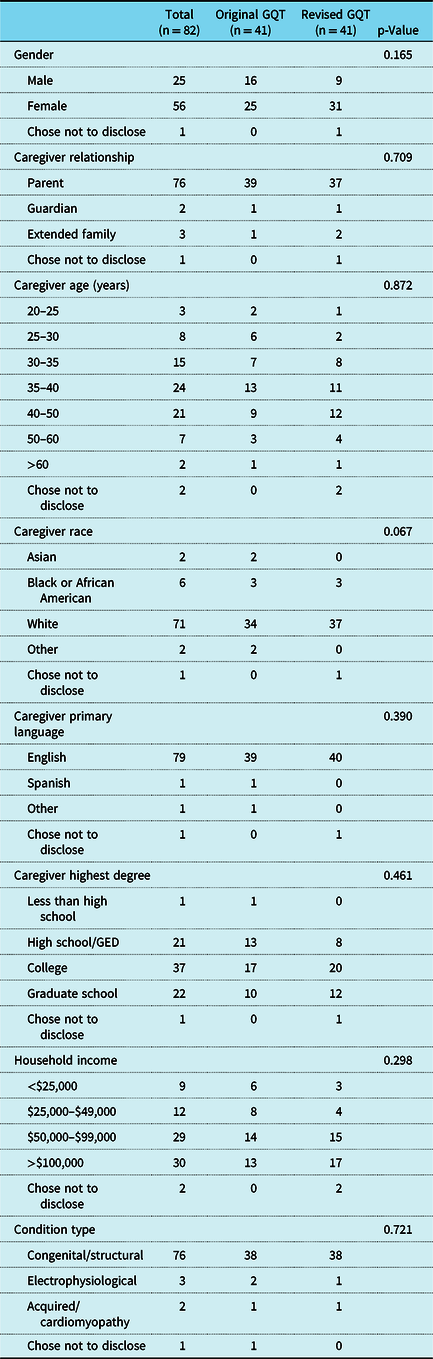
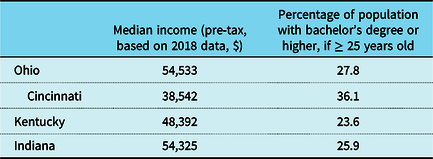
A total of 82 CHD caregivers were enrolled in the study (51 and 31 in Phase I and II, respectively). When examining the population as divided by those randomised to receive the original Guided Questions Tool versus revised Guided Questions Tool, there were no significant demographic differences between the groups (p > 0.05). The population was well educated, with a large portion of the population reporting a college education or more (“College” and “Graduate School” combined, n = 59, 72%). Regarding income, 72% of the population reported at least $50,000 of pre-tax income per year, with 37% (n = 30) reporting over $100,000 of pre-tax income per year (Table 1). When compared to income and education statistics of the sampled population, the study group had skewed characteristics as shown in Table 2.
Demographic data.

GED = General educational development; GQT = Guided Questions Tool.
Population-level demographic data representative of general population sampled.32

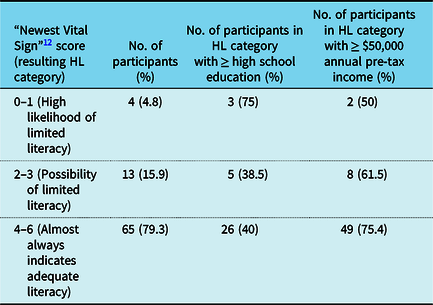
The majority of the population scored in the top tier for health literacy (n = 65, 79.3%; Table 3). In addition, socio-economic status data for the various health literacy tiers demonstrate overall high education and income levels distributed across all health literacy categories. There was not a correlation between health literacy score and understandability score (r = 0.06). Furthermore, in regard to caregiver age, there was no difference in understandability (p = 0.83) or actionability (p = 0.67) by age group. In addition, there was also not a difference in understandability (p > 0.99) or actionability (p = 0.99) in groups based on pre-tax household income.
“Newest Vital Sign”Reference Weiss, Mays and Martz12 scores.

HL = health literacy.
HL scores and some associated socio-economic-related demographics demonstrating overall highly educated and affluent population distributed amongst all HL groups.
When examining understandability scores according to original Guided Questions Tool compared to revised Guided Questions Tool, there was a strong trend towards improved understandability with the revised Guided Questions Tool (p = 0.06). There was no significant difference in actionability between the two versions of the Guided Questions Tool (p = 0.46). When exploring the qualitative data, some common themes emerged. In regard to the original Guided Questions Tool, there were consistent requests for improved visual aids, space to write comments, notes, or questions, and a bulleted or checklist format. The qualitative comments based on the revised Guided Questions Tool also requested more visual aids and a desire for space to take notes but did not request an abridged or modified format.
Discussion
Using tenants of health literacy as suggested by the Agency for Healthcare Research and Quality18 and the Centers for Medicaid and Medicare Services,19 the Guided Questions Tool was successfully revised from an eighth-grade reading level to a sixth-grade level as determined by the Fry Readability Scale.Reference Fry16 Based on the working definition of health literacy used by the National Academy of Medicine,Reference Nielsen-Bohlman, Panzer and Kindig6 our revisions were associated with improved processing and understandability of information. While the difference in understandability between the original Guided Questions Tool and the revised Guided Questions Tool only approached statistical significance, it may well be that further difference would be measured across a more heterogenous population.
There is a paucity of information regarding health literacy in paediatric cardiology and health outcomes. Thus, we are encouraged by the trend in our results and motivated by the fact that this was the first study of its kind to specifically address health literacy of print media educational tools in paediatric cardiology. This work is important not only with regard to baseline physician stewardship for effective communication and education but also when considering future health outcomes for CHD patients given their chronic healthcare needs. Enhancing health literacy has been associated with improved metrics in several areas of healthcare. In the context of chronic paediatric illness, improving health literacy in paediatric asthma care has been shown to be associated with decreased emergency room visits and hospitalisations, as well as improvement in self-efficacy.Reference Robinson, Calmes and Bazargan23,Reference DeWalt, Dilling, Rosenthal and Pignone24 In addition, refining the educational process, and therefore health literacy, involved in dosing medications in paediatrics has been shown to circumvent adverse health outcomes related to improper dosing.Reference Yin, Mendelsohn and Wolf25 This is particularly important given that low parent literacy has been independently shown to be a predictor of difficulty understanding over-the-counter medications.Reference Yin, Johnson, Mendelsohn, Abrams, Sanders and Dreyer26 Finally, a relationship between low health literacy and all-cause mortality has been demonstrated in adult populations.Reference Sudore, Yaffe and Satterfield27 Therefore, we are hopeful that this investment in the health literacy of materials designed for our CHD population may also have outcome-related impacts as the patients in question progress in their CHD journey.
Although our study did not identify any specific demographic factors as independent predictors of poor understanding of either version of the Guided Questions Tool, prior population-based studies have demonstrated differential health literacy based on demographic factors. Low education level, low income, Black/Hispanic ethnicity, and birth outside of the United States of America have all been associated with low health literacy.Reference Yin, Johnson, Mendelsohn, Abrams, Sanders and Dreyer26 The National Assessment of Adult Literacy has also demonstrated that adults living below the poverty level have lower than average literacy.Reference Kutner, Greenberg, Jin and Paulsen28 As a result, attention to the health literacy of educational tools should occur with these vulnerable populations in mind.
Health inequities based on race, ethnicity, and socio-economic status within the CHD population independent of established literacy risks have also been established previously. Several additional factors likely contribute to health disparities including structural (i.e., social class-based) inequities, such as access to care, as well as implicit bias.Reference Smedley, Stith and Nelson29 Differential mortality based on race and ethnicity has been demonstrated in various CHDs, with notably increased mortality in the postnatal and early childhood period for non-Hispanic Blacks and Hispanic White infants.Reference Nembhard, Pathak and Schocken3,Reference Nembhard, Salemi, Ethen, Fixler, Dimaggio and Canfield4 Similarly, increases in post-operative mortality have been noted in non-White patientsReference Chan, Pinto and Bratton30,Reference Oster, Strickland and Mahle31 and those with Medicaid insurance, while these patients also had increased odds of non-elective admissions for congenital heart surgery.Reference Chan, Pinto and Bratton30 Perhaps most significant to the aims of this study, Black patients and those with Medicaid insurance were also shown to have higher odds of referral to high-mortality hospitals,Reference Chan, Pinto and Bratton30 highlighting the importance that all caregivers understand their child’s diagnosis, associated treatments, and options for care. Limited health literacy in specific patient demographics compounded with poorer outcomes associated with vulnerable populations, as well as the frequent need for rapid decision-making under stress, highlights the critical importance of improved health literacy in CHD.Reference Penny14
The results of this study are impacted by the following limitations. The range of health literacy scores measured during this study skewed towards highly health literate caregivers. Despite efforts to measure families outside of the hospital setting, as well as in general paediatric cardiology clinic, we were not able to capture a sample that was entirely generalisable. This limitation is highlighted by the fact that 79% of the study sample demonstrated proficient health literacy compared to the expected value of 12% in the general population.Reference Kutner, Greenberg, Jin and Paulsen28 Therefore, despite an overall sufficient sample size to demonstrate difference in understanding and actionability, we were likely under-powered in participants with low health literacy. Additional limitations include the fact that the study took place at a single centre and included a population from a particular geographic area. Overall, participants represented a narrower range of demographic background than the study was designed to capture.
In summary, using strategies specifically aimed to improve the health literacy of print material, our study team successfully revised a standardised educational tool currently utilised in multiple paediatric cardiac care settings. These revisions resulted in a trend towards improved caregiver understandability. The findings of this study highlight the importance, and feasibility, of addressing health literacy when creating CHD education materials. Next steps include testing of the revised Guided Questions Tool in a more generalisable population sample.
Acknowledgements
The authors wish to thank Amy Basken, David Kasnic, and the Conquering CHD organisation for their support of this investigation and for allowing the use of the Guided Questions Tool. We also acknowledge the hard work of all original authors of the Guided Questions Tool for providing an excellent platform for families to begin important conversations with their medical teams.
Financial support
This research received no specific grant from any funding agency, commercial or not-for-profit sectors.
Conflicts of interest
None.
Ethical Standards
Not applicable.