The subfield of civil–military relations in the Arab world is attracting renewed scholarly interest after decades of neglect.Footnote 1 However, although scholars agree that events in Tunisia were a catalyst for the Arab upheavals and that armies heavily shape the outcomes of popular uprisings, they have given little attention to Tunisian civil–military relations.Footnote 2 This article is intended to fill this gap. Its contribution is threefold. First, while observers of the Arab Spring have correctly maintained that the Tunisian Armed Forces (al-Quwwat al-Musallaha al-Tunusiyya) were unenthusiastic about the Bin ʿAli regime, this is the first study to examine the origins of their discontent and its evolvement during Bin ʿAli's tenure. Second, the article challenges the conventional wisdom among observers of Tunisian politics that Bin ʿAli ordered the armed forces to shoot on demonstrators at the beginning of the uprising, an order the army's chief of staff, Rashid ʿAmmar, supposedly refused to obey, thereby “saving the revolution.”Footnote 3 Bin ʿAli certainly ordered the armed forces to deploy in the streets of Tunis, but little evidence exists to suggest that he instructed the military to open fire on civilians. Third, I qualify the emphasis that journalists and others have put on ʿAmmar's agency—his refusal to uphold the status quo—in explaining why the military was not used to crush the uprising.Footnote 4 This article argues that, regardless of his will, ʿAmmar lacked the ability to save the regime. My findings suggest that we should focus less on ʿAmmar's preferences and more on the constraints that his subordinates in the officer corps imposed on him. Whereas many cite the apolitical ethos of the Tunisian military to explain its performance in times of crisis, I maintain that it was the officers’ frustration over their lack of political influence that determined their behavior in 2011. The 1991 Barakat al-Sahil affair and the interinstitutional rivalry throughout Bin ʿAli's tenure between, on the one hand, the armed forces, and on the other hand, the police and the ruling Rassemblement Constitutionnel Démocratique (Democratic Constitutional Party), must be revisited in order to put the military's behavior in its historical and political context.
THEORETICAL FRAMEWORK
Academics and revolutionaries alike have long acknowledged that the behavior of armies is critical to the outcomes of popular uprisings.Footnote 5 Unsurprisingly, therefore, scholars working on the Arab Spring have sought to explore the reactions of militaries to the challenges of the 2011 civilian mobilizations. Some of these scholars—particularly those working on Egypt—emphasize the effects of the military's rivalry with the police and with the ruling party on its attitude toward the regime.Footnote 6 Others stress the way ethnic, tribal, and familial solidarities shape civil–military relations and, consequently, the loyalty of the armed forces to the powers that be, a dynamic particularly relevant to Syria.Footnote 7 Still others highlight the difference between Arab armies that serve as personal instruments of the ruler and his family and Arab armies that enjoy a greater degree of institutional autonomy.Footnote 8
While these perspectives have enhanced our understanding of Arab armies and their behavior in 2011, they share a tendency to treat officer corps in aggregated terms as unified actors. Few have responded to Eva Bellin's judicious call for disaggregating the coercive apparatuses of Arab authoritarian regimes in order to understand how they reacted to the 2011 popular mobilizations.Footnote 9 Particularly neglected are interactions within the officer corps between commanders at the head of the military, senior officers at the head of subbranches, and midranking and junior officers in operational command. These interactions have had tremendous influence on the course of events.
This article opens the black box of the Tunisian officer corps by disaggregating it vertically. I separate the leadership of the armed forces from the other components of the officer corps because chiefs of staff in Arab autocracies are typically on the side of the regime—rulers make sure to buy their loyalty—while the remainder of the officer corps, especially young officers in midranking and junior positions, tend to be less favorable to the status quo. As I show through the case of Tunisia, a stark separation between the commanders of the armed forces and their subordinates can severely restrict the former's leeway.
I also pursue two other disaggregations that are critical to my theoretical framework. The first of these involves separating the political and military components of the regime so as not to treat the state's machinery as a unified actor. Admittedly, some militaries are so committed to the survival of authoritarian regimes that they cannot be considered autonomous agents. However, the agenda of a state's political leadership does not always coincide with that of its military, a point that explains why armies do not always save authoritarian rulers from trouble. In some cases, officers may be frustrated enough with the status quo or confident enough about the postregime order that they feel no compulsion to defend an autocrat in power. In other cases, officers may have the will but not the capacity to thwart popular mobilizations. Either way, rather than lump civilians and generals into one homogenous category, we ought to scrutinize the relationship between these two components of an authoritarian regime.
The second disaggregation involves breaking down the coercive apparatus into its constituent elements—that is, the military, the police, and other internal security forces. Each of these institutions tends to have a distinct set of interests, alliances, and values. The rivalry between them shapes their reaction to popular mobilizations, as does the depth of their attachment to the regime. The disaggregation of the coercive apparatus sits at the heart of my methodological approach to the Tunisian case.
I open the article with an analysis of the armed forces’ expectations with the rise of Bin ʿAli to power in 1987. I then investigate civil–military relations during Bin ʿAli's tenure, paying particular attention to the 1991 Barakat al-Sahil affair, a critical juncture that has been ignored in literature on Tunisian politics. Finally, I flesh out causal dynamics linking institutional rivalries during Bin ʿAli's years in power to the military's behavior in 2011.
BIN ʿALI’S SEIZURE OF POWER
In the wake of decolonization, Arab armed forces launched themselves into politics in dramatic fashion through a series of military coups. Lacking popular legitimacy, officers-turned-presidents remained dependent for survival on the military institutions from which they hailed. In countries such as Egypt, Syria, and Iraq, armies inevitably became politicized—that is, they bound their loyalties to a particular political figure or set of political figures.
Tunisia followed a different course. The founder of the modern Tunisian state, al-Habib Bourguiba, was a civilian with little sympathy for the military.Footnote 10 Throughout his long tenure as president, stretching from 1957 to 1987, he leaned on his ruling Parti Socialiste Destourien (PSD; Constitutional Socialist Party), to maintain a firm grip on power. Over time, the boundaries between the state and the ruling party became extremely porous, a common feature of single-party systems. Studies on postindependence Tunisia often refer to a “party–government symbiosis,” or a lack of “clear-cut functional separation between party and government,” and an “overlapping membership” between the PSD and the bureaucracy.Footnote 11 According to a detailed analysis of Tunisia's ruling class under Bourguiba, “most of the visible elite are at least official members of the party and usually have been active enough to rise to positions of elected status in the total, regional, or national frameworks.”Footnote 12
Investigating the affiliations of political and bureaucratic elites under Bourguiba is beyond the scope of this study.Footnote 13 Suffice it to say that the PSD's grip over the Tunisian state was exceptionally strong. As single-party rule dragged on, PSD apparatchiks grew accustomed to perceiving the state's most sought-after positions as theirs for the taking. This party–government symbiosis is essential to understanding how institutional rivalries structured civil–military relations in the wake of Bourguiba's fall in 1987, and why they were particularly pernicious during the early years of Bin ʿAli's rule.
Unlike Bourguiba, the PSD's founder and historical leader, Bin ʿAli was the product of Tunisia's military and security establishments. While it is true that Bin ʿAli was affiliated with the party, this affiliation was largely instrumental; without it, he could not have risen through the ranks from director of the Securité Nationale (National Security), the main branch of the country's secret police, to minister of interior, and finally to prime minister. His power base was located not in the PSD, but rather in the armed forces and the Ministry of the Interior. Understandably, party elders felt threatened in the wake of Bin ʿAli's successful coup in 1987. Bourguiba's fall, they feared, could signal the end of the party's hegemony over the state and, consequently, of the apparatchiks’ own domination over the bureaucracy.Footnote 14
At the other end of the institutional spectrum, Tunisia's long-marginalized generals were guardedly optimistic. In my interview with Muhammad Mizughi, a retired colonel-major in the Tunisian army and the former director of the Tunisian War College, he maintained that,
The first years of Bin ʿAli's regime gave us some reasons for hope. Bin ʿAli appointed General Habib ʿAmmar and General ʿAbd al-ʿAziz al-Shaykh as ministers. He also appointed General Yusuf Barakat as ambassador to Greece and General Saʿid al-Katib as ambassador to Cameroon. He chose a few governors from within the ranks of the armed forces. We thought that the military institution was finally being given a chance to play a role in the country. We are a republican military and we never wanted to become politically hegemonic; this goes against our values. But after decades of marginalization under Bourguiba we did hope to gain some political influence in Tunisia.Footnote 15
The military elite's optimism was due to Bin ʿAli's background in the armed forces: in 1956, he joined the military; between 1964 and 1974, he founded and headed the armed forces’ Securité Militaire; during eighteen years in the armed forces, he made many connections and allies. By 1987, Bin ʿAli had long been out of the military, but the officers still considered him one of their own.Footnote 16
The generals did not, however, expect the PSD to surrender its hegemony easily. Indeed, their ambition to secure a greater share of civilian positions hitherto reserved for the PSD did not go unnoticed by the party. The military elite's hope for greater influence in Tunisian affairs rested on Bin ʿAli's reliance on the support of senior military officers to unseat Bourguiba. The most indispensable person in Bin ʿAli's bid for power was the military general Habib ʿAmmar, who served at the time as commander of the National Guard. ʿAmmar sent his troops to surround the presidential palace on the night of the coup, leaving Bourguiba at the mercy of the plotters. Bin ʿAli also secured the cooperation of the army's chief of staff Yusuf Barakat, the director of military security Yusuf bin Sulayman, and the army inspector Saʿid al-Katib. They ensured that the troops would not move against ʿAmmar's National Guard.Footnote 17 The presence of these men in the new ruling circle, the generals thought, could shift the balance of power away from the party and toward the military.Footnote 18 Bin ʿAli's rise to power seemed to suggest that the officers’ hopes—and the party's fears—were realistic.
Bin ʿAli seemed to corroborate the military's rosy expectations when, immediately after seizing power, he rewarded his allies in the Tunisian Armed Forces: Major General Yusuf Barakat was promoted lieutenant general and appointed chief of staff of the three Tunisian armed corps attached to the Ministry of Defense; Brigadier Saʿid al-Katib was promoted major general and appointed chief of staff of the army; Colonel Rida ʿAttar was promoted brigadier and appointed commander of the air force; and Colonel Yusuf bin Sulayman was promoted brigadier and kept in place as director of military intelligence.Footnote 19 Bin ʿAli also avoided the purges that typically follow successful putsches. Immediately prior to the coup, he dismissed ten officers who had been critical of his performance as prime minster; soon after, he dismissed two additional officers, General Hamid Naʿman Buzgharu, the commander of the air force and Bourguiba's nephew, and Colonel Ghazi Iskandar of the army's general staff.Footnote 20 The total of twelve dismissals appears relatively moderate when compared to other cases of postcoup reshufflings within armed forces. Furthermore, Bin ʿAli refrained from appointing a minister of defense during the 1988 governmental reshuffling, opting instead to combine the position with the presidency and thereby attach the Ministry of Defense to his office.Footnote 21 In the sanguine mood prevalent in military circles at the time, this move was seen as a favorable sign. Many felt that the new president had acknowledged his predecessor's neglect of the military and was taking personal charge of the institution's renewal.Footnote 22 Some observers disagreed, arguing that, rather than a sign of goodwill, Bin ʿAli's unusual gesture betrayed his lack of trust in the military. They maintained that Bin ʿAli appointed himself minister of defense in order to secure greater control over the armed forces during the transitional period through which Tunisia was still passing. However, this interpretation was not prevalent within military circles.Footnote 23
Bin ʿAli then made the long-awaited nominations for prestigious nonmilitary positions, which also went to army personnel: in 1987 he appointed General Habib ʿAmmar minister of the interior, and in 1991 he replaced him with General ʿAbd al-Hamid al-Shaykh; also in 1991 he appointed the military officer ʿAli Sariati director of the Ministry of the Interior's Sûreté Nationale (National Security Agency); and he gradually transferred other officers from the armed forces to Tunisia's major security organizations.Footnote 24
Bin ʿAli also appointed prominent officers to other nonmilitary positions that under Bourguiba had typically been reserved for civilians. For example, Generals Nur al-Din Abu Jallabia, ʿAbd al-Hamid al-Shaykh, Bashir bin ʿIsa, Habib ʿAmmar, Saʿid al-Katib, and Yusuf Barakat were appointed ambassadors to different countries, some for several terms.Footnote 25 Colonel Abu Bakr bin Krayyim was appointed governor of Kef. In 1990, rumors suggested that Bin ʿAli intended to appoint military men to head all of Tunisia's peripheral governorates.Footnote 26 The generals’ hour appeared to have come. Indeed, the observer of Tunisian military politics, Lewis Ware, prophesized at the time that the generals’ rise to political prominence was “certain.”Footnote 27
And yet a careful examination of Bin ʿAli's allocation of positions to military elites during the initial years of his rule reveals no rupture with Bourguiba's practices. Although he appointed more officers to ministerial and diplomatic positions than did Bourguiba, the difference was marginal.Footnote 28 Further, most of the officers whom Bin ʿAli appointed to civilian posts belonged to his own cohort; the new president was rewarding life-long friends, not the military institution.Footnote 29
This point was not clear to many at the time. The appointments raised the alarm in ruling party ranks, compounding anxieties triggered by Bin ʿAli's plans to reinvent the PSD as the Rassemblement Constitutionnel Démocratique (RCD; Democratic Constitutional Rally). Party apparatchiks believed that Bin ʿAli's bestowment of positions on the military's top brass was only the start of a potentially disastrous course.Footnote 30 Civilian figures such as Hadi Bakkush, Bin ʿAli's first prime minister, ʿAbd al-Rahim Azwari, the RCD's influential first secretary general, and their allies in the party establishment, led a campaign to counter the perceived “militarization” of the bureaucracy.Footnote 31 In their drive to block the much-feared rise of the generals, they were able to count on the backing of the security establishment—that is, the Direction Générale de la Sureté Nationale, or the police—a powerful player in Tunisian politics.
Tunisia's security establishment had three misgivings about the armed forces. First, it had long viewed the military as its competitor for state financial resources. Despite Bourguiba's lack of enthusiasm for the armed forces, he allocated more funds to the military than to the police during his presidency. No one expected the competition between the armed forces and the police over shares of the budget to abate under Bin ʿAli.Footnote 32 Second, the police were envious of the armed forces’ popularity at a time when they had become widely unpopular for their heavy-handedness during the 1984 “bread uprising” (intifāḍat al-khubz).Footnote 33 Third, the police resented Bin ʿAli's appointment of senior military officers to commandership positions within the security establishment—that is, the “militarization of the police.” They perceived the generals to be encroaching on a realm that should naturally remain the preserve of elites within the police and high bureaucrats in the Ministry of the Interior.Footnote 34
Against this backdrop of suspicion, the military and the RCD security nexus competed to gain the favor of the ultimate arbiter, Bin ʿAli. In 1991, the military lost out for good.
THE BARAKAT AL-SAHIL AFFAIR
In the 1989 legislative elections, Tunisia's main Islamist party, al-Nahda, won 17 percent of the ballot. It was widely rumored that al-Nahda had actually reaped as much as double the official figure, but Bin ʿAli rigged the elections.Footnote 35 A short honeymoon between Bin ʿAli and Rashid al-Ghannushi, al-Nahda's leader, which had begun prior to the election, ended abruptly when al-Ghannushi condemned the regime for engaging in massive fraud to reduce the Islamists’ tally. Al-Ghannushi went into exile in London in May 1989 amidst mounting friction on Tunisian university campuses between al-Nahda and RCD supporters.Footnote 36 Two events in the early 1990s re-energized al-Nahda: the triumph of fellow Islamists in neighboring Algeria's municipal elections, and the vast popular mobilization against Western intervention to expel Iraq from Kuwait. Although both the Bin ʿAli regime and al-Nahda espoused a pro-Iraq stance, al-Nahda's anti-Western rhetoric had greater popular appeal. Al-Ghannushi's party also benefited from its Islamic credentials and the regime's known ties to France and the United States. Against a backdrop of heightened tensions and continued massive protests in support of Iraq, an increasingly nervous regime declared a state of emergency and deployed the armed forces in the streets of Tunisia's main cities.Footnote 37
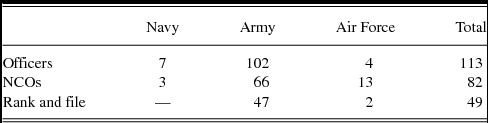
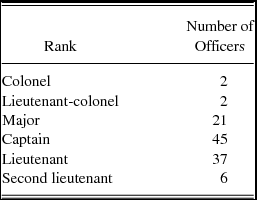
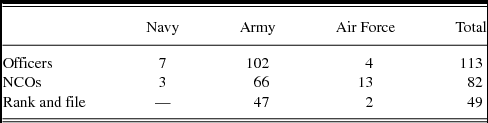
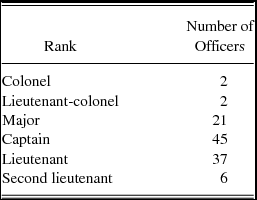
In May 1991, Tunisia's minister of the interior ʿAbd Allah Qallal stunned his countrymen by revealing at a press conference that the police had uncovered a coup plot.Footnote 38 Army Captain Ahmad ʿAmara confessed on national television to attending a secret meeting held on 6 January 1991 in Barakat al-Sahil, a hamlet near the coastal town of Hammamet, to plan the overthrow of the government. In his confession, ʿAmara said that al-Nahda sympathizers had built a wide network of supporters in the army and enlisted the help of Islamist militants trained in Afghanistan. He alleged that the aim of their coup was to impose shariʿa law and an Iranian-style theocracy under al-Nahda rule. What ʿAmara could not divulge to his countrymen was that his confessions were extracted under torture.Footnote 39 Nor did Tunisians know that from January to July 1991 scores of other army personnel were detained and tortured at the Ministry of the Interior, including 113 officers, 82 noncommissioned officers (NCOs), and 49 soldiers.Footnote 40 A majority of the officers implicated in the affair held junior and midranking positions, though some held senior positions. Three of the five aides to the army's chief of staff were arrested. Colonel Zughlami Munsif, Lieutenant Colonel Muhammad Ahmad, and Lieutenant Colonel ʿAli Hajji were the respective heads of the three most important bodies in the army's high command: the Operation Bureau, the Intelligence Bureau, and the Bureau for Military Studies and Planning. Interior Minister Qallal supervised the operation, sometimes interrogating the prisoners himself.Footnote 41 The head of Tunisia's Securité Nationale, ʿAli Sariati, the director of the Sûreté de l’Etat (State Security), ʿIzz al-Din Jinayf, and the undersecretary of the Ministry of the Interior, Muhammad ʿAli Qanzuʿi, also participated in the investigations. Through the Barakat al-Sahil affair, the RCD machinery and the security establishment humiliated the officer corps and, by extension, the entire armed forces. The affair had repercussions for inter- and intrainstitutional relations during the remainder of Bin ʿAli's tenure. Tables 1 and 2 provide details on officers, NCOs, and soldiers arrested in the Barakat al-Sahil affair.
Did the minister of the interior dupe Bin ʿAli by leading him to think that officers were conspiring against him, or was the minister simply following the orders of his president? The officers with whom I met during my fieldwork generally concur that the minister of interior and his top aides manipulated the president, not the other way around:
The security establishment was behind Barakat al-Sahil. The minister of the interior at the time, ʿAbd Allah Qallal, wanted to drive a wedge between the president and the armed forces, and to prove to Bin ʿAli that the security establishment was the true defender of his regime. Bin ʿAli was not at the origin of Barakat al-Sahil. His mistake was that he believed the lies of the security establishment.Footnote 42
The roots of the conspiracy were in the Ministry of the Interior and the party. The minister of the interior, ʿAbd Allah Qallal, masterminded the whole affair.Footnote 43
Officers, NCOs, and soldiers arrested in the Barakat al-Sahil affair
Source: Qadiyyat Barakat al-Sahil, unpublished study prepared by INSAF, an NGO founded by the officers implicated in the Barakat al-Sahil affair. It is currently headed by Munsif Zughlami, a retired army colonel.
Ranks of officers arrested in the Barakat al-Sahil affair
Source: Qadiyyat Barakat al-Sahil, unpublished study prepared by INSAF, an NGO founded by the officers implicated in the Barakat al-Sahil affair. It is currently headed by Munsif Zughlami, a retired army colonel.
The scheme paid off. In the wake of the Barakat al-Sahil affair, Bin ʿAli became convinced that al-Nahda could infiltrate the armed forces more easily than it could the police. His trust in the military was durably shaken and he feared that the armed forces would unseat him, just as he, a former military officer, had unseated Bourguiba.Footnote 44 The true pillars of his regime, he decided, were the party and the security establishment.Footnote 45
Ill feeling went both ways. The officers had hoped their hour had come now that one of their own was in command. The 1991 events caused them great trauma, which gave way to a deep but silent resentment toward the Bin ʿAli regime. In the words of three retired senior officers I interviewed in Tunisia:
It was common knowledge in the officer corps that our comrades arrested in 1991 were tortured and that their families were humiliated. Adding insult to injury, they were interrogated at the Ministry of the Interior even though the armed forces’ regulations stipulate that military officers answer only to the Ministry of Defense. We were convinced that they were innocent because we knew them well. We were also outraged because the leadership of the armed forces did not defend them. After the Barakat al-Sahil affair, Bin ʿAli became extremely unpopular in the officer corps.Footnote 46
I know personally twenty officers who were implicated in the affair and were later stricken from the lists—they were all innocent. I told a chief of staff at the time that these men were wrongly accused of being al-Nahda supporters and that he should talk to the president and defend them. He replied that if he did so, he might join them in prison. As I was talking to him, I understood that he was terrified. So was the officer corps as a whole.Footnote 47
After 1991, the armed forces lost the competition with the police and the party. The president became even more convinced that the police and the party were his true allies.Footnote 48
The second implication of the Barakat al-Sahil affair was that the chiefs of staff became unpopular in the officer corps and among the rank and file. Muhammad bin Hasin was particularly loathed, for he was accused of failing to defend the armed forces even though the corps he led bore the brunt of Qallal's accusations. Yet Bin Hasin's unpopularity in the officer corps did not affect his tenure; in fact, it may have contributed to its longevity because it made him less threatening to Bin ʿAli.Footnote 49 As a general rule, the officer corps did not hold most chiefs of staff under Bin ʿAli in high esteem. Bin ʿAli is alleged to have promoted the most uncharismatic, bureaucratic-minded, and personally loyal officers over the most competent ones.Footnote 50 The subordinates of most chiefs of staffs considered the latter less their representatives within the regime than the regime's delegates to the armed forces.Footnote 51
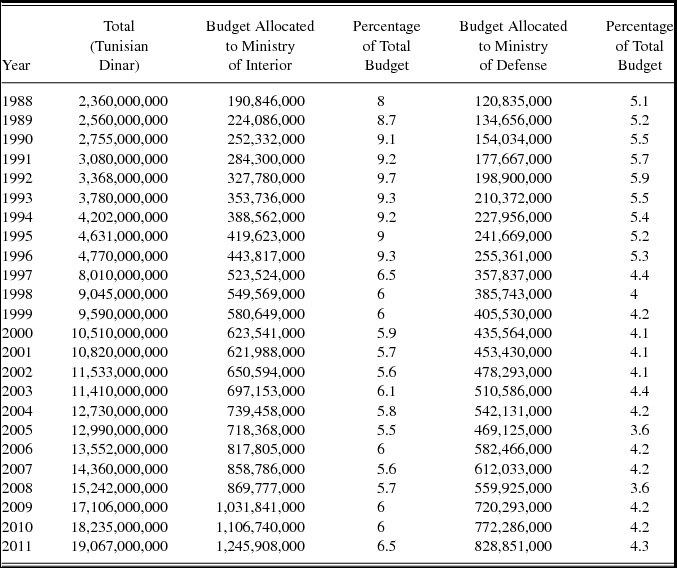
The third consequence of Barakat al-Sahil was the heightening of the military's animosity toward the police.Footnote 52 The armed forces perceived the affair as a trap set by the security establishment in collaboration with the party. That the officers implicated in the investigations were interrogated at the Ministry of the Interior rather than the Ministry of Defense was especially demeaning.Footnote 53 Meanwhile, the confidence of the security establishment grew after it successfully uncovered the “conspiracy,” leading it to meddle in the military's affairs and keep a very close watch on the officer corps, whose members knew that their careers could be made or broken by police and al-Amn al-ʿAskari (the armed forces intelligence organization) reports.Footnote 54 Making matters worse, the military was losing out to the various security institutions in the scramble for public resources. In 1992, the year following the Barakat al-Sahil affair, the government allocated to the Ministry of the Interior a staggering 9.7 percent of the budget, whereas the Ministry of Defense's share stagnated at 5.9 percent, an imbalance that was to continue throughout Bin ʿAli's years in power.Footnote 55 As the regime's campaign against al-Nahda took a more repressive turn, Bin ʿAli relied more and more heavily on the security establishment. The armed forces, by contrast, stayed out of the business of squelching domestic dissent. As evidence of this shift, Bin ʿAli awarded many more honors and decorations to police officers each year than he did to military personnel, a stable disparity that armed forces circles could not help but notice.Footnote 56 The two decades following the 1991 events would be filled with disappointment for the military institution.
ON THE MARGINS: THE MILITARY IN THE WAKE OF BARAKAT AL-SAHIL
Underfunding is a classic indication of a military's neglect under any regime. During the Bin ʿAli years, the Tunisian Armed Forces were in persistent financial distress. According to retired Colonel-Major Mukhtar Hishayshi:
All that we were asking for was a bit more comfort for our troops, sleeping bags, better food, and bigger dormitories at the barracks—and a modest enlargement of the armed forces that would enable us to give overworked soldiers more days off. We also wanted a salary increase; parts of our equipment had become obsolete, and we needed to replace them with modern weaponry. We were not asking for much; but we never got it.Footnote 57
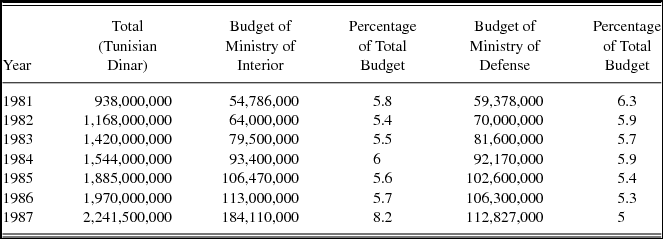
In fact, the armed forces were already starved for resources under Bourguiba, but a combination of factors led them to feel that underfunding was more egregious during Bin ʿAli's tenure. First, the military, as with the public at large, saw an aura of personal integrity surrounding Bourguiba. When he argued that postindependence Tunisia lacked resources and that development should have priority over armament, the officers could generally agree. By contrast, Bin ʿAli and his brothers-in-law—the Trabulsi clan—as well as the several oligarchs allied with the presidential couple, were viewed as ostentatiously corrupt. The gap between their conspicuous consumption and the officers’ meager salaries and outdated equipment was increasingly infuriating to members of the armed forces and to Tunisians in general.Footnote 58 Second, the armed forces did not expect anything from Bourguiba, for he was a civilian known to have lukewarm feelings for the military. Bin ʿAli, however, was a fellow officer; when he neglected their interests, they could only feel embittered.Footnote 59 Third, unlike the police organizations, the military was starved for resources and equipment under Bin ʿAli.Footnote 60Tables 3 and 4 show how the shares of the Ministry of Defense and the Ministry of the Interior shifted during Bourguiba's last years in power and during Bin ʿAli's tenure.
Budget during Bourguiba's last years in power (1981–87)

Source: See the December issues of al-Raʾid al-Rasmi for the figures pertaining to the budget.
Budget under Bin ʿAli (1988–2011)
Source: See the December issues of al-Raʾid al-Rasmi for the figures pertaining to the budget.
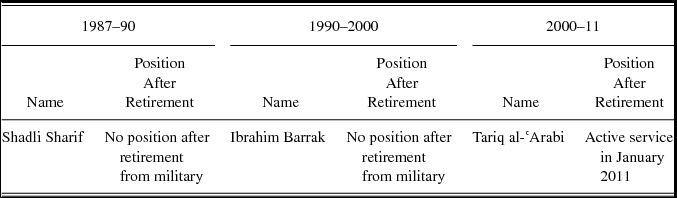
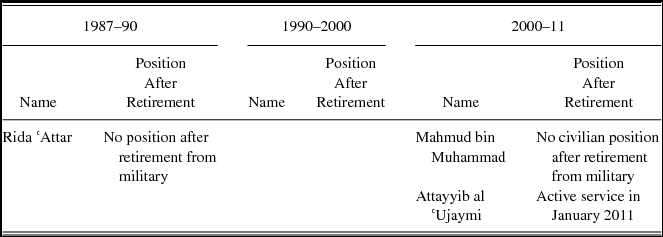
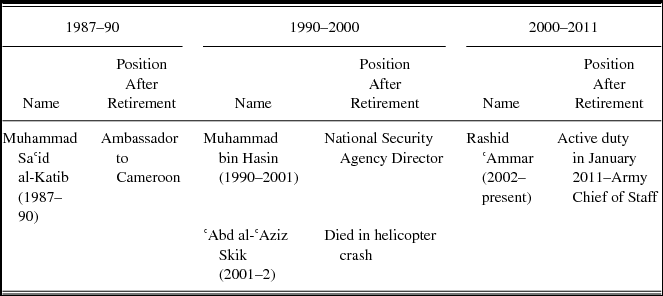
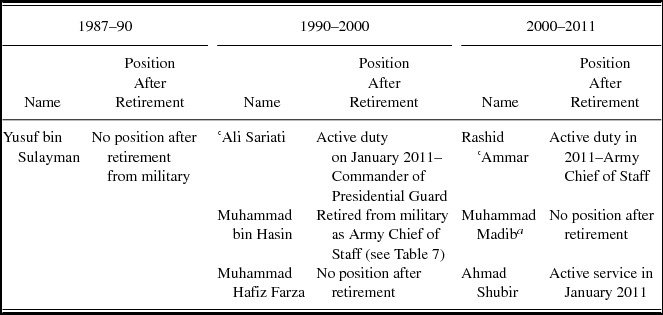
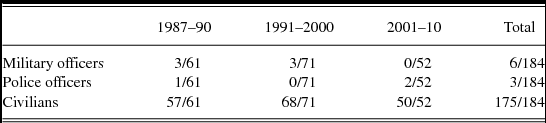
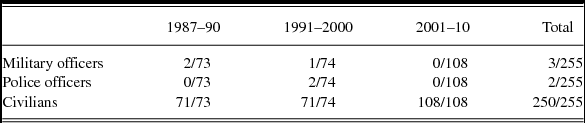
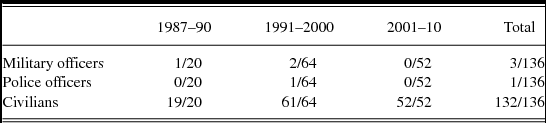
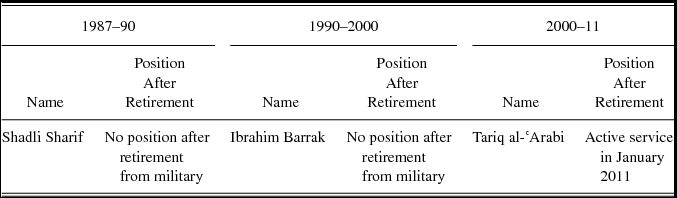
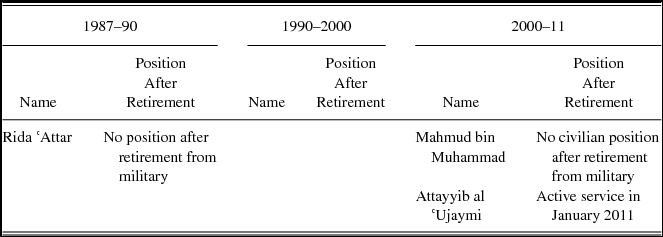
It has long been custom in the Arab world to reward retiring chiefs of staff with plum civilian jobs.Footnote 61 The scarcity of prestigious civilian appointments for retired military officers throughout Bin ʿAli's tenure was another sign of the marginalization of the armed forces. The much-decried “militarization” of the administration never happened. The generals secured a few high-status nominations between 1987 and 1991 but such nominations became increasingly rare in the years that followed. Tables 5–11 show the extent to which Bin ʿAli avoided appointing senior military officers to diplomatic, gubernatorial, and ministerial positions. Officers who maintained that they were better prepared than civilians to handle the kinds of security challenges faced by governors in Tunisia's peripheral regions were particularly frustrated by the paucity of appointments to gubernatorial positions.Footnote 62 But as Tables 9–11 show, the number of governors with a military background remained negligible under Bin ʿAli (Table 11), and the same is true of diplomatic and ministerial positions (Tables 9 and 10).
Second careers of Tunisian navy chiefs of staff under Bin ʿAli by decade
Source: Retired chief of staff (navy) who wished to remain anonymous, author's interview, Tunis, 15 July 2013. By contrast, among the five officers who were appointed chiefs of staff of the Egyptian navy and retired under Mubarak, two became presidents of the national navigation company and another was appointed president of the Suez Canal Authority. Hicham Bou Nassif, “Wedded to Mubarak: The Second Careers and Financial Rewards of Egypt's Military Elite, 1981–2011,” Middle East Journal 67 (2013): 509–30.
Second careers of Tunisian air force chiefs of staff under Bin ʿAli by decade
Source: Retired chief of staff (air force) who wished to remain anonymous, author's interview, Tunis, 7 July 2013. By contrast, among the five officers who were appointed chiefs of staff of the Egyptian air force and retired under Mubarak, three were nominated ambassadors, one became a governor, and another, Ahmad Shafiq, was appointed minister of aviation and then prime minister. Bou Nassif, “Wedded to Mubarak.”
Second careers of Tunisian army chiefs of staff under Bin ʿAli by decade
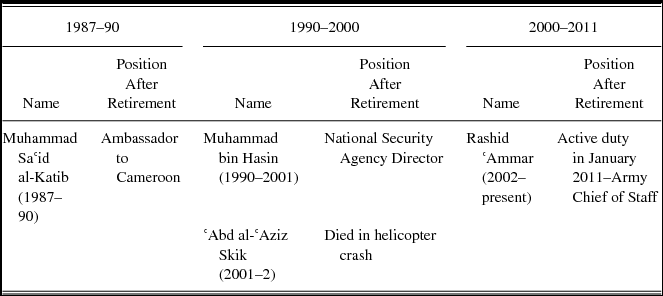
Source: Muhammad Mizughi, retired colonel-major in the Tunisian army, former director of the Haute Ecole de Guerre (Tunisian War College), and military attaché in France, author's interview, Tunis, 5 June 2013.
Second careers of the military security commanders under Bin ʿAli by decade
a Madib was appointed director of Tunisian customs after the fall of Bin ʿAli.
Source: Mizughi, author's interview.
Professional backgrounds of ambassadors under Bin ʿAli by decade
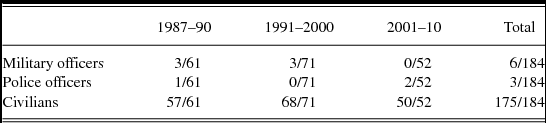
Source: I drew on the following decisions by the Tunisian Ministry of Foreign Affairs, all published in al-Raʾid al-Rasmi, for the data in this table. 2010: 2694–2695–2696–2697–2698–2699–2700–2701–2702–2703–2704–2705–2706–1676–1677–790–791; 2009: 3508–1027–1028; 2007: 1337–390–391–392–393; 2005: 3377–356–357–358–359–360–361–362–363; 2003: 2081–1972–1973–1974; 2002: 3257–3256–3152–3151–3152–3150–2067–2068–2069–2896–1965–1353–179–180; 2001:1064–2222–2223–2224–2225–2226–2227–2228–2229–2230–2484–2485–2486–2847; 2000: 2138–2139–2140–2141; 1999: 2392–2393–2394–2395–2856–2857–2275–2202–2203–627–628–350–206; 1998: 2242–1798–1773–1774–1775–790–571; 1997: 1855–1971–1972–1973–1974–1975–1976–1718–1720–1721–1722–1723–1724–1725–1726–1727–1728–1729–1730–1731–985–88–89; 1996: 1838–1839–1769–1770–1771–664–1663–1230; 1995: 758–645; 1994: 2503–2197–2198–2199–2200–2201; 1993: 2023–2024–2025–2026–2027–2028–2029–2030–2031–2032–2033–2034–2035; 1992: 2253–2254–1769–1768–1767–1766–1765–1764–1763–1762–1761–636; 1991: 2010–2009–1767–1755–1756–1757–1652–1651–1379–1380–1381–1382–1383–1384–1064–1065–1066–636–303–37–102; 1990: 2091–1625–1626–1627–1628–1629–1630–1631–1632–1633–1634–1635–1636–1637–1638–1639–1640–1641–1755–1756–1757; 1989: 758–747–1150–1151–1152; 1988: 1969–1950–1898–1899–1900–1663–1664–1665–1666–1646–1584–1585–1150–1151–1152–1447–1421–1420–1419–1403–1402–1296–854–742–60–61–62–63; 1987: 1452–1451–1450. I drew on the archives of several Tunisian newspapers, mainly Le Temps, al-Maghrib, al-Sabah, and al-Shuruq, for the professional backgrounds of the ambassadors. Colonel Abu Bakr Bin Krayyim, Colonel-Major Mukhtar Hishayshi, and a retired diplomat who did not wish to be named, helped me to fill the gaps.
The professional background of ministers under Bin ʿAli by decade
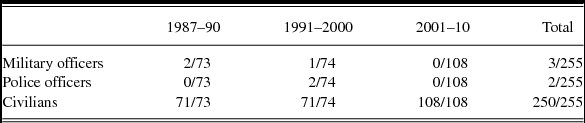
Source: Tunisian newspapers publish the names of ministers as well as information on their professional backgrounds upon their appointment. For the data in this table, I drew on the archives of several Tunisian newspapers, mainly Le Temps, al-Maghrib, al-Sabah, and al-Shuruq.
The professional background of governors under Bin ʿAli by decade
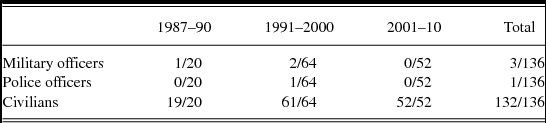
Source: I drew on the following decisions by the Ministry of the Interior and Local Development, all published in al-Raʾid al-Rasmi, to collect the data in this table. 2009: 3275–3274–1085; 2008: 3276–3275–1746; 2004: 2742–2743–2744–2745; 2002: 2137–1744–1745–1746; 1999: 2667–2668; 1998: 1517 1516; 1997: 654; 1996: 1747–1746; 1994: 1355–1354–1353; 1993: 1550; 1992: 1998–1202–1201–1200–344; 1991: 1132–1133–1134–1135; 1990: 1765–1764–1763–1762–1761–1760–1759–1758–269–238–239; 1989: 1516–1155–472; 1988: 1497–1496–1495–376–354; 1987: 1308. I also drew on the archives of several Tunisian newspapers, mainly Le Temps, al-Maghrib, al-Sabah, and al-Shuruq, for the governors' professional backgrounds. Colonel Abu Bakr Bin Krayyim and Colonel-Major Mukhtar Hishayshi helped me to fill the gaps. In contrast to the Tunisian case, 63 out of 156 governors (40%) appointed by Mubarak in Egypt hailed from the military. Bou Nassif, “Wedded to Mubarak.”
In addition to being deprived of resources and postmilitary civilian career opportunities, the officer corps had to adapt itself to the constant watch of the regime's security organs. As mentioned earlier, after a brief career in the artillery corps, Bin ʿAli headed the Securité Militaire between 1964 and 1974.Footnote 63 Because this decade was rife with coups in the Arab world, Bin ʿAli received leeway from a wary Bourguiba to keep a close watch on the officer corps. This task was facilitated by the fact that the Securité Militaire was an integral part of the armed forces—that is, the military officers who directed it were familiar with the inner workings of their institution.Footnote 64 Bin ʿAli was subsequently appointed general director of the Sûreté Nationale in 1977 and again in 1984, before becoming minister of the interior in 1986. Over the course of this career path, he developed intimate familiarity with the security organs of both the military and the police. The latitude these organs were granted to keep the officer corps in check betrays the depth of Bin ʿAli's distrust of the military.Footnote 65 In the wake of the Barakat al-Sahil affair, the armed forces fell under the control of the Ministry of the Interior. The latter's grip was so firm that officials at the Ministry of Defense were unable to transfer a military unit without first notifying their counterparts at the Ministry of the Interior. The police would then dispatch informants to confirm that the movements of the military unit proceeded according to plan.Footnote 66 Furthermore, in order to prevent officers from developing ties that could facilitate coup attempts, the security organs of the military and the police discouraged them from meeting at social events, mingling with each other, or interacting outside the workplace.Footnote 67 All of this the officers found demeaning.
THE 2011 TUNISIAN UPRISING
In 2006, Bin ʿAli's cohort in the Tunisian officer corps was celebrating the fiftieth anniversary of its graduation from Saint-Cyr, France's most prestigious military academy. After promising to attend the celebration, the former president did not show up.Footnote 68 He had lost touch with most of his former comrades, whose alienation from the regime had become complete.Footnote 69 Chiefs of staff had fewer reasons to complain than the rest of the officer corps. They enjoyed long tenures in their positions, often more than a decade.Footnote 70 They also received credits directly from the Office of the President to purchase real estate property and undeclared yearly allowances.Footnote 71 Yet the rest of the officer corps—the overwhelming majority—were unhappy with Bin ʿAli's neglect of the armed forces throughout his tenure, resentful of both the ruling party and the police, and increasingly outraged by the corruption of the presidential clan, namely, the president's wife, Layla bin ʿAli, and her family.Footnote 72 Such was the state of civil–military relations in Tunisia when the 2010–11 popular uprisings unfolded.
Did Bin ʿAli order the armed forces to shoot at the demonstrators challenging his regime? Early accounts of the uprising maintain that he did. Moreover, the army's chief of staff Rashid ʿAmmar was credited with refusing to obey Bin ʿAli and thus saving Tunisia from a bloodbath. The general quickly became an icon of the uprising. This version of events became less credible when Yasin ʿAyari, the young Tunisian activist who first spread the rumor on social media that ʿAmmar had rejected Bin ʿAli's order, admitted that he invented the story in order to turn the president against the army's chief of staff.Footnote 73 After Bin ʿAli fled from Tunisia, ʿAmmar himself denied that the former president had ordered him to shoot on demonstrators.Footnote 74 Officers interviewed over the course of my research expressed their belief that Bin ʿAli never made such an order. They dismissed as baseless accounts arguing that ʿAmmar defected from the regime because he was preparing a coup. My interviewees, many of whom knew both ʿAmmar and Bin ʿAli personally, concur that the former respected the principle of military subordination to civilian authority until the end. This point was corroborated in my interviews with two retired colonel-majors, ʿAbd Allah bin ʿAbd Allah and Muhammad Mizughi, who stated, respectively:
ʿAmmar behaved as a professional soldier. The politicians were the decision-makers during the 2011 crisis and he accepted their authority. He did not improvise. Keep in mind that according to the armed forces regulations, an officer should retire at sixty. ʿAmmar reached sixty in 2006 and should have retired then. But the president kept renewing his tenure year after year. By 2011, Bin ʿAli had renewed ʿAmmar's tenure five times. He trusted him.Footnote 75
What was said about ʿAmmar refusing to shoot on the population was nonsense; ʿAmmar remained loyal to the president until the end.”Footnote 76
The question of ʿAmmar's loyalty aside, opening fire on demonstrators was not an option he could consider. Lest we forget, chiefs of staff may issue orders, but senior officers and their subordinates execute them. Officers occupying midranking and junior positions are particularly important to the implementation of military directives because they lead the men in the field. The findings of this study suggest that even if ʿAmmar had the will to keep Bin ʿAli in power, he lacked the capacity to do so because the officer corps was extremely alienated from the regime and happy to see it fall. My interviewees consistently maintained that ʿAmmar's subordinates, the senior, midranking, and junior officers of the Tunisian military, were not ready to shed blood in order to save Bin ʿAli. The officers with whom I met maintain that orders to shoot not only would have failed to rescue the president, but also could have triggered an officers’ mutiny that would have been extremely dangerous to ʿAmmar's position. In private interviews with the author, a retired chief of staff of the navy expressed this exact sentiment:
The officers would not have opened fire on the protesters. By officers I do not mean mid-ranking and junior officers alone, but the officer corps as a whole, including senior officers. The overwhelming majority in the officer corps was unhappy with the regime. Bin ʿAli had marginalized the armed forces, just as Bourguiba had done before him. The officers were not going to risk their lives, and the lives of others, for the sake of a regime that had offered nothing to the armed forces. Had the orders been given to shoot, the officer corps in its entirety would have turned against ʿAmmar.Footnote 77
A retired chief of staff in the air force made a similar point during my interview with him:
I don't believe that Bin ʿAli would have ordered ʿAmmar to open fire on the protesters. Had he done so, the armed forces would not have followed orders. I don't have a single doubt about that. In 1991, the regime humiliated the armed forces; 2011 was payback time for us. After Barakat al-Sahil, we were silent but resentful. Our attitude vis-à-vis the 2011 uprising was simple: good riddance, Bin ʿAli. His was the regime of the police, which had become like the Eastern German Stasi. The armed forces were not going to defend the regime of the security establishment, which had humiliated the military institution. Why should they have?Footnote 78
These quotations show that the Tunisian officer corps did not stage a coup against the rule of Bin ʿAli because putsches are anathema to its institutional culture. All of the officers interviewed for this study expressed pride in la specificité tunisienne, the tradition of a republican military respectful of civilian rule in a regional environment where militaries have been coup-prone. In addition, Bin ʿAli had “coup-proofed” carefully by balancing the military with a robust police force that kept the officer corps under close watch. Officers believed that a putsch would be both dishonorable and unlikely to succeed. Yet the regime had consistently identified with the military's institutional rivals—the party and the police. By 2011, the officer corps’ alienation from Bin ʿAli had become entrenched and pervasive, irrespective of branch or rank. The 2011 uprising offered a solution to the moral and practical dimensions of the officer corps’ quandary. By 15 December 2010, three weeks after the beginning of the uprising, the police had crumbled and the party proved unable to countermobilize. In order to bring the regime to its end, the military had only to decline to uphold the status quo, which is precisely what it did.
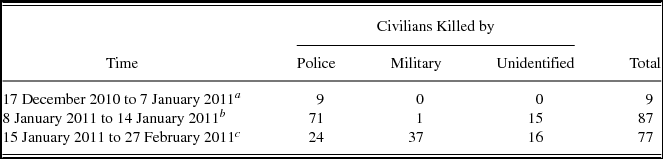
Bin ʿAli ordered the armed forces to help the police restore order on 7 January 2011. Although the troops did deploy around embassies and ministries as well as in the streets of major cities, chiefly Tunis, they were unwilling to take drastic measures such as firing on civilians, even to prevent them from burning police stations.Footnote 79 As late as 13 January, the day before Bin ʿAli's flight, the head of the presidential guard ʿAli Sariati was still complaining about the “lack of efficiency” in the military's action on the streets of Tunis.Footnote 80 But as long as Bin ʿAli remained in power, the armed forces would not open fire on civilian demonstrators. As Table 12 shows, only after he fled Tunisia, when the situation appeared to be drifting toward chaos, could the military be used to intervene forcibly. This article suggests that in explaining the armed forces’ behavior, attention should be paid not merely to Rashid ʿAmmar's preferences, but more importantly to constraints structuring the army chief of staff's agency. The breakdown of the Bin ʿAli regime ushered in the fall of both the security establishment and the RCD. Tunisian military officers applauded the ruin of their loathed rivals. Framing ʿAmmar as the Tunisian uprising's savior is reductionist. Considering the inter- and intrainstitutional dynamics exposed in this study, ʿAmmar had little option but to accept the downfall of the Bin ʿAli regime, irrespective of his own inclinations.
Breakdown of the Tunisian uprising's victims killed by the police or the military
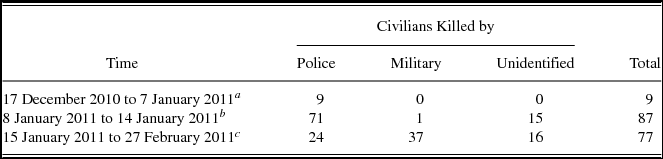
aFrom the beginning of the protests to the deployment of the army.
bFrom the deployment of the army to Bin ʿAli's flight.
cFrom Bin ʿAli's flight to the end of the Tunisian uprising.
Source: I collected the data for this table from ʿAbd al-ʿAziz Belkhodja and Tarak Cheikhrouhou, 14 Janvier, lʿenquete (Tunis: Appolonia, 2013); ʿAzmi Bishara, al-Thawra al-Tunisiyya al-Majida Binyat Thawra wa-Sayruratuha min khilal Yawmiyyatiha (Beirut: Arab Center for Research and Policy Studies, 2012); Salah Weslati, Chronologie de la revolution tunisenne: Democratie ou guerre civile? (Tunis: Nirvana, 2011); and the Tunisian periodicals Le Temps and al-Sabah.
A COMPARATIVE APPROACH TO THE BEHAVIOR OF ARMED FORCES IN THE ARAB SPRING
A comprehensive and structured comparison of the behavior of armed forces in different national contexts within the Arab world during the 2011 uprisings is beyond the limits and purpose of this article. Nevertheless, this section shows that the theoretical framework I have used to examine Tunisia can be useful analytically in other contexts as well. Egypt is a case in point. The Mubarak regime was much more generous than Bin ʿAli to allies in the armed forces. Recent studies have documented the extent to which Mubarak used corruption, or at least turned a blind eye to it, in order to wed the Egyptian military top brass to his rule.Footnote 81 Yet the military did not crush the anti-Mubarak mobilization when the Egyptian police crumbled in Cairo and elsewhere in Egypt. Mubarak's financial rewards were strictly lavished on the military elite and did not trickle down to the midranking and junior officers who suffered from Egypt's economic woes.Footnote 82 The generals worried that suppressing the civilian protests might further alienate the midranking and junior officers and create a split along generational lines within the officer corps.Footnote 83 The conclusion from both Egypt and Tunisia is that the commanders of the armed forces can only uphold the status quo if their subordinates in the officer corps are ready to slaughter their own countrymen in order to prevent political change. Short of this, the loyalty of the military leadership may not suffice to avoid authoritarian regime breakdown.
The behavior of the armed forces in Syria corroborates this point. The divergence between the upper military echelon and its subordinates in terms of their attitude toward the regime—so palpable elsewhere—has been practically nonexistent in the ethnically stacked Syrian Armed Forces. Fostering shared aversions through group solidarity contributes to keeping militaries responsive to autocrats’ call for repression; ethnic stacking reduces the possibility for entrenched generational cleavages between loyalist commanders and their subordinates in the officer corps. Consequently, repression of civilian protesters becomes more likely.
CONCLUSION
With each new wave of popular uprisings against autocratic regimes—-from Southern Europe to Latin America, Eastern Europe, Indonesia, and, more recently, Serbia, Georgia, Ukraine, and the countries of the Arab Spring—the central question has been the same: will the military defect or remain loyal? Armed forces are difficult to study due to the secrecy that surrounds them, but understanding their role in regime breakdown or the perpetuation of the status quo is crucial to mapping revolutionary processes. The quantitative turn in political science has pushed qualitative methods to the margins of the discipline; my work on Tunisia suggests that a theoretically informed, fieldwork-based engagement with military actors may yield original data that is vital to understanding militaries and revolutions and that cannot otherwise be collected. A renewed interest in qualitative methods and area studies may provide greater analytical clarity to the study of the outcomes of popular uprisings.
Military elites have the authority to issue orders for their troops to break popular mobilizations, but it is the midranking and junior officers as well as soldiers under their command who have to face civilian protesters in public squares. The rank and file take their orders from their immediate superiors, the midranking and junior officers. If the latter defect to popular uprisings, the generals lose control over the military and risk going down with beleaguered autocrats. When the military commandership risks mutiny within the lower echelons of the officer corps, its leeway is inevitably constrained. Such a split is not inevitable. Officers of all ranks may converge over the need to sustain the status quo, or they may favor change and welcome regime breakdown. Either way, we should not assume a priori that officer corps necessarily operate in a unified fashion. Relationships between chiefs of staff, senior officers, and their subordinates should be problematized and analyzed accordingly.
Based on this premise, this article is an exercise in disaggregation. Rather than thinking in terms of “incumbents” versus “challengers,” a framework that is prevalent in formal modeling work on democratic transitions, I have dissected the relationship between the military commandership and the rest of the officer corps, between the military commandership and the political elite, and between the armed forces and the police. Put differently, I made two simultaneous disaggregations: a vertical one of the officer corps, and a horizontal one that separates the military from the security establishment and the political elite.
I have argued in this article that institutional rivalries between the armed forces, the police, and the ruling party under Bin ʿAli structured military behavior during the 2011 uprising. Long marginalized under Bourguiba, the Tunisian military had hoped to become more prominent with the 1987 rise to power of the former officer Bin ʿAli. These ambitions threatened to upset the ruling party's exclusive control over the Tunisian state and were perceived as a menace by the security establishment, the military's competitor for power, prestige, and public resources. The convergence of interests between the party and the police created a configuration of power unfavorable to the military, perpetuating its marginalization. In retrospect, one can argue that Bin ʿAli had distrusted the armed forces since his early years in power. He did distribute perks to military officers, but in doing so he was rewarding them as co-plotters in the 1987 coup and as personal friends, not as representatives of the armed forces. In the wake of the 1991 Barakat al-Sahil affair, the Tunisian officer corps became permanently alienated from the Bin ʿAli regime. During the 2010–11 uprising the Tunisian officers and the troops they commanded were unwilling to slaughter unarmed civilians—their own countrymen, friends, and relatives—in order to uphold the status quo.
As explained previously, the army's chief of staff Rashid ʿAmmar may have had good reasons to remain loyal to Bin ʿAli, but he lacked the capacity to save the Bin ʿAli regime. My findings suggest that had ʿAmmar ordered an unwilling army to crush the rebellion, he might have triggered his own downfall as chief of staff. It is my hope that the methodological choices pursued here have provided a better picture of the internal workings of an authoritarian regime challenged by massive and sustained popular mobilization, and that disaggregations can help to explain similar dynamics in other countries of the Arab world and beyond.