Introduction
Background
Hemorrhage is the leading cause of death in combat in modern conflicts. Moreover, extremity hemorrhages have been considered a cause of preventable death in combat.Reference Champion, Bellamy, Roberts and Leppaniemi 1 The wide-spread use of tourniquets and their systematic availability for each combatant has led to a sharp decrease in avoidable deaths in combat settings.Reference Kragh, Littrel and Jones 2 , Reference Mozingo 3 Thus, tourniquet pre-deployment training is a major concern for Armed Forces.4– Reference Kragh, Lunati and Kharod 6 Indeed, the tourniquet’s effectiveness is very high in laboratory conditions, but it decreases significantly in simulation and stress conditions.Reference Savage, Tenn and Vartanian 7 – Reference Kragh, Walters and Baer 9 Numerous studies have highlighted the importance of training to improve users’ ability to apply a tourniquet.Reference Schreckengaust, Littlejohn and Zarow 10 , Reference Unlu, Kaya and Guvenc 11
Importance
It is unclear whether a refresher tourniquet training session conducted in a combat zone (in addition to the standard pre-deployment training program) improves the performance of tourniquet application.
Goals of the Investigation
The purpose of this study was to assess the impact of a refresher tourniquet training session, during simulation sessions, conducted directly in the theater of military operations. A dedicated score of performance was designed for the tourniquet applications evaluation. It was hypothesized that this dedicated training could improve the tourniquet application performance, measured with this score improvement.
Materials and Methods
Study Design and Setting
A monocentric, controlled, and single-blind prospective experimental study was conducted on healthy volunteers at the ROLE 2 Medical Treatment Facility (MTF) of M’Poko Camp, in Bangui, Central African Republic, from October 2015 through April 2016.
Selection of Participants
Fifty-two French soldiers were enrolled to participate in the study. They were from two combat platoons (26 subjects in each platoon) simultaneously engaged in the Central African Republic, as part of Operation SANGARIS.Reference Barbier, Pasquier, Racle, Baudoin and Malgras 12 Any military personnel belonging to one of the two participating platoons were included, after giving their informed consent.
Exclusion criteria were refusal to participate in the study, a medical history of arterial or venous thrombosis in the lower limbs, history of venous insufficiency, wounds or infections, injuries, or recent lower limbs trauma.
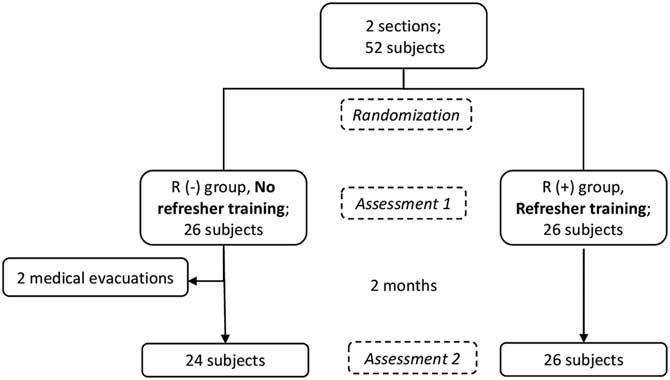
Both platoons were divided into two groups using simple randomization by flipping a coin, one undergoing the refresher training (R (+) group), and one without any refresher training (R (−) group). Two subjects in the R (−) group were considered as lost to follow-up, after their aeromedical evacuation toward France before the study’s completion (Figure 1).
Study Flow Chart.

Before being included in the study, the last tourniquet placement training for all the subjects was performed in France, before their arrival in the Central African Republic.
Materials
The SOFTT model (Special Operation Forces Tactical Tourniquet; Tactical Medical Solutions; Anderson, South California USA) tourniquet was used for the study, currently available for all combatants in their French combat first aid kit. A Sonosite M-Turbo (Sonosite Inc.; Bothell, Washington USA) portable ultrasound device was used to test the popliteal arterial Doppler flow interruption after tourniquet application.
All participants, fully equipped for combat, first underwent a simulation-based assessment. The models for tourniquet application testing were three males, independent of the subjects of the study, and healthy volunteers from the Role 2 MTF. They weren’t allowed to give feedback to those being tested.
The simulation sessions were conducted following the steps below:
a) Collection of demographic data (first assessment only).
b) Short briefing: “You are engaged in a patrol mission, your buddy has just been injured in the leg, he is bleeding profusely, you will have to put a tourniquet in place.”
c) Stopwatch start at the examiner’s signal: “It’s up to you!”
d) Assessment of the tourniquet performance included two points: the global time for placement (measured by the stopwatch, until the participant shouted “Ok, tourniquet placed!”) and the effectiveness (assessed by the detection of a popliteal arterial Doppler flow interruption, by an experienced examiner).
e) Personalized debriefing of the actions performed during the session.
Immediately after the first assessment, an official instructor conducted refresher training for tactical tourniquet application to the R (+) group. During two months, no other courses were delivered for the subjects included in the study. Two months after the first assessment, both R (+) and R (−) groups were called back and underwent a second assessment, under the same conditions (Figure 1).
Methods and Measurements
The following data were collected during the assessments.
Demographic Data
Age, gender, military rank, date of enlistment, and date of last tourniquet training were collected. The time delay between the last tactical tourniquet training and the first assessment was calculated. According to the French Military Medical Service doctrine, pre-deployment training includes a dedicated course for tourniquet training in the six months before deployment.
Measures During Simulation Sessions
Each simulation session included an assessment of the following items:
- Pre-positioning and preparation of the tourniquet. The tourniquet was noted as pre-positioned if it was immediately available on the tactical jacket and prepared if the buckle was already engaged.
- Effectiveness. The tourniquet was deemed effective if the popliteal artery color Doppler flux was abolished. Two lengths of time were graded: “On-hand” time, measuring the elapsed time between the stopwatch start and the tourniquet grip; and “Global time” for tourniquet application, measuring the time between the stopwatch start and the end of tourniquet application.
Qualitative Assessment of Performance Score
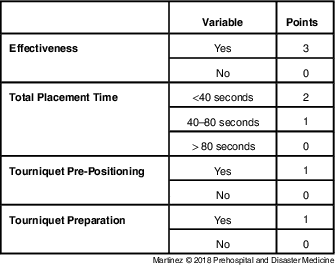
To reflect the overall performance of the tourniquet, a composite score was developed, integrating and weighting several qualitative and quantitative items. A panel of experts in the field participated in a consensus meeting. All these experts held local or national roles in tourniquet training programs. Each item, empirically determined, was graduated according to its relative importance for management of extremity hemorrhage. The possible values ranged from zero (zero performance) to seven (best performance). Table 1 gives the details of the performance score. For recognizable reason, effectiveness was considered as the most important factor and was rated as three points or zero point. The speed at which the tourniquet is placed is decisive for the survival of the war casualties.Reference Kragh, Walters and Baer 13 Based on published studies about tourniquet performance, a total placement time shorter than 40 seconds was considered as “ideal” and rated at two points, comprised between 40 to 80 seconds as “acceptable” and rated at one point, and insufficient longer than 80 seconds as “insufficient” and rated at zero points.Reference Schreckengaust, Littlejohn and Zarow 10 , Reference Higgs, Maughon, Usn, Ruland, Usn and Reade 14 – Reference Savage, Pannell, Payne, O’Leary and Tien 16 Finally, to increase the speed of the tourniquet placement, it is important to consider the device access. One study has shown that the manner of storing the tourniquet affects the catching time.Reference Higgs, Maughon, Usn, Ruland, Usn and Reade 14 Thus, criteria pre-positioning and preparation were considered as described above and rated each criterion at one or zero points.
Performance Score

Key Outcomes
The primary outcome was the improvement of the performance score between the two assessment sessions. The secondary outcomes were the time and effectiveness of tourniquet application.
Analysis
Given the primary outcome of the study, no data were available in the literature concerning the primary outcome; thus, it wasn’t possible to determine an a priori sample size and chose a convenience sample determined by the possibility of delivering consistent training and evaluation.
Continuous data were summarized using medians and interquartile ranges (IQRs) or means and standard deviation (SD), depending on the distribution of the variable; categorical data were presented as absolute numbers and percentages. Comparison tests were performed using Student’s t-test for continuous variables and χ2 tests for categorical variables when the applicable conditions were fulfilled. If necessary, non-parametric tests were performed (Wilcoxon-Mann-Whitney test and Fisher exact test, respectively). The significance threshold was set at .05.
Ethical Considerations
This study received approval from a local Ethics Committee (Comité d’Ethique de la Recherche en Anesthésie et Réanimation; SFAR; Paris, France) under the number IRB 00010254. All participants were informed and gave their written consent to participate in the study.
Results
Characteristics of Study Sample
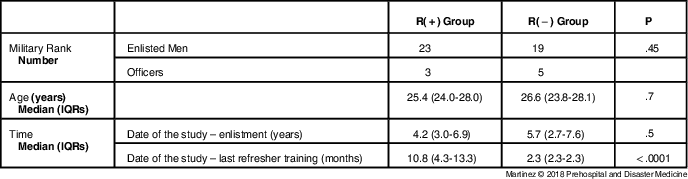
The two groups were similar, except for the time between the last tourniquet placement training and the first assessment, with a median time of 10.8 months (IQR: 4.3-13.3) for the R (+) group and 2.3 months (IQR: 2.3-2.3) for the R (−) group; P <.0001 (Table 2). No eligible soldier refused to participate in the study.
Participants Characteristics According to the Randomization Group (R+ / R-), n=50

Note: The “Time” measure expresses the delay between:
- Enlistment in the French army and the date of the study (expressed in years)
- The last refresher training for tourniquet application, in France, before the deployment of the subjects and the date of the study (expressed in months)
Main Results
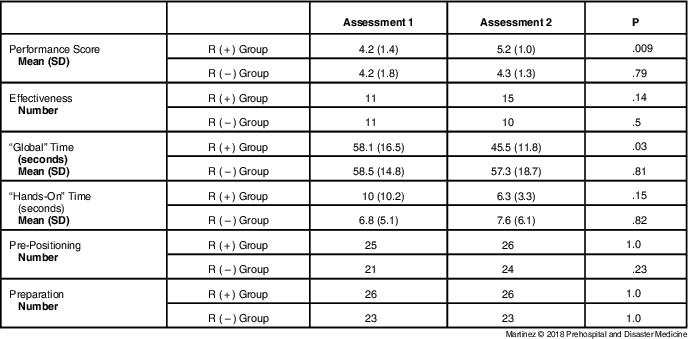
The mean performance score between the two assessments increased from 4.2 (SD=1.4) to 5.2 (SD=1.0) for the R (+) group (P=.009), in comparison to the R (−) group 4.2 (SD=1.8) at Assessment 1 and 4.3 (SD=1.3) at Assessment 2 (P=.79; Table 3).
Data Measured at Assessment 1 and 2 According to the Randomization Group (R+/R-), n=50

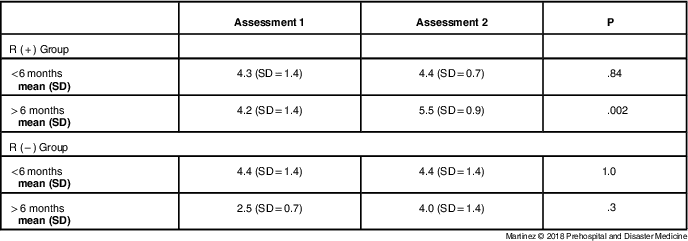
There was significant improvement in the mean performance score of the R (+) group whose last refresher training was more than six months old, the standard time delay scheduled in official pre-deployment training. There was no such improvement in the R (−) group (Table 4).
Mean Performance Score According to the Group and the Time Elapsed Since the Last Refresher Training

Analysis of the Performance Score Improvement Between Assessments
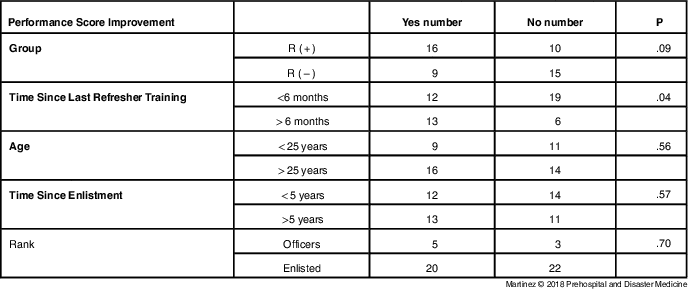
Soldiers whose most-recent refresher training occurred more than six months prior were more likely to improve their performance score between the two assessments (P=.04). The number of subjects who improved their performance score between the two assessments was 16 in the R (+) group and nine in the R (−) group, although below the significance threshold (P=.09; Table 5).
Performance Score Improvement Analysis

No complications were observed among participants, including among simulation actors (no complications following the tourniquet application).
Discussion
A refresher tourniquet training session did not improve the performance score for all participants. Nevertheless, the performance score was significantly higher for soldiers who underwent local refresher training at Assessment 2 (Table 3).
Improvement of the Performance Score
A dedicated performance score was designed to include all parameters describing correct tourniquet application. The mean performance score increased between both assessments in the R (+) group and didn’t in the R (−) group. This outcome is not directly comparable with results from published data since the performance score was designed specifically for this study. To the best of the authors’ knowledge, no previous study has reported such a score to explore tourniquet application performance. These results emphasize the results of Kragh, et al highlighting the best way to assess the tourniquet trainings. They showed that trainee learning curves vary according to the chosen metric, and the use of many metrics allows to assess training in a more comprehensive way.Reference Kragh, Mabry, Parsons, Broussard, Aden and Dubick 17 Indeed, they compared the learning curves of six characteristics (effectiveness, pulse stop, blood loss, laying time, number of turns of the tourniquet, and pressure exerted) when repeatedly applying a tourniquet to a manikin. According to the criterion analyzed, the learning curve varied widely. Among other findings, authors have emphasized the interest of composite criteria to evaluate accurately the acquisition of this skill. Indeed, the score provides a better capability to show a performance improvement instead of a single criterion such as the effectiveness.
The performance score provides a pedagogic tool for the tourniquet training. This study, applying the four-levels scale described by Kirkpatrick, corresponds to the second level.Reference Kirkpatrick and Kirkpatrick 18 The third level and, even more, the fourth level seem difficult to reach because they need an evaluation in real-life settings. The third level might be obtained by applying the performance score during a high-fidelity simulation session during an unexpected exercise. This could be the better way to approximate real-life and evaluate the knowledge transfer.
Effectiveness
The mean effectiveness rate for tourniquet placement was only 44% at Assessment 1 and 50% at Assessment 2. In an experimental study for the tourniquet placement by inexperienced subjects, the effectiveness rate was 44% in the group of participants who received a single period of short instruction.Reference Goolsby, Branting, Chen, Mack and Olsen 19 The appropriateness of the placement was judged on a combination of subjective criteria such as correct anatomical location, adequate tightness, and properly secured windlass and straps. In an Israeli army study, the SOFTT tourniquet was successfully placed in 62% of the cases. Effectiveness assessment included abolition of the distal pulse (palpation and Doppler flow) and tourniquet stability.Reference Heldenberg, Aharony, Wolf and Vishne 20 In this study, participants were not equipped for combat, unlike the study participants. Schreckengaust, et al also explored the beneficial effect of tourniquet training. This prospective study analyzed the SOFTT tourniquet application in repeated simulation sessions for 89 US soldiers.Reference Schreckengaust, Littlejohn and Zarow 10 Two simulation sessions were performed four days apart. Participants received a refresher course before each simulation session. The effectiveness was recorded by dorsalis pedis Doppler flow elimination. The effectiveness percentage improved from 30% to 43% between the two sessions. In this study, the criterion for the tourniquet applications effectiveness was the popliteal arterial Doppler flow interruption. Numerous experimental studies have adopted this same assessment criterion.Reference Calkins, Snow, Costello and Bentley 21 – Reference Wenke, Walters, Greydanus, Pusateri and Convertino 23 However, in a real-life scenario, the only criterion for effectiveness is the stop of bleeding. Thus, it is difficult to compare the effectiveness results with those of other studies from real-life combat settings.
The type of tourniquet can also influence the effectiveness. Numerous studies have compared SOFTT, CAT (Combat Application Tourniquet; Phil Durango LLC; Golden, Colorado USA), and EMT (Emergency and Medical Tourniquet; Delfi Medical Innovations; Vancouver, British Columbia, Canada) tourniquets.Reference Savage, Pannell, Payne, O’Leary and Tien 16 , Reference Heldenberg, Aharony, Wolf and Vishne 20 , Reference Kragh, O’Neill and Walters 24 Because of its characteristics (fragile pneumatic tourniquet and bulkier compared to SOFTT, not adapted for operational combat settings), the EMT seems to be preferred for secondary management; for example, during the evacuation to hospital. Nevertheless, the SOFTT was used because it’s the official tourniquet in the French Army.
Participants were all combatants and not professional health care providers. However, the professional category (physicians, paramedics, or combatants) may be associated with differences in performance for the tactical tourniquet.Reference Lakstein, Blumenfeld and Sokolov 8 , Reference Goolsby, Branting, Chen, Mack and Olsen 19 , Reference Heldenberg, Aharony, Wolf and Vishne 20 A higher level of skill in first aid improves the effectiveness of the tourniquet.Reference Lakstein, Blumenfeld and Sokolov 8
Preparation and Pre-Positioning
The preparation of the tourniquet involved engaging the tightening strap and removing the tourniquet from its packaging. Only one subject in the R (−) group and in the two assessments did not take this precaution before beginning the exercise. The pre-positioning involved a tourniquet hung directly on the combat equipment, making it more easily accessible. At Assessment 1, four subjects did not meet this pre-positioning criterion, whereas all did so at Assessment 2. In the tactical tourniquet training programs, soldiers are trained to both pre-position and prepare. Higgs, et al have demonstrated that access modalities of the tourniquet might influence the time taken to apply it.Reference Higgs, Maughon, Usn, Ruland, Usn and Reade 14 This study compared the differences in CAT placement time between American and Australian soldiers. The Australian Defense Force uniform uses buttons to secure the pocket, whereas the US uniform uses a hook and loop fastener system. The US personnel removed their tourniquets in a shorter time (median 2.5 seconds) than the Australians (median 5.72 seconds; P <.0001).
Time for Tourniquet Application
Here, the global tourniquet application time for the entire team was 58.3 seconds at Assessment 1 and 51.4 seconds at Assessment 2. Mean lower limb SOFTT application times from published data range from 26 to 59 seconds.Reference Schreckengaust, Littlejohn and Zarow 10 , Reference Savage, Pannell, Payne, O’Leary and Tien 16 , Reference Heldenberg, Aharony, Wolf and Vishne 20 , Reference Baruch, Benov and Shina 25 However, few studies provided details about the measurement of time for tourniquet placement. In this study, stopwatches started before the participant caught the tourniquet in his hands. Therefore, the global time for tourniquet application included the time of catching, positioning, and tightening the tourniquet. Considering only studies using the same timing modalities, this duration varies from 48 to 55 seconds, comparable with the data from this study.Reference Schreckengaust, Littlejohn and Zarow 10 , Reference Baruch, Kragh and Berg 15 , Reference Hill, Montgomery, Hopper and Roy 26 Analyzing each group separately, time for tourniquet application decreased significantly between the two assessments in the R (+) group but did not in the R (−) group. Schreckengaust, et al previously described the average duration for tourniquet application decreasing 55 to 50 seconds between both assessments.Reference Schreckengaust, Littlejohn and Zarow 10
Time Since the Last Refresher Training
A significant difference was observed in the time between the study and the last tourniquet refresher training between the two groups: 10.8 months in the R (+) group versus 2.3 months in the R (−) group; P <.0001. The combat section randomized into the R (+) group could not undergo the refresher training session usually included in the operational pre-deployment because of a rapid and unexpected surge in Operation SANGARIS. In this study, a post-refresher training interval greater than six months was associated with increased effectiveness of the refresher training and with a significant improvement of the performance score. The pre-deployment training is a major factor associated with a rapid and effective tourniquet application.Reference Schreckengaust, Littlejohn and Zarow 10 , Reference Unlu, Kaya and Guvenc 11 , Reference Goolsby, Branting, Chen, Mack and Olsen 19 , Reference Kragh, O’Neill and Walters 24 , Reference Baruch, Benov and Shina 25 To the best of the authors’ knowledge, this study is the first to precisely highlight the influence of such a long delay on the learning of the tourniquet’s use. This notion has been suggested by the work of Higgs, et alReference Higgs, Maughon, Usn, Ruland, Usn and Reade 14 In addition to measuring the tourniquet “hands-on” time of the American and Australian soldiers, the authors also measured the time of tourniquet application. This study was carried out in simulation, in the theater of military operations. The “hands-on” time of the Australian soldiers was longer than that observed among the American soldiers. Paradoxically, the global time for tourniquet application was significantly shorter (41.4 Seconds) for the Australian soldiers compared with American soldiers (58.9 seconds; P=.0037). The authors interpreted this result by the differences in training that had benefited the two groups of soldiers. In fact, American soldiers have received only initial training and then an annual refresher training, while Australian soldiers have benefited from two refresher training periods: before and immediately after their deployment in the theater of military operations.
Kragh, et al found no significant association between the post-training time interval and the tactical tourniquet application effectiveness.Reference Kragh and Dubick 27 However, the study period was less than three weeks, and no study has ever explored the performance change over a longer period.
Assessment in a Combat Zone
Several other studies have evaluated the impact of training on tourniquet use.Reference Schreckengaust, Littlejohn and Zarow 10 , Reference Unlu, Kaya and Guvenc 11 , Reference Jaffer, Aslam, Kasivisvanathan, Patni, Midwinter and Standfield 22 , Reference Hill, Montgomery, Hopper and Roy 26 The originality of this work was to conduct this evaluation in a combat zone, directly during the deployment in a military operation. This distinction is important. Firstly, the goal of the tourniquet training is to improve its appropriated use for management of combat casualties presenting with extremity hemorrhages. Thus, it is appropriate to conduct this work directly where soldiers can potentially benefit the most from its use. Secondly, several studies have shown a strong psychological effect of military operations that can influence the performance of soldiers.Reference Lane, Hourani, Bray and Williams 28 , Reference McNulty 29 Conducting this work during a military operation included this factor.
Limitations
Number of Participants
One of the main limitations of the study is the lack of power in relation to the limited number of participants. This lack of power may partly explain the absence of difference in performance score improvements observed between the two groups. The number of subjects needed could not be estimated given the outcome of the study. However, it should be emphasized that this study was carried out in a combat zone and was therefore subject to operational imperatives. It limited de facto the number of subjects available for inclusion during the study period. Therefore, it remains uncertain if this training assessment is applicable for a large majority of soldiers.
Experimental Model
In the study, healthy volunteer actors simulated fake combat casualties. Thus, the participants stopped tightening the tourniquet when they felt that it was enough, with no obvious sign to determine effectiveness. Under real-life conditions, the tourniquet is tightened until the bleeding stops. Thus, the tightening of the tourniquet could have been stopped prematurely. Moreover, the pressure generated by the tourniquet is painful for the victim. It is possible that the fear of hurting the fake victim may have limited the effectiveness of the SOFTT application.Reference Walters, Wenke, Kauvar, McManus and Al 30 Finally, a screaming and bleeding simulation manikin could have been more appropriated. But in the setting of military operation, devices dedicated to simulation training were unavailable. Furthermore, the study did not include any combat simulation details like blood, or other simulated components of a combat environment. Therefore, the stress-level might be lower compared to real combat situations. Innovative and dedicated tools, such as serious games,Reference Pasquier, Mérat and Malgras 31 , Reference Planchon, Vacher and Comblet 32 could improve this training and be particularly effective in case of unexpected deployment with shortened operational preparation.
Performance Score
Authors acknowledge that the performance score is novel and unique. It was designed according to previously published data but was not statistically validated.
Conclusion
In the study, there was no significant difference in the improvement of tourniquet application performance scores between two groups of soldiers, with or without a refresher training session, conducted directly in the theater of military operations. Conversely, results suggest that in-theatre refresher training is particularly useful for soldiers who are deployed unexpectedly. Authors acknowledged a six months maximum delay since the last training session to maintain adequate skills for the use of tourniquets. The benefits of the refresher training session observed in the study, as well as the significant failure rate of tactical tourniquet application in combat setting, highlight the critical nature of tactical tourniquet training programs.