INTRODUCTION
Tropical forests are being threatened by elevated rates of deforestation, which turn continuous forest areas into a mosaic of isolated fragments of various sizes and shapes surrounded by a non-forested matrix (Turner Reference TURNER1996). This modification in the landscape causes a reduction in forest area and the creation of abrupt edges between forest and non-forest habitats, altering local microclimatic conditions (Camargo & Kapos Reference CAMARGO and KAPOS1995), and often the diversity and composition of plant (Benítez-Malvido & Martínez-Ramos Reference BENÍTEZ-MALVIDO and MARTÍNEZ-RAMOS2003) and animal assemblages (Brown & Hutchings Reference BROWN, , Laurance and Bierregaard1997, Carvalho & Vasconcelos Reference CARVALHO and VASCONCELOS1999, Stouffer & Bierregaard Reference STOUFFER and BIERREGAARD1995).
Ecological processes, many of which are mediated by insects (Janzen Reference JANZEN1987), can also be affected by the fragmentation of tropical forests (Murcia Reference MURCIA1995), including the decomposition of organic matter (Vasconcelos & Laurance Reference VASCONCELOS and LAURANCE2005), plant pollination (Aizen & Feinsinger Reference AIZEN and FEINSINGER1994), seed dispersal (Andresen Reference ANDRESEN2003), parasitism (Kruess & Tscharntke Reference KRUESS and TSCHARNTKE1994) and herbivory (Arnold & Asquith Reference ARNOLD and ASQUITH2002, Benítez-Malvido Reference BENÍTEZ-MALVIDO, Bierregaard, Gascon, Lovejoy and Mesquita2001). However, relatively little is known about the consequences of habitat fragmentation on herbivory (Arnold & Asquith Reference ARNOLD and ASQUITH2002, Benítez-Malvido & Lemus-Albor Reference BENÍTEZ-MALVIDO and LEMUS-ALBOR2005, Benítez-Malvido et al. Reference BENÍTEZ-MALVIDO, GARCÍA-GUZMÁN and KOSSMANN-FERRAZ1999, Rao et al. Reference RAO, TERBORGH and NUÃEZ2000) in spite of the importance of this process for the cycling of nutrients (Schowalter Reference SCHOWALTER2000) and the regeneration of plant species (Crawley Reference CRAWLEY1983, Dirzo Reference DIRZO, Dirzo and Sarukhán1984, Marquis Reference MARQUIS1987).
Plants in tropical forests suffer higher herbivory rates than those in temperate forests, and perhaps because of this herbivory pressure, tropical plants present a higher diversity of physical, chemical and biological mechanisms of defence (Barone & Coley Reference BARONE, COLEY, Guariguata and Kattan2002). This diversity of defence mechanisms is thought to result in a greater specificity in the relationship between plants and herbivores (Coley Reference COLEY1998). However, it is not clear how changes caused by habitat fragmentation affect the interaction between herbivores and their host plants, as well as between herbivores and their natural enemies. Some studies suggest that fragmentation can negatively affect the abundance and diversity of insect predators and parasitoids (Kruess & Tscharntke Reference KRUESS and TSCHARNTKE1994), thus favouring populations of insect herbivores. On the other hand, the amount and quality of food resources for herbivores may also change with habitat fragmentation. This is because light levels increase near fragment edges, and light can affect plant productivity and leaf chemistry (Yamasaki & Kikuzawa Reference YAMASAKI and KIKUZAWA2003). However, studies conducted so far have failed to detected an edge effect on herbivory (Benítez-Malvido Reference BENÍTEZ-MALVIDO, Bierregaard, Gascon, Lovejoy and Mesquita2001, Benítez-Malvido & Lemus-Albor Reference BENÍTEZ-MALVIDO and LEMUS-ALBOR2005).
The purpose of this study was to determine if herbivory is affected by forest fragmentation and, if so, whether this is due to changes in plant characteristics or in levels of herbivore predation by natural enemies. More specifically, we examined the effects of forest fragment area on: (1) herbivory levels in a community of tree saplings; (2) herbivory rates on saplings of two common tree species in our study sites, Protium hebetatum and Henriettella caudata; (3) the defensive and nutritional characteristics of the foliage of these two tree species; and (4) the incidence of predation on insect herbivores (artificial caterpillars).
METHODS
Study sites
This research was carried out at the study sites of the Biological Dynamics of Forest Fragments Project. The sites are spread over an area of c. 20 × 50 km, and located 70 km north of Manaus, Brazil (2°25′S, 59°50′W). This area was partially fragmented during the late 1970s and early 1980s when large tracts of forest were cleared to create pastures for cattle grazing. A replicated series of isolated forest fragments, ranging in size from 1 to 100 ha, was then established. Several other equivalent-sized and larger forest areas have been marked, but remained part of continuous forest and are used as controls (for a more detailed description and a map of the study sites see Gascon & Bierregaard Reference GASCON, BIERREGAARD, Bierregaard, Gascon, Lovejoy and Mesquita2001). The forest of the region is a terra firme (non-flooded) evergreen forest, with a 30–35-m-tall canopy with emergent trees reaching 55 m (Rankin-de Merona et al. Reference RANKIN-DE Merona, PRANCE, HUTCHINGS, SILVA, RODRIGUES and UEHLING1992). The understorey is relatively open and is dominated by stemless palms. Annual rainfall ranges from 1900 to 3500 mm, with a distinctive dry season between June and October (Gascon & Bierregaard Reference GASCON, BIERREGAARD, Bierregaard, Gascon, Lovejoy and Mesquita2001). The dominant soils in the area are classified as yellow latosols, which are acidic and nutrient-poor (Chauvel Reference CHAUVEL1983).
Standing levels of herbivory
We measured standing levels of herbivory on tree saplings from three sites in continuous forest and from nine forest fragments (four of 1 ha, three of 10 ha, and two of 100 ha). These fragments were isolated from other forest areas by distances ranging from 150 to 900 m (Gascon & Bierregaard Reference GASCON, BIERREGAARD, Bierregaard, Gascon, Lovejoy and Mesquita2001). In each site a 2500-m2 (50 m × 50 m) plot was established. Plots were established in the centre of each fragment, while in continuous forest plots were located more than 500 m from the forest edge. All plots were established in relatively flat areas, on plateaux, where soils have a high clay content (Chauvel Reference CHAUVEL1983).
In each plot, 100 randomly selected tree saplings (2–7 m in height and > 1 cm in dbh) were marked. Fifteen leaves were collected at random from each tree. Leaf collections were performed in one plot at a time, between April and July 2001, with the temporal order of sampling for different plots being determined at random. The image of each collected leaf was digitized in a scanner. The undamaged area (UA) and the total area (TA) of each leaf were determined with the aid of the Windias 2.0 software (Delta-T Devices Ltd). The percentage of herbivory in each leaf was then calculated as: Herbivory (%) = ((TA−UA)/TA) × 100.
Herbivory rates on selected plant species
For this study we selected two abundant tree species at our study sites. Protium hebetatum D.C. Daly (Burseraceae) is a generalist species with seedlings and saplings found in the shaded understorey as well as in small gaps, whereas Henriettella caudata Gleason (Melastomataceae) is a light-demanding species most commonly found in treefall gaps and other forms of forest clearing (S. B. Fáveri, pers. obs). Saplings and juvenile trees of both species produce new leaves year-round, although there seems to be an increase in leaf production between November and March (S. B. Fáveri, pers. obs). We located and marked individuals of each plant species in three 1-ha fragments, in three 10-ha fragments and in five sites in continuous forest. In total, 132 P. hebetatum and 88 H. caudata, from 1.5 to 3.5 m in height, were studied. Between January and August 2003 all existing, undamaged and expanding new leaves from each individual plant were marked with coloured wired rings. The number of marked leaves per individual varied from 1 to 11 (mean = 3.45, SD = 1.93). New leaves were marked continuously over the study period, as they became available. After 60 d, all marked leaves were harvested for determination of their total leaf area and area damaged by herbivores. Herbivory rates (per cent of the total leaf area damaged per day) were determined for each leaf, but for the purpose of the statistical analyses only the average values per plant per site (mean of all marked individual plants) were used.
Nutritional and defensive foliar characteristics
For the two species described above, the following foliar characteristics were measured: water content, nitrogen content, leaf toughness as measured with a penetrometer, condensed tannins and total phenols. In each site, 10 undamaged leaves from each of six randomly selected individuals per species were collected between 1 and 3 December 2003. To minimize variability due to leaf age, we always collected the fourth leaf from the branch apex.
Water content was determined as the difference between fresh and dry weights, relative to fresh weight. Leaf ‘toughness’ was measured with a penetrometer (Chantillon, model 516–500, Scales Galore, Brooklyn, New York), the readings of which provide the weight equivalent necessary to effect penetration of the penetrometer needle into the leaf. The total amount of nitrogen in the leaves was determined using the distillation method (Anderson & Ingram Reference ANDERSON and INGRAM1993). For measurement of total phenols we followed the technique described by Price & Butler (Reference PRICE and BUTLER1977) using tannic acid as a standard, while for condensed tannins the method of Waterman & Mole (Reference WATERMAN and MOLE1994) was used. Total phenols were measured as per cent dry weight, while for condensed tannins values are reported in terms of absorbance given that it was not possible to develop a calibration curve. Although absorbance does not provide a precise value of tannin concentration, it gives a readily comparable index of the amount of tannins in our samples.
Levels of predation on artificial herbivores
We compared predation levels on differently sized forest areas using artificial caterpillars made with modelling clay. Artificial caterpillars have been widely used to estimate predation levels in various systems (Koh & Menge Reference KOH and MENGE2006, Loiselle & Farji-Brener Reference LOISELLE and FARJI-BRENER2002, Posa et al. Reference POSA, SODHI and KOH2007), and although they do not provide an estimation of natural predation levels they provide relative measures of predation across habitats (Koh & Menge Reference KOH and MENGE2006). Furthermore, caterpillars were among the main herbivores observed feeding on the leaves of our two focal plant species (S. B. Fáveri, pers. obs.). The bodies of all artificial caterpillars (c. 30 × 5 mm) were made with light green modelling clay, while the heads were light brown. Predation levels were measured once in three 1-ha fragments, in three 10-ha fragments and in three continuous-forest sites, all at about the same time of the year (between January and February 2003). A total of 200 caterpillars were randomly distributed in each site, along existing human trails. Each caterpillar was placed on a different plant, at least 5 m from each other, on the surface of a leaf, 1.5 to 2.5 m above ground. After 24 h, all caterpillars were collected and checked for marks left by predators. The identity of the predators (birds, wasps or ants) was determined by examining the marks.
Statistical analyses
Multidimensional scaling (MDS) was employed to ordinate forest fragments and continuous forest sites by their similarity in the composition of the tree sapling community. For this, we employed the Morisita index of similarity (Magurran Reference MAGURRAN1989), using data on species abundances at each site.
Linear regressions were used to analyse the relationship between forest area (log-transformed) and: (1) standing levels of herbivory, irrespective of the plant species; (2) herbivory rates in H. caudata and P. hebetatum; (3) nutritional and defensive characteristics of the leaves of H. caudata and P. hebetatum; and (4) predation levels on artificial caterpillars. For the purpose of these analyses, continuous forest sites were considered as having an area of 1000 ha. Measurements of herbivory and leaf characteristics are here reported as mean values per site. No transformation was needed for these data. All analyses were performed using the Systat 8.0 software.
RESULTS
Standing levels of herbivory in the plant community
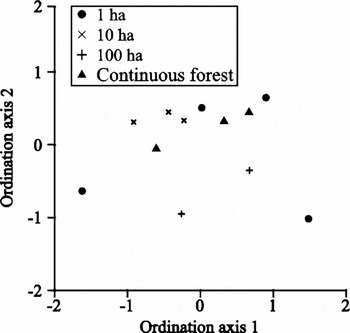
Standing levels of herbivory were measured on leaves from a total of 1200 saplings, from 337 species in 47 families. The most diverse plant families were Leguminosae (with 35 species), Chysobalanaceae (30 species), Sapotaceae (29 species), Burseraceae (21 species) and Lecythidaceae (19 species). Ordination of our 12 sites according to the species composition of the sapling tree community did not reveal any grouping of sites according to forest area (Figure 1).
Non-metric multidimensional scaling ordination of the nine forest fragments and the three continuous-forest study-plots according to composition of the tree sapling community. N = 100 tree saplings (2–7 m in height and > 1 cm in dbh) in each plot. Ordination was based on species abundance data for a total 337 central Amazonian tree species.

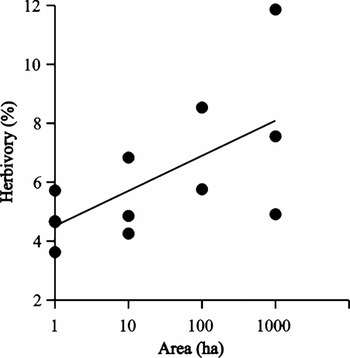
There was a positive and significant relationship between forest area and herbivory levels (r2 = 0.404, P =0.026, n = 12) (Figure 2). Herbivory levels increased from 4.66 % ± 0.42% in the 1-ha fragments (n = 4 fragments) to 8.11% ± 2.2% in continuous forest (n = 3 sites).
Effect of forest area on standing levels of herbivory (per cent of leaf area damaged) on leaves of central Amazonian tree saplings. In each forest site, herbivory was measured in 100 randomly selected saplings. Points represent the mean level of herbivory per site, and the line is the estimated regression line, where Herbivory = 4.51 + 1.19Log(Area) (r2 = 0.404, P = 0.026).

Herbivory rates in selected plant species
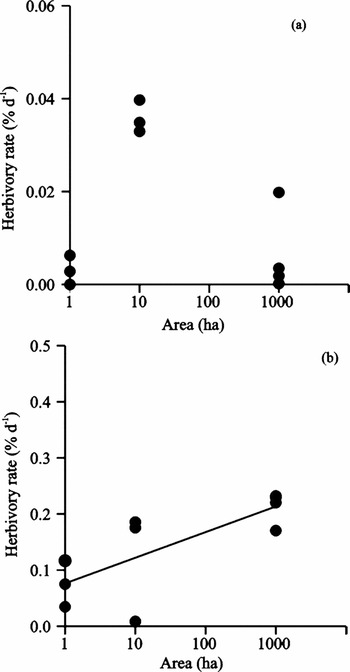
Forest area did not affect the rates of leaf herbivory in P. hebetatum (r2 = 0.05, P = 0.508, n = 11; Figure 3). However, herbivory was significantly greater in the fragments of 10-ha than in the 1-ha fragments and the continuous forest (F2,8 = 21.7, P = 0.01). For H. caudata, there was a positive and significant relationship between forest area and rates of herbivory, despite the fact that one data point for the 100-ha site was an outlier (r2 = 0.573, P = 0.011, n = 10; Figure 3). Individuals of H. caudata in continuous forest suffered on average three times more damage than in fragments of 1 ha (0.21 ± 0.03% d−1 versus 0.07 ± 0.04% d−1, respectively).
Effects of forest area on leaf herbivory rates (% damaged d−1) in saplings of Protium hebetatum (a) and Henriettella caudata (b). Points represent the mean rate of herbivory per plant species per site, and the line is the estimated regression line for H. caudata, where Herbivory = 0.076 + 0.046Log(Area) (r2 = 0.573, P = 0.011).

Leaf characteristics of selected plant species
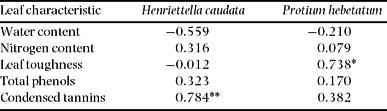
Forest area did not have a significant influence on the leaf water content either for H. caudata or for P. hebetatum (Table 1). Similarly, no effect of area was detected for the nitrogen content of leaves of H. caudata or P. hebetatum (Table 1).
Pearson correlation coefficients for the relationship between forest area and some nutritional and defensive characteristics of the leaves of Protium hebetatum and Henriettella caudata. For both plant species n = 10 sites for which an average value for each leaf characteristic was calculated based on the sampling of six plants (*P < 0.05, **P < 0.02).
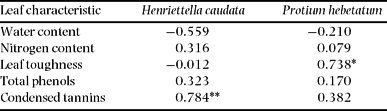
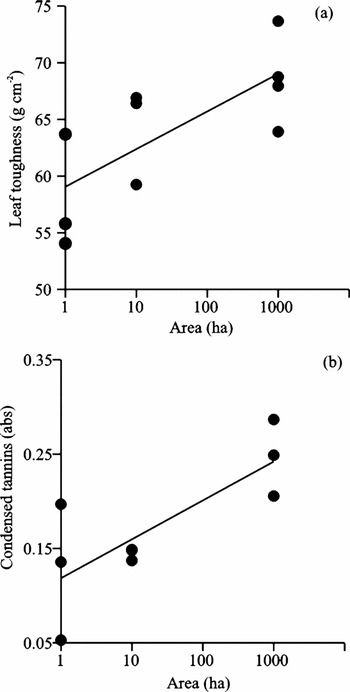
There was a positive and significant relationship between leaf ‘toughness’ and forest area for P. hebetatum (Figure 4) but not for H. caudata (Table 1). Leaves of P. hebetatum in continuous forest had penetrometer readings about 20% higher than those in 1-ha fragments.
Relationship between forest area and leaf ‘toughness’ in Protium hebetatum (a), and between forest area and the amount of condensed tannins in leaves of Henriettella caudata (b). Points represent mean values per site. Leaf ‘toughness’ = 59.1 + 3.32Log(Area) (r2 = 0.544, P = 0.015) and concentration of tannins = 0.118 + 0.041Log(Area) (r2 = 0.615, P = 0.012).

No significant influence of forest area on the concentration of total phenols was detected for the studied plant species (Table 1). For condensed tannins we observed a positive effect of forest area in H. caudata (Figure 4) but not in P. hebetatum (Table 1).
Levels of predation on artificial herbivores
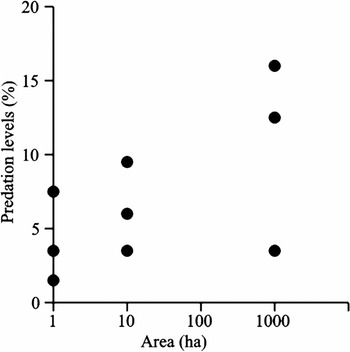
Predation levels on artificial caterpillars were relatively low, ranging from 4.17% to 10.6%. Almost all marks found on these caterpillars were made by ants or wasps, suggesting that these are the main predators of lepidopteran larvae in our sites. There was a trend towards greater levels of predation in continuous forest than in small forest fragments (Figure 5), but this was not statistically significant (r2 = 0.354, P = 0.091, n = 9).
Relationship between forest area and levels of predation upon artificial caterpillars. Values represent the percentage of artificial caterpillars (n = 200 caterpillars randomly distributed in each site) showing marks of attack by ants, wasps, or birds after 24 h.

DISCUSSION
The results of this study strongly suggest that forest fragmentation affects herbivory on tree saplings. Standing levels of leaf damage, the majority of which were caused by insects (Vasconcelos Reference VASCONCELOS1999), were about two times greater in plants from continuous forest than in those from fragments of 1 ha. This difference did not result from differences in plant species composition between the study sites, as ordination of our 12 sites according to the species composition of the sapling tree community did not reveal any grouping of sites according to forest area, suggesting that fragmented and non-fragmented forests are not composed of distinct assemblages of tree saplings. The community of saplings we studied was very diverse, containing on average 63.8 ± 3.9 species per sample of 100 plants and most of these species were rare. The few abundant species, such as Duguetia flagellaris, Protium altsonii, P. hebetatum and Rinorea macrocarpa (each containing 30 or more individuals in our sample of 1200 plants), were present in most of our sampling sites (Fáveri Reference FÁVERI2004).
Our findings also indicate that changes in herbivory patterns due to habitat fragmentation can be species-specific. While for H. caudata herbivory increased linearly and positively with forest area, for P. hebetatum a more complex pattern was detected, with greater herbivory rates in fragments of intermediate size than in small fragments or in continuous forest. Herbivory rates in P. hebetatum were about one order of magnitude lower than in H. caudata (Figure 2), probably because its leaves are less nutritious (less nitrogen, and lower water content) and better defended (tougher, and with higher concentration of phenols and tannins) against insects. However, it is not clear whether or not these interspecific differences in leaf characteristics mediated the differential responses of these two plant species to habitat fragmentation. Additional studies, using phylogenetically independent contrasts, are necessary to evaluate this hypothesis.
Previous studies in tropical and subtropical forests have also detected a positive relationship between fragment area and herbivory (Arnold & Asquith Reference ARNOLD and ASQUITH2002). In all these studies the greater level of herbivory observed in plants from larger forest tracts has been attributed to a greater abundance of herbivores (Arnold & Asquith Reference ARNOLD and ASQUITH2002). However, there is little information about the mechanisms responsible for these changes in herbivore populations. We did not find a relationship between levels of predation upon artificial caterpillars and forest area, although we caution that these results are based on a short-term experiment and further data are required to evaluate the consistency of this finding. However, by comparing our data with those from similar short-term experiments it seems that levels of damage in artificial caterpillars in forests near Manaus are much lower than in other tropical forests. For instance, Loiselle & Farji-Brener (Reference LOISELLE and FARJI-BRENER2002) found that 51.3% of the artificial caterpillars they placed in the understorey of a Peruvian forest were attacked, mostly by ants, within 24 h. This value is about one order of magnitude higher than the one we found in here, perhaps reflecting the fact that ant activity in the understorey vegetation of Amazonian forests near Manaus is rather low (Benson & Harada Reference BENSON and HARADA1987).
Another possibility that we have explored here is that the observed relationship between forest area and herbivory is mediated by bottom-up forces; that is, that fragmentation is altering the quality of plant resources to herbivores, thus changing the size of their populations. However, no evidence was found that the nutritional characteristics of the leaves of the species we studied changed as a result of forest fragmentation. Both water and the nitrogen content of leaves – important determinants of the performance of insect herbivores (Coley Reference COLEY1983) – were independent of forest area. Similarly, for most of the defensive characteristics we measured no relationship with forest area was detected. However, leaf ‘toughness’ in P. hebetatum and the amount of tannins in H. caudata both increased with forest area, suggesting that forest fragmentation may lead to a relaxation of the plant's investment in at least some defensive compounds. Nevertheless, such a decline in levels of leaf defences did not translate into a concomitant increase in herbivory. In fact, for H. caudata the opposite trend was found. Individuals of this species suffered more damage in continuous forest than in isolated fragments despite the fact that in continuous forest their leaves had more tannins. Perhaps the observed concentrations of tannins in continuous forest were not elevated enough to deter the action of herbivores, given that these compounds are more efficient when in high concentrations (Harborne Reference HARBORNE1988). Alternatively, it is possible that other compounds that we did not evaluate are more important than tannins in deterring the herbivory of H. caudata.
We cannot completely discard the role of top-down and bottom-up forces given that only a limited number of plant defensive compounds were evaluated, and that predation on artificial caterpillars may not reflect natural predation rates. Other factors could also affect herbivory in our fragmented landscape. We propose that insect dispersal limitation is one likely factor. In tropical forests, many species of herbivorous insects are relatively specific in their food habits, feeding on a restricted number of plant species (Barone Reference BARONE1998, Novotny & Basset Reference NOVOTNY and BASSET2005). As such they often have patchy distributions and limited ability to colonize new sites (Price Reference PRICE, Hunter, Ohgushi and Price1992). In this sense, forest fragmentation and isolation are likely to affect the movement of at least some species of herbivorous insect (Shahabuddin & Terborgh Reference SHAHABUDDIN and TERBORGH1999). The habitat around the fragments (i.e. the matrix of cattle grasslands) may represent a barrier for their dispersal, in as much as it represents a barrier for other forest species (Gascon et al. Reference GASCON, LOVEJOY, BIERREGAARD, MALCOM, STOUFFER, VASCONCELOS, LAURANCE, ZIMMERMAN, TOCHER and BORGES1999, Laurance et al. Reference LAURANCE, STOUFFER and LAURANCE2004), especially considering the absence of their food plants and the harsher abiotic conditions prevailing in the matrix habitat. Regardless of the exact mechanisms involved, our findings indicate that Amazonian forest fragmentation strongly alters patterns of herbivory on tree saplings. Given that herbivory often affects plant performance (Marquis Reference MARQUIS1987) and competitive ability (Crawley Reference CRAWLEY1983, Dirzo, Reference DIRZO, Dirzo and Sarukhán1984), the observed changes in herbivory regimes may have important consequences for the structure and dynamics of these plant communities.
ACKNOWLEDGEMENTS
We thank A. Cardoso, J. A. Tenasol and J. de Deus for helping with the field work, and A S. N. Oliveira, B. Ruiz and E. Mendonza for helpful comments on the manuscript. Patrícia Guevara and Tania Pimentel aided with the chemical analyses. This study was supported with grants from the Biological Dynamics of Forest Fragments Project (BDFFP) and the Brazilian Council for Scientific Research and Development (CNPq). This is publication number 498 in the BDFFP Technical Series.