1. Introduction
In English, German, and Dutch, asyndetic conditional clauses and syndetic conditional clauses behave differently. As variously observed in the literature (for example, Reis & Wöllstein Reference Reis and Wöllstein2010, Leuschner & Van den Nest Reference Leuschner and Van den Nest2015), an asyndetic protasis cannot in all syntactic and semantic contexts be substituted for a protasis introduced by wenn/if, for instance, when following the apodosis. Reis & Wöllstein (Reference Reis and Wöllstein2010) attribute the differences to the fact that V1 clauses are not prototypical embedded clauses but merely “semantically licensed substitutes” for such clauses in German (Reis & Wöllstein Reference Reis and Wöllstein2010:113). This is also reflected in König & van der Auwera's claim (Reference König, van der Auwera, Haiman and Thompson1988) that V1-protases tend to be syntactically less integrated into their apodosis in both German and Dutch. Unlike syndetic protases, V1-protases do not occupy a position inside the matrix clause, the apodosis, but are adjoined to it (Reis & Wöllstein Reference Reis and Wöllstein2010).
Reis & Wöllstein (Reference Reis and Wöllstein2010) also observe, however, that conditionals in German containing sollte ‘should' (the past subjunctive of the modal verb sollen ‘shall’) seem to be much less sensitive to the asyndetic/syndetic divide, and that V1-conditionals with sollte are even allowed in contexts in which V1-conditionals with other verbs are excluded. In some contexts, the interpretive difference between syndetic conditionals with wenn ‘if’ and asyndetic conditionals with sollte seems minimal indeed, while asyndetic conditionals with verbs other than sollte are ruled out:
-
(1)


Reis & Wöllstein (Reference Reis and Wöllstein2010:136–137), who refer to German sollte-V1-conditionals as a Sonderfall (‘special case’), note in passing that sollte appears to fulfill the same function as the conditional conjunction falls ‘in case’. They also hint at the conclusion that sollte, like wenn or falls, constitutes an “overte Markierung des Bedingungscharakters” [overt conditionality marking] absent in V1-conditionals with other verbs, which enables asyndetic sollte-conditionals to be distributed like syndetic wenn/falls-conditionals.
As we show below, similar observations can (to varying degrees) be made about English should (see also Reis & Wöllstein Reference Reis and Wöllstein2010:137, note 34), standard Dutch (Algemeen Nederlands) mocht, and colloquial Belgian Dutch moest ‘should’ in conditionals.Footnote 1 The suggestion that these modals may function as overt conditional subordinators matches the observation that their modality in conditional clauses is rather different from that outside of conditionals. Whereas these verbs normally express root modality (obligation with should, sollte, and moest, ability/permission with mocht), their meaning is nearly vacuous in conditionals. According to Glas Reference Glas1984, the meaning of sollte in conditionals is idiosyncratic, that is, it is restricted to conditionals. According to Welke Reference Welke1965, sollte does not contribute any independent modal meaning but has a purely supporting role, foregrounding the conditional relationship. Similar claims have been made or implied about English should (Nieuwint Reference Nieuwint1989, van der Auwera & Plungian Reference van der Auwera and Plungian1998, Leech Reference Leech2004) and Dutch mocht (Nieuwint Reference Nieuwint1987, Nuyts et al. Reference Nuyts, Byloo and Diepeveen2005).
In the current paper, we start from the above observations indicating that conditional should, sollte, mocht, and moest assume a special position in their respective languages. We argue that they have progressed to different degrees on a path to becoming purely conditional markers (see also Breitbarth Reference Breitbarth, Chiara, Jäger and Penka2015 on English should). Following an overview of our methodology and data (section 2), we provide a contrastive analysis of the syntactic distribution and semantic properties of conditionals containing these modals (section 3). We focus on levels of clause-linkage (see Sweetser Reference Sweetser1990), tense/mood patterns, the syntactic integration of the (preposed) protasis into the apodosis features, and briefly also on the order of main and subordinate clause, indicating differences with other studies, where appropriate.
The analysis reveals that the sandwich metaphor is of little value in conceptualizing the synchronic relationship between conditionals with should, sollte, and mocht/moest, for two reasons. First, there is no sense in which English should- and German sollte-conditionals occupy opposite ends of a scale, with mocht and moest appearing in between. Second, mocht and moest are too different to be given a uniform analysis that would allow “Dutch” to be placed in relation to English and German.Footnote 2 What we find instead is a very similar behavior on the part of the former obligation modals should and sollte, a significantly different behavior on the part of the former ability/permission modal mocht, and a behavior on the part of the remaining obligation modal, nonstandard Belgian Dutch moest, that is more similar to should and sollte than to standard Dutch mocht. We then discuss the development of sollte, should, mocht, and moest from modal verb to conditional marker, adopting a formal approach to grammaticalization (section 4). In conclusion, we point out prospects for future research, especially from a diachronic point of view (section 5).
2. Procedure and Data
In our study, only the prototypical conditional subordinators were taken into consideration for the collection of syndetic conditionals, that is, English ‘if’, German ‘wenn’, and Dutch ‘als’. We excluded stylistically and/or semantically restricted alternative markers whose meaning tends to include ‘should’, such as German falls and sofern, Dutch indien and mits, all roughly translating as ‘in case’.
For English should, we used the 196 tokens selected by Breitbarth (Reference Breitbarth, Chiara, Jäger and Penka2015) from the BNC: i) the first 99 conditionals obtained by a search for the string “. should”, which finds should as the first word of a sentence; ii) the first 97 valid clauses obtained by a search for the collocation of should following if within four words. All of these 196 instances of should in conditionals have the “conditional” meaning.Footnote 3 The BNC data comprise both written language as well as conceptually oral language.
For German sollte, we used the data originally selected by Goubert (Reference Goubert2014) from the archive of present-day written German (W) in the Deutsches Referenzkorpus (DeReKo). The archive contains texts dated 1985 to 2012 from Germany, Austria, and Switzerland. Once all nonconditionals in the German data had been manually deselected, 160 tokens remained, of which 93 are asyndetic and 67 syndetic.
For Dutch mocht and moest, an original dataset was developed based on the Colibri-webcorpus data from the year 2014. This corpus differs somewhat from the other two, in particular the DeReKo, in that it contains blogs and forums, that is, usage that tends to be conceptually oral. Therefore it seems well-suited to the study of moest-conditionals, given their tendency to occur in conceptually oral, rather than formally written, contexts.Footnote 4
The corpus was searched for conditionals with moest and mocht, either clause-internally in the vicinity of als ‘if’ or clause-initially.Footnote 5 From several thousand randomized results with moest, the first 400 relevant hits (200 syndetic, 200 asyndetic) were retained; for mocht, 200 relevant hits were retained (100 syndetic, 100 asyndetic). Among the deselected syndetic hits, many contained moest and mocht with a clear deontic sense (moest ‘had to’, mocht ‘were allowed to’).Footnote 6 We also discarded a few tokens where moest or mocht occurred in a clause which was formally a conditional protasis but had a special syntactic function. Such a clause could be either an apparently extraposed argument coindexed with a 3rd person pronoun in the apodosis (which then invariably preceded the protasis), or an exclamative main clause. The two functions are illustrated in 2a and 2b, respectively.
-
(2)
Cases such as 2a are known as “complementing wenn-clauses” (“ergänzende wenn-Sätze”, Fabricius-Hansen Reference Fabricius-Hansen, Mogens, Hyldgaard-Jensen and Olsen1980) in the German literature (see Boogaart Reference Boogaart2007:17, who regards this construction as Belgian Dutch and finds no examples from Northern Dutch in his corpus). Cases such as 2b represent a type of insubordination (Evans Reference Evans and Nikolaeva2007). After hits like these were removed along with instances of deontic meaning and semantic ambiguity, 478 Dutch tokens remained: 304 with moest, 174 with mocht.
3. Toward a Sandwich-Style Analysis
3.1. Linkage Levels
According to Sweetser (Reference Sweetser1990; see also Dancygier & Sweetser Reference Dancygier and Sweetser2005), the semantic relationship between protasis and apodosis in conditionals may be situated on one of three levels of linkage: the content (or predictive) level, the epistemic (or inferential) level, or the speech-act (or illocutionary) level. In 3a, the state of affairs in the protasis forms the prerequisite for a state of affairs predicted to come about, under this condition, in the real world. In 3b, the protasis serves as the epistemic basis for an inference as to the likely referent of anyone. In 3c, the protasis expresses a circumstance under which the speaker's phone number could be relevant to the addressee, and the apodosis (which is true regardless of the addressee's intentions) implies an invitation to be contacted at that number.
-
(3)
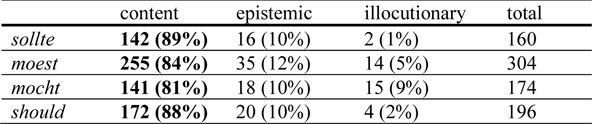
Table 1 shows the frequencies for each linkage level per modal verb in our corpus.
Linkage levels in conditionals with “conditional” should, sollte, and moest/mocht.

Since content-level linkage is the prototypical one of the three linkage levels (Athanasiadou & Dirven Reference Athanasiadou, Dirven, Athanasiadou and Dirven1997:65), we are not surprised to find that it is the most frequent linkage level for each modal. However, there are some notable distributional divergences between the four modals. Differences between the distributions of sollte, should, and moest are not statistically significant (in fact, the distributions of sollte and should are nearly identical).Footnote 9 In contrast, the distribution of mocht does differ significantly from the distributions of sollte and should, though not from the distribution of moest.Footnote 10 Taking mocht and moest together, the differences between the three languages are clearly caused by the greater use of illocutionary-level linkage in Dutch. This level of linkage has comparable frequency with mocht (7%) and moest (5%). However, what matters for our purposes is that mocht is clearly the odd one out in the group of four “conditional” modals with respect to level of linkage.
3.2. Tense/Mood Patterns
It is well known that conditionals linked at the content level can express three probability readings: realis/neutral, potentialis/tentative, and irrealis/counterfactual (Quirk et al. Reference Quirk, Greenbaum, Leech and Svartvik1985, Leech Reference Leech2004). The distinction is marked by tense/mood patterns traditionally known as consecutio temporum, or sequence of tenses, as shown in 4 (examples based on Van den Nest Reference Van den Nest2010:80–81).
-
(4)
As variously noted in the literature on German and English, protases with “conditional” sollte and should often diverge from the rules of consecutio temporum (for example, Van den Nest Reference Van den Nest2010:117–118, 123 on German and English), a phenomenon referred to as “tense mismatch” by Breitbarth (Reference Breitbarth, Chiara, Jäger and Penka2015 on English should). Corresponding Dutch examples with moest and mocht are quoted in passing by Nieuwint (Reference Nieuwint1987), Boogaart (Reference Boogaart2007), and others, but as far as we know, the mismatch has not been explicitly identified with regard to mocht/moest before. As we argue in section 4 below, tense mismatch with “conditional” modals is evidence of an increased degree of grammaticalization. In most cases of tense mismatch, the form of the modal verb in the protasis goes back to a past subjunctive form and standardly receives a potentialis (‘would’) reading; it would therefore require the apodosis to have a verb form with a corresponding hypothetical reading (English would, Dutch zou ‘would’). Tense mismatch occurs mostly with the apodosis verb in the future tense, as in 5a, or in the present tense, as in 5b,c.
-
(5)
With mocht in particular, tense mismatch occurs very frequently in the context of contact requests, as it does indeed in 5c. There are also examples in (Belgian) Dutch combining a pluperfect protasis with a past subjunctive apodosis, as in 6, forcing a counterfactual reading.
-
(6)
In fact, moest differs from all the other modals under investigation, including mocht, in allowing counterfactual readings even in pattern B protases, as shown in 7a (see also Boogaart Reference Boogaart2007:10). With mocht this is extremely rare: 7b is the only example in our corpus in which a pattern B protasis with mocht receives a counterfactual reading.
-
(7)
As 7b is from a Belgian website—and Flemish speakers are known to occasionally use mocht with the distribution of moest when trying to accommodate to the standard (Demol Reference Demol1973:99; Boogaart Reference Boogaart2007:12, 17)—the B pattern is probably due to Flemish substrate interference.
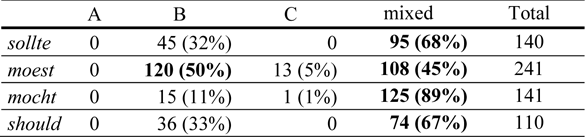
Table 2 summarizes the distribution of tense/mood patterns in our corpus, including in the “mixed” column the various types of tense mismatch as described above.
Tense/mood patterns in content-level sollte- and moest-/mocht-conditionals.

As suggested in table 2 by the figures in bold, the crosslinguistic distribution of tense mismatch is surprisingly disorderly: English should (66%) and German sollte (68%) keep closely together (p=1 in Fisher's Exact test), while the Dutch modals mocht and moest behave very differently both with respect to should/sollte and (in particular) to each other.Footnote 15 A striking 89% of mocht-protases occur with tense mismatch, mostly combining a pattern B-protasis with a pattern A-apodosis, as in 8a, but sometimes a pattern C-protasis with a pattern A-apodosis, as in 8b.
-
(8)
In contrast, moest occurs with tense mismatch much more rarely than mocht (45%), that is, slightly less often than with pattern B (50%). Most tense mismatch tokens with moest (98/108) combine a pattern B-protasis with a pattern A-apodosis, only 10 with a pattern C-apodosis.
3.3. Clause Integration
A well-known issue concerning conditionals, especially asyndetic ones, is the syntactic relationship of the protasis to the apodosis. Following König & van der Auwera Reference König, van der Auwera, Haiman and Thompson1988, we assume three degrees of syntactic integration: full integration, resumption, and nonintegration. Since different degrees of syntactic integration only exist in verb-second languages, we only discuss German and Dutch in this section and leave English aside. Given the observations in Reis & Wöllstein Reference Reis and Wöllstein2010 among others on the similar syntactic behavior of sollte-protases regardless of whether they are asyndetic or syndetic, we consider the degrees of integration of both types here. Exemplification is kept sparse for reasons of space.
With full integration, the protasis occupies the prefield of the apodosis, and the topic of the apodosis (usually the subject) follows the verb (in bold), as in 9a (German) and 9b (Dutch).Footnote 18
-
(9)
Resumption occurs when the apodosis is introduced by a deictic, or “resumptive” adverb (German dann ‘then’ or so ‘so, thus’; Dutch dan ‘then’) that stands in for the immediately preceding protasis, as in 10a (German) and 10b (Dutch).Footnote 20 In such cases, the apodosis again shows inversion of topic and verb, but now the resumptive adverb occupies the prefield and the protasis is in the pre-prefield:Footnote 21
-
(10)
With nonintegration, the prefield of the apodosis is occupied by the topic as in prototypical declarative clauses, and the protasis is left in the pre-prefield without any surface link to the apodosis at all, as in 11a (German) and 11b (Dutch).
-
(11)
Although nonintegration is mandatory in most cases, it is sometimes optional, leading to the apodosis being processed as a (relatively) separate assertion about some hypothetical state of affairs (see König & van der Auwera Reference König, van der Auwera, Haiman and Thompson1988).
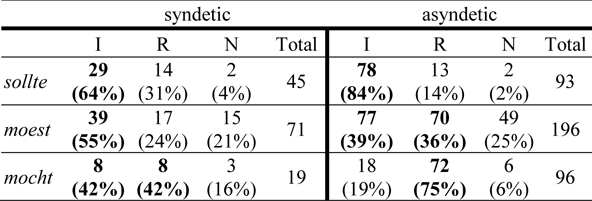
Table 3 presents the numbers for each modal in our corpus data.
Degree of integration in sollte/moest/mocht-conditionals. (I = integration, R = resumption, N = nonintegration)

These figures deviate strikingly from the tendencies postulated by König & van der Auwera for German and Dutch conditionals in general (1988:117; compare Van den Nest Reference Van den Nest2010 on German; Renmans & Van Belle Reference Renmans and van Belle2003 on Dutch). Contrary to expectation, there is no clear difference between syndetic and V1-conditionals: Full integration seems to be universally preferred in sollte- and moest-conditionals, while resumption is preferred in mocht-conditionals, regardless of whether they are syndetic or asyndetic.Footnote 24 Instead, the data confirm observations reported elsewhere (Reis & Wöllstein Reference Reis and Wöllstein2010, Delva Reference Delva2014) pointing to a markedly different, but internally uniform, syntactic distribution of “modal” protases.
König & van der Auwera (Reference König, van der Auwera, Haiman and Thompson1988) argue that full integration is historically younger than resumption; thus, under their view, degree of syntactic integration is an indicator of degree of grammaticalization. Based on their argument, we conclude that in English, German, and Belgian Dutch, asyndetic conditionals with modals have developed further than regular V1-conditionals (without any sandwich pattern emerging in the process). Admittedly, the absolute figures in table 3 are low, and a larger dataset might reveal smaller discrepancies between the individual modals. On the basis of our data, however, standard Dutch mocht stands out by favoring resumption even in syndetic conditionals (as already observed by Boogaart Reference Boogaart2007). These results suggest, once more, that mocht has undergone a separate development from its West Germanic cousins. However, German sollte, too, disappoints expectations based on König & van der Auwera Reference König, van der Auwera, Haiman and Thompson1988, as full integration is more—not less—frequent with asyndetic conditionals than with syndetic ones: Asyndetic sollte-protases are fully integrated 20% more often than syndetic ones and occur with resumption less than half as often as syndetic sollte-protases. While Belgian Dutch moest prefers full integration to a significantly higher degree than standard Dutch mocht, it still exhibits a much higher frequency of resumption and nonintegration than German sollte. That is, moest again assumes an intermediate position between sollte and mocht.
One factor that seems to allow for nonintegration is subjunctive mood in the apodosis (that is, the past subjunctive or würde+infinitive in German and the zou+infinitive in Dutch; see also König & van der Auwera Reference König, van der Auwera, Haiman and Thompson1988:114). In our corpus, 49% of all nonintegrated moest-clauses (24/49) have a subjunctive apodosis, as in 12.
-
(12)
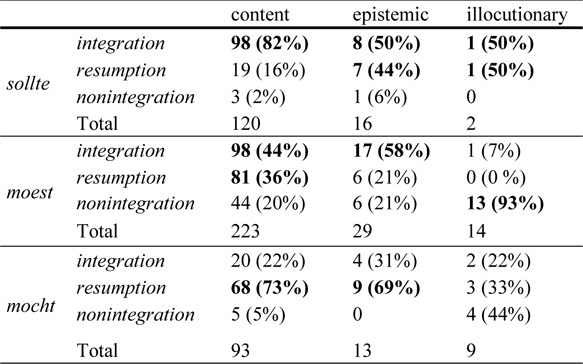
Many authors (for example, König & van der Auwera Reference König, van der Auwera, Haiman and Thompson1988, Haegeman Reference Haegeman2003, Renmans & Van Belle Reference Renmans and van Belle2003, Boogaart Reference Boogaart2007) claim that the degree of syntactic integration in conditionals is a reflex of semantic integration. König & van der Auwera posit an iconic relationship between the degree of syntactic integration and the level of clause linkage (1988:111; see also Van den Nest Reference Van den Nest2010). On this view, conditionals linked at the content level tend to be more integrated syntactically than conditionals linked at the epistemic or illocutionary levels. To see if this tendency is confirmed by our data, in table 4 we cross-tabulate the three levels of clause linkage with the three degrees of syntactic integration.
Syntactic and semantic integration in sollte/moest/mocht-conditionals.

Again, one can make a number of instructive observations. In the case of sollte, full integration is the preferred pattern not only with content conditionals but also with epistemic conditionals, although resumption is nearly as frequent as full integration. With illocutionary conditionals, the absolute numbers are too low to make any claims regarding iconicity. Nor can moest conditionals confirm or disprove the expectation of diagrammatic iconicity: All three levels of linkage vary greatly with respect to syntactic integration, with a more pronounced bias toward full integration in content- and epistemically-linked conditionals, and a strong bias toward nonintegration only in illocutionary conditionals. Mocht again shows a different behavior, with resumption being its most favored pattern, regardless of the degree of semantic integration; absolute figures for illocutionary conditionals are again too low to draw any conclusions.Footnote 26
We must conclude, then, that our data do not suggest an iconic relationship between syntax and semantics in conditionals with sollte, moest, and mocht. The fact that sollte prefers full integration and mocht prefers resumption more likely points, once more, in the direction of these modals having undergone some form of specialization in conditionals, and that this tends to override any iconic pressure motivating syntactic disintegration.
3.4. Interim Summary
In summary so far, we have to accept that no uniform synchronic analysis is possible for the four “conditional” modals under investigation. First, there are no sandwich-style patterns among them: Far from representing opposite ends of a scale, sollte and should clearly pattern together, and mocht and moest in turn fail to take a clearly defined intermediate position between them. Second, and more significantly, it is not meaningful to compare “Dutch” with German and English in the first place, as mocht and moest not only both differ (to varying degrees) from sollte and should, but also—and most importantly—from each other. Moest is far more similar to sollte/should than mocht, which behaves like a different animal altogether, appearing to be much more restricted in its distribution and more specialized.
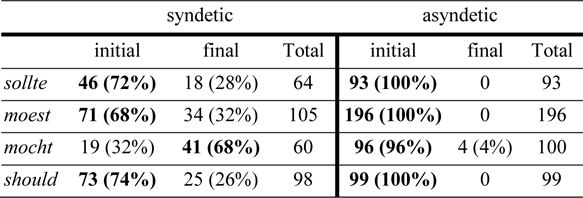
Some final observations relating to should-, sollte- and moest-/mocht-conditionals confirm this picture with regard to yet another parameter of comparison: clause order. As shown inter alia by Axel & Wöllstein (Reference Axel, Wöllstein, Winkler and Featherston2009) and Boogaart (Reference Boogaart2007), conditionals in German and Dutch allow not only sentence-initial placement of the protasis, but also sentence-final placement, as in 13a, and sentence-medial placement, as in 13b.
-
(13)
Although both positions are in principle acceptable in syndetic and V1-conditionals, sentence-medial placement is very rare, and we henceforth leave it aside. As to sentence-final placement, the study of Axel & Wöllstein Reference Axel, Wöllstein, Winkler and Featherston2009 suggests a sharp, near-complementary distribution between syndetic and V1-conditionals in German: Whereas sentence-final protases occur in just 8% of tokens in German V1-conditionals, in wenn-conditionals no less than 81% of protases are sentence-final.Footnote 27 We are not aware of any corresponding studies of English and Dutch. However, it has been pointed out in the literature that V1-conditionals with sollte behave more similarly to syndetic conditionals (regardless whether the latter contain sollte or not) than V1-conditionals generally. It therefore seems reasonable to ask whether this is confirmed by our data, and whether the Dutch and English cousins of sollte-conditionals show a similar absence of restrictions regarding their external syntax.
Our data in this respect show some very surprising patterns, as suggested by table 5. In asyndetic conditionals in all three languages, protases with sollte, should, and moest prefer sentence-initial position to such an extent that our data do not contain a single sentence-final protasis with these verbs. There is more variation in syndetic conditionals, but here, too, sollten, should, and moest pattern closely together, with 68%–74% of protases occurring sentence-initially. In contrast, with Standard Dutch mocht, the pattern is sharply split: 68% of syndetic protases are sentence-final and only 32% sentence-initial (the exact inverse of moest), and there are few examples (4%) of asyndetic protases with mocht that are sentence-final.Footnote 28 This is a striking result indeed, which highlights, once more, the fairly uniform behavior of sollte, should, and moest, and the distinct behavior of mocht.
Order of clauses in conditionals with conditional sollte, moest, mocht, and should.

In view of such results, a sandwich-style analysis is clearly not instructive, as should, sollte, and southern Dutch moest tend to pattern very similarly at least in some significant ways (but not in ways suggesting a sandwich-style pattern), whereas standard Dutch mocht is the odd one out in the set. An obvious reason could be its distinct etymology, as outside of conditionals, mogen is an ability modal, not an obligational one like sollen/shall and moeten. However, a detailed contrastive analysis of the historical evolution of the four “conditional” modals is beyond the scope of the present paper. Instead, we pursue a more modest aim in the next section, investigating whether the special behavior of mocht reflects a different grammaticalization path across “modality's semantic map” (van der Auwera & Plungian Reference van der Auwera and Plungian1998) from the other three modals.
4. The Grammaticalization Perspective
4.1. The Grammaticalization of Conditional Modals
All the modal verbs in English, German, and Dutch—including shall, sollen, mogen, and moeten—are already highly grammaticalized in their root and epistemic meanings: They have acquired a more functional status as (quasi-)auxiliaries, and in most cases have lost their original lexical (“premodal” in van der Auwera & Plungian's Reference König, van der Auwera, Haiman and Thompson1988 terminology) meaning, which in the case of sollen/shall, for instance, was ‘to owe’.
In terms of Hopper's (Reference Hopper, Closs Traugott and Heine1991) grammaticalization parameters, one sees, in particular, a specialization of sollte, should, mocht, and moest for the conditional meaning. Historically, there is evidence of divergence and layering: In Middle High German and Middle English, mugen and mouen, respectively, occurred with a conditional meaning, competing with suln/shulen (Van den Nest Reference Van den Nest2010, Breitbarth Reference Breitbarth2012, Reference Breitbarth2014, Reference Breitbarth, Chiara, Jäger and Penka2015). That is, the cognates of mogen, the modal verb that now expresses the conditional meaning in Dutch, were found in older stages of German, shown in 14a, and English, shown in 14b, competing with the surviving modals.
-
(14)
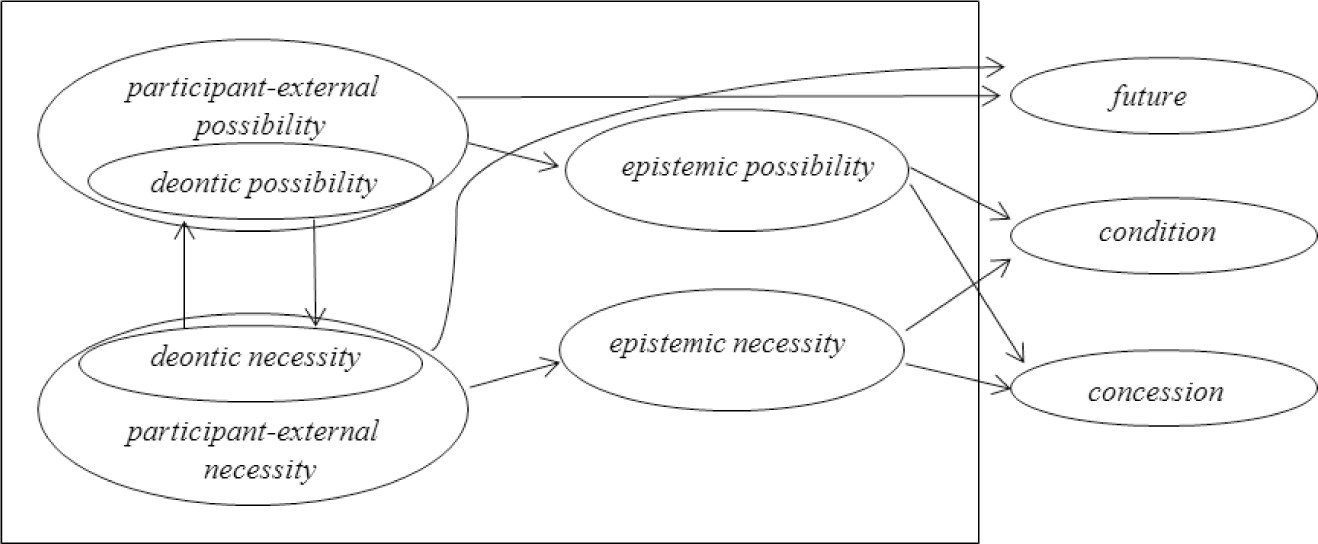
The “conditional” meaning of sollte, should, moest, and mocht that is so characteristic of their use in conditional clauses (see above) belongs to what van der Auwera & Plungian (Reference van der Auwera and Plungian1998:93) call “postmodal” meanings. Modal verbs may develop such meanings, besides optative, concessive, or evidential (see Diewald Reference Diewald1999 on the evidential use of German sollen). According to van der Auwera & Plungian, this “conditional” develops out of the epistemic meaning, as shown in figure 1.
Modality's semantic map. (van der Auwera & Plungian Reference König, van der Auwera, Haiman and Thompson1988).Footnote 29
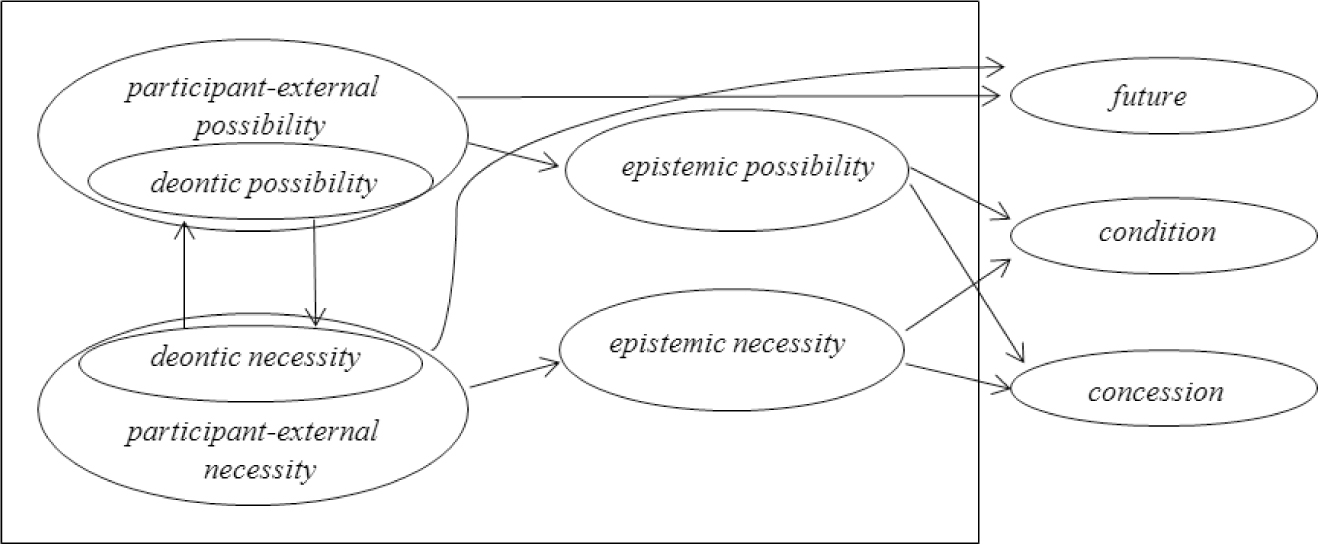
It is true that “conditional” modals syntactically pattern with the high modals (in a sense to be clarified below), like epistemics and evaluatives. This has been shown in a number of tests for Dutch mocht and moest by Haegeman (Reference Haegeman2010), and for sollte and should by Breitbarth (Reference Breitbarth2012, Reference Breitbarth2014, Reference Breitbarth, Chiara, Jäger and Penka2015:304). Yet a diachronic connection between the conditional and the epistemic meaning, such that the epistemic is the older one, is implausible for the following two reasons. First, an epistemic reading of modal verbs is impossible in conditional protases, as shown in 15 (Breitbarth Reference Breitbarth, Chiara, Jäger and Penka2015:304).
-
(15)
According to Leirbukt Reference Leirbukt, Debus and Leirbukt1997, this is because conditional protases typically express a degree of probability, while the locus of epistemic evaluation of this probability is typically the apodosis.Footnote 30 While should has been argued to have an epistemic variant (Copley Reference Copley2006, this is not the one found in conditional protases, as in 16 (Breitbarth Reference Breitbarth, Chiara, Jäger and Penka2015:305).
-
(16)
According to Copley Reference Copley2006:10, epistemic should asserts that although the proposition is true in the most plausible epistemically accessible world, a more informative epistemic state is possible. Conditional should cannot make such an assertion, or indeed any reference to epistemic states at all, only about states of the world. We return to the property of conditional should below.
Second, the conditional meaning is historically older than the epistemic one (see also Stevens Reference Stevens1995). For instance, should was certainly already available in Middle English (Breitbarth Reference Breitbarth, Chiara, Jäger and Penka2015) and sollte by Middle High German (Van den Nest Reference Van den Nest2010, Breitbarth Reference Breitbarth2014), though perhaps as early as Old High German (Stevens Reference Stevens1995). Epistemic uses, in contrast, do not arise before the (Early) Modern periods (see, for example, Fritz Reference Fritz1997a, Diewald Reference Diewald1999).
Following Roberts & Roussou Reference Roberts and Roussou2003, the grammaticalization of conditional modals proceeds by way of upward reanalysis through the hierarchy of functional projections. To account for the diachronic development of English must (dynamic possibility > deontic necessity > epistemic necessity), Roberts (Reference Roberts, Closs Traugott and Trousdale2010, Reference Roberts, Brugé, Cardinaletti, Giusti, Munaro and Poletto2012) merges Roberts & Roussou's (Reference Roberts and Roussou2003) approach with a cartographic analysis. In the present paper, we adopt Roberts's (Reference Roberts, Closs Traugott and Trousdale2010, Reference Roberts, Brugé, Cardinaletti, Giusti, Munaro and Poletto2012) approach. Under a generative approach, hierarchical structure reflects semantic scope (at least at the level of Logical Form), following the principle of compositionality. It can be demonstrated that epistemic modals take syntactic and semantic scope over deontic modals. This is especially easy to see in languages such as Dutch and German, where nonfinite forms of modal verbs are possible, and hence stacking of several modal verbs with different modalities is possible. Dynamic modals (ability) are the lowest in the hierarchy (see 17; Breitbarth Reference Breitbarth2012).
-
(17)
Evidence shows that the scope order of modal meanings just discussed does, in fact, reflect the diachronic development of modal meanings (lexical > ability > deontic > epistemic), and hence the grammaticalization paths of modal verbs. Given this evidence, the development of different modal (and postmodal) meanings of modal verbs can be analyzed as upward reanalysis through Cinque's (Reference Cinque1999) syntactic hierarchy of functional projections, including modality.
Haegeman (Reference Haegeman2010) argues that conditional moest and mocht originate in Cinque's (Reference Cinque1999) Moodirrealis head, as shown in 18a. This is the same projection in whose specifier she also locates the base position of the conditional operator (see Bhatt & Pancheva Reference Bhatt, Pancheva, Everaert and van Riemsdijk2006).Footnote 31 From this position, moest and mocht may move to the left periphery along with the conditional operator to form asyndetic protases. Merging Haegeman's analysis with Kempchinsky's (Reference Kempchinsky2009) treatment of subjunctives, we assume that the motivation for this potential movement is the conditional modal in Moodirrealis licensing an uninterpretable World feature in the clausal left periphery, either by moving there or by agreeing with it, as shown in 18b.Footnote 32 In asyndetic conditionals, the modal moves on to the head of ForceP along with the conditional OPW (targeting SpecForceP) in the fashion also outlined by Haegeman.Footnote 33
-
(18)
This analysis immediately accounts for the fact that the epistemic use of, for example, sollte has appeared historically later than the conditional one: MoodPirrealis is hierarchically below ModPepistemic and is therefore reached later by upward reanalysis. The question now is, how (conditional) sollte, should, moest, and mocht should have reached MoodPirrealis in the first place, given that they first had deontic modal meanings (obligation/permission).
Breitbarth (Reference Breitbarth, Chiara, Jäger and Penka2015) argues that conditional meaning of should developed out of the hypothetic possibility meaning—ModPpossibility is lower than MoodPirrealis on Cinque's hierarchy. Under her analysis, the use of shall as a future auxiliary derives from a lexical split: While future shall retains the element of “speaker's control” (Haegeman Reference Haegeman1981) that deontic shall has, conditional should does not. The hypothetical possibility meaning is available for should throughout the Middle English period, and can be found, for instance, in free-choice contexts, such as 19. The irrealis interpretation was presumably supported by a more general reinterpretation of past morphology as subjunctive, as witnessed in, for example, English and Dutch, where past tense and past subjunctive have syncretic forms in most cases.
-
(19)
Stevens (Reference Stevens1995) suggests that the conditional meaning of German sollte developed out of its future meaning. The past (subjunctive) also adds some irrealis note here (see Fritz Reference Fritz1997b:291). Using the past (subjunctive) of the future auxiliary could therefore also be a possible path, and it still constitutes an upward reanalysis (TPfuture to TPpast; Cinque Reference Cinque1999). However, TPfuture and TPpast are hierarchically higher than MoodPirrealis according to Cinque Reference Cinque1999, and at least for English, the lack of speaker's control in conditional should is a strong argument for a separate development of the future and conditional uses of the modal.
One may furthermore wonder whether a hypothetic possibility stage can also be reconstructed or perhaps even empirically proven for German sollte. Diewald (Reference Diewald1999:202, note 32) points out the similarity in meaning between conditional sollte and the use of sollte in 20.
-
(20)
An intermediate step in the grammaticalization of conditional modality involving hypothetical possibility would furthermore be able to cover the development of the conditional meaning of Dutch mocht and the fact that historically, suln/shulen were in competition with mugen/mouen (Middle High German/Middle English). One possible reason for the distinct behavior of mocht in our data might lie in the layering of the grammaticalization process: While the hypothetical possibility uses of should and sollte are rather marginal today, possibility is the core meaning of mocht, possibly leading to interference in conditionals.
For lack of sufficient diachronic data in corpora of written usage, we cannot verify whether this path can also be reconstructed for nonstandard Belgian Dutch moest. It has been speculated that it is a Gallicism, brought into the language through contact with French (for example, Goossens Reference Goossens1961). However, the much greater syntactic and semantic freedom that moest enjoys compared to French devoir (Delva Reference Delva2014) suggests that the form was replicated with autochthonous means at best, replacing an already present conditional modal (for instance, mocht) and at the same time keeping or imposing the distributional properties of the latter on it. The syntactic distribution and semantic meaning cannot have been replicated from French.
4.2. From Modal Verb to Conditional Marker
The behavior of conditionals with a special modal verb in the protasis tends to blur the normally strict divide between V1- and syndetic conditionals in English, German, and Dutch. To account for this behavior, we take up Reis & Wöllstein's (Reference Reis and Wöllstein2010) suggestion that sollte serves as the “overte Markierung des Bedingungscharacters” (‘overt marking of conditionality’), as well as Breitbarth's (Reference Breitbarth, Chiara, Jäger and Penka2015) suggestion concerning should. We propose to treat the conditional modals as incipient conditional markers. We have two main arguments in favor of this proposal.
First, we already noted the high incidence of tense mismatches in conditionals linked at the content level with all the conditional modals under consideration here. As Breitbarth (Reference Breitbarth2014, Reference Breitbarth, Chiara, Jäger and Penka2015) shows for should and sollte, the number of instances with tense mismatch relative to constructions observing the sequence of tenses has increased significantly, diachronically. The analysis proposed in the previous section can capture this as a further step of upward reanalysis in the grammaticalization of these modals. If movement from Moodirrealis to Fin in order to license Fin's [uW]-feature is lost, and the conditional modal is merged directly in Fin, it is merged (and hence, interpreted) above T. As Tense cannot scope over the modal any longer, the modal becomes independent of it, giving rise to tense mismatches:
-
(21)
Second, we noted in section 3.3 that in our corpus, based on much more recent data than König & van der Auwera's (Reference König, van der Auwera, Haiman and Thompson1988), the connection between the degree of syntactic integration and the level of clause linkage can no longer be called iconic. Rather, we observed significant differences between the languages as a whole: Sollte-protases are fully integrated; moest-protases are leaning toward full integration regardless of being syndetic or asyndetic, while mocht-protases tend toward resumption. In light of these findings, we propose that clause integration ceases to have a predictive value once the conditional modal has (nearly) completed the development into a conditional marker. In principle, it functions as such a marker regardless of whether it occurs in a syndetic or an asyndetic conditional; but apparently, it does so even better if there is no other conditional marker present, in this case wenn ‘if’.Footnote 34
This proposal is further corroborated by telltale performance errors attested in all three languages. Example 22a is from an internet forum, and 22b from social media. They show that should and moest are stored in the working memory during production not as finite verbs in C, but as pure conditional markers, leading to the use of another finite verb within the same clause (gets, zou ‘would’).
-
(22)
While the use in social media may be attributed to lax orthography and lack of editing, similar performance errors are found on respectable news websites such as www.tagesschau.de, as shown in 23.
-
(23)
We take these observations to indicate that sollte, moest, and should are well on their way to becoming conditional markers in C similar to if/wenn or falls ‘in case’. It is no coincidence that one is dealing with V1-conditionals here. Under Haegeman's (Reference Haegeman2010) analysis, the conditional modal originates in Moodirrealis, like the conditional operator, and in V1-conditionals, it moves along with the conditional operator to the C-domain.
5. Conclusion
We started our investigation with the suggestion that conditionals containing modals in Germanic seem to be surprisingly insensitive to the asyndetic/syndetic divide. In our own analysis, we therefore treated syndetic and asyndetic conditionals with English should, German sollte, and Dutch mocht/moest together, comparing their syntactic behavior. The data revealed not only the absence of any sandwich-like patterns but also some surprising divergences. The divergent distribution of tense mismatch with “conditional” modals proved to be particularly striking and can be regarded as evidence of an increased degree of grammaticalization. This is further suggested by the fact that tense mismatch is far more frequent in our should-/sollte-data than in the asyndetic conditionals investigated by Leuschner & Van den Nest (Reference Leuschner and Van den Nest2015). In their data, 21.6% of V1-conditionals have tense mismatch in English and 14.4% in German (pp. 56, 53). Leuschner & Van den Nest investigated all V1-conditionals regardless of protasis verb but excluded ‘if-protases. Therefore, our data not only confirm, from a different point of view, their assumption that should/sollte is disproportionally responsible for tense mismatch (Leuschner & Van den Nest Reference Leuschner and Van den Nest2015:54), but also suggest that this is indeed a special feature of conditionals with modals, reflecting further grammaticalization.
Some modal-specific aspects of this process are brought into relief by the strikingly divergent behavior of mocht, both vis-à-vis should and sollte, and in part also vis-à-vis moest. We attributed the divergence partly to meaning ambiguities of moest and mocht, and partly to specialization. Regarding meaning ambiguities, we noted that moest doubles as a subjunctive marker in colloquial Belgian Dutch, which accounts for its high frequency in counterfactuals, while conditional mocht may be limited by ambiguity arising from layering, as mocht also continues to express hypothetical possibility. Mocht furthermore shows signs of further specialization in conditionals, occurring very frequently in the requests to make contact. In contrast, the other three modals have rather been broadening their scope, grammaticalizing into markers of pure conditionality.
In summary, our results complement earlier investigations such as the pioneering study of clause integration by König & van der Auwera (Reference König, van der Auwera, Haiman and Thompson1988) and in particular the contrastive analysis of V1-conditionals in English and German by Leuschner & Van den Nest (Reference Leuschner and Van den Nest2015). Whereas Leuschner & Van den Nest tend to highlight crosslinguistic divergences in asyndetic conditionals, convergences between English and German come to the fore once we focus on conditionals with modal verbs regardless of the syndetic/asyndetic distinction, and add Dutch to the mix. Needless to say, the absence of sandwich-like patterns in our analysis in no way excludes the possibility of such patterns emerging separately in asyndetic conditionals once Dutch is added to the bilateral contrastive analysis of English and German. It is clear, however, that any such approach should take into account the distinction between mocht and moest and the special behavior of protases with modal verbs, as demonstrated by the present investigation.