In mid-2003, Rep. Bill Thomas (R-Calif.), Chairman of the House Ways and Means Committee, attempted to rush a ninety-page pension reform bill through his committee. Having not had an opportunity to read the bill, Democrats fled the committee room to review the legislation in an adjacent library. An irate Thomas called for an immediate vote, and passed the bill with only one Democrat, Rep. Pete Stark (D-Calif.), still in the room. When Stark objected to Thomas’s tactics, Rep. Scott McInnis (R-Col.), a majority party committee member and Thomas’s ally, told Stark to ‘shut up’. The 71-year-old Stark challenged McInnis, twenty-one years his junior, to ‘make him’ shut up and then repeatedly called him a ‘little fruitcake’. Chairman Thomas took the unusual step of calling the Capitol Police to subdue Stark and eject the Democrats from the library. Although such a move was not without precedent in the modern era, it was, to say the least, highly irregular. This and similar episodes illustrates the intense polarization that has been said to characterize contemporary American politics.
There are many indications that American politics is now marked by sharper divisions and more intense conflicts than has typically been the case in earlier times. A distinctly conservative Supreme Court decided the 2000 presidential election in favour of the conservative candidate who was the popular vote loser, causing Democrats much consternation and Republicans much exhilaration. Income inequality has reached its highest point since the United States started keeping such data in the 1940s,Footnote 1 and class-based voting has become the most pronounced it has been in at least the last fifty years.Footnote 2 New policy disputes about issues with the potential to evoke strong feelings, such as the legality of gay marriage and the future of abortion rights, occupy more space on the issue agenda.Footnote 3 Religion has become a potent political force, creating a deep new partisan cleavage between the faithful and the secular.Footnote 4 And the war in Iraq has caused the political left to accuse the president of lying and the political right to accuse the left of undermining the war. Little wonder that 85 per cent of Americans said they cared ‘a great deal’ who won the 2004 presidential election, a higher percentage by far than any time since the survey question was first asked in 1952.
At the elite level, many studies show that Congress is increasingly polarized, with party members clustering towards the ideological poles and the middle a vast wasteland.Footnote 5 Evidence that ordinary citizens are polarized, however, is less clear. Morris Fiorina, in his compelling book Culture War? The Myth of a Polarized America, argues that voters appear polarized because the political arena offers mainly polarized choices. He argues that voter preferences remain moderate, have generally not moved farther apart over time even on hot button social issues, and are increasingly tolerant of difference.Footnote 6
In contrast, Gary Jacobson sees polarization in the unprecedented partisan differences in evaluations of George W. Bush, a larger partisan split on the war in Iraq than any previous war, and the mental gymnastics that mass partisans apparently engage in now to buttress their opinions even when they are demonstrably false.Footnote 7 In addition, Abramowitz and Saunders see polarization in the increased consistency in liberal and conservative views in the mass public.Footnote 8 In any case, while many of Fiorina’s recent critics present compelling evidence in support of their understanding of polarization, they most often fail to engage Fiorina’s.
Assessing the extent and pattern of polarization is an important endeavour. Elite polarization without mass polarization has the potential to alienate a moderate public. Ideologues might be invigorated but the middle might participate less. In addition, policy outcomes may not reflect the preferences of most Americans. Specifically, party leaders in Congress may adopt strategies that make it more likely for outputs to correspond to the median party position rather than the median chamber position, which would be at odds with the preferences of the median voter.Footnote 9 Whether polarization consistently leads to non-median policy outputs is another matter,Footnote 10 but this probability is certainly higher than when elites are not polarized.
I begin this article by reviewing the evidence of increased elite polarization, while placing it in historical context. Although elites polarized by party may seem new because the post-Second World War era was atypically consensual, it is more the norm. I next detail the causes of partisan polarization in Congress that have occurred both outside and inside the institution. I then discuss the consequences of elite polarization. Although I conclude that the present arrangement will most often produce outcomes similar to an unpolarized environment, recent changes in rules and new conventions increase the likelihood of more polarized outputs. Moving to the electorate, I review the scholarly debate about polarization, finding that much of the disagreement can be understood as a question of definition. In detailing the different definitions of polarization, I focus on how deeply sorted mass partisans have become, concluding that significant sorting has occurred. I next review the causes of mass level sorting, placing particular emphasis on the importance of elite-level polarization. And, finally, I explore some consequences of party sorting. Most notably, sorting has created an environment in which partisanship plays a much stronger role than in years past. It is also possible that party sorting allows elites to polarize further without much concern for their respective political futures.
High level of elite polarization
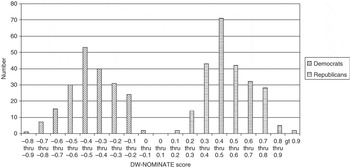
Little doubt remains that elites are polarized today. Schlesinger identified a marked increase in party-line voting in the House, with the Democratic party producing a level of unity in 1983 that had not been seen since 1908.Footnote 11 Examining data from 1959 to 1980, Poole and Rosenthal demonstrated that members of the Senate had moved towards the ideological poles as well.Footnote 12 In his treatment of the post-reform House, Rohde provided the first full statement of this phenomenon.Footnote 13Figure 1 provides an ideological snapshot of the 109th Congress, which served in 2005–06. The most common scholarly measure of ideology in Congress is Poole and Rosenthal’s dw-nominate scores, although any measure of legislator ideology tells basically the same story.Footnote 14
Ideology of members of House of Representatives, 109th Congress, DW-NOMINATE scores

Figure 1 is a picture of ideological separation. The dw-nominate scores are, for methodological reasons, essentially bounded at −1 and +1, and one finds a very small handful of members towards those extremes and small handful of members who are moderates. The distribution is widely dispersed, with two modes clustering around −0.5 and +0.5, respectively. It is probably important to note that ideology is not actually clustering at the poles of the distribution, but party differences are stark. Therefore, scholars of Congress nearly universally view preferences as polarized by party.Footnote 15
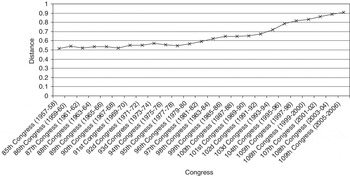
The process of partisan polarization in Congress has been occurring over time. As Figure 2 shows, the distance between the mean Republican and mean Democratic House member has increased markedly. It was bounded between 0.51 and 0.62 points from the late 1950s through the early 1980s. Starting with the 97th Congress, the parties began to grow apart steadily and sometimes dramatically. While it took twenty-eight years for the distance between the median caucus members to increase from 0.51 to 0.62 points, it only took twelve years for it to increase from 0.62 to 0.72 points. Between the 103rd and 105th Congresses alone, the median distance increased by a full 0.1 points. Over the succeeding five congresses, polarization has continued to grow slightly, with the mean distance between Republican and Democrats 0.91 points in the 109th Congress.
Change in distance between median party members in US House, DW-NOMINATE scores, 1957–2006

These data suggest that the contemporary period is different from the 1950s through the 1970s. They do not, however, suggest that the present degree of partisan polarization in Congress is anomalous. In fact, if one extends the analysis presented in Figure 2 back to the turn of the twentieth century, as Brady and Han do, it is the 1950s–1970s that are conspicuous.Footnote 16 In fact, much of the early twentieth century features distances between median members of the House party caucuses that are somewhat larger than those observed today. The distances in the late nineteenth century are sometimes much larger.
Moreover, the substance and intensity of the conflicts today are certainly nothing like those in the years leading up to the Civil War, which ranged from the unpleasant to the dangerous. To take one notable example, Representative Preston Brooks of South Carolina beat Senator Charles Sumner of Massachusetts nearly to death with a cane on the Senate floor after Sumner gave a speech laced with personal invective directed at some of those who supported the admission of Kansas to the Union as a slave state. This event was prelude to what Robert Dahl traces as the narrowing of compromise alternatives to solving the slavery question.Footnote 17 At the time of Sumner’s beating in 1856, most Republicans, including Abraham Lincoln, would have accepted slavery in the South, provided it did not expand to the western territories, and more slave-friendly solutions such as popular sovereignty were squarely on the table. On issues other than slavery, northerners and southerners commonly formed coalitions.
By the end of the decade, cross-region coalitions fell by the wayside. With Lincoln’s victory in 1860 (with far less than a majority of popular votes), southern political elites believed their alternatives disappeared. In their view, a Republican government would move from limiting the spread of slavery to the territories to imposing its will on the South itself. Secession, although endorsed by far less than a majority of members in what would become the states of the Confederacy, became an increasingly popular and ultimately winning position. As this account makes clear, the stakes in 1860 were much higher than they are in the early twenty-first century. Then, the republic itself was in grave peril. Today, feelings run deep, but cross-party compromises still occur regularly, and, even if they ceased, the future of the nation would not hang in the balance.
That is not to suggest that polarization does not exist in the present period, only that context is important. In fact, if one views the entire history of the nation rather than just the most recent sixty years, partisan polarization appears to be more the rule than the exception. Just ask Charles Sumner and Preston Brooks. Or, for that matter, ask Aaron Burr and Alexander Hamilton.Footnote 18
Non-institutional causes of elite polarization
In identifying the causes of partisan polarization in Congress, Jacobson suggests sorting them by those that occur outside political institutions, such as changes in the electorate or electoral system, and those that occur inside them, such as rule changes or changes in the character of party leadership.Footnote 19 Poole and Rosenthal demonstrate that the lion’s share of change in party preferences can be explained by the replacement of old members with new ones.Footnote 20 And, as Fleisher and Bond and also Grose and Yoshinaka, demonstrate, party switching by members whose ideological profile is inconsistent with their party is more likely in recent years compared with the several decades after the Second World War.Footnote 21 Moreover, Nokken and Poole demonstrate that these party switchers, especially recent ones, exhibit large changes in their voting behaviour, reinforcing polarization.Footnote 22
The roots of the present partisan polarization in Congress are found in the 1950s and 1960s when party difference were small. The more liberal northern elements of the Democratic party had to balance this impulse with southern preferences, which have tended to be much more conservative especially on racial issues. Southerners generally stayed in the Democratic fold until the party’s embrace of civil rights,Footnote 23 which started in the mid to late 1940s and culminated with the Voting Rights Act of 1965. Once barriers to African-American voting were lifted in the South, however, two things happened. Conservative southern whites bolted from the Democratic party in droves, which ultimately led to the replacement of conservative southern Democrats in Congress with even more conservative southern Republicans. And, especially around southern population centres, African-American votes elected members to Congress who were typically more liberal than those they were replacing.Footnote 24
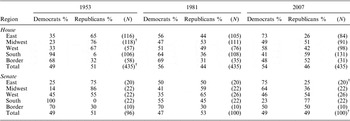
The north-east underwent a similar, albeit less dramatic change. Although among the most liberal areas in the country, it long had a tradition of electing liberal Republicans. As the national image of the Republican party grew more conservative, however, these states turned increasingly to liberal Democrats.Footnote 25 Although this pattern took more time to take hold in congressional voting than it did in presidential voting because of the power of incumbency, voting for both House and Senate began to reflect these changes very clearly by the 1980s.Footnote 26 The data in Table 1 highlight this evolution. After the 1952 election, Republicans won only 6 per cent of the 106 southern House seats but won 65 per cent of the 115 eastern House seats. After the 2006 election, however, Republicans held 59 per cent of the now 131 southern House seats but only 26 per cent of the eighty-four eastern seats. In fact, New England, a Republican stronghold only a few decades before, features only a single Republican House member, Christopher Shays of Connecticut, who only narrowly retained his seat in 2006. The changes are even starker in the Senate. In 1952, Republicans held none of the Senate seats in the eleven states of the former Confederacy. After the 2006 elections, they held seventeen out of twenty-two. The ten eastern states have flipped. After the 1952 election, 75 per cent were held by Republicans. After 2006, only 25 per cent were.
Party Shares of Regional Delegations in Congress: 1953, 1981 and 2007

†Includes two independents.
Source: Paul R. Abramson, John H. Aldrich and David Rohde, Change and Continuity in the 2004 Elections (Washington, D.C.: Congressional Quarterly Press, 2006), as updated.
The end result of this ‘Big Sort’ is not just greater distance between the parties, but less difference within them. In the 92nd Congress, the standard deviation of the dw-nominate scores for all Democratic members of the House was 0.231, and, for all Republican members, it was 0.193. In the 109th, the standard deviations were 0.158 and 0.163, respectively. The decreasing standard deviations were not caused by both parties moving towards the centre. Again using the 92nd Congress as a baseline, 58 per cent of members fell into the middle third of the distribution (from −0.33 to +0.33), but, by the 109th Congress, only about 20 per cent did, far less than half the number as in the early 1970s.Footnote 27
Regional party changes are not the entire story. Judging by their voting records, Republicans in Congress from all regions have grown increasingly conservative while congressional Democrats from all regions have grown increasingly liberal over the past thirty years. Jacobson believes that changes in the voting constituency of House members help account for this, although the direction of causation is unclear.Footnote 28 He shows a dramatic increase in the correlation between House voters’ party and ideological self-identifications over time. In 1972, the tau-b correlation was below 0.3 for the sample as a whole and below 0.2 for southerners. By 2002, both correlations were above 0.5. As a likely consequence, self-identified liberals and self-identified conservatives are doing a better job voting for candidates who reflect their ideological predispositions than before. Although Collie and Mason find that the actual differences in ideological self-identification in House districts are quite small,Footnote 29 Jacobson concludes that a closer connection between voters’ ideologies and the candidates whom they send to Washington to represent them is a major reason for the increase in ideological voting by members.
Even if the public is linking their ideology better to their political choices, it is still true that the median voter remains moderate. The median voter theorem would suggest that members ought to move towards the ideological centre to capture more votes. Ansolabehere, Snyder and Stewart argue, however, that House candidates do not do this now, nor have they generally tried to moderate their preferences to fit their constituencies over time.Footnote 30 The only exception they find in their data, which stretches from 1874 to 1996, is the period from the 1940s to the 1970s. In the 1980s and 1990s, candidates reverted to the usual form of being less responsive to district influence.
Some argue that redistricting, the decennial redrawing of state and congressional district boundaries based on the population shifts reflected in the most recent census, is also important.Footnote 31 Parties tend to work together through this process to protect incumbents from meaningful challenges. The absence of inter-party competition in most elections is potentially important because a vast majority of members need not worry much about losing elections if they are more ideologically extreme than their district. Such a member would, on average, face more peril in a primary election.Footnote 32 Importantly, primary election constituencies, especially those in closed primary states, ought to be more ideologically extreme than general election constituencies.Footnote 33
Of course, the Senate has experienced polarization of its party caucuses over the last thirty years as well. Since the Senate is not subject to redistricting, it casts much doubt on the centrality of redistricting in explaining polarization.Footnote 34 In fact, the Senate has undergone a sorting that parallels the House. Specifically, states are increasingly more likely to elect two Senators from the same party than they used to be.Footnote 35 In 1976, for example, twenty-four states featured a split party delegation. After the 2004 election, only thirteen did. Moreover, the party of choice for the Senate increasingly matches the state’s presidential vote.Footnote 36 Since both the 1976 and 2004 elections were close and since 1976 was a decidedly unpolarized time, they provide a good point of comparison. Of the thirty-seven unified Senate delegation states in 2004, thirty-one (84 per cent) voted for the same party in the presidential race. Of the twenty-six unified states in 1976, only sixteen (62 per cent) did. Moreover half of these sixteen were southern states, which often still had two Democratic senators and also voted for native son Jimmy Carter. Had the Democratic presidential candidate not been a southerner, this number almost certainly would have been smaller.
McCarty, Poole and Rosenthal identify other structural factors, including income inequality, as the core explanation for polarization. Using data for 1947–2003, they find that the Gini Index, the federal government’s most important measure of inequality, is highly correlated with polarization between Republicans and Democrats in Congress (r = 0.94). The key point here is that Republicans have chosen to pursue less generous redistributive policies, thus moving them significantly to the right, because recent immigrants and a higher percentage of poor people are non-white and/or non-citizens.Footnote 37 Because non-citizens cannot vote and because voters are less generous towards non-white groups for redistribution,Footnote 38 Republicans can pursue more ideologically extreme alternatives with relative impunity.
Finally, the interest group system reinforces polarization. According to McCarty, Poole and Rosenthal, the pattern of contributions is increasingly tilted to the ideological extremes.Footnote 39 This was particularly true of so-called ‘soft money’ contributions to political parties, which, before they were outlawed by the McCain–Feingold Campaign Finance Act in 2001, were not subject to limits. With the end of soft money, 527 groups, which can contribute without regulation from the Federal Election Commission provided their donations are made independent of the campaign apparatus, have emerged in their place. These 527 tend to attract money from strongly ideological sources. Such contributions are sure to reinforce the present level of polarization and probably serve to move the parties further apart.
Institutional causes of polarization
Over the past thirty years, a number of developments designed to enhance the power of party leadership have also contributed to the polarization in Congress. A response to a generation of committee government dominated by conservative (and autocratic) Democratic committee chairmen from the one-party south, such developments included revitalized party caucuses, strengthened whip organizations and majority-party leaders with significantly more institutional resources under their control.Footnote 40 Importantly, most of these devices pertain to the House and not the Senate, although recently the Senate, too, has implemented some party leadership strengthening measures.
These devices have two effects, the second following from the first. First, they are designed to limit the number of alternatives that rank-and-file members have to vote on, by advantaging alternatives championed by the majority-party leadership.Footnote 41 Members are increasingly forced to vote for or against a version of a bill managed tightly by the leadership.Footnote 42 As a consequence, outcomes tend to be closer to the party’s median position, which is significantly to the right of centre when Republicans are in the majority and significantly left of centre when Democrats are, rather than the chamber median position, which is nearer the ideological centre.
The Rules Committee, which exists only in the House of Representatives, is critical to understanding the increased power of elected leaders. During the era of committee government, Rules was dominated by a coalition of conservative (usually southern) Democrats and Republicans. Largely autonomous from party leaders during that period, it often served as the graveyard for liberal initiatives, notably civil rights legislation.Footnote 43 The party reforms of the 1970s changed this by essentially making the Rules Committee an arm of the party leadership. Under Jim Wright’s (D-Tex.) Speakership, the Committee played a critical role in facilitating passage of Democratic priorities and limiting the shots of the ‘GOP’ (Grand Old Party or Republicans) in the legislative process. Republicans made similar use of the Rules Committee when they took control of House in 1995.Footnote 44
Sinclair identifies a number of changes in how the Rules Committee does business. Restrictive rules, which limit the number of amendments and specify which amendments can be proposed on the floor and the amount of time a bill can be debated, have become far more common. Indeed, some controversial bills receive rules allowing for no amendments. Such rules ensure that rank-and-file members can only vote on the party leadership’s preferred version of the bill. In the contemporary House, the Rules Committee almost never provides moderates with the opportunity to craft alternatives to legislation backed by the party leadership.
Omnibus legislation, which refers to single bills that contain many (sometimes only tangentially related) provisions, is now more common in the House as well. Rather than allowing rank-and-file members to support the leadership on certain bills and buck them on others, leadership presents the rank and file with a single bill and hence a single choice. If members want to support something that might benefit their constituencies, then they will also have to vote for something they might otherwise have opposed.Footnote 45
Other important changes have taken place in the House since the 1994 Republican Revolution. Seniority was traditionally the most important factor in determining who became a committee chair. Chairs, moreover, could serve in this capacity as long as they wished, which allowed them to develop considerable power independent of the party leadership. When Newt Gingrich became Speaker in 1995, however, he ignored the seniority system in some cases, appointing loyalists such as Bill Livingston (R-La.) chair of the powerful Appropriations Committee. In addition, he implemented new rules that limited the terms of committee chairs to six years. As Dodd and Oppenheimer observe, ambitious would-be chairs must continually appeal to the party leadership by voting the party line.Footnote 46 The power of committee chairs has also been weakened by other party leadership practices, such as the use of task forces to bypass committees on major legislation, leadership-controlled conference committees, and the increased willingness of party leaders to intervene in committee affairs on legislation important to the party.Footnote 47
Evidence also suggests that leaders are more effective in exerting influence on rank-and-file behaviour in more traditional ways. Burden and Frisby demonstrate that, when members change their preferences between a count of the vote by party whips and the actual vote, it is most often in the direction of party leadership.Footnote 48 This suggests that contemporary party whips are quite persuasive. Forgette demonstrates that party caucus meetings maintain party discipline. When leadership calls caucus meetings in advance of important votes, members are more inclined to toe the party line.Footnote 49
It is critical to note that the enhancement of leadership powers is not simply a function of leaders becoming more ambitious. Instead, a broad swath of party members has become increasingly willing to provide leadership with these powers. The most likely explanation for this change in behaviour from the rank and file is that the ideological predispositions of the party caucuses have become more homogeneous over time (the within-party standard deviations have shrunk). Leaders are probably doing mostly what most party members want them to do. If that ceased to be the case, the rank and file would rein in leadership powers.
Cultural causes of elite polarization
Cultural changes wrought by these new devices and electoral realities are likely to contribute to the polarization in Washington as well. The 1994 elections were significant for reasons beyond the introduction of a new Republican majority in both the House and Senate. The Republicans won, in part, by running as outsiders who promised to break the perceived cycle of corruption that had come to taint the Democrats’ forty-year stranglehold on the House of Representatives. To this end, House Speaker Newt Gingrich cautioned his insurgents against spending too much time in Washington, encouraging them instead to tend to their districts. Gingrich in the House and Majority Leader Trent Lott in the Senate decreased the length of the Washington work week, scheduling business on a tight Tuesday to Thursday period.Footnote 50 The short week had important implications. Members had less time to develop relationships with other members, particularly across party lines. They also had little incentive to set up residences, instead opting for rooming houses disproportionately occupied by other members of their party.Footnote 51 Since the members’ families were not as likely to accompany them to Washington, relationships between spouses, which often crossed party lines in a bygone era, did not develop.Footnote 52
In addition, political junkets fell out of favour. Many new Republicans won their seats by highlighting the number of taxpayer dollars that Democratic incumbents had spent going on ‘official missions’ to sometimes exotic locales. In practice, however, these trips were important in that they allowed members of opposite parties to meet and develop friendships.Footnote 53 It is much easier to attack people in the other party if you do not have to see them (and their spouses) for dinner next week.
Members of Congress and scholars alike identify the close partisan division in Congress as another cause of polarization. A team mentality develops in the majority when co-operation from almost all members is necessary for the successful passage of legislation. The caucus can also act as a team around election time when they need to protect all of their incumbents to ensure majority status.Footnote 54 In that sense, the good of the party is more tangible when party margins are tight. The dramatic increase in incumbent campaign contributions to fellow party candidates and to the party congressional campaign committees is consistent with this line of thinking.Footnote 55
Indeed, this is an important component of what Aldrich and Rohde describe as conditional party government.Footnote 56 Specifically, they argue that parties will be more disciplined and will make institutional changes that facilitate party discipline when two conditions are met. First, the preferences of in-party members must be relatively homogeneous. Secondly, the preferences of out-party members must be relatively distant from those of the in-party. Of course, there is ample evidence that both conditions have been met, especially after the election of the 104th Congress in 1994. Moreover, Aldrich and Rohde show that this defining election was closely followed by institutional changes imposed by the Republican leadership on the House Appropriations Committee that served to perpetuate these more disciplined parties.Footnote 57
It is worth noting here, again, that the institutional practices facilitating strong parties in the contemporary Congress are not without precedent. Indeed, several scholars have likened the contemporary House to the party government that existed in the House between 1890 and 1910, when Speakers Reed and Canon used their control over the floor, the Rules Committees and committee assignments to establish a highly centralized and intensely partisan House.Footnote 58 Members eventually revolted against such centralization, of course, producing the committee government that characterized the House for much of the twentieth century – and against which the partisan forces that initiated the current revitalization of party leadership strength reacted.Footnote 59
Consequences of elite polarization
Polarization carries a negative connotation because of all the sharp words and incivility that accompany it. But polarization might have benefits. One outgrowth of polarization has been the development of party government, which is exactly what political science reformers had in mind in the post-Second World War years. In 1950, the American Political Science Association (APSA) penned a set of recommendations designed to engender what they called more responsible parties.Footnote 60 The central thrust was to encourage political elites to campaign and govern as partisans, which would, in turn, facilitate voters’ ability to act as the ‘Gods of Vengeance and Reward’ depending on their satisfaction with outputs.Footnote 61 The rule changes in the House, which have had the effect of shutting the minority party out of the policy-making process, are broadly consistent with the APSA recommendations. Moreover, the Democrats’ sweeping victories in the 2006 elections (and the Republicans’ sweeping victories in 1994) suggest that those who have been in power can be held accountable when the public is dissatisfied.
Today the polarized parties in Washington are more ‘responsible’ in the 1950s sense of the word, but scholars still express concern. Sinclair argues that the emphasis that party leaders now place on party unity and expeditiousness has the potential to produce ‘spoiled sausages’, or sub-optimal policies. Rather than inviting the minority into the policy-making process and allowing for the possibility of compromise, polarized majorities ignore time-honoured processes that Sinclair believes produced better laws. One example is committee mark-ups of bills. They have become public charades with the real decision making carried out behind the scenes by majority-party committee members and their party leaders, with little or no input from a broad range of experts.Footnote 62 Mann and Ornstein highlight the tax cuts passed in the first months of the 107th Congress as a textbook example of polarized politics hampering good public policy.Footnote 63
One area the APSA report did not consider was the potential fate of rigorous congressional oversight in a unified, ideologically homogeneous party government. For example, critics argue that Republicans in Congress failed to ask difficult questions after the American military failed to find weapons of mass destruction in Iraq and when the intelligence community disclosed that Iraqi ties to al-Qaeda were tenuous. Others have criticized the Republican Congress’s lack of oversight on such matters as the administration of the Medicare prescription drug bill, global warming and contracts given to businesses to do work in Iraq without tendering bids.
It is hard to assess empirically whether the quality of outputs in a polarized, unified government differs from those produced by a different set of arrangements. More testable is whether outputs differ ideologically. The rules changes adopted by both Houses of Congress from the 1970s through the 1990s were intended to make the process more responsive to and reflective of majority-party preferences. Since House leaders are more ideologically extreme than in generations past, it could move policy outputs away from the median chamber position in Congress and towards the median party position.
Krehbiel shows, however, that such an outcome is unlikely as long as there are even a few moderate members in the caucus, particularly in the Senate where the majority party needs sixty votes to close off debate on most bills.Footnote 64 Although Krehbiel’s analysis requires some heroic assumptions, the experience of the 109th Congress demonstrates that the House is often able to pass legislation reflecting the party median position in that chamber, but significant moderating changes are often required to get legislation through the Senate, moving the content towards the chamber median.Footnote 65 That outputs are inclined to collapse towards the chamber median is normatively comforting. Those who study polarization on the mass level often fret that polarized parties on the elite level will produce policy outputs that are at odds with the centrist preferences of the electorate. Krehbiel’s work suggests that such an outcome is unlikely in the present, evenly divided, environment.
Median party outcomes are more likely to emerge on matters in which sixty votes are not required to end debate in the Senate. For example, budget matters and reconciliation bills can be considered and passed by the Senate with simple majorities. In addition, although omnibus legislation requires sixty votes in the Senate for cloture, these bills often contain perks for most members, increasing incentives to support it even if the overall bill is more extreme than they might prefer. Since these devices are much more commonly employed today than in the past, it is possible that important legislative outputs might more often reflect the more extreme median party position.
Finally, McCarty, Poole and Rosenthal have demonstrated the most concrete policy consequence of elite polarization. In addition to being caused by income inequality, they demonstrate that polarization increases income inequality.Footnote 66 Greater polarization has been accompanied by falling real wages and decreases in top marginal tax rates. Because policy change is so difficult in American legislative politics due to the myriad checks and balances, efforts to redress this growing gap have been stymied. Intense political majorities, in this case those on the political right, have managed to protect the policies that have increased inequality over time.
Mass polarization
Elites are prone to polarization because they know and care about politics. As a consequence, they understand the issues and are more inclined to invest themselves in one side or another. In contrast, we know from decades of survey research that most Americans care little about politics and are, instead, consumed with their work, family and other non-political pursuits.Footnote 67 Despite all the talk about red states versus blue states, it is not clear that ordinary citizens are polarized today.
A number of factors militate against the emergence of mass-level polarization. Most central, the issue agenda is often not conducive to it. Political disagreements differ in their divisiveness from era to era. Some enduring divisions were born of events and performance rather than ideas, which is important because polarization implies deep philosophical differences. The New Deal party system was forged by a problem – the Great Depression – and the Republicans’ inability to solve it. The Democrats’ more government-orientated philosophy was less important than the fact that the Democrats were not the Republicans. The dominant cleavage centred on less visceral disagreements, such as size of the government’s role in the economic market and the relationship between business and labour.Footnote 68
Polarization suggests an intensity that draws on attitudes that people hold deeply. People come to perceive that their views of right and wrong and good and bad are diametrically opposed to those of their opponents, making it difficult to understand (or perhaps even respect) the worldview that makes those preferences possible. Importantly, people tend to feel most intensely about issues that can be understood on the gut level. Carmines and Stimson refer to these as ‘easy’ issues.Footnote 69 An easy issue – race – forged a new party system in the 1960s (and the 1860s for that matter).
Easy issues are at the heart of what sociologist James Davison Hunter forecast as the emerging polarization of American politics. In his 1991 book Culture Wars: The Struggle to Define America, which is often cited as the impetus for Pat Buchanan’s fiery speech at the 1992 Republican National Convention and the dawn of polarized politics, he suggests that the emergence of new social issues, such as abortion, the death penalty and gay rights make polarization inevitable.Footnote 70 According to Hunter, such issues have scant middle ground. People either think life begins at conception or not; they believe people are gay by choice or by genetic predisposition; they believe moral values are constant or they believe they are mutable to a changing world.Footnote 71 Whether or not these are true dichotomies, the important point remains that such issues require people to use their core values to make political judgements, uniquely dividing Americans into what Hunter described as ‘orthodox’ and ‘progressive’ camps.
Much recent scholarship, however, questions whether ‘values issues’ even represent the dominant cleavage in contemporary American politics. The traditional New Deal cleavage has proven remarkably durable. As evidence, Stonecash shows that class now plays a much more important role in structuring party identification and vote choice than it did in generations past.Footnote 72 Bartels shows that, while the import of social issues today is greater than it was in the 1980s and 1990s, attitudes about the traditional left–right dimension remain much more important.Footnote 73
Although these micro-level treatments suggest the continued pre-eminence of the New Deal cleavage, it is hard to square with recent presidential outcomes and the increasingly distinct congressional map. Miller and Schofield use the state as unit of analysis to argue for the primacy of the social dimension in contemporary American politics.Footnote 74 They demonstrate that the states won by Kennedy in 1960, a New Deal election, bore little resemblance to those won by Gore in 2000 (and, by extension, Kerry in 2004). The states won by (Republican) McKinley in 1896 when the social dimension was ascendant and those won by (Democrat) Gore in 2000, however, were highly correlated. They conclude that the social dimension has reawakened and switched parties. If so, it would help to explain why politics today seems more acrimonious than it did during the New Deal party system, when economic issues reigned supreme.
If anything, the issue environment has become increasingly conducive to a culture war, with gay rights, in particular, playing a central role in 2004. Indeed, fully thirteen states offered anti-gay marriage ballot initiatives in 2004, with another eight following in 2006. But a definition of polarization that merely centres on the issues on the political agenda does not allow scholars to evaluate polarization claims. The presence of hot button issues is probably a necessary condition, but these issues must be more than present. Unfortunately, scholars have not agreed on what serves as evidence of polarization, which has led to very different conclusions drawn from the same data sources.
Little evidence of popular polarization
Operational definitions of polarization are numerous, which helps explain why some top-notch scholars argue passionately that it does not exist in the American electorate while other eminent scholars argue, with equal passion, that it does. DiMaggio, Evans and Bryson provide a straightforward definition of polarization, which Fiorina adopts. Although they use the generic term ‘polarization’, it relates to what Fiorina refers to as popular polarization, which is simply movement towards the poles of a distribution.Footnote 75 It is characterized by wide dispersion of preference between groups and, eventually, bimodality, or a clustering of preferences near the poles. In statistical terms, this rendering requires (1) a large difference of means (or proportions) between two groups and (2) large and increasing standard deviations in distributions of interest.Footnote 76
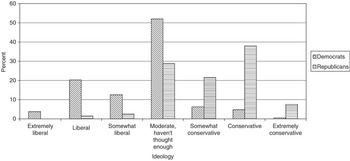
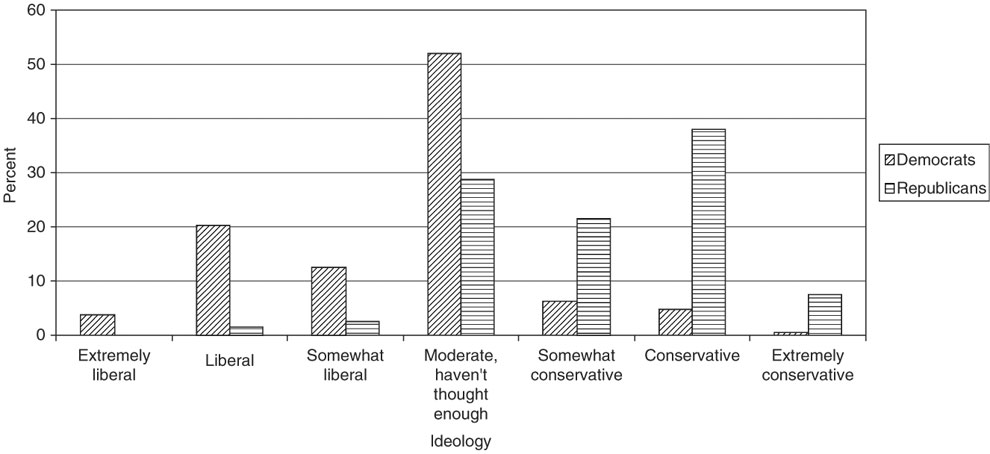
Based on the DiMaggio, Evans and Bryson definition, there is not much evidence of popular polarization. Extending DiMaggio, Evans and Bryson’s work (which covered the period from the early 1970s through 1996) into the 2000s, Fiorina quite convincingly shows that Americans’ issue preferences have been and remain generally moderate.Footnote 77 A key piece of his evidence is the National Election Study (NES)’s ideological self-placement question. When people are asked to place themselves on a seven-point scale from extremely liberal at one end to extremely conservative at the other with moderate, middle-of-the-road at the midpoint, about 50 per cent of Americans either characterize themselves as moderate or are unable to place themselves on the scale.
Figure 3 shows the responses to the ideological self-placement question in 2004 broken down by party. The picture presents a marked contrast to the elite level. The modal response among Democrats is moderate, or ‘haven’t thought enough about it’. Less than 40 per cent of Democrats are even willing to label themselves as liberals of any sort. Although Republicans embrace the conservative label more easily than Democrats do the liberal label, nearly 30 per cent of Republicans think of themselves as moderate or say they have not thought enough about it. Fiorina, moreover, shows similarly overlapping, moderate preferences for a litany of issues.
Ideological self-placement by party identification, leaners not treated as partisans, 2004
Such an operational definition of polarization has both advantages and limitations. Its main advantage is its face validity. The hostility and venom that is implied by polarization seems to require significant distance between group means. Moreover, since polarization has the word ‘pole’ as its root, examining whether groups are moving towards and clustering at the poles certainly makes sense.
Yet, given what scholars know about the nature of public opinion and the survey instrument itself, such a definition may be too limited because the conditions imposed by it are perhaps impossible to meet. Surveys tend to depress dispersion because respondents, especially the ill-informed, tend to choose the midpoint of survey items regardless of their true preferences (if such preferences can be gleaned at all). If the most esteemed theories of the survey response are correct, a relatively small percentage of Americans will have the cognitive ability and/or the political certainty to cluster towards the poles of a distribution.Footnote 78 Even in the case of elite polarization in Congress, moreover, members today are not clustering together at the ideological poles. Recall from above that, whereas dw-nominate scores are roughly bounded at −1 and +1, the clustering of members is occurring around −0.5 and +0.5. That means that, even though party leaders in Congress do not allow members to consider the most extreme alternatives, most members’ measured preferences generally do not even approach the ideological poles. Although scales of elite and mass opinion are not directly comparable, we should expect that mass preferences will tend bunch closer to the middle than those of elites because of the massive differences in ideological sophistication.
The DiMaggio, Evans and Bryson definition also suffers from the fact that there is no agreed amount of distance between groups necessary for popular polarization to exist. Do their preferences, on a scale from 0 to 100, need to cluster around 90 and 10, 70 and 30, or something else? Can groups be polarized if they are far apart but are on the same side of the midpoint?
In comparing residents of red and blue states, Fiorina often dismisses differences of 10 and 15 percentage points as not representing polarization, which seems appropriate. It is theoretically possible for these groups to be 100 percentage points apart. Of course, differences of this magnitude are really a Never Never Land possibility. After all, you can always find some Red Sox (Liverpool) fans in a city as big as New York (Manchester), and perhaps a few more, even braver Yankees (Manchester United) fans in Boston (Liverpool). Even during the Civil War, perhaps the most polarized time in the nation’s history, significant numbers of southerners sympathized with the north and vice versa, making it unlikely that northerners and southerners would have differed by anything approaching 100 points on slavery. Indeed, as Dahl notes, 94 per cent of blacks were effectively barred from voting in the North as well and, even less than a year before secession, ‘abolitionist’ was not in the vernacular of ordinary citizens.Footnote 79 To the extent that group differences approached 100 per cent, surveys would have struggled to reflect it.
Some context might be helpful. Although the survey era has generally been characterized by muted differences, the struggle over civil rights provides an exception. Prior to the time that the courts extended civil rights protections to non-southern blacks in the late 1960s and early 1970s, southern and non-southern whites have been portrayed as having fundamentally different preferences about segregation. Fortunately, survey data are available to test how different their preferences had been, which might provide a sense of how far apart groups must be for polarization to exist.
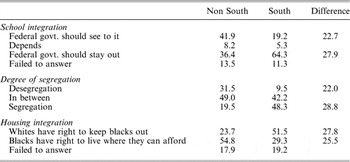
In 1964, the year the Civil Rights Act was enacted, the NES asked people their positions on whether the federal government should work to ensure school integration, their preferred degree of segregation and support for housing segregation. The results appear in Table 2. The differences between white southerners and white non-southerners were substantial: non-southerners were 22.7 percentage points more likely to support a federal role in school integration, 22 points more likely to support desegregation rather than segregation or something in between, and 25.5 points more likely to believe that blacks should be able to live wherever they could afford. Fiorina often dismisses large differences in the contemporary context if both groups are on the same side of the midpoint, indicating that the two sides agree on substance but differ only in degree. But, regarding civil rights in 1964, less than a majority of southern and non-southern whites supported both a federal role in school integration (41.9 per cent non-southern vs. 19.2 per cent southern) and the notion of full desegregation more generally (31.5 per cent to 9.5 per cent). Perhaps northerners and southerners were not polarized on civil rights, but, if not on this issue at this point in time, it is not clear where to look for an illustration.
Whites’ Opinions about Blacks’ Civil Rights, 1964
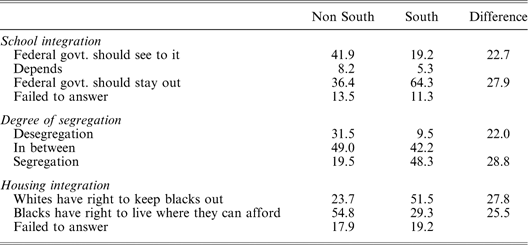
Source: American National Election Study, 1964.
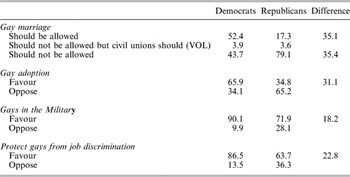
It is worth noting that the gulf between non-black Democrats and Republicans on gay rights is roughly the same today as was the difference between southerners and non-southerners on civil rights in the mid-1960s. In fact, opinions today on gay rights are, in some cases, even more divergent.Footnote 80Table 3 displays the results. Both on support for gay marriage and on support for gay adoption, Democrats are more than 30 points more tolerant than are Republicans. The differences are somewhat smaller, but still substantial, for protecting gays from job discrimination and supporting gays in the military.
Non-Black’s Opinions about Gay Rights, by Party, 2004
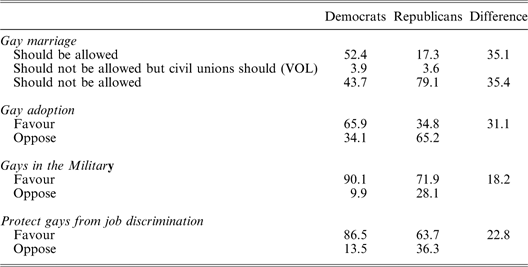
Source: American National Election Study, 2004.
A second problem with the DiMaggio, Evans and Bryson definition is that standard deviations and differences of means do not capture salience. Salience helps to determine the weight that opinions carry. Indeed, accounting for salience explains why the politics of race in the 1960s was much more polarized than the politics of gay rights in the 2000s, despite the fact that preferences are more dispersed now than they were then. In 1964, the percentage of Americans who responded ‘civil rights’ to Gallup’s most important problem question was generally greater than 30 per cent. The percentage of Americans who think gay rights is most important today is typically in the low single digits. Gay rights and other social issues are more important than they were ten years ago, but they do not define politics the way race did in the 1960s.Footnote 81
Excluding salience from our understanding of polarization, however, can also be used to argue that there is more polarization today than working from the DiMaggio, Evans and Bryson definition would suggest. Salience can make issues seem more polarizing even if the distance between groups remains relatively small. Consider public opinion about homosexuals, a hot button issue with the potential to polarize. Since the 1980s, the mean distance between how Republicans and Democrats feel about gays and lesbians on the NES’s feeling thermometer has actually decreased from about 12 to about 10 degrees. As Fiorina notes, tolerance among both has increased, but, since Republicans started from a lower baseline, their average score has increased faster. From this, the DiMaggio, Evans and Bryson definition would conclude that no polarization exists because the two sides are not near the poles and are even moving closer.
Such a conclusion, however, misses an important change. Although the distance between parties is now smaller, that distance is substantively more important because gay rights have become more salient. In fact, the very reason that gay rights have become more salient is because opinion has become so much more moderate. Gays and lesbians were so unpopular in the 1980s (mean feeling thermometer 28.50 degrees in 1988 – 7 degrees cooler than for the ever-popular ‘illegal aliens’), that political leaders would have embraced gay rights only with political suicide in mind. In 2004, however, tolerance for gays and lesbians had increased markedly (mean feeling thermometer in 2004, 48.52 degrees), making discussion of gay rights thinkable.
Perhaps, then, another way to consider the relative degree of polarization caused by an issue is as the product of distance between groups and the salience of the issue. Considered this way, gay rights can still be a source of at least relative polarization even as the distance between groups has shrunk. Consider the homosexuality example. The distance, in this case, was 12 in the 1980s, but, since the issue was not salient, its weight was 0. Polarization could be calculated as 12 × 0 = 0. Even though the distance has dropped to 10 more recently, its salience has increased dramatically. Let us say it carries a weight equal to 10. Polarization in this rendering would be calculated as 10 × 10 = 100. Even if the difference in means or proportions remains constant or even shrinks a little over time, relatively higher levels of polarization can result if the weight attached to that issue is increasing.
Another new issue that challenges the DiMaggio, Evans and Bryson definition is terrorism. Prior to 1993, the salience of terrorism approached 0, with few Americans living in fear of a terrorist attack. Now the percentage of Americans identifying it as an important problem is consistently in the double digits and has approached 50 per cent at times. To the extent that people perceive meaningful party differences on this issue today – and survey evidence suggests that they doFootnote 82 – its marked increase in salience will affect how polarized the political environment feels.
These mild definitional critiques are not intended to suggest that popular polarization is widespread in the American electorate. Instead, I highlight the importance of salience, in particular, to suggest why ordinary Americans might feel differently about politics even if they are not polarized per se. Feelings are relatively stronger in the electorate today than they were twenty years ago, because issues with the ability to provoke strong feelings have become more important.
Strong indication of partisan sorting
Those who argue that polarization exists on the mass level are, for the most part, conceptualizing polarization differently from Fiorina. They most often highlight increasing distances between the average Republican and Democrat in the electorate irrespective of whether those opinions are clustering near the ideological poles.Footnote 83 In statistical terms, differences in means and, when appropriate, proportions are the only measures of concern. With the poles out of the picture, Fiorina and Levendusky question the use of the term ‘polarization’ to describe the phenomenon. Instead, they favour the term ‘party sorting’.Footnote 84 By ‘sorting’, they mean that mass partisans are following what are now clearer elite cues to sort themselves into the ‘correct’ party, which decreases intra-party heterogeneity and increases the difference between party adherents.
With sorting, differences in means or proportions can increase, even as the dispersion of opinions in the population remains relatively constant. For example, the distribution of opinion on abortion might not have become more extreme over time, but the average Democrat and Republican could be farther apart if formerly Democratic pro-lifers changed their party affiliation, realizing their old party was not an appropriate home (and vice versa). Democratic partisans will have become more homogeneously liberal and Republican partisans more homogeneously conservative, with the average distance between them larger as a result.
Some ideological sorting has indisputably occurred. For example, the distance between ideological self-placement of the average Democrat and Republican using NES data has increased dramatically, and, accounting for the entire range of these variables, so, too has the correlation between partisanship and ideology. In 1972, a mere 0.66 points separated mass partisans on the seven-point scale, with a correlation between the two variables of 0.28. By 2004, the mean distance had more than doubled to 1.62 points, and the correlation increased to 0.57. These results, however, do not reveal how many people are better sorted. Fiorina agrees with his critics that political activists are well sorted ideologically. In fact, they are probably even polarized.Footnote 85 On a whole range of issues, those in the most involved segment of the electorate differ greatly. This is true of abortion,Footnote 86 women’s issues,Footnote 87 the environment, gay rights’ issuesFootnote 88 and, most recently, the war in Iraq.Footnote 89
Less clear is how far below the activist level that sorting penetrates. Fiorina argues, not much. Jacobson as well as Abramowitz argue, however, that the increase in the correlation between party and ideology is too large to be confined to hard core activists. In addition, Abramowitz believes that, not only is the ‘politically active’ segment of the population larger than Fiorina allows, it has become markedly larger.Footnote 90
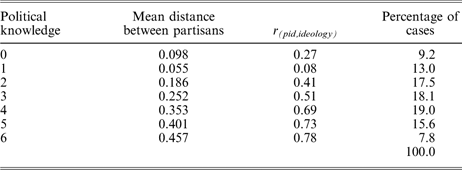
One way to assess the percentage of people who are showing obvious signs of sorting is to segment the electorate by political acuity. Although many people say they are interested in politics, that they vote and that they participate in other ways, they do so because it is the socially desirable thing to say. People who really do these things, however, ought to know more about politics than those who do not. Those who are most politically sophisticated should reflect the elite polarization in the information environment better than those who know less about politics. As a consequence, they will be more likely to have sorted their ideological predispositions with their partisan predispositions. Zaller suggests that factual political knowledge is the best measure of political acuity, so I create a measure of political knowledge by summing the number of correct answers that respondents provide to questions such as which party holds the majority in the House of Representatives and what jobs or offices political figures like Dick Cheney, Tony Blair and William Rehnquist hold. Since 2004 shows a large jump in the correlation between ideology and partisanship, I focus on these data.
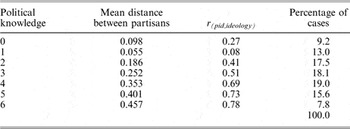
The results appear in Table 4. Given that I have mapped ideology onto a 0 to 1 interval, the differences can be interpreted as the percentage difference between the mean Republican and mean Democrat. The second column shows that the average distance is very large among those with the most political information – better than 45 percentage points among the 7.8 per cent of people who answer all six questions correctly. The 35 and 40 percentage point differences among those who answered four of five questions correctly are nearly as large.
Mean Distance in Ideology Between Partisans and Bivariate Correlation (Pearson’s r) between Partisanship and Ideological Self-Placement by Political Knowledge, 2004
Source: American National Election Study, 2004.
The correlations allow me to account for the entire range of the variables. Those who work with survey data will find their size to be extraordinary. Because of the measurement error inherent in surveys, analysts are often quite pleased to find correlations of 0.2 or above. An association of 0.3 is considered very strong. The correlation between party and ideology among people who answered all six factual questions approaches 0.8 is remarkable. Political animals like these are rare in the population, but the correlation for those who answered four or five questions correctly, which accounts for another 35 per cent of the population, is about 0.7, still a very close fit. This analysis suggests that more than 40 per cent of Americans show evidence of deep party sorting, and another 35 per cent (those who answer two or three questions correctly) do not appear to be completely in the dark either.
These data do not allow me to assess whether the electorate is better informed now than before. Delli Carpini and Keeter show that Americans did not come to know appreciably more about politics between the 1960s and 1990s, but their data do not extend into the 2000s.Footnote 91 Unfortunately, the battery of factual items I use here is not conducive to intertemporal comparison because their difficulty differs depending on context. Although Americans say they are more involved and interested, these responses may simply be a function of increased efforts by parties and interest groups to mobilize an evenly divided electorate, not because Americans are more polarized themselves.Footnote 92
It is also worth noting that there is evidence of increasingly deep sorting on several measures of values. Since 1986, the NES has asked a battery of questions about what is termed ‘moral traditionalism’. Respondents are asked their agreement with a set of statements, including ‘the newer lifestyles are contributing to the breakdown of our society’, ‘the country would have many fewer problems if there were more emphasis on traditional family ties’, and ‘the world is always changing and we should adjust our view of moral behavior to those changes’. Those who score high in moral traditionalism are what Hunter terms ‘orthodox’, people who view morals as unchanging. Those who score low are consistent with Hunter’s ‘progressives’ who believe that morals must change with an evolving society.
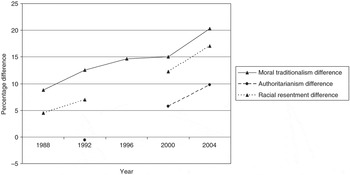
Figure 4 tracks the difference among non-blacks between self-identified Democrats and Republicans over time. Since I have mapped these items onto a 0–1 interval, the difference represents the percentage difference between party identifiers. In 1986, the average difference between Republicans and Democrats was only 4 percentage points. Ten years later, it had increased to 15 percentage points, and, by 2004 it had increased further to 23 points. Taking the full range of both party identification and moral traditionalism into account, the correlations between them increased from 0.09 in 1986 when the items were first introduced to 0.45 in 2004.
Changes in difference between mass partisans on values’ batteries, 1988–2004

Figure 4 shows the parties are better sorted on racial resentment as well. This concept was developed by Kinder and Sears and extended by Kinder and Sanders to tap symbolic racism, which has in their view replaced the overt racism of years past.Footnote 93 The difference between Republicans and Democrats in racial resentment increased gradually between 1988 and 2000, then surged between 2000 and 2004. This pattern of change is curious, in that race has recently come to play a less central role in electoral politics as Americans have become more accepting of African-Americans.
Finally, Hetherington and Weiler suggest that the parties are also sorting on another high heat dimension, namely authoritarianism, a pattern also captured by Figure 4.Footnote 94 Many have shown that authoritarianism is correlated with measures of prejudice, both racial and those relating to sexual orientation, which may explain the increase in sorting on racial resentment as well.Footnote 95 That this attitude, which scholarship suggests is activated by perceived threat,Footnote 96 might have begun to shape partisanship makes sense in a very threatening world following 11 September 2001 (9/11). In addition, the inclusion on the issue agenda of gay marriage, what Stenner would consider a normative threat, might also serve to activate authoritarianism.Footnote 97 The bottom line here is that party differences may go far beyond disagreements over policy choices and even ideology, to conflict about core self-understandings of the basis of a moral society.
Causes of party sorting
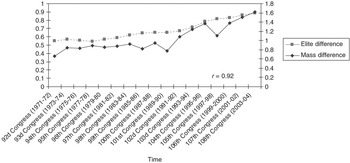
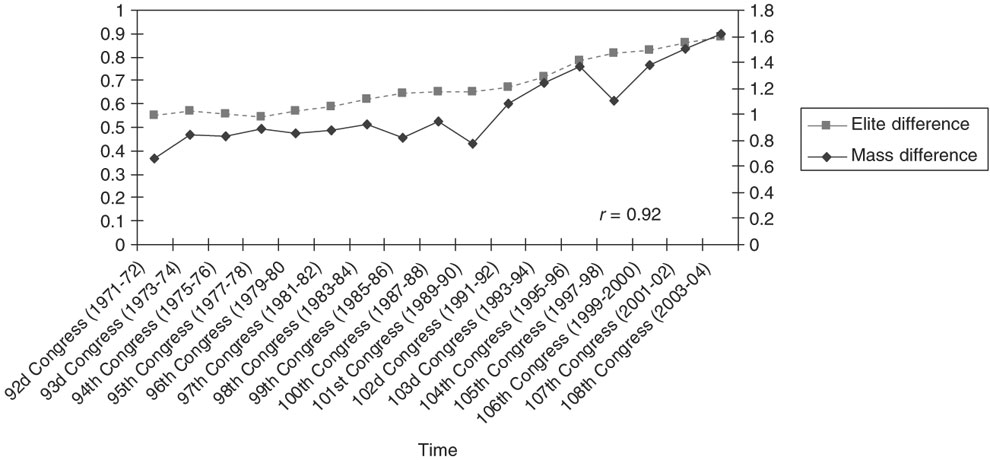
Generations of scholarship suggest that elite-level changes usually cause mass-level changes.Footnote 98 Hence it seems reasonable to believe that the very real polarization in Washington must be, in part, at the core of whatever sorting is taking place in the electorate. The data unequivocally support this hypothesis. The trends appear in Figure 5. The correlation between the mean distance between Republicans and Democrats using the dw-nominate in the House and the mean distance between Republicans and Democrats using the NES’s ideological self-placement from 1972 (the year the NES began to record ideological self-placement) and 2004 is 0.92. If I confine the analysis to presidential election years, which is when Americans are paying more attention to politics, the correlation increases to 0.98.
Mean ideological distance between congressional and mass partisans, DW-NOMINATE scores and NES ideological self-placement, 1971–2004
Some argue that political campaigns have adopted non-median voter campaign strategies to mobilize their base by highlighting hot button issues like abortion and gay rights. Hillygus and Shields, however, believe that the use of hot button issues as a political strategy is less about mobilizing the base, which is inclined to be active anyway, than an effort to attract what they term ‘cross-pressured’ voters.Footnote 99 By ‘cross-pressured’, they mean voters who have policy positions on issues that run counter to their party identification. It just so happens that, today, more people are cross-pressured on hot button social issues than on other issues. Specifically, there is a relatively high proportion of pro-school prayer Democrats, pro-choice Republicans, and anti-gay marriage Democrats. Highlighting such issues is raw meat for the base, but it is also an effective strategy for attracting the shrinking percentage of persuadable voters. As for polarization, strategies such as these will make these polarizing considerations more salient for voters when they are asked to evaluate themselves and the parties.
The conventional journalistic wisdom is that the changing nature of the mass media has contributed to polarization. Patterson suggests that the mainstream media have become much more adversarial and interpretive in their reporting practices.Footnote 100 Such changing conventions could encourage polarization because journalists now often ascribe nefarious motives to political actors. Even more adversarial is the large menu of ‘news’ programmes on cable television, such as The O’Reilly Factor and Hannity and Colmes on Fox News and Countdown with Keith Olbermann on MSNBC, which provide a departure from the time-honoured journalistic norms of balance and fairness. They also favour a format designed to produce polarization. Invective-laced appearances from people on the extreme right and extreme left are common. Mutz and Reeves suggest that, for consumers, such a format does little to elevate the political dialogue. And, by violating traditional social norms favouring civility and proximity to subjects, the ‘in-your-face’ presentation style of cable news shows actually causes people to take counter-arguments less seriously, which, in turn, intensifies their own opinions.Footnote 101
Before one brands cable news shows as the main culprit for at least causing people to feel like the nation is polarized, it is important to realize that these shows have limited reach. Prior notes that only about 3 million people watch even the highest rated cable news show, the O’Reilly Factor, on any given night, which is less than 2 per cent of the eligible electorate (and nearly 20 million fewer than watch Desperate Housewives).Footnote 102 Such viewers, moreover, are the most likely to be strong, well-sorted partisans already. Rather than moving people further apart or better sorting them into appropriate parties, these offerings probably reinforce feelings and predispositions.
One could add ‘talk radio’ and the internet ‘blogosphere’ to this discussion of potentially polarizing forms of mass media. If conservatives want to hear the conservative spin on the day’s events, they can turn to Rush Limbaugh. Liberals might browse the liberal internet blogs. In either case, consumers will receive a one-sided flow of information, which will cause their opinions to coalesce around those of the information source.Footnote 103 Although more people consume these forms of mass media than they do cable television, both are more effective in reinforcing opinions than changing them. Ideological media seem an ill-suited explanation for sorting, although Prior argues that it may be helpful in explaining why the choices voters face are more ideological than they once were.Footnote 104
Consequences of party sorting
My review turns up little evidence of popular polarization but strong indication of significant party sorting in several, but not all, areas. Should we be concerned? Certainly it does not seem to have demobilized the electorate. I have shown elsewhere that elite polarization has stimulated participation at the mass level even though the masses remain relatively moderate albeit better sorted. Not surprisingly, ideologues are now more engaged, but it is also true of moderates and non-ideologues. In the aggregate, levels of voting and non-voting participation, interest and investment in campaigns and elections, and perceptions of government responsiveness have improved among all ideological groups.Footnote 105 Abramowitz and Stone suggest that this is in large measure a function of strong feelings about George W. Bush.Footnote 106 Surely the parties’ increased efforts at mobilization are important as well?Footnote 107
One way to assess whether sorting matters is understanding people’s motivations for sorting. The interesting, perhaps unprecedented, feature of the recent rise of moral and culture issues is that they have not displaced more venerable economic and class issues in dividing the parties. This seems odd. We are all likely to be acquainted with many who are liberal on social policy but conservative on fiscal issues, and vice versa. This indicates that the social and economic dimensions often cut across one another. Yet the results of Bartels and others suggest that voters are increasingly bringing their issue preferences on both dimensions together with their partisanship. Throughout American history one cleavage has usually displaced another (conflict displacement), but the present environment is better characterized by what Layman and Carsey call ‘conflict extension’.Footnote 108
That the correlations between economic preferences, social preferences and party preferences are increasing suggests that many voters have either been changing their preferences on the issues to reconcile them with their party preference or changing their party preferences to line up with their issue preferences. The causal direction has important implications for the polarization debate. If most of the change is the result of people simply reconciling preferences on issues that they do not care or know much about with their existing partisanship, it suggests a lack of passion about the issues, which is a critical ingredient in polarization. If, instead, they are changing parties because they care deeply about certain issues, then party sorting could be of much greater consequence.
Green, Palmquist and Schickler provide clear evidence that the realignment of the South from solidly Democratic to more Republican was issue based.Footnote 109 Abramowitz and Saunders demonstrate that ideology drove change in partisanship in the 1990s as well.Footnote 110 Carsey and Layman, however, show that a little bit of both is going on. Some party changing has been occurring, but only among people who (1) perceive party differences on the issue and (2) see the issue as salient.Footnote 111 Their results square nicely with venerable understandings of partisanship. Party is not immutable, in that issues that people feel intensely about can cause partisan change. But it is mostly the case that partisanship structures change in issue preferences rather than the other way around. Indeed, Goren even demonstrates that party has been influential in causing change in what ought to be deeply held values, such as moral traditionalism.Footnote 112
Even if these analyses suggest that sorting is of perhaps limited direct import, Jacobson would disagree, viewing partisan change and the choices that political elites make as fundamentally dynamic processes. Specifically, polarization at one level has the ability to beget more polarization at the other. If elite polarization causes party sorting in the electorate, ideologically extreme elites will, in turn, feel even less pressure to moderate their positions than they did when their constituencies were more heterogeneous. As evidence, the polarization of Congress has increased dramatically in the last fifteen years while re-election rates have remained stratospheric. In most years, it has been almost impossible to beat a House incumbent, with more than 98 per cent regularly securing re-election. If they thought their jobs depended on it, incumbents would moderate their positions. Even when the Republicans lost control of Congress in 2006, it was moderate members who bore the brunt of the public’s dissatisfaction, not ideologues. And it is unlikely that many of these Republicans would have lost had the war effort in Iraq gone more smoothly, a criterion quite apart from ideology.
Another important consequence of party sorting is that it has produced an environment in which party serves as a more powerful filter of information than it once did. Other things being equal, this will, on average, increase the effect of all these attitudes on each other and on other variables of normative import. This is another area in which weight is important. Party sorting will cause the weight attached to an attitude, a preference or party identification to increase.
The increased effect of partisanship is manifest in many ways, but most obviously in shaping presidential approval and vote choice.Footnote 113 According to the Gallup Survey, George W. Bush regularly received the approval of at least 90 per cent of self-identified Republicans during his first term, while approval from Democrats, at times, slipped into the single digits. As Jacobson notes, the partisan gap in approval ratings from President Eisenhower, when Gallup introduced the measure, though President Clinton never exceeded 70 percentage points. In the twelve polls leading up the 2004 election, however, the partisan gap for Bush never fell below 70 per cent. Similarly, better than 90 per cent of self-identified Democrats and Republicans voted for their parties’ presidential candidate, the high point in the NES time series.
The effect of party seems to overwhelm the effect of moderation. Republican approval of Bush has been remarkably strong among moderates though governing style has often been immoderate. According to the 2004 NES, 89 per cent of Republicans who identified themselves as ‘moderate, middle-of-the-road’ or said they had not ‘thought much about it’, said they approved of the president. To be sure, this is less than the 95 per cent approval rate among those who identified themselves as either ‘conservative’ or ‘extremely conservative’, but not by much.
In addition, public opinion about the war in Iraq has been much more partisan than it was during earlier wars. In the first weeks of the Iraq War, Jacobson found differences in support between Democrats and Republicans of about 30 percentage points, and, by the fourth quarter of 2004 with the Iraq War about a year and a half old, the gap had grown to an average of 63 percentage points. This is more than twice the maximum partisan difference achieved during the first Gulf War, which had previously been the most partisan war.Footnote 114 Jacobson also notes that partisan differences on factual matters, as opposed to opinions, are quite large. Specifically, Republicans were 42 percentage points more likely to think Saddam Hussein possessed weapons of mass destruction before the American invasion than Democrats, and 19 percentage points more likely to believe that Saddam had participated in the terrorist attacks of 11 September.Footnote 115 Although Democrats were much less likely to answer factual questions about the state of the economy correctly at the close of Reagan presidency,Footnote 116 the partisan differences then were much smaller than they are now.
The question that remains unanswered is whether this more partisan and better sorted environment is attributable solely to George W. Bush, a president whom scholars agree has been a divider not a uniter. On most issues, underlying attitudes are often quite moderate, even on the war. According to Klinkner, Republicans and Democrats differ statistically but not substantively on many things, including the importance of a strong military, the proper balance between diplomacy and force to achieve foreign policy goals, patriotism and feelings about the country.Footnote 117 It might be that an Obama presidency could change the tone on the elite level, which would change how the masses responded to politics. But, given that the incentives built into the political system reward more extreme behaviour in elites, the trend may be quite difficult to reverse.
Conclusion
Contemporary American politics is probably best described as polarized on the elite level and increasingly well sorted in the electorate. In the 109th Congress (2005–06), Republicans and Democrats in the House achieved complete ideological separation, and the distance between the average Republican and Democratic member reached its highest point in nearly a hundred years. On the mass level, the ideological distance between partisans is now larger, but their attitudes are not clustering towards the poles even if their evaluations of specific polarizing political leaders are often very far apart.
The pattern of elite and mass differences provides evidence for the nature of their dynamics. Although it might be normatively most satisfying in a democracy if elite behaviour responded to mass opinion, that is not the norm. Instead, elite cues most often shape public opinion. For most of the last six years of his presidency, the signal about George W. Bush transmitted from elite to mass could not be clearer, and the subject matter, the sitting president, could not carry a higher profile. It follows that, on the mass level, party polarization in evaluations of Bush and his favoured policies is very large. Given how elites have portrayed Washington politics lately, it might seem all but treasonous for a Republican to defect from him or for a Democrat to defend him. Mass publics can reflect this easily.
The story is different for attitudes. By their nature, attitudes are complicated and abstract, and they are not so easily tied to one set of partisan players or the other. Hence the elite signal about attitudes is less clear than it is for evaluations or even specific policies. When Republicans advocate a Constitutional Amendment banning same sex marriage, they do not argue that gays and lesbians are bad people leading a shameful lifestyle. Rather the argument typically centres on protecting the institution of marriage. Similarly, when Democrats in Congress criticize the administration’s war policies, they do not couch their concerns in terms of high-minded principles that suggest the advantages of subtle diplomacy over coarse military action. Instead, they criticize the president’s approach to foreign policy problems as incompetent. If elites provided clear signals about attitudes, mass polarization might follow, at least among those who follow politics closely. Because elites do not, their cues will, at most, produce mass-level sorting on attitudes rather than polarization.
In general, it is important to remember that elite stimulus is at the root of this change in mass behaviour. Had elites not become more ideologically polarized, party sorting on the mass level would not have occurred. At present, it appears that the process is self-perpetuating. Mass-level sorting allows polarized elites the opportunity to move further towards the ideological poles without much cause for concern. If they could continue to win elections and govern further and further towards the poles when voters were not well sorted, it is even easier for them to do so now that voters are sorted.
It is also critical to note that polarization on the elite level is best considered in relative terms rather than as either existing or not existing. Although elites today are more polarized than they have been in a long time, there are several periods in American history when polarization was much greater, most notably the Civil War. As the opening paragraphs of this article illustrated, contemporary members of Congress are calling each other names; they are not beating each other over the heads with heavy canes. Conflicts today run deep, but cross-party co-operation, though not the norm, still exists on many issues. Indeed, much of the partisan polarization in congressional roll-call voting is on procedural issues rather than substantive matters.Footnote 118
Moving outside of Congress, it is also striking that polarizing elites have not spawned a wave of centrist third-party candidacies. Centrist third-party candidacies in the Civil War party system are noteworthy features of that very polarized environment. Although Michael Bloomberg, recently an independent Mayor of New York City, considered a centrist presidential run, he decided to sit on the sidelines in 2008. It is true that Ross Perot’s runs for president in 1992 and 1996 defied ideological labels, but his campaigns focused on the incompetence of the major parties, not their ideological extremity. Moreover, he benefited more from Americans’ distrust in government than their concerns about hyper-partisanship in Washington.Footnote 119
Much of the scholarly disagreement about whether or not ordinary Americans are polarized can be explained by the fact that different scholars have focused on different objects and meant different things by the term ‘polarization’. Jacobson, by and large, focuses on evaluations of political figures who will pass from the political stage before long, while Fiorina focuses on attitudes, which ought to be more durable. In addition, Fiorina adopts a more literal definition than his critics do. Polarization, in his view, requires both large distances between groups in their issue preferences and a clustering of those preferences towards the ideological poles – things that, by and large, have not occurred. Fiorina’s critics label as ‘polarization’ increasing distances between the preferences of ordinary Republicans and Democrats, without requiring clustering towards the poles. Different definitions produce different conclusions.
Scholars have expressed grave concerns about the implications for representation posed by polarized elites and an unpolarized mass. Certainly, rule changes that give party leaders more influence and the increased use of omnibus legislation enhance the likelihood of ideologically extreme outcomes. In most cases, however, it appears that policy outcomes are unlikely to be particularly extreme. Even a small handful of moderate members combined with the small partisan majorities in the Senate, where sixty votes are necessary to end debate on most matters, will tend to moderate policies. It is also important to note that ordinary Americans can at times act as a check as well. After a bill that would have banned most abortions in South Dakota was signed by the governor in 2006, voters first signed petitions to force the question onto the ballot and later voted the anti-abortion measure down. After the Kansas State School Board removed teaching evolution from the state’s science curriculum by a 6–4 vote in 2005, Republican primary voters in Kansas, probably among the most conservative people in the nation, replaced two anti-evolution members with pro-evolution members in the next election.
Still, American politics no doubt feels different from how it felt twenty or thirty years ago. There is now relatively more polarization and deeper sorting than in the past, processes that may continue into the future. Moreover, these changes are not without consequence. The divisions today, however, are not by any stretch akin to those faced during the great crises in American politics. Although issues like abortion and gay marriage inject more passion into politics than do issues like health care reform and taxes, it is frankly hard to imagine them tearing the nation asunder.