Introduction
Emerging techniques of sex determination in early pregnancy offer opportunities for sex selection in countries that permit both induced abortion and sex determination in early pregnancy (Avent & Chitty, Reference Avent and Chitty2006; Cheng, Reference Cheng2008). Techniques of sex determination have developed since the 1970s, and have been further refined in recent years. The most popular techniques are ultrasonography and amniocentesis, although more and more people now rely on DNA probes on blood samples (Avent & Chitty, Reference Avent and Chitty2006). Whatever the technique, women can learn the probable sex of their fetus at the end of the first trimester of pregnancy, and if desired may undergo a sex-selective abortion. Sex-selective abortion (SSA) developed rapidly in the 1980s and 1990s in several Asian countries (India, China, Korea, Vietnam), and more recently in countries of the Southern Caucasus (Armenia, Azerbaijan and Georgia) (Zeng et al., Reference Zeng1993; Das Gupta & Bhat, Reference Das Gupta and Bhat1997; Chu, Reference Chu2001; Das Gupta et al., Reference Das Gupta, Zhenghua, Bohua, Zhenming, Chung and Hwa-Ok2003; Cai & Lavely, Reference Cai, Lavely, Zhao and Guo2007; Chung & Das Gupta, Reference Chung and Das Gupta2007; Guilmoto, Reference Guilmoto2009; Jha et al., Reference Jha2011; Duthé et al., Reference Duthé, Meslé, Vallin, Badurashvili and Kuyumjyan2012).
Most documented cases of sex selection target female fetuses, so that an increase in the sex ratio at birth (defined as the ratio of male to female births) is seen in countries where female SSA is practised on a wide scale. In fact, since there are no reliable statistics on SSA, it is through changes in the sex ratio at birth that these changes in behaviour are usually noticed. For instance, in some areas of India and China, the sex ratio at birth has jumped from a baseline around 105 to high values of 115, 120 or even more, indicating widespread female SSA. Sex-selective abortion in China is special because of the one-child policy that has been in place since the early 1980s, so that sex selection applies primarily to the first and only birth, and less frequently to the second birth in places where it is tolerated. In India, where completed family size is larger and where families commonly have two, three or four or more babies, sex selection is closely linked to birth order, and in particular to the number of girls already born, so that it applies typically to higher birth order pregnancies (Das Gupta & Bhat, Reference Das Gupta and Bhat1997).
There is no reason why sex selection could not also apply to male fetuses, when too many boys are already born. In fact, most families value more a balance between boys and girls than imbalance or single-sex families, assuming that they have an even number of children (two, four, six or more). When they have an odd number of children (three, five, seven or more), a majority of families prefer more boys than more girls, although some prefer more girls than more boys (see Fuse, Reference Fuse2010, for details). So, in theory sex-selective abortion could work both ways, and is likely to depend primarily on the number of girls already born (for selecting out female fetuses) or on the number of boys already born (for selecting out male fetuses).
This study aims at investigating these complex relationships between sex-selective abortion and family composition in countries of the Southern Caucasus, where preference for boys is not different from nearby countries, where induced abortion is legal and widely used for contraception, and where sex-selective abortion is also acceptable and widely used since the early 1990s. The study uses data from demographic surveys with comprehensive birth histories to investigate these relationships. In the analysis, a stand different from that of earlier studies on sex-selective abortion is taken (UNFPA, 2012). A more balanced approach between boys and girls is adopted, accepting the idea of sex selection for both sexes, and introducing a new concept of ‘gender saturation’, characterized by a behaviour of sex selection by families who perceive that they have too many children of one sex, and want a change for the next child.
Framework for analysis
Sex-selective abortion is basically the only way to manipulate the sex ratio at birth, although selective in vitro fertilization could potentially lead to similar effects, but remains a rare phenomenon. Sex-selective abortion usually depends on birth order and sex composition of the family. Therefore, a method of choice for assessing the extent of sex-selective abortion is to compare sex ratios at birth before and after SSA was practised, and to study these changes according to birth order, or better according to the number of children of the same sex, boys or girls, already born.
Several studies have documented a natural heterogeneity in the probability of bearing a boy or a girl (Malinvaud, Reference Malinvaud1955; Edwards, Reference Edwards1958). In the heterogeneous case, the sex ratio varies among couples: some couples tend to have more boys while others tend to have more girls for biological reasons. The extent of this heterogeneity in European and African populations has been shown elsewhere (Garenne, Reference Garenne2009a, Reference Garenneb). As a result, in the absence of SSA, the sex ratio of the next child tends to increase with the number of boys already born, and tends to decrease with the number of girls already born. If anything, SSA is assumed to have a counter-effect on these relationships, since couples are likely to abort a female fetus when they have already had too many girls, and may also be likely to abort a male fetus when they have already had too many boys. Therefore, SSA is expected to change the natural relationships between the sex ratio of the next birth and the number of boys and girls already born. This is the rationale for this study.
Data and Methods
Two countries of the Southern Caucasus with known practice of sex-selective abortion were selected: Armenia and Azerbaijan. Both conducted Demographic and Health Surveys (DHSs) with full maternity histories, which were made available for further research. Armenia conducted three DHSs in 2000, 2005 and 2010, which were merged together for final analysis. Azerbaijan conducted only one DHS in 2006. In these two countries, as in nearby Georgia, sex ratios recorded in vital registration statistics increased markedly after 1992 because of widespread use of sex-selective abortion, so the year 1992 was used as a cut-off for analysis. The 1992 date was confirmed by discussions with key informants by one of the authors (SH), who conducted a series of interviews on these issues in the three Southern Caucasian countries. Sex-determination techniques were apparently not available for the population before the collapse of the Soviet Union.
The statistical analysis of maternity histories was straightforward, using cross-tabulation and linear-logistic regression on the probability of bearing a boy, i.e. the logarithm of the sex ratio at birth. In earlier studies, the linear-logistic model was found to fit properly the pattern of heterogeneity, identified as a positive slope of the sex ratio of the next birth according to the number of boys already born, and as a negative slope according to the number of girls already born. These slopes were even larger in absolute values when single-sex families were considered (only boys or only girls born before the index child; see Garenne, Reference Garenne2009a, Reference Garenneb, for details). In the present study, three regression models were used: one for all families, the others for single-sex families of either sex. In formula this gives:
All families:
 $$\logit (p) = a + b_1 \times Males + b_2 \times Females$$
.
Single-sex families (only males or only females born before the index birth):
 $$\logit (p) = a + b_1 \times Males$$
,
 $$\logit (p) = a + b_2 \times Females$$
, where p is the proportion of male births, and therefore logit(p) is the logarithm of the sex ratio of the index birth, Males is the number of previous male births, and Females the number of previous female births.
The change in slopes in these relationships before and after the cut-off point, if statistically significant, will be considered as a signature of sex-selective abortion. In the case of female fetus abortion, the sex ratio of the index child is expected to increase when too many girls are already born, and conversely, in the case of male fetus abortion, the sex ratio is expected to decline when too many boys are already born. If a fraction ‘p’ of female fetuses are aborted, then the number of female births is multiplied by (1−p), and the sex ratio is divided by (1−p), which allows the proportion of female fetuses aborted to be directly measured. The same type of relationship applies when male fetuses are selectively aborted.
In order to make the case of the Southern Caucasus more convincing, the same analysis was replicated in all nearby countries with similar DHS data. Since most of these samples were quite small, they were also grouped by area: Eastern Europe (Albania, Moldova, Ukraine), Middle East (Jordan, Turkey) and Central Asia (Kazakhstan, Kyrgyzstan, Tajikistan, Uzbekistan). For countries with several DHSs, data were grouped together, as was done for Armenia. The details of each survey can be found on the Measure-DHS website (www.measuredhs.com).
Results
The analysis was based on 13,565 births in Azerbaijan and 30,007 births in Armenia, of which about half (51.2%) occurred before 1992. These are rather small samples for studying sex ratios, but as will be seen below the effects of sex-selective abortion were so large that differences were still statistically significant (Tables 1 and 2).
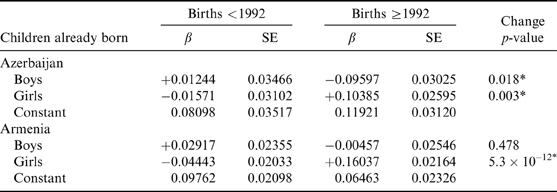
Net effect of the number of boys and girls already born on the sex of the next child (from linear-logistic regression), Azerbaijan and Armenia

Coefficients estimated from maternity histories in demographic surveys (Azerbaijan: 2006 DHS; Armenia: 2000, 2005, 2010 DHS). Test measures the statistical significance of the changing slopes between ‘before’ and ‘after’ 1992.
* p<0.05.
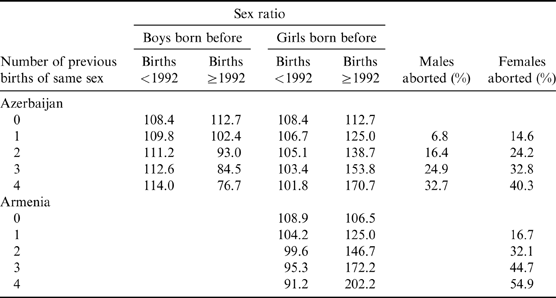
Sex ratios and sex selection according to the number of boys and girls already born
Calculated from regression models presented in Table 1. No statistical evidence of male-selective abortion in Armenia. Net effect of male-selective abortion exaggerated by high value of sex ratio of the first birth in Azerbaijan. See text for details.
Azerbaijan
In Azerbaijan before 1992, the relationship between sex ratio of the next birth and the number of boys and girls already born was as expected: positive with number of boys and negative with number of girls, fully consistent with underlying heterogeneity, and of the same magnitude as in other populations such as France or Germany (Garenne, Reference Garenne2009a). In contrast, after 1992 both relationships were inversed, indicating sex-selective abortion in both directions. The changes in slope before and after 1992 were highly significant: p=0.018 for number of boys, and p=0.003 for number of girls. Therefore, the data indicate a widespread use of selective abortion both ways, when too many girls or too many boys were born in a family. Estimates from the regression model indicate that some 24% of female fetuses were selected out after two girls, and 32% after three girls. Conversely, some 16% of male fetuses were selected out after two boys and 25% after three boys. These last two values of male-selective abortion seem to be over-estimated by the regression model. Indeed, the changing slope after 1992 for boys was in part due to the higher sex ratio when no male birth had occurred (due either to data artefact or to female fetus abortion for the first birth), and in part due to the lower sex ratio when two or more boys were already born (due to male fetus abortion). If the effect of the first male is ignored (it is not statistically significant), then the fall in the sex ratio after two boys appears smaller (observed sex ratio 104.4, instead of 90.7 predicted by regression, and compared with 111.1 before 1992), and the proportion of male fetuses aborted will also be much smaller (6.0%), which seems more realistic, and more consistent with the overall increase in sex ratios.
Armenia
In Armenia, the pattern was similar for selection of girls, but not for boys. Here also, the relationship between sex ratio of the next birth and the number of girls already born (negative slope) was as expected for births that occurred before 1992. The coefficient of the number of girls changed significantly after 1992 (p<10−10), indicating abortion of female fetuses when too many girls were born. The magnitudes of the changes, and therefore the proportion of female fetuses selected out, were similar to those found in Azerbaijan, with some 32% aborted after two girls and 44% after three girls. This, however, was not true for male fetuses, for whom there was no change in behaviour, and therefore no evidence of male-selective abortion.
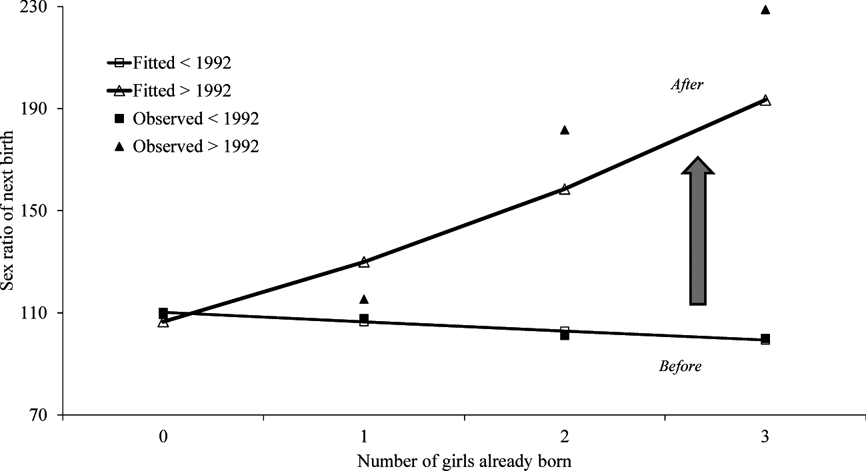
Figure 1 displays the changing pattern of the sex ratio according to the number of girls already born, with both the observed data and the fitted data by the linear-logistic regression. Single-sex families were selected for direct comparison between observed and fitted values. Both countries were merged together for drawing this figure, in order to increase sample size and to reduce random fluctuations. This was justified because the slopes before 1992 were similar (p=0.968), and because the changes after 1992 were in the same direction and of the same magnitude, although more pronounced in Azerbaijan (p=0.013). The figure shows the dramatic change in the pattern before and after 1992, a clear signature of female SSA.
Changing sex ratios of the next birth, before and after 1992, in single-sex families with no boys, Azerbaijan and Armenia combined.
Note that some of these events were rather rare. With a baseline sex ratio of 106, the probability of having three girls in a row is only 11.4%, and that of having three boys in a row is about the same (13.6%), therefore the high rates of selective abortion associated with high numbers of children of the same sex apply only to a small fraction of the population. Furthermore, the proportion of families with four children or more is also small in both countries, since the average completed family size is rather small for these cohorts of women (2.8 children per woman in Azerbaijan, 2.6 children per woman in Armenia), and only 28% of women in Azerbaijan and 18% in Armenia have four children or more by age 40–49. A large majority of women have either two or three children (62% in Azerbaijan, 74% in Armenia). Therefore, sex-selective abortion seems to apply mostly to the second and third pregnancy, with much lower proportions aborted. There was no evidence of sex selection for the first birth in either country, the sex ratio of the first birth being identical (p=0.983) for births that occurred before 1992 (SRB=109.8) and those that occurred after 1992 (SRB=109.4). The high value of the sex ratio of the first birth was probably due to the high proportion of births to very young women (68% occurred before age 22) (see Garenne, Reference Garenne2008, for details).
Comparison countries
Findings from Azerbaijan and Armenia were compared with those from nearby countries with similar DHS data: Albania (2008 DHS), Moldova (2005 DHS), Ukraine (2007 DHS), Kazakhstan (1995, 1999 DHS), Kyrgyzstan (1997 DHS), Tajikistan (2012 DHS), Uzbekistan (1996, 2002 DHS), Jordan (1990, 1997, 2002, 2007, 2009 DHS) and Turkey (1993, 1998, 2003 DHS). The first three countries belong to a group of European countries from the Eastern Bloc under soviet influence until 1991. The next four countries belong to a group of Central Asian countries, members of the Soviet Union until 1991. The last two countries are Middle Eastern countries, geographically close to the Southern Caucasus.
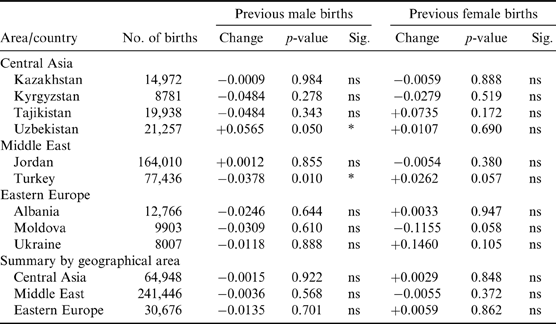
In these comparison countries, there was no statistical evidence of changing slopes before or after 1992 in the relationship between sex ratio of the next birth and the number of girls already born (p=0.947 in Albania; p=0.058 in Moldova; p=0.105 in Ukraine; p=0.888 in Kazakhstan; p=0.519 in Kyrgyzstan; p=0.172 in Tajikistan; p=0.690 in Uzbekistan; p=0.380 in Jordan; p=0.057 in Turkey). The lack of significance could be due to the small sample size, but the results were also not significant when countries were grouped by geographical area (Eastern Europe; Central Asia and Middle East; Table 3).
Change before and after 1992 in regression coefficients of log sex ratio of index birth on number of male and female births born before, comparison countries (data from DHS surveys)
When gender saturation occurs, change in male coefficient is negative (selection for females), and change in female coefficient is positive (selection for males). The case of Turkey is discussed in the text.
*p<0.05; ns=not significant.
Likewise, in most of the comparison countries, there was no change in the slopes before and after 1992 in the relationship between sex ratio of the next birth and the number of boys already born (p=0.644 in Albania; p=0.610 in Moldova; p=0.888 in Ukraine; p=0.984 in Kazakhstan; p=0.278 in Kyrgyzstan; p=0.343 in Tajikistan; p=0.855 in Jordan). In Uzbekistan, the change in slope was opposite to that corresponding to gender saturation, and was only borderline (p=0.050). However, in Turkey, the change in slope was statistically significant for boys, from positive before 1992 to negative after 1992 (p=0.010). This result seems to be due to erratic values of the sex ratio of first birth after 1992 (112.3) compared with that before 1992 (106.5). The difference between the former and the latter was not statistically significant (p=0.100), and could be explained by random fluctuations.
Discussion
The behaviour of couples in countries of the Southern Caucasus appears to be very rational, and more so in Azerbaijan than in Armenia, because it is more symmetrical between the two genders. Couples appear to take the opportunity of using the newly developed sex-selective abortion techniques to reach their goal of a more balanced family sex composition, avoiding too many births of the same sex. The effect was more pronounced when too many girls were born, leading towards a higher sex ratio at birth in the whole population.
One could discuss endlessly the ethics of this behaviour, as is the case for induced abortion in general (Johnston, Reference Johnston2001; Van Balen, Reference Van Balen2006). Given that it could be symmetrical, as in Azerbaijan, sex-selective abortion no longer appears to be solely biased against female fetuses, and rather appears as a desire for more balanced families, a wish expressed in most opinion surveys throughout the world (Williamson, 1996; Fuse, Reference Fuse2010).
Since there are several countries around the world, in Europe, Latin America and southern Africa, where more women express a preference for girls than for boys, changes in the coming years can be anticipated if sex-selective abortion becomes more accepted in these parts of the world. If this is the case, a significant change in the sex ratio at birth might not be noticed, or there might even be a decline in the sex ratio, so current screening methods focusing on increasing sex ratio values might become obsolete. On the contrary, this study's method of comparing sex ratio by family composition is more likely to enable the identification of changes in any direction, and should be preferred when data are available.
This study has limitations because of the small sample size in the DHSs, and it would be good to conduct similar studies on larger samples in order to achieve smaller confidence intervals. However, the consistency of the data in the two countries, with large increases in the sex ratio at birth, and the lack of change in nearby countries where SSA was not documented or remained very limited in scale, gives further value to the empirical analysis based on DHS data.
The high prevalence of sex-selective abortion implied by the higher (or lower) sex ratio at birth associated with many girls (or boys) indicates a very determined behaviour from large segments of the population. These high values are consistent with the high prevalence of induced abortion in the two countries (0.18 abortions per live birth in Azerbaijan in 1992–2006; 0.41 abortions per live birth in Armenia in 1992–2010 according to official statistics). Sex-selective abortion is applied in only a small fraction of families who have several children of the same sex. The ratio of sex-selective abortion to the total number of induced abortions appears very high in Azerbaijan, indicating very strong motivations for sex selection.
There was no obvious reason for not finding male-selective abortion in Armenia, given what was found in Azerbaijan. Both countries are very tolerant of induced abortion, both were part of the former Soviet Union, gained independence at the same time and have similar demographic, social and public health histories, despite different ethnic and religious backgrounds. Given the fact that female-selective abortion is similar in both countries, the difference in attitude towards male-selective abortion is more likely to be explained by symbolic values or by economic factors, which need to be further explored. For instance, Armenia was affected by a severe economic crisis in the 1990s, which led to a large drop in fertility (TFR=1.8 in 2001–2002, compared with 2.8 in 1990) and massive use of induced abortion between 1992 and 1999 (ratio of 0.65 abortions per live birth in 1996, compared with 0.32 in 1990). This crisis led to serious population decline and massive out-migration of men, and families relied more and more on the earnings of male migrant workers for their survival. This might have increased the perceived economic value of male children, and might have been a further incentive to keep as many boys as possible, hoping that they would move away to work abroad and send money back to their parents.
This study addressed the issue of gender saturation characterized by sex-selective abortion after several births of the same sex. Other behaviours could also happen when sex-selective abortion is acceptable in a society, such as selection for the sex of the first birth. Among the countries investigated in this study, three exhibited an unexpected (though not significant) change in the sex ratio of the first birth after 1992: Azerbaijan (116.5 against 108.5 before 1992; p=0.199), Moldova (114.4 against 106.7 before 1992, p=0.244) and Turkey (112.3 against 106.5 before 1992; p=0.100). None of these differences was statistically significant, so no conclusion could be drawn from these survey data. Overall, for the whole set of countries investigated, there was no change in the sex ratio of the first birth (108.1 after 1992 against 107.7 before 1992, p=0.776). However, sex selection for the first birth remains a possibility in countries where a first boy is seen as desirable for the family.
The desire for balanced families when even numbers of children are born (two and four children in particular), and a higher sex ratio in the case of an odd number of children (three and five children in particular), seem to be very frequent, although not universal, in the Southern Caucasus. More sex-selective abortion (both male and female) might be seen in the future if this behaviour becomes more acceptable. Changing sex-selection behaviour might also be seen in the case of rapid fertility decline (leading to smaller families and more families with one or two children) and during periods of economic hardship, as well as in the case of fertility increase (leading to larger families, and more families with three or four children) when the economic situation becomes better. These new trends could be further monitored to better understand new families' desires and choices, and how they adjust their reproductive strategies to changing economic situations.
Acknowledgment
The authors would like to thank Professor Cécile Lefèvre, Université Paris V-Descartes, for useful comments on the draft manuscript.