In 1529, Zahiruddin Muhammad Babur, descendant of the Timurid dynasty and founder of the Mughal empire, wept at the sight of melons. A mere fruit had reminded Babur of the homeland he had left behind in central Asia. In a letter to Khwaja Kalan, the emperor writes of the drudgeries of a ruler in a foreign land, who is forced to do without the tastes of home: “How can one forget the pleasures of that country? . . . Recently a melon was brought, and as I cut it and ate it I was oddly affected. I wept the whole time I was eating it” (423).Footnote 1 The Baburnama, a personal record of the establishment of a new empire in the subcontinent, might seem like an unusual place to begin an essay on Victorian India. But Babur's nostalgia for the home left behind in Samarkand poignantly anticipates some of the hidden longings of the British as Company Raj gave way to Crown Raj in India. While the East India Company attempted to oust the Mughal rulers between the second half of the eighteenth century and the first half of the nineteenth century, after India was incorporated into the Empire, the British would also attempt to don the mantle of the Mughals.Footnote 2 On 1 November 1858, when India officially became part of Queen Victoria's Empire, the British inherited the Mughal's melons. Whether it was roast beef or mulligatawny, a pint of pale ale or a chhota peg, the British discovered their own versions of Babur's melons over time – an idea of homeland contained in a mouthful.
Anglo-Indians from the three presidencies of nineteenth-century India identified each other by their particular culinary and domestic preferences.Footnote 3 Residents of the Madras presidency were dubbed Mulls, consumers of mulligatawny,Footnote 4 the Bombay presidency produced Ducks, partakers of the piquant Bombay Duck (dried anchovies),Footnote 5 and the Bengal presidency gave rise to the ubiquitous Qui Hyes,Footnote 6 imperiously ordering their numerous servants for yet another brandy pawney (brandy water). It is in the land of the Qui Hyes, the Bengal presidency of the 1850s, that George Francklin Atkinson, a captain in the Bengal Engineers, situates his fictitious station.Footnote 7Curry & Rice (on Forty Plates); or, The Ingredients of Social Life at “Our” Station in India is a book of lithographs and satiric vignettes of life in a British station in India, drawn and composed by Atkinson in 1859. Written in the vein of contemporary humorous takes on Anglo-Indian social life, such as the hudibrastic poem by “Quiz” entitled The Grand Master; or, Adventures of Qui Hi? in Hindostan (1816) and Charles D'Oyly's Tom Raw, the Griffin (Reference D'Oyly1828), this book is an amusing description of English life in a foreign land, a satire of Englishmen abroad, as well as a sharp criticism of social customs in England. Atkinson's work oscillates between striking out at the British, at the Anglo-Indians, and at India itself. The resulting voice of the unseen satirist, a character about whom readers know very little even as they reach the final lithograph, is one that typifies contemporary British India – a voice neither clearly British nor comfortably Indian.
Before sitting down to Curry & Rice, a detour into Henry Yule and A.C. Burnell's Hobson-Jobson – a dictionary of Anglo-Indian words – will help readers to locate the nineteenth-century curry of which they are invited to partake. Hobson-Jobson was designed to enable the colonial abroad to speak with his brethren back home (a problem characteristically anticipated by Dr. Johnson in his introduction to the first dictionary in 1755). Its elaborate and convoluted entry on curry is an anxious attempt both to claim and to repudiate the ubiquitous Anglo-Indian dish. The lexicographers define curry as a relish to be added to a quantity of rice or bread. They then continue to examine the origins of curry:
It is possible, however, that the kind of curry used by Europeans and Mahommedans is not of purely Indian origin, but has come down from the spiced cookery of medieval Europe and Western Asia. The medieval spiced dishes in question were even coloured like curry. Turmeric, indeed, called by Garcia de Orta, Indian Saffron, was yet unknown in Europe, but it was represented by saffron and sandal-wood. A notable incident occurs in the old English poem of King Richard, wherein the Lion-heart feasts on the head of a Saracen –
While saffron and sandalwood, as well as a host of other eastern spices, were a part of English cookery in the medieval period, what is most significant here is the example of curry the author provides. He does not present a chicken, a piece of beef, lamb, or pork dressed in saffron and sandalwood. These would have been reasonable enough examples of medieval English cookery. Instead, he chooses the most unusual meat of all in order to bring curry within the realm of Englishness: human flesh.
What Yule's and Burnell's definition elides is the real motivation behind King Richard's cannibalism. In what context does the anonymous poet dare to immortalize the English monarch taking part in such a taboo activity? King Richard, as the section of the long poem from which Hobson-Jobson finds its evidence of the European curry elaborates, is taken sick in Islamic territory during the Crusades. The only cure for his strange fever is a dish of pork. Since pig flesh is hard to procure in this Muslim country, the ingenious courtiers decide to substitute the flesh of a fat, young Saracen.Footnote 9 Through this convoluted set of circumstances, Richard unknowingly partakes of his enemy's flesh and makes a miraculous recovery. The king's enforced cannibalism in the poem is more of an index of the unreasonable religious superstitions of Islam than of Christian depravity. More importantly, in claiming the particular kind of curry represented in Richard's meal dressed in “powder and spysory” within the provenance of things English, Hobson-Jobson hardly carves out a neat territory for English cuisine and instead lands itself in the most contested zone of all. Redolent with its complex origins in a battleground between the east and the west, this curried human head, the Saracen's head, rests squarely within the cultural tradition that Hobson-Jobson claims as authentic English.Footnote 10
With such English and cannibalistic definitions of curry as the starting point, let us turn to Atkinson's volume. In 1859, when this book was published, the domestic colonial novel was on the rise and about to replace the travel adventure (Sainsbury 164). The kitchen was to be the new site of adventure, expansion, and domination. Alongside the Anglo-Indian domestic novel, a few other sub-genres of English writing in India are relevant to this work. The publication date of the book and the nonchalant prefatorial nod to “the narratives of horror that have of late fallen upon the English ear” clearly situate Curry & Rice among the Mutiny novels of British India.Footnote 11 That the invisible political background of Atkinson's deadpan humor is the military insurgency of 1857 is further complicated by his position as an officer in the British army.Footnote 12 Sketches by military officers in British India form a significant sub-genre within the corpus of amateur artists working in India. These soldier-artists combined their training in strategic observation and surveillance of enemy territory with the prevailing aesthetics of the picturesque in order to produce images of India on paper and canvas.
Atkinson's caricatures also follow British satirical and humorous art in the tradition of Gillray, Rowlandson, and Cruickshank, as well as D'Oyly, and the caricatures found in Punch or the London Charivari. Punch itself was widely read in Victorian India and gave rise to a number of Indian versions, such as the Hindi Punch, the Gujrati Punch, the Parsi Punch, the Oudh Punch, and the Indian Charivari, among others. It would be misleading to suggest that Atkinson and his fellow humorists worked within an environment in which jokes, satirical cartoons, and caricatures flowed only in one direction. In the second half of the nineteenth century, a number of popular indigenous periodicals emerged with a widely appreciated slew of politically inflected caricatures. The most important among these in the Bengal Presidency, the area in which Atkinson was stationed, were Basantak, Amrita Bazaar Patrika, Mookerjee's Magazine, and Manasi o Marmabani. The Indian caricatures in popular magazines not only critiqued the Anglo-Indians, but also were equally harsh in their treatment of the westernized Bengali babu. In their formal techniques and thematic concerns, these caricatures borrowed both from their western counterparts, as well as from the older style of Kalighat and Bat-tala paintings (Mitter, Art and Nationalism 137–72).
The images in Curry & Rice, printed by Day and Son, Lithographers to the Queen, fall within the picturesque tradition of nineteenth-century British portraits of Indian life. There were many other popular books of this sort being published in London around this time, such as the Indian lithographs of Balthazar Solvyns and Mrs. Belnos.Footnote 13 Such illustrated and beautifully bound volumes, often hand-colored, were rather expensive, and only the wealthy could acquire them. A few private libraries would also keep copies in their collections. In his preface, Atkinson issues an invitation to an exotic meal to the exclusive few who can afford an armchair visit to India:
And now, having brought you so far on your voyage, with the comforting assurance that you are not the persons “so cruelly handed up,” let me land you in the East, where you will receive a warm welcome most assuredly. That you may experience a pleasant time of it during your visit at “Our Station,” I indulge a hope; and if in the Plates of “Curry and Rice,” now set before you, the flavour is found to be a little too spicy and a little too pungent, and, to many perhaps, a thought too hot, remember that it is the nature of Curry to be so.Footnote 14
Using forty linked vignettes accompanying each illustration, Atkinson introduces his chief protagonists through an elaborate metaphor of food and consumption. The metaphor of food is carried out diligently, if not tediously, through the forty pieces. Not only are the station and the district in which it is situated given culinary names, but each European character's name also is derived from the vast, eclectic kitchens of colonial India. Carry Cinnamon, the Spin, ends up marrying Captain Cheeny (sugar); Fruitz is the German missionary who competes for native converts with Padre Ginger; the Turmerics, Chutneys, Capiscums, and Huldeys attend the same dinner parties; Major Garlic is married to his “sable spouse,” a native woman who has provided him with a large number of children. In fact, it seems that all the English residents of Kabob have been tainted by local flavor and come together to form the spicy, figuratively cannibal curry. The author, quite consciously, offers not only India, but also his own Anglo-Indian society up for consumption to his compatriots in England. The reader is configured as the English visitor to Kabob, a griffin, or newcomer to the east, and an outsider. Yet the presumed Englishness of the reader also drags him or her into the circle of “our” station. The first person plural possessive, frequently offset with quotation marks, repeated with increasingly dizzying levels of self-referentiality throughout the book, is a difficult word to define here. At first, the word seems to refer to the English residents of the colonial station, clearly excluding the griff, or griffin, from the circle of the initiated.
In parodies and satires of Anglo-Indian society, the griffin is frequently a figure of ridicule, an apprentice colonizer. The griffin's perspective is a useful strategy adopted by Anglo-Indian writers seeking to expose the absurdities of colonial life.Footnote 15 Yet a griff, one must remember, is never a complete outsider from the Anglo-Indian point of view. A griff is, after all, always “one of us,” a member of the race. As Atkinson's reader moves forward into the detailed vignettes about the local coffee shop, the races, the ball, the bazaar, and such, he or she is implicitly included in the circle of “our” Indian life and explicitly separated from the natives. The final farewell to Kabob in “Departure for Home,” then, includes not only the invisible author, but also the reader. The “ten years of exile in Ind” (40) has become both the reader's and the author's curse.
The particular tension that arises in Curry & Rice in its attempt to include the outsider in the colonial landscape is that, while the English reader is drawn to far-away Kabob, the fictional inhabitants of Kabob yearn for the voyage home. Thus, even as spicy curry is doled out onto forty plates, the narrator himself ponders, “Are we to taste once more of the real ‘roast-beef of old England,’ and our palate be gratified with really fresh oysters and porter?” (40). Why does the narrator of Curry & Rice fiercely desire a return to England? And what are the impediments to his voyage home? Approaching an answer to these questions necessitates a look at those “narratives of horror” the book chooses to discard.
Forget Cawnpore
In his preface toCurry & Rice, Atkinson promises a look at the “sunny side of Indian life, after all the narratives of horror that have of late fallen upon the English ear.” In one bold stroke, the author transforms the site of widespread massacres and political instability into a subject fit for a humorous, leisurely evening. Scholars of nineteenth-century Britain have reminded us that the Indian Mutiny of 1857 and the Crimean War were two military events that most occupied the imagination of the Victorian popular mind.Footnote 16 “In the cultural system of Anglo-India,” writes Bernard S. Cohn, “the Great Rebellion of 1857–8 can be viewed as demarcating crucial changes. For the British ruling élites, at home and in India, the meanings attached to the events of 1857–8, and the resulting constitutional changes, were increasingly the pivot around which their theory of colonial rule rotated” (179). Atkinson himself was undoubtedly preoccupied with the events of 1857, for he had published another book, The Campaign in India, in January 1859, a few months prior to Curry & Rice. The two Indias depicted in Campaign and Curry & Rice bear little resemblance to each other. Campaign is a sincere, patriotic sibling to the jocular, unstable Curry & Rice. The text consists of twenty-six colored lithographs depicting selected military events during the Mutiny of 1857. The tone of the accompanying commentary is largely journalistic and markedly different from the satirical voice of Curry & Rice. The collection begins with a dedication to Queen Victoria (“by permission,” as the text is careful to add) and creates a teleological narrative that opens with a scene composed of sepoys (Indian soldiers) at rifle practice and closes with two images of recovering British soldiers at the hill stations of Shimla (Simla) and Dugshai (Dagshai).Footnote 17 The images, similar in technique to those of Curry & Rice, are remarkable for their restraint in depicting violence on the battlefield. The bodies of the wounded and the dead, both British and Indian, are rarely shown to be mutilated, battered, or even bleeding. They seem to be merely sleeping on the uneven ground in artistic poses of relaxation. The only bodies transformed by the events illustrated by Atkinson are those of the British soldiers recuperating in the cooler air of the hills. Missing arms or legs in these final plates are the remnant physical marks of the Mutiny: marks that are recorded with absence of British limbs or of Indian bodies. In his dedication of the book, the author who, within months, would display the foibles of Kabob's British residents for all to read adopts a tone of unwavering racial loyalty:
When a remorselessly treacherous and rebellious foe sought to uproot the British power in India, and by acts of deliberately-planned ferocity and fiendish cruelty strove to destroy every European and Christian in the land, the devoted heroism of a small but resolute force, who fought to maintain the rights of their Sovereign and the honour of England, was so far crowned with success as to stay the arm of the destroyer, wrenching from his grasp the stronghold of rebellion, and winning for them not only victory in the crime-stained streets of Delhi, but the proud satisfaction of YOUR MAJESTY's gracious approval and heart-felt sympathy.Footnote 18
Even in this more serious text intent on presenting factual information to the Queen, the author's rhetorical flourishes alter the shape of the mutinous Indians. They are exaggerated into larger-than-life fiends, and simultaneously reduced to the singular “foe.” In Curry & Rice, Atkinson uses similar tricks of exaggeration to comical ends, while minimizing the real specter of dangerous rebels. Any reading of Curry & Rice's culinary humor and its light-hearted caricatures of the Capsicums, Huldeys, Garlics, and Cloves must take into account the more somber twin text of Mutiny violence Atkinson had completed only months before.
The Mutiny, which began in May 1857, with uprisings in the northern station of Meerut, soon spread throughout the northern plains of the subcontinent and threatened the East India Company's footing. The Mutiny, it must be remembered, was not only a blow to colonial power, but also to the colonial purse: the British spent $36 million to suppress the insurgency. The causes of the Mutiny were disparate and mostly localized. Its leaders encompassed a wide social spectrum and often united at the last possible minute, bringing together wide-ranging motivations. The historian Gautam Bhadra writes that it was the “perception and day-to-day experience of the authority of the alien state in his immediate surroundings that determined the rebel's action” (175) and united men as different as tribal youths, small landowners, peasants, and maulvis (Muslim clerics). Yet contemporary British observers of the Mutiny chose to look for a single conspiracy, unifying a wide range of insurgents from different parts of the subcontinent. Theories abounded that Hindu (and Muslim) superstitions led the sepoys to imagine a threat of conversion by the British. The chief motivations listed by military personnel who lived through the violent months of 1857 were often based on British readings of native rumors and an incomplete understanding of indigenous religious taboos.
Published in 1858, Martin Gubbins's An Account of the Mutinies typifies the soldier's Mutiny memoir and offers a starting point for tracing the prevailing Mutiny theories of the day. It is a sincere accounting of the events in the cantonment leading up to the insurgency, a list of possible causes for Indian disaffection, and a prescription for changes in the system of military and civil governance to prevent a repetition of 1857. As a member of the Bengal Civil Service, Gubbins writes that the chief reason for the Mutiny was suspected religious defilement. In April 1857, he notes that the newspapers “had made known the general repugnance felt by the sepoys to the use of the new cartridge” (2).Footnote 19 He also notes a telling incident that occurs in his regiment at around that time. One of the military physicians, a certain Dr. Wells, took a sip directly from a bottle of medicine in the infirmary. The sepoys, upon hearing this information from their informant, the native apothecary, refused “to touch any of the medicines prescribed for them” (4). Dr. Wells was made to apologize to the sepoys in public and the bottle in question smashed. Nonetheless, the sepoys set fire to Wells's bungalow.Footnote 20
Indian superstition, it seems, follows an irrational and violent course. The perpetuation of the myth of these food taboos as reason for revolt thus reduces the events of 1857 from a modern military rebellion to a primitive superstitious reaction. Gubbins's account of sepoy superstition, of course, follows a long tradition of Anglo-Indian representation of Hindu irrationality and fear of defilement. In Purity and Danger, Mary Douglas writes that “ideas about separating, purifying, demarcating and punishing transgressions have as their main function to impose system on an inherently untidy experience” (4). What is most remarkable about British narratives that harp on pollution taboos as causes of the Mutiny is that they speak more to the colonizer's need for a tidy organization of knowledge than to any indigenous need for symbolic order.
Gubbins, on the eve of the Mutiny, presents a list of defilement rumors floating about India. First, he reports that news of the Enfield rifle cartridges greased with pork and beef fat was leaked by a low-caste Hindu to a Brahmin. The low-caste informant told the Brahmin that soon, all high-caste Hindu sepoys would be debased by ingesting the beef and pork fat used to grease the cartridge.Footnote 21 The second rumor involved a British plan to mix bone dust into the flour and sweetmeats sold in the bazaar, thereby rendering the entire Hindu population casteless. The third rumor, Gubbins writes, implied that the British were entrapping hill men in the north and boiling them down for their fat. This human fat was to be sent down to Calcutta for unnamed purposes. The fourth, most complex rumor pointed to a reproductive vulnerability of Indian men and involved Crimean war widows. All the widows of the Crimean war were to be shipped en masse to India, and the zamindars (landlords) would be forced to marry these Christian women. The children resulting from such marriages would, of course, not be Hindus, and the British would thereby supplant the Hindu zamindars (Gubbins 85–88).Footnote 22 Gubbins's list of Indian rumors signals two presuppositions: religious beliefs among Indians were the most important factor in motivating the rebellion, and India was crisscrossed by a vast network of indigenous lines of communication, rumor mills, and grapevines that remained invisible to the British eye. Modern historians of the Mutiny have already clarified the former presupposition. As Bhadra shows, the causes of the Mutiny were numerous, overlapping, and occasionally in conflict with each other. Complaints about terms of military employment, anger directed at missionary practices, and resistance to Dalhousie's “rule of lapse” are just a few of the causes of the Mutiny hypothesized by historians.Footnote 23 But what of the presupposition of an invisible Indian network spanning the subcontinent? The humble chapati, a flat, unleavened bread, which Hobson-Jobson reports to be the staple food of northern India (219), appears around 1857 as the chief protagonist of the invisible grapevine.
Lady Charlotte Canning, the wife of the Governor-General at the time of the Mutiny, wrote to her monarch, Queen Victoria, in 1857:
There is an odd, mysterious thing going on, still unexplained. It is this. In one part of the country the native police have been making little cakes – ‘chupattis’ – and sending them on from place to place. Each man makes twelve, keeps two, and sends away ten to ten men, who make twelve more each, and they spread all over the country. No one can discover any meaning in it. (Allen 52)Footnote 24
The circulation of the chapatis is noted by almost all reports of the Mutiny. Gubbins, too, had noted it in his memoir. The chapatis, in all these contemporary Mutiny narratives, are signs of imminent trouble. The seemingly innocuous pieces of bread, making their round from one station to another, are disturbing to the Anglo-Indian who cannot decipher them. The chowkidars or watchmen (supposedly the main characters involved in the circulation), when questioned, seemed to be genuinely ignorant of the meaning of the chapati. They claimed to be simply obeying a directive that originated from no known source. It is the diffused and all-encompassing nature of the chapati circulation that troubles most British narratives. Everyone agrees that there must be a hidden message and that a network is being activated by such a message. But what is the message, and what is the network supposed to do?
The historian Ranajit Guha writes that the Indian chowkidars were not lying to their employers. They, too, were genuinely unsure of the meaning of the chapati:
The symbolic agent of an epidemic in the countryside[,] it [the circulating chapati] took on an added meaning as the carrier of an imminent but undefined political holocaust. No index of any kind of conspiracy, it connected neither with the past nor with the present. As an omen it looked ahead of events, and in an atmosphere charged with growing unrest in agrarian communities and army barracks it transmitted the rebellion in anticipation by sounding a tocsin for all to hear but none yet to understand why. (246)
In addition to Guha's reading of the chapati, Homi Bhabha's observation that the “sign of the chapati is constituted in the transmission of fear and anxiety, projection and panic in a form of circulation in-between the colonizer and the colonized” provides a deeper, nuanced analysis of the significance of the flatbread in 1857 for Anglo-Indians (206). I take this detour into the mysteries of the chapati in order to set the scene for Atkinson's nonchalant jokes about the unleavened bread. When Atkinson takes us to the farmyard (38) and introduces us to the simple pleasures of hand-churned Indian butter and a warm chapati, just off the griddle, the contemporary reader with personal ties to India (which would include a significant section of the British population) would inevitably notice how the chapati has been cleansed of all its associations with the pre-Mutiny months.
The mysterious circulation of bread in 1857 only serves to reiterate the problem of knowing the facts: Who ordered the circulation? How did they construct a system of secret communication? What was the motive? India remains unknowable, rife with rumors and half-truths. In The Imperial Archive, Thomas Richards writes that the Empire was an immense administrative challenge, a fantasy of overreach and control of knowledge (4). The indecipherable sign of the flatbread, then, posed a challenge to that imperial fantasy. The Queen herself felt unsure of her understanding of the events of the Mutiny. Again, she writes to her Indian source, Lady Canning, on October 22, 1857:
. . . I should be very thankful if you & Lord Canning could ascertain how far these [reports of atrocities] are true . . . Some of these stories certainly are untrue – as for instance that of Colonel & Mrs Farquarson who were said to be sawn asunder and has turned out to be a sheer invention, no such people existing in India! What I wish to know is whether there is any reliable evidence of eye witnesses – of horrors, like people having to eat their children's flesh – & other unspeakable & dreadful atrocities which I could not write? (Allen 81)
It is precisely this sort of confusion and ignorance that Atkinson seeks to dispel. Although his is not an official collection of factual information about India as Queen Victoria expects from the Cannings, it is nonetheless an account that seeks to clarify what goes on in the subcontinent. The narrator of Curry & Rice stands confident in his knowledge of Kabob, and the reader-visitor is never allowed a moment of insecurity while in the protection of his or her host.
A final cue from Gubbins before we enter Kabob ourselves. Gubbins's Anglo-Indian protagonist in the midst of the Mutiny is a nervous, dissembling figure.
What position, indeed, could be more terrible to the European officer? Himself and his family living in a thatched cottage, surrounded by a multitude of armed men, who might at any moment rise, fire his house, and destroy himself and those dear to him! He had no place of refuge; he dared take no precaution for his safety, lest by manifesting his mistrust he should provoke an outbreak; but was forced to dissemble, and assume a confidence which he did not feel. Those were indeed fearful days! (Gubbins 100, emphasis mine)
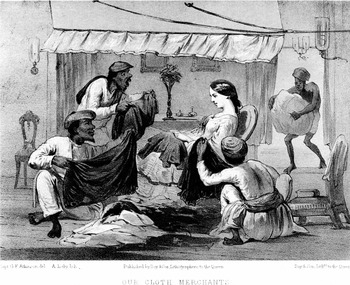
Is Curry & Rice a dissembling narrative, striking a confident, even jovial, pose at a time of terrible uncertainty and fear?Footnote 25 Atkinson's book, however, is not simply a revision of Mutiny narratives; its feigned amnesia and self-deprecatory humor is an elaborate masking of the British administration's insecurity about their control over colonial subjects and territories. Instead of rallying his fellow countrymen to avenge the slaughter of British women and children, the author tries to counter native insurgents by reducing them to comical bit players in an English farce. Unlike the bloodthirsty British soldiers who emerged from their thatched cottages of fear and descended upon suspected rebels with the cry “Remember Cawnpore,” Atkinson issues a different call: Forget Cawnpore.Footnote 26 Atkinson's Kabob so diligently sets out to divert its readers from the narratives of horror that the only form of Indian conspiracy allowed is the koprawalah's (cloth merchant) machination to sell an overpriced piece of cambric or a milkman's sly addition of water to the daily pail. Rupee Doss and Chouse Lall surround the wives of Kabob with their bales of fabric and launch into wheedling, lying, gossip mongering, and flattering in order to sell some silk or cotton.
Servants form the landscape of Kabob and are as numerous as the hazy outlines of undifferentiated palm trees in the horizon of each plate. Contemporary writers frequently comment on the sheer number of servants employed by an Anglo-Indian household. For instance, Robert Riddell's Indian Domestic Economy and Receipt Book, first published in 1849, devotes the entire opening essay to the management of servants, their proper treatment, punishment, wages, and liveries.Footnote 27 For many Anglo-Indians, the excess of domestic servants is both delightful and threatening. Consider the following passage from Lady Maria Nugent's Indian journal, published in 1839:
I sat leaning on the table, expecting a cup of tea and a biscuit on a waiter, when the folding doors were thrown open, and the huge butler, or khanasounah, looking like the great Mogul himself, marched up towards me, followed by eight men, one with a cup of tea, another with milk, a third with sugar, and so on – one man with a chowrie, or silver stick, with a white cow's tail, to keep the flies off, &c. I begged to be left alone, and at last, by signs, made them understand me; however, the Mogul would not leave me, he placed the others outside the door, and then stood behind my chair. (87)
Lady Nugent's entry is melodramatic in its over-description. Her position of privilege is inflated and threatened in the same scene. The “Mogul” is her servant. At the same time, she is scared of the domestic help. In fact, Lady Nugent's position of power and vulnerability is the topic of a rather large body of postcolonial scholarship engaged with the politics of gender and imperialism.Footnote 28 In 1857, Lady Nugent's teatime realization becomes a prototype of the Anglo-Indian female experience.
The figure of Indian men surrounding a lone British woman occurs frequently in Curry & Rice, and Plate 35, “Our Cloth Merchants,” is no exception.” (Figure 4). The memsahib sits on an upholstered European chair in a room bearing the aesthetic signs of western civility in the form of two, symmetrically placed framed paintings on the wall and an arrangement of flowers in a tall vase placed exactly in the middle. The only sign of the east to be seen in the room, aside from the presence of the cloth merchants, of course, is the punkha (fan) strung across the top of the image. The merchants crowd the picture, holding up lengths of fabric in a tantalizing semicircle around the white woman. Heaps of fabric lie at her foot, and even more fabric seems to be on its way, as evinced by the half-clad figure entering through the door at the back with a heavy bale of cloth. The popular Mutiny image of rapacious sepoys surrounding a vulnerable and morally upright British woman is given a new dimension in this arrangement of bodies poised strictly for a commercial transaction. Gaunt and crouching, the men here are clearly inferior in class and possess little virility. However, their threat looms in a fiscal, not sexual, form, for they “have the very soul of profit within them . . . [and] their bundles traverse every street, and their bills haunt every bungalow” (35).
Plate 25, “Our Cloth Merchants.” Illustration from George Francklin Atkinson, Curry & Rice (on Forty Plates) or The Ingredients of Social Life at “Our” Station in India (London: Day and Son, Reference Atkinson1859).

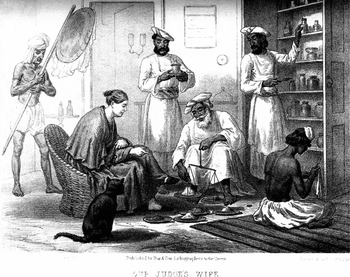
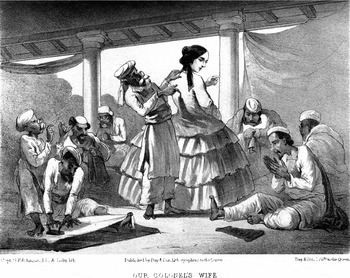
No doubt the commercial relationship between the memsahib and her Indian vendors serves a regulatory, and even a reassuring force. The woman retains her position of power as a consumer of goods, a mistress of the household and a member of the ruling elite. She is routinely on the lookout for cheats and liars and monitors her servants and suppliers rigorously. In another plate (Plate 4), Mrs. Turmeric, the judge's wife and “our” burra beebee (grand lady), is shown surrounded by Indians within her own domestic space (Figure 5). Looking far from threatened by a possible insurgency, she literally holds the keys to the situation in her hands. In the accompanying narrative, she vigilantly observes cheating servants and, according to Garlic, hits the milkman for a “deficit in the milk-pail” and the groom for feeding extra grain to the horse. (She apparently also metes out this treatment to her livestock, “walloping” her turkeys, for instance, thus putting her domestic servants on the same level as her domestic animals.) However, a contemporary reader would no doubt be privy to the undercurrents of tension in illustrations such as these depicting Anglo-Indian women surrounded by cloth merchants, household servants, and tailors. In Plate 8, Mrs. Capsicum, the colonel's wife, stands alone among eight Indian men, being measured for a dress (Figure 6). The men observe her body, take stock of it, and handle it. Although the image is jocular, the cries of the Bibighar massacre in Cawnpore do not die away quickly. The location of this image at the liminal point, quite literally at the threshold or the verandah of the house, between an interior, domestic setting marked by English aesthetic order and an outdoor picturesque landscape with its attendant irregularities (no doubt partially tamed by the artist's hand) sets the scene for a potentially disruptive set of occurrences. The tension of the image lies in the ambiguity of both the relationship between the English woman and the Indian men and of their respective relationships to the space they occupy. Atkinson's verandah scene freezes the colonel's wife in a part of the house leading outside. One step past the pillars of the verandah and, as the reader can well imagine, “Our Colonel's Wife” will be well on her way to the Indian outdoors, past the presumed safety of her bungalow. The Indian tailors occupy a similar transitional space: while the business transaction between them and the white woman allows for their presence within the outer limits of her domestic space, what can happen if they overstep that boundary and enter the house proper?
Plate 4, “Our Judge's Wife.” Illustration from George Francklin Atkinson, Curry & Rice (on Forty Plates) or The Ingredients of Social Life at “Our” Station in India (London: Day and Son, Reference Atkinson1859).

Plate 8, “Our Colonel's Wife.” Illustration from George Francklin Atkinson, Curry & Rice (on Forty Plates) or The Ingredients of Social Life at “Our” Station in India (London: Day and Son, Reference Atkinson1859).

Whatever actually occurred to those women who were caught up in the events of the Mutiny, the European woman's fear for her personal bodily safety was widespread in 1857. Even Queen Victoria, sitting far away in London, never a firsthand witness of any of the atrocities, cannot help but echo the woman's nervousness. In September 1857, she writes to Lady Canning, her indefatigable correspondent and supplier of Indian information, as follows:
Dear Lady Canning,
That our thoughts are almost solely occupied with India & with the fearful state in which everything there is – that we feel as we did during Crimean days & indeed far more anxiety, you will easily believe. . . . A Woman & above all a Wife & Mother can only too well enter into the agonies gone thro' of the massacres. (Allen 79)
In contrast, Atkinson's British wives and mothers feel no threat from their Indian servants. The narrator, an insider of Kabob society, implores us, the newcomer from England, to forget Cawnpore and enjoy the service of effete, sycophantic native servants who pose little threat to anyone. The violent rupture of Anglo-Indian domestic life – rape, mutilation, forced conversion – caused by the events of 1857 is erased in favor of the wedding of Carry Cinnamon and Captain Cheeny at the conclusion of the forty plates.Footnote 29 It is a ceremony that desperately consolidates British presence in the colonies and promises domestic felicity for the colonial couple.
But all is not pukka in this image of Victorian domestic bliss. Although the women are not abducted, raped, or forcefully converted to Islam,Footnote 30 Kabob has been so thoroughly permeated by eastern spices and seasonings that the English body has been dyed yellow, brown, and black and named Judge Turmeric, Padre Ginger, Bella Clove, and Major Garlic.Footnote 31 The station of Kabob is filled with the pungent flavors of Indian cookery – a barely veiled metaphor of cultural consumption that betrays latent anxieties of cultural pollution and miscegenation.
Curry & Rice typifies the mid-nineteenth century Anglo-Indian's sense of exilic nostalgia for England. Yet a return to the English dinner table far from the cries of Cawnpore is fraught with difficulties as well: the narrator who yearns for English roast beef and a bottle of claret finds the return home complicated by his changed manner of feeding in the eastern colonies.
Chutney Mary and Pickled Harry
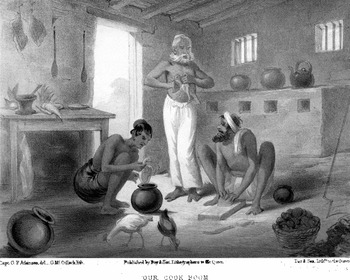
It is the nostalgic dream of an exiled English population that provides the alternative side dishes to the Indian feast. While Indian dishes form the dominant metaphor for Anglo-Indian life in “Our Station,” remembered feasts from life in England provide a persistent counterpoint to the narrative of exile. The delicious curry which Atkinson promises in his preface appears only twice in the entire book. Significantly, both these discussions of a satisfying curry are part of largely nostalgic episodes. Every description of curry is overshadowed by a remembered meal back home. Even the delicious curries prepared by Indian cooks in Kabob send the narrator into reveries of well-scrubbed English kitchens with gleaming saucepans and spotless crockery and a “plump, red-faced, and brawny” cook in “Our Cook Room” (34). The narrator's fantasy of the red-faced English cook is important to understanding the colonial home around 1857. The narrator's dream kitchen includes:
the glittering array of saucepans, the rows of cleanest crockery marshalled on their shelves, the cups and jugs hung pendent from the ledge, the table and the dresser with their spotless purity; and then the glittering range, with the bright fire blazing in the grate, and all the appurtenances and appliances arranged in the neatest order and precision, while cleanliness is the conspicuous feature in it all . . . (34)
Anne McClintock's formulation of “the undervaluation of women's work in the domestic realm, the overvaluation of the commodity in the industrial market and the disavowal of colonized economies in the arena of empire” (208) explains the scene at hand in “Our Cook Room” (Figure 7). Order and invisible labor are key features in this remembered English space. The servant's labor has been mysteriously erased while its product, the clean pots and pans, are displayed with fetishistic precision. Although the housewife or domestic servants (with predominantly female servants in charge of kitchen work) might have tended to the remembered English kitchen, in colonial India, such work is transferred to the male native servant. Here, the undervaluation of female labor in England is directly substituted by the disavowal of colonized economies. Further, while the narrator nostalgically longs for the plump, red-faced female cook of his past domestic life, he harbors no such sentiment for the Indian khansama (chef) who presides over the dark kitchen. His memory's cook offers physical and moral sustenance; the khansama, in contrast, produces unpalatable, if not dangerous, fare.
Plate 34, “Our Cook Room.” Illustration from George Francklin Atkinson, Curry & Rice (on Forty Plates) or The Ingredients of Social Life at “Our” Station in India (London: Day and Son, Reference Atkinson1859).

Aesthetically, the spotless purity of the English kitchen – and by extension of the English civilization – is reflected by the shiny surfaces of pots, crockery, range, and fire.Footnote 32 It is here that we run into a small problem: the bright fire in the grate, the source of light that adds the glow to all the other objects in the English kitchen was on the wane in the second half of the nineteenth century. In her study of Victorian cookery, Sarah Freeman writes that the newly invented gas range was ousting the open fire from the kitchen (121). Such ranges appeared infrequently, if at all, in the nineteenth-century colonial kitchen. As a contemporary Anglo-Indian account laments, English-style roasting was indeed a dilemma in the Indian kitchen:
And now you will ask how we roast. I might, if I desired to avoid the question, inform you with some anxiety that we have amongst us a few English kitchen ranges, but I must honestly confess my fear that we could not muster many more than a sufficiency of them to roast the joints of a Herefordshire ox or an Airedale heifer. (Anglo-Indian Domestic Sketch 24–28)
However, back in England, the innovation in the management of fire was not free of contention. As Freeman notes, the new gas oven led to a public controversy over the favorite national dish, roast beef. Many Victorians complained that meat cooked in a closed heating system without direct contact with fire tasted baked and not roasted. Thus, as the colonial in Kabob yearns for a glowing fire and roast beef, the technological innovations of the nineteenth century make way for entirely different kitchens and national dishes.Footnote 33
While the “spotless purity” of the bright Victorian kitchen undergoes its own change in England, what is the status of Kabob's kitchens? It is an impenetrable area for most Anglo-Indians, the heart of darkness.
Look into that Oriental kitchen. If your eyes are not instantly blinded with the smoke, and if your sight can penetrate into the darkness, enter that hovel, and witness the preparation of your dinner . . . The preparation for your dinner must therefore be performed in the earth's broad lap, like everything else in this Eastern land. (34)
The dark, smoky hovel is truly the most Indian space in an Anglo-Indian house. The furniture, the decor, the labor – all is predominantly Indian in this room. While the other rooms in a typical European Kabob house are fitted with imported furniture, paintings, pianos, and libraries, the kitchen remains untouched by the western hand. The cooking is done on the floor, and the latest gas ranges from England have barely made their appearance. The elderly head chef is an Indian who poses a comical threat to English cuisine:
And a not over-alluring object is that head of the culinary department, I must confess – a venerable man with silvery locks. We entertain the most profound respect for grey hairs, but only when in their legitimate sphere of utility . . . [a]nd when we see the snowy locks that flutter in the breeze, we sincerely trust that they will continue to flutter in the breeze, and not invade the sanctity of the saucepan. (34)
No doubt the narrator is joking with mock-grandiosity about the possibility of the cook's hair showing up on his dinner plate. Yet the language of invasion – an Indian invasion of British sanctity – must be read in the context of contemporary events. What we find here is an inversion of Gubbins's reported rumors. The supposed Indian anxiety of cultural defilement through enforced ingestion of taboo foods (human parts, pork, beef, and so forth) has been inverted into a British anxiety of defilement. By extension, colonial violence unleashed upon the so-called Indian traitors is erased in favor of alleged crimes against the English body.
We have seen the claims of enforced cannibalism in Queen Victoria's letter to Lady Canning earlier: the Queen wonders if the Anglo-Indians were really made to eat their children by rebel sepoys. The rumor here involves a situation where the British are made cannibal, degraded and pushed outside of the limits of society, by the sepoys.Footnote 34 In her account of Mutiny atrocities, Jenny Sharpe reports that the British, in turn, also pushed their Indian prisoners outside the bounds of society as they exacted vengeance in 1857. Prisoners were made to eat taboo meats and practice a kind of enforced vampirism by licking up the dried blood of their British victims before being hanged in public.Footnote 35 It is against this backdrop of degradation and counter-degradation involving the eating of taboos that the silvery locks from an Indian head appear on the narrator's plate. The threat of “invasion” posed by the cook's hair is both a political and a cultural threat. Indianness, as it turns out, enters the British body via more than one route in Kabob.
At first, the Indians seem to pose little threat to “Our Station.” These brown men are not poised to rape. Their women are never dangerously seductive. As the description accompanying the first plate, “Our Station,” establishes, “Kabob is not regarded in the light of being the most attractive station in India” (2). The hideous Hindu mythological figures which grace bazaar walls are a deadpan parody of the beauties of the subcontinent made famous in the west by François Bernier and Samuel Purchas.Footnote 36 And the products of Indian culture offer little charm. Even Indian food, which we all await, proves to be unpalatable. The local delicacies appear to be grotesque creations when compared with the lost delights of home. The visitor is invited to a stroll through the ubiquitous Indian bazaar and chances upon a sweet shop:
Opposite is a small confectioner's shop; to be sure we miss the ice-creams and tartlets, the jellies, and the buns – Bath and plum, the pastry and the cakes; but do we not see, and do not our mouths water at the contents of those brazen dishes, those savoury-looking mounds of tawny-coloured sweetmeats – combinations of oil, of treacle, and of flour, upon which the eyes of those two urchins have fallen and are feasting; and in which the Oriental damsel, with coin at command, is about to invest, lured by that pungent odour which, penetrating our olfactories, reaches to the very roots of our hair. (31)
The horror of those brazen, tawny-coloured mounds bears distinct resonances of a Swiftian portraiture of the Yahoo fondness for putrid food and excrement in Jonathan Swift's Gulliver's Travels (1726). The danger of those sweets that can actually penetrate the olfactory glands rests in their disregard for boundaries, a quality that Julia Kristeva names as the cause of abjection (4). Much like the cook's errant hair, the very smell of the sweetmeats can enter the English body. Yet the narrator demystifies the power of the unnamed indigenous sweet as he reverses the process of cooking to lay bare the familiar raw ingredients: oil, treacle, flour. However, the instrument of Indian aggression – the pungent, far-reaching aroma – remains veiled in mystery in this reversal. After all, neither oil, nor treacle, nor flour is particularly pungent. For the Anglo-Indian protagonists, the process by which Indian sweets acquire such a repulsive smell remains secret.
Native attempts at English cuisine are not much better. Besides the obvious unavailability of specific European food products (which was partly compensated by hermetically sealed tins of food from Messrs. Crosse and Blackwell) and the unsuitability of weather, much of the narrator's ire is directed at the ineptitude showed by native cooks in handling western fare. In fact, Atkinson's depiction of native cooks anticipates the observation in E. M. Forster's 1924 novel A Passage to India that the Anglo-Indians ate “the food of exiles, cooked by servants who did not understand it” (49).
Undoubtedly, the native cook is placed in a tight spot: his lack of an English repertoire marks him as irredeemably savage, and his vain attempts at “Christian cookery” mark him as a laughable impostor. On a visit to “Our Nuwab,” the denizens of Kabob are treated to a comical English meal, a pathetic native aping of western culture. The only Indian figure with any political authority is thus reduced to a harmless figure of fun. In place of the Rani of Jhansi or Bahadur Shah Zafar, we meet a nawab with a foolish taste for European objects and customs.Footnote 37 At his dinner party, the china and silverware are most inappropriately chosen, the order of courses – no doubt a commentary on indigenous administrative abilities – muddled and ludicrous. Not being in possession of the proper English sensibility and taste, the prince has simply ordered all sorts of tinned products from the local European store, “Sticker Doss's Europe Shop.” The white dinner guests can barely contain their snickering at this poor imitation of a London dinner party where “Lobsters and ‘tart fruits’ commingle, while truffled sausages and sugared almonds share mutually the same dish” (29).
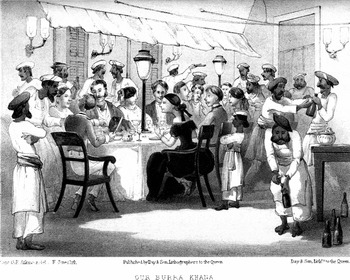
In this land of savagery where European culinary rules hold no sway, how is the narrator to maintain his Englishness? Curry & Rice is as much a satire of Anglo-Indian life as it is an apology for the social conduct of the English in India. The residents of Kabob attend balls, go to fox hunts, drink bohea at their coffee shops, and attempt to copy all the current London fashions at Mrs. Jhootmoot's tailoring shop.Footnote 38 They drink champagne and eat turkeys, hunter's beef, fowls, jellies, and blancmange at the annual ball. The more formal Burra Khanah (Figure 8) imports distant geographies as the smell of savory meats, such as ham and turkey, hang “about like a London fog” over a table fanned by a hand-pulled punkha (23). Yet the meals are never truly English: the champagne not quite chilled, the claret not quite right, and, more alarmingly, the guests not quite white.
Plate 23, “Our Burra Khana.” Illustration from George Francklin Atkinson, Curry & Rice (on Forty Plates) or The Ingredients of Social Life at “Our” Station in India (London: Day and Son, Reference Atkinson1859).

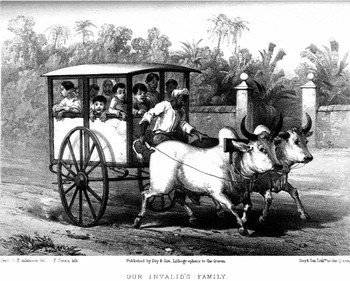
The falseness of English food in an Indian station is paralleled in the characters themselves of Curry & Rice. There are constant allusions to miscegenation in the station and to half-castes trying to pass as pukka English. “Our Invalid Major” Garlic is the most obvious figure of racial mixing with his brood of half-Indian children ranging in color from “unqualified coffee-colour” to “genuine, undeniable mud,” to “the yellow, the tawny, and the pink” (15). “Garlic's Colour-Box” is the name given by the disapproving English neighbors to the small coach that carries this group of multi-colored children – “Garlic's Irregulars” – around Kabob (Figure 9). The plate depicting Garlic's colour-box is the only lithograph that actually includes half-castes. Through the other thirty-nine plates, half-castes are the subject of gossip, never of illustration.
Plate 15, “Our Invalid's Family.” Illustration from George Francklin Atkinson, Curry & Rice (on Forty Plates) or The Ingredients of Social Life at “Our” Station in India (London: Day and Son, Reference Atkinson1859).

Garlic's exile from his homeland will last more than ten years – it is an irreversible and fatal exile:
Garlic has taken a step which he acknowledges will bind him irretrievably to the land of exile. Here he has made it his abiding-place, and here he will remain till he finds a still narrower home in the burial-ground of “Our Station.” (15, emphasis mine)
Garlic's progress from England to Kabob to his home with his “sable spouse” to the burial ground is charted along a downward curve. His home, much like the “Oriental kitchen,” is “the land of darkness.” His children, “of every tincture and of every tinge,” are the new shades for the Indian picturesque. Garlic's home is a model of eastern excess: bodies of innumerable children litter the floor; the air is heavy with the “odour of eastern confections and condiments”; his wife remains behind the purdah (the veil) and has ballooned into “an obese, ring-nosed, unctuous matron” (15). Clearly, Garlic's choice of lifestyle holds little temptation for any of the British men. The representation of Garlic's choice coincides with the prevalent social values of the day. Benita Parry writes that “[w]hite men in India continued to patronize Indian prostitutes and keep Indian mistresses, but intermarriage with Indians and Eurasians had by the mid-nineteenth century become a symptom of degeneration, and in popular fiction Eurasians were shown as debased and without dignity, as shrill and cringing, a warning against the mixing of the races” (50). Contemporary representations of the so-called Eurasian do indeed ring shrill in their conservatism. Here is a late Victorian portrait of the unfortunate multi-racial figure as seen through the eyes of an Anglo-Indian:
And sometimes the whitey-brown man is objectionable. He is vain, apt to take offense, sly, indolent, sensuous, and, like Reuben, “unstable as water.” He has a facile smile, a clammy hand, a manner either forward or obsequious, a mincing gait, and not always the snowiest of linen. (Aberigh-Mackay 102)
As any Anglo-Indian reader of Curry & Rice would guess, the children of the “colour-box” will receive no better reception in Atkinson's Kabob.
But what about female citizens of “Our Station”? Are they not tempted by the Indian men around them? Are we not to find a Miss Wheeler, living behind the purdah, in the bazaar?Footnote 39 The possibility of English women marrying Indian men is totally suppressed in Curry & Rice, and the wives and daughters are safely at home, in control of their servants and households. If Anglo-Indian society of Atkinson's era strongly discouraged the marriage of British men and Indian women, the union of a British woman and an Indian man was even more rigorously monitored (Strobel 4). The only women who pose any threat to this portrait of Victorian domestic stability are the ladies with suspiciously olive complexions who try to pass as Spanish. Mrs. Jhootmoot, Miss Chunam, Signora Jyfulini, and Miss Letitia Goley are four ladies who try to hide their true ancestry and claim Spanish blood.Footnote 40 The Qui Hyes of the Bengal presidency referred to women of mixed racial heritage as the chi-chis and the Chutney Marys. These figures exist on the borders of the colonial station. Signora Jyfulini's father is Portuguese and, as our host swears, “her mother is as black as my hat” (6). Letitia Goley cannot find a husband, and we are told, as an aside, that “Grandmamma Goley was indigenous, and powerfully tinctured with the blood of a Hindoo” (16). The unfortunate Mrs. Chunam's racial unveiling is quite dramatically discussed in “Our Coffee-Shop”:
Mrs. Chunam, who, as it is declared, has eleven pence out of the shilling of Hindoo blood floating in her veins, and who delights to veneer as much of herself as is exposed to public view, for the purpose of the whitening of her otherwise shady complexion – the heat, we understand, was so great, that the veneer cracked and peeled off in flakes; and further, that her dress happening to subside from off her shoulders, a lovely olive rim, where the veneer had not been applied, became visible, for the general edification. (19)
The Indian sun is responsible for the discovery of Mrs. Chunam's racial origins. Can these potent rays Indianize others in Kabob? This sun does not tan or merely darken the surface: it peels off the surface and reveals a darkness lying beneath. Significantly, there are no exact male counterparts for Mrs. Chunam and the other Chutney Marys. This early example of chutnification remains unquestionably feminized in Curry & Rice, leaving no Pickled Harrys (Anglo-Indian slang for bi-racial men) in its wake. In Kabob, British women are both the site of cultural purity and cultural deception.
Starboard Home
The curry spices which permeate the book as character names, the obsessive recollection of the “roast-beef of old England,” the tittering references to hunting dogs as “a miscellaneous assortment of indescribables, rejoicing in unabbreviated ears, and ambiguous in their genealogy” (24), and the continuing complaints about unpalatable local fare are surely metaphors for the anxiety of racial/cultural purity.Footnote 41 While the book modestly advertises itself as a reflection on the “sunny side of Indian life,” Curry & Rice is also a bid for acceptance among elite English readers. Nonetheless, as eager as the Kabob narrator, our cultural informant, might be for acceptance as truly English and as eager as he might be for the starboard cabin on the voyage home at the end of forty plates, the use of Hindustani words and phrases – sometimes translated but mostly functioning as metonymic gaps – continues to align the book alongside the exotic curry, slightly outside the perimeter of Englishness.Footnote 42 Moreover, while the author attempts to transport the English reader to the east, the circle of “Our Station” remains deceptively impenetrable: the land of Kabob, Bobarchy (chef), and Dekchy (cooking pot) remain veiled with “the scent of the flavouring-essences, together with the pungent odour of eastern confections and condiments undergoing the ordeal of concoction” (15) – much like Major Ginger's culturally/racially hybrid home.
Of course, curry continued to be part of nineteenth-century England's “colonial” menu. Mrs. Beeton's Dictionary of Every-Day Cookery (Reference Beeton1865) contained two recipes for curry powder.Footnote 43 The Indian Domestic Economy and Receipt Book had run into the sixth edition by 1865, while The Indian Cookery Book was published twice by 1880 (Oxford 182–83). However, the eastern spices seemed to disappear from recipes deemed “truly” British, such as roasts, puddings, and pies. A division was appearing between English, Indian, and Anglo-Indian taste.
In 1859, perhaps it was too late to extract oneself from the culinary game as Atkinson offered his invitation to an Indian dinner party to Englishmen back home and launched his elaborate food joke. Significantly, Atkinson's culinary intrigues reverse direction and continue well into the twentieth century. If the place of curry in British cuisine is a sign of the colonizer's continuing relationship with the colonized, then Saladin Chamcha's struggle with kippers, as memorably narrated by Salman Rushdie in The Satanic Verses (Reference Rushdie1988), is an instance of reciprocal appropriations by a postcolonial migrant. Saladin, a literary descendant of that famous Saracen, Salah al-Din Yusuf ibn Ayyub, sits down to his first breakfast of kippers at an English boarding school and realizes that his conquest of England begins with his crusade against that unmanageable, bony fish.