Introduction
As the general population ages, the number of older patients requiring inpatient psychiatric assessment and treatment is expected to increase. This segment of the population requires a healthcare workforce that has knowledge and expertise regarding its needs and challenges. Inpatient admissions are often helpful in determining the underlying psychiatric conditions of older patients, especially in uncovering previously undiagnosed dementia (Ashley et al., Reference Ashley2001). Geriatric psychiatric hospital units are an invaluable resource with known clinical benefit (Zubenko et al., Reference Zubenko, Rosen, Sweet, Mulsant and Rifai1992; Wancata et al., Reference Wancata, Windhaber, Krautgartner and Alexandrowicz2003). Due to the cost and limited availability of specialized geriatric psychiatric units, it is incumbent upon healthcare providers to use these resources in a judicious and optimal manner, especially in the context of an aging population and increasing need.
The length of stay of older psychiatric inpatients varies across studies and depends as much on hospital setting (e.g. general medical hospital vs. psychiatric-specific hospital) as on demographic and illness factors. Although historically not well described, it has been suggested that in a general hospital setting, complex comorbidities, the behavioral symptoms associated with dementia, the predisposition of older patients with dementia to hospital-acquired infections and complications of treatment and difficulties in arranging placement or community services contribute significantly to prolonged LOS (Saravay et al., Reference Saravay2004; Connolly and O’Shea, Reference Connolly and O’Shea2013). Comparison groups in general hospital settings are patients with illnesses such as congestive heart failure or atrial fibrillation, whereas in psychiatric hospitals, where the relationship between dementia and LOS is less clear, the comparison patients have schizophrenia, depression and bipolar disorder. For example, a study of 272 patients age 60 years and over (71 of which had a diagnosis of dementia) admitted to a geropsychiatric hospital in Michigan state over the span of 22 months revealed a mean (SD) of days spent in hospital was 392.3 (752.81). The median number of days of hospitalization was 72.0. Diagnosis in this study did not affect length of stay (Parks and Josef, Reference Parks and Josef1997). An Australian study of 60 people age 65 years and over admitted to a general psychiatry unit and a further 43 of the same age range admitted to a long-term psychogeriatric unit over the span of four years, all of whom were diagnosed with dementia, found a mean length of stay of 28.5 days and 47.9 days at each respective facility (Snowdon, Reference Snowdon1993). A diagnosis of dementia has also been found to lead to lengthier hospitalizations in general medical hospitals when the reason for admission is not directly related to the diagnosis of dementia. An Australian study of approximately 253,000 people over the age of 50 (of which approximately 20,000 had a diagnosis of dementia) admitted to one of 222 public hospitals in New South Wales between July 2006 and June 2007 found that those diagnosed with dementia had a mean length of stay of 16.5 days, whereas those who did not have a diagnosis of dementia had a mean length of stay of 8.9 days (Draper et al., Reference Draper, Karmel, Gibson, Peut and Anderson2011).
Despite the often lengthy nature of geriatric psychiatric hospitalizations, there is a lack of empirical data guiding the use of these beds and services. Therefore, we analyzed data from a large database to characterize older patients who were hospitalized for the treatment of psychiatric illness and to identify the predictors of hospital LOS in geriatric psychiatric inpatients who had dementia. To better understand these predictors, we analyzed and compared the dementia group to without dementia geriatric psychiatry patients admitted to the same wards. We hypothesized that a dementia diagnosis would predict a longer LOS.
Methods
Setting
The Centre for Addiction and Mental Health (CAMH) is a 538-bed academic specialty hospital that offers both secondary and tertiary services to adult patients with mental and substance-use disorders. CAMH is located in downtown Toronto, Ontario. It is Canada's largest mental health and addictions teaching hospital and has specific programs for various illnesses and age groups. The hospital was once a traditional mental health institution but in 1999 was deemed acute care and has a psychiatry emergency department and a primary care clinic. Hospital funding is part of a universal healthcare model in which hospital costs are paid for out of provincial government budgets. The two identical geriatric inpatient units at CAMH comprise 48 beds, more than half of the 94 specialized geriatric psychiatry beds in Toronto, a city with over 2.6 million people. Patients admitted to these two units are over 60 years of age and are primarily diagnosed with dementia, mood disorders, or schizophrenia. The CAMH geriatric psychiatry beds are one of only 2 sites in Toronto that cater to severe behavioral disturbances in dementia. Patients are admitted directly from CAMH emergency department, upon transfer from other units at CAMH, upon referral from other hospitals, or upon direct referral from CAMH outpatient clinics or from the community for scheduled admissions.
Assessment instrument
All patients admitted to a CAMH inpatient unit are assessed with the RAI-MH on admission and at discharge, as well as quarterly if they are in hospital for more than three months. The RAI-MH is a patient-focused, multidimensional inventory designed to be part of a larger integrated health information system (Hirdes et al., Reference Hirdes1999). It allows for the systematic assessment of patient characteristics and it has been shown to be a valid and reliable method to characterize patients (Poss et al., Reference Poss2008). It has been used to predict outcomes in geriatric psychiatry patients (Smith and Hirdes, Reference Smith and Hirdes2009; Ismail et al., Reference Ismail2012). Its use has been mandated by the province of Ontario for all adult inpatient mental health beds since October 2005. The RAI-MH provides extensive data, including demographic information, language, education, reasons for admission, residential status, mental health service history, inpatient status, capacity, forensic history, mental state, function, self-care, cognition, service utilization, and psychiatric diagnosis. At CAMH, the RAI-MH is completed through an online tool by members of the multidisciplinary team, with psychiatric nurses providing the majority of the required information. All staff are trained in the RAI-MH domains for which they are responsible, and data consistency is monitored through a decision support office at CAMH.
Database creation
This analysis focused on data for all patients admitted to and discharged from geriatric psychiatry units comprising 48 beds between January 1, 2005 and December 31, 2010. Data were anonymized by removing the patient's name and medical record number from the data file. The anonymized final data file contained the following information for each patient included in the analysis: hospital LOS; patient age; gender; diagnosis; and RAI-MH outcome data. The RAI-MH assesses multiple domains pertinent to a patient's care, including their abilities, medical and psychiatric status, key supports, and needs.
Patients
There were 699 visits from 490 patients available for analysis in the master dataset. 370 patients were found to have a single visit, while the remaining 120 patients had more than one visit. For each multiple visit patient, only one of the multiple visits was randomly selected for inclusion in the analysis. This was necessary in order to meet the independence of observations assumption that underlies the statistical methodology. 13 patients whose multiple visits spanned different inpatient programs were omitted. The resulting sample contained 477 patients: 169 geriatric patients with dementia, and 308 geriatric patients without dementia.
This study was approved by the CAMH Research Ethics Board and exempted from the requirement for informed consent because the study involved de-identified data acquired during routine care.
Data analysis
Data analysis was conducted using SAS/STAT software, version 9.1.3 of the SAS System for Windows (Copyright 2002–2003 SAS Institute Inc., Cary, NC, USA). A series of clinically relevant predictors were selected and the set was reduced through preliminary exploratory analyses (t-tests, χ2 tests, and ANOVA were used as appropriate). A natural-logarithm transformation was applied to hospital LOS (defined by the number of days between discharge and admission) prior to testing in order to improve its distributional properties, to better meet the statistical assumptions underlying the approach.
To investigate the characteristics associated with hospital LOS among geriatric inpatients, a series of general linear models were conducted. The variables included (with RAI-MH item number) in the analysis are: gender (BB1); threat to others (CC2b); inability to care for self (CC2c); involvement with the criminal justice system (CC2f); living arrangements (alone compared with not alone) (CC3); number of recent psychiatric admissions (DD1); age at first hospitalization (DD6); inpatient status (voluntary, compared with involuntary) (A3); incapacity (A4); insight (B2); history of falls (I7a); medication refusal (K2); use of control interventions (M1); close or constant observation (M2); available social supports (P1); total days in alternative level of care (X75); activities of daily living (ADL); ADL hierarchy; instrumental ADL (ADL); cognitive performance scale; depression rating scale; positive psychotic symptoms; negative psychotic symptoms; aggressive behavior scale; changes in health, end-stage disease and symptoms and signs (CHESS) scale; and pain. The analysis incorporates the values of these variables at time of admission, collected within the first 72 hours. While discharge information was available for most of these variables as well, these characteristics would be of limited value in predicting hospital LOS among future patients, as they cannot, by definition, be known until the end of each patient's stay. The one exception to this rule is incapacity (item A4). Patients are defined as having incapacity if any of the RAI-MH capacity items (treatment, property, disclosure of health information, or having a substitute decision-maker) are endorsed at either admission or discharge, because capacity assessment can often be overlooked during the first 72 hours of hospitalization when safety and initiation of treatment are prioritized.
Any predictors that were not associated with hospital LOS were excluded using a purposeful selection of covariates approach. Two-way interactions between the study group and all of the predictors were investigated, and only those found to achieve or approach statistical significance were retained in the final model.
Results
Descriptive analysis
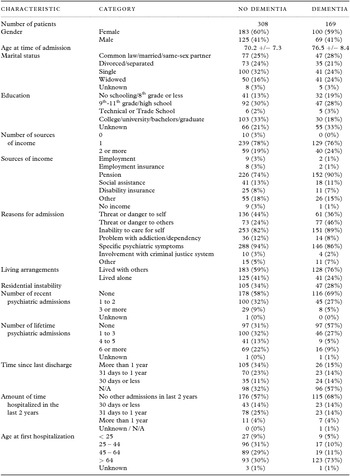
Group demographics are shown in Table 1. The mean (SD) LOS for geriatric dementia patients was 74.7 (93.7) days with a median (range) of 46.0 (4.0–795.0); the mean (SD) LOS for without dementia geriatric psychiatry patients was 69.8 (87.5) days with a median (range) of 42.0 days (3.0–861.0). The geometric mean LOS was 38.13 days in the dementia group and 34.63 days in without dementia group, a non-significant difference (p = 0.32).
Group demographics – continuous measures are summarized by their mean and standard deviation, while categorical measures are reported as n (%)

The mean age among patients without dementia was 70.2 (SD 7.3) and among dementia patients was 76.5 (SD 8.4). These groups differed significantly in age (t = 8.09, df = 304.3, p < 0.0001). 100 of the dementia patients were female (59%) and 183 of the without dementia patients were female (60%). 33% of without dementia patients were college- or university-educated, compared to 18% of dementia patients. 46% of dementia patients were described as a threat or danger to others, while the same was true of 24% of without dementia patients. 41% of without dementia patients lived alone, while 24% of dementia patients lived alone. 57% of dementia patients had no previous psychiatric admissions, compared to 31% of without dementia patients. Finally, 30% of without dementia patients were admitted to hospital for the first time after the age of 64 years, whereas 73% of dementia patients were over the age of 64 years for their first hospitalization. Taken together, these findings suggest that without dementia patients were more likely to be college- or university-educated, less likely to post a threat or danger to others, more likely to live alone, more likely to have previous psychiatric admissions, and more likely to be hospitalized earlier in life than dementia patients.
Predictive analysis
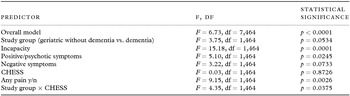
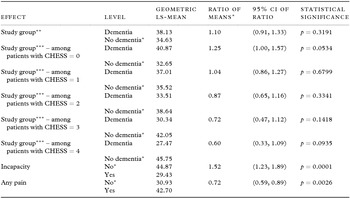
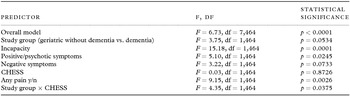
Table 2 describes the results of the reduced general linear model comparing dementia patients to without dementia patients. The interpretation of group effects and parameter estimates is different than in a standard linear model due to the log-transformation of the outcome variable. Instead of obtaining beta coefficients, which can be used to estimate of the difference between group means, estimates of the ratios of the geometric means of patients across levels of each predictor variable are obtained. These ratios and corresponding hospital LOS geometric means are summarized in Table 3.
Model results, dementia sub-analysis – R 2 = 0.09, n = 472
Geometric LS means, dementia sub-analysis

*Reference category for ratio.
**Averaged over all levels of all other predictors.
***Averaged over all levels of all predictors not involved in the interaction.
The only predictor that varies across study groups is CHESS score, a marker of medical burden. A low score, reflecting minimal medical burden predicts a longer LOS in the dementia group versus the without dementia group. A high score, reflecting a greater medical burden predicts a shorter length of stay in the dementia group versus the without dementia group. Predictors of LOS in both dementia and without dementia study groups are incapacity and positive psychotic symptoms which significantly increase LOS, and the presence of pain which significantly decreases LOS.
For every unit increase in CHESS scores, length of stay decreases on average by 9% among dementia patients (95% CI: 21% decrease to 3% increase in length of stay per unit increase in CHESS scores). Among patients with low CHESS scores (0, which is very close to the sample mean), dementia patients stay on average 25% longer than without dementia patients (95% CI: 0%–57% longer stays among dementia patients). At high CHESS levels (i.e. 4, the scale maximum), dementia patients stay on average only 60% as long as without dementia patients (95% CI: 33% – 109%).
Patients with any incapacity (at either admission or discharge) stay on average 52% longer (95% CI: 23%–89% longer) than those with no incapacities, irrespective of study group. Similarly, the presence of positive psychotic symptoms increased LOS in both dementia and without dementia groups. LOS in patients with positive psychotic symptoms was 7% longer than those without (95% CI: 1%–14%). The presence of pain, in both study groups, predicted a shorter LOS. Patients with pain had a mean LOS that was 28% less (95% CI: 21%–41%) than those without pain.
Discussion
We have found that overall, mean LOS is not significantly different between study groups. A review of 131 admissions, comprising 121 patients over the age of 55 (of which 59 had dementia), during a one-year period to a geropsychiatry ward in the United States also found that the diagnosis of dementia did not increase LOS (Aisen et al., Reference Aisen, Giblin, Packer and Lawlor1994). This is in contrast to another study in South Korea of 26,712 patients aged 65 and over admitted between January 1, 2005 and June 30, 2006 for any psychiatric reason to any medical institution (comprising “psychiatric and non-psychiatric institutions”), which determined that a diagnosis of dementia increased LOS in a psychogeriatric population of patients admitted to hospital, regardless of the type of hospital (Chung et al., Reference Chung, Oh, Suh, Lee, Oh and Yoon2010). Another study of 80 general adult psychiatry patients admitted between June 2001 and 2002 to the Massachusetts General Hospital Inpatient Psychiatry Unit (which is not a specialized psychogeriatric unit) also found that older age and the presence of cognitive impairment increased LOS (Blais et al., Reference Blais2003). Our findings suggest that in specialized geriatric psychiatry inpatient service, dementia diagnosis alone does not predict a longer LOS in comparison to other patients with late life mental health issues such as schizophrenia, depression and bipolar disorder.
The number of medical comorbidities was measured by the CHESS score, which was designed to provide a single, parsimonious summary variable rather than a collection of individual items (Hirdes et al., Reference Hirdes, Frijters and Teare2003). The number of medical comorbidities appeared to decrease LOS, but only in patients with dementia. The mean LOS for dementia patients with a CHESS score of 0 (n = 101, 59.8%) was 25% longer (95% CI: 0%–57%) than without dementia patients with the same CHESS score (n = 181, 58.8%), while the mean LOS for dementia patients with a CHESS score of 4 was 40% shorter (95% CI: 67% shorter to 9% longer) than without dementia patients with the same CHESS score. A sequential increase in CHESS score, from 0 to 4, among dementia patients bore an inverse relationship to LOS compared to without dementia patients. This finding was consistent among the range of CHESS scores. It could suggest, however, that the presence of multiple medical co-morbidities among patients with dementia could predict a shorter LOS because patients with dementia experience greater burden from the cumulative effect of acute, reversible medical causes than without dementia patients. It is possible that assessing and treating this medical burden in dementia patients results in more rapid discharge from the geriatric psychiatry inpatient environment due to improvement in the patient's presenting condition. This is consistent with a retrospective naturalistic Canadian study of geriatric psychiatry inpatients in a psychiatric hospital. Over the 4-year study period, the 85 patients admitted who required antibiotics for treatment of infection within the first 2 weeks of admission had a significantly shorter LOS than the 305 patients admitted who did not require antibiotics. Dementia was equally represented in both groups (Malyuk et al., Reference Malyuk, Wong, Buree, Kang and Kang2012). By contrast, in a small prospective study of 88 admissions (comprising 73 diagnostically heterogeneous patients) to a psychogeriatric unit in Sydney, Australia, medical illness was not predictive of LOS (Draper and Luscombe, Reference Draper and Luscombe1998). Similarly, In a 1-year study of 121 diagnostically heterogeneous admissions to a psychogeriatric unit, Aisen et al. also found no correlation between medical co-morbidity and LOS, and in fact found that discharge disposition and not clinical factors were associated with LOS (Aisen et al., Reference Aisen, Giblin, Packer and Lawlor1994). From our data, one can speculate that the dementia patients have decreased brain and cognitive reserve, making them more susceptible to underlying medical illness, and more likely to present with behavioral and psychiatric symptoms resulting in hospitalization to a psychiatric unit as opposed to a general hospital medical unit (Jones et al., Reference Jones2010). Similarly, in a recent study assessing inappropriate psychiatric admission of elderly patients with unrecognized delirium (Reeves et al., Reference Reeves, Parker, Burke and Hart2010), the authors found that symptoms of delirium appear more likely to be incorrectly attributed to psychiatric illness in patients with a history of mental illness than in patients without such a history. It is these very patients that may be admitted to a psychiatric hospital at which point the medical workup is completed and reversible medical issues are treated. Treating these medical illnesses may more rapidly return functioning to baseline, which may result in a corresponding shorter LOS. In contrast to our elderly population, in the general adult population when medical issues are prominent, hospital LOS is longer and functional and psychiatric outcomes our poorer (Lyketsos et al., Reference Lyketsos, Dunn, Kaminsky and Breakey2002).
In both study groups, the presence of incapacity predicts longer LOS. Patients with any incapacity stay on average 52% longer (95% CI: 23%–89% longer) than those who are not deemed incapable. This finding is consistent with previous work, including our studies of geriatric patients with mood disorders (Ismail et al., Reference Ismail2012). The presence of incapacity contributes to longer LOS when the need for hospitalization and prescribed treatment are contested (Blank et al., Reference Blank, Hixon, Gruman, Robison, Hickey and Schwartz2005). When a clinical finding of capacity is contested, this in turn leads to delays in treatment and a substantially longer LOS (Kelly et al., Reference Kelly, Dunbar, Gray and O’Reilly2002).
The presence of positive psychotic symptoms also increases mean LOS in both study groups. Patients with positive psychotic symptoms stay on average 7% longer (95% CI: 1%–14% longer) than those without positive psychotic symptoms. This finding is consistent with another study that found that higher brief psychiatric rating scale positive symptoms scores, the provision of ECT, falls, pharmacology complications, multiple prior psychiatric hospitalizations, and requiring court proceedings to provide medications or continue hospitalization, were predictors of longer stays for geriatric patients in general (Blank et al., Reference Blank, Hixon, Gruman, Robison, Hickey and Schwartz2005). Positive psychotic symptoms therefore are not just a sign of a significant mental illness, but also a predictive factor of longer LOS compared to other factors.
Higher admission pain scores predict shorter LOS in both dementia and without dementia diagnostic groups. Patients with pain had a 28% shorter LOS (95% CI: 11%–41%) than those without pain. This is consistent with our previous published findings in geriatric, but not adult, patients with mood disorders (Ismail et al., Reference Ismail2012), in which it was felt that pain had a greater functional impact in older adults. There remains little published data of which we are aware that explains this finding. We postulate that in the population of older adults admitted to geriatric psychiatry in a psychiatric hospital, pain may have a similar effect on LOS to that of increased medical burden and CHESS score in dementia patients. Pain may contribute significantly more to loss of function and symptom severity, and increase need for hospitalization in this patient population. Identifying and treating pain may result in a more rapid amelioration in overall symptom burden, and corresponding shorter LOS. Further study into this interesting finding is warranted.
Although, the time frame and population size of our study were substantial, there are several limitations to this study. CAMH is a psychiatric hospital, so while the results may be generalizable to other such psychiatric hospitals, the applicability to general hospitals is less clear. Further, the economic and health systems environment may vary across venues, and these results may only be applicable to the universal healthcare system studied, in which there is a single provincial government payer for hospital costs and physician fees. While there is pressure for bed turnover, this is not fuelled by insurance companies or a potential lack of reimbursement, but rather by waiting lists and need for timely admissions. The decision to include only those patients who have already been discharged from CAMH over the 5-year period may also bias the results by not including those patients with extremely long hospital LOS who had not yet been discharged. Given the 5-year study duration, and the fact that these very long stay patients are uncommon, we feel that the results do represent the vast majority of admissions for geriatric patients with dementia and without dementia diagnoses.
We have determined predictors of psychiatric hospital LOS in geriatric patients with and without dementia. Overall, psychiatric hospital LOS is similar in geriatric inpatients, regardless of diagnosis. The only variable which affected dementia and without dementia groups differently was the presence of a greater number of medical comorbidities, as indicated by higher CHESS score. While a higher CHESS score does not appear to predict LOS among without dementia patients, a higher CHESS score is associated with a shorter hospital LOS among dementia patients. Incapacity and positive psychotic symptoms predict significantly longer psychiatric hospital LOS in geriatric patients regardless of psychiatric diagnosis. Conversely, pain on admission predicts a significantly shorter psychiatric hospital LOS, also irrespective of diagnostic group. Assessing predictors of hospital LOS is significant for optimal management of valuable, and scarce, hospital resources. Identifying the factors that predict hospital LOS would permit more timely and focused interventions that reduce hospital LOS, improve overall access to inpatient beds, and allow patients to be cared for in the community. Community resources themselves could be enhanced and focused on addressing predictive factors, both before and after hospitalization, resulting in fewer and shorter inpatient stays.
Conflict of interest
None.
Description of author's roles
Z. Ismail – application for funding, study conceptualization and design, literature search, manuscript preparation.
T. Arenovich – database creation, data analysis and interpretation, manuscript revision.
R. Granger – manuscript preparation.
C. Grieve – database creation, data collection and interpretation, manuscript revision.
P. Willett - database creation, data collection and interpretation, manuscript revision.
S. Patten – manuscript revision.
B. Mulsant – study conceptualization and design, manuscript revision.
Acknowledgments
This study was supported by the Government of Ontario AFP Innovation Fund.