Two Category 5 storms, Hurricane Irma and Hurricane Maria, hit the U.S. Virgin Islands (USVI) within 13 days of each other in September 2017. These storms caused catastrophic damage across the territory, including a widespread loss of power, destruction of homes, and devastation of critical infrastructure such as the hospitals, water sanitation, and airports.Reference Dwyer 1 – 3 Although many remained in their damaged homes, hundreds of residents sought refuge at the available shelters, many of which were in partnership with the American Red Cross (Red Cross).
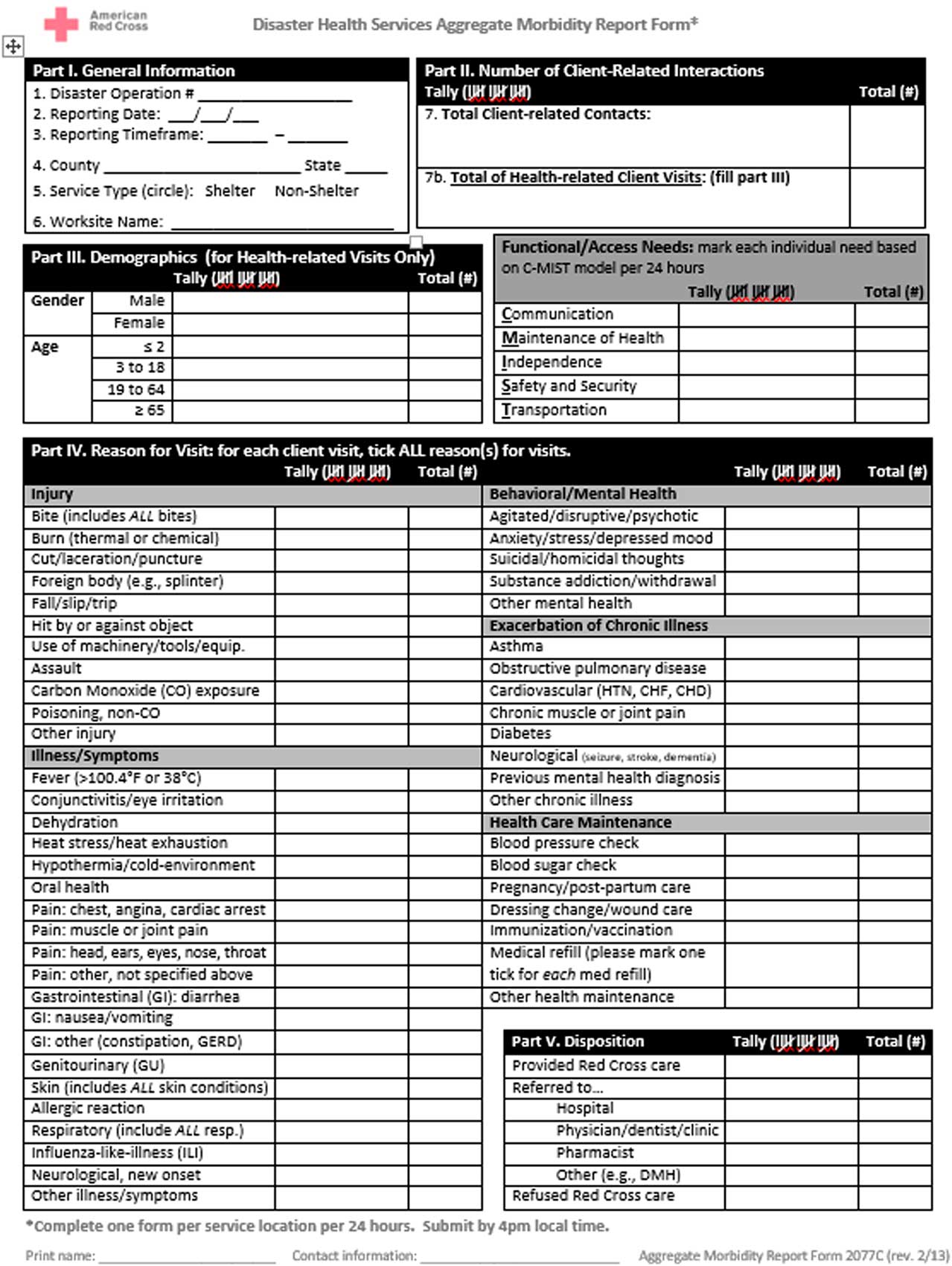
During large scale disasters, such as Hurricanes Irma and Maria, public health surveillance is an important tool to track emerging illnesses and injuries, identify at-risk populations, and assess the effectiveness of response efforts. 4 Timely morbidity surveillance of sheltered populations is crucial for identifying and addressing immediate needs and allows us to better prepare for future disasters. The USVI Department of Health (DoH) partnered with shelter staff volunteers to implement the Red Cross Aggregate Morbidity (Tally) form, which tallies daily client visits from an individual location (eg, shelter) on a single form every 24 hours (Figure 1). This article summarizes the health surveillance data collected by shelter volunteers in St. Thomas and St. Croix in response to Hurricanes Irma and Maria. Although there was 1 open shelter in St. John, the shelter did not have any nursing or health services volunteers; all medical issues were sent off-site to the deployed disaster medical assistance team (DMAT).
American Red Cross Aggregate Morbidity (Tally) Form.

METHODS
We used data collected from the 3 shelters in St. Croix – The St. Croix Educational Complex (Complex), Canegata Ball Park (Canegata), and the Herbert Grigg Home for the Aging (Herbert Grigg) – between September 19, 2017 and October 17, 2017 and 2 shelters in St. Thomas – Knud Hanson Memorial Hospital (Knud Hanson) and Lockhart Elementary School (Lockhart) – between September 18, 2017 and October 27, 2017. Timeframe variation reflects the length of time that shelters were open with nursing or health services volunteers. According to standard Red Cross protocol, all client visits for health care assistance are documented on a single Tally form by Red Cross Disaster Health Services staff (primarily registered nurses) every 24-hour period ending at 4:00 PM local time and e-mailed, faxed, or texted to the Centers for Disease Control and Prevention (CDC) and/or the local public health department. However, because of the complex nature of the hurricane response in USVI with the majority of the communication systems down (eg, cell towers, Internet) and limited Red Cross Disaster Health Services staff on the island, we provided a shelter staff member with some medical background a just-in-time training on form completion and collected the forms every other day. We entered and analyzed the data in Microsoft Excel and developed a report, when possible, which contained information from the previous 24–48 hours as well as aggregate data to date.
The Tally form collects demographic information on client visits and reason for visit (ie, the reason that the person sought care at the shelter) for the following 5 main categories: acute illness/symptoms, injuries, behavioral or mental health, exacerbation of chronic illness, and health care maintenance, as well as client visit disposition, including referrals. Reason(s) for the visit refers to the complaint with which an individual presented (eg, gastrointestinal illness, pain, blood pressure check). Each client visit could list multiple reasons for the visit, and a client visit disposition could include both treatment at the shelter and referral to 1 or more locations. Because all data are anonymous, if an individual accesses care more than once, each visit was counted individually and is included in the total. All percentages reported in this article are combined aggregate totals of all 5 shelters in St. Thomas and St. Croix, unless otherwise noted.
RESULTS
Shelter Reporting, Client Visits, and Demographics
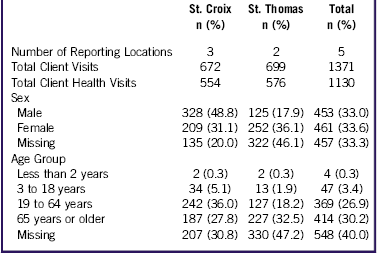
All 5 shelters in St. Thomas and St. Croix completed the Tally form at least 1 time for a total of 1371 client visits (1130 health-related visits) (Table 1). Volunteers recorded client visits that were not health-related as functional needs (communication, maintaining health, independence, services and support, transportation [CMIST]). Canegata reported daily (n = 17) prior to its closure with a total of 168 client visits (125 health-related visits), Knud Hanson reported 32 times (80.0%) with a total of 647 client visits (524 health-related visits), Complex reported 11 times (37.9%) for a total of 254 client visits (206 health-related visits), Herbert Grigg reported 10 times (34.5%) with a total of 250 client visits (223 health-related visits), and Lockhart reported 3 times (7.5%) with a total of 52 client visits (all health-related visits).
Total Client Visits and Demographics at Shelters by Island

Gender varied between the islands with more male clients (48.8%) than female (31.1%) in St. Croix and vice versa in St. Thomas (17.9% and 36.1%, respectively). However, 20.0% of visits were missing gender information in St. Croix and almost half in St. Thomas. Age was more comparable between the islands with few (less than 1%) client visits less than 2 years old and between 28%–33% for older adults (65 years or older). A third (32.4%) of visits in St. Croix and 47.2% in St. Thomas were missing age data.
Overall Reasons for Visit
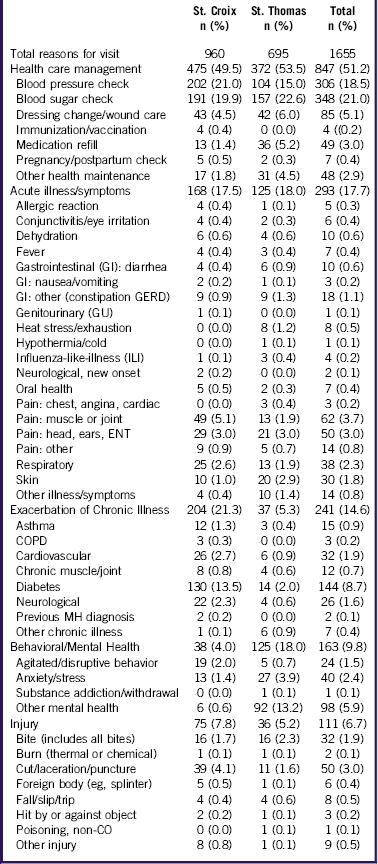
A total of 1655 reasons for the visit were reported during the Hurricanes Irma and Maria response: 960 (58.0%) in St. Croix and 695 (42.0%) in St. Thomas (Table 2). In St. Croix, almost half (49.5%) of the visits were for health care management and follow-up care (eg, blood pressure check, dressing change or wound care, medication refill); 21.3% for exacerbation of chronic illness; 17.5% for acute illnesses and symptoms, which includes respirator conditions, gastrointestinal illness, and pain; 7.8% for injury; and 4.0% for behavioral or mental health. St. Thomas had a slightly different pattern, with over half of the visits for health care management (53.5%) followed by 18.0% for acute illnesses and symptoms, 18.0% for behavioral or mental health, 5.3% for exacerbation of chronic illnesses, and 5.2% for injury.
Reasons for Visit at Shelters by Island

CO = carbon monoxide; COPD = chronic obstructive pulmonary disease; ENT = ears, nose, throat; GERD = gastroesophageal reflux disease; MH = mental health.
Health Care Management and Follow-Up Care
Healthcare management and follow-up care accounted for more than half (51.2%) of the visits. Overall, 21.0% of visits were related to blood sugar checks and 18.5% for blood pressure checks. Shelter staff also provided other health care management services such as dressing changes or wound care (5.1%), medication refills (3.0%), and other routine care (2.9%).
Acute Illness
Acute illnesses and symptoms accounted for 17.7% of all reasons for the visit. Pain was the top reason for these visits with almost half (44.0%) of visits for acute illness, including a report of pain. The second most common acute illness reason for the visit was respiratory conditions (13.0% of acute visits), followed by gastrointestinal illnesses, including diarrhea, nausea or vomiting, and constipation (10.6% of acute visits); and skin-related symptoms (10.2% of acute visits).
Exacerbation of Chronic Disease
Exacerbation of chronic diseases accounted for 14.6% of visits during the response (21.3% of visits in St. Croix and 5.3% in St. Thomas). Of those visits, diabetes (59.8%) accounted for the most reasons for a visit followed by cardiovascular illnesses (13.3%), neurological conditions (10.8%), and asthma (6.2%).
Behavioral and Mental Health
Although only 10% of overall reasons for the visit related to acute behavioral or mental health symptoms, rates differed between islands. In St. Croix, acute behavioral or mental health symptoms accounted for only 4.0% of all reasons for the visit, and those accounted for 18.0% of overall reasons for the visit in St. Thomas. Anxiety and stress were the most common behavioral or mental health symptoms captured on the form (24.5% of mental health visits). The second most common behavioral or mental health symptom during the aftermath of Hurricanes Irma and Maria was agitated or disruptive behavior (14.7%). Other mental health indicators captured included suicidal or homicidal thoughts and other mental health issues (eg, depression).
Injury
Injuries are typically an area of concern after hurricanes because of floodwaters, debris, and other dangerous conditions. However, visits related to injuries were not very common among USVI shelter residents, accounting for roughly 7% of all reasons for the visit. About half (45.0%) of visits for injuries involved cuts, lacerations, and punctures.
Disposition
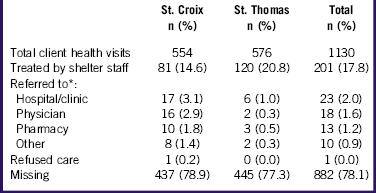
Shelter staff volunteers treated the majority of health-related visits with a known disposition within the shelter (Table 3). However, 78.1% of disposition data were missing. During the response to the storms, Red Cross volunteers also made 64 referrals; each visit could have more than 1 disposition (eg, treated at Red Cross and/or referred to 1 or more locations). Of the referrals, a third (35.9%) were to a hospital or clinic, 28.1% to a physician, 20.3% to a pharmacy, and 15.6% to another source.
Disposition at Shelters by Island

* Client could be referred to more than 1 source.
DISCUSSION
During the weeks following the storms, shelter staff volunteers at the 5 shelters in USVI provided disaster relief services for over 1300 client visits. Almost a third of client visits were for older adults, a departure from data from previous hurricanes such as Harvey (Texas, 2017), Sandy (New Jersey, 2012), and Gustav/Ike (Texas, 2008), which ranged from 8% to 18% older adult clients.Reference Schnall, Hanchey and Nakata 5 This may partially be because Herbert Grigg was a shelter location in St. Croix, which is typically a home for the aging population. However, it is also important to note that a large percentage of visits had missing age and gender information, so true distribution is unknown.
Shelter staff provides important services (eg, blood pressure checks, blood sugar checks, medication refills) for those displaced during disasters, especially for vulnerable populations such as the elderly and those with chronic illnesses.Reference Noe, Schnall and Wolkin 6 With Hurricanes Irma and Maria causing a massive disruption in health management and continuity of care with the closure of clinics, limited functionality of hospitals, massive power outages, the burden of chronic illnesses, and routine care was partially placed on shelter volunteers. Additionally, documenting health care management visits provided important information to shelter volunteer staff by capturing the current and changing health status of the sheltered population.
Similar to previous disasters, exacerbation of chronic disease was a top reason for visits.Reference Schnall, Hanchey and Nakata 5 – Reference Noe, Schnall and Wolkin 6 Among the 241 visits related to exacerbation of chronic illness, over half were related to diabetes. This was especially concerning because the territory had difficulty obtaining insulin after the hurricanes due to airport and port closures. In addition, the lack of power and refrigeration, along with the warm, tropical climate, made storage of insulin at the proper temperature a challenge, leading to potential serious health concerns. In response, the Emergency Operations Center (EOC) distributed ice packs for coolers and generators to those in the community in need when resources allowed.
Injuries were another area of concern with widespread flood waters, debris, and other dangerous conditions after hurricanes. Seven (7%) percent of reasons for visit in the shelter were related to injuries and, among those, 50% were for cuts, lacerations, or punctures. This helped provide further evidence-based support for the DoH while requesting additional Tdap (tetanus, diphtheria, and pertussis) and Td (tetanus and diphtheria) vaccines for the territory.
Fewer than 10% of overall reasons for visits were for acute behavioral or mental health. Although behavioral and mental health can be captured on the Tally form, it is likely that these numbers are underrepresented because clients typically seek medical attention primarily for physical symptoms. However, it is interesting to note the difference between St. Croix (4.0%) and St. Thomas (18.0%). This difference may be the result of the timing of the hurricanes and length of stay in shelters with St. Thomas being devastated by Hurricane Irma 2 weeks earlier than Maria, which directly impacted St. Croix. In response, Health and Human Services deployed a separate mental health team to assist both shelter residents and staff.
Shelter volunteers treated many of the health-related visits within the shelters; however, the exact number is unknown due to missing disposition information. Five (4.6%) percent of health-related visits resulted in a referral to a higher level of care at the hospital, pharmacy, local physician, or other outside source. The capacity of the shelter volunteers to help address the health needs of the shelter residents is a critical resource for state, local, and territorial public health agencies overwhelmed by the disaster.
During the response to Hurricanes Irma and Maria, shelter surveillance was one of the only sources of evidence-based, near real-time public health data available. While typically the reporting of shelter surveillance occurs every 24 hours, because of the complex circumstances in the territory, we could collect data approximately every 48 hours only. However, given this limitation, data were still integral to the response and allowed for the USVI DoH to monitor the sheltered population, determine any changing needs, and assist in resource allocation based on evidence. Therefore, we encourage jurisdictions to develop alternative plans for shelter surveillance during extreme circumstances when routine protocols are not possible.
We found that managing chronic conditions presented a more notable resource demand than acute injuries and illnesses. Although there remains room for improvement because reporting was inconsistent throughout the response, the documented capacity of shelter staff to address the health needs of shelter residents and the ability to monitor the health needs in the sheltered population were critical resources for the USVI DoH overwhelmed by the hurricanes. As the sole source of public health data during the initial phase of the response, the continual collection of shelter surveillance enabled managers and responders to affirm the appropriate allocation of resources and the quick detection of any aberrations. Such near real-time information about the health and needs of the shelter population helped maximize the effect of the limited available resources while informing the need for any changes and strategy improvements. Despite the inconsistent completion and missing datapoints, our data confirmed the notion that shelter morbidity surveillance after a disaster plays a vital role in the immediate and ongoing health needs of sheltered residents and can be used to guide response and recovery efforts to protect the public health of the community. Because form completion was new for the shelter volunteers, providing a brief training on the importance of shelter surveillance and the tools used via a short (2-3 minutes) video viewed on a cell phone and/or a 1-page printed fact sheet would potentially improve data quality in future responses.
CONCLUSION
Shelter surveillance is an efficient means of quickly identifying and characterizing health issues and concerns in sheltered populations following disasters. Identifying and foreseeing potential or actual health risks is a fundamental duty of those managing disasters, and shelter data enable such managers to develop evidence-based strategies to address identified needs. When incorporated into broader surveillance strategies using multiple data sources, shelter data can enable disaster epidemiologists to paint a more comprehensive picture of community health. Therefore, shelter data can enhance their ability to plan for and respond to health issues that may occur both inside and outside of shelters.