Introduction
Research on the effects of birth order on child outcomes has a long history in social sciences (Zajonc & Markus, Reference Zajonc and Markus1975; Blake, Reference Blake1981; Sulloway, Reference Sulloway1996; Black et al., Reference Black, Devereux and Salvanes2005). Although results are often mixed and controversial, one common conclusion emerging from most studies is that later-born children do significantly worse in every sphere of life. Studies on the relationship between birth order and mortality among children find a J- or U-shaped relationship between birth order and infant mortality, indicating that first- and later-born children are more likely than those in the middle to die young. In this paper, this hypothesis is extended by examining the roles of the stage of infancy and child’s sex in modifying the relationship. Essentially, the paper addresses the following two questions: ‘How different are the patterns of relationship between birth order and infant mortality at neonatal and post-neonatal stages of infancy?’ and ‘How pronounced are sex differences in these patterns?’
Birth order has been associated with a variety of adverse life outcomes for children, including morbidity and mortality. According to much of the previous research, the association is curvilinear, with both first- and later-born children being at a higher risk of dying young compared with those in the middle. However, the association is direct and linear in a number of studies. Puffer and Serrano’s (Reference Puffer and Serrano1975) ‘Inter-American Investigation of Mortality in Childhood’ used data for about 35,000 deaths from thirteen Latin American projects and two additional projects in the United States and Canada to identify the major factors in explaining mortality for infants and children under 5 years of age. In this study, maternal age, birth order and birth weight were found to be the three most important determinants of infant mortality. The study also found that generally mortality increased with the rise in birth order.
Using data for a pre-industrial population identified in the Utah (USA) Population Database, Penn and Smith (Reference Penn and Smith2007) investigated how early life factors for 21,000 couples who were married between 1860 and 1895 were associated with their mortality risks in adulthood. They found that children with larger numbers of siblings were less likely to survive to reproductive age (age 18) and that birth order had a significantly negative effect on children’s survival, with later-born children in large families (birth order 12 or higher) experiencing the lowest likelihood of survival. The researchers pointed to the ‘trade-off between offspring quantity and quality’ as a possible explanation for their observation.
Modin (Reference Modin2002) used data for a birth cohort consisting of about 14,000 children who were born at an academic hospital in Uppsala, Sweden, during 1915–1929 in order to examine the sex-specific patterns of mortality by birth order at four stages of the life course (infancy, childhood, adulthood, and middle and old age). In this study, the relationship between birth order and mortality risk was linear and positive for all children, but the pattern of relationship was particularly pronounced for girls. This observation led Modin to posit that poor economic climate in early 20th century Sweden may have forced the parents of large families to provide insufficient parental resources to later-born children, especially girls. Another Swedish study (Barclay & Kolk, Reference Barclay and Kolk2015), which used population register data for persons age 30–69 born between 1938 and 1960, revealed that the effect of birth order on mortality persisted into adulthood. By comparing siblings within the same family (born to the same biological mother and father), the study found that later-born children had higher age-specific mortality than their first-born siblings. Interestingly, the relationship between birth order and mortality was considerably stronger for women relative to men.
Brenøe and Molitor (Reference Brenøe and Molitor2015) used matched administrative data for more than 1,000,000 children born in Denmark between 1981 and 2010 for examining birth order differences in various measures of health at birth (birth length, birth weight and prematurity). Using a within-family design by comparing siblings born to the same parents, this study found a large and positive relationship between birth order and health at birth, irrespective of family size. Although socioeconomic environment, risk behaviour of the mother and hospitalizations for pregnancy complications differed by birth order, these factors did not explain the health advantage of later-born children. The study suggested that ‘biology shapes the positive birth order effect on health at birth’.
Using data from the two phases of a fertility survey conducted in 1985 and 1987 in two municipalities and seven provinces of China, Ren (Reference Ren1995) estimated the effect of birth order on the odds of children’s survival during the neonatal, post-neonatal and early childhood periods. This study found a consistent negative effect of birth order on odds of survival for all children during the three stages of childhood. However, the effect was stronger for females than males in the neonatal period, whereas the converse was true in the post-neonatal and early childhood periods. The study suggested that ‘females of high-order births in China, a country with a strong preference for sons, may be extremely vulnerable during the first month of their lives’.
Using data from the first wave of India’s National Family Health Survey, 1992–93, Pandey et al. (Reference Pandey, Choe, Luther, Sahu and Chand1998) estimated mortality rates for children at various stages of childhood for the country and its states. The study found a U-shaped relationship between birth order and infant mortality. The relationship was negative in the neonatal period, with mortality rate declining linearly with the rise in birth order. However, in the later stages of childhood, the pattern was somewhat reversed. In the post-neonatal period, the rates were quite similar for children of birth orders 1, 2 and 3, and rose for children of higher birth orders, whereas in early childhood mortality rate increased linearly with the rise in birth order.
Singh and Tripathi (Reference Singh and Tripathi2013) analysed data from the third round of India’s National Family Health Survey to examine the association between a number of socioeconomic characteristics of mothers and mortality of children under age 5 at birth order 1 to 5. Rather than focusing on the effect of birth order on mortality, this study examined the relative importance of various background factors for explaining child mortality at specific birth order. Moreover, the analysis did not differentiate between deaths that occurred at the early and later stages of childhood, which are differentially sensitive to background characteristics.
Several hypotheses about the mechanisms through which birth order affects infants’ health and mortality have been suggested. According to the Resource Dilution Hypothesis, child outcomes are heavily influenced by the quantity and quality of parental resource investment (Blake, Reference Blake1981; Elliot, 1992; Hanushek, Reference Hanushek1992; Horton, Reference Horton1988; Price, Reference Price2008; Barclay, Reference Barclay2014). This hypothesis posits that parental material and emotional resources available to each child decrease with the increase in sibship size. Using time-use data from the American Time Use Survey, Price (Reference Price2008) found that the typical second-born child received roughly 20–30 minutes less quality time a day with his/her parent than the first-born child of the same age from a similar family. Thus, later-born children, particularly the last ones, are faced with restricted access to those resources and consequently an increased morbidity (Cabrera, Reference Cabrera1980; Gribble, Reference Gribble1993; Modin, Reference Modin2002). Yet, according to another view later-born children are in a more advantageous position than their older siblings because of better access to material resources that their older parents would have accumulated over the life course (Parish & Willis, Reference Parish and Willis1993). This implies that first-borns are not necessarily at a lower risk of illness and mortality as the Resource Dilution Hypothesis suggests. Thus, it is reasonable to hypothesize that both first-borns and last-borns are at a greater risk of mortality compared with middle-born children.
Another argument for the impact of birth order on health and mortality risks has been formulated within the Biological Depletion Hypothesis. According to this hypothesis, later-born children are more likely than their older siblings to be less healthy because they are born to older mothers who have already given birth to a number of children before and therefore are physiologically less able to produce stronger children (Riordan et al., Reference Riordan, Morris, Hattie and Stark2011; Hotz & Pantano, Reference Hotz and Pantano2015). Studies find that stillbirths and preterm deliveries are more common among older mothers (Astolfi & Zonta, Reference Astolfi and Zonta1999; Astolfi et al., Reference Astolfi, Ulizzi and Zonta2000). Also, many later-born children may be unwanted and therefore face benign neglect from their parents. As an analysis of Demographic Health Survey (DHS) data from ten high-fertility countries (Mali, Niger, Tanzania, Haiti, Pakistan, Ghana, Nigeria, Chad, Malawi and Benin) revealed, higher order births are less likely to receive critical maternal and child health services than lower order births (Sonneveldt et al., Reference Sonneveldt, Plosky and Stover2013). In this study, maternal health interventions (e.g. institutional delivery and delivery with a skilled birth attendant) that are known to be directly linked to mortality were of utmost significance in all countries. According to an analysis of data from the US National Longitudinal Study of Youth that included the sample of births between 1973 and 2010, higher parity women were less likely to make investments in their own health and that of their later-born children. These mothers, for example, were less likely to receive early prenatal care or take prenatal vitamins in a higher-order birth than in the first. They were also less likely to breast-feed their later-born children, compared with the first-borns (Buckles & Kolka, Reference Buckles and Kolka2014). A large British study of children born in 1958 found that first and second children were more likely than their later-born siblings to be immunized against polio, diphtheria and smallpox (Kaplan et al., Reference Kaplan, Mascie-Taylor and Boldsen1992).
There is yet another argument formulated within the Hygiene Hypothesis for the positive impact of birth order on morbidity and mortality risks. There is evidence that younger siblings – particularly the last ones – get exposed to health hazards from infectious and communicable diseases that their older siblings bring home (Strachan, Reference Strachan1989; Elliott, Reference Elliott1992; Kaplan et al., Reference Kaplan, Mascie-Taylor and Boldsen1992; Holman et al., Reference Holman, Shay, Curns, Lingappa and Anderson2003). Studies have also found that younger siblings are less likely to be immunized than older ones, while last-borns are most deprived (Barreto & Rodrigues, 1992; Schaffer & Szilagyi, Reference Schaffer and Szilagyi1995; Gavrielov-Yusim et al., Reference Gavrielov-Yusim, Battat, Neumann, Friger and Balicer2012).
However, there is some evidence to the contrary. There is a body of research that has found that older siblings – particularly first-borns – are at greater risk of diseases and death because they are typically born to younger women who are neither mature and experienced enough in mothering, nor economically well enough off to provide adequate emotional and material resources to their newborn babies. Also, many of these children are born prematurely and have low birth weight – a most important predictor of neonatal mortality (Wong, Reference Wong1990; Miller, Reference Miller1994; Cote et al., Reference Cote, Blanchard and Lalumiere2003; Siervo et al., Reference Siervo, Horta, Stephen, Victoria and Wells2010; Swamy et al., Reference Swamy, Edwards, Gelfand, James and Miranda2012). On the other hand, later-born children are, on average, heavier at birth and therefore less susceptible to disease and death than their older siblings (Puffer & Serrono, 1975; Ayeni & Oduntan, Reference Ayeni and Oduntan1978; Fessler et al., Reference Fessler, Navarrete, Hopkins and Izard2005). This argument reinforces the aforementioned curvilinear hypothesis according to which both first-borns and last-borns are at a greater risk of dying compared with middle-born children.
In this paper, the birth order–mortality hypothesis is extended in two major ways. First, a distinction between deaths that occur in the first month of a child’s life (the neonatal period) and deaths that occur in the next 11 months (the post-neonatal period) is made. Overall infant mortality rate (i.e. deaths under the age of one) hides many of the fine differences between neonatal and post-neonatal periods in terms of their differential sensitivity to the variables that affect mortality at the two stages of an infant’s life. Moreover, they are affected by a different set of factors (Bicego & Boerma, Reference Bicego and Boerma1993; Lawn et al., Reference Lawn and Zupan2005).
In many less-industrialized countries, the number of deaths that occur in the first month of life forms almost half of all child deaths under the age of five (Black et al., Reference Black, Morris and Bryce2003; Ram et al., Reference Ram, Jha, Ram, Kumar, Awasthi and Seth2013; UNICEF, 2014). In the first few weeks of life, infants’ mortality risks are influenced primarily by ‘endogenous’ conditions that are associated with biological and genetic factors and conditions arising in the prenatal period or very early postnatal period, prematurity, low birth weight, asphyxia (lack of oxygen at birth), congenital anomalies, birth trauma, diarrhoea, tetanus and severe infections. In contrast, mortality risks in the post-neonatal period are caused often by ‘exogenous’ conditions that arise after the delivery and have an environmental origin. During this period, the influence of biology diminishes and the influence of socio-cultural factors is enhanced (Das Gupta, Reference Das Gupta1987; Kembo & Van Ginneken, Reference Kembo and Van Ginneken2009; Sawyer, Reference Sawyer2012). In this process, later-born children – particularly the last ones – become more vulnerable to the detrimental effects of external social, cultural and economic conditions than their older siblings. Thus, it is hypothesized that the direct relationship between birth order and mortality is more pronounced in the post-neonatal period than in the neonatal period. It is also hypothesized that socioeconomic factors play a more dominant role in explaining the relationship of birth order with mortality risks in the post-neonatal period than in the neonatal period.
Second, the hypothesis is extended further by introducing into the model child’s sex as a modifier variable. Economic theories of the family view children as investment goods, which are expected to yield high returns – both material and psychological – to parents. In many less-industrialized and high-fertility societies such as India, parents prefer to have more sons than daughters because sons provide greater economic security to parents in older ages, whereas girls leave the parental home after marriage and bring financial burden on families incurred from wedding expenses and dowry (Das Gupta, Reference Das Gupta1987; Das Gupta et al., Reference Das Gupta, Zhenghua, Bobua, Zbenming, Chung and Hwa-Ok2003). By contrast, the birth of a baby boy tends to enhance the status of the mother among family members and relatives. In their analysis of several waves of the China Health and Nutrition Survey, Li and Wu (Reference Li and Wu2011) found that having a first-born son increased the mother’s relative bargaining position within the family. It is not surprising, therefore, that parents invest greater resources in a male child.
A fair amount of empirical evidence indicates that the effect of birth order on infant mortality varies significantly by the sex of the child (Das Gupta, Reference Das Gupta1987; Das Gupta & Bhat, Reference Das Gupta and Bhat1997; Croll, Reference Croll2002; Das Gupta et al., Reference Das Gupta, Zhenghua, Bobua, Zbenming, Chung and Hwa-Ok2003; Ram, Reference Ram2012; Singh & Tripathi, Reference Singh and Tripathi2013; Altindag, Reference Altindag2016). In certain cultures and societies, higher-order female births are unwanted, and therefore they are subject to neglect and even higher mortality. This pattern has even spread to lower-order births over the years during the course of fertility decline (Das Gupta & Bhat, Reference Das Gupta and Bhat1997). In almost every society, girls have health and survival advantages over boys because of their genetic and biological superiority and therefore they tend to experience lower mortality in general and among first-borns in particular. However, in certain societies such as India, the effect of external environment begins to overshadow the biological survival advantage of girls with the rise in sibship size and order of birth. This results in enhanced discriminatory practices and consequently an elevated risk of morbidity and mortality among them as they move from the neonatal period to the post-neonatal period (Choe et al., Reference Choe, Ho and Wang1995; Modin, Reference Modin2002; Lahiri et al., Reference Lahiri, Hazra and Singh2011). Thus it is hypothesized that excess mortality becomes perceptible among girls of higher birth order in the post-neonatal period, compared with those in the neonatal period.
Methods
The study uses data from a large-scale household survey, the NFHS-3, which was carried out in 2005–2006. This survey was designed to provide estimates on various aspects of demographic behaviour, including mortality and health. The NFHS-3 was conducted by the International Institute for Population Sciences (IIPS) in Mumbai under the stewardship of the Ministry of Health and Family Welfare, Government of India. Technical assistance was provided by ORC Macro, Calverton, MD, USA (now known as ICF International). The present analysis is based on the information from weighted samples of births that took place in the 5 years preceding the survey.
The primary dependent variable for the study is infant mortality. This was derived from the retrospective information on the history of births and deaths of children, which were provided by mothers aged 15–49. Age at death was recorded in days for children who died in the first month and in months for other children who died before their second birthday (IIPS & ORC Macro, 2007). This information was used to arrive at the three measures of infant mortality presented in this paper: overall infant mortality (deaths in the first year of life), neonatal mortality (deaths in the first month of life) and post-neonatal mortality (deaths after the first month but before the first birthday). Since these measures are based on the information on deaths that occurred during the 5 years preceding the survey, mortality rates refer approximately to the 2001–2005 period.
Most independent variables refer to the characteristics of mothers, although a few refer to the children’s characteristics. Children’s characteristics include birth order, sex and birth weight, while mother’s characteristics include age at the time of survey, current place of residence (urban/rural), years of schooling, religion and caste. Mother’s age and child’s sex are the two most important covariates of infant mortality. Previous research clearly shows that children born to women in both very young and very old age brackets are more susceptible to the risk of dying young compared with those born to women in the middle age brackets (Puffer & Serrano, Reference Puffer and Serrano1975; Finley et al., Reference Finley, Ozaltin and Canning2011; Matthews & MacDorman, Reference Matthews and MacDorman2013; Barclay, Reference Barclay2014).
Child’s birth weight is one of the most powerful predictors of infant mortality. In general, the lower the birth weight, the higher the mortality risk during the first year of life, particularly in the first month (Wilcox & Russell, Reference Wilcox and Russell1983). Birth weight is not only a biological marker of prenatal health, but also an indicator of a multifaceted public health condition including quality of, and access to, medical care, public health practices and socioeconomic conditions (McCormick, Reference McCormick1985; UNICEF & WHO, 2004). Also, it is positively and strongly associated with birth order (Kramer, Reference Kramer1987; Barclay, Reference Barclay2014). Studies show that the incidence of low birth weight – infants weighing less than 2500 g – is higher among first-borns (Dowding, Reference Dowding1981; Seidman et al., Reference Seidman, Ever-Hadani, Stevenson, Slater, Harlap and Gale1988; Miller, Reference Miller1994; Price, Reference Price2008; Swamy et al., Reference Swamy, Edwards, Gelfand, James and Miranda2012) and much of this higher incidence is due to intrauterine growth retardation and premature delivery, which make first-born children more susceptible to infections, diseases and death (Puffer & Serrano, Reference Puffer and Serrano1975; Kramer, Reference Kramer1987; Haaga, Reference Haaga1989; Samuelsen et al., Reference Samuelsen, Magnus and Bakketeig1998; Matthews & MacDorman, Reference Matthews and MacDorman2013). It may be mentioned that survey data on birth weight are based on respondents’ subjective assessment of the baby’s size at birth and that a large proportion of newborns are delivered at home, without the assistance of a skilled attendant and are therefore not weighed at birth (UNICEF & WHO, 2004).
The remaining control variables in the model include four background characteristics – mother’s education, place of birth (rural versus urban), religion and caste – which are known to be strongly associated with infant mortality. Beginning with Caldwell’s (Reference Caldwell1979) Nigerian study, studies in various developing countries have found maternal education to be an important determinant of infant mortality (Cleland & Van Ginneken Reference Cleland and Van Ginneken1988; Basu & Stephenson, Reference Basu and Stephenson2005). Maternal education exerts a direct influence on infant mortality through adequate care, adequate utilization of maternal and child health services and support to their newborn children (Govindasamy & Ramesh, Reference Govindasamy and Ramesh1997). Also, it influences infant mortality indirectly through birth weight: children born to less-educated women are more likely than those born to better-educated women to be underweight and consequently more likely to die young (Kramer, Reference Kramer1987; Shoham-Yakubovich & Barell, Reference Shoham-Yakubovich and Barell1988). Maternal education is also likely to influence the relationship between birth order and infant mortality (Modin, Reference Modin2002). Children of higher birth order are more susceptible to the risk of mortality because they more often have mothers who are not as well educated as children of lower birth order.
Place of residence is also an important covariate of infant mortality in India. Studies show that rural parents are not knowledgeable enough about prenatal and antenatal care or other medical facilities that are available to mothers. Also, adequate health care facilities are not easily accessible to rural parents, in particular because health care centres are usually located close to urban centres (Rao et al., Reference Rao, Caleb, Khan and Townsend2001).
In India, both caste and religion are strongly associated with infant mortality. In spite of numerous social welfare measures, children from lower castes and who are indigenous remain highly susceptible to mortality risks (Ram et al., Reference Ram, Singh and Yadav2016). This could be due to either their lower socioeconomic status or discriminatory practices on the part of medical professionals. Paradoxically, children from Muslim families and ‘other religious groups’ are at a significantly lower risk than those born to Hindu parents. Lower mortality among children from ‘other religious groups’ does not come as a surprise, considering the fact that people belonging to these groups (which are largely composed of Christians and Sikhs) have, on average, higher socioeconomic status than those belonging to the Hindu religion. But lower mortality among Muslim children is somewhat surprising because Muslim parents are, on average, less educated and poorer than are Hindu parents (Bhalotra et al., Reference Bhalotra, Valente and Van Soest2009). Better sanitation practices (such as avoidance of open defecation and use of piped water) among Muslims have been found to be a possible explanation for this paradox (Guillot & Allendorf, Reference Guillot and Allendorf2010; Geruso & Spears, Reference Geruso and Spears2014). Also, a greater propensity for Muslims to live in urban areas may also be associated with better health practices and lower infant mortality among them.
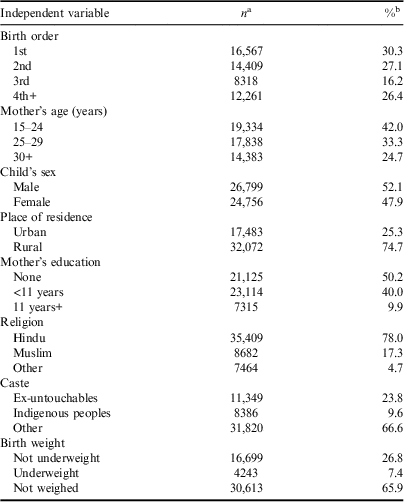
The sample for the study consists of 51,555 children who were born to ever-married women aged 15–49 during the 5 years preceding the survey. The descriptive statistics of all background characteristics of these children are presented in Table 1. In general, the sample seems to represent the entire population of India. As expected, slightly more than half (52%) of the children are males. Most of these children are either of first (30%) or second birth order (27%), while 16% are of third birth order and 26% are of fourth and higher birth order. About two-fifths of mothers who had given birth to these children are under age 25 and one-third are in the 25–29 age bracket, whereas the remaining quarter are 30 years or older. As expected, three-quarters of the women come from rural areas. Most of the sample women (78%) belong to the Hindu religion, while 17% belong to the Muslim religion and 5% to other religious groups. About a quarter of the women are from the ex-untouchable castes (scheduled castes) and one-tenth are from the indigenous group (scheduled tribes), whereas the remaining two-thirds are from other castes. About half of the sample women do not have any education, whereas 40% have attained less than 11 years of schooling and just one-tenth have attained 11 years or more schooling. As mentioned earlier, data on birth weight are of relatively poor quality, considering the fact that almost two-thirds of the infants were not weighed at birth. Most of the children are likely to be born at home, come from rural areas and belong to disadvantaged families. At the very least, therefore, the ‘not weighed’ category can be used as a measure of lower socioeconomic status rather than birth weight and as a proxy for inadequate facilities for the delivery of babies.
Distribution of the sample by background characteristics, NFHS-3, 2005–06

a Unweighted;
b weighted.
Logistic regression analysis is a commonly used method for estimating the effects of various factors on infant mortality. A major drawback of this procedure is the censoring of data, which means that children under 1 year of age who are not fully at risk of mortality (i.e. births that took place in the 12 months preceding the survey) must be dropped from the sample. In order to deal with this issue, in this study the Cox Proportional Hazards model is used to estimate the effects of birth order and its covariates on the three measures of infant mortality described above. This model allows for the inclusion of censored data (i.e. children who were surviving at the time of survey). It is important to note that all models are estimated with robust standard errors. The hazards ratios and their 95% confidence intervals (CI) are calculated after the adjustment for relevant covariates.
It may be useful to state at the outset that this study is cross-sectional and therefore it would be somewhat presumptuous to infer causal relationships between various variables. Considering that the dependent variables are derived from the information on deaths that occurred during the 5 years preceding the survey while independent variables refer usually to the survey date, there is a possibility of causality running in the reverse direction. However, retrospective information is likely to circumvent this problem to some extent.
Results
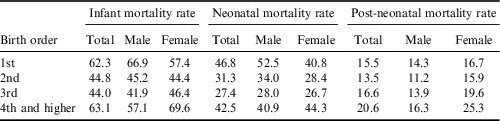
Table 2 presents infant mortality, neonatal mortality and post-neonatal mortality rates by birth order and child’s sex. A U-shape relationship between birth order and infant mortality is found, with the rate being much higher for both first- and last-born (fourth and higher order) children (62 and 63 per 1000 live births, respectively) than that for the middle children (45 per 1000 for second-born and 44 per 1000 for third-born children). A somewhat similar pattern emerges in the neonatal period, which is to be expected given the fact that the number of neonatal deaths forms almost three-quarters of all deaths during the first year of life. However, in the post-neonatal period the relationship between birth order and mortality is slightly J-shaped, with the rate varying between 16 per 1000 for first-borns and 21 per 1000 for last-borns.
Infant mortality, neonatal mortality and post-neonatal mortality rates (per 1000 live births) by birth order and child’s sex
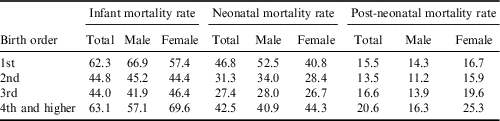
These observations become highly revealing when three measures of infant mortality rate are examined by child’s sex. The pattern of relationship between birth order and infant mortality for boys is found to be of a reverse J-shape, with first-borns exhibiting a higher mortality rate than last-borns (67 versus 57 per 1000), whereas for girls the pattern is J-shaped, with the mortality rate being much lower for first-borns than last-borns (57 versus 70 per 1000). Thus, while the infant mortality rate is higher for boys than girls among first-borns, the converse is true among last-borns.
Furthermore, in the first month of life girls fare much better than boys when they are of a lower birth order. Among first-borns, for example, girls experience a significantly lower mortality rate than boys (41 versus 53 per 1000), showing an advantage of 22%. The gender gap shrinks with the rise in birth order: to 16% among second-born children (34 versus 45 per 1000) and to only 5% among third-born children (27 versus 28 per 1000). The pattern is reversed among the children of fourth and higher order (44 versus 41 per 1000), with girls’ mortality rate being 8% higher than boys’. It appears that with the rise in birth order, girls become increasingly vulnerable.
The picture is very different in the post-neonatal period. Even among first-borns, girls experience higher mortality than boys (17 versus 14 per 1000), with an excess of 17%. The gap tends to widen with the rise in birth order: 42% among second-born (16 versus 11 per 1000), 41% among third-born (20 versus 14 per 1000) and 55% among last-born children (25 versus 16 per 1000). This implies that in the post-neonatal period, girls are not only at a greater risk of dying compared with boys, but also become increasingly vulnerable with the rise in birth order.
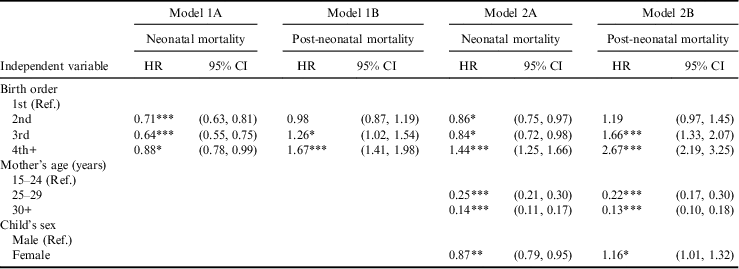
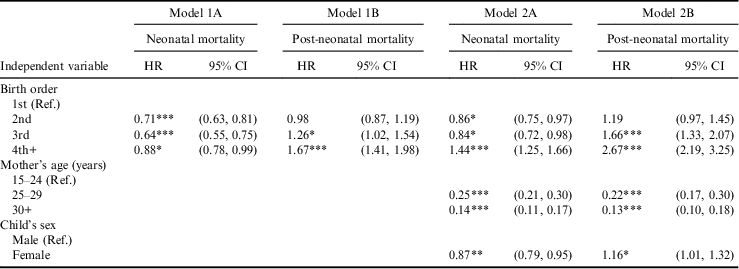
Why are the patterns of relationship between birth order and mortality risk so different at the two stages of infancy? In order to address this question, multivariate analysis is done by using Cox Proportional Hazards regression procedure (Table 3). The base model estimates the effects of birth order on mortality risks without any controls. The results presented in this model are basically a repeat of what was described above: a U-shape association between birth order and mortality risk in the neonatal period (Model 1A) and a mildly J-shaped association in the post-neonatal period (Model 1B). However, when mother’s age and child’s sex – the two most important potential confounders – are controlled, the findings are changed substantially. In the neonatal period (Model 2A), mortality risk for second- and third-born children is only slightly different from that for first-borns (reference category). However, children of fourth and higher birth order, most of whom are presumably born to older women, are at a much greater risk (Hazard Ratio, HR=1.44; Confidence Intervals, CI=1.25, 1.66).
Hazards ratios for birth order, mother’s age and child’s sex
Ref.: reference category.
*p<0.05; **p<0.01; ***p<0.001.
The birth-order effect is much stronger in the post-neonatal period. It emerges earlier in the life cycle and becomes increasing discernible among later-born children. The results presented in Model 2B show that, compared with first-borns, mortality risks for second-born children are not significantly different, although the risks get intensified among the children of higher birth orders (3rd: HR=1.66; CI=1.33, 2.07; and 4th and higher order: HR=2.67; CI=2.19, 3.25). This observation is consistent with the hypothesis that the effect of the depletion of parental resources on health hazards and mortality risks is particularly pronounced in the later phases of infancy when children get exposed to the detrimental effects of external environment and socioeconomic conditions.
In these models, mother’s age is very strongly associated with infant mortality, indicating that children born to older women (aged 25–29 and 30+) are less than half as likely to die in both neonatal and post-neonatal periods as those born to younger women aged 15–24. It is not clear if child’s sex has an effect on the relationship between birth order and infant mortality. However, it may be useful to note that girls are at a lower risk of dying in the neonatal period (Model 2A: HR=0.87; CI=0.79, 0.95), but at a slightly higher risk in the post-neonatal period (Model 2B: HR=1.16; CI=1.01, 1.32). This observation is consistent with previous research, which finds that, because of their innate physiological superiority, newborn girls have fewer inherited abnormalities and are less susceptible to birth complications, infections and premature death, while the pattern is reversed in the later stages of infancy when the effect of biology is weakened and socio-cultural milieu and discriminatory practices against baby girls begin to play a dominant role (Das Gupta, Reference Das Gupta1987; Kembo & Van Ginneken, Reference Kembo and Van Ginneken2009; Sawyer, Reference Sawyer2012).
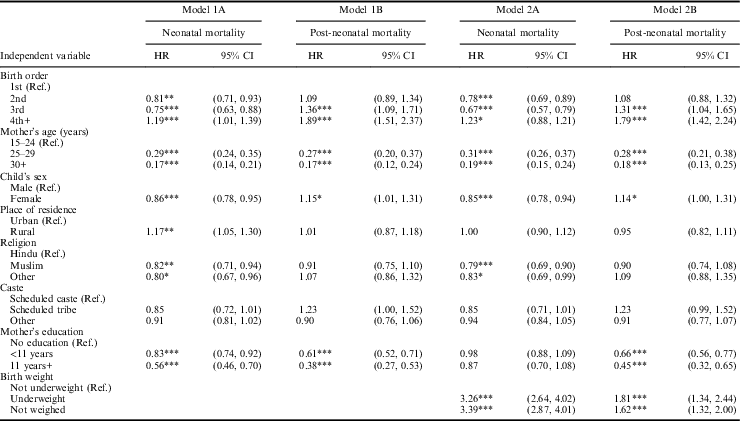
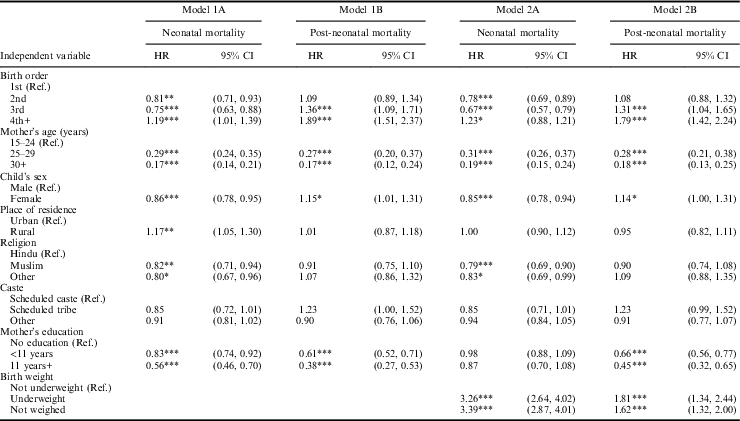
The analysis is extended further by including a number of socioeconomic variables in the model. The results presented in Table 4 show that place of residence, religion and mother’s education are the most important variables that influence the relationship between birth order and mortality risk. Place of residence and religion explain to some extent why children of fourth and higher birth order are at a greater risk of dying in the neonatal period. It is possible that rural children of higher birth order suffer from their parents’ ignorance of prenatal and antenatal care and also from the inaccessibility to adequate health care facilities (Rao et al., Reference Rao, Caleb, Khan and Townsend2001). It is also possible that children from Hindu families are more vulnerable than those from Muslim families because of poorer sanitation practices and greater propensity to reside in rural areas; they are also more vulnerable than those from ‘other religious groups’, probably because of their poorer socioeconomic conditions.
Hazards ratios for birth order and its covariates
Ref.: reference category.
*p<0.05; **p<0.01; ***p<0.001.
Mother’s education has a profound effect on mortality risk at both stages of infancy, but the magnitude of the effect is larger in the post-neonatal than the neonatal period. Mother’s education emerges as the most important variable to explain the positive relationship between birth order and mortality risk in the post-neonatal period. In Model 2B (Table 3), which does not control for mother’s education, the hazards ratios are as follows: 3rd birth order: HR=1.66; CI=1.33, 2.07; 4th and higher birth order: HR=2.67; CI=2.19, 3.25. However, when mother’s education is included in Model 1B (Table 4), these hazards ratios are substantially attenuated: 3rd birth order: HR=1.36; CI=1.09, 1.71; and 4th and higher birth order: HR=1.89; CI=1.51, 2.37. These observations clearly indicate that children of higher birth order are at a greater risk of dying in the post-neonatal period, partly because of the poorer educational background of their mothers.
Taken together, the pattern of relationship between birth order and mortality risk in the neonatal period is found to be slightly J-shaped: compared with first-borns, children of second birth order are at a 19% lower risk (HR=0.81; CI=0.71, 0.93) and those of third birth order are at a 25% lower risk (HR=0.75; CI=0.63, 0.88), whereas children of fourth and higher order are at a 19% greater risk (HR=1.19; CI=1.01, 1.39). The relationship between the two variables is positive and much stronger in the post-neonatal period. Although there are no significant differences in mortality risks between first and second-born children, third and last-born children are at much greater risk.
Finally, child’s birth weight – one of the most important covariates of both birth order and infant mortality – is included in the model (Models 2A and 2B). In line with most previous research, birth weight is strongly associated with increased risk of dying at both stages of infancy, although its effect is much stronger in the neonatal than the post-neonatal period (Modin, Reference Modin2002). Underweight children are slightly more than three times as likely as normal-weight children to die in the neonatal period (HR=3.26; CI=2.64, 4.02), whereas the comparable risk is less than twice as high in the post-neonatal period (HR=1.81; CI=1.34, 2.44). It is a reasonable finding, given the fact that birth weight matters more during the first few weeks of life when children are highly vulnerable to the detrimental effects of prenatal and perinatal factors than during the later phases of infancy when children are healthier and stronger. Interestingly, these patterns are very similar for children who were not weighed at birth. Although birth weight does not alter significantly the relationship between birth order and infant mortality in a significant way, consistent with some previous research (Kramer, Reference Kramer1987; Shoham-Yakubovich & Barell, Reference Shoham-Yakubovich and Barell1988), it emerges as an important intervening mechanism through which background variables such as maternal education, place of residence and religion influence the risk of mortality in the neonatal period.
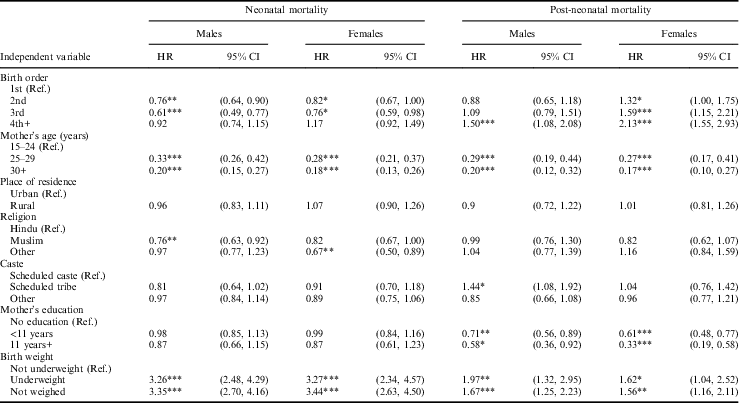
Interestingly, these variables do not exert much influence on the relationship between child’s sex and infant mortality. Even when all control variables are taken into account, female children remain less susceptible to mortality risk in the neonatal period (HR=0.85; CI=0.78, 0.94) and slightly more susceptible in the post-neonatal period (HR=1.14; CI=1.00, 1.31). In order to examine whether the relationship between birth order and mortality varies by sex of the child, separate models were run for boys and girls. The results presented in Table 5 show that in the neonatal period, the pattern of relationship between birth order and mortality is somewhat curvilinear, especially for boys. Patterns are particularly revealing in the post-neonatal period. Male children of second and third birth orders are not significantly different from first-borns in terms of mortality risks, but last-born children are at a much greater risk (HR=1.50; CI=1.08, 2.08). In contrast, female children are vulnerable, even when they are of lower birth order and their vulnerability increases monotonically with the rise in birth order. Thus, compared with girls of the first birth order, those of the second birth order are at 32% greater risk (HR=1.32; CI=1.00, 1.75), those of third birth order are at 59% greater risk (HR=1.59; CI=1.15, 2.21) and those of fourth and higher order are at twice greater risk (HR=2.13; CI=1.55, 2.93) of dying in the post-neonatal period.
Partial results of the Cox Proportional Hazards model by child’s sex
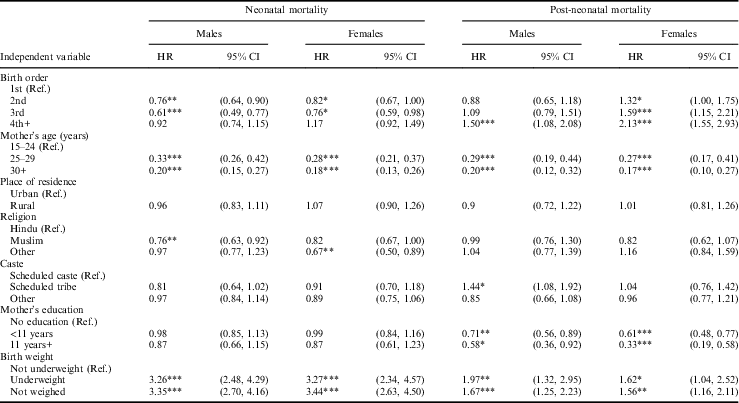
Ref.: reference category.
*p<0.05; **p<0.01; ***p<0.001.
Discussion
The major objective of this study was to argue, and provide evidence, that the curvilinear relationship of birth order with infant mortality portrayed in much of the previous research masks the pattern of relationship between these variables in a less-industrialized country such as India. In this paper, it is argued that without taking into account the stage of infancy and sex of the child, a study on this subject would hide many important details. Previous research has shown that different factors affect mortality at different stages of life. Prenatal and perinatal factors play dominant roles in the first few weeks of life, whereas social, cultural, economic and environmental factors play more dominant roles in later periods. Also, there are important sex differences in mortality by the stage of life. Boys are more vulnerable in the early phases of life because of their genetic–biological disadvantage, whereas girls are more vulnerable in the later phases because of socio-cultural factors that govern parental preference for a baby boy and discrimination against a baby girl (Das Gupta, Reference Das Gupta1987; Kembo & Van Ginneken, Reference Kembo and Van Ginneken2009; Sawyer, Reference Sawyer2012).
The present analysis based on data from a large, nationally representative survey (the National Family and Health Survey, 2005–2006) comes up with several important findings. There are two distinct patterns of relationship between birth order and infant mortality at the two stages of infancy. Consistent with some previous research (Gribble, Reference Gribble1993; Modin, Reference Modin2002), the relationship is J-shaped – or mildly U-shaped – in the neonatal period, indicating that while first-born children are slightly more susceptible to the risk of dying young compared with children of second and third birth order, last-born children (i.e. fourth and higher order births) are at the worst risk.
However, in the post-neonatal period the relationship between birth order and mortality is positive, with mortality risk increasing with the addition of successive births. It is worth emphasizing that last-born (fourth and higher order) children are at significantly greater risk of dying compared with earlier-born children in both neonatal and post-neonatal periods, but this phenomenon is more pronounced in the post-neonatal period. These findings are highly consistent with the Resource Depletion Hypothesis according to which, with the addition of successive children in the family, parental resources – both material and emotional – become diminished and consequently last-borns suffer the most. This is particularly true in the post-neonatal period since resource depletion is so heavily influenced by socioeconomic and environmental conditions that come into play in the later phases of infancy (Das Gupta, Reference Das Gupta1987; Kembo & Van Ginneken, Reference Kembo and Van Ginneken2009; Sawyer, Reference Sawyer2012).
That in the neonatal period both first- and last-born children are more susceptible to the risk of dying than those in the middle is in line with the hypothesis that both have restricted access to parental attention, supervision and resources (Hanushek, Reference Hanushek1992). First-born children are at a higher risk because they are born to couples who are neither economically as well-off nor experienced enough in parenting, whereas last-borns suffer from diminished resources (Cote et al., Reference Cote, Blanchard and Lalumiere2003; Siervo et al., Reference Siervo, Horta, Stephen, Victoria and Wells2010; Swamy et al., Reference Swamy, Edwards, Gelfand, James and Miranda2012). Also, many first-born children are born prematurely and are of lighter weight and therefore highly susceptible to health hazards and mortality risks, whereas last-born children are more susceptible to biological depletion of higher parity mothers. However, first-borns are least susceptible in the post-neonatal period, especially because they have already survived the most hazardous phase of life, and also because they are not as exposed to genetic and biological forces any more.
The finding that, compared with first-borns, second-born children are at a lower risk in the neonatal period, but are not significantly different in the post-neonatal period, is somewhat puzzling. This observation does not appear to support the Resource Depletion Hypothesis. Perhaps the addition of the second child does not exert a significant adverse effect on children since the two-child family is the most preferred family size among Indian couples. However, this issue remains a subject for future research.
There are marked differences in these patterns by the child’s sex. While female children are less prone to the risk of dying in the neonatal period in comparison with male children, the converse is true in the post-neonatal period. Female children not only run a higher risk of dying in the post-neonatal period, but also become progressively more vulnerable with the addition of successive children. These findings are in line with Modin’s (Reference Modin2002) Swedish study in the early 20th century (1915–1929), which found that girls had a significantly higher mortality risk among later-born children than among first-borns.
In this context, it may be useful to reiterate Das Gupta’s (Reference Das Gupta1987) findings on sex differences in mortality among children in India, which are highly consistent with the present study. In her analysis of a sample of 400 rural households in Ludhiana district of the state of Punjab, Das Gupta found that in the early 1980s, Punjabi parents were careful to limit the number of daughters they had. Interestingly, this was particularly true among young and educated women, most of whom did not want to have even one daughter and almost none wanted to have a second daughter. This attitude was clearly reflected in families spending more than twice as much on the health care of boys than that on girls in the first 2 years, which in turn resulted in higher mortality among girls – particularly of higher birth orders – compared with their siblings in the later phases of childhood. The present findings suggest that not much seems to have changed concerning the effects of birth order on higher mortality among girls over the years.
Among the control variables, four – mother’s age, mother’s education, child’s sex and child’s birth weight – are highly significant in confounding, explaining or modifying the relationship between birth order and infant mortality. Mother’s age is a highly significant and robust predictor of both neonatal and post-neonatal mortality. Even after controlling for all variables, children born to younger women remain more vulnerable than those born to older women. While mother’s age largely explains why first-born children are more likely than later-born children to be at the risk of dying in the neonatal period, it suppresses the direct and strong effect of birth order on mortality risks in the post-neonatal period.
Mother’s education is another highly significant predictor of infant mortality, particularly in the post-neonatal period. It proves to be the most important variable to explain the positive relationship between birth order and mortality risk in the post-neonatal period. Its effect persists even when other background factors are taken into account. Consistent with much of the previous research, birth weight is another powerful predictor of infant mortality, but more so in the neonatal period (Wilcox & Russell, Reference Wilcox and Russell1983). It also proves to be an important intervening mechanism through which background variables – mother’s education in particular – influence mortality (Kramer, Reference Kramer1987; Shoham-Yakubovich & Barell, Reference Shoham-Yakubovich and Barell1988). Child’s sex is also an important predictor of infant mortality, showing that female children are at a significantly lower risk than male children in the neonatal period. However, as discussed earlier, this variable modifies the relationship between birth order and infant mortality.
Several implications follow from these findings. At the conceptual level, the study suggests that a global measure of infant mortality would be misleading in order to fully understand mortality dynamics in a less-industrialized country such as India. Since different sets of factors are at play in explaining mortality in the neonatal and post-neonatal periods, policymakers need to adopt different strategies to deal with mortality in these two stages of life.
The finding that first-born children of both sexes are highly susceptible to the risk of dying in the neonatal period, even when all confounders are taken into account, suggests that policymakers and health professionals need to pay particular attention to first-time mothers. Considering the fact that these children are born to younger women, better antenatal and prenatal facilities need to be developed for first-time mothers, who may not be fully prepared for the experience of mothering, lack adequate knowledge about postpartum care and do not have easy access to institutional medical services. Also, particular attention has to be paid to children of fourth and higher birth order – particularly girls – who are most vulnerable to health hazards and mortality risks. How to reach these two categories of mothers is a challenge for policymakers and health professionals.
However, given the fact that there is a continuous decline in fertility and reduction in the number of births to older and higher parity women and that there is an increasing acceptance of the two-child family norm among Indian couples, it is expected that the direct relationship between birth order and infant mortality will weaken in the future. In particular, it is expected that the relative disadvantage of children of fourth and higher birth order will diminish in the coming years.
A few comments on the limitations of this study are in order. First, the data used for the analysis are dated. Since infant mortality statistics in NFHS-3 refer approximately to the 2001–2005 period, they may not capture much of the developments that have taken place in recent years, in terms of reductions in mortality and policy initiatives. Second, data on infant mortality in a less-industrialized country such as India is subject to recall lapse, failure of reporting of a sad event and consequently under-reporting of deceased children, particularly among high-parity women. Third, the control variables included in this study do not fully capture the effect of socioeconomic status on mortality differences by birth order. If some macro-level variables (such as neighbourhood and residential segregation), various cultural practices and programmes and policies were to be included in the model, birth order differences in mortality could be more adequately addressed. Fourth, birth weight as a control variable is of questionable quality, as the majority of births are not delivered in an institutional setting and are therefore not weighed. Considering the importance of this variable in explaining neonatal mortality, some kind of services (e.g. mobile medical units) need to be developed for measuring the birth weight of children born at home. Fifth, data on the background variables included in this study were measured on the survey date, while the dependent variable – infant mortality – was derived from the number of children who were born during the 5 years preceding the survey. Although this is potentially an important bias, in practice the characteristics used in the study are either permanent (for example caste or religion) or unlikely to be influenced by infant mortality (for example education). However, this is not an important bias because none of the characteristics is likely to be influenced by infant mortality. Finally, the study does not control for sibship size, which is an important confounder of the relationship between birth order and mortality (Barclay & Kolk, Reference Barclay and Kolk2015). Since children of higher birth order come from large families, unless adjustment is made for sibship size the direct relationship between birth order and mortality remains questionable. This study does not use the within-family comparison, which involves comparison of siblings born to the same father and mother pairing. However, recent research using high-quality longitudinal administrative register data, controlled for sibship size and used a within-family comparison approach suggests that a birth-order effect exists and that later-born children perform worse on various measures of cognitive, educational and health outcomes (Black et al., Reference Black, Devereux and Salvanes2005; Barclay & Kolk, Reference Barclay and Kolk2015).
Acknowledgments
A preliminary version of this paper was presented at the annual meeting of the Canadian Population Society, St Catherine, Ontario, Canada, April–May 2014. The authors would like to thank the anonymous referees for their helpful comments on an earlier draft of the paper.