The Hutizilapa Archaeological Salvage Project began in 1993 as a consequence of the damage to a pre-Columbian settlement caused by the construction of the Guadalajara-Tepic freeway in northwestern Jalisco. The groundwork, roadbed, and installation of the freeway construction project affected a series of architectural features that made up the monumental area of the Huitzilapa site. An evaluation of the damage and an archaeological salvage project were formulated for different sectors of the settlement. We carried out a survey and excavations in the Valley of Huitzilapa to identify the settlement pattern of the pre-Columbian population and its role at the regional level, and we discovered the only scientifically excavated shaft tomb recorded in this region to date. The information we recovered suggests the presence of social inequality by the Late Formative period (300 b.c.–a.d. 200), and we determined that the region was immersed in a process leading to the emergence of an ancient complex society. In this article we offer a summary of our findings to provide a context for our discussion. We stress the relation between monumental architecture and the suntuary consumption and offering of luxury items as a hallmark of the process of social differentiation in the core area of the Teuchitlan tradition.
THE TEUCHITLAN CULTURAL TRADITION
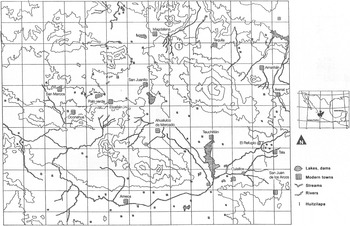
The Huitzilapa zone is in the region of highland valleys and lake basins located in the vicinity of the Tequila volcano, an area rich in lacustrine resources and fertile soils (Figure 1).This area also had an abundance of rare resources, the most outstanding being high-quality obsidian (Weigand 1985, 1989, 1992a, 1992b; Weigand and Beekman 1998:36–37). These were the main characteristics of the area that provided an exceptional setting for ancient societies. In fact, there are numerous archaeological sites that share the same cultural identity, collectively known as the Teuchitlan tradition, which had its beginning in the Middle Formative period and ended in the later part of the Early Classic period (600 b.c.–a.d. 450/500).

Location of the Huitzilapa site in central Jalisco, West Mexico.
The Teuchitlan tradition has been defined through the architectural record, and one of its most relevant features is the circular pattern observed in its architecture. In the Middle Formative period (San Felipe phase, 600–300 b.c.), it is possible to find individual circular platforms, and these evolved through time into more complex compounds. The basic design of five elements included four rectangular platforms oriented to the cardinal points with a central altar, a distribution that became a standard feature during the Late Formative period (Arenal phase, 300 b.c.–a.d. 200). The Formative period in this region is also characterized by El Opeño-like tombs and later, at the end of the Formative, by elaborate shaft tombs that served as elite burial chambers and were associated with surface architecture.
The centuries that followed were periods of continuous population growth and increasing cultural complexity. The circular pattern continued its development through the Early Classic period (Ahualulco phase, a.d. 200–450/500), adding a larger number of structures around the plaza, until circles up to 16 units in size were formed. Weigand (1979) proposed that severe decline of this tradition began with the Teuchitlan II phase (a.d. 700–900), but new radiocarbon dates and excavations in the area indicate that this cultural tradition concludes with the end of Ahualulco phase (a.d. 450/500).
The geographical region associated with the Teuchitlan tradition was very extensive and took in the southeastern area of Nayarit, the northwestern part of Jalisco, and the southwestern corner of Zacatecas. There is also recent evidence of circular architectural patterns in the Atemajac Valley, the northwestern part of the Bajio (Sánchez and Marmolejo 1990), the Lerma River drainage (Cárdenas 1999), and the Colima Valley (Serna 1991). These neighboring regions were gradually annexed to the core area, which circumscribed the Tequila volcano.
At the beginning of the Late Formative period (300 b.c.–a.d. 200) the Teuchitlan tradition may be defined as a fully stratified society on the level of chiefdoms. A distinguishable difference of rank in the settlements is believed to be the result of an evolutionary process, tending to the formation and consolidation of the chiefdom structure.
Some authors concur in situating chiefdoms in Mesoamerica toward the Middle and Late Formative periods where the distribution of settlements, the appearence of monumental architecture, and funerary cults are synonymous with hierarchical structure, derived from a process of social evolution where the techno-economic aspect is understood as a causative factor. Emphasis has been placed on aspects of adaptation, productivity, specialization of activities, and redistribution of goods associated with a political configuration of hierarchy and prestige (Sanders and Price 1968). Recently archaeologist have focused on other factors, such as political, military, and ideological sources of power, and how power was used in a social context (Blanton 1995; Earle 1991, 1997; Johnson and Earle 1987; Mann 1986; Price and Feinman 1995).
Social inequality is defined as “the monopolization or asymmetrical relations of power between members or specific sectors of a society” (Cashdan 1980; Flanagan 1989). Objective sources of power can be understood as valuable and necessary components of material culture (Blanton et al. 1996). Differential access to resources of fundamental importance strengthens social inequality. In this process, wealth legitimizes status and social inequality by reinforcing social boundaries (Brumfiel 1987; Hicks 1991). Wealth is embodied in primitive valuables used in display, ritual, and exchange, and in ancient societies it became an objective source of power (Brumfiel and Earle 1987:4). Some of the valuables were prestige goods or luxury items. Persons or sectors of society that controlled the circulation of these luxury items were in positions of great power; this was one of several political strategies employed to create and maintain social inequality (Blanton et al. 1996; Carneiro 1981; Earle 1977; Harris 1979; Hass 1982). The use of prestige goods served to consolidate membership within a group by announcing social connections, and it also had the function of differentiating between sectors of society (Appel 1982; Blanton and Feinman 1984; Brumfiel 1994; Brumfiel and Earle 1987; Clark and Blake 1994; Rice 1987). The difference in distribution of prestige goods in the archaeological record is understood to be a result of social inequality and was used to help separate households and burials into distinct social strata where high-status sectors of the society had greater access to prestige goods (Chase and Chase 1992, Costin and Earle 1989, Drennan 1976, Tourtellot and Sabloff 1972). Based on information gathered at sites in the region and the Huitzilapa shaft tomb, we may associate our data with some principles of this approach.
HUITZILAPA
Archaeologists conceive of the Teuchitlan core area as being divided into six habitation zones, and the Huitzilapa Valley is considered to have been one of these major habitation zones (Weigand 1990:48, 1993; Ohnersorgen and Varien 1996:106). In these zones, Weigand (1996) proposed a relationship between formal architecture and site function, with public functions carried out in the largest site with monumental structures.
In the El Arenal phase, ranking of social group is suggested by the evidence of house mound size, location of household clusters within the sites and across the entire valley, architectural layout, and distribution of prestige goods among households and monumental shaft tombs. In the Huitzilapa zone at least three levels of well-defined settlements existed: (a) the civil-ceremonial level, represented by the main site of Huitzilapa; (b) the residential level, represented by smaller sites like La Robleda, El Lienzo, and Los Soles, closely linked to the center and composed by residential clusters with ballcourts; (c) the level of sites related to specialized activities, such as El Tezontle, where the area of terraces indicates that this was a place for agricultural production. There are also sites like La Mina, where mining of the obsidian deposit and manufacturing of lithic tools took place.
Huitzilapa is located in the hills to the east of the Magdalena Lake basin. It is bounded on the north by natural slope, which descends to the Santiago River canyon; on the east by the foothills of the Tequila volcano; and on the south by the Huitzilapa Valley. This settlement stands out because of its great extension and complexity, having more than one hundred structures distributed in an area of about 30 ha. The site is composed of a series of monumental architectural clusters arranged around plazas, forming a settlement that lasted at least three centuries, from approximately the beginning of this era to about a.d. 300. This chronology has been obtained from radiocarbon dating of the tomb and other structures at the site. The chronology of the Huitzilapa tomb (Ramos and López Mestas 1996: Table 3) is directly associated with the date of 100 b.c. obtained for Las Cebollas tomb in Nayarit (Furst 1966:140). Both features share a chronological moment within the estimated range for the San Sebastian tomb in Etzatlan, Jalisco, which ranges between 140 b.c. and a.d. 400, and—together with the shaft tombs of El Arenal, Mary Pérez, Santa María, and Las Cuevas—form part of the shaft tomb complex in the Magdalena Lake area (Long 1966:93).
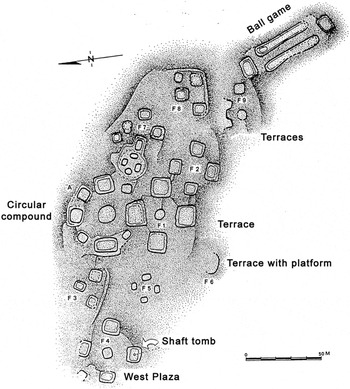
The plazas are formed by rectangular platforms distributed in a cross pattern, most often containing a circular altar in the center of the open space. The five-element design discussed earlier determined the construction of the majority of the residential clusters at sites of this cultural tradition. Thus the ceremonial space became specialized, as principles of formal design, cruciform platforms with a central altar, ultimately developed into circular compounds (Weigand 1996). There are also sectors with differing distributional patterns; these may be a product of the evolution in design and growth of the settlement over time (e.g., units F7, F8, and F11).
A hierarchical arrangement can be seen within the site itself. If we consider the height and area of the platforms that surround the plazas, the largest compounds were represented by units F5, F1, the circular unit (A), and the West Plaza (F4), where the shaft tomb was found. There are also a series of small residential clusters spread around the site leading down to the floor of the valley (Figure 2). Ohnersorgen and Varien (1996) viewed the formal architecture as a characteristic of the hierarchical organization of this settlement system.

Huitzilapa site. Drawing by Phil C. Weigand.
Traces of increasing complexity can be recognized in the differences between the sites of the valley. Huitzilapa was the more important community, not only because of its size, but also because it contained buildings of a distinctly ceremonial and political character, such as the ball court. This settlement boasts the largest ball court encountered in the area researched. It is formed by two elongated structures of 62 m each and is closed at the ends by two rectangular buildings. It is classified as Type II-B according to the policy established for the region (Weigand 1993:180). Ball courts were associated with ritual competition of groups within and across polities and with communal gatherings. The development of ball courts was found in increasingly more complex societies, in which status hierarchies were in placed (Scarborough and Wilcox 1991) and were important elements in the political consolidation that took place at the Arenal phase.
West Plaza
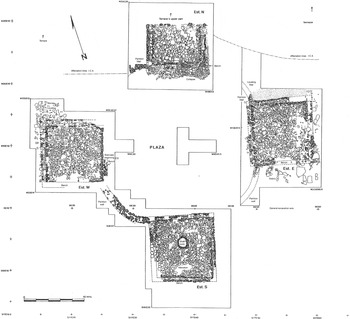
The West Plaza (F4) is one of the largest architectural clusters in the site. It is formed by four structures organized in the form of the cross, oriented to the cardinal points. The original small central altar was destroyed, with only some foundational evidence remaining. Considering the size of the foundations of the structures that make up this cluster—an average of 120 m2—in comparison with the normal range of 30–40 m2 in other clusters of the site, it is possible that these structures had more than one habitation on top. The residences would have been of two ore more rooms, as well as different areas of activity, as is seen in the earthenware models found in shaft tombs.
The excavation of this plaza yielded important information about the character of these large compounds. The controlled access to the area may be seen by walls that joined the corners of the four structures, creating a configuration that we infer gave a particular use to this type of space (Figure 3). It must have been a restricted place used for a particular purpose by a specific social sector of the community. This sector may have represented a certain lineage that controlled the economic, political, and religious activities of the community. The shaft tomb discovered in the structure at the southern end of the plaza could strengthen this hypothesis.

Huitzilapa West Plaza (F4).
Earthenware models exist which illustrate scenes of various domestic activities linked to ceremonies that took place in ball courts and in this type of precinct with its open spaces. These models offer us a wealth of etnographic elements for the interpretation of the function of these precincts in the communities that participated in this cultural tradition (von Winning and Hammer 1972). Control over the rituals associated with these places became more visible and impressive. Ceremonies such as palo volador and ballgames possibly took place in this area. Power consolidation may be reflected by increasingly more centralized distributions of ball courts and cruciform and circular plazas as are seen in the Huitzilapa Valley.
Social differentiation is understood to be a result of an evolutionary process involving the social relations of production. One sector or group of the community acquires higher status once its members are able to obtain objective control over certain elements of the production process, thus generating ties of dependence of other units on this sector. As a consequence, more political power and social prestige is obtained within the former group. This social differentiation may be reflected in the architectural spaces used by these social sectors for the specialized activities that they perform (Sarmiento 1992). The addition of ball courts, cruciform and circular compounds, and monumental shaft tombs seems to coincide with the emergence of social hierarchies.
Funerary Patterns
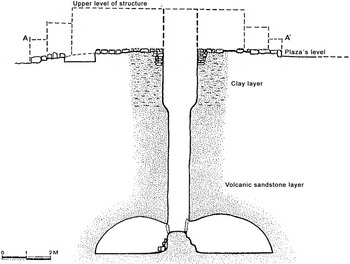
One of the most important consequences of our research was the discovery of a shaft tomb, composed of two chambers, beneath the center of the south structure of the West Plaza (F4). It is the first tomb in West Mexico associated with monumental characteristics that was discovered before looters had the opportunity to pilfer its contents. As a result, we were able to see in situ the disposition of the bodies and offerings that reflect an elaborate funerary ritual dedicated to a special personage in the community. Excavation of the south structure revealed a circular track of stones marking, on the surface, the shaft of the tomb. The shaft itself, 7.6 m deep and excavated through compact volcanic tuff, leads to two mortuary chambers facing each other and oriented along a north–south axis (Figure 4).

Shaft tomb located at south structure of West Plaza.
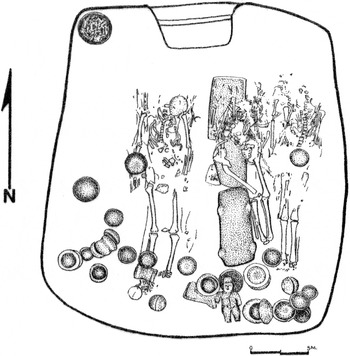
The north chamber contained the burials of three individuals placed in a face-up extended position, with heads toward the entrance. The skeletal remains are of two men and a woman (Figure 5). In this chamber one individual is exceptional for the quantity of associated offerings and is recognized as the principal personage of the group. Robert Pickering's osteological analysis estimates his age at about 45 years, and he was positioned on the east side of the chamber. We believe that the tomb was constructed for him and the important funerary rites were performed in his honor. He was the most outstanding in his lavish adornment and offerings. He was accompanied by shell bracelets, noserings, earrings, greenstone beads, and carved pendants, as well as a cloth sewn with thousands of shell beads. Ornamented conch shells were placed on his loins and at his sides, along with atlatl hooks (López Mestas y Ramos 1998; López Mestas et al. 1998).

North chamber.
The second male, aged 30–40 years, also wore beaded shell necklaces and other shell and greenstone jewelry, and held atlatl hooks in his right hand. The female was at least fifty years old, and also wore shell jewelry, but in lesser quantity than the principal personage. Spindle whorls used in the production of textiles were placed near her left foot and at her right hand.
Seventy-seven ceramic vessels arrayed along the north and west sides of the chamber were laden with food offerings: pots, plates, gourd-shaped vessels, water jugs, and bowls, decorated mainly with red, black, and buff-colored paint. These pieces of fine ware, used exclusively for funerary purposes, correspond to the Ahualulco and Oconahua types and their varieties: Oconahua Polychrome, Oconahua Red on White, Oconahua Polished monochrome in Red and Black, Ahualulco Red on Cream, and Ahualulco Polychrome (Beekman and Weigand 2000). Some decorated pottery types, among them the Oconahua and Ahualulco types, have been classified as prestige goods produced by specialized artisans (López Mestas 2005; López Mestas and Benz 2000). This pottery was associated with funerary rites and ideological activities carried out by the elite group of the community. Some pottery types were exchanged over long distances, like the Ixtlan Polychrome vessel found in the south chamber and the Oconahua Polychrome and Red on White.
Six hollow figurines, averaging 50 cm in height and belonging to the Arenal Brown style (Long 1966), were also found in the north chamber. Three represent female figures, two in a seated position and the other standing. The other three figurines depict male personages, one of them old and the other young, both in an identical seated position. The third male figure is a ball player, standing with a ball in his upraised hand.
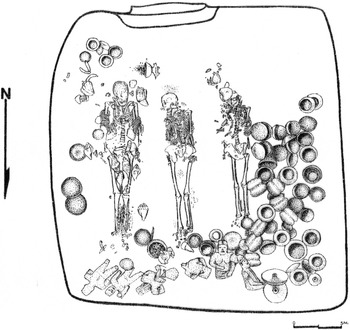
The south chamber presents differences in size and form in relation to the north chamber. In the south, there were also three individuals resting in a face-up position with their heads toward the tomb entrance. The skeletal remains corresponded to one man and two women (Figure 6). The man was approximately 40 years of age and was adorned with a shell necklace, noserings, and earrings; atlatl hooks were place in his right hand. This burial was outstanding because of the special mortuary treatment. It was the only skeleton in the south chamber with a conch shell between the legs, just as seen with the principal personage of the north chamber. This individual had an offering composed of a string of shells beads, a slate disc, and a quartz crystal lying at his feet.

South chamber.
A woman between 20 and 40 years of age was placed between the other two bodies, resting on a layer of organic material that had been deposited on the surface of two large metates (grinding stones). The other young female, approximately 16–20 years of age, was found wrapped in a mat, and a layer of red heart was spread under the body. This individual was found in a very bad state due to water filtration into this area of the soth chamber. Both women were ornamented with simple pendants and shell jewelry.
The offerings in this chamber consisted of fine ware of the Ahualulco and Oconahua Polychrome and Monochrome variants, one Ixtlan Polychrome vessel, as well as two hollow figurines of the Arenal Brown style, that represent a standing male and a seated woman. These pieces are of smaller size than those found in the north chamber.
DISCUSSION
The discovery of the Huitzilapa tomb placed us within one of the most important controversies of Western Mesoamerican archaeology, the “shaft tomb tradition.” Valdez (1994) carried out a revision in which he observed that this tradition is far from being geographically and chronologically defined through archaeological investigations, much less explained through interpretations that give it an anthropological validity in the sociocultural context in which it operated (Taylor 1970; Valdez 1994; Weigand 1993). Fortunately, new investigations of shaft tombs have been undertaken in search of the meaning—in a broader sense—of the cultural expresion of the groups that shared this funerary custom (Cabrero y López 1993; Oliveros 1992; Valdez 1994).
Many researchers recognize the existence of a group of original ideas that form a basic primogenital conceptual body upon which a complex network of social, political, economic, and ideological relationships were structured. These ideas, expressed with the passage of time and giving origin to regional cultural developments, gave rise to what we know today as Mesoamerica (López Austin 1990). “Universal structures, cosmogonies, calendars, rituals, myths, legends, principles, and magic practices and pantheons offer in Mesoamerica a very rich blend, but at heart there is no doubt that the central concepts coincide” (López Austin 1990:32; translation ours).
One of the fundamental principles within the cosmovision of the inhabitants of Mesoamerica is that of the geometry of the universe, the product of a concept whose structural, taxonomic, and explicative elements of its dynamic were shared (López Austin 1984, I:59).
With the cosmological creation the surface of the heart is transformed into sacred space, divided into parts ruled over by divine forces, with spatial orientation, colors, and symbols that imbue each space, each place, with a trascendent meaning that exceeds the material reality. The terrestrial space is transformed into a replica of the sacred order wich rules the universe in a reproduction of the cosmological archetype. (Florescano 1994:27; translation ours)
This cosmic division appears in different regions and cultures of the Classic and Postclassic periods. It may be seen in representations in codices, stelae, and documents written during the era of Spanish contact (Dresden and Madrid Codices for the Mayan zone; Gomez Orozco Codex for the same concept among the Mixtecs; Mendocino and Ferjervary-Mayer Codices for the Nahuas of Central Mexico).
In the Nahua conception, the important principle of the duality and a horizontal division of terrestrial space—conceived as having a square form—were outstanding features. The center was the sacred area, point, or place where vertical communication from Earth to Heaven and the Underworld was established. These squares were connected with the four cardinal points, the center being the point where all parts of the created world converge. As part of this idea, all of the corners of the horizontal plan had heavenly supports: columns or cosmic trees related to the central axis, the universal center. “These were roads the gods and their powers traveled upon to reach the surface of the earth. They were conceived as being formed of two pairs of helicoidal bands—principle of duality—in constant movement, which brougth the forces up from the urderworld and down from the heavens.”
In the search for the elements, which persist in a historical process, we may recognize the ethnohistorical analogy as a methodological resource. We observe that the four-part pattern manifested in the residential cluster of the Late Formative sites of the Teuchitlan tradition shares the cosmological principle of elemental spatial geometry found in other cultures of Mesoamerica. This distribution reflects the persistence of common representations, ideas, and beliefs in this society. Although the settlements in later periods (Teuchitlan I and II) combine other patterns, the common nuclear cosmological elements are not lost. These variants widen the possibility for investigation by observing the phenomenon of spatial transformation as a historical process of long duration (Braudel 1992).
If we transfer these principles to the architectural structure within which the undisturbed Huitzilapa tomb was located, this area adopts the form of cosmic space with its four sides oriented horizontally to the cardinal points, and the center of the quadrangle the point that expressed the vertical division of this space, linking heaven, earth, and the underworld. The temple-pyramid, sacred area of the compound or plaza, is in Mircea Eliade's terms (1968) proposed to be the “center of the universe.” It is the contact point between heaven, earth, and the underworld.
Thus, the Huitzilapa tomb also permits us to recognize a specific example of social stratification, beginning with the identification of a differenciated mortuary treatment for the group of individuals buried there. The data that permit us to recognize this stratification are the following:
- The tomb construction is outside the area—cemetery—usually reserved for community burials.
- The tomb is located beneath an architectural structure, part of a special monumental complex within the most important site in the valley.
- No other tombs have been observed in any other structures investigated, pointing to the exclusivity of the one found in the south structure of the West Plaza.
- The funerary space did not show any sign of being reutilized.
- Finally, the most important aspect associated with the criteria of status and social hierchy is the quality and quantity of the offered prestige goods in shell, greenstones, ceramics, slate, quartz, and obsidian.
The best documented and most extensive example of a sector of shaft tombs is that described by Javier Galván (1991) in the Atemajac Valley on the periphery of Guadalajara. He describes the association of different types of tombs and offerings as evidence of status and social stratification, the re-use of tombs that had evidence of multiple burials, and a relative chronological sequence for the existente of this mortuary tradition, from 350 b.c. to a.d. 400.
In regard to the parallel ideas among different cultures, the character of the offerings is recognized as a shared ritual practice in funerary events, related to the survival of man after death. The Nahua groups considered that Mictlan, one of the four places to which the dead could travel, was located in the underworld. It took four years to cross the nine levels or divisions of the underworld. During these four years the dead person was sustained by mourning relatives who brought food, drink, and clothing. For rulers and other important personages, these relatives, as well as women, slaves, dwarves, and hunchbacks were sacrificed to accompany the deceased and provide the pleasures they had enjoyed in life (Garza 1978:94). “… If he was a ruler or lord of a village, upon death he was offered slaves who were killed to accompany him on his journey to serve him, and the women who ground the corn were also killed to accompany him and provide him with bread in the other world” (Duran 1967, I:56; translation ours).
Recognizing that the number of sacrificed persons varied according to the status of the dead, it is possible that the victims, as well as other forms of sacrifice in honor of the deceased, reflected the ostentation of power and wealth. This fact underlines the importance given to the hierarchical structure in society, manifested even beyond death, as in Huitzilapa. This aspect of hierarchization is also relevant to the analysis of style of the great quantity and variety of figurines offered regularly in this type of tomb.
The great quantity and variety of ceramic figures found in these tombs illustrate a variety of sociocultural patterns and indicate how this society had a certain level of stratification, with an elite group possessed of considerable power and prestige (Fuente 1974). In the case of Huitzilapa, the hollow figurines may reflect portraits of the pricipal personage in different stages of his life; showing his youth, his maturity, and as a participant in the ritual ballgame, as well as the representation of his female companions, who are depicted offering sustenance and attention in death. These hollow earthenware sculptures are considered to be prestige goods because of their specialized manufacture and the way they describe images and attitudes of the caciques. Hollow figures mainly represent seated male personages, a characteristic way to depict a cacique; female figures with bowls are depicted as participating in ritual feasting offered by caciques. All these figures display differentiated roles inherent in the stratification process.
This social inequality is also observed through the prestige goods deposited as grave offerings. Prestige goods were a fixed set of luxury items. In Mesoamerica these included jade and greenstones (Grove 1984; Leventhal et al. 1987), seashells (Andrews IV 1969; Suárez 1977; Velázquez 1999), pyrite mirrors (Flannery 1968; Furst 1966), and decorated pottery (Ashmore and Sharer 1978; Coe 1975; Coggins 1975; Feinman et al. 1981; Sharer 1978). Referring to the concept of prestige and status shared by different cultures, the shell and greenstone offerings found in this tomb are excellent examples of this characteristic. Grove and Gillespie (1992), in a comparative study of Formative sites in different Mesaomerican regions—Chalcatzingo, Tlatilco, and San Lorenzo—have observed an association of objects made from shell and jade in funerary contexts. These, in relation with other archaeological markers, support prestige and aid in differentiating status. The West Mexican parallel is the El Opeño site in Michoacán (Oliveros 1974), ca. 1500 b.c., a burial site identified as the direct antecedent of the shaft tomb. The Capacha complex of Colima (Kelly 1980) , ca. 1500/1000 b.c., corresponds to a different funerary pattern, but it also documents the association of greenstones and shell materials.
Shell in archaeological contexts is observed in multiple forms and has been found to be associated with celestial, aquatic, and creator deities, as well as with concepts of birth, fertility, the underworld, cold, humidity, and sacrifice (Suárez 1994). In the Huitzilapa tomb all of the burials had shell ornaments. Strings of shell beads wrapped the ankles and knees of the three burials in the north chamber, and the principal personage was invested with finely worked objects: shell bracelets, nekclaces with carved shell beads and pendants, tiny greenstone figures, quartz and jade beads, an atlatl, noserings, and earrings. A full-length garment made of cloth covered with thousands of little beads enveloped the body of the primary male in the north chamber. Conch shells of different species—some decorated with pesudo-cloisonné technique—were placed aroud and atop the body; three of them between the legs, underneath the decorated garment, showing a clear symbolism related to life and fertility concepts. The persistence through time confirms the importance of the shell objects in pre-Columbian groups. As a result of her study of historical sources, Suárez (1994) has mentioned the relevance bestowed on these objects as indicators of status in some social groups, especially the status of rulers and warriors (Graham 1998). Shells also played a role in the religious and funerary rituals in groups such as Purépechas, Coras, Huicholes, Sinaloas, among others (Suárez 1994).
Before the Huitzilapa tomb discovery, greenstones and jade had only been found in collections of looted objects. Now, for the first time, the presence of greenstone objects in a shaft tomb context is confirmed. Our research permits us to include greenstones in a complex of shaft tomb offerings including worked shell objects, pyrite mirrors, slate objects, quartz, fine ceramic ware, and decorations adorned with pseudo-cloisonné. We believe the greenstone pieces contain important symbolic elements not yet identified. Nevertheless we can observe that the anthropomorphic and zoomorphic figurines refer to well-defined ideas and forms. The presence of certain elements, such as birds, as well as the identical repetition of some human figures in greenstone, suggests a possible relationship with a deity or reknowned personage venerated within the religious conceptions of these societies.
At this point we are able to state only that the great numbers of objects found associated with the principal personage confirm a recognized hierarchy. The objects manufactured of non-local materials, like greenstone and shell, also reflect the participation of this region in a network of communication and exchange with other areas. There were examples of conch shells identified as Fasciolaria princeps and Strombus peruvians from the Pacific, as well as Turbinella angulata and Strombus costatus from the Caribbean (Villanueva et al. 1998). A coastal route was one of the most important in this network and permitted the transport of products for the consumption of the regional elite. Thus we see the sites of the Teuchitlan tradition immersed in an important interregional dynamic.
CONCLUSIONS
If we were to acknowledge that the archaeological features that are shared in a certain geographical region are the reflection of a particular cultural development, we would then have to observe the material expressions and spatial elements that define the different stages of its evolution. We believe that the investigations in Huitzilapa provide a reference for comparative analysis of spatial, architectural, funerary, and iconographic features with other settlements at the end of the Formative period. The associations of sites with different levels of complexity that are related to nucleated and monumental sites such as Huitzilapa, describe a clear sociopolitical hierarchy, aswell as a level of well-developed ideological expresion. The construction pattern and the spatial layout in a cruciform found in the majority of the settlements in the valley, reflect this hierarchy and expression. We have also seen that the Huitzilapa tomb exhibits definite aspects of social stratification:
- First of all, the location of the tomb within a monumental architectural complex and its possible connotation as a sacred/ceremonial space.
- The design and construction of the tomb of a certain depth, with a certain number of chambers, and a distinct form and size.
- The special mortuary treatment bestowed on the individuals buried there, which is expressed through the type and variety of materials and objects represented in the offerings.
All of this offers us the possibility of confirming a clear example of social stratification and the level of social relations within these communities of the Formative period. To venerate, to remember, to justify an earthly order and power starting from these basic points of the funerary cult, are without doubt examples of this unity, where the pre-Columbian groups of Western Mesoamerica exhibited their particular form of ritualizing the practice. The emergent chiefs of the El Arenal phase used the ancestor cult as a symbolic mechanism to legitimize consolidation of their power.
RESUMEN
El sitio de Huitzilapa, localizado hacia el noroeste del volcán de Tequila, en el centro de Jalisco, es un sitio de tamaño medio de la tradición Teuchitlan. Una tumba de tiro sin saquear, descubierta y excavada en dicho sitio, ha aportado la información más detallada, conocida hasta la fecha, acerca de las costumbres funerarias del formativo tardío. Este artículo evalúa la posición de Huitzilapa en el patrón de asentamiento local y regional, actualizando el conocimiento de los entierros en tumbas de tiro, basado en los análisis en curso, a la vez que examina como la evidencia de Huitzilapa apoya la propuesta de una sociedad estratificada en el centro de Jalisco durante el período formativo tardío.