Methods
This study was conducted within the Duke University Health System and community hospitals participating in the Duke Antimicrobial Stewardship Outreach Network (DASON). Hospitals were located in North Carolina (n = 18), Georgia (n = 7), Virginia (n = 2), South Carolina (n = 1), and Florida (n = 1). DASON is a collaborative network of community hospitals supported in ASP implementation by consultation with experts in antimicrobial stewardship. DASON provides a common data infrastructure for network comparisons and routine data analysis and feedback. Reference Hawkins, Drew, Lewis, Anderson, Sexton and Moehring5 Antimicrobial use data are collected prospectively via extracts from electronic medication administration records and patient bed-movement data, which were previously validated at each site through sampled manual chart review.
We calculated monthly estimates of hospital-wide inpatient antibiotic use between January 2013 and December 2017. Antibiotic use was measured in days of therapy (DOT) per 1,000 patient days. Individual hospitals had varying network entry dates and contributed to the study data set only during their months of participation. Antimicrobial data were obtained for 37 different antibiotics and were analyzed by indication category, antibiotic class, or as individual agents. Antibiotics that had similar indications as fluoroquinolones were analyzed as a group.
We used an interrupted time-series approach with negative binomial regression to estimate antibiotic use trends over time among study hospitals. Model parameters included a monthly trend parameter, an indicator for the period after July 2016, and an interaction term between the trend and indicator parameters. An autoregressive correlation structure accounted for repeated observations from individual hospitals. Rate ratios (RR) compared the effects on antibiotic use immediately before the announcement (July 2016) and at the end of the study period (December 2017). We estimated the immediate effect of the advisory by evaluation of the indicator parameter. Statistical analyses were conducted using SAS version 9.4 software (Cary, NC).
Results
In total, 28 community hospitals and 1 academic hospital were evaluated over the 60-month study period, totaling 6,685,950 patient days. The median hospital size was 214 beds (range, 25–957). For each study month, a median of 22 hospitals contributed data (range, 7–29).
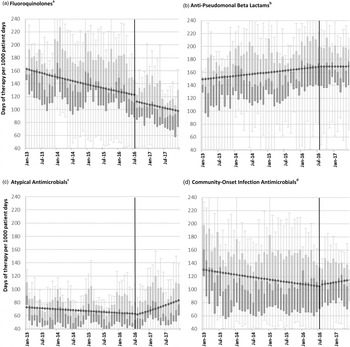
Fluoroquinolone use declined by 0.7% each month prior to the July 2016 FDA announcement (~1 DOT per 1,000 patient days per month). This resulted in an ~25% decrease from January 2013 through July 2016 (Fig. 1A). An additional decrease in fluoroquinolone use of 10.4 DOT per 1,000 patient days (7.6%; P = .002) occurred between July and August of 2016. Following the announcement, fluoroquinolone use continued to decline at a similar rate (0.9% per month). The risk ratio (RR) between July 2016 and the end of the study period (December 2017) was 0.89 (95% confidence interval [CI], 0.79–1.01).
Estimated trends in antibiotic use compared to raw fluoroquinolone use in 29 southeastern US hospitals, 2013–2018. Whisker plots represent the observed antibiotic use by month for the 29 study hospitals. Dark-gray bars represent the first quartile to median value and light-gray bars represent the median value to third quartile of antibiotic use among all 29 hospitals. (a) Ciprofloxacin, levofloxacin, moxifloxacin; (b) cefepime, ceftazidime, ceftazidime/avibactam, ceftolozane/tazobactam, doripenem, imipenem with cilastatin, meropenem, piperacillin/tazobactam, ticarcillin/clavulanate; (c) azithromycin, clarithromycin, erythromycin, doxycycline, minocycline, tetracycline; and (d) ceftriaxone, cefotaxime, ertapenem.

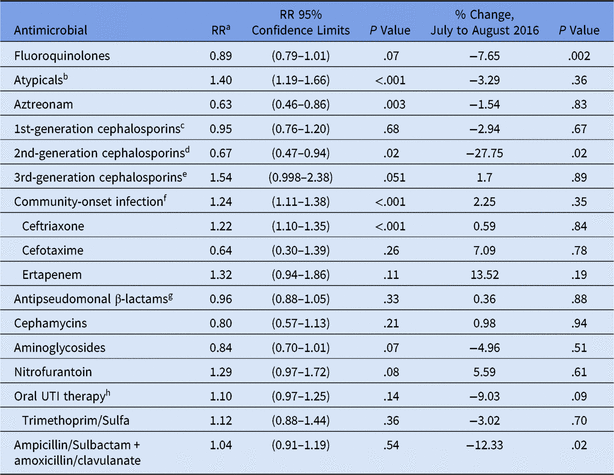
Alternative antibiotic use increased for certain antibiotic groups after the warning (Table 1 and Fig. 1C and 1D). Antibiotics commonly used as treatment for community-acquired infections included cefotaxime, ceftriaxone, and ertapenem. This group collectively declined by 0.5% per month prior to the FDA announcement and after July 2016 increased by 0.6% per month (RR, 1.24; 95% CI, 1.11–1.38). Ertapenem and cefotaxime, when analyzed as individual agents, had no significant change. Ceftriaxone, however, was decreasing by 0.3% per month and in July 2016 changed direction to increase 0.8% per month. Antibiotics for atypical infections (macrolides and tetracyclines) significantly increased after the announcement. The use of second-generation cephalosporins and aztreonam use significantly decreased after July 2016.
Fluoroquinolone and Alternative Antibiotic Rate Ratios After 2016 FDA Advisory

Update
Note. FDA, US Food and Drug Administration; RR, rate ratio; UTI, urinary tract infection.
a Rate at end of study period (Dec 2017) divided by the rate prior to FDA announcement (July 2016).
b Azithromycin, clarithromycin, erythromycin, doxycycline, minocycline, tetracycline.
c Cephalexin, cefadroxil.
d Cefaclor, cefprozil, cefuroxime (oral only).
e Cefdinir, cefditoren, cefixime, cefotaxime, cefpodoxime, ceftibuten, ceftizoxime.
f Ceftriaxone, cefotaxime, ertapenem.
g Cefepime, ceftazidime, ceftazidime/avibactam, ceftolozane/tazobactam, doripenem, imipenem with cilastatin, meropenem, piperacillin/tazobactam, ticarcillin/clavulanate.
h Trimethoprim/Sulfamethoxazole, cefdinir, cefpodoxime, cefuroxime, cephalexin, nitrofurantoin.
Black diamonds represent antibiotic use per month as predicted by regression models.
Whiskers represent minimum and maximum values.
Discussion
Fluoroquinolone use decreased throughout the study period. The July 2016 fluoroquinolone advisory update was associated with an additional, immediate drop in fluoroquinolone use by 7.6%. As fluoroquinolone use decreased, antibiotic use shifted toward agents that target atypical and community-acquired infections.
Our results are consistent with other reports of declining fluoroquinolone use. The Centers for Disease Control and Prevention (CDC) reported a rise in outpatient fluoroquinolone use between 1991 and 2010 that plateaued between 2011 and 2015. Reference Almalki, Yue, Xia, Wigle and Guo6 A Veterans’ Health Administration study showed a non–statistically significant decline in inpatient fluoroquinolone use as a percentage of all antimicrobials between 2007 and 2015. Reference Kelly, Jones and Echevarria7 A review of a drug database that included inpatient antimicrobial use data from >300 US hospitals found a nearly 20% decrease in fluoroquinolone use between 2006 and 2012. Reference Baggs, Fridkin, Pollack, Srinivasan and Jernigan2 Our study is unique because we examined a more recent period and included inpatient acute-care hospitals. The sizeable decline in fluoroquinolone use from 2013 to 2017 may be partially explained by effects of the 2016 FDA advisory update in addition to prior safety labeling changes. The observed trend also included other factors that occurred during the study period, namely concerted efforts by ASPs to avoid quinolones.
Many ASPs have identified decreasing fluoroquinolone use as a program goal due to the emerging safety data, increasing rates of fluoroquinolone resistance among Enterobacteriaceae, and risks of C. difficile. Reference Dalhoff8, Reference Pépin, Saheb and Coulombe9 We believe that the decline in fluoroquinolone use was a result of both locally implemented stewardship initiatives and the recognition of the risks of fluoroquinolones by clinicians. Examples of ASP initiatives employed in DASON include quinolone-sparing local guidelines and order sets, educational materials, processes to improve penicillin allergy assessments, and post-prescription review activities. The ASP activities targeting quinolones present prior to the announcement were reflected in the trend prior to July 2016. The FDA announcement may have added further immediate motivation to change prescribing decisions.
In our study, we estimated the impact of FDA safety labeling changes on use of a specific antibiotic and described a “squeezing the balloon” effect with shifts toward alternatives. The use of agents that target atypical infections and ceftriaxone increased following the FDA advisory update. This observation has significant clinical implications due to the potential risks associated with alternative agents. For example, ceftriaxone use increases risk for cephalosporin resistance (eg, ampC or ESBL mechanisms) and C. difficile and requires use of intravenous therapy. Oral alternatives to fluoroquinolones may be insufficient due to poor pharmacokinetics or narrower spectra. Decreased quinolone use may cause a paradoxical increase in overall DOT because antibiotic combinations may be necessary to achieve a similar spectrum of activity as fluoroquinolones (eg, ceftriaxone plus azithromycin instead of levofloxacin to treat community-acquired pneumonia).
This study has several limitations. First, we evaluated inpatient antibiotic use from southeastern US hospitals participating in a collaborative stewardship network, which may not be widely generalizable to outpatient settings or hospitals with less support for ASPs. We did not attempt to identify or study the impact of the diverse and variable stewardship initiatives employed locally that may have affected the use of fluoroquinolone and other antibiotics. Furthermore, the FDA announcement in May 2016 may have affected fluoroquinolone use leading up to the July 2016 labeling changes. Lastly, our study did not evaluate clinical or safety outcomes.
Fluoroquinolones remain relevant for limited clinical indications despite the known safety risks. The July 2016 FDA label update was associated with a decline in fluoroquinolone use; however, the impacts of such advisories and resultant shifts to alternative agents require ongoing assessment including patient-level outcomes.
Acknowledgments
Financial support
R.W.M was supported by the Agency for Healthcare Research and Quality (AHRQ grant no. K08 HS023866 to R.W.M.).
Conflicts of interest
All authors report no conflicts of interest relevant to this article.
Supplementary material
To view supplementary material for this article, please visit https://doi.org/10.1017/ice.2019.247.