Introduction
The employment of peer support workers (PSWs), where people with a condition are employed in a service supporting others with that condition (Mowbray et al., Reference Mowbray, Moxley and Collins1998), is widely established within mental health services (Resnick and Rosenheck, Reference Resnick and Rosenheck2008). Such initiatives are likely to benefit those with dementia (Keyes et al., Reference Keyes2016), but they and work evaluating them are in their infancy (Keyes et al., Reference Keyes2016).
In other client groups, benefits include more positive staff attitudes toward services (Dixon et al., Reference Dixon, Hackman and Lehman1997), reduction of hospital readmission rates (Forchuk et al., Reference Forchuk, Martin, Chan and Jensen2005), and service users feeling more understood (Corrigan, Reference Corrigan2006). PSWs experience increased self-esteem, purposeful activity, use of skills, friendship and well-being as well as the rewards of helping others, normalization, and stigma reduction (Mowbray et al. Reference Mowbray, Moxley and Collins1998; Yuen and Fossey, Reference Yuen and Fossey2003).
Challenges for PSWs (e.g. Gates and Akabas, Reference Gates and Akabas2007) include disappointment in performance and lack of support (Mowbray et al., Reference Mowbray, Moxley and Collins1998), whereas PSW role definition, accountability, and the management of boundaries present challenges for staff (Gates and Akabas, 2007; Repper and Carter, 2011).
Work evaluating PSW programs in other patient groups is informative but may not directly relate to people with dementia as while there are commonalities, such as experience of stigma (Mak et al., Reference Mak, Poon, Pun and Cheung2007; Milne, Reference Milne2010), there are also differences. In particular, dementia is associated with more severe, generally progressive, cognitive impairment (Wright and Persad, Reference Wright and Persad2007; Prince et al., Reference Prince, Bryce and Ferri2011). To our knowledge no study has investigated the challenges and benefits of PSW programs to the PSWs with dementia and the staff who work with them, and this is the focus of the current work.
Methods
Participants
Participants were PSWs (n = 4) and staff (n = 8) employed within two memory services in the UK. PSWs were concurrently patients of the services and employees of the program. Roles included co-facilitating groups, assisting in memory cafes, conference presentations, and designing service materials. Staff included admiral nurses (AN), psychologists (Psy), a deputy manager (DM), a dementia advisor (DA) and an occupational therapist (OT). Staff: PSW ratio across both services was 29:5.
Procedure
Three focus groups were run using nominal groups (NG) methodology (Delbecq and Van de Ven, Reference Delbecq and Van De Ven1971). This methodology was chosen as it has been adapted for use with people with dementia (Dening et al., Reference Dening, Jones and Sampson2012) and enables structured evaluation of the varied views expressed within the groups (Dening et al., Reference Dening, Jones and Sampson2012). All participants gave informed consent. Ethical approval was not required as the study was a service evaluation.
Three structured groups – NG 1 (PSWs only, n = 3); NG2 (Staff only, (2 ANs, 1 Psy, 1 DM, 1 DA, and 1 OT)), and NG 3 (staff (1 Psy and 1 OT) and peers, n = 4) – lasting between 1.5 and 2.25 h, were facilitated by two facilitators, AM and JMS. They were audio-recorded with detailed notes taken. The combination of mixed and non-mixed groups of staff and PSWs was chosen to allow some assessment of whether the discussions differed when both parties were or were not present. (Dening et al., Reference Dening, Jones and Sampson2012).
Each of the three groups consisted of five stages as follows:
-
1. Silent generation of ideas (10 min): Participants wrote down benefits and challenges of the PSW program.
-
2. Group discussion of ideas (30 min minimum): Ideas were generated and written on a flipchart to facilitate a structured, time-limited conversation (Van de Ven and Delbecq, Reference Van De Ven and Delbecq1972).
-
3. Further silent generation of ideas (10 min).
-
4. Discussion and generation of common themes (30 min minimum).
-
5. Ranking of themes (10 min): The five most important benefit and challenge themes were individually ranked by participants (high = 1, low = 5).
Data analysis
As suggested by Dening et al., (Reference Dening, Jones and Sampson2012), two approaches to analysis were taken to enhance content and face validity of the emerging themes.
-
1. Thematic analysis of detailed session notes and audio recordings
Detailed session notes and audio recordings were analyzed using Braun and Clarke (Reference Braun and Clarke2006)’s six phases of thematic analysis. After coding for units of meaning, key emergent themes were developed jointly by two authors (AM and JMS). Respondent validity was demonstrated through giving participants a summary of the analysis, which all validated as an accurate reflection of their views.
-
2. Collation and ranking of themes within each group
The highest ranking theme for each individual was given a score of 10 with the lowest ranking theme scored as 2. Theme scores were summed to give an overall “rank score” for each theme.
Results
Thematic analysis
Three emergent “benefit themes” and four emergent “challenge themes” were identified through the thematic analysis.
Benefit Themes
Theme: Quality of life
A prominent theme was the positive impact of the program on PSWs’ quality of life. PSWs emphasized features of well-being, engaging in stimulating activities and experiencing enjoyment, and achievement within a positive environment. The PSW program was also normalizing of experience and facilitated the learning of new skills, enhancing a sense of meaning and purpose:
“my life would be dull without it(. . .,,) If I was sitting at home, I'd just be playing solitaire” PSW1 (NG1).
PSWs also emphasised the social connections given by the work:
“. . .being here makes me feel like I'm not an isolated idiot” PSW 3 (NG3)
and the positive experience of reciprocity:
“It's not just a benefit going out, but also a benefit coming in” PSW 4 (NG3)
Theme: Peers adding value to the service
All groups agreed that PSWs made a valuable contribution to service development, delivery, and research activities. PSWs’ expertise in lived experience and the fact that they increased diversity of ideas within the service were particularly valued, as illustrated in the quote below:
“we are not all mental health professionals. . .people relate to people differently. . .more scope, different views, different ideas.” Staff member 1 (NG2).
Staff also highlighted that the PSW program increased the profile of the service:
“It's good PR. . . it's got a lot of press. . .” Staff member 6 (NG2)
Theme: Reduction of stigma associated with dementia
Participants discussed a shift in stereotypical and stigmatizing representations of dementia. For PSWs, this included reinforcement of there being “life after diagnosis” (PSW1, NG1). For staff, PSWs were seen as “examples of living well with dementia” (Staff member 7, NG3), challenging negative preconceptions about the abilities of those with a diagnosis, which were further challenged through contact and joint work with PSWs:
“it helped me to start from a position of assuming capability, skills. . .” (Staff member 4, NG2).
Challenge themes
Theme: Lack of role definition
Some staff were unclear about the PSWs’ specific day-to-day roles within the service:
“The time when I see them is when they are having their food. . .there's nothing negative . . . . . . . . . .it's just questioning the purpose of their role. . .” Staff member 2 (NG2).
While PSW's themselves expressed the desire to have more opportunities, to get involved, and to put their ideas forward:
“More please! . . . I'd like more to do” PSW3 (NG3)
Theme: The challenge of working with clients as colleagues
Working with clients as colleagues changed the “them and us” dynamic, but also led to difficulties managing PSWs’ dual roles as patients and members of staff.
“They are still on my caseload and I work with them as well” Staff member 3 (NG2).
A subtheme within this was the role of power. PSWs reported hesitancy about communicating anything negative about the program because they “[did] not want to offend” (PSW 2, NG1). Staff reported concerns about power more directly:
“I think there's a real power imbalance. . .I treat them quite different and act quite different to how I would act with any other member of staff.” Staff member 4 (NG2)
A second subtheme was the challenge of managing PSWs’ practical and emotional needs. Staff discussed the challenge of managing professionalism, with PSWs requiring prompting to come to work and having difficulties arriving on time. Both staff and PSWs also highlighted the role's emotional challenges, including potential exposure to negative experiences, such as discrimination. PSWs highlighted how hearing about experiences of dementia was sometimes upsetting;
“When I went to these conferences there were people talking about. . .the end result of dementia, you know, how they get uh, locked up in homes and things like this! I find that all very depressing. . .” PSW 1 (NG3).
They also discussed how their own experiences of dementia could make such stories more difficult to hear. Staff discussed the challenge of managing these negative impacts on PSWs as well as potential risk issues raised by PSWs when they were both colleagues and clinicians to them.
Theme: Resource limitations
Resource limitations and cost to the service were particularly an issue for staff, who discussed some concerns about the cost of the project and also that the project was not necessarily a service priority. Staff felt they needed to focus on other activities than the PSW project with one consequence being that that they did not have time to recruit or support large numbers of workers. This was noticed by PSWs themselves, who reported that there were not enough PSWs.
Theme: Considering disease progression among PSWs
Staff and PSWs raised concerns about disease progression, including the increased physical and cognitive effort involved on the part of peers as disease progressed as well as the potential loss of role and relationships when it was no longer possible for peers to continue work. Although staff discussed that they might be able to use their clinical skills to manage this, there was concern about the effects of turning an empowering experience into one that was disabling:
“You're working? But actually, no, you're a bit far gone now. What does that feel like for the person?” Staff member 5 (NG2)
Although this was a significant challenge, PSWs reported faith in the service's ability to manage role changes with sensitivity:
“If they sort of say well, “ha ha, we don't want you any more”, then it would be, well, it wouldn't happen!” PSW 4 (NG3).
Ranked themes
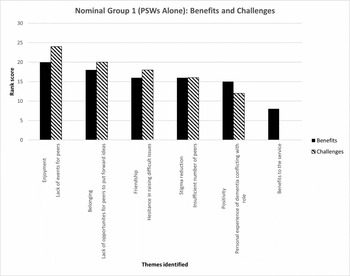
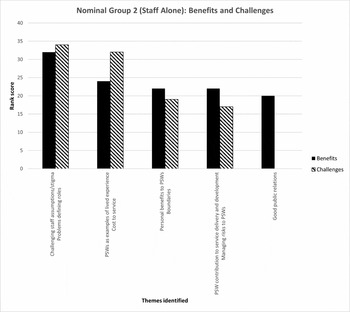
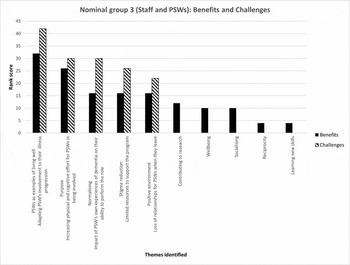
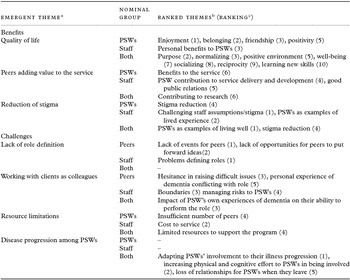
Graphs of theme rankings from the NG process are given in Figures 1–3. Table 1 shows the cross-tabulation of ranked themes (generated in the NGs) with emergent themes (generated by thematic analysis). All ranked themes are associated with an emergent theme providing evidence of face and content validity. It was noticeable that while all three emergent benefit themes were represented by ranked themes from all groups, ranked items representing emergent challenge themes differed across groups; lack of role definition was not discussed in the mixed group, with “limited resources” and “working with clients as colleagues” represented across all groups, but from different perspectives. The challenge of “considering disease progression” was only raised when PSWs and staff were in a group together.
Ranking of benefits and challenges: nominal group 1 (PSWs alone).

Ranking of benefits and challenges: nominal group 2 (staff members alone).

Ranking of benefits and challenges: nominal group 3 (PSWs and staff members).

Cross-tabulation of emergent themes from thematic analysis with ranked themes generated in each group

Note a“Emergent theme” refers to a theme from the thematic analysis.
b“Ranked theme” refers to a theme ranked within the nominal groups process.
c“ranking” refers to ranking of theme within the nominal group in terms of numbers endorsing it * how highly it was ranked. (high ranking means that the theme was generally ranked as more important).
“–” indicates where no ranked themes representing that particular emergent theme were generated in that group.
Discussion
To our knowledge this is the first study to investigate the challenges and benefits of a PSW program to staff and PSWs. Three “benefit” and four “challenge” themes were identified through thematic analysis with evidence of content and face validity provided through nominal group rankings. Reported benefits of increased quality of life, stigma reduction, and contribution to service delivery were similar to those found in mental health PSW programs (Mowbray et al., Reference Mowbray, Moxley and Collins1998). Benefits such as “life beyond diagnosis” and a sense of meaning and reciprocity echo those found where people with dementia take part in self-help networks (Clare et al., Reference Clare, Rowlands and Quin2008; Keyes et al., Reference Keyes2016)
In terms of challenges, the difficulty of working with clients as colleagues, and the lack of clear PSW roles, is also similar to mental health (Repper and Carter 2011). However, while mental health PSWs tend to report feeling overwhelmed (Mowbray et al., Reference Mowbray1996), PSWs with dementia reported the opposite, wanting more opportunities. Also, uniquely to this setting, both staff and PSWs reported concerns about how to adjust or end a PSW's role upon significant deterioration. In general, the challenge themes suggested that if PSWs are over-exposed to negative experiences, under-utilized, and asked to leave due to disease progression, such programs could actually increase stigmatization.
Power emerged as an issue in our study; PSWs reported hesitancy in raising difficult issues, and only reported certain challenges (lack of events/opportunities, insufficient peers) when not in the presence of staff. This may be because stigmatized groups who have less power have difficulty speaking up (Kaiser and Miller, Reference Kaiser and Miller2003). By contrast, some issues (costs to service, risk issues) were only discussed when staff were on their own. This is perhaps because, as a more powerful majority group they were worried about offending PSWs (Goncalo et al., Reference Goncalo, Chatman, Duguid and Kennedy2015). However, it is important to note that mixed groups were also generative, with the issue of disease progression only being raised in this format.
This was an initial study of a novel area. There was a small sample size (reflective of the small number of services operating such programs), which limits generalizability. The UK based, inner-city, memory services in this study may not be representative of other areas and countries, and PSWs and staff involved in the study were self-selecting, possibly biasing results and not reflecting the experiences of these groups as a whole.
Although replication in a larger sample with assessment of impact on service users is recommended, this study does provide preliminary evidence that PSW programs have benefits for people with dementia. In the light of the challenges, we suggest that such programs need to be well resourced and set up. From the outset, there should be clarification of peer and staff roles and how disease progression might be managed. We also suggest that there should be explicit discussions about power relationships.
Conflict of interest
None.
Description of authors’ roles
J. Stott designed the study, wrote the paper and supervised A. Mwale and J. Sweeney in data collection. J. Sweeney contributed to study design, data collection, data analysis, and edited the manuscript for important content. L. Koschalka contributed to study design, data analysis, and edited the manuscript for important content. L. O'Connor contributed to study design, analysis, and edited the manuscript for important content. A. Mwale contributed to study design, data collection, data analysis, and writing of the paper.
Acknowledgments
This work was written up as part of a fellowship awarded to Joshua Stott by the Alzheimer's society, Grant number 236 (AS-CTF-14-005). The authors would like to acknowledge the hard work and dedication of all involved in the PSW program detailed in this paper, especially the PSWs themselves.