Introduction
In the year 2000, the introduction of the Mandatory Provident Fund (MPF) scheme in the Hong Kong SAR (henceforth: Hong Kong) required employees to contribute 5 per cent of their monthly salaries to an individual retirement savings account and for this contribution to be matched by their employers (Chou et al., Reference Chou, Yu, Chan, Chan, Lum and Zhu2014). In context of the persistent inadequacy of the existing social assistance safety-net schemes in Hong Kong to tackle old age poverty, the introduction of the MPF scheme was intended to reduce reliance on government welfare provision, at least in the long run (Commission on Poverty, 2015).
Yet, since its inception, the MPF scheme in Hong Kong has attracted many criticisms, variably pointing towards its high administration costs, low investment returns, low contribution rate, the persisting coverage gap of the non-working population, and inadequate protection of low-income earners (Chan, Reference Chan2003; Commission on Poverty, 2015). Official Hong Kong population projections suggest that the percentage of persons aged sixty-five and above will increase from 15.4 per cent of the total population (or 1.07 million) in 2014 to 35.9 per cent (or 2.58 million) in 2064 (Census and Statistics Department, 2015). The perceived limitations of the current retirement system together with the rapidly ageing society have made reform of the retirement pension system one of the most heavily debated social policy issues in contemporary Hong Kong (Commission on Poverty, 2015).
While some studies have examined how individual characteristics and perceived effects of pension reform measures affect preferences for specific reform proposals (Abid et al., Reference Abid, Doherty, Flannery and O’Donoghue2013; Abid and O’Donoghue, Reference Abid and O’Donoghue2014), the public’s attitudes on pension reforms have received relatively little attention to date (Boeri et al., Reference Boeri, Börsch-Supan and Tabellini2002; Jaime-Castillo, Reference Jaime-Castillo2013). This is particularly the case if compared to the recent surge in public opinion research in other key areas of social policy (Busemeyer et al., Reference Busemeyer, Lergetporer and Woessmann2018; Berens and Gelepithis, Reference Berens and Gelepithis2019; Buss, Reference Buss2019). Not least, theoretical discussions of the politics of pension reform have often, implicitly or explicitly, relied on the conceptual and empirical evidence garnered for defined-benefit (DB) retirement pensions provided by the state or occupational schemes and the dynamics of welfare state retrenchment in the Western hemisphere (see, e.g. Larsen, Reference Larsen2008; Svallfors, Reference Svallfors2012). This article therefore aims to make a substantive contribution by focussing on the analysis of public attitudes towards compulsory or voluntary defined-contribution (DC) retirement pension reform in East Asian context. Whereas the benefit level of DB plans depends on the person’s contribution record and individual earnings, DC plans convert accumulated personal contributions and investment returns into a pension income after retirement (Kühner and Chou, Reference Kühner and Chou2019).
More particularly, we focus on two specific MPF reform options in the Hong Kong context: (i) increasing MPF contributions to sustain the individualist/particularist nature of the Hong Kong retirement pension system; or (ii) shifting towards more solidaristic/risk pooling elements in Hong Kong’s retirement pension system by partly re-allocating MPF contributions to support the introduction of a new universal pension. Using data obtained from a 2014 phone survey of 975 contributors to the MPF scheme, we examine whether agreement with these MPF reform options can be explained by respondents’ self-interest and their attachment to four different welfare attitudes, including liberalism, familism, universalism, and conservativism. We also take into account how the level of confusion with the MPF, uncertainty about future MPF income, and the level of trust in the Hong Kong government to deal with the MPF affects public attitudes on the two MPF reform options in the specific Hong Kong context.
The next section briefly introduces the current retirement income protection system in Hong Kong. Thereafter, we summarise the key theoretical approaches in the mainstream literature on DB retirement pension reform and develop some alternative hypotheses adapting these accounts for empirical analysis of DC retirement pension reforms in Hong Kong. After presenting our sampling strategy, and dependent and independent variables, we discuss our main findings and conclude by highlighting their wider theoretical and policy implications. We also stress the need for further theoretical and methodological investment to study the determinants of citizens’ support of DC retirement reforms in East Asia and beyond.
Retirement income protection in Hong Kong
The multi-pillar pension model advocated by the World Bank was adopted in Hong Kong as the blueprint for its retirement protection system (Chou et al., Reference Chou, Yu, Chan, Chan, Lum and Zhu2014). The zero pillar, namely publicly funded non-contributory pension schemes, includes assistance under the Comprehensive Social Security Assistance Scheme (CSSA), Old Age Living Allowance (OALA), and Old Age Allowance (OAA), and is intended to serve as a safety net for older persons in Hong Kong.
Both the CSSA and OALA are means-tested, but the OALA scheme, newly implemented in 2013, has less stringent income and asset limits than the CSSA, which considers bank savings, properties, insurance policies, investments in stocks and shares of the applicant together with those of all family members in order to determine eligibility. In contrast, the OAA scheme is universal, but is the least generous in terms of its level of allowance (Kühner and Chou, Reference Kühner and Chou2019). OALA receipt is restricted to permanent Hong Kong residents aged sixty-five or above that are not in receipt of OAA, CSSA, or the so-called Disability Allowance (DA) under the Social Security Allowance Scheme.
In the financial year 2014–15, the three zero pillar pension schemes covered approximately 73 per cent of the aged population – including 13 per cent by the CSSA, 37 per cent by the OALA, and 19 per cent by the OAA – and their combined recurrent expenditure was USD 3.1 billion, representing about 9 per cent of total recurrent government expenditure in that year (Commission on Poverty, 2015).
The second pillar in Hong Kong is the MPF, which is employment-based, privately managed, and involves compulsory savings through individual accounts. This scheme has been in operation since December 2000 and is similar to recent retirement pension reforms in the United States, some European, and several developing countries, where the retrenchment of DB pensions has been coupled with an increasing preponderance of DC pension provision (Ashcroft, Reference Ashcroft2009; Ebbinghaus and Whiteside, Reference Ebbinghaus and Whiteside2012; Ebbinghaus, Reference Ebbinghaus2015). Indeed, the introduction of the MPF is widely considered to be the most important retirement pension reform in Hong Kong in the past two decades: by 2016, the MPF’s accumulated assets had reached USD 76.2 billion with 2.55 million Hong Kong employees – or roughly 67 per cent of all employees – making compulsory contributions to the scheme (MPFA, 2016).
The third pillar is voluntary savings made by individuals, and the fourth pillar is family support, intended to supplement formal retirement incomes. In the case of Hong Kong, the total annual financial support received from family members, mainly adult children, is substantial and amounts to approximately USD 2.97 billion, i.e. roughly equivalent to the total government expenditure on the CSSA, OALA, and OAA for older persons together. Hong Kong workers saved about USD 50.8 billion for their retirement through private savings in 2012 (Chou et al., Reference Chou, Yu, Chan, Wu, Zhu and Lou2015). Nonetheless, concerns have been raised that it may be impossible to sustain the fourth pillar in the next three decades due to the declining fertility rate, which reduces the number of adult children, as well as the weakening of intergenerational familial obligations (Chou, Reference Chou2010).
Due to the criticisms of the MPF scheme and the persistent high poverty rate among the elderly, the local Hong Kong Commission on Poverty (2015) proposed several measures including the introduction of a universal pension, the introduction of a new means-tested welfare programme, increasing contributions to MPF scheme, and encouraging private retirement savings through tax concessions. The Hong Kong government and stakeholders in the business sector immediately raised concerns regarding the financial sustainability of introducing more universalist elements in the Hong Kong retirement income protection system if funded solely by taxes (Commission on Poverty, 2015).
Consequently, supporters of the universal pension suggested that its cost could be recovered by partly re-channelling some of the contributions to the MPF scheme to the universal pension scheme. However, observers noted that such a reform measure would result in the weakening of the function of the MPF scheme in Hong Kong. Therefore, in order to ensure retirement income security via DC pension reform in Hong Kong, a counter-suggestion was made to increase the MPF contribution rate from a relatively low 10 per cent (5 per cent from employees and 5 per cent from employers). Following these public debates in Hong Kong, this article focuses on two specific MPF reform options: (i) increasing MPF contributions or (ii) reallocating MPF contributions to the proposed universal pension.
Theorising public attitudes to MPF reform in Hong Kong
Self-interest
The literature on public attitudes on pension reform has evolved along several theoretical lines. The self-interest approach builds on studies on the redistributive impact of different welfare structures and predicts that net beneficiaries support pension reforms, while net losers are against them (Lynch and Myrskylä, Reference Lynch and Myrskylä2009). For instance, in the context of DB pension reform, the beneficiary group, namely retirees, has typically opposed government attempts to contain costs and cut back benefit levels, even in cases where retirement income protection was framed in the public discourse as comparatively generous and financially unsustainable (Immergut et al., Reference Immergut, Anderson and Schulze2007; Janky and Gál, Reference Janky and Gál2007). In contrast, such DB pensions reforms tend to be more popular among current contributors, namely salaried workers and employees, because they should ensure that pay-as-you-go retirement pension systems will still be in place when they retire in the future (Galasso and Profeta, Reference Galasso and Profeta2002; Weaver, Reference Weaver2003).
According to these accounts, we might expect that current contributors to the MPF in Hong Kong who are closer to retirement age should be more likely to support a shift towards a universal pension, because they will be beneficiaries soon enough, but are required to contribute to a universal pension through their MPF contributions merely for a short period (Hypothesis H1a). Similarly, a shift towards a universal pension might also be expected to be attractive for self-interested older MPF contributors because the MPF has not had sufficient time to fully mature and, as such, offers insufficient financial security over the whole course of retirement for the older cohorts in Hong Kong. At the same, however, given the relative importance of the fourth pillar and substantial financial support received from family members in Hong Kong, older MPF contributors in Hong Kong, who are more likely to be aware that the accrued savings in their MPF account are insufficient to ensure their retirement income security, may also be expected to support an increase in MPF contributions, because it ensures that their adult children are able to save more for their own financial security after retirement (H1b).
In contrast, one might expect that younger MPF contributors should be opposed to a universal pension if one of its funding sources is re-channelled MPF contributions. This is because they may be concerned about the financial sustainability of such an arrangement for the future when they retire. One might further argue that, compared with older MPF contributors, younger ones should be more likely to support an increase in MPF contributions, so that the protection for their retirement income security from MPF could be strengthened (H1ci). However, it is also possible that given the current competitive environment in Hong Kong, where younger workers have faced heightened financial pressures due to steep increases in housing costs and diminished earnings premiums of higher education credentials (Mok and Jiang, Reference Mok and Jiang2018), that younger MPF contributors may have stronger negative sentiments towards increases in MPF contributions as they may favour more choice over alternative investment strategies for their own future financial security, particularly properties and investment in stocks and shares. Put differently, younger MPF contributors in Hong Kong may indeed find it difficult to support any of the two MPF reform options for the above reasons (H1cii).
Welfare ideologies
Support for different retirement pension systems and reforms are typically not solely explained by the self-interest of future pension beneficiaries (Tepe, Reference Tepe2006; Groezen et al., Reference Groezen, Kiiver and Unger2009). Several international studies have noted the importance of individuals’ welfare ideology to predict their preference for different pension systems (Mau, Reference Mau2004) or other key areas of social policy (Chung et al., Reference Chung, Taylor-Gooby and Leruth2018). In particular, three welfare ideologies have been discussed in the broader comparative literature: (i) social democratic ideology, which emphasises equality and tends to strongly support redistribution and universalism; (ii) conservative ideology, which is based on a hierarchy of class and status and reproduces a segmentation of welfare for elderly people based on corporate/occupational divisions of labour during their working lives; (iii) a liberal ideology, which promotes the equality of opportunities and is more akin to the belief that each individual should be responsible for their own welfare (Esping-Andersen, Reference Esping-Andersen1990). In East Asian context, it is common to add a fourth welfare ideology, i.e. familism, which promotes the importance of intergenerational solidarity and filial piety (Gelissen, Reference Gelissen2001).
While most studies have focused on the relationship between welfare regimes and the preferences for different pension reforms at the macro-level (Boeri et al., Reference Boeri, Börsch-Supan and Tabellini2002; Jaime-Castillo, Reference Jaime-Castillo2013), individuals with attachment to different welfare ideologies should also have different preferences for the two MPF reform options in Hong Kong. For instance, an agreement with liberal welfare principles should be inconsistent with the introduction of a universal pension, which would increase the fiscal burden on the local public system and potentially result in tax increases (H2a) (Jaime-Castillo, Reference Jaime-Castillo2013). This is particularly the case in Hong Kong where successive governments have warned against the expansion of the social safety net, as this would arguably undermine the fiscal prudence and long-term competitiveness of the Hong Kong political economy (Chan, Reference Chan2011). At the same time, an agreement with liberal welfare principles might be said to be consistent with support for increasing MPF contributions since it allows MPF contributors to increase their own savings for retirement (H2bi). At the same time, however, the MPF scheme in Hong Kong includes compulsory savings, which are at odds with traditional welfare liberalism/libertarianism (H2bii).
The most straightforward reading of familistic welfare ideology underlines the autonomy of the family in the provision of welfare and stands against any reform of retirement pensions that would increase the government’s role in the provision of benefits and services for elderly people. At the individual level, it is therefore reasonable to expect that respondents’ with strong familistic values should oppose increasing contributions to the MPF and reallocating MPF contributions to a new universal pension since both will reduce the families’ role in elderly care and the resources to take care of elderly family members on their own terms (either through compulsory savings and/or increased taxation) (H3ai). At the same time, however, East Asian familism can also be understood as the government taking an active role in encouraging its citizens to fulfil family obligations, which is why some people with strong familistic values may approve of more universalist principles in old age pension provision. As has been demonstrated in other international examples (see e.g. Duflo, Reference Duflo2000), universal pensions promise to raise overall household incomes, which can then be shared within the multi-generational family unit. In this alternative perspective, respondents with strong familistic welfare values might be expected to support a reallocation of MPF contributions to a universal pension, but not an increase of contributions to the individualised MPF (H3aii).
Furthermore, we might expect that MPF contributors who uphold universalistic principles should support the reallocation of MPF contributions to a newly-introduced universal pension (Tepe, Reference Tepe2006) (H4ai); whereas adherence to conservative principles, in turn, should be more in line with greater support for increasing contributions to the MPF as this will secure individuals’ social status through the maintenance of pre-retirement income during their later years (H4b). However, there is a question whether this conceptual distinction will bear out empirically in the particular Hong Kong context, where the public has traditionally experienced limited government involvement in old age pension provision. Indeed, one might argue that a more simple preference for ‘more’ or ‘less’ public involvement in old age pensions might thwart more technical support of universal or privately-managed DC retirement pensions.
Crucially, if the latter were the case, MPF contributors with stronger universalistic attitudes might be expected to favour both the introduction of a universal pension and an increase in MPF contributions since both MPF reform options would signify an expansion of welfare involvement by the government (H4aii). Given the importance of maintaining social status in old age, however, it is unlikely that respondents with stronger conservative values, will equally be supportive of an introduction of a universal pension, whereas those with strong liberal values should want to hold on to a more residual welfare model with strict means-tested allowances and aim to avoid any expansion of government involvement in retirement income security.
MPF uncertainty and trust in government
The role of uncertainty and trust in government have been identified as important ‘second-order’ changes for public pension delivery affecting public attitudes and putting considerable downward pressures on reform proposals of DB retirement pension systems (Taylor-Gooby, Reference Taylor-Gooby2011). In the UK, for instance, the empirical evidence suggests that individuals perceive pensions to be the most complicated of all financial products, with almost two-thirds of UK citizens (63 per cent) agreeing that ‘sometimes pensions seem so complicated that I cannot really understand the best thing to do’ (MacLeod et al., Reference MacLeod, Fitzpatrick, Hamlyn, Jones, Kinver and Page2012: 59). When individuals plan and implement savings for their retirement, they must navigate complex choices; yet, due to exposure to market risk, most are uncertain how much they will actually receive from their pension during retirement (Ring, Reference Ring2010; Clark et al., Reference Clark, Strauss and Knox-Hayes2012). We therefore suggest that contributors who do not find the MPF confusing (H5a) and feel certain (H5b) about their future MPF retirement income should be more likely to support further increases in MPF contributions.
As for the role of trust in determining individuals’ preferences for different welfare policy options, the general argument is that individuals may rely on stakeholders they trust, such as the government, employers, and the financial sector, to make the best decisions for them when it comes to retirement savings (Zinn, Reference Zinn2008; Ring, Reference Ring2012). There are many different meanings of the term ‘trust in government’ in the context of the MPF reform, such as relying on the government to protect the interests of MPF users, relying on the government to ensure the MPF will bring reasonable returns during retirement life, or relying on the government to not allow itself or any other body to draw from the savings from MPF user accounts for any other purposes, and so on, and these can be difficult to capture in survey designs. However, independent of these different meanings, it seems reasonable to expect that those MPF contributors that ‘trust’ the Hong Kong government to deal with MPF issues should also be more inclined to support both MPF reform options since the MPF will mostly be operated by the local Hong Kong government (H6a). Appendix Table 1 presents a summary of our hypotheses.
Method
Data collection
Following common practice in the public attitudes literature, the data used in this study were derived from a telephone survey conducted during the period July-August 2014 by the Public Opinion Programme recently relaunched as the Hong Kong Public Opinion Research Institute which has become the major provider of rigorous public opinion polling data in Hong Kong since its establishment in 1991 at the University of Hong Kong.
The sampling procedure for the telephone survey consisted of two steps. First, a fixed set of telephone numbers was randomly selected from the latest residential directories and used as seed numbers. In order to address potential sampling issues due to unlisted landline numbers or households that exclusively use mobile phones, another set of numbers was generated by randomly adding or subtracting 1 or 2 to each of the seed numbers to obtain new and unlisted telephone numbers (the plus/minus 1/2 method). Second, since the target of the interviews were adults aged twenty-five to sixty-four, who were formally employed, Cantonese-speaking, Hong Kong residents, trained telephone interviewers only asked the potential respondent in each household to participate if they met these inclusion criteria. If there was more than one potential respondent in a household, one individual was selected by using the ‘next birthday’ rule, meaning that the person whose birthday was the soonest at the time of interview was selected. All interviews were conducted anonymously, whereas the performance of the interviewers was monitored and evaluated by qualified supervisors using real-time camera surveillance.
A total of 1,016 individuals were interviewed with a response rate of 68.0 per cent. In the subsequent analyses, we include only those interviewees, who were actively contributing to the MPF scheme at the time of interview (n = 998). Due to missing values for certain variables, the final sample for analysis contained data from 975 respondents. Given the specific inclusion criteria for our telephone survey, this sample includes slightly more male and highly-educated (i.e. with at least a post-secondary or tertiary degree) respondents than would normally be found in a representative sample of the general Hong Kong population (Census and Statistics Department, 2015). We do not claim that our findings are generalisable to the general Hong Kong population, but merely intend to examine the determinants of support to the two specific MPF reform proposals among current MPF contributors.
Measures
As discussed previously, we operationalised two dependent variables measuring respondents’ support to two MPF reforms: (i) increasing the contribution to the MPF; and (ii) relocating MPF contribution to a universal pension. Responses to these two items were collected using a 5-point Likert type scale ranging from 1 (strongly disagree) to 5 (strongly agree). We created two binary variables indicating whether each respondent ‘supported’ (strongly agree/agree) or ‘did not support’ (neither agree or disagree/disagree/strongly disagree) the two MPF reform options, respectively.
Data on the respondents’ age was collected to test our hypotheses in regards to the self-interest of MPF respondents. The respondents’ welfare ideologies, including universalistic, conservative, liberal, and familistic, were measured based on four common items of solidarity principles in European survey research (Jaime-Castillo, Reference Jaime-Castillo2013): (i) universalistic principles were measured by asking respondents if they agreed with the statement that ‘A guaranteed minimum pension should be a basic social right of every citizen’; (ii) conservative principles were assessed by asking respondents if they agreed that ‘A good pension system should allow everyone to maintain an adequate standard of living comparable to their income when they were working’; (iii) liberal principles were evaluated by asking respondents whether they agreed with the statement that ‘The amount of one’s pension should be strictly based on the amount of contributions one has contributed into the pension scheme’; (iv) familistic principles were measured by asking respondents if they agreed that ‘There should be a legal obligation for children to support their elderly parents financially if they don’t have enough income of their own.’ All four items were again rated on a 5-point Likert scale ranging from 1 (strongly disagree) to 5 (strongly agree) and dichotomised into four separate binary variables, either indicating ‘agreement’ (strongly agree/agree) or ‘disagreement’ (neither agree or disagree/disagree/strongly disagree) with each of the four statements, respectively.
The items of MPF confusion and uncertainty were included based on a study conducted in Scotland (Webb et al., Reference Webb, Watson, Ring and Bryce2014) by asking respondents if they agreed with the statements ‘The MPF is too complicated, I do not really understand the best thing to do,’ and ‘The MPF is not worth investing in because I do not know how much I will receive when I retire’. Finally, trust in the Hong Kong government was assessed with the statement: ‘I trust the government to manage MPF issues’Footnote 1. Responses for these items were collected using a 5-point Likert scale ranging from 1 (strongly disagree) to 5 (strongly agree). Once more, we created dummy variables to measure respondents’ degree of ‘confusion’ (1 = strongly disagree/disagree), ‘uncertainty’ about future MPF returns (1= strongly disagree or disagree), and ‘trust’ in the Hong Kong government to manage MPF issues (1= strongly agree or agree), respectively.
Several control variables were included covering key demographic characteristics of our respondents, namely gender (male = 0, female = 1), educational level (1 = elementary and below, 2 = high school, 3 = university and above), and occupation (1 = administrators or professionals, 2 = clerks or service workers, 3 = elementary occupations). Education and occupation were used as a proxy for socioeconomic status to avoid missing values due to the sensitive nature of questions about respondents’ income.
Results
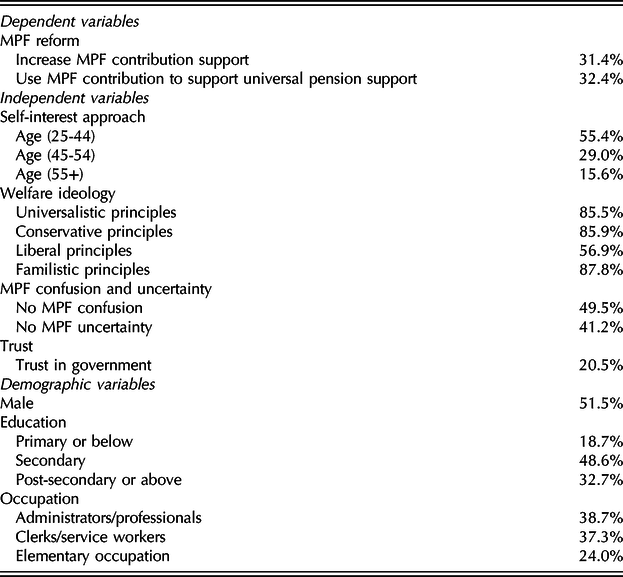
The descriptive results of all examined variables are shown in Table 1. We found an almost equal share of respondents agreeing to the two MPF reform options, respectively: (i) 31.4 per cent supported increasing MPF contributions and (ii) 32.4 per cent supported relocating MPF contributions to a universal pension. This finding also suggests that neither of the two MPF reform options had a majority support according to our sample. A majority of our respondents (85+ per cent) agreed with universalistic, conservative and familistic welfare principles, respectively, while roughly 57 per cent agreed with the liberal welfare principle that one’s retirement pension should be strictly based on the amount of contributions one has individually accumulated.
Descriptive statistics (N = 975)
Our survey further found a great deal of confusion about the MPF and uncertainty about MPF investment returns, with only 49.5 per cent of respondents stating that they experienced ‘no confusion’ and 41.2 per cent stating ‘no uncertainty’, respectively. This clearly shows that there is room for improvement in terms of providing more public information for MPF contributors in Hong Kong. However, MPF pensions rely on market credentials and only about one-fifth of respondents trusted the Hong Kong government (20.5 per cent) to manage issues related to the MPF adequately.
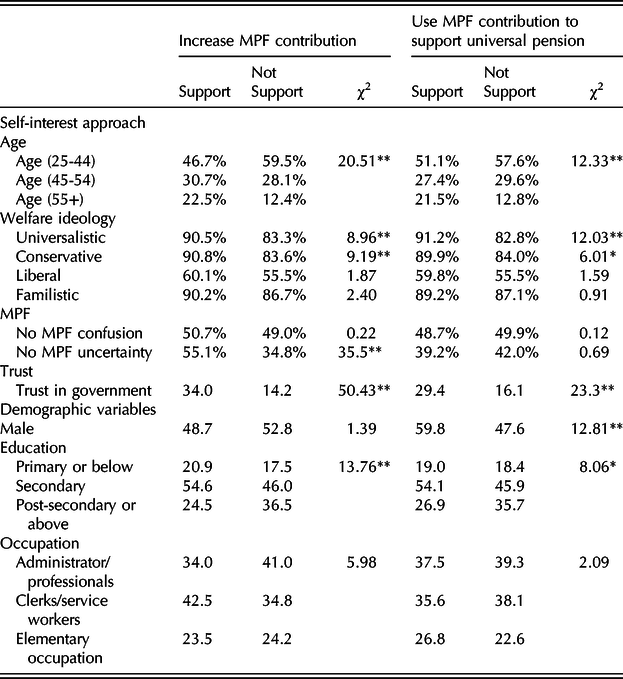
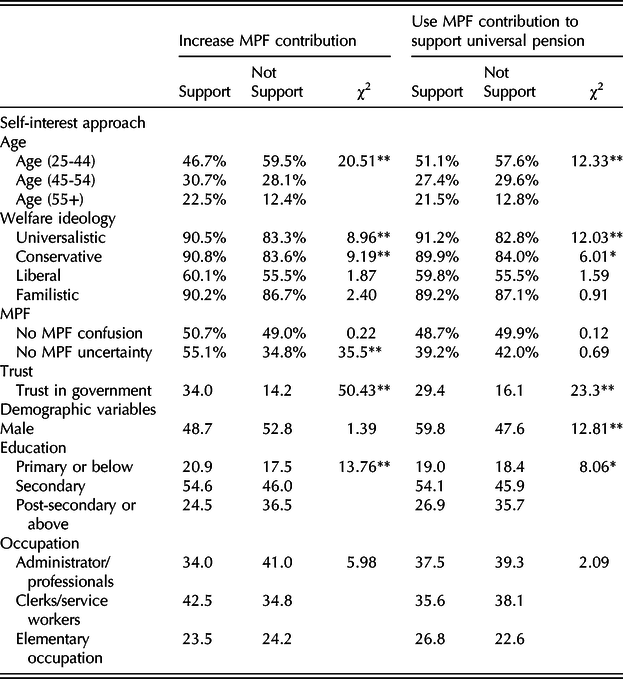
Chi-square tests were performed to assess the relationship between respondents’ support of the two proposed MPF reform options and our explanatory variables. As shown in Table 2, we find a statistically significant relationship between respondents’ support of both MPF reform options and their age, agreement with universalistic and conservative principles, trust in the Hong Kong government to manage MPF issues, and education level, respectively. There was also statistically significant association between respondents’ uncertainty with the MPF and their support for increasing MPF contributions; males were more likely to support the use of MPF contributions for the implementation of a new universal pension in Hong Kong.
Bivariate analysis of MPF reform options (N = 975)
Note: ** p < 0.01; * p < 0.05
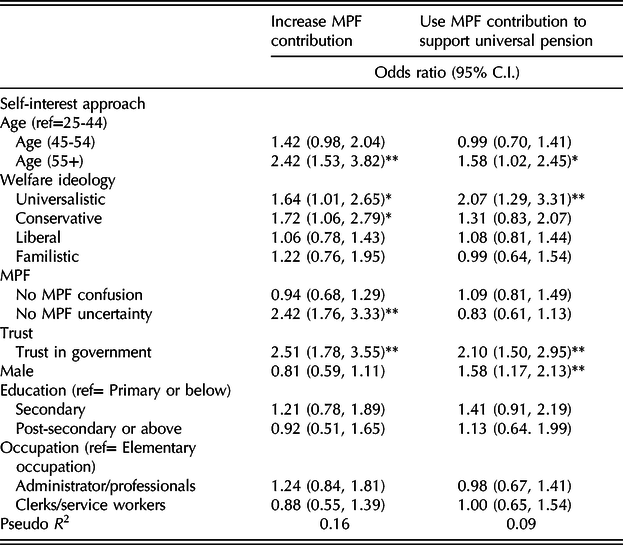
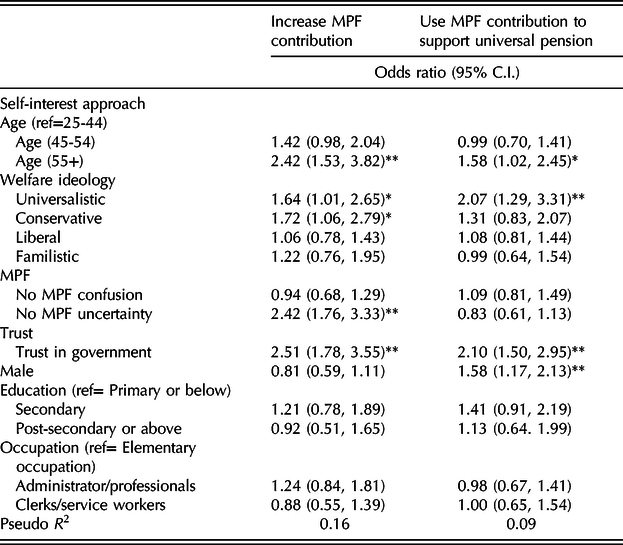
Multivariate logistic regression helps to disentangle these bivariate results (Table 3). Respondents who were older (fifty-five plus), who upheld universalistic and conservative welfare principles, were more certain about the MPF, and trusted the Hong Kong government to manage the MPF, were more likely to support increasing MPF contributions. On the other hand, those who were older (fifty-five plus), endorsed the universalistic welfare principle, trusted the Hong Kong government to manage the MPF and were male were more likely to support the use of MPF contributions for the implementation of a new universal pension in Hong Kong.
Logistic models of public attitudes toward MPF reforms (N = 975)
Note: ** p < 0.01; * p < 0.05
Discussion
Our findings show that only about one-third of respondents indicated a preference for increasing MPF contributions (31.4 per cent), which is much lower than in other developed countries. For instance, a survey conducted in 2001 showed that support for raising pension contributions in fifteen European countries ranged from 49.8 per cent in Portugal to 73.9 per cent in the UK (Jaime-Castillo, Reference Jaime-Castillo2013). Similarly, about one-third of respondents (32.4 per cent) supported using MPF contributions to support a universal pension. While this still meant that a majority of respondents did, however, not agree with the second MPF reform option, there is recent evidence suggesting that public attitudes in Hong Kong have continued to shift towards more solidaristic forms of retirement pension provision. For instance, according to a random phone survey conducted in 2016, a majority of respondents favoured the development of the Hong Kong retirement pension system towards the direction of ‘regardless of rich or poor’ (47.1 per cent) rather than for ‘those with financial needs’ (45.1 per cent) (Chung and Pang, Reference Chung and Pang2016). In the same year, more than 1,000 people, including about 300 elderly or disabled wheelchair users, took to the streets in Hong Kong to pressure the Hong Kong government to back a universal pension scheme.
In terms of the theoretical predictions considering support for the two MPF reform options in Hong Kong, our findings partially support our hypotheses regarding the rational self-interest of respondents. As expected, the logistic regression models show that compared with younger MPF contributors, older MPF contributors aged fifty-five and above were more likely, everything else being equal, to endorse an increase in MPF contributions (H1a) and the introduction of universal pension using MPF contribution (H1b). In contrast, younger MPF contributors in our study sample did not support any of the two MPF reform options, ceteris paribus (H1ci). As suggested this may point to a greater salience of the limitations of the current retirement pension status quo and concerns about the future well-being of adult children among the older age groups, alongside stronger negative sentiments towards the MPF among younger workers in Hong Kong. Given the low level of support to any of the proposed MPF reform options, future studies should be undertaken to gain a better understanding of the short- and long-term consumption and savings preferences particularly among younger MPF contributors in Hong Kong.
As expected, individuals endorsing universalistic principles were more likely to support a re-allocation of MPF contributions to support the proposed universal pension and increases in MPF contributions (H4aii), whereas those holding conservative principles were more likely to support increases in MPF contributions only (H4b). The former finding gives credence to our suggestion that those respondents who favour an extension of social rights in retirement pension provision may do so beyond the more technical considerations of the two specific MPF reforms in question. At the same time, there was no support for the hypothesis that agreement with liberal principles should be related, everything else being equal, with support for increases in MPF contributions (H2bi). Instead, agreement with liberal principles was found to be at odds with support for the introduction of a universal pension (H2a) and support for increases in MPF contributions (H2bii). Similarly to H4aii this may point to the fact that those upholding liberal principles in Hong Kong reject an extension of compulsory savings and government involvement in retirement pension provision more generally. Taken together, these findings point to the need to establish a clearer conceptual distinction of liberal principles in the context of DC retirement pension reforms (e.g. is attachment to liberal principles more conducive to alternative reform proposals, such as tax concessions to strengthen the third pension pillar). They also raise methodological issues of how universalist and liberalist welfare ideology can be distinguished with greater nuance in survey-based and mixed methods research designs in Hong Kong and elsewhereFootnote 2.
Agreement with familistic principles was associated with support for neither MPF reform option, which is in line with our expectations (H3ai). Those respondents who held stronger familistic values in our sample may have thought that family support is not exclusively responsible for the provision of elderly care and income security, but the notion that those who uphold familistic values may favour the introduction of a universal pension because it promises to increase the families’ overall resources to support elderly family members was not supported (H3aii). However, we concede that much more needs to be done to more adequately capture the different meanings of ‘familism’ in East Asia empirically, preferably via multiple survey items and the development of multidimensional scales that are robust across different East Asian societies. In the absence of widely-accepted tools in the quantitatively-informed literature (at least to our knowledge), researchers will likely rely on more qualitative research techniques to fill this gap in the first instance.
Individuals who were certain about their future MPF income were more likely to support increasing MPF contributions (H5b). This finding was among the strongest statistically (odds ratio: 2.42) and is consistent with the literature that argues a lack of information regarding the MPF scheme, such as the estimated accrued savings at retirement age and what is a sufficient amount of retirement savings, may be one of the major reasons for opposition to MPF reform (Boeri and Tabellini, Reference Boeri and Tabellini2012; Naumann, Reference Naumann2017). It is not clear why a lack of confusion with the MPF was not associated with support for increases in MPF contributions as predicted (H5a). It is possible that confusion with the MPF may lead to inertia, where MPF contributors are no longer actively engaged in the investment choices for their MPF savings; at the same time, those who stated that they do not find the MPF confusing may simply be deterred from supporting increasing MPF contributions due to low investment returns and/or other well-rehearsed criticisms of the MPF in Hong Kong. Linking public attitudes on the MPF to broader questions of risk management and reflexivity in, and the financialisation of, Hong Kong people’s everyday lives promises to be another fruitful avenue for future research.
Finally, we found that respondents who trust the Hong Kong government to manage the MPF are more likely to support both MPF reform options as expected (H6a). Indeed, the role of trust in the Hong Kong government to deal with MPF issues was the strongest individual determinant of support to both MPF reform options according to our findings: respondents were more than twice as likely, everything else being equal, to support both MPF reform options if they trusted the Hong Kong government to deal with MPF issues, compared to if they did not trust the Hong Kong government to fulfil this function (odds ratio: 2.51 and 2.10, respectively). The important question is how to enhance MPF contributors’ trust in government given the fact that the level of general trustfulness in the local government among Hong Kong citizens is currently at such a low level. Even in more favourable contexts, public trust in government has important implications for the politics of DC pension reform, especially as it may be difficult to dispel uncertainty completely due to the fact that individual contributors themselves shoulder investment risks.
Conclusion
The reform of retirement income protection systems has been at the top of the policy agenda for many governments in East Asia and across the globe for at least two decades. However, the underlying mechanisms of public attitudes to different pension reform options are still not well understood. More importantly, the public attitudes on reforms of DC retirement plans, like the Hong Kong MPF scheme, have not been examined systematically enough, with large parts of the theoretical literature relying on empirical evidence for DB retirement income protection and processes of DB retirement pension retrenchment.
The main purpose of this article was to contribute to these literatures by examining the determinants of support of MPF contributors in Hong Kong to two DC retirement pension reform proposals: (i) increasing the MPF contributions and (ii) partly re-allocating MPF contributions to a newly introduced universal pension. By focussing on the particular context of Hong Kong, we developed a series of hypotheses to test the veracity of mainstream accounts of public attitudes towards MPF reform.
Our conceptual research framework suggested that individuals’ self-interest, their agreement to different welfare ideologies, their level of confusion with the MPF, their uncertainty about their future MPF income, and their level of trust in the Hong Kong government to manage the MPF, should be able to explain their support of these specific MPF reform options, but also that the exact direction of these relationships is not always easy to determine conceptually. According to our empirical findings, it was the uncertainty with future MPF income and low trust in the Hong Kong government to deal with the MPF that have the most significant effect on respondents’ reform preferences. Mainstream accounts of the effect of public attitudes on DB pension retrenchment are only partially confirmed in our empirical analysis, underlining the need for alternative explanations to account for the effect of self-interest, liberalist, universalist, conservative, and familistic welfare attitudes in the context of DC retirement pension reforms.
Indeed, our findings leave open some important questions, inviting further investigations into the nuances of individuals’ welfare attitudes, their support of the MPF and similar DC retirement schemes, including their trust in government, employers, and the financial sector. As was highlighted throughout, some investment will undoubtedly have to focus on conceptual and methodological advancements to provide better measurements of key indicators and sets of indicators of interest. However, we also need a better understanding of how existing policies may induce favour or opposition according to positive and negative policy feedback loops or personality traits, such as e.g. time preference (Fernández and Jaime-Castillo, Reference Fernández and Jaime-Castillo2013). Future studies should further examine whether individuals that are better informed about DC retirement schemes such as the MPF in Hong Kong or the increasing pressure to reform retirement pension systems in the context of ageing societies are more willing to support ‘unpopular’ reforms to raise the contribution rate or the retirement age. Together, these efforts will go some way in developing a more formal model of public attitude formation and its ex-ante and ex-post effects on old age pension reform success and failure in the context of societal ageing and rapidly changing labour markets.
Appendix 1 Hypotheses for individuals’ support of two MPF reform options in Hong Kong

Note: Hypotheses that are not confirmed by our empirical findings are provided in Italics.