


Introduction
Cognitive behavioural therapy (CBT) is effective for treating internalizing disorders such as depression and anxiety among adolescents (Horrel et al., Reference Horrell, Goldsmith, Tylee, Schmidt, Murphy, Bonin, Beecham, Kelly, Raikundalia and Brown2014; Naeem et al., Reference Naeem, Sarhandi, Gul, Khalid, Aslam, Anbrin, Saeed, Noor, Fatima, Minhas, Husain and Ayub2014; Soltani et al., Reference Soltani, Ahghar and Asadzadeh2013). This treatment works by dealing with the vicious loop of negative thoughts, feelings, emotions and maladaptive behaviours (Cuijpers, Reference Cuijpers2017; Fenn and Byrne, Reference Fenn and Byrne2013). Like other evidence-based psychotherapies, CBT has been developed in the West; however, these therapies have been proved to be effective when adapted for other cultures (Cuijpers et al., Reference Cuijpers, Eylem, Karyotaki, Zhou, Sijbrandij, Stein, Bass and Hofmann2019). Therefore CBT has been adapted in various cultures (Aguilera et al., Reference Aguilera, Garza and Muñoz2010; BigFoot and Schmidt, Reference BigFoot and Schmidt2010; Coutinho et al., Reference Coutinho, Dias, Marques, Range, Brasil, Filpi and Nardi2017; Hinton et al., Reference Hinton, Hofmann, Rivera, Otto and Pollack2011; Guo and Hanley, Reference Guo and Hanley2014; Kananian et al., Reference Kananian, Ayoughi, Farugie, Hinton and Stangier2017). Using a culturally adapted therapeutic intervention helps therapists overcome barriers that might hinder the engagement, process and outcome of therapy (Mir et al., Reference Mir, Ghani, Meer and Hussain2019; Naz et al., Reference Naz, Gregory and Bahu2019; Rathod et al., Reference Rathod, Phiri and Naeem2019). Culturally adapted behaviour therapy is also effective for treating symptoms of social anxiety (Jankowska, Reference Jankowska2019). CBT has been culturally adapted in the Urdu language for local use for the treatment of depression and anxiety in Pakistan (Naeem et al., Reference Naeem, Irfan and Ayub2015).
Mental health services in low- and middle-income countries are poorly resourced (Wang et al., Reference Wang, Guilar-Gaxiola, Alonso, Angermeyer, Borges and Bromet2007). This is because of know–do gap: a gap between what is known and what is implemented in developing countries (Yamey, Reference Yamey2012). This gap can be narrowed by scaling up evidence-based tools and services through large-scale implementation of these services. CBT in self-help format has proven to be effective and is practised worldwide (Heimberg and Becker, Reference Heimberg and Becker2002). CBT-based self-help approaches guide an individual to change their way of thinking and behaving.
Moreover, it addresses one’s feelings of being assessed negatively in a social situation that leads to abatement in anxiety (Berger et al., Reference Berger, Caspar, Richardson, Kneubühler, Sutter and Andersson2011; Furmark et al., Reference Furmark, Carlbring, Hedman, Sonnenstein, Clevberger, Bohman and Andersson2009; Horrel et al., Reference Horrell, Goldsmith, Tylee, Schmidt, Murphy, Bonin, Beecham, Kelly, Raikundalia and Brown2014). The present study has incorporated the World Health Organization’s concept of scaling up in two ways: one by cultural adaptation of the therapy and second by developing a self-help manual to be used by the general population. The study focused on testing the effectiveness of culturally adapted CBT-based guided self-help in reducing social anxiety.
There is evidence to suggest that individuals who experience social anxiety have low self-esteem (Kocovski and Endler, Reference Kocovski and Endler2000) and higher fear of negative evaluation (Cheng et al., Reference Cheng, Zhang and Ding2014; Iqbal and Ajmal, Reference Iqbal and Ajmal2018). Fear of negative evaluation is the worry related to one’s own assessment within the social context by others (Watson and Friend, Reference Watson and Friend1969). This would not only make a person anxious and self-conscious, but may raise emotional thoughts related to a negative assessment of oneself, ultimately leading to social avoidance (Edelmann and Baker, Reference Edelmann and Baker2002; Schlenker, Reference Schlenker1980). Social anxiety eventually causes feelings of shyness, inferiority, embarrassment, inadequacy and depression (Cheek and Melchior, Reference Cheek, Melchior and Leitenberg1990; Edelmann and Baker, Reference Edelmann and Baker2002; Gilbert, Reference Gilbert2000). Previous studies (Kocovski and Endler., Reference Kocovski and Endler2000; Kumar et al., Reference Kumar, Athilakshmi, Maharishi and Maya2015) also indicated a positive correlation between fear of negative evaluation and symptoms of social anxiety. According to cognitive theorists, this fear may arise due to biased information processing in examining social circumstances (Clark and McManus, Reference Clark and McManus2002; Rapee and Heimberg, Reference Rapee and Heimberg1997). Essentially individuals with high degrees of fear of negative evaluation are excessively worried about how they are perceived or judged by others, and as a consequence show avoidant behaviour within social situations such as public speaking (Cuncic, Reference Cuncic2018), paruresis (Nall, Reference Nall2017), performance in tests (Cherry, Reference Cherry2018) as well as sports (Quinn, Reference Quinn2018), and fear of interacting with people in authority (Radek, 2013). While facing these anxiety-provoking situations, people frame a mental portrayal of ones’ appearance and it brings physical, emotional and behavioural changes that form a vicious cycle to produce social anxiety (Clark and Wells, Reference Clark, Wells, Heimberg, Liebowitz, Hope and Schneier1995; Rapee and Heimberg, Reference Rapee and Heimberg1997).
Kocovski and Endler (Reference Kocovski and Endler2000) reported that a higher level of anxiety may become an antecedent of low self-esteem. Self-esteem is considered as having trust in one’s own abilities; it is related to a person’s worth and respect (Hewitt, Reference Hewitt2009; Rosenberg, Reference Rosenberg1965). It refers to the way an individual thinks about her capacities as well as abilities, and how these contribute to making future expectations like academic achievement, happiness and satisfaction with life (Baumeister et al., Reference Baumeister, Campbell, Krueger and Vohs2003; Marsh, Reference Marsh1990; Smith and Mackie, Reference Smith and Mackie2007). Individuals who experience a higher level of fear and anxiety have lower self-esteem (Izgic et al., Reference Izgic, Akyüz, Dogan and Kugu2004). As research indicates that social anxiety and self-esteem are negatively correlated (Ahmad et al., Reference Ahmad, Bano, Ahmad and Khanam2013; Kocovski and Endler, Reference Kocovski and Endler2000), we assumed that by reducing symptoms of social anxiety, self-esteem can be enhanced. The goal of this study was to assess the effectiveness of guided self-help using a CACBT-based self-help manual to reduce symptoms of social anxiety and enhance self-esteem.
The prevalence rate of anxiety disorder in children and adolescents is higher than any other disorders (Beidel et al., Reference Beidel, Turner and Morris2000; Burstein et al., Reference Burstein, He, Kattan, Albano, Avenevoli and Merikangas2011; Costello et al., Reference Costello, J. Egger, Copeland, Erkanli, Angold, Silverman and Field2011; Lawrence et al., Reference Lawrence, Johnson, Hafekost, Boterhoven De Haan, Sawyer and Ainley2015). Social anxiety, if left untreated in adolescents, leads towards more severe functional impairment at later ages (Beesdo-Baum et al., Reference Beesdo-Baum, Knappe, Fehm, Hofler, Lieb and Hofmann2012). Prevalence rate increases until mid-adolescence and ranges between 2 and 9% (Gren-Landell et al., Reference Gren-Landell, Tillfors, Furmark, Bohlin, Andersson and Svedin2009; Ranta et al., Reference Ranta, Kaltiala-Heino, Koivisto, Pelkonen and Marttunen2007; Ranta et al., Reference Ranta, Kaltiala-Heino, Rantanen and Marttunen2009). The lifetime prevalence of social anxiety is different in various cultures; in Turkey it is 23% (Dilbaz et al., Reference Dilbaz, Enez, Cavus and Saleh2011), in Malaysia 9.2% (Al-Naggar, Reference Al-Naggar2012), in India 12.8% (Mehtalia and Vankar, Reference Mehtalia and Vankar2004), and in the USA and Germany 5–15% (Heimberg et al., Reference Heimberg, Stein, Hiripi and Kessler2000). In Pakistan, the mean overall prevalence of anxiety and depression based on community samples is 33.62%, with a point prevalence of 45.5% in women and 21.7% in men (Mirza and Jenkins, Reference Mirza and Jenkins2004). However, prevalence-based studies on social anxiety in adolescents are not reported (Ahmed and Bano, Reference Ahmed and Bano2013). No data are available on prevalence of social anxiety in Pakistan (Khan et al., Reference Khan, Kalia, Itrat, Khan, Kamal, Khan and Naqvi2007).
While social anxiety is one of the most common mental health issues (Furmark, Reference Furmark2002; Kessler et al., Reference Kessler, Avenevoli, Costello, Georgiades, Green, Gruber and Sampson2012; Spence and Rapee, Reference Spence and Rapee2016), parents and teachers are often unfamiliar with its signs and symptoms. Therefore, adolescents having social anxiety tend to develop distress, fear of social evaluation and social avoidance, which further leads to social, emotional and academic dysfunction (Beidel et al., Reference Beidel, Turner and Morris1999; Rao et al., Reference Rao, Deborah, Turner, Ammermanb, Crosby and Sallee2007; Spence et al., Reference Spence and Donovan1999). Pakistani adolescents in general experience a lack of confidence and lower self-esteem, and as a result they may feel anxious in a variety of situations (Ahmad et al., Reference Ahmad, Bano, Ahmad and Khanam2013). Cognitive behavioural therapeutic techniques have proven to be beneficial for reducing symptoms of social anxiety and depression (Heimberg and Becker, Reference Heimberg and Becker2002; Horrell et al., Reference Horrell, Goldsmith, Tylee, Schmidt, Murphy, Bonin, Beecham, Kelly, Raikundalia and Brown2014; Soltani et al., Reference Soltani, Ahghar and Asadzadeh2013). This paper reports a randomized controlled trial (RCT) to test the effectiveness of a CACBT-GSH intervention ‘Khushi aur Khatoon’ (Naeem et al., Reference Naeem, Irfan and Ayub2015) to reduce social anxiety and to enhance self-esteem among adolescents in Multan, Pakistan.
Method
Participants and setting
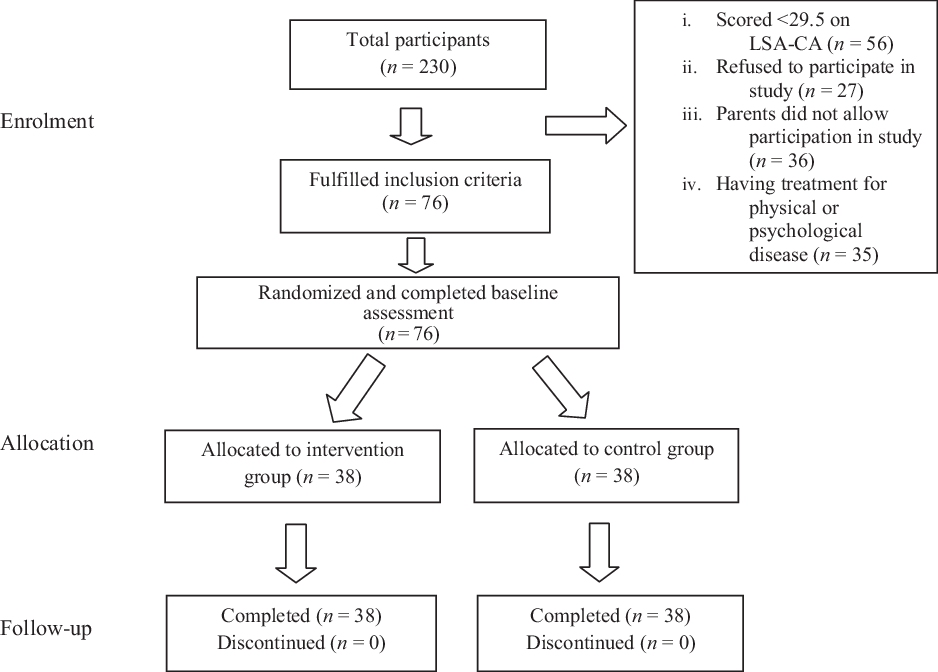
The trial was conducted at six private schools in Multan, which is the most densely populated city in Southern Punjab, Pakistan. Permission was granted by the respective school authorities. A total of 230 adolescents were screened, of which 76 adolescents within the age range of 13–16 years (mean = 14.84; SD = 0.98), studying in 9th and 10th grades, met the eligibility criteria. Non-consenting participants (refusal by students or parents to consent), those suffering from a physical or psychological illness, and those scoring less than 29.5 on the Liebowitz Social Anxiety for Children and Adolescents (LSAS-CA) Scale were excluded from the study.
Participants were randomized into two groups with 1:1 allocation (38 each in the intervention and control groups) using www.randomization.com. Students in the intervention group received guided self-help using CACBT (CaCBT-GSH) over 8 weeks in the classroom setting, while the control group was treated as usual. For the present study, TAU was the support provided by the teacher.
Ethical considerations
The study received ethics approval from Bahauddin Zakariya University, Multan, Pakistan. All participants were given detailed information regarding the study, and written consent was taken from the parents in parent/teacher meetings, especially arranged for this study as the children were under the legal age of consent.
Measurements
Assessments were carried out at baseline and at the end of the therapeutic sessions by raters blind to the allocation. Self-report questionnaires were completed by participants, facilitated by a psychologist who was blind to the allocation. The primary outcome measure was the LSAS-CA. The secondary measures were the Fear of Negative Evaluation Scale (FNES) and the Rosenberg Self-Esteem Scale (RSES).
The LSAS-CA (Masia et al., Reference Masia, Klein and Liebowitz1999) is based on the adult version of the Liebowitz Social Anxiety Scale (Liebowitz, Reference Liebowitz2014). LSAS-CA is available as a clinical self-report rating scale to measure social anxiety and avoidance in the 7–18 year age range. The LSAS-CA consists of 24 items; 12 items describe the score of Fear in social interaction situations and performance, while the other 12 describe the avoidance related to social interaction as well as performance situations. The items of the first subscale are rated on a 4-point scale in which anxiety scale responses are given as 0 (none), 1 (mild), 2 (moderate) and 3 (severe). The avoidance subscale responses are 0 (never), 1 (sometimes), 2 (often) and 3 (usually). Total anxiety is the sum of the score of the anxiety and avoidance scales. Higher scores indicate a high level of anxiety. For the present study, a cut-off score of 29.5 (Masia-Warner et al., Reference Masia-Warner, Storch, Pincus, Klein, Heimberg and Liebowitz2003) was used as it is indicative of moderate social anxiety. The study showed high test–re-test reliability and internal consistency of this version of the scale. LSAS-CA showed high correlations with the other measure of social anxiety, which predicts high validity of the scale. For the present study, the scale was translated into Urdu through a forward and backward language translation method (Beaton et al., Reference Beaton, Bombardier, Guillemin and Ferraz2000) to make it understandable for participants. The Urdu version of the scale has an internal consistency of .90 and a test–re-test reliability of .88.
The Brief FNES (Leary, Reference Leary1983) is the short version of the initial Fear of Negative Evaluation Scale (which consists of 30 items with true/false responses). It is a 12-item scale having responses on a 5-point Likert scale, with three items reversed scored (items 2, 7 and 10). The Brief version scale ranges from 12 (low fear of negative evaluation) to 60 (high fear of negative evaluation). Both original and short versions of the FNES show high internal consistency. There is also a robust correlation between the original and brief versions of the scale (Rodebaugh et al., Reference Rodebaugh, Woods, Thissen, Heimberg, Chambless and Rapee2004). An Urdu translated version of the scale (Bano et al., Reference Bano, Riaz and Khanam2009) was used in the present study. The internal consistency of the scale for the current study was .87.
The RSES (Rosenberg, Reference Rosenberg1965) is a scale consisting of 10 items measuring the self-esteem of an individual by examining both positive and negative sentiments about the self. The responses are ranked on a 4-point Likert scale from ‘strongly agree’ to ‘strongly disagree’. Scores range from 0 to 30; a score less than 15 indicates low self-esteem, which causes problems. In this scale, five statements are positive, while the other five statements are negatively worded, which reflects the feelings of the respondent. The scale is a valid and reliable tool for assessment of self-esteem (Bagley and Mallick, Reference Bagley and Mallick2001; Supple and Plunkett, Reference Supple and Plunkett2011). An Urdu translated version of the scale (Rizwan et al., Reference Rizwan, Aftab, Shah and Dharwarwala2012) was used in the current study. The internal consistency for the present study was .84.
Therapist and supervisor
Therapy was guided by a masters-level trained psychologist who had completed her post-graduation training. The training was given in the form of descriptions, use of self-help techniques, supervising assessment measurements, and use of audio relaxation exercises. The therapist stayed in schools during school times to provide therapy flexibility. Author F.N. provided continuous support and supervision through Skype.
Intervention
The culturally adapted CBT-based self-help manual ‘Khushi aur Khatoon’ for the treatment of depression and anxiety was developed in Pakistan (Naeem et al., Reference Naeem, Irfan and Ayub2015). Through this manual, using CBT techniques, ‘self-help’ treatment is available for individuals for a reduction in depression and anxiety. This manual has exercises focusing on thinking, feeling, behavioural aspects, exposure techniques, cognitive restructuring methods, and problem-solving techniques, helping individuals to balance their thinking patterns, improving relationships with others, and enabling them to lead a healthy life. The manual is written in the Urdu language and uses locally accepted idioms, stories, images and phrases which help participants to easily understand the self-help techniques and exercises. Writing diaries and homework assignments help participants to practise newly learned techniques.
A definitive objective of CACBT self-help is for an individual to be able to become his or her own therapist. In this manner, self-improvement consolidates cognitive restructuring, in-session exposure, and homework assignments, to help individuals deal with anxiety, and make them comfortable in social situations and their day-to-day interactions. The culturally adapted self-help manual consists of chapters equivalent to sessions of therapy. There were a total of eight sessions: one session per week for the intervention group.
The following treatment components were delivered through guided self-help, supported by worksheets:
(1) The main focus of the therapeutic sessions was identifying symptoms and possible reasons for anxiety (Fig. 1). Participants were provided with an explanation on social anxiety, and how social anxiety is linked to stress, fear and anxiousness when they are in any social evaluative situation. There was a brief discussion of the signs and symptoms and their possible reasons, with a list of symptoms related to avoidance. Techniques to control their symptoms by changing their lifestyle, sleep hygiene and thinking styles were explained. Progressive muscle relaxation and breathing exercises in audio format were provided as homework assignments.
(2) Participants received an explanation of the basic principle of behavioural activation and were encouraged increase their activities. These activities included: social, creative, personal and professional activities and activities related to entertainment such going out with friends, meeting new people, etc. These activities need to be performed at home step-by-step, keeping a record by writing about these activities in a diary.
(3) Participants were asked to list their problems and possible solutions while in social situations. These problems and their solutions were discussed with the caregiver.
(4) The vicious cycle of emotion, physical symptoms, behaviour and thinking process in response to any social situation was used to explain the presence of negative thinking patterns. Participants were educated in cognitive errors. A thought diary was provided as a homework assignment.
(5) Participants were given information on identifying cognitive errors. The second thought diary required them to list evidence in favour and against their distressing thoughts. In this way, a process of balancing their thinking was taught by analysing these pieces of evidence. Finally, the participants were asked to write down balanced thoughts in a third diary.
(6) Information on how to improve relationships and to deal effectively with any situation by expressing emotions and discussing disagreement with others was provided, such as culturally adapted assertive communication and conflict management.
(7) Concluding sessions focused on improving social relationships and staying healthy. Participants were educated regarding their past sessions and the participants gave their views about their homework, feelings, and symptoms at the end of each session.
(8) Exposure techniques were used to help participants deal with avoidance in day-to-day life, outside of a treatment session.
Consort flow diagram of the trial.

This self-help manual can be downloaded from the PACT website (http://www.pact.com.pk).
Statistical analysis
We followed the CONSORT guidelines for reporting the RCTs. Analysis was done using SPSS version 24.0. To examine the treatment effect on social anxiety, fear of negative evaluation, and self-esteem in interventional and control groups, analysis of covariance (ANCOVA) was used. Moreover, a chi-square test was performed to check whether treatment response was related to groups (intervention and control). A p-value less than 0.05 was considered significant.
Results
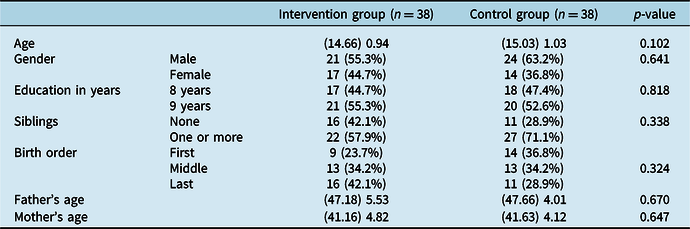
Table 1 describes the participants’ demographic characteristics.
Demographic characteristics of the participants showing differences in demographic variables between the intervention and the control groups at the baseline, where figures are number (mean) and SD for age, while the rest are number (%)

p-value using t-test for age, father’s and mother’s age, while chi-square was used for the rest.
After therapeutic sessions, participants in the intervention group showed a significant reduction in anxiety (p < .001), fear of negative evaluation (p < .001), and improvement in self-esteem (p < .001) from baseline compared with participants in the control group. There was a partial eta square of .477 for social anxiety, .605 for fear of negative evaluation and .422 for self-esteem (Table 2).
Differences between intervention and control group analysed by using ANCOVA

* p-values calculated using ANCOVA; SD, standard deviation. A reduction in scores for social anxiety and fear of negative evaluation means improvement for self- esteem scores enhanced after therapy.
Cross tabulation of intervention and control groups with treatment response

** p < 0.01. Adjusted standardized residuals appear in parenthesis below frequencies.
The difference between the intervention and control groups in terms of treatment response (remitted and non-remitted) was significant (χ2 = 10.38, d.f. = 1, n = 76). In the intervention group, 25 (65.8%) participants showed a reduction in scores below the cut-off (<29.5) on primary outcome measure (LSAS-CA). For the control group, only 10 (26.3%) scored below the cut-off (Table 3).
Discussion
The study was conducted to investigate the effectiveness of guided self-help using a CACBT-based self-help manual to treat social anxiety and enhance self-esteem in adolescents in Multan, Pakistan. To our knowledge, this is the first trial of CACBT-GSH for treating social anxiety in adolescents delivered by trainee therapists in Pakistan (Ahmed and Bano, Reference Ahmed and Bano2013; Khan et al., Reference Khan, Kalia, Itrat, Khan, Kamal, Khan and Naqvi2007). The results are consistent with a prior study (Warwick et al., Reference Warwick, Reardon, Cooper, Murayama, Reynolds, Wilson and Creswell2017), which concluded that CBT self-help skills would be effective in treating social anxiety in adolescents. Similarly, the results of the present study indicate that culturally adapted CBT self-help is also effective for treating symptoms of social anxiety in adolescents in low-income countries like Pakistan, where resources are very limited, rates of social anxiety are high and self-esteem is low in adolescents (Ahmad et al., Reference Ahmad, Bano, Ahmad and Khanam2013). The findings of this study also confirm that the culturally adapted CBT self-help manual developed by Naeem et al. (Reference Naeem, Gobbi, Ayub and Kingdon2010, Reference Naeem, Sarhandi, Gul, Khalid, Aslam, Anbrin, Saeed, Noor, Fatima, Minhas, Husain and Ayub2014) is effective and helpful (Naeem et al., Reference Naeem, Phiri, Rathod and Ayub2019).
The results of this study are consistent with the previous findings of Soltani et al. (Reference Soltani, Ahghar and Asadzadeh2013) suggesting that CBT is useful for reducing the fear of negative evaluation as well as symptoms of social anxiety in adolescents (Hullu et al., Reference Hullu, Sportle, Nauta and de Jong2017). These studies concluded that students who receive CBT show a decrease in social anxiety compared with students who did not receive any therapy.
We also found improvement in self-esteem among those who received the intervention. These findings are consistent with past research (Horrell et al., Reference Horrell, Goldsmith, Tylee, Schmidt, Murphy, Bonin, Beecham, Kelly, Raikundalia and Brown2014). CaCBT-GSH can be effective for treating low self-esteem and social anxiety in adolescents compared with no treatment at all.
The present study provides preliminary data that can be used by policymakers in Pakistan for further research in this area, which can ultimately add to upgrading teacher training programmes to help students improve their well being. This might enable teachers to identify students’ problems and help them to learn these coping skills. It will also be beneficial in reducing treatment gap in Pakistan as there is a shortage of professionals in the field of psychology in school settings.
Future research should explore the possibility of implementation and large-scale in-service evaluation of CACBT-GSH in schools in Pakistan, and assess its effectiveness in preventing anxiety disorders in schools. Future studies could focus on taking student samples from government schools; make sample comparisons of culturally adapted versus standard (not adapted) CBT in order to see the effectiveness of the adapted version; and make comparisons by using demographic variables.
There are notable limitations of this study. The participants recruited in the study were only from private schools in Multan, Pakistan. Therefore, the results might not be generalizable to public sector schools and to schools from other provinces of Pakistan. Moreover, the present study did not explore comparisons on the basis of gender and socioeconomic status. We observed large effect sizes, but caution is warranted as the sample size was not calculated for this study.





Comments
No Comments have been published for this article.