The DSM-IV-TR describes Attention Deficit Hyperactivity Disorder (ADHD) as a persistent pattern of inattention and/or hyperactivity-impulsiveness that is more frequent or severe than individuals with a comparable level of development normally exhibit. According to the same diagnostic manual, the predominantly inattentive subtype meets the A1 criterion, but not A2, during the last six months; the predominantly hyperactive-impulsive subtype meets criterion A2, but not A1, during the last six months; and the combined subtype satisfies both criteria, A1 and A2, during the last six months (American Psychiatric Association, 2000). The current prevalence of Attention Deficit Disorder is estimated between 3 and 7% world-wide (Willcutt, Reference Willcutt2012), and at 6.8% in Spain (Catalá-López et al., Reference Catalá-López, Peiró, Ridao, Sanfélix-Gimeno, Gènova-Maleras and Catalá2012).
Various studies have reported increased slow wave power in participants with ADHD compared to control groups, especially increased Theta (Amer, Rakhawy, & El Kholy, Reference Amer, Rakhawy and El Kholy2010; Chabot & Serfontein, Reference Chabot and Serfontein1996; Mann, Lubar, Zimmerman, Miller, & Muenchen, Reference Mann, Lubar, Zimmerman, Miller and Muenchen1992) and Alpha band amplitude (Koehler et al., 2008; Lazzaro, Gordon, Li, Lim, & Plahn, Reference Lazzaro, Gordon, Li, Lim, Plahn, Whitmont and Meares1999; Swartwood, Swartwood, Lubar, & Timmermann, Reference Swartwood, Swartwood, Lubar and Timmermann2003). Clarke and his colleagues have additionally found a new encephalographic profile (EEG) relating to combined-subtype ADHD: a small increase in the proportion of Beta bands (Clarke, Barry, McCarthy, & Selikowitz, Reference Clarke, Barry, McCarthy and Selikowitz2001b). Subsequent studies by the same research team at least support the existence of a specific EEG pattern in children with ADHD compared to a normative database (Barry, Clarke, McCarthy, & Selikowitz, Reference Barry, Clarke, McCarthy and Selikowitz2002; Clarke et al., Reference Clarke, Barry, McCarthy, Selikowitz, Magee, Johnstone and Croft2006), and differential EEG patterns in girls with predominantly inattentive and combined-type ADHD (Dupuy, Clarke, Barry, McCarthy, & Selikowitz, Reference Dupuy, Clarke, Barry, McCarthy and Selikowitz2014). Meanwhile, Heinrich and his colleagues studied EEG activity in two groups of children with ADHD, one with the predominantly inattentive subtype and the other combined-type, while doing a task requiring attention. They discovered that the combined-type ADHD group had a high theta/alpha ratio, while the predominantly inattentive group had a high theta/beta ratio (Heinrich et al., Reference Heinrich, Busch, Studer, Erbe, Moll and Kratz2014).
Neurofeedback, or EEG biofeedback, is a type of biofeedback that records electrical activity in the brain and transforms it into a digital visual and/or auditory signal, that is utilized as feedback, the purpose being to get the person to learn to self-regulate the amplitude of specific frequency waves (Hammond, Reference Hammond2011). The theta/beta neurofeedback training protocol has probably been the one most widely utilized in studies of neurofeedback and ADHD.
Some studies have reported significant improvements through neurofeedback training over controls (Drechsler et al., Reference Drechsler, Straub, Doehner, Heinrich, Steinhausen and Brandeis2007; Gevensleben et al., Reference Gevensleben, Holl, Albrecht, Schlamp, Kratz, Studer and Heinrich2009); improvement on tests of attention and response inhibition (Xiong, Shi, & Xu, Reference Xiong, Shi and Xu2005) and improvement in aspects of behavior and cognitive functioning (Nazari, Querne, De Broca, & Berquin, Reference Nazari, Querne, De Broca and Berquin2011).
Comparative studies have found that groups receiving neurofeedback treatment respond better than medicated groups in terms of inattentive behavior (Linden, Habib, & Radojevic, Reference Linden, Habib and Radojevic1996; Monastra, Monastra, & George, Reference Monastra, Monastra and George2002), yet others have reported significant improvements in symptomatology in neurofeedback as well as medicated groups (Fuchs, Birbaumer, Lutzenberger, Gruzelier, & Kaiser, Reference Fuchs, Birbaumer, Lutzenberger, Gruzelier and Kaiser2003; Moreno-García, Delgado-Pardo, Camacho-Vara de Rey, Meneres-Sancho, & Servera-Barceló, Reference Moreno-García, Delgado-Pardo, Camacho-Vara de Rey, Meneres-Sancho and Servera-Barceló2015). On another note, Arns and his collaborators (Arns, de Ridder, Strehl, Breteler, & Coenen, Reference Arns, de Ridder, Strehl, Breteler and Coenen2009) completed a meta-analysis of 15 controlled studies (N = 1194), 11 of which used the theta/beta protocol. At the end of their analysis, they conclude that the neurofeedback technique is “efficacious and specific,” and suggest that neurofeedback treatment of ADHD can be considered clinically significant, with a large effect size on symptoms of inattention and impulsivity, and a moderate effect size on hyperactivity symptoms. The same author later conducted a meta-analysis of the theta/beta ratio in cases of ADHD under the eyes open condition. This included nine studies (N = 1253) of children and adolescents 6 to 18 years old. From that analysis, the authors concluded that while a high theta/beta ratio cannot be considered a diagnostic measure of ADHD, it may have value in predicting how a patient will respond to pharmacological treatment versus neurofeedback treatment (Arns, Conners, & Kraemer, Reference Arns, Conners and Kraemer2013). The protocol’s main task is for subjects to learn to lower their theta band amplitude (8–12Hz) and increase their beta band amplitude (12–20Hz) (Lubar, Reference Lubar1997; Vernon et al., Reference Vernon, Egner, Cooper, Compton, Neilands, Sheri and Gruzelier2003). Using this protocol in clinical practice is supported by electrophysiology studies that have found significantly increased slow wave amplitude, and markedly decreased theta band amplitude in children with ADHD (Amer et al., Reference Amer, Rakhawy and El Kholy2010; Cornelio, Borbolla, & Gallegos, Reference Cornelio-Nieto, Borbolla-Sala and Gallegos-Dimas2011; Helps et al., Reference Helps, Broyd, James, Karl, Chen and Sonuga-Barke2010; Yordanova, Heinrich, Kolev, & Rothenberger, Reference Yordanova, Heinrich, Kolev and Rothenberger2006). Clarke, Barry, McCarthy, and Selikowitz (Reference Clarke, Barry, McCarthy and Selikowitz2001a) identified three different EEG groups in children with ADHD: the first characterized by excess slow wave activity and fast wave deficit, the second presenting significantly increased theta amplitude with decreased beta activity; and the third showed excess beta activity. The results led the authors to conclude that in terms of EEG profile, children with ADHD do not constitute a homogenous group (Clarke et al., Reference Clarke, Barry, McCarthy and Selikowitz2001a).
The use of neurofeedback in clinical practice has increased in the past decade, bearing significant improvement in some symptoms of ADHD (Butnik, Reference Butnik2005; Holtmann et al., Reference Holtmann, Stadler, Leins, Strehl, Birbaumer and Poustka2004; Leins et al., Reference Leins, Goth, Hinterberger, Klinger, Rumpf and Strehl2007; Meisel, Servera, Garcia-Banda, Cardo, & Moreno, Reference Meisel, Servera, Garcia-Banda, Cardo and Moreno2013). Yet while the effectiveness of this neuronal self-regulation technique now has ample meta-analytical backing (Arns et al., Reference Arns, de Ridder, Strehl, Breteler and Coenen2009), few studies have examined differences between ADHD subtypes using a pre-post research design (Xiong et al., Reference Xiong, Shi and Xu2005), or compared the theta/beta protocol’s effectiveness in different subtypes (Leins et al., Reference Leins, Goth, Hinterberger, Klinger, Rumpf and Strehl2007). To our understanding at the time this research was conducted, there was no evidence that any studies had investigated the theta/beta protocol’s effects in ADHD subtypes by looking at EEG changes, or described the learning curve of training in cortical self-regulation of EEG waves.
The present study was conducted with the following objectives in mind: a) evaluate whether after neurofeedback training, differences are observed between a predominantly inattentive subgroup and a predominantly hyperactive ADHD subgroup in terms of IVA/CPT scores and theta/beta ratio; b) determine whether the theta-beta ratio behaves during training like a predictor variable of attention scores; and c) analyze whether the results obtained in the group that received neurofeedback training have some relationship with the form of medication used during training (immediate versus extended-release).
Method
Participants
Fifty-four children – 20 girls (average age 12.05; SD = 2.49) and 34 boys (average age 11.52; SD = 3.05) – diagnosed with ADHD participated in the study. Assignment to the neurofeedback treatment group was determined by participants’ order of arrival. Personnel outside the research team prepared the participant list. Said personnel belonged to the center where the study was conducted, and the investigators were made aware of the participant list only at the end of the recruitment process. The first 40 participants were assigned to the neurofeedback (NF) treatment group (n = 40; average age = 11.53; SD = 2.62), of which 14 were girls (average age 11.81; SD = 2.04) and 26 were boys (average age = 11.38; SD = 2.92). The remaining 14 participants were assigned to the control group (average age = 12.25; SD = 3.47) – 6 girls (average age = 12.60; SD = 3.50) and 8 boys (average age = 11.98; SD = 3.66) – which received no intervention of any kind. Next, the group designated to receive neurofeedback training was divided into two subgroups according to their respective ADHD subtypes. In making that determination, we used the Spanish edition of the Behavior Assessment System for Children (BASC) (González-Marqués, Fernández-Guinea, Pérez-Hernández, & Santamaría, Reference González-Marqués, Fernández-Guinea, Pérez-Hernández and Santamaría2004) to identify predominantly inattentive versus hyperactive cases. Combined-type cases were excluded from the study, as the investigators’ main interest was to compare the effect of neurofeedback training on attentional variables and response inhibition. Thus, the composition of groups by subtype was as follows: the predominantly inattentive (PI) group (n = 16; average age = 11.57) was made up of 5 girls and 11 boys; and the predominantly hyperactive (PH) group (n = 20; average age = 11.91) was comprised of 6 girls and 14 boys. Of the participants in the treatment group, 14 were taking immediate-release (IR) methylphenidate (average age = 12.30), 24 were taking extended-release (ER) methylphenidate (n = 24; average age = 11.39), and two were taking different medications and were thus excluded from any analyses relating the form of drug to treatment results. All the children who participated belonged to the Association of Parents of Children with Attention Deficit with or without Hyperactivity of Madrid (ANSHDA from the acronym in Spanish). All participants were receiving pharmacological treatment at the time the study began and throughout neurofeedback training. To be accepted into the study, participants were required to meet all of the following inclusion criteria:
-
- Aged 7 to 17 years old
-
- Having a formal prior diagnosis of ADHD
-
- Keeping the medication dosage constant, and not changing it over the course of neurofeedback training.
-
- Intellectual quotient (IQ) > 80
-
-Not exhibiting other comorbid disorders
-
- Informed consent of parents
The parents of all children selected to participate in the study were informed in a private interview of their right to withdraw from participating in the study at any time. Written, signed consent forms were required from participants’ parents before beginning treatment. The ADHD diagnosis and IQ of children chosen to participate in the study were confirmed by ANSHDA, where they were evaluated previously by competent professionals based on DSM-IV criteria. No additional assessments were applied for the purpose of diagnosis. Participants were randomly assigned to experimental groups.
This study was approved by the board of directors and the ethics committee of the ANSHDA., and was conducted in keeping with the Declaration of Helsinki (World Medical Association, 2013, October).
Materials and Procedure
Integrated Visual Auditory Continuous Performance Test (IVA/CPT)
The IVA/CPT is a computerized, standardized test developed to evaluate response inhibition and level of attention (Sandford & Turner, Reference Sandford and Turner1994; Seckler, Burns, & Sandford, Reference Seckler, Burns and Sandford1995, November). The test lasts approximately 13 minutes and mainly consists of 500 trials presenting visual and auditory patterns. Global quotient scores have a mean of 100 and a standard deviation of 15.
Scores on the six main scales of the IVA/CPT tap visual and auditory performance on two full scales: a) Full Scale Response Control Quotient (FSRCQ) scale, comprised of the subscales prudence, consistency, and stamina; and b) Full Scale Attention Quotient (FSAQ) scale, comprised of the subscales vigilance, focus, and speed. In the present study, we decided to utilize the global scales, demonstrated to be highly reliable measures (sensitivity 92%; specificity 90%; positive predictive strength 89%, and negative predictive strength 93%) of attention and impulse control (Sandford, Fine, & Goldman, Reference Sandford, Fine and Goldman1995, Seckler et al., Reference Seckler, Burns and Sandford1995) and validated measures that are helpful in diagnosing ADHD (Sandford & Turner, Reference Sandford and Turner1994). Furthermore, these global quotients provide stable measures over time, making them especially appropriate for studies with repeated measures (pre-post). Two IVA/CPT measures were taken from each participant: a) Before neurofeedback training started, and b) after neurofeedback training. The boys and girls who participated in the study were instructed to click on the button only when they saw or heard a “1,” and not to click (inhibition) when they saw or heard a “2.” IVA/CPT results are generally reported graphically as well as numerically so that changes in quotient scores can be calculated between the two times the IVA/CPT was administered and capture any treatment effects.
EEG frequency recording
Continuous data from pre-post EEG recordings were collected, and neurofeedback training carried out, using the BrainMaster System – Atlantis II. Specifically, the recording and training software utilized was BrainMaster 3.0 for clinical use, version 37i.
We took two EEG recordings (eyes open) for all children in a resting state, the first prior to neurofeedback training and the second 12.5 weeks later, following the last training session. In the control group, too, there was a period of 12.5 weeks between pre and post recordings. The sampling rate was 256 Hz, and the electrodes’ impedance was kept below 5kΩ. A band-pass filter of 1 to 40 Hz was applied, and an electronic noise reduction filter, or nocht filter, was set at 50Hz. We utilized an exit channel on the central midline (CZ) a reference electrode placed frontally and centrally (FZ), and a ground electrode on the left earlobe (A1), according to the International 10–20 system. Cortical placement (CZ) was chosen for two reasons: first, previous studies have found significant results at that location associated with neurofeedback training in cases of ADHD (Drechsler et al., Reference Drechsler, Straub, Doehner, Heinrich, Steinhausen and Brandeis2007; Gevensleben et al., Reference Gevensleben, Holl, Albrecht, Schlamp, Kratz, Studer and Heinrich2009; Heinrich, Gevensleben, Freisleder, Moll, & Rothenberger, Reference Heinrich, Gevensleben, Freisleder, Moll and Rothenberger2004; Levesque, Beauregard, & Mensour, Reference Levesque, Beauregard and Mensour2006). Furthermore, we believe CZ is appropriate given that its placement is relatively free from eye movements and EMG artifacts compared to other sites closer to the eyes and jawbones; it is beneficial to keep that in mind when training children with ADHD. Electrooculography (EOG) and electromyography (EMG) were not used, because the EEG recording software has integrated filters (120 µV) that detect and exclude signals over the threshold, excluding EOG and EMG artifacts. We also visually inspected the data prior to analysis to confirm the absence of artifacts. Pre- and post-training EEG recording data were obtained from global EEG recordings during neurofeedback training. Individual averages were calculated from the theta and beta band amplitudes recorded during each session (25 recordings of 60 seconds each). Averages for all participants were subsequently sorted.
Neurofeedback training protocol
Neurofeedback training was carried out in an isolated room, without interruption. All the children who participated in the study received two weekly neurofeedback sessions of 25 minutes each for 12.5 weeks, completing a total of 25 sessions. The neurofeedback training protocol was designed to reduce Theta band activity and increase Beta band activity.
The neurofeedback training interface was presented to participants on a computer screen in the form of eight different types of digital games, synchronized with a preset training protocol. The games were presented progressively over the course of the 25 training sessions so as to maintain participants’ motivation for the full duration of training. All the games had a visual display showing the respondent’s score, updated in real time, in the upper left or right of the screen. It was synchronized with an auditory stimulus they heard through the speaker whenever they met the task conditions simultaneously: a) to lower theta-band amplitude, and b) increase beta-band amplitude. A reward criterion was set: one point for every 500 milliseconds that the task lasted.
Statistical analyses
To statistically analyze all the measures taken, the SPSS statistical package, version 20, was utilized. To evaluate the effect of training on different IVA/CPT measures, average scores in the experimental and control groups were compared using Student’s t test for repeated measures. This first study was completed using regression analysis, the purpose being to test the predictive hypothesis that children who receive neurofeedback training will score higher on the IVA/CPT as a function of having achieved better neuronal self-regulation in terms of theta/beta ratio. In cases where Student’s t indicated statistically significant differences (p < .05) between pre- and post-treatment means, effect size was computed per Cohen: d = M / SD. We took into account the following interpretation criteria: small: │d│ = .20 to .50; medium:│d│= .50 to .80; and large: │d│≥ .80 (Cohen, Reference Cohen1998). To avoid overestimating effect size, we used the Standard Deviation (SD) of the test rather than SD of the differences between pre and post measures (Dunlap, Cortina, Vaslow, & Burke, Reference Dunlap, Cortina, Vaslow and Burke1996). Finally, repeated measures Analysis of Variance (ANOVA) was used to test whether factors like ADHD subtype, medication type, or their interaction, were related to success in neurofeedback training.
Results
Pre-post IVA/CPT Measurement in the Control Group vs. Neurofeedback Group
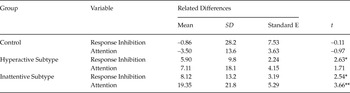
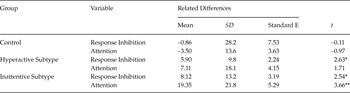
As shown in Table 1, the means difference in the control group was negative, because post IVA/CPT scores were slightly lower than pre; in any case, the differences were not statistically significant on the FSAQ (M = –3.50, SD = 13.6), t(13) = –.97, p = .352, d = –0.535 nor the FSRCQ (M = –0.86, SD = 28.2), t(13) = –.11, p = .911, d = –0.063. That is consistent with previous studies’ results in terms of IVA/CPT measures, which show good temporal stability and pre-post reliability in the absence of some mediating intervention (Sandford & Turner, Reference Sandford and Turner1994).
T Test for Related Samples in the Control Group and Groups that Received Neurofeedback Training
* p < .05.
** p < .01.
On another note, with respect to the groups who received neurofeedback training, significant improvements were observed on the FSRCQ in the predominantly inattentive group (M = 8.12, SD = 13.2), t(15) = 2.54, p = .023, d = 1.31, as well as the predominantly hyperactive group (M = 5.90, SD = 9.8), t(19) = 2.63, p = .016, d = 1.21 (see Table 1). Referring to the FSAQ, significant differences were observed in the predominantly inattentive group (M = 19.35, SD = 21.8), t(15) = 3.66, p < .01, d = 1.89, whereas differences in the predominantly hyperactive group did not reach the level of statistical significance (M = 7.105, SD = 18.1), t(19) = 1.71, p > .04, d = 0.79.
Efficacy of the Intervention as a Function of Subtype and Form of Medication
To evaluate possible effects of the variables ADHD subtype and type of medication on treatment efficacy, repeated measures ANOVA was carried out. The measurement factor was the 25 sessions averaged across five periods: Period 1, sessions 1 to 5; Period 2, sessions 6 to 10; Period 3, sessions 11 to 15; Period 4, sessions 16 to 20, and Period 5, sessions 21 to 25. The independent variables were: a) ADHD subtype – Inattentive Subtype (IS) or Hyperactive Subtype (HS); and b) Form of methylphenidate – Immediate Release (IR) or Extended Release (ER). Additionally, a post-hoc pairwise comparison analysis was done, based on Student’s t test and implemented in SPSS – called the Minimum Significant Difference (MSD) – in order to determine statistical significance between levels of the factors.
ANOVA revealed a significant main effect of the treatment variable, F(4, 128) = 6.578, p < .001, partial η2 = .17, and an interaction effect of treatment and ADHD subtype, F(4, 128) = 3.536, p = .009, partial η2 = .10. Statistically significant differences were not observed according to ADHD subtype, F(1, 32) = 2.869, p = .10, or type of medication, F(1, 34) = 1.470, p = .234.
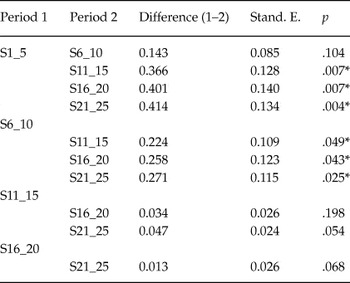
Training produced a gradual decrease in average theta/beta ratio in the five periods analyzed, but the most marked decrease occurred during the first three periods (the first 15 sessions): means S1_5 = 2.18, S6_10 = 2.04, S11_15 = 1.81, S16_20 = 1.78, S21_25 = 1.77. Post-hoc pairwise comparison through MSD confirmed that between the first two periods and the rest, differences were generally statistically significant (see Table 2).
Pairwise Comparison of Theta/Beta Ratio in the Five Training Periods Analyzed

Note: The measurement factor was the 25 sessions averaged across five periods: Period 1: S1_5; Period 2: S6_10; Period 3: S11_15; Period 4: S16_20, and Period 5: S21_25.
* p < .05.
**p < .01.
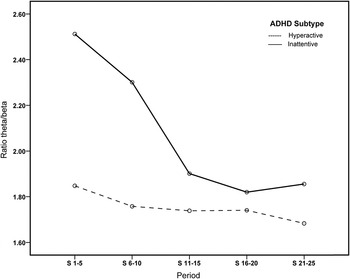
Figure 1 represents the interaction between neurofeedback training and ADHD subtype. It shows a steep decrease in theta/beta ratio with training during the first three periods (first 15 sessions) in the predominantly inattentive group. Conversely, the predominantly hyperactive group exhibited a slower, more gradual decrease all the way through the final period considered (sessions 21 to 25).
Interaction Effect of Neurofeedback Training and ADHD Subtype.
Note: Notice that in the figure, the inattentive group’s theta/beta ratio decreases more steeply than in the hyperactive group, which shows a more gradual curve.

Regarding medication type, no significant differences were found in theta/beta ratio between subjects taking Immediate Release (IR) versus Extended Release (ER) methylphenidate.
Relationship between Lower Theta/beta Ratio and Improved Attention
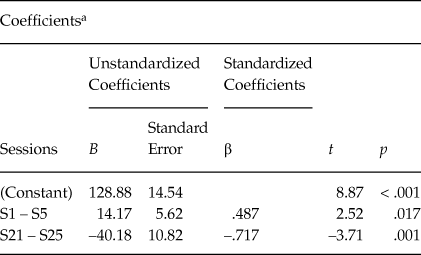
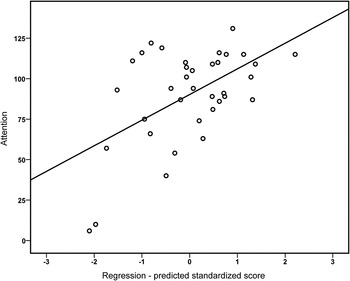
Table 3 presents results from the regression model, using average theta/beta ratios from the first five and last five sessions as predictor variables. Results indicate that these variables predict attention scores in the form of a linear model with predictive validity r = .54.
Attention = 128.88 + 14.17 (S1_5) – 40.18 (S21_S25)
Regression Model of Theta/Beta Ratio’s Ability to Predict Attentional Performance

a dependent variable: performance on FSAQ.
The scatter plot in Figure 2 conveys that values on the FSAQ increase as a function of the difference between the first period S1_S5 and last period S20_25.
Scatter Plot of the Regression Model with Predictor Variable in Attention.
Note: The values in the attention scale increase as a function of the difference between the first period S1_S5 (sessions 1 to 5) and last period S20_25 (sessions 20 to 25).

Discussion
After carrying out a training program using the neurofeedback technique and applying the theta/beta protocol to two groups of children diagnosed with ADHD, one predominantly inattentive and one predominantly hyperactive, our results verify that the predominantly inattentive group obtained better results than the predominantly hyperactive group. On the other hand, our analyses suggest that theta/beta ratio behaves like variable that predicts scores on attention scales.
In this study’s first objective, we sought to determine whether after theta-beta protocol training, differences would be observed in measures of attentional variables between a group of predominantly hyperactive children, and a group of predominantly inattentive children. The main purpose of that objective relates to IVA/CPT results, in particular, to identify potential variations between pre- and post-treatment measures on the test’s main scales. Regarding the FSRCQ, we observed significant differences in the predominantly inattentive group (p < .05) as well as the predominantly hyperactive group (p < .05), the result being particularly favorable in the former group since the FSRCQ relates to inhibitory control, consistency, and stamina. Those results are consistent with Xiong’s findings, who utilized the same test and found improvement on the FSRCQ for both subtypes, following a neurofeedback training phase (Xiong et al., Reference Xiong, Shi and Xu2005). Other studies that also utilized the IVA/CPT before and after neurofeedback training, but did not discriminate among ADHD subtypes, have reported improvements on both scales (Moreno-García et al., Reference Moreno-García, Delgado-Pardo, Camacho-Vara de Rey, Meneres-Sancho and Servera-Barceló2015), or on FSAQ (Hillard, El-Baz, Sears, Tasman, & Sokhadze, Reference Hillard, El-Baz, Sears, Tasman and Sokhadze2013).
A notable result regarding the FSAQ is that only the predominantly inattentive group showed significant differences between pre- and post-treatment measures (p = .02), and the effect size was large (d = 1.88). That is not in line with Xiong’s results, who found improvement in groups made up of both subtypes. The discrepancy between our results and Xiong’s may relate to the number of neurofeedback sessions used in that study compared to ours. If that relationship is confirmed through controlled studies, including a larger number of sessions, it would support the hypothesis that it takes more time for children with predominantly hyperactive ADHD to learn to self-regulate attention-related neuronal response than to improve self-regulation of response inhibition. The analysis of variance we conducted – to determine if the efficacy of neurofeedback training was related to ADHD subtype – seems to back that hypothesis. Taking theta/beta ratio as a variable indicative of training, we performed repeated measures analysis of variance, comparing five periods, each corresponding to a five-session phase of total training. Results suggested that in the predominantly inattentive group of children, theta/beta ratio declined steeply during the first 15 sessions, then more gradually until the 25 sessions were over. Conversely, the predominantly hyperactive group displayed a subtler decrease in theta/beta ratio across the entire course of training, with steady slope until the final session. This suggests that predominantly hyperactive children need a greater number of sessions to lower their theta/beta ratio, at least in the case of the protocol studied here. These results are not conclusive, but they do indicate it is important to more closely examine the behavior of the theta/beta protocol learning curve to corroborate this finding in future studies with a greater number of sessions.
The second objective of this study was to evaluate whether there is a correlation between IVA/CPT results in the group receiving neurofeedback training, and their level of neuronal self-regulation of theta/beta ratio during the 25 training sessions. That analysis’ point of interest lies in estimating whether theta/beta ratio behaves like a predictor variable of scores on the FSRCQ and FSAQ scales of the IVA/CPT. Results obtained through regression analysis indicate that theta/beta ratio indeed predicts attention scores, fitting a linear model, with predictive validity r = .54. These results could be of clinical utility in cases where cerebral mapping prior to neurofeedback training is not available, because with such a map, the EEG profile of a child with ADHD can be identified to see if it fits the profile of excess theta activity (Chabot & Serfontein, Reference Chabot and Serfontein1996) and deficient beta frequency, which is the profile predominantly found in cases of ADHD (Amer et al., Reference Amer, Rakhawy and El Kholy2010; Mann et al., Reference Mann, Lubar, Zimmerman, Miller and Muenchen1992), profiles where beta waves predominate (Clarke et al., Reference Clarke, Barry, McCarthy and Selikowitz2001b), or profiles with irregularities in other brain waves (Koehler et al., 2008; Lazzaro et al., Reference Lazzaro, Gordon, Li, Lim, Plahn, Whitmont and Meares1999; Swartwood et al., Reference Swartwood, Swartwood, Lubar and Timmermann2003). However, in cases where the theta/beta protocol is applied and there is no previous electroencephalographic test to go on, one can use theta/beta curve analysis after an initial block of 15 to 20 sessions and estimate whether or not the protocol will be effective in this specific case.
Finally, regarding the third objective, which sought to determine if there was a relationship between the neurofeedback training group’s results and the form of pharmacological treatment, significant differences were not observed between participants taking the Immediate Release (IR) versus Extended Release (ER) form.
This study contributes to our understanding of how neurofeedback training using the theta/beta protocol influences response inhibition and attentional variables in cases of ADHD, with either inattentive or hyperactive predominance. Furthermore, it makes a new contribution to the clinical field in suggesting the theta/beta ratio can behave like a predictor variable of scores on attention scales. Nevertheless, this study’s limitations, such as sample size, sampling method, and the wide age range of participants, mean these results must be interpreted with caution and moderation. That being said, the results reported here serve as a foundation for conducting future research geared toward optimizing the use of neurofeedback intervention protocols.