

China is emerging as a global technology giant. It is home to more than a third of the world's high-tech unicorns (ie private companies with a valuation of at least one billion US dollars), trailing the United States closely.Footnote 1 The country has the second largest share (15 per cent) of global startup hubs, with Beijing and Shanghai ranked among the top ten startup cities in the world.Footnote 2 The Chinese startup ecosystem has produced a growing number of the world's biggest tech companies, including Alibaba, Baidu, and Tencent.Footnote 3 More important than their sheer size is the fact that Chinese tech firms are no longer merely gigantic copycats but innovative leaders in some cutting-edge areas such as mobile tech and facial and speech recognition.Footnote 4 With the rising importance of Chinese tech companies and their global expansion, understanding how China incubates its tech startups is a pressing task for researchers and policymakers.
The common approach to assessing a startup ecosystem is to benchmark it against Silicon Valley, often viewed as the leading model of technology-led economic development. While China's startup ecosystem appears to share some key elements with Silicon Valley, its underlying configuration is more than meets the eye. Legal explanations of Silicon Valley's success focus on the confluence of three areas of law: financial capital, intellectual property, and human capital. With regard to financial capital, Chinese startups, like their counterparts in Silicon Valley, tap into venture capital for financing. Yet, unlike Silicon Valley, the rapid growth of China's venture capital market is attributable to government orchestration rather than market operation.Footnote 5 As to intellectual property, the traditional explanation for Silicon Valley's success is associated with strong protection for intellectual capital, though American legal scholars have recently been debating whether strict intellectual property rights help innovation.Footnote 6 In comparison, China is notorious for poor intellectual property protection. The rise of Chinese tech companies in a weak intellectual property law regime appears perplexing. A growing body of literature has attempted to explain away the problem by suggesting that China has been significantly improving its intellectual property rights system and converging on the experiences of more economically-developed countries in Asia.Footnote 7 With respect to human capital, American legal scholars propose two legally complementary arrangements important for the rise of Silicon Valley: the unenforceability of covenants not to compete (CNCs), which facilitates high job mobility and leads to regional knowledge sharing, and the widespread use of stock options, which provides high-powered incentives to tech workers.Footnote 8 On its face, China's startup ecosystem is similar to that of Silicon Valley where job-hopping and equity compensation are very common for tech workers. However, this article shows that the underlying legal infrastructure for the high job turnover and the common use of employee equity compensation in China's tech ecosystem is strikingly different from that of Silicon Valley.
China's tech startup ecosystem presents two puzzles in light of Silicon Valley's experience. First, CNCs are enforceable in China, yet China's tech ecosystem presents a high-velocity labour market. Second, Chinese tech startups commonly compensate employees with stock options, but prior to liquidity events, they routinely exercise their right to buy back departing employees’ equity interests, which is virtually taboo in Silicon Valley. The two puzzles cannot be resolved without delving into the peculiarities of China's legal and political institutions.
This article shows that actual judicial and corporate practices help mitigate the negative impact of enforceable non-compete agreements on labour mobility. Chinese courts take a cautious approach, and Chinese tech unicorns rarely enforce non-compete agreements. Meanwhile, the buyback norm makes employee equity compensation similar to cash compensation. It may save employees from potential financial losses, but it also prevents employees from using job-hopping to diversify their investment risks in startups. The buyback norm does not originate from an intention to exploit employees, but has deeper roots in China's complex political economy. The buyback norm is partly a compromise solution to problems arising from the state's strict control over foreign exchange, foreign investment, and access to domestic and international capital markets.
This article not only elucidates the puzzling arrangements of China's tech ecosystem but also speaks to a broader policy debate about the replicability of Silicon Valley and the necessity of such replication. Today, the Silicon Valley model has ‘gone viral and global’.Footnote 9 Policymakers around the world have been enthusiastic to replicate Silicon Valley. Guidebooks and manuals on how to replicate Silicon Valley are copious.Footnote 10 This article offers two opposite examples to illustrate the replication complexity: the common use of employee equity compensation (but with a buyback norm) illustrates a deformed replication, whereas the co-existence of enforceable non-compete agreements and the high-velocity labour market exemplifies non-replication, yet with similar outcomes. Copying a proven successful model like Silicon Valley appears to be a safe and efficient way for policymakers to build an innovation economy. However, policymakers should heed the common warning in comparative law scholarship: a law transplanted from a foreign jurisdiction often dies or mutates instead of growing like its original.Footnote 11
This article proceeds as follows: Part I provides an overview of the development of China's tech startup system, and Part II investigates the relationship between CNCs and the mobile labour market in China's tech sector. Part III illustrates the institutional underpinnings of the buyback norm and the implications for employees’ motivations. Part IV discusses the policy implications for the replicability debate of Silicon Valley.
I. THE LANDSCAPE OF CHINA'S TECH STARTUPS: A BRIEF OVERVIEW
The startup ecosystem in China comprises various types of organizations including tech startups, supporting organizations (incubators and accelerators), funding organizations, research and knowledge institutes, and the government.
In the late 1970s, the State Scientific and Technological Commission (now the Ministry of Science and Technology, or MOST) began to explore strategies for high-tech development in China. After investigating and comparing Silicon Valley, Massachusetts Route 128, and some other regions, government officials were inclined to take Silicon Valley as the model for emulation.Footnote 12 A series of policy experiments in the 1980s led to the launch of the so-called ‘Torch Program’ in 1988, which planned to establish national high-tech zones. Since then, high-tech industrial parks have mushroomed nationwide. As of 2017, China had 156 national high-tech zones.Footnote 13 Geographically speaking, Chinese tech startups are mainly concentrated in the high-tech zones scattered in the metropolitan areas of Beijing, Shanghai, and Shenzhen.Footnote 14 Perhaps the most well-known zone is the Zhongguancun Science Park in Beijing.Footnote 15
Over the past decades, an increasing number of Chinese tech startups have grown into unicorns. According to TechCrunch, as of October 2019, 178 (about 35 per cent) of the world's 516 unicorns were in China, with a valuation of USD 783 billion in total.Footnote 16 The world's largest unicorn is Ant Financial and the second largest is ByteDance, both of which are in China.Footnote 17 Chinese tech unicorns mainly use internet services or big data technologies to revolutionize retail, commerce, entertainment, finance, transportation sectors, etc.Footnote 18 Some of the unicorns have grown into the world's largest tech companies. Nine of the world's twenty largest internet giants by valuation are Chinese companies (eg Alibaba, Tencent, and Baidu) and the rest are American companies (eg Amazon, Google, and Facebook), with none of these companies located outside the United States and China.Footnote 19
Like firms in Silicon Valley, Chinese tech companies in their early stages are nourished by the so-called incubators and accelerators – networking organizations through which startups can get in touch with providers of various resources including business model development, funding, product development, marketing strategy, etc. Incubators and accelerators are developing nationwide, with the number growing from 73 in 1995 to 4,063 in 2017.Footnote 20
The growth of Chinese tech startups would be impossible without venture capital (VC). Despite its recent market slowdown, China is second only to the United States in terms of the amount of VC raised, invested, and exited.Footnote 21 The number of VC institutes has grown remarkably from 17 in 1994 to 2,045 in 2016.Footnote 22 In recent years, the government has been pumping money into the venture capital market. Since 2007, MOST has launched many state-owned ‘guidance funds’ to increase the supply of VC for tech startups. Over 2,000 government guidance funds are now in operation, with RMB 5.3 trillion (approximately USD 792 billion) under management.Footnote 23 Despite there being many government-funded VC firms, the most active VC firms in startup investment are usually non-government ones, including foreign firms such as IDG Capital, Sequoia China, and Matrix Partners China.Footnote 24 Although domestic VC has been growing quickly, foreign VC still accounts for a third of venture investments in Chinese tech startups.Footnote 25 Compared to domestic VC firms, foreign VC firms are more interested in investing in seed-stage startups, and much less interested in mature ones.Footnote 26
II. THE HIGH-VELOCITY LABOUR MARKET AND THE COVENANTS NOT TO COMPETE
A. The Puzzle
A distinctive feature of Silicon Valley is its ‘high-velocity’ labour market, in which employees frequently change jobs across companies.Footnote 27 The average employee tenure at Silicon Valley tech companies is only about two to three years.Footnote 28 Sociologist AnneLee Saxenian maintains that the job-hopping culture of Silicon Valley is much more conducive to knowledge spillovers across firms than the internal career culture of Massachusetts Route 120.Footnote 29 Still, why does Silicon Valley have this job-hopping culture? Professor Ronald Gilson argues that the cultural difference results from the legal fact that CNCs in employment contracts are unenforceable in California, whereas they are enforceable in Massachusetts.Footnote 30 An enforceable CNC restricts an employee's ability to work for the employer's competitors or to establish a competing business herself for a specified period in a designated geographic area after the end of employment. The traditional wisdom of CNCs concerns a trade-off between employers’ investment in human capital and trade secrets, on the one hand, and employees’ self-investment and talent market efficiency on the other.Footnote 31 CNCs with reasonable constraints on employee job mobility are enforceable in the large majority of the US states, but not in California.Footnote 32 The unenforceability of CNCs provides a legal environment in which a job-hopping culture can flourish in Silicon Valley.
Unlike in Silicon Valley, CNCs are enforceable in China. The early implicit sources of CNCs in China were the Anti-Unfair Competition Law 1993 and the Labour Law 1994. The former prohibited the unauthorized use of trade secrets;Footnote 33 the latter permitted the employer and the employee to stipulate in the employment contract matters concerning trade secret protection and compensation for damages resulting from breaches by the employee.Footnote 34 Despite the absence of express recognition in national legislation, CNCs were clearly permitted under many local regulations of high-tech science parks.Footnote 35 For example, the Zhongguancun Science Park Regulations 2000 provided that the maximum non-compete period was three years after the termination of employment and the employer should compensate the employee.Footnote 36 Explicit legislative recognition of CNCs at the national level arrived with the enactment of China's Labour Contract Law 2008.Footnote 37 Under the law, the employer and the employee may agree that the employer shall make a compensation payment to the employee on a monthly basis during the post-employment non-compete period, and the employee shall pay liquidated damages to the employer if the employee breaches the non-compete obligation. The maximum non-compete period under the law is two years.Footnote 38 In 2013, the People's Supreme Court issued an interpretative release providing that the monthly compensation should not be less than 30 per cent of the average monthly salary in the last twelve months prior to the termination of employment.Footnote 39 The release also provides that the employee shall be bound by the CNC unless the employer waives the right to execute, or the employee requests to terminate the CNC after the employer fails to pay the compensation for more than three months.Footnote 40
Despite the enforceability of CNCs, China has a high-velocity labour market nationwide, particularly in the tech sector. In both China and the United States, the tech sector has regularly been one of the sectors with the highest employee turnover rates.Footnote 41 In China, the employee turnover rate of tech startups over the years has been consistently over 25 per cent.Footnote 42 As noted, the average employee tenure for Silicon Valley firms is as short as two to three years. Some studies suggest that the average employee tenure for Chinese tech companies is comparable to or even shorter than that of Silicon Valley. A labour market survey in 2006 showed that the average tenure for employees of Chinese internet companies was less than three years.Footnote 43 More recently, in 2014 another survey showed that the average employee tenure of Chinese internet companies was as short as 31 months, while the average was 45 months for their American counterparts.Footnote 44 Recent evidence shows that Chinese tech professionals have accelerated their job-hopping. A survey of the internet sector shows that the average employee's tenure decreased from 22.8 months in 2015 to 19.3 months in 2017, and only 9.7 per cent of the employees had a tenure of more than three years.Footnote 45 The average tenure of senior tech employees was merely 17.3 months, and only 19.8 per cent of them had stayed for two years or more at their previous employer.Footnote 46 Another report similarly shows that in 2018, the average employee tenure in China's internet sector was only 17.6 months. Footnote 47
Human resource reports in China often attribute the high job mobility to the high growth market, where employees have plenty of opportunities for career and income growth.Footnote 48 Besides the economic factors, what is the role of enforceable CNCs in relation to the high-velocity job market of China's tech sector? In light of Silicon Valley's experience, it is puzzling to observe such a high frequency of job changes in China's tech sector. Why do enforceable CNCs appear not to be a hurdle to job mobility in China's tech sector?
B. Possible Explanations
1. Rare Enforcement
An intuitive hypothesis is that Chinese tech companies rarely enforce CNCs. In China, CNCs are enforceable only when the employer pays compensation to the employee during the non-compete period. As a result, the employer would weigh the costs and benefits and enforce CNCs selectively. The compensation requirement particularly limits CNC enforcement by startups that are tight on cash.
Anecdotal evidence in news reports and online forums indicates that the use of CNCs in employment contracts has become a norm among Chinese tech companies in recent years.Footnote 49 Yet, the common use of CNCs in employment contracts does not necessarily mean that tech companies routinely enforce CNCs. Empirical evidence of CNC court cases may shed some light on the hypothesis of rare enforcement.
As of September 2019, China Judgments Online, a database of court cases maintained by the People's Supreme Court, returned 4,879 cases with a keyword search of jingye xianzhi (the standard translation of CNC in Chinese) under the labour dispute category. Note that not all Chinese court cases are publicly available.Footnote 50 It has been estimated that China Judgments Online covers about 50 per cent of all court cases in China.Footnote 51 By this estimate, the number of the CNC court cases in reality could be twice as many as the reported cases, which should be acknowledged in interpreting the following results.
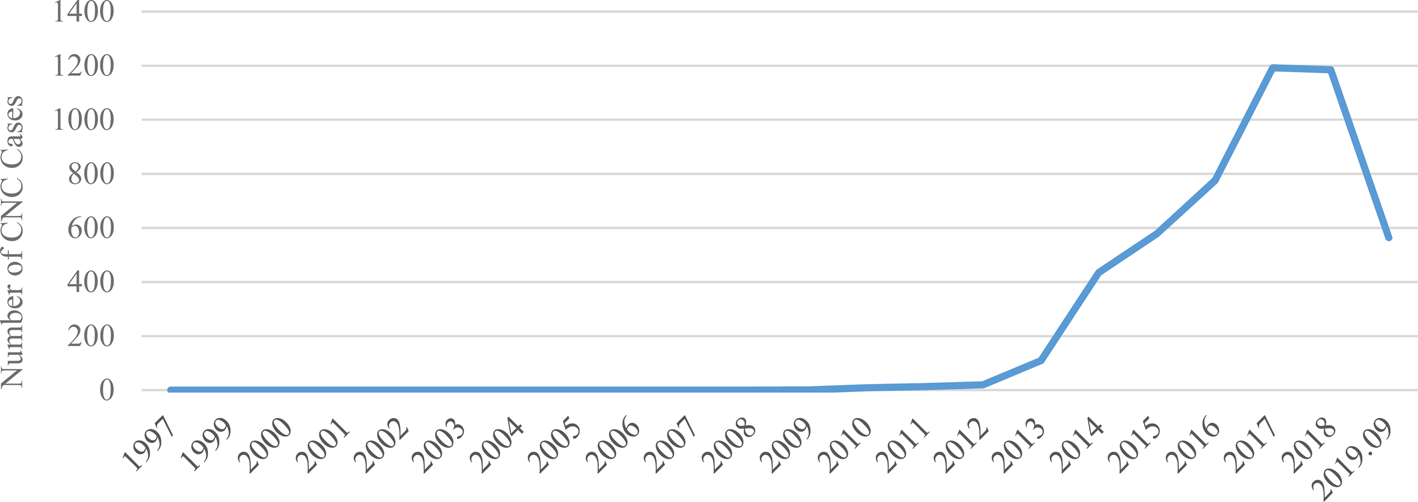
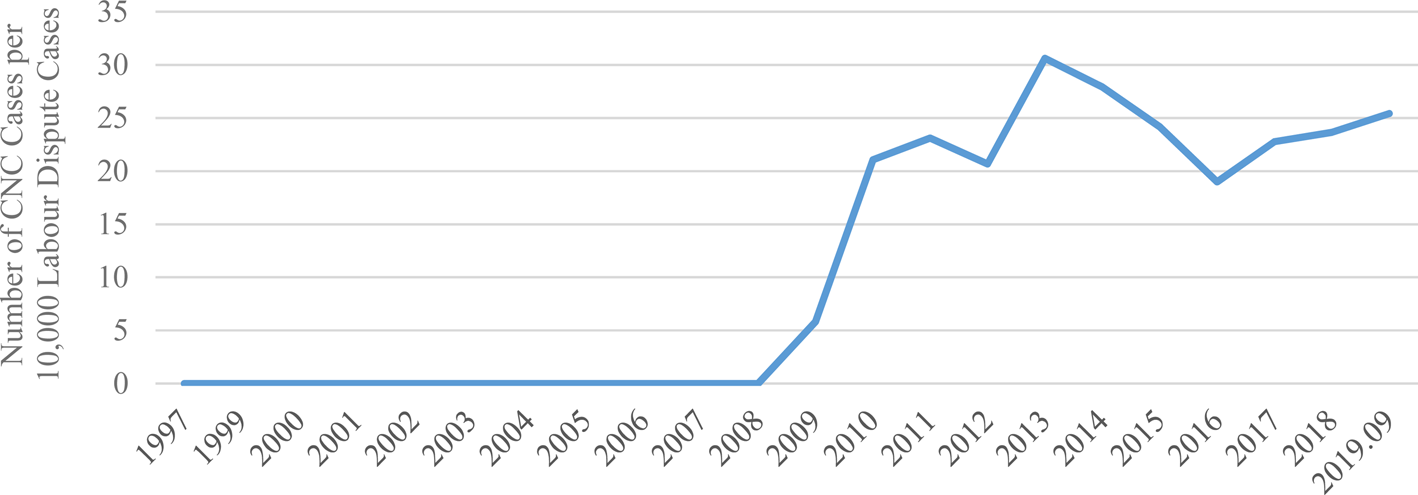
Figure 1 shows the case distribution over the years. Note that the CNC cases reported in Figure 1 include cases where employers sued former employees for CNC breaches and cases where former employees sued former employers to request compensation for CNC compliance. The first case was reported in 2009, one year after the enactment of the Labour Contract Law 2008. There was a slow growth of cases in the following years until a noticeable increase starting from 2013. The rise in the gross number of CNC cases since 2013 might be attributable to greater data availability, as the database was launched in 2013. To address this concern, Figure 2 shows the percentage of CNC cases in relation to the total labour disputes reported in the database. The database includes labour cases from as early as 1997. Figure 2 shows a significant increase in the percentage of CNC cases since 2008. The noticeable growth of CNC court cases suggests the increasing use of CNCs in employment contracts. The more common use of CNCs in employment contracts increases the likelihood of observing the growth of CNC court cases.
Number of CNC Cases, 1997–2019

Number of CNC Cases per 10,000 Labour Dispute Cases in China, 1997–2019

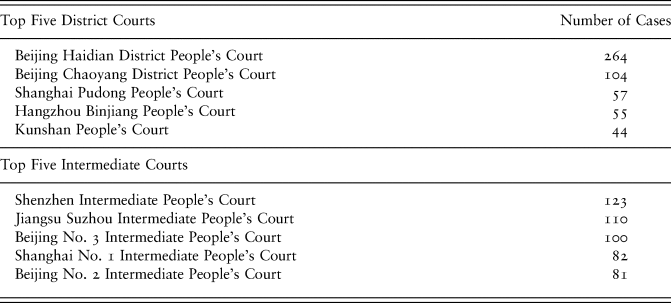
A closer look at the data shows that CNC cases tend to concentrate in jurisdictions where tech companies have strong presence in the local economy. Table 1 shows the courts with the highest number of CNC cases, including cases pursued by employers or employees. The local court of Beijing Haidian District – the jurisdiction in which China's leading tech hub Zhongguancun is located and many leading tech firms such as Baidu, Youku, and Souhu are headquartered – has the largest number of CNC cases (264). Beijing Chaoyang District is known for its financial industry. Shanghai Pudong has the well-known financial district Lujiazui and the Zhangjiang Hi-Tech Park. Hangzhou Binjiang District houses the Hangzhou Hi-Tech Park and Alibaba's headquarters. Kunshang has been known for its information technology and semiconductor industry since the 1990s. The empirical findings in Table 1 are consistent with anecdotal evidence that CNCs are mostly common in the technology and financial sectors.Footnote 52
Top Courts by Number of CNC Cases, January 2008 – September 2019.

The sample cases of the Beijing Haidian District People's Court show that 96.6 per cent of the employers involved were tech companies.Footnote 53 Employers sought to enforce CNCs against employees in about 60 per cent (133 out of 224) of the tech company cases, involving 59 different tech companies since 2008. The rest of the cases involved situations where employees sought compensation due from employers under non-compete arrangements. In other words, a significant portion of the CNC cases was actually pursued by employees rather than employers.
To further investigate the use and enforcement of CNCs in the tech sector, this article examines whether China's 131 ‘unicorns’ and its ten largest tech public companies have been involved as a plaintiff or defendant in CNC court cases.Footnote 54 As of October 2019, 14 (9.9 per cent) of the 141 tech companies have been involved in 41 unique court cases.Footnote 55 The former employees involved in the cases ranged from rank-and-file engineers to senior executives, which evidences the broad-based use of CNCs in employment contracts in the tech sector. Of the 14 companies, four (Baidu, Alibaba, Tencent, and JD) are publicly listed companies, while the rest are unicorns. Of the 41 cases, 26 cases involved nine companies seeking to enforce CNCs against former employees. In other words, only nine (6.3 per cent) of the 141 tech companies have ever sued a former employee for CNC breaches since 2008. Given the size of these large companies and the time span of over a decade, the number of lawsuits (even if doubled in reality) is miniscule. Notably, in the other 15 cases, former employees sought compensation paid by former employers.
While court cases may be helpful in assessing the frequency of CNC enforcement, most CNC disputes, like most labour disputes, are resolved privately or by arbitration. In China, it is a pre-requisite for parties in labour disputes to first seek arbitration before taking their cases to court. Due to the confidentiality of arbitration, it is hard to assess the frequency of tech employers using arbitration to enforce CNCs against former employees. Available sources suggest that between one in five to one in eight labour arbitration cases in the tech sector would be appealed to a court.Footnote 56 Accordingly, it is estimated that a total of 260 to 416 CNC-related arbitration cases have been filed by the 141 large tech companies (or, on average, 2 to 3 arbitration cases per company) over the past decade.Footnote 57
Overall, available empirical evidence suggests that CNCs are commonly used in employment contracts by Chinese tech companies. Nevertheless, it seems that Chinese tech companies rarely enforce CNCs against their former employees through either arbitration or litigation. The low frequency of CNC enforcement may be partly related to increased enforcement costs and low breach costs, as discussed below.
2. Increased Enforcement Costs
The court data shows that tech employers fare worse than employees when seeking CNC enforcement. The sample cases of the Beijing Haidian District People's Court show that tech employers lost in 56 per cent (74 out of 133) of cases where employers alleged CNC breaches by employees, and in 67 per cent (61 out of 91) of cases where employees sought compensation paid by employers due to non-compete agreements.Footnote 58 Often, the plaintiffs lost their cases due to their failure to prove the existence of a valid non-compete agreement.
From an employer's perspective, CNCs may be a double-edged sword when widely adopted. Each employer may protect its own trade secrets from being unlawfully exploited by departing employees. Meanwhile, each employer may encounter legal barriers to hire employees from competitors. In the face of the increasing adoption of CNCs, Chinese tech companies and tech professionals have recently developed strategies in an attempt to dodge these CNCs. The common avoidance strategies are as follows: the competitor would hire the CNC-bound employee through its subsidiary or affiliate; the competitor would hire the CNC-bound employee as an independent contractor rather than an employee; the competitor would enter into an employee leasing agreement with an outsourcing agency which is the official employer of the CNC-bound employee; the CNC-bound employee would entrust his shares in the competing business to a third party such as a friend; or the CNC-bound employee would establish an offshore company that contractually controls a domestic operating company in competition against his former employer.Footnote 59 The purpose of all these strategies, which use either indirect employment or indirect ownership, is to make it difficult for the former employer to detect and prove possible CNC breaches. As a result, this raises enforcement costs and may cause former employers to abandon the pursuit of CNC enforcement. Court cases suggest that plaintiff employers seeking to prove a CNC breach often expended considerable effort collecting evidence on the defendant employee's affiliation with the competitor. Plaintiff companies often employ various methods such as hiring private detectives and using surreptitious means to collect such evidence.Footnote 60 However, the admissibility and weight of evidence collected through such methods vary from case to case.Footnote 61
3. Low Costs of Breach
From an economics perspective, the employee who is subject to an enforceable CNC may weigh the costs and benefits of breaching the contract. When the benefits outweigh the costs, the employee has incentives to breach the agreement. In China, when a former employee breaches a CNC, the employer often seeks the return of the paid monthly compensation and any liquidated damages stipulated in the contract. The liquidated damages are often set as a multiple of the total amount of the monthly compensation. The court has the authority to reduce the liquidated damages if this is excessive.Footnote 62 In practice, defendant employees routinely request courts to exercise the discretion to reduce liquidated damages, and courts often do so in accordance with the defendant employees’ wishes.Footnote 63 The court cases related to the 131 unicorns and the ten largest tech companies in China show that the average liquidated damages requested by the employer was about RMB 1.9 million (USD 280,000) while the average liquidated damages approved by the court was around RMB 570,000 (USD 84,000), merely about 30 per cent of the claimed amount. The median approved liquidated damages was RMB 290,000 (USD 43,000).Footnote 64 Another data source shows that the Haidian District Court, the court with jurisdiction where Zhongguancun is located, allowed liquidated damages in only 42 (25.6 per cent) of the 164 cases sought by employers and granted a total of RMB 5.1 million (USD 75,000) between 2010 and 2016.Footnote 65 The liquidated damages do not appear intimidating to tech professionals given their average income, especially for those at the leading tech companies and unicorns.Footnote 66 More importantly, it is quite common for the employee and her current employer to make a private agreement in which the current employer helps the employee to pay off the liquidated damages in case the former employer attempts to enforce the CNC agreement.Footnote 67
C. Beyond CNCs
Employee job mobility is not simply ‘the higher, the better’. Excessive employee turnover hurts the company's productivity and bottom line. How do employers retain employees in a highly mobile labour market? In Silicon Valley, firms use equity compensation to bind employees because CNCs are unenforceable in California.Footnote 68 Do Chinese tech firms adopt a similar strategy? As shown below, Chinese tech startups widely adopt equity compensation as part of employee compensation. Yet, the contractual norm of equity compensation is very different from that in Silicon Valley, which causes equity compensation to lose its lustre.
III. EQUITY COMPENSATION AND THE BUYBACK NORM
A. The Puzzle
The use of broad-based employee stock option plans is often believed to be a key ingredient in the recipe of replicating Silicon Valley's success.Footnote 69 Stock options as part of employee compensation are by no means an innovation of Silicon Valley. What is special is that tech companies in Silicon Valley expand the use of stock options to a wide range of employees rather than limiting it to top executives.Footnote 70 The stock option plan is a contract between the company and its employees. A stock option gives an employee the right, but not the obligation, to buy a specific number of the company's shares at a specified price (called ‘strike price’) within a specified number of years. The stock option contract is designed as a long-term contract to retain employees by imposing vesting restrictions. In a typical plan, the options are granted over four years, with 25 per cent of the options vested at the end of the first year (called the ‘one-year cliff’) and the balance vested on a monthly basis over the next three years. The employee would typically have up to ten years from the grant date to exercise the options, as long as she continues to work for the company. However, if the employee leaves the company, she would typically have only three months to exercise any vested options under the contract (this is called the ‘golden handcuff’), and any vested but unexercised options would be cancelled after the three-month deadline.Footnote 71
The employee can make a fortune by selling the vested shares at a price higher than the strike price if and when the company goes public or was acquired. Stock options have generated many thousands of millionaires in Silicon Valley.Footnote 72 Stock options with a potential for spectacular economic gains are a powerful motivation tool for employees to work for the company's success. In addition to the incentivizing function, stock options are a useful recruiting tool for startup companies that are tight on cash and cannot compete with large companies that offer big salaries. Startup companies offer stock options as lottery tickets in exchange for lower salaries.
In recent years, the motivation function of stock options for startup employees has come under threat in the United States as startups have found ways to lengthen their cash runway rather than going for an initial public offering (IPO). Instead of going public within six to eight years after its foundation, a startup company now can raise significant money from the so-called ‘growth funds’ and defer the need for an IPO to ten or more years after the company is founded.Footnote 73 The increasing delay of IPO places startup employees in a dilemma if their stock options are expiring – exercising the options (ie purchasing shares and paying taxes) with no liquidity event within the visible horizon, or forgoing the lottery tickets. Commentators have suggested a number of solutions that startup companies may use to ameliorate the negative impact on their employees, including offering restricted stock units (RSUs, which are like options but with a strike price of $0), extending the exercisable period for options, offering a repurchase program in which employees may opt to cash out some of their shares, etc.Footnote 74
Like their counterparts in Silicon Valley, Chinese tech startups often include stock options as part of employee compensation. The use of employee stock options in Chinese tech startups began in the 1990s. In 1999, the government issued a policy statement that endorsed privately-owned tech companies’ use of stock options as a way to incentivize employees.Footnote 75 In 2000, the Ministry of Finance handpicked eight tech companies in the Zhongguancun Science Park to promote the use of employee stock ownership plans (ESOPs).Footnote 76 A survey in 2000 showed that a majority of Chinese internet companies had already adopted employee stock options.Footnote 77 More recently, a group of leading Chinese venture capital firms published a series of annual reports showing that a predominant majority of Chinese startups have used stock options to incentivize employees.Footnote 78 Public information shows that China's largest public tech companies, including Alibaba and Baidu, often launched ESOPs in their startup stage.Footnote 79
At first glance, the ESOPs of Chinese tech startups resemble the plans of Silicon Valley firms. Yet, there is a fundamental difference in the contractual norm. When the employee exercises the vested options and purchases the shares, the norm in Silicon Valley is that the employee would be entitled to keep the shares even after leaving the company.Footnote 80 Any attempt to claw back vested shares or vested options where the employee has no fault would raise concerns that this norm had been violated, and would be called out as ‘evil’ or ‘vampire capitalism’.Footnote 81 As noted by Sam Altman, the chairperson of Y Combinator (the best known startup accelerator in Silicon Valley), ‘it's fine if the company wants to offer to repurchase the shares, but it's horrible for the company to be able to demand this’.Footnote 82 As the real value of owning startup shares comes at the liquidity event (IPO or acquisition), an early redemption forfeits the employee shareholder's opportunity to realize the financial growth upon the liquidity event.
Unlike Silicon Valley startup workers, Chinese startup employees cannot rest assured of their ownership of vested shares or options, as their employers may exercise the repurchase right when the employment relationship ends. Various sources of information including news media, online blogs, and discussion forums widely used by Chinese lawyers and tech professionals, as well as private interviews with experienced lawyers specializing in employee stock plans, consistently show that Chinese tech startups typically retain the right to repurchase vested shares or vested options from the employee, and often exercise this right if the employee leaves before the occurrence of a liquidity event such as an IPO or acquisition.Footnote 83 When the startup exercises the repurchase right under the ESOP, the employee is obliged to sell her vested shares or options to the firm or its designated entity. The repurchase price is often stipulated in the ESOP. Chinese startups usually adopt one of three approaches to set the repurchase price: (a) the startup's net assets at the end of the prior financial year, multiplied by the employee's shareholding percentage (if options were exercised); (b) the firm's post-money evaluation in the latest round at a discount (usually 30 to 50 per cent) multiplied by the employee's shareholding percentage (if options were exercised); or (c) a multiple (usually 1 to 3) of the strike price multiplied by the number of options.Footnote 84 Regardless of the method chosen, the repurchase price – especially at the early stage of the startup – is likely to be far below the price at which the employee could sell in case of an IPO or acquisition.Footnote 85 Often, the repurchase clause applies broadly, regardless of the cause of employment termination.Footnote 86
What is the rationale, if any, for the buyback norm? The buyback norm appears puzzling in light of Silicon Valley's prevailing practice. Clawbacks may cost startup employees a fortune and thus undermine the incentive function of equity compensation. Is it simply that Chinese startups are ‘evil’ to take advantage of employees? As shown below, the buyback norm has its origin in China's peculiar institutional setting.
B. Institutional Explanations
1. State Control over Foreign Investment and Foreign Exchange
A startup is often initially financed by its entrepreneurial founders who attempt to develop and commercialize a product or service for which they believe there is a demand. Due to high development costs and limited revenues, startup companies, especially those in the tech sector, often cannot reach a self-sustaining stage without additional funding from external sources. Yet, China's capital market has been unfriendly to startups founded by private entrepreneurs. The major banks, which are all state-owned, cater to state-owned enterprises whose debts are presumably guaranteed by the government, rather than serving private startups whose risks and returns are difficult to assess. Meanwhile, domestic venture capital used to be limited until recent years.Footnote 87 In addition, Chinese tech startups often have difficulties raising funds through an IPO on domestic stock exchanges. The listing standards typically require ‘one share one vote’ and a proven record of profitability.Footnote 88 Many startup founders hold ‘super voting shares’ to retain their control over the company after equity dilution due to multiple rounds of funding.Footnote 89 Furthermore, many tech startups, especially those in the internet sector, are unable to meet the profitability requirement because they are often not profitable yet while still in need of larger-scale financing after Series C funding.Footnote 90 Moreover, the Chinese government has suspended IPOs occasionally and unexpectedly, which increases uncertainty regarding timely access to equity capital.Footnote 91 The challenges of domestic listing also suggest that a domestic IPO is a difficult exit strategy for investors of tech startups in China. As a result, many Chinese tech startups have been seeking foreign venture capital and overseas listing.
Yet, challenges emerge when seeking capital abroad. The Chinese government restricts foreign investment in many tech-related sectors such as telecommunications, internet, and media.Footnote 92 Notably, foreign investment in internet-based news services, online publishing services, online video services, and online public information dissemination services remain entirely prohibited, despite the government relaxing some foreign investment restrictions over the years.Footnote 93 Moreover, overseas listing of a domestic company is subject to approval by the China Securities Regulatory Commission and the Ministry of Commerce. The approval process is tedious and has profitability requirements.Footnote 94
To circumvent the regulations on foreign investment and offshore listing, Chinese tech startups commonly adopt the so-called ‘VIE’ (variable interest entity) structure. A VIE is a domestically incorporated entity held by Chinese nominees and contractually controlled by a foreign entity. Under a VIE structure, the domestic company holds the requisite licenses to operate the business in the restricted sector while the foreign entity controls the domestic company through a set of operation and service agreements that allow profits to be consolidated under the foreign entity. The VIE structure was first adopted by Sina when seeking listing on NASDAQ in 2000. Many other Chinese tech companies such as Baidu and Alibaba followed suit. The VIE structure has been a popular model for Chinese tech companies, especially those in the internet sector, though the legality of the VIE structure in the Chinese legal system remains unclear.Footnote 95
Under a VIE structure, the domestic company hires tech workers to develop products while the foreign entity, usually incorporated in the Cayman Islands, is the entity that will be listed overseas and thus the entity that issues stock or stock options to employees. Chinese employees establish the employment relationship with the domestic operating company, but sign ESOP agreements with the offshore company. An employee who exercises her vested stock options and buys the corresponding shares needs to transfer her payment for the shares to the offshore company. According to the regulations, such a transfer is subject to registration and approval by the State Administration of Foreign Exchange (SAFE).Footnote 96 In practice, the SAFE allows foreign exchange registration for employee share purchases if the issuer is a listed company, but refuses registration if the issuer is an unlisted company.Footnote 97 As a result, Chinese startup employees cannot legally exercise their stock options until the offshore company becomes a listed company. The foreign exchange registration being available only after listing is problematic to employees of startups that aim to be acquired rather than go public.
Under the VIE structure, both the startup and its employees face enhanced legal risks and uncertainties with regard to the exercise of stock options. On some occasions, Chinese startup employees, in complicity with their employers, resort to illegal methods such as registration with false information about transfer purposes (eg travel) or transfer through underground banks.Footnote 98 If caught by the government, they would incur penalties and would encounter problems in remitting any money derived from the sale of the shares back to China. Sometimes, startups may cunningly use the government's refusal of registration as an excuse to deny or delay employees’ request to exercise their vested stock options.Footnote 99 As ESOP agreements typically provide that unexercised stock options expire within three months after the end of employment, employees would often helplessly watch their options expiring. Disgruntled employees rarely seek legal help because the ESOP agreements signed with the offshore company often provide for arbitration or jurisdiction outside China. As such, the enforcement costs typically outweigh the economic value of the equity interests at issue, especially for rank-and-file employees. Moreover, Chinese courts have traditionally taken the view that disputes over employee equity compensation are governed by contract law rather than labour law, and this puts employees in a disadvantaged position because the contractual terms in the ESOP agreement tend to be written in favour of employers.Footnote 100
Alternatively, but relatively uncommonly, some startups would allow departing employees to informally exercise stock options and complete the foreign exchange registration later when the offshore company becomes a listed company, or allow departing employees to hold their vested stock options until listing and exercise them then.Footnote 101 After the listing, foreign exchange registration is legally feasible and thus employee stock options become practically exercisable. From a tax perspective, the delayed exercise is beneficial for employees because there is no practical tax benefit for the early exercise of stock options in China, unlike in the United States.Footnote 102 Moreover, the delayed exercise considerably reduces financial risks for employees because the value of the stock options becomes clear after the IPO. Nevertheless, the delayed registration or exercise is susceptible to dispute if good contract management is lacking. Often, it takes many years for a startup to go public, and by then some employees have already left the company. It requires the company's good faith and commitment to good management of equity compensation information, not only for current but also for former employees. Otherwise, the validity, quantity, and price of stock options would be a source of dispute after a long lapse of time, as has been well-illustrated in a number of court cases.Footnote 103
Given the risks and uncertainties for startups and their employees, a more common strategy is that startups routinely include a repurchase clause in the ESOP agreement whereby the company or its designated entity (often the Chinese startup founders, who are nominee holders of employee shares or options) has the right to buy back vested stock or options upon the termination of employment. Chinese tech startups often exercise this right unless they have significant financial difficulties.Footnote 104 From the employer's perspective, it saves administrative costs to maintain stock options for former employees and avoids potential litigation that may arise years later when the options become exercisable upon listing. It also saves the need to issue new shares or options for current and future employees, and thus slows down the equity dilution for existing shareholders. Importantly, the repurchase right is a legally permitted arrangement without any involvement of foreign exchange registration or government approval.
2. Domestic Regulatory Hurdles
In recent years, China's domestic venture capital funds have grown significantly. With the increasing supply of domestic venture capital, Chinese tech startups now have less need to rely on foreign capital and may thus do away with the problems of using the VIE structure. Yet, the buyback norm remains for different reasons.
When incorporated domestically, Chinese tech startups are routinely established as limited corporations. Under China's corporate law, a limited corporation is not allowed to have more than 50 shareholders, and the name of each shareholder must be listed in the articles of association filed with the government.Footnote 105 The buyback of employees’ shares or options helps to limit the number of shareholders and save the administrative trouble of filing the amended articles of association whenever employees exercise their stock options. Moreover, in a limited corporation, shareholders make a wide range of important decisions in a shareholder meeting or through a unanimous written resolution.Footnote 106 Maintaining a smooth channel of contact with each shareholder is critical for the operation of the company. However, it is sometimes difficult to track down, and communicate with former employees (especially those who might have had some dissatisfaction with the company) or their heirs. More importantly, employee equity compensation is usually tied with the CNC obligation. If the employee breached the non-compete agreement, her shares would be forfeited as per the contract. As noted above, the enforcement costs of CNCs are increasing. The institutional disparity across provinces and between the urban and rural areas in China adds further enforcement costs and legal uncertainties.Footnote 107
In practice, Chinese tech startups often set up limited partnerships (LPs) as employee shareholding platforms to avoid the restriction on the number of shareholders. The LP is a shareholder of the startup company and holds the shares to be allocated to employees of the startup company. In the LP, the general partner is typically the controlling shareholder of the startup company (a limited corporation) and employees are limited partners with no role in the management of the LP. Under this arrangement, startup employees are not shareholders of the startup company but limited partners who have a portion of the equity interests in the LP. Under the Partnership Law 2006, each LP may have up to 50 partners. Thus each LP can practically take on up to 49 employees for equity compensation purposes.Footnote 108 Multiple LPs would be required if shares are issued to more than 49 employees. Using LPs as shareholding platforms formally complies with the maximum number of shareholders of a limited corporation. Nevertheless, this arrangement works only if the startup has no plans for domestic listing.
Chinese securities regulations require that a non-public company shall have no more than 200 shareholders, unless an exemption is granted by the China Securities Regulatory Commission (CSRC).Footnote 109 When counting the number of shareholders, the CSRC pierces the shareholding platforms and includes each individual on the platforms. While startup companies with more than 200 shareholders may seek exemption, in practice the CSRC rarely grants exemptions.Footnote 110 The CSRC denies a startup company's IPO application if the company fails to comply with the maximum number of shareholders. As a result, Chinese startup companies usually buy back their departing employees’ vested shares or options to prevent this problem potentially arising at the IPO stage.Footnote 111
In addition, the CSRC requires clarity in the ownership of the IPO firm.Footnote 112 Stock option plans established and implemented prior to the IPO could be a concern to the ownership clarity requirement. Holders of stock options may or may not exercise their options and thus may or may not become shareholders of the company. Moreover, the CSRC requires there to be no potential disputes regarding the ownership of the IPO-seeking company.Footnote 113 Employment termination is prone to dispute. Leaving stock or stock options in the hands of departing employees increases litigation risks over ownership issues. As a result, startup companies usually prefer to buy back stock or stock options from departing employees to prevent all potential legal risks that may add bumps on their road to an IPO.
After successful listing, the company may adopt new ESOPs. In practice, listed companies normally allow departing employees to retain their equity interests. In other words, the buyback norm ceases to operate once the companies are listed.
C. Assessment from Employees’ Perspective
The institutional analysis that has been presented above comes mainly from the employer's perspective. In the eyes of startup employees, the buyback norm carries ambivalent implications.
Working in a startup involves financial and career risks. There is great uncertainty about the future of a startup, especially in the early stage. Most startups fail to survive. Even among the survivors, only a tiny portion will become a listed company. Given the high ‘mortality rate’, there are high chances that a startup's common stock will become worthless sometime down the road. Moreover, given the low probability of public listing, the event that stock options become exercisable upon listing is unlikely to occur. It becomes even more difficult to assess the startup's survivability and listing probabilities after an employee leaves the company. Departing employees, as minority shareholders, may regard the buyback as an opportunity to exit the closely-held corporation. In this regard, a buyback that results in some cash compensation right after the end of employment might be better than nothing in the unforeseeable future.
While the buyback norm may help the startup employee avoid a financial loss if the firm eventually turns out to be a failure, the norm increases opportunity costs and investment risks for the startup employee when chasing the financial dream promised by the firm. The real value of holding startup stock comes with an exit event like an IPO, but the buyback norm makes it harder for startup employees to realize that growth in value. Under the buyback norm, startup employees have to stay and persist until such time that the company becomes a listed company in order to retain the equity interests and enjoy the financial gains. It normally takes about eight to ten years for a startup to get from being founded to going public, and it is not uncommon for this process to take more than a decade.Footnote 114 As a result, the buyback norm puts tight ‘golden handcuffs’ on Chinese startup workers. It requires workers in early startups to give a significant career commitment to the startup in exchange for its equity interests. Otherwise, a pre-listing departure would incur a forfeiture of potential wealth derived from vested shares or options. Under the buyback norm, a startup employee needs to take into account not only the probability that the startup will successfully go public, but also the probability that she will continue working for the same firm until the listing event. The buyback norm may channel talent away from early startups to late-stage startups ready to go public.
Moreover, the buyback norm precludes startup employees from risk diversification. In Silicon Valley, startup workers can normally exercise their options upon vesting and can keep their vested shares after leaving the company. Silicon Valley startup employees can diversify their investment risks through job-hopping – holding equity interests in multiple startups that they have worked in before, in the hope that one or some of these startups will eventually deliver handsome returns. That makes startup employees like venture capitalists who often make investments across an array of startups to spread risks. However, the buyback norm takes away the risk diversification opportunity from Chinese tech workers.
The buyback norm might act as a substitute for fully enforceable CNCs. It penalizes employees who leave their employers. Chinese tech employers might wish to use the buyback norm to bind employees in the highly mobile labour market. Meanwhile, given the high-velocity labour market in China's tech sector, the effectiveness of the buyback norm to bind employees remains unclear. Employees might view the ‘golden handcuffs’ of the buyback norm as being too restrictive.
IV. POLICY IMPLICATIONS
Over the past decades, policymakers around the world have been striving to emulate the success of Silicon Valley. From Beijing to London and Moscow to Tel Aviv, there is a race to lure talent and money for innovation. Despite the policy enthusiasm, commentators often wonder whether the Silicon Valley model is replicable and whether policymakers should even try to replicate it.Footnote 115 China's experience with regard to CNCs and ESOPs provides some food for thought.
A key characteristic of the Silicon Valley ecosystem is its high labour mobility. It is commonly believed that the unenforceability of CNCs in California provides an environment conducive to the rise of the high-velocity labour market in Silicon Valley. Many scholars argue for outright or near-outright bans on CNCs to promote labour mobility and knowledge circulation.Footnote 116 Some economic empirical studies of the United States have attempted to establish a positive relationship between the unenforceability of CNCs on the one hand and labour mobility and innovation on the other.Footnote 117 However, as some American legal scholars aptly noted, such empirical studies tend to measure CNC laws superficially and overlook the actual and complex operation of CNCs and their substitutes.Footnote 118 There is serious doubt over the validity and reliability of CNC measurements and the related findings.Footnote 119 In addition, the American legal scholars noted the little research on a key question: how often do tech companies actually enforce non-compete agreements? Consistent with these concerns, the Chinese experience, despite its stark institutional differences from the United States, raises the similar question about whether it is necessary to ban CNCs to obtain high labour mobility and thus technological development.
CNCs are enforceable in China. However, Chinese law requires not only reasonable restrictions on mobility but also compensation to be paid to the departing employee. Chinese courts generally take the position that the compensation should be an extra payment obligation rather than being part of employment remuneration. Chinese courts also hesitate to approve liquidated damages and routinely exercise their discretion to reduce the stipulated amount, which significantly reduces the costs of breach for employees. This suggests that the enforceability of CNCs is not a binary matter and, even if measured on a quantitative scale, it probably would involve great arbitrariness and complexity.Footnote 120 More importantly, despite the enforceability of CNCs, China's large tech companies seldom seek CNC enforcement. One may argue that China's legal experience is sui generis, as is commonly characterized. Yet, China is probably not unique in this respect. A recent empirical study of the state of Washington (where a large number of tech companies including Amazon and Microsoft are headquartered, and CNCs are favourably enforceable) shows similar corporate behaviour.Footnote 121 Tech companies, whether in the United States or in China, might share some general reasons for not pursuing CNC enforcement, including concerns about litigation and reputation costs. For instance, small firms do not have resources to engage in legal proceedings while large firms may encounter the challenge of tracking and pursuing a large number of departing employees. Importantly, tech companies rely heavily on talented workers. Any CNC enforcement against departing employees may scare away talented workers, and such information may spread quickly among tech workers through social media. Thus, tech companies would enforce CNCs only in high-stakes situations.
The policy call for banning CNCs to promote labour market mobility for innovation is inspired by Professor Gilson's influential paper. Yet, in the same paper, Professor Gilson cautioned against blind replication, a factor which is unfortunately often overlooked. He concluded with the statement that policymakers:
should not blindly seek to replicate the historical source of Silicon Valley's success. Given the opportunity to act by design rather than by historical accident, the better approach may be to craft a legal infrastructure that has the flexibility to accommodate the different balance between external economies and intellectual property rights protection that may be optimal in different industries.Footnote 122
While Silicon Valley firms cannot rely on CNCs to protect trade secrets, they have other legal means such as confidentiality or patent litigation and the use of employee equity compensation to protect intellectual assets and bind employees.Footnote 123 Any policy attempt to ban CNCs should take into account the existence of any substitutes for enforceable non-compete agreements. China's intellectual property protection regime remains weak, albeit improving. The way that employee equity compensation works in China's tech ecosystem is quite different from the Silicon Valley way. Startup companies may use CNCs as a tool of last resort against threats of trade secret leakage, while other tools may not function or even exist. Many developing countries other than China may face similar institutional challenges, including weak intellectual property protection and distorted use of employee equity compensation. Fundamentally, the Chinese experience suggests that the relationship between CNCs and labour mobility may be complex and obscured by non-legal factors such as market conditions.
Whereas the operation of CNCs in China's tech sector challenges the need to copy Silicon Valley, the buyback norm among Chinese tech startups exemplifies a deformed replication. Chinese tech startups transplant employee equity compensation from Silicon Valley. However, the contractual transplant mutates in China's political climate and develops a buyback norm that may significantly weaken the original function – incentivizing and binding employees. On its face, the ESOP appears to be merely a contractual arrangement between the employer and its employees. However, the ESOP is not a simple contract. The design and implementation of the contract require sophisticated institutional support. Global discussion about how to replicate the stock option element of the Silicon Valley model focuses on tax law reforms.Footnote 124 The standard tax reform recommendations are to allow employees to defer tax until they sell the shares (instead of taxation at the time of granting or exercising the option) and to treat profits made from the sale of the shares as a capital gain rather than employment income. However, the Chinese experience shows that the challenge of replication is more than just about technical legal rules, but is also rooted in politics and business culture.
While the buyback norm is an expedient way to solve some institutional restraints, it poses its own threats to promoting innovation. If the buyback norm currently represents an equilibrium in China's tech startup ecosystem, what forces might destabilize it? The norm might change with legal-political conditions, business culture, and/or market dynamics. As illustrated, the buyback norm emerged as a response to the state's strict control over foreign exchange and foreign investment. These regulatory areas are full of national interests and other political concerns. In recent years, the Chinese government has increasingly tightened its control over foreign exchange for fear of mass outflow of capital possibly resulting in economic, social, and political instability, and ultimately threatening the Chinese Communist Party's rule. The restrictions on foreign investment in tech sectors have been a source of conflict in the US-China trade war. Still, the Chinese government maintains its blanket ban on foreign investment in online news media, online audio/video services, and online information broadcasting services, etc. The restrictions serve the government's interests in media censorship and suppression of the freedom of speech. In this regard, the norm change through the relaxation of the state's control over foreign exchange and foreign investment may encounter political feasibility problems, at least within the foreseeable feature.
As noted, the buyback norm is partly a response to the strict access to China's domestic stock market. Tech startups often have difficulties in meeting the listing requirements of the major stock exchanges in China. The launch of the Star Market of the Shanghai Stock Exchange (SSE) in July 2019 might bring some potential for normative change. The SSE Star Market eases the listing requirements for high-tech companies and thus removes some of the reasons for the buyback norm. The SSE Star Market adopts a registration system instead of an approval system, which reduces some uncertainties in the listing application. It allows the dual-class share structure and cross-listing by Hong Kong listed companies; it removes the profitability requirement under some circumstances; and it does not pierce shareholding platforms to count the number of shareholders if certain requirements are met.Footnote 125 At the time of writing, the SSE Star Market has listed 70 companies since its launch. It is too early to judge how the SSE Star Market will develop and whether it will bring about normative change. Nevertheless, some commentators are concerned that the SSE Star Market will likely repeat the failed experience of its predecessors (ChiNet and the National Equity Exchange and Quotation system), ultimately suffering liquidity problems and failing to attract high-quality firms.Footnote 126 If the SSE Star Market does not thrive and overseas listing remains the preferred exit strategy for tech startups, the buyback norm will probably continue as an expedient solution to the state's strict control over foreign exchange and foreign investment.
In addition, the buyback norm might evolve if business culture changes. Under the current legal rules, Chinese tech startups are permitted to let departing employees keep their options and exercise them upon listing. Indeed, some tech startups occasionally adopt this approach. A good example is Xiaomi, a Chinese tech company that went public in Hong Kong in 2018. In its early startup stage, Xiaomi's board of directors allowed departing employees to retain their vested options and shares partly because some of the board members who had work experience in Silicon Valley appreciated the prevailing practice in Silicon Valley and preferred to follow suit.Footnote 127 This requires special arrangements (such as delaying the exercise of stock options or delaying the registration of shareholder status) and good faith commitment on the part of the employer. As noted above, it is not uncommon for Chinese startups to use delay tactics to avoid honouring stock options granted to employees. The complexity of ESOPs, coupled with the imbalance of bargaining power between employers and employees, gives ample room for employers to take advantage of employees. The risk of exploitation significantly increases when the business culture prefers informality and falls short of good faith.
Finally, the market might push for normative change. The buyback norm cannot be sustained if tech workers refuse to play by the rules. ESOPs remain quite new in China and the legal documents are often written in English. Many Chinese tech workers have no clear idea what their rights are under the agreement. The terms of ESOPs are written by employers with advice from their lawyers and consultants, and are unsurprisingly drawn up in favour of employers’ interests. Rank-and-file employees often have little power to bargain for changes in the contractual terms. In recent years, a growing number of Chinese tech workers have come to perceive the buyback norm as a trap, and thus avoid startups.Footnote 128 If the number of such workers grows to a critical mass that disrupts the supply of qualified workers in the startup labour market, the buyback norm will likely be altered or even abandoned.
Replicating Silicon Valley is a grand project that entails many institutional borrowings, including law, culture, politics, market, etc. As comparative law scholarship often cautions, there is seldom a one-size-fits-all model. Policymakers should find their own solutions based on comparative advantages rather than blindly following Silicon Valley to create desirable conditions for innovation.
V. CONCLUSION
Human capital is critical to technology-led economic development. This article takes an institutional perspective to investigate the bewildering legal infrastructure of human capital in China's startup ecosystem. China looks to Silicon Valley but it still does things its own way, whether intentionally or inadvertently. Besides China, many startup ecosystems around the world are emerging, such as ‘Silicon Island’ (Taiwan), ‘Startup Nation’ (Israel), and ‘Silicon Plateau’ (Bengaluru in India). How do the startup ecosystems differ from Silicon Valley and from each other, especially from a comparative law perspective? Although existing scholarship, mostly by non-legal scholars, has sketched the basic contours of some of these promising systems, it often overlooks the legal infrastructure of human capital.Footnote 129 Existing literature on the role of law in generating and protecting human capital in the innovation economy has focused almost exclusively on comparing different states within the United States rather than between different innovation hubs around the world; a shortcoming which this article goes some way in addressing.