Traditional dairy products are an integral part of many cultures and culinary traditions, known for their unique flavours, textures and sensory properties. These characteristics are primarily the result of complex microbial interactions occurring during fermentation and maturation processes. Among these products, Kargı Tulum cheese, a traditional Turkish cheese, holds a special place due to its artisanal production methods and reliance on natural fermentation (Kunduhoglu et al., Reference Kunduhoglu, Elcioglu, Gezginc, Akyol, Pilatin and Cetinkaya2012). Its name appears to derive from the word ‘tulum’ which means animal-skin-bag.
The cheese originates from the Kargı district of Çorum province, located in the Black Sea region of Turkey (Kalkan and Altuntas, Reference Kalkan and Altuntas2020). Kargı Tulum cheese is produced using raw sheep, goat and cow milk or their mixtures collected from local farms; following a time-honoured method that involves spontaneous fermentation without the use of commercial starter cultures (Dinkci et al., Reference Dinkci, Akalın, Gönc and Ünal2007; Yıldırım and Özbey, Reference Yıldırım and Özbey2022). This process highlights the critical role of natural microbiota in shaping the cheese's flavour, texture and overall quality. The production method includes coagulating the milk with rennet, pressing the curd into cloth bags, salting and fermenting in sheep or goat skin bags, which further contribute to the development of its distinctive sensory profile (Kirdar et al., Reference Kirdar, Kose, Gun, Ocak and Kursun2015).
The identification and characterization of yeasts in cheese production hold significant industrial value due to their impact on product quality, safety and process efficiency. These microorganisms contribute significantly to the fermentation and maturation processes. They play essential roles in flavour and aroma development through proteolysis, lipolysis and the production of volatile compounds such as esters, alcohols and organic acids. Furthermore, yeasts enhance the textural properties of cheese, promote microbial diversity and stabilize fermentation by interacting with other microorganisms like lactic acid bacteria (LAB) (Gardini et al., Reference Gardini, Tofalo, Belletti, Iucci, Suzzi, Torriani, Guerzoni and Lanciotti2006; Zheng et al., Reference Zheng, Shi and Wang2021). Certain species also play a role in controlling spoilage microorganisms by competing for nutrients or producing antimicrobial compounds, thus improving the microbiological stability and shelf life of cheese. Moreover, understanding the yeast composition allows manufacturers to standardize fermentation processes, develop starter or adjunct cultures with desirable traits and tailor flavour profiles to meet market preferences (Zheng et al., Reference Zheng, Shi and Wang2021). In traditional and artisanal cheese varieties, monitoring yeast diversity is crucial for preserving product authenticity and meeting consumer demand for natural, high-quality cheeses.
A wide variety of yeast genera, including Candida, Kazachstania, Pichia, Kluyveromyces, Geotrichum, Rhodotorula and Saccharomyces, have been identified in traditional cheeses, where they contribute to flavour development and microbial stability. However, their diversity, functionality and technological roles remain insufficiently studied, particularly in Kargı Tulum cheese (Tofalo et al., Reference Tofalo, Fusco, Böhnlein, Kabisch, Logrieco, Habermann, Cho, Benomar, Abriouel, Schmidt-Heydt, Neve, Bockelmann and Franz2020; Bintsis, Reference Bintsis2021; Geronikou et al., Reference Geronikou, Larsen, Lillevang and Jespersen2022; Câmara et al., Reference Câmara, Margalho, Lang, Brexó and Sant'Ana2024).
The physicochemical properties of cheese, including pH, acidity, salt content, dry matter, fat, protein levels and maturation index, are equally important in determining its final quality (Mureşan et al., Reference Mureşan, Marc, Anamaria Semeniuc, Ancuţa Socaci, Fărcaş, Fracisc, Pop, Rotar, Dodan, Mureşan and Mureşan2021). These parameters influence microbial activity, enzyme function and the overall sensory profile of the cheese. For instance, the pH affects enzyme activity and microbial growth, while the maturation index, defined as the ratio of water-soluble protein to total protein, is a key indicator of proteolysis and ripening. Understanding these physicochemical dynamics is crucial for assessing the contributions of microbial populations during cheese production (Çelik, Reference Çelik2023).
This study aimed to investigate the microbial dynamics, focusing on yeast populations and the physicochemical changes occurring during the production of Kargı Tulum cheese. By analysing samples collected at critical production stages, the study sought to characterize the diversity and phenotypic traits of yeasts, and to examine the impact of these microorganisms on the physicochemical and sensory properties of the cheese. This comprehensive approach not only highlights the importance of natural microbiota in traditional cheese production but also provides insights into optimizing these processes to enhance quality and consistency while preserving the authenticity of Kargı Tulum cheese and its cultural heritage.
Materials and methods
Sample collection
Samples were collected during the production of traditional Kargı Tulum cheese, which was made by a local producer in the Kargı district of Çorum province, Turkey. The raw material used was full-fat milk, a mixture of sheep, goat, cow and buffalo milk, obtained from local farmers in February. The traditional production steps of Kargı Tulum cheese, along with the sampling stages (SN1–SN5), are illustrated in Fig. 1. Samples were taken at six critical stages of production (Fig. 1), as follows:
• RM: Full-fat, non-heat-treated milk, a mixture of sheep, goat, cow and buffalo milk.
• SN1: After 12 h of filtration and precipitation (rennet addition), when the curd was placed into cloth bags.
• SN2: During spontaneous fermentation, after removing water by placing weights on the bags, and kneading the curd with salt.
• SN3: After the cheese had been drained from the cloth bags and before laid out on a sheet.
• SN4: Just before the process of pressing the cheese into skin bags to remove air pockets.
• SN5: The final Kargı Tulum cheese product.
All samples were transported to the laboratory without breaking the cold-chain and were immediately subjected to microbiological analyses. Until further analyses, samples were stored at −18°C to ensure their preservation.
Figure 1.

Physicochemical analyses
The pH values of the milk sample and the cheese samples were determined in accordance with the Marshall (Reference Marshall1992) standard. The titratable acidity, represented as % lactic acid, was measured using the Association of Official Agricultural Chemists (AOAC) 947.05 method for milk samples and the AOAC 920.124 method for cheese samples (AOAC, 1997). Dry matter content was quantified as a percentage based on the guidelines outlined in Marshall (Reference Marshall1992). Fat content analysis was performed using the Gerber method and reported as a percentage (Ardö and Polychroniadou, Reference Ardö and Polychroniadou1999). Salt content was assessed via the Mohr method and expressed as a percentage (Fox, Reference Fox1963). Protein analysis included total protein and protein solubility at pH 4.40, prepared according to Gripon et al. (Reference Gripon, Desmazeaud, Bars and Bergere1975). Protein concentrations were measured using the Lowry method (Waterborg, Reference Waterborg2009) and presented as a percentage. The ripening index was determined by calculating the percentage ratio of water-soluble nitrogen to total protein content (Alais, Reference Alais1984).
Isolation and enumeration of yeasts
Ten grams (or mL for raw milk) of the samples were diluted in 90 mL of a sterile solution of 0.85% (w/v) sodium chloride (physiological saline) and homogenized using a Stomacher for 30 s. For all samples, 10-fold serial dilutions were prepared in the sterile sodium chloride solution, and enumeration was performed by surface plating on yeast-extract peptone dextrose (YEPD) agar (Merck, Germany) supplemented with 0.01% chloramphenicol (Merck, Germany) to inhibit bacterial growth. Plates were incubated at 28°C for 48 h.
All samples were analysed in duplicate, and colony counts were evaluated as colony-forming units (CFU) per gram or millilitre. Yeast colonies were differentiated based on their morphology (e.g., surface smoothness, border regularity, consistency and colour). Selected colonies were streaked onto Yeast Extract Malt Extract Agar (0.3% yeast extract, 0.3% malt extract, 1.0% dextrose, 0.5% meat peptone and 2.0% agar) to obtain single colonies. These plates were incubated for 48 hours at 28°C to ensure the growth of isolated yeasts for further characterization.
Yeast cultures were stored at −70°C in YEPD broth supplemented with 20% (v/v) glycerol. All strains were sub-cultured on YM agar slants, incubated at 28°C for 24 hours, and subsequently stored at 4°C until further use (Mujdeci and Ozbas, Reference Mujdeci and Ozbas2021).
Phenotypic characteristics of isolates
The microscopic morphologies of the yeast isolates were determined by preparing slides from cultures grown in yeast malt (YM) broth for 24–48 h. The prepared slides were examined microscopically to observe budding or fission as reproduction methods, cell shapes (spherical, ellipsoidal, oval, etc.), and aggregation characteristics of the isolates (Harrigan, Reference Harrigan1998; Yarrow, Reference Yarrow, Kurtzman and Fell1998; Kurtzman et al., Reference Kurtzman, Boekhout, Robert, Fell, Deak, Boekhout and Robert2003). For the macroscopic morphological evaluation of yeast cultures, pure cultures activated in YM broth were streaked onto malt-extract agar (MEA) plates using the single-colony isolation method. The inoculated plates were incubated at 28°C for 4 days. After incubation, the resulting colonies were analysed in terms of colony diameter, colour, edge structure, sheen, dryness, and top and side views (Kurtzman et al., Reference Kurtzman, Boekhout, Robert, Fell, Deak, Boekhout and Robert2003).
Fermentation tests of the yeast isolates were performed according to the method described by van der Walt and Yarrow (Reference van der Walt, Yarrow and Kreger-van Rij1984), using glucose, galactose, sucrose, maltose, lactose and raffinose as substrates. Fermentation assessments were conducted in a Durham tube containing liquid media composed of yeast extract (5 g/L) and glucose (20 g/L). The inoculated media were incubated at 28°C for 28 days. At the end of the incubation period, gas production in the Durham tubes was evaluated. Cultures producing gas were considered positive, while those without gas production were considered negative. In the experiments where the growth properties of yeasts at 37°C were examined, cultures inoculated onto MEA medium were incubated at 37°C for 7 days. At the end of the incubation period, cultures exhibiting growth were evaluated as positive (Yarrow, Reference Yarrow, Kurtzman and Fell1998). The ability of yeast cultures to grow at 10% salt concentrations was examined using ME broth media containing 10% NaCl (w/v). Active cultures inoculated into these prepared media were incubated at 28°C for 7 days (Karasu-Yalcin et al., Reference Karasu-Yalcin, Senses-Ergul and Yesim Ozbas2012). At the end of the incubation period, cultures exhibiting growth were evaluated as positive.
Identification of yeast isolates using internal transcribed spacer (ITS) sequence analysis
DNA isolation was conducted using the GeneMATRIX Plant & Fungi DNA isolation kit (EurX, Poland). The concentration and purity of the isolated DNA were evaluated with a Nanodrop 2000 spectrophotometer (Thermo Scientific, USA). Universal primers ITS1 and ITS4 were used in PCR to amplify the ITS regions for species identification. The primer sequences were: ITS1 (5’-TCCGTAGGTGAACCTGCGG-3’) and ITS4 (5’-TCCTCCGCTTATTGATATGC-3’). PCR conditions consisted of an initial denaturation at 95°C for 5 min, followed by 40 cycles of denaturation at 95°C for 45 s, annealing at 57°C for 45 s and elongation at 72°C for 1 min. A final elongation step was performed at 72°C for 5 min, after which the reaction was cooled to 4°C.
The PCR products were analysed by electrophoresis using a 1.5% agarose gel prepared in 1× TAE buffer. Electrophoresis was conducted at 100 V for 90 min, and the gel was stained with ethidium bromide to visualize DNA under UV light. Amplification generated a single ∼700 bp fragment, indicating successful PCR, which was performed using Solis Biodyne (Estonia) FIREPol® DNA Polymerase. Single-band PCR products were purified with the MAGBIO HighPrep™ PCR Clean-up System (AC-60005), following the manufacturer's protocol. Sanger sequencing was performed at Macrogen (the Netherlands) using the ABI3730XL sequencer and the BigDye Terminator v3.1 Cycle Sequencing Kit (Applied Biosystems, Foster City, CA). Sequences obtained from ITS1 and ITS4 primers were aligned into a consensus sequence using the CAP assembly algorithm in BioEdit software.
Statistical analysis
The data collected from the study, conducted in three replicates, were presented as means with standard deviations. Statistical analysis of the data was performed using a one-way (Analysis of Variance) test (P ≤ 0.05). Duncan's test was employed to compare the means of the data (P ≤ 0.05). These tests were conducted using the SPSS software (IBM SPSS Statistics 22.0, United States).
Results and discussion
Physicochemical characteristics of samples
The physicochemical properties of raw milk and Kargı Tulum samples are presented in Table 1. The lower pH value and higher titratable acidity observed in RM compared to cow milk were attributed to the activity of microorganisms, likely due to the absence of heat treatment. Additionally, the higher total solids, fat and protein contents in RM compared to cow milk were considered to result from the mixture of sheep, goat, cow and buffalo milk.
Physicochemical characteristics of raw milk and samples collected during Kargı Tulum cheese production

RM, raw milk; SN 1, after 12 hours of filtration and precipitation (rennet addition), when the curd was placed into cloth bags; SN 2, during spontaneous fermentation, after removing water by placing weights on the bags and kneading the curd with salt; SN 3, After the cheese had been drained from the cloth bags and before laid out on a sheet; SN 4, Just before the process of pressing the cheese into skin bags to remove air pockets; SN 5, The final Kargı Tulum cheese product.
a Note: Mean ± standard deviation.
b,c,d: Values with different letters in the same column are statistically different (P ≤ 0.05).
The pH of the curd in cheese plays a crucial role in influencing the efficient separation of whey, calcium content, the diffusion of added salt throughout the cheese, and, ultimately, the texture and structure of the final product. During the maturation process, pH significantly impacts enzyme and microorganism activity, thereby affecting the flavour, aroma and shelf life of the cheese (Varol, Reference Varol2019; Bansal and Veena, Reference Bansal and Veena2022). While the pH of the raw milk was 5.10 ± 0.035, the pH values of samples collected during Kargı Tulum cheese production ranged between 3.03 ± 0.017 and 3.70 ± 0.032. Variance analysis indicated that the samples differed significantly in terms of pH values (P ≤ 0.05). pH values in samples collected during ripening showed fluctuations. The reason for this has been attributed to the buffering capacity of compounds formed as a result of proteolysis (Rençber & Çelik, Reference Rençber and Çelik2021).
The titratable acidity (%lactic acid) values of the samples ranged between 0.91 ± 0.161 and 3.33 ± 0.17. Titratable acidity values increased during maturation, particularly in SN1 and SN5 samples. This increase is attributed to the breakdown of lactose into lactic acid and the hydrolysis of fats, leading to an increase in free acid content. Variance analysis showed that the titratable acidity of the SN5 sample differed significantly from the others, whereas SN1 and SN4 were statistically similar to each other, as were SN2 and SN3.
Dry-matter content, a critical quality parameter for Tulum cheese, varies depending on the composition of the milk used and the production technique (Cetinkaya and Oz, Reference Cetinkaya and Öz2019). Analysis showed that the dry-matter content of Kargı Tulum cheese samples ranged between 28.79% ± 0.98% and 50.41% ± 1.56%. A consistent increase in dry-matter content was observed from SN1 to SN5 samples, which is considered normal as SN1 represents the initial sample post-coagulation, and SN5 represents the market-ready sample. Variance analysis indicated significant differences among the samples (P ≤ 0.05). SN1 was entirely different from the other samples, while SN2 and SN3, as well as SN4 and SN5, were statistically similar.
Fat plays a significant role in the flavour, aroma and textural properties of cheese (McSweeney and Sousa, Reference McSweeney and Sousa2000). The fat content of the samples varied between 4.64% ± 1.45% and 33.50% ± 5.41%. Variance analysis revealed that SN1 and SN5 samples were statistically different from the others, with SN1 showing the lowest fat content as the initial post-coagulation sample and SN5 showing the highest fat content as the market-ready sample.
Salt is added to cheese to control enzymatic and microbial activity while contributing to flavour and aroma development (Rençber and Çelik, Reference Rençber and Çelik2021). The salt content of the cheese samples ranged from 0.58% ± 0.08% to 3.03% ± 0.58%. The lowest value, 0.58% ± 0.08%, was recorded in the pre-salting sample. Variance analysis showed that SN1 was entirely different from the other samples, while the remaining samples were statistically similar.
The protein content of the cheese samples during production ranged between 13.83% ± 1.88% and 20.63% ± 1.16%. Variance analysis indicated no statistically significant differences among the samples (P > 0.05). Protein content showed a gradual increase until SN5, the market-ready product, but a slight decrease was observed in the final sample. This decrease is attributed to the breakdown of proteins into water-soluble forms (Cetinkaya and Öz, Reference Cetinkaya and Öz2019).
Water-soluble protein is a key indicator of proteolysis, representing the breakdown of casein into smaller peptides, free amino acids and nitrogenous compounds during cheese maturation (Beşir, Reference Beşir2020; Kalender, Reference Kalender2020). The water-soluble protein content of Kargı Tulum cheese ranged from 0.74% ± 0.02% to 2.24% ± 1.78%, showing an expected increase during maturation. Variance analysis indicated no significant differences among the samples (P > 0.05).
The maturation index, calculated as the ratio of water-soluble protein to total protein, is an important indicator of cheese ripening. The maturation index of Kargı Tulum cheese ranged from 5.54% ± 0.71% to 16.26% ± 4.35%. A consistent increase was observed until SN4, followed by a decline in SN4 and a peak in SN5. Variance analysis showed no statistically significant differences among the samples (P > 0.05). SN1, representing the initial post-coagulation sample, had the lowest maturation index, while SN5, the market-ready sample, had the highest. However, the differences observed among the other samples are thought to be due to the non-homogeneous distribution of the sample.
Kargı Tulum cheese is traditionally produced without standardized starter cultures, leading to variation in its physical and chemical characteristics, depending on production method, milk source and ripening conditions. Oral (Reference Oral2024) investigated the chemical and textural changes in Kargı Tulum cheese during ripening (15–270 days). In that study, pH decreased from 4.33 to 4.08 while titratable acidity increased from 1.77% to 2.48% lactic acid. This trend is consistent with our findings, where pH values declined from 5.10 ± 0.035 in raw milk to 3.43 ± 0.031 in matured cheese (SN5), while titratable acidity rose from 0.91% ± 0.161% to 3.33% ± 0.17%, demonstrating advanced acidification.
Dry matter content, which is a crucial parameter for texture and shelf-life, reached 50.41% ± 1.56% for matured Kargı Tulum cheese of this study. These values are slightly lower than those reported by Dinkci et al. (Reference Dinkci, Akalın, Gönc and Ünal2007) (61.91%–70.34%) and Yıldırım and Özbey (Reference Yıldırım and Özbey2022) (61.71% ± 8.77%), who analysed market samples that were produced using the traditional method by family±owned companies in the Kargı district of Çorum. These results may be due to longer ripening or dehydration. Similarly, Kalender (Reference Kalender2020), who collected samples during the 180-day probiotic Tulum cheese production, periodically observed a wider dry matter range (54.34%–77.56%), exceeding our maximum values, possibly due to the effects of additional LAB strains and controlled maturation.
In terms of fat content, SN5 showed the highest value as 33.50% ± 5.41%, comparable to values from Yıldırım and Özbey (Reference Yıldırım and Özbey2022) (30.28% ± 4.84%) and aligning with Oral (Reference Oral2024), who reported an increasing trend during ripening, reaching up to 38.00%. Protein levels also increased from 3.70% ± 0.93% in RM to 17.75 ± 10.16% in SN5, which fits within the range noted by Yıldırım and Özbey (Reference Yıldırım and Özbey2022) (20.17% ± 3.19%). This increase is largely attributable to moisture loss and concentration of solids during maturation.
Salt content in our samples rose from 0.58% ± 0.08% in SN1 to 3.03% ± 0.58% in SN5. This aligns with the range reported by Yıldırım and Özbey (Reference Yıldırım and Özbey2022) (4.76% ± 1.67%) where extended ripening and traditional salting methods result in elevated salt levels. However, our values remain slightly below the maximum, likely due to lower initial salting rates or environmental differences during storage.
The fat-free dry matter (FFDM) and maturation index also showed marked increases in the later stages of ripening. FFDM reached 76.99% ± 8.55% in SN5, suggesting significant dehydration and compositional concentration, in line with Kalender's findings that probiotic addition enhances proteolysis and ripening. The maturation index in SN5 was 16.26 ± 4.35, consistent with intensified proteolysis and enzymatic activity, as similarly observed by Oral (Reference Oral2024) in later ripening stages.
In summary, minor variations in composition can be attributed to differences in milk composition, starter culture usage, ripening duration and environmental conditions. These findings contribute to the broader characterization of traditionally made Kargı Tulum cheese and underline the importance of standardization in artisanal production for product consistency.
Identification and characterization of yeast strains
In this study, the yeast counts in samples taken at various stages of the traditional production process, including natural fermentation, from raw milk to the production of Kargı Tulum cheese, were determined. Accordingly, the yeast counts in raw milk, SN1, SN2, SN3, SN4 and SN5 samples were identified as 2.2 × 10⁸ cfu/mL, 2.0 × 10⁸ cfu/g, 2.1 × 10⁷ cfu/g, 5.3 × 10⁷ cfu/g, 9.0 × 10⁶ cfu/g and 6.7 × 10⁷ cfu/g, respectively. Bintsis (Reference Bintsis2021) reported that the total raw milk yeast counts are generally in the range of 10–103 cfu/mL. Despite often being present in lower numbers than LAB, yeasts play an essential yet underappreciated role in traditional cheese production, especially during ripening. Yeast counts in intermediate and final production stages of artisanal cheeses typically range from 103 to 10⁷ CFU/g, whereas LAB can exceed 10⁸ CFU/g. However, it is important to note that a single yeast cell has a volume approximately 50 times greater than a bacterial cell, which means that the overall microbial biomass contribution of yeasts is substantial (Câmara et al., Reference Câmara, Margalho, Lang, Brexó and Sant'Ana2024). This larger cell volume, combined with the production of volatile and non-volatile compounds, allows yeasts to significantly impact the organoleptic characteristics of cheese, including aroma, texture and flavour development. In this study, the yeast count in raw milk was quite high and maintained the population during the production, which means yeasts have an active role in Kargı Tulum cheese production.
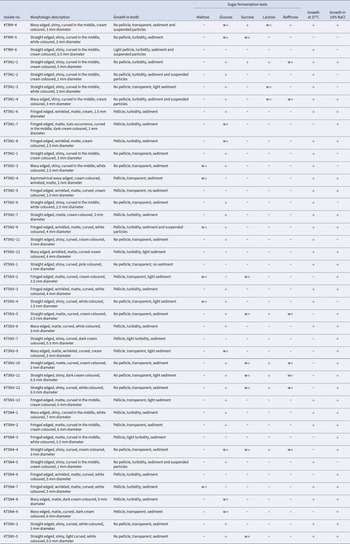
A total of 42 isolates, including all isolates showing different colony characteristics, were examined phenotypically. The phenotypic characteristics of the isolates are presented in Table 2. Accordingly, based on their growth characteristics in liquid media, their ability to ferment different sugars and other relevant features, the isolates were classified into distinct groups that are both critical for their identification and indicative of their technological characteristics. The isolates were divided into four main groups:
1. Group 1 isolates neither fermented nor showed weak fermentation ability for maltose, glucose, sucrose, lactose and raffinose. These isolates formed a film on liquid media and produced matte and wrinkled colonies on solid media. While showing different growth characteristics at 37°C, all isolates in this group were able to grow in media containing 10% NaCl.
Table 2.The phenotypic characteristics of the isolates

w+, weakly positive; +, positive; −, negative.
2. Group 2 isolates were able to ferment glucose but not other tested sugars. These isolates formed filamentous and wrinkled colonies, created a film in liquid media and could grow at 37°C and in the presence of 10% NaCl.
3. Group 3 isolates were distinct due to forming smooth, shiny and convex colonies. These isolates did not form a film in liquid media, did not cause turbidity and produced sediment. Similar to Group 2, these isolates fermented glucose but not the other tested sugars.
4. Group 4 isolates stood out with their strong lactose fermentation ability. While they could not ferment maltose, they were able to ferment sucrose, raffinose and glucose. These isolates did not form a film in liquid media and produced smooth-edged, convex colonies. Other isolates were differentiated from this group based on their phenotypic characteristics.

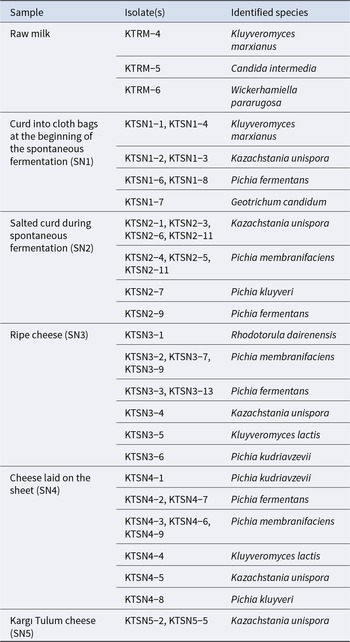
The data presented in Table 3 illustrate the diversity and distribution of microorganisms isolated during the production process of Kargı Tulum cheese. In raw milk samples, species such as Kluyveromyces marxianus, Candida intermedia and Wickerhamomyces pararugosa (Candida pararugosa) were identified. These microorganisms represent the natural microbiota of milk and have the potential to play significant roles in the fermentation process. In particular, Kl. marxianus can actively participate in lactic acid fermentation by fermenting milk sugars. Similar to our results, Kluyveromyces sp., G. candidum, Yarrowia lipolytica, D. hansenii and Pichia sp. have been reported as among the more frequently occurring yeast species in raw milk (Fröhlich‐Wyder et al., Reference Fröhlich‐Wyder, Arias‐Roth and Jakob2019).
Diversity and distribution of microorganisms isolated during the production process of Kargı Tulum cheese

At the beginning of fermentation, Kl. marxianus, Kazachstania unispora, Pichia fermentans and Geotrichum candidum were isolated from the curd placed in cloth bags. K. unispora persisted throughout maturation even after salting, alongside Pichia membranifaciens, Pichia kluyveri and P. fermentans. At this stage, K. unispora emerged as a dominant microorganism. The salting process exerted selective pressure on microorganisms, promoting the proliferation of some species while inhibiting others.
In matured cheese samples, microbial diversity increased, with species such as Rhodotorula dairenensis, P. membranifaciens, P. fermentans, K. unispora, Kl. lactis and P. kudriavzevii are present. During the resting phase of the cheese, species such as P. kudriavzevii, Pichia fermentans and Pichia membranifaciens continued to dominate. Additionally, species like Kluyveromyces lactis and Pichia kluyveri were also detected which may enhance the textural and aromatic properties of the cheese.
In the final stage, namely in Kargı Tulum cheese, the persistent presence of Kazachstania unispora is noteworthy. This indicates that K. unispora is a resilient and important microorganism in the production process of Kargı Tulum cheese. Kazachstania unispora (formerly Saccharomyces unisporus) is a yeast species isolated from various traditional dairy products, where it plays vital roles in fermentation processes. Notably, its presence in kefir and kumis highlights its significant role in the natural microbiota of dairy products.
When evaluated in the context of its role in kefir, K. unispora stands out for its probiotic properties. Studies have shown that this yeast species supports the growth of Lactobacillus spp., thereby promoting the population of beneficial bacteria in dairy products (Lopitz-Otsoa et al., Reference Lopitz-Otsoa, Rementeria, Elguezabal and Garaizar2006; Sun and D'Amico, Reference Sun and D'Amico2023). This characteristic contributes to the stabilization of the fermentation process and enhances the health benefits of kefir. Moreover, although it can ferment glucose, its inability to ferment lactose prevents it from competing with lactose-fermenting bacteria, which explains its frequent occurrence in dairy products (Korcari et al., Reference Korcari, Ricci, Capusoni and Fortina2021).
The isolation of K. unispora from traditional products such as kumis and fermented mare's milk demonstrates that its presence is not limited to bovine dairy products but extends to fermented dairy products derived from various animal sources (Tang et al., Reference Tang, Ma, Hou, Li, Xu, Liu, Sun, Haobisi and Menghe2020; Kondybayev et al., Reference Kondybayev, Achir, Mestres, Collombel, Strub, Grabulos, Akhmetsadykov, Aubakirova, Kamidinkyzy, Ghanmi and Konuspayeva2023). This diversity highlights the species’ ability to adapt to different environmental conditions and substrates.
Studies on the isolation of K. unispora from cheese are quite limited. Its detection in semi-hard cow milk cheeses and other varieties suggests that it may play a role in the maturation process (Bhattacharya et al., Reference Bhattacharya, Yan, Yadav, Tyagi and Surampalli2013; Ceugniez et al., Reference Ceugniez, Taminiau, Coucheney, Jacques, Delcenserie, Daube and Drider2017). The presence of K. unispora in cheeses can positively affect both aroma and textural characteristics. Research has shown that K. unispora contributes to proteolytic and lipolytic activities during the maturation of semi-hard cheeses, aiding in the development of the cheese's characteristic flavour profiles and texture. Additionally, it has been reported in surface-ripened cheeses, indicating its role in shaping the surface microbiota (Bhattacharya et al., Reference Bhattacharya, Yan, Yadav, Tyagi and Surampalli2013).
A study on Moroccan goat cheeses revealed that K. unispora constituted 8% of the yeast population (Ouadghiri et al., Reference Ouadghiri, Amar, Daniel, Swings and Vandamme2014). This finding indicates that the species consistently plays a role in traditional cheese production and collaborates with other yeast species to support the fermentation process. Notably, its co-occurrence with species such as Kluyveromyces lactis, Yarrowia lipolytica and Candida parapsilosis underscores the dynamic structure and symbiotic relationships of microbial communities.
Another species that persisted throughout the fermentation process in this study was Pichia fermentans. This yeast, commonly isolated from cheeses, is notable for its biochemical and technological properties. It has been found in various mould-ripened and aged cheeses, contributing significantly to the maturation process. Research on Cabrales cheese showed that P. fermentans was particularly prevalent in the interior of the cheese, where its proteolytic and lipolytic activities supported the development of unique flavour and aroma compounds (Álvarez-Martín et al., Reference Álvarez-Martín, Flórez, López-Díaz and Mayo2007).
Similarly, Pichia fermentans has been isolated from Turkish Civil cheese. In this study, it was reported to play a significant role in the microbial ecosystem of mould-ripened cheese, contributing to the maturation process. The species produces enzymes such as proteases and lipases, which impart characteristic aroma and texture to the cheese. Additionally, it was observed to increase the pH of the environment by consuming lactic acid, thereby supporting the growth of proteolytic bacteria (Yildiz et al., Reference Yildiz, Turgut, Cetin and Kesmen2021).
In a study on soft cheeses from the Extremadura region, the probiotic potential of Pichia fermentans was thoroughly examined. This study demonstrated the species’ resilience to low pH, bile salts, and gastrointestinal conditions. Moreover, P. fermentans strains exhibited antioxidant activity, auto-aggregation capacity, hydrophobic properties and antimicrobial effects against pathogenic microorganisms. These features position P. fermentans as a promising candidate for functional cheese production (Merchán et al., Reference Merchán, Benito, Galván and de Herrera2020).
In this study, Kluyveromyces marxianus was isolated from raw milk during the initial stages of fermentation. This yeast is an important species in the dairy industry, known for its ability to ferment lactose and its classification as a homothallic yeast, commonly isolated from dairy environments. However, K. marxianus is not restricted to dairy settings and can be found in various habitats (Fasoli et al., Reference Fasoli, Barrio, Tofalo, Suzzi and Belloch2016). Notable for its thermotolerance, it can grow at high temperatures, such as 42°C, while also thriving under low-temperature conditions, such as refrigeration (Fonseca et al., Reference Fonseca, Heinzle, Wittmann and Gombert2008; Tofalo et al., Reference Tofalo, Fasoli, Schirone, Perpetuini, Pepe, Corsetti and Suzzi2014).
The impact of K. marxianus on cheese maturation is linked to its proteolytic and lipolytic activities, which contribute to the formation of volatile aroma compounds (Perpetuini et al., Reference Perpetuini, Rossetti, Rapagnetta and Tofalo2024). A study by Tofalo et al. (Reference Tofalo, Fasoli, Schirone, Perpetuini, Pepe, Corsetti and Suzzi2014) identified this yeast as the dominant species in Pecorino di Farindola cheese, with significant genetic polymorphism. The isolated strains demonstrated diverse growth kinetics in whey, organic acid metabolism (production/degradation), amino acid utilization and competitive lactate consumption. These traits suggest that K. marxianus has potential as a cheese culture additive (Tofalo et al., Reference Tofalo, Fasoli, Schirone, Perpetuini, Pepe, Corsetti and Suzzi2014).
Pichia membranifaciens and Kluyveromyces lactis are species isolated from mature and aged cheeses during the final stages of fermentation. Their presence indicates their adaptation to the salt concentration and pH conditions of the cheese. K. lactis, with LAB, enabled the rapid fermentation of lactose (Mayo et al., Reference Mayo, Rodríguez, Vázquez and Flórez2021). Kl. lactis contributes significantly to cheese maturation through its proteolytic and lipolytic activities, which result in the formation of esters, alcohols (e.g., 2-phenylethanol, isoamyl alcohol) and organic acids (e.g., hexanoic and decanoic acid). These aromatic compounds enhance the fruity and floral characteristics of the cheese, creating a more complex aroma profile. Additionally, the high survival rate of Kl. lactis under gastrointestinal conditions (>80%), its self-aggregation ability, and hydrophobic properties make it an ideal candidate for probiotic cheese production (Andrade et al. Reference Andrade, Oliveira, Lopes, de Abreu and Duarte2019; Silva et al., Reference Silva, Tavares, Andrade, Santos and Duarte2025).
Meanwhile, P. membranifaciens holds a significant role in shaping the cheese microbiota. Its enzymatic activity supports the breakdown of proteins and fats, contributing to the production of aroma-active compounds. The species enhances creaminess and deepens the flavour of the cheese (Onmaz et al., Reference Onmaz, Gungor, Al, Dishan, Hizlisoy, Yildirim, Kasap-Tekinsen, Disli, Barel and Karadal2021; De Miranda et al., Reference De Miranda, De Souza, de Souza Costa Sobrinho, Dias, Schwan and Ramos2023).
Studies on the yeast flora of Tulum cheese are limited. Research on Turkish Tulum cheeses has reported the isolation of Debaryomyces hansenii, Torulaspora delbrueckii and Saccharomyces cerevisiae (Ozmen Togay et al., Reference Ozmen Togay, Capece, Siesto, Aksu, Sandikci Altunatmaz, Yilmaz Aksu, Romano and Karagul Yuceer2020). Another study identified P. membranifaciens, Candida zeylanoides, Debaryomyces hansenii and Geotrichum candidum among the yeast species isolated from Konya Mould-Ripened Tulum cheese.
While LAB contribute substantially to acidification, texture development and inhibition of spoilage organisms, especially in raw milk cheese matrices, the characterization of yeasts in Kargı Tulum cheese is particularly valuable considering the unique aroma, flavour and texture attributed to its traditional production and regional microbial diversity. While many studies on cheese microbiota have focussed on LAB, recent literature emphasizes that yeasts, particularly in raw milk and artisanal cheeses, play critical roles in the ripening process. This study underscores the importance of natural microbiota in traditional cheese production and highlights the potential for optimizing these processes to enhance cheese quality.
Conclusions
The findings emphasize the significance of natural microbiota in traditional cheese production and suggest that optimizing microbial interactions could further enhance the sensory and nutritional properties of Kargı Tulum cheese. Moreover, the identification of yeast species with potential probiotic characteristics opens avenues for developing functional dairy products. Future research should explore the genetic and metabolic profiles of these microorganisms to better understand their contributions to cheese maturation and to innovate sustainable and high-quality production techniques for traditional cheeses.