The Social Democratic party family ranks among the most successful political projects in modern European political history. In the two decades following World War II, vote shares for Social Democratic parties exceeded 30 per cent across all European democracies (Benedetto, Hix and Mastrorocco Reference Benedetto, Hix and Mastrorocco2020). However, starting in the 1980s, right-wing populist parties successfully peeled significant numbers of voters off the Social Democratic coalition, in no small part by appealing to the anti-immigration sentiments of traditionally left-wing voters (Givens Reference Givens2005).
This places contemporary Social Democratic and similar mainstream left parties in a strategic dilemma (Bale et al. Reference Bale2010). As right-wing populist parties continue to attract anti-immigration voters, mainstream left parties can respond either by taking a more restrictive position on immigration or move to the left in order to appeal to new groups of voters. Following Meguid (Reference Meguid2005), who builds on a spatial model of party and voter behavior, we refer to these strategies as accommodative and adversarial, respectively. Empirical scholarship on the electoral effects of these competing strategies remains inconclusive. Prior observational studies have found negative (Abou-Chadi and Wagner Reference Abou-Chadi and Wagner2020; Dahlström and Sundell Reference Dahlström and Sundell2012) as well as positive (Klüver and Spoon Reference Klüver and Spoon2020; van Spanje Reference van Spanje2018) associations between mainstream party accommodation and the relative success of mainstream left parties. This has led some to conclude that accommodation has limited effects on mainstream left party success.
We argue that even if accommodating right-wing populist parties on the issue of immigration has no effect on support for the mainstream left party, it can still help it succeed. To see this, imagine that the mainstream left party's rightward turn on immigration attracts anti-immigration voters from a right-wing populist party and repels an equal number of pro-immigration voters who defect to a party that is further left on immigration. In this stylized case, net support for the mainstream left party remains unchanged, yet support for the left as a whole increases. If the more left-wing party is part of the mainstream left party's governing coalition, then accommodation may help the mainstream left secure a governing majority even in the absence of net changes in support for the mainstream left party.
A scope condition for this argument is that the mainstream left party's governing coalition includes a party that is further left on the issue of immigration. Yet as we document below, this scope condition is often met: more than half of all Social Democratic governments in the European Union and the Organisation for Economic Co-operation and Development in the past 20 years included another left-wing party. At the same time, there will be cases where there is no such left-wing party or where the norms of party competition make it unlikely for a far-left party to be a governing partner for the mainstream left. We expand on this in the conclusion.
To test our argument, we exploit a rare situation in which government negotiations create credible ambiguity about the position of a large mainstream left party on immigration. This ambiguity allows us to effectively manipulate respondents' perceptions of their position in a survey experiment. Our survey experimental approach avoids a severe type of selection bias endemic to observational approaches, which stems from the fact that parties do not choose their policy positions at random. If national or local parties that believe they stand to lose voters to right-wing populist challengers are more or less likely to accommodate in anticipation of this electoral threat, then an observational estimate of the effect of accommodation on mainstream left electoral support will be biased either upwards or downwards. In our experiment we control which strategy voters observe, which allows us to estimate the electoral effect of an accommodative strategy without bias.
In line with our argument, we find that accommodation by the Social Democratic party increases electoral support for the left as a whole. Subgroup analyses show that, consistent with a spatial theoretical framework, the increase in support for the left is driven by anti-immigration voters who previously voted for right-wing populist parties. Our findings imply that accommodation can improve the political prospects of the mainstream left if a more left-wing party can pick up alienated pro-immigration voters and is willing to be part of the mainstream left party's governing coalition. This implication contrasts with prior work that emphasizes the potential electoral benefits of mainstream left parties taking culturally progressive (and thus, inter alia, pro-immigration) positions (Abou-Chadi and Wagner Reference Abou-Chadi and Wagner2019; Abou-Chadi and Wagner Reference Abou-Chadi and Wagner2020). It also contrasts somewhat with work emphasizing the diminishing electoral importance of industrial workers to the mainstream left (Benedetto, Hix and Mastrorocco Reference Benedetto, Hix and Mastrorocco2020). We discuss how our study relates to this body of work in the concluding section.
In addition to providing novel insights into how the mainstream left may respond to challenges from right-wing populist parties, our study provides an important corrective to research suggesting that parties are increasingly ‘weak’ actors. In spite of the power of partisanship at the individual level (Barber and Pope Reference Barber and Pope2019) and issue ownership at the party level (Seeberg Reference Seeberg2017), and consistent with spatial models of voter behavior (Downs Reference Downs1957), parties can still affect their electoral fate through strategic positioning on salient issues.
Electoral Effects of Mainstream Left Position Taking on Immigration
When mainstream left parties adopt an accommodative strategy and move right on the issue of immigration, they can potentially pick up voters who are sympathetic to the party on other issue areas, such as ‘first-dimension’ issues on social spending or redistribution, but further to the right on the issue of immigration. This is why the accommodative strategy is potentially attractive (Meguid Reference Meguid2005). At the same time, the mainstream left party risks alienating pro-immigration voters if they move right on immigration, pushing these voters towards more left-wing parties or, if they have no attractive alternatives, demobilizing them (Abou-Chadi and Wagner Reference Abou-Chadi and Wagner2019).
This leaves us with an unclear empirical prediction about the electoral effects of accommodation on support for the mainstream left party. Consistent with this theoretical ambiguity, studies that aim to estimate the effects of accommodation on support for the mainstream left have found inconclusive, contradictory or null results (for example, Abou-Chadi and Wagner Reference Abou-Chadi and Wagner2019; Abou-Chadi and Wagner Reference Abou-Chadi and Wagner2020; Klüver and Spoon Reference Klüver and Spoon2020). However, accommodation may have politically consequential electoral effects beyond support for the mainstream left party itself.
As originally argued by Strøm (Reference Strøm1990), parties may pursue office-seeking as well as vote-seeking strategies, and the former may come at the expense of the latter. Specifically, a mainstream left party may see little or no vote gain from moving to the right on immigration, because vote gains from anti-immigration voters is offset by losses among pro-immigration voters. But because this latter group of voters will tend to defect to other parties on the left, accommodation may increase the mainstream left party's chances of forming a government based on a coalition of other left parties.
This effect of accommodation on the size of the left party governing coalition is conditional on there being a left-wing party that voters alienated by the mainstream left party can defect to. How often is this condition met? According to the ParlGov database (Döring and Manow Reference Döring and Manow2019), which includes ninety-seven governments led by a Social Democratic party since 2000, 60 per cent have at least one left-wing coalition partner (see Appendix A for additional details on calculations). In addition, any Social Democratic single-party minority government that relies on support from more left-wing parties in parliament would be in a similar situation. However, since we lack firm data on such informal coalitions, we cannot say how common this is.
A separate, methodological issue associated with studying the electoral effects of mainstream left position taking is that due to selection bias at the party level, observational approaches face serious inferential challenges in estimating the effect of an accommodative strategy. Even so, previous studies of the effects of accommodation typically rely on observational designs. For example, studying a cross-section of Swedish municipalities, Dahlström and Sundell (Reference Dahlström and Sundell2012) find that ‘tougher’ mainstream left party positions on immigration are associated with higher support for the Sweden Democrats. Similarly, in a cross-country sample, Krause, Cohen and Abou-Chadi (Reference Krause, Cohen and Abou-Chadi2019) update and extend Meguid (Reference Meguid2005), and find no association between mainstream left party positions on immigration and right-wing populist party support. Most recently, Abou-Chadi and Wagner (Reference Abou-Chadi and Wagner2020) find that authoritarian/nationalist positions are associated with less support for the mainstream left, whereas Klüver and Spoon (Reference Klüver and Spoon2020) find that accommodation increases mainstream left support.
The key challenge with these observational studies is that the ‘treatment’ – that is, mainstream left party position – is not likely to be independent of parties' potential outcomes with respect to electoral support. That is, mainstream left positions are plausibly endogenous to expected changes in right-wing populist party support. Specifically, we posit that national or local parties that believe they stand to lose voters to right-wing populist challengers are more likely to accommodate in anticipation of this electoral threat. As a consequence, an observational estimate of the effect of accommodation on mainstream left electoral support will be biased downwards.
Our research design accounts for these theoretical and methodological issues in two ways. First, we estimate the potential side effects of accommodation on support for the mainstream left party's governing majority. Secondly, we address problems related to causal inference by experimentally manipulating voters' perceptions of mainstream left party positions on immigration in a context of positional ambiguity.
Empirical Setting and Research Design
We conducted a survey experiment in the aftermath of Denmark's 5 June 2019 general election. The election was announced a month earlier by the incumbent prime minister of the center-right Liberal Party, who led a right-wing coalition. Throughout, the center-right government relied on support in parliament from the right-wing populist Danish People's Party. The Social Democrats' candidate for prime minister, Mette Frederiksen, had signaled a shift to a more restrictive position on immigration when taking over leadership of the party four years earlier. This positional shift was significant enough to be picked up by the international media (for example, Milne Reference Milne2019). The incumbent Liberal Party made immigration salient in the campaign by questioning the credibility of the Social Democrats' shift, appealing to voters' memories of the most recent era of Social Democratic government, 2011–15, in which the Social Democrats had made considerable policy concessions to their coalition partners, effectively reneging on several key campaign promises (Bille Reference Bille2013). The election result, while delivering a sizable parliamentary majority to the parties supporting the Social Democratic prime minister, saw a small decline in support for the Social Democrats and a considerable gain for the relatively pro-immigration Social Liberals. As a result, the mainstream left returned to power in Denmark in the 2019 election, but created uncertainty as to whether Social Democrats' tougher immigration stance would be reflected in the new government's policy.
Experimental Design
We situate our survey experiment in this context, fielding a nationally representative survey in the short interval between election day and the official formation of a single-party minority Social Democratic government supported by the Social Liberals and two socialist parties. We partnered with YouGov, a private polling firm, which conducted the survey on 14–17 June 2019, recruiting 2,016 respondents with the Danish voting-age population as the target population.
The timing of our experiment addresses a recurrent challenge in research on party position taking, namely that parties tend to have stable policy positions, which makes it difficult to observe outcomes of interest under alternative policy positions. Earlier studies addressed this challenge by observing voters before and after shifts in party position (for example, Slothuus Reference Slothuus2010). However, this approach requires the researcher to either foresee a shift in party position or fortuitously field a panel survey shortly before a shift. Moreover, even this design remains vulnerable to confounding by simultaneous changes in the political environment that are not attributable to the change in party position. Alternatively, some studies use an experimental design that randomly assigns positions to parties. However, party reputations often limit the set of credibly manipulable issues to less salient issues, on which voters are unsure about parties' positions (Slothuus Reference Slothuus2016). Unlike these studies, we are able to credibly manipulate a party's position on the highly salient issue of immigration by exploiting the transitional policy ambiguity before the formation of the new government.
The experiment randomly assigned respondents to one of three conditions. In the control condition, we informed respondents that the Social Democrats are negotiating with other left-wing parties about the immigration policy of the coming government. In the first of the two treatment conditions, we then told respondents that ‘observers’ believe the Social Democrats will continue the restrictive immigration policy of the previous government. In the other treatment condition, the ‘observers’ believe the Social Democrats will set a less restrictive immigration policy. To ensure the credibility of the treatments, we backed up each treatment message with a paraphrased quote from the leader of the Social Democrats. Following Meguid (Reference Meguid2005), we label the first treatment accommodative and the latter adversarial. (Meguid identifies a third strategy, dismissive, which we bracket here, focusing on the positional distinction between accommodative and adversarial strategies). Appendix C presents the experimental conditions in full with English translations.
Dependent Variables and Moderators
We examine the effect of the treatments on three outcomes of interest. First, we asked respondents to rate the restrictiveness of the Social Democrats on immigration policy on a 1–10 scale. This manipulation check allows us to assess whether the treatments successfully altered respondents' perceptions of the party's stance on immigration. Secondly, we asked respondents to rate their propensity to vote (PTV) for the Social Democrats in light of the government negotiations on a 0–10 scale (Van der Eijk et al. Reference Van der Eijk2006).
Lastly, we measured vote intention for the coalition of parties supporting a Social Democratic government, called the left bloc, by asking about their PTV for these parties on a 0–10 scale. To obtain a composite measure of left-bloc support, we return the maximum value on the PTV variable across the left bloc. This measure allows us to test whether the PTV for any party in the left bloc increased in response to the experimental treatments. Although this measure covaries with PTV for the Social Democrats, they are distinct: among respondents who assigned their highest PTV to a left bloc party, 56 per cent chose another left-wing party than the Social Democrats. We do not use a measure of central tendency across parties in the left-bloc, such as the mean PTV, because this would not register if the treatment drove respondents to become less likely to vote for the Social Democrats and more likely to vote for a coalition partner.
The theoretical argument for why accommodation should work is underpinned by a spatial model of voter behavior, which implies that accommodation increases the Social Democrats' electoral appeal among anti-immigration voters and decreases the appeal among pro-immigration voters. To test this implied mechanism, we estimate the effect of accommodation across two moderators: respondents' anti-immigration attitudes and voting history. We measure anti-immigration attitude by asking respondents before the experimental treatments whether they consider immigration ‘a threat to Danish culture’, and whether Denmark ‘should take in more refugees compared to today’. We combined these two variables into an anti-immigration attitude index (Cronbach's α = 0.83). We measure former vote choice by asking respondents before the experimental treatments about their vote choice in the 2015 general election, grouping answers into three categories: left bloc parties, Danish People's Party (DPP) and other right bloc parties. If the effect of accommodation is driven by attracting anti-immigration voters, we should expect the effect to be concentrated among voters highest in anti-immigration attitudes and those who supported the DPP in the previous election.
Because the treatments are randomly assigned, the experimental groups are balanced on all pre-treatment variables in expectation. In Appendix D, we show that our experimental treatments are balanced across a range of pre-treatment covariates. Some minor observed imbalances remain, which is consistent with what would arise by chance alone. Experimental methodologists disagree on the appropriateness of testing for balance and adjusting for pre-treatment covariates (see, for example, Mutz and Pemantle Reference Mutz and Pemantle2015). In the interest of full transparency, we present all estimates in bivariate model specifications (in black) as well as covariate adjusted for covariates with observed imbalances (in gray). All dependent variables are recoded to range between 0 and 1.
Results
The credibility of our research design relies on our ability to manipulate respondents’ perceptions of the Social Democrat's position on immigration. We offer three pieces of evidence in support of this assertion. First, we note that voters were particularly split on positioning the Social Democrats on the issue of immigration. In our control group, a small majority of 63 per cent saw them as right wing (above 5 on the 1–10 scale). For the other parties in the left bloc the corresponding number is below 15 per cent. For the Liberal Party, the largest mainstream right party, it was above 85 per cent.
Secondly, in Appendix B we report the results of a content analysis of news stories during this period, which shows considerable media attention to the incoming government's immigration policy, but uncertainty about its position. In particular, we show that one in three articles about the government negotiations mentioned the issue of immigration, and that there was no consensus on the outcome of the negotiations in the articles that offered a prediction: two out of three articles suggested that the Social Democrats would have to make some concessions, but one in three maintained that they would stand firm.
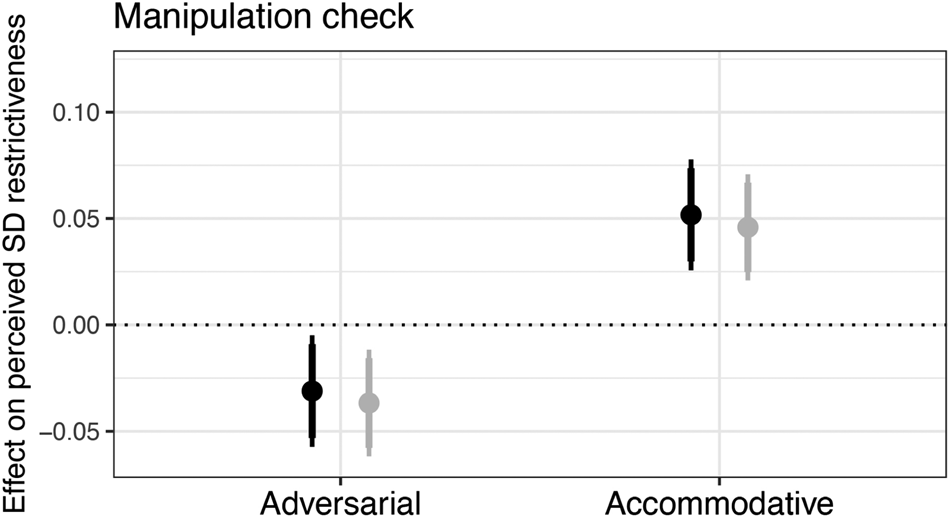
Thirdly, and most importantly, Figure 1 shows that our treatments had a sizeable effect on respondents' perceptions of the Social Democratic Party's position on immigration (p < 0.01 for all pair-wise comparisons). If we compare respondents who were exposed to the accommodative vs. adversarial treatments, the former perceived the Social Democrats as roughly 0.1 scale points tougher on immigration, corresponding to 10 per cent of the full scale or half a standard deviation.
Manipulation check, showing effects of experimental conditions on perceptions of Social Democrats' restrictiveness on immigration
Note: covariate-adjusted estimates in gray. Error bars represent 90 and 95 per cent confidence intervals, respectively.

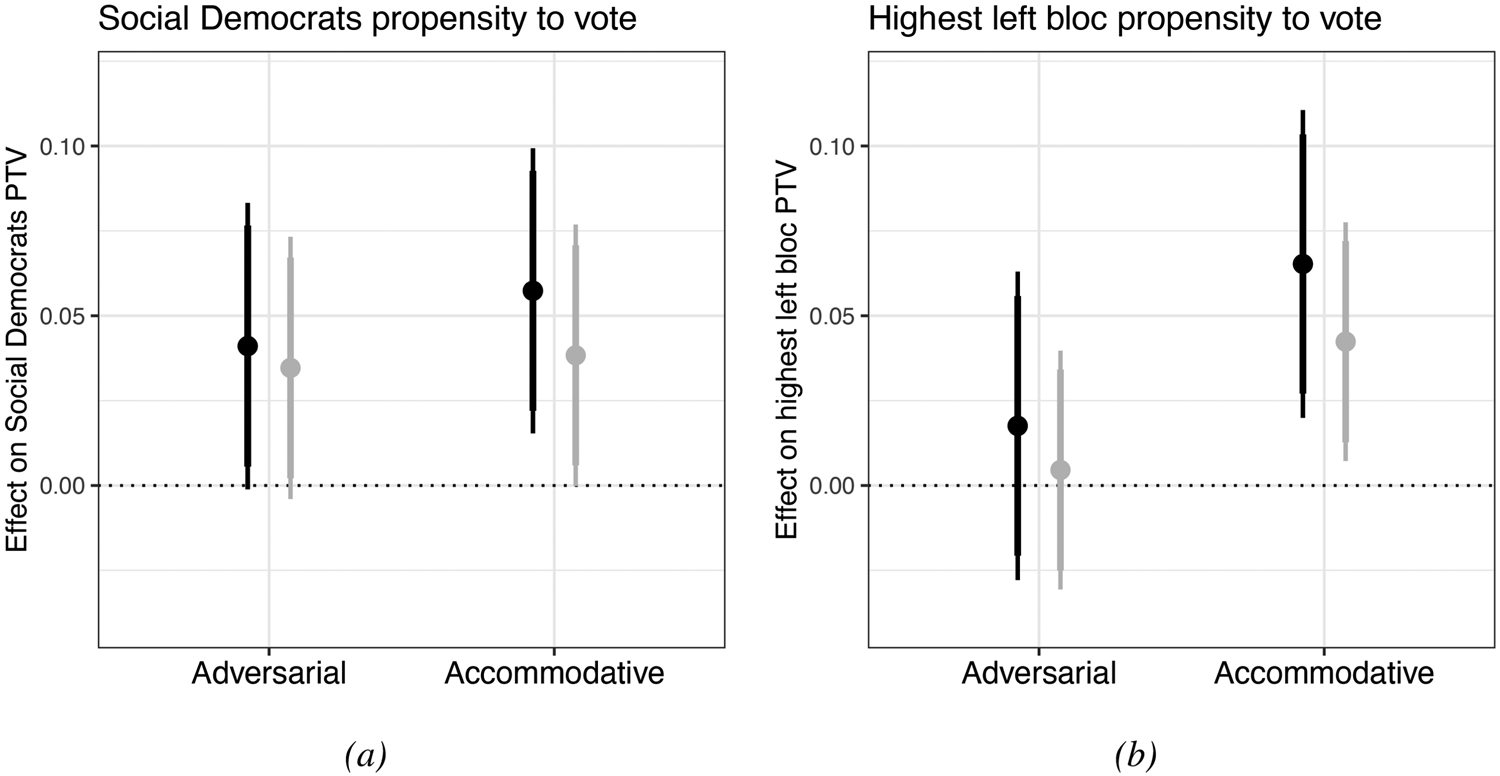
Figure 2 presents the results for the two dependent variables of interest. Panel A shows that both the adversarial and accommodative treatments increased PTV for the Social Democrats compared to the control condition, though the effect is significant only for the accommodative treatment (p < 0.05); the difference between the two effects is not statistically significant. This is unexpected, but may be because some voters were more willing to vote for the party when uncertainty about its position on immigration is reduced one way or the other.
Effects of treatment conditions on PTV for Social Democrats (Panel A), and effects on left bloc vote intention (Panel B)
Note: covariate-adjusted estimates in gray. Error bars represent 90 and 95 per cent confidence intervals, respectively.

However, as shown in Panel B, the treatment conditions differ when considering effects on PTV for the left bloc as a whole. The effect of accommodation is significant and positive. Depending on the specification, respondents exposed to accommodation are 4–7 percentage points more likely to support the left bloc than those in the control condition (both p < 0.05). Notably, this effect is roughly comparable to the 4.9 percentage points total change in support for the left bloc between the 2015 and 2019 elections.
In contrast, the effect of the adversarial treatment on left bloc support is close to zero and statistically insignificant. Comparing the two treatments directly, the effect of accommodation is 4–5 percentage points greater than the effect of the adversarial strategy, a statistically significant difference (both p < 0.05).
In sum, while accommodation does not discernibly increase support for the Social Democrats relative to the adversarial strategy, the accommodation strategy does increase support for the left bloc as a whole, and significantly more so than the control condition or the adversarial strategy.
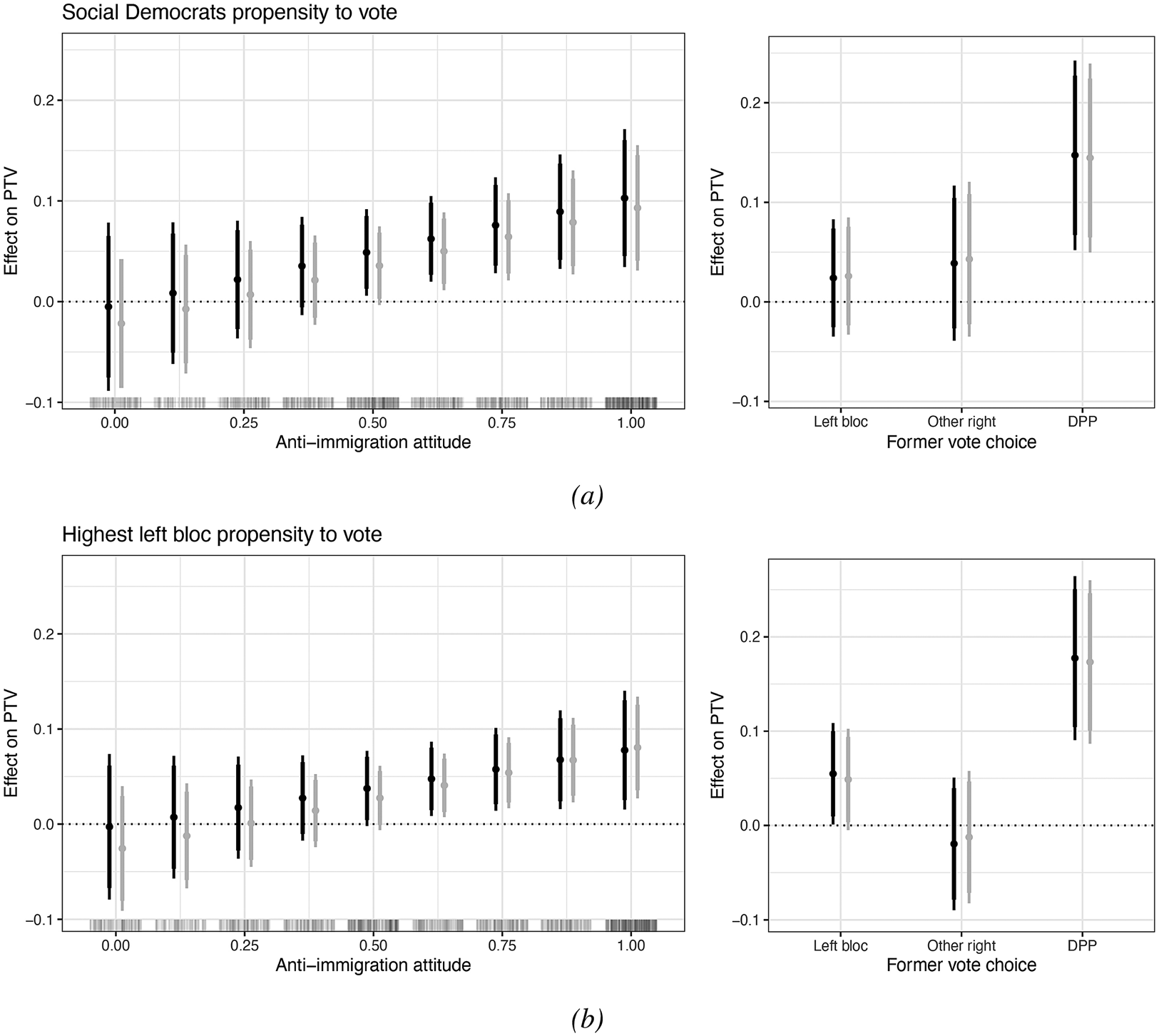
In Figure 3 we turn to heterogeneous effects, examining how immigration attitudes and prior vote choice moderate the observed effects. Panel A shows that, consistent with the spatial model of voter behavior, the positive effect of accommodation on PTV for the Social Democrats is concentrated among respondents with the most anti-immigration attitudes (left panel) and prior supporters of the Danish People's Party (right panel).
Effect of accommodation treatment on PTV for Social Democrats (Panel A) and highest left bloc PTV (Panel B), compared to the control group
Note: covariate-adjusted estimates in gray. Error bars represent 90 and 95 per cent confidence intervals, respectively. Rug plot shows distribution of anti-immigration attitudes in the sample.

Panel B shows a similar pattern when highest left bloc PTV is the dependent variable. Importantly, there is no sign of a reduction in the vote share among those who voted for the left bloc in the last election. The effects among prior DPP voters are sizeable: exposure to the accommodation treatment increases prior DPP voters' PTV for the Social Democrats or any left bloc party by around 15 percentage points. Appendix E presents estimates from the linear regression models underlying these figures, and in Appendix F we show that the linear interaction effect assumption is satisfied.
Conclusion
Using a survey experiment in a rare setting of ambiguity about the mainstream left party's position on immigration, we have shown that a strategy of accommodation in the form of taking a more restrictive position on immigration can increase mainstream left party support as well as support for the left bloc as a whole. While accommodation does cost votes among pro-immigration voters, these voters tend to defect to other parties on the left, which typically support a mainstream left government. Since accommodation attracts former supporters of populist right-wing parties, the result is a net gain for the mainstream left's governing coalition.
Our findings only apply to situations in which the mainstream left party governs with parties that are more left wing on the issue of immigration. As documented above, this is a common situation, but there are of course exceptions. For instance, our findings will not generalize to two-party systems, where pro-immigration voters disaffected by an accommodating mainstream left party cannot defect to another left-wing party. Beyond the formal structure of the party system, norms structuring party competition can also make the accommodation strategy less viable. For instance, German party politics is characterized by a strong norm of excluding the most extreme parties from the governing coalition. Even if the German Social Democrats could obtain a majority by including the socialist Left Party in their governing coalition, they would likely refrain from doing so. Instead, if the German Social Democrats failed to win a majority in their own right, they would be more likely to seek a grand coalition with the mainstream right. In this context, accommodation would be a risky strategy, as pro-immigration voters defecting from the Social Democrats would be leaving the governing coalition entirely. More broadly, accommodation should be less effective in countries where co-operating with the far left is an infeasible option for the mainstream left.
Finally, our work speaks to the ongoing scholarly debate about the electoral fate of the mainstream left. Recent studies have found that among mainstream left parties, taking left-wing positions on ‘second-dimension’ issues such as immigration is associated with greater electoral support, especially among socio-cultural professionals (Abou-Chadi and Wagner Reference Abou-Chadi and Wagner2020). Moreover, this class of voters makes up an increasingly large proportion of mainstream left voters, at the expense of industrial workers, which have declined in absolute numbers as well as their propensity to support the mainstream left (Benedetto, Hix and Mastrorocco Reference Benedetto, Hix and Mastrorocco2020). Jointly, these stylized facts would seem to suggest that appealing to newer professional classes in part through liberal socio-cultural positions is a potential winning strategy for the mainstream left.
We do not dispute this argument per se. While we find that accommodation on the issue of immigration can improve the political prospects of the mainstream left, this does not imply that it is the only way to do so. However, our findings should give pause to the notion that right-wing populist voters are irredeemably lost to the mainstream left. In fact, because of their historical class base, mainstream left parties are plausibly uniquely well positioned to make appeals to this set of voters. In doing so, the mainstream left may be able to regain electoral territory that it has ceded to right-wing populist parties.
Given the centrality of mainstream left parties to European party politics, this ongoing debate is an important one. There are likely multiple electorally effective strategies available to the mainstream left. Fully characterizing these strategies and their political consequences is an important task for future research.
Supplementary material
Online appendices are available at https://doi.org/10.1017/S0007123420000563.
Acknowledgements
We thank Henrik Seeberg, Martin Bisgaard, Rune Slothuus and two anonymous reviewers for comments on earlier drafts of this article.
Data availability statement
Data replication sets are available in Harvard Dataverse at: https://doi.org/10.7910/DVN/QXBZOZ
Financial support
This research was supported by an Aarhus University Research Foundation Starting Grant.