Introduction
Pelagic seabirds often nest on islands that are far from productive foraging areas. The Procellariiformes (petrels, shearwaters and albatrosses) are among the longest-ranging seabirds; they have several adaptations that permit them to efficiently utilize distant foraging areas and fast for long periods during incubation (Phillips & Hamer Reference Phillips and Hamer1999). Giant petrels (Macronectes spp.) are large surface-nesting procellariiforms. They feed both by direct predation and by scavenging carrion, and they are the largest avian predator-scavengers in the Southern Ocean. Among procellariiform seabirds, one partner forages while their mate remains on the nest to incubate their single egg (Warham Reference Warham1990). Northern giant petrels (Macronectes halli) have incubation shifts lasting up to 17 days (Cooper et al. Reference Cooper, Brooke, Burger, Crawford, Hunter and Williams2001). In general, incubating procellariiform seabirds do not feed during their shift (Warham Reference Warham1990). We report the first case to our knowledge of a procellariiform seabird, a northern giant petrel, actively feeding at its nest whilst incubating.
Study area and methods
Sub-Antarctic Marion Island (46°54'S, 37°45'E, 290 km2) is home to large breeding populations of seabirds and pinnipeds. Study colonies of northern giant petrels (c. 70–135 nests per year; Cooper et al. Reference Cooper, Brooke, Burger, Crawford, Hunter and Williams2001) have been monitored annually from egg laying to fledging at Marion Island since the mid-1980s. Nests are checked every 3–4 days during the egg-laying period, weekly once all eggs are laid and every two weeks once the chicks are no longer brooded. Annual counts of the entire breeding populations of giant petrels are conducted once all eggs are laid. Any unusual observations are recorded during these nest visits.
Results
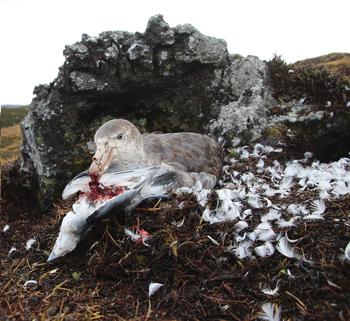
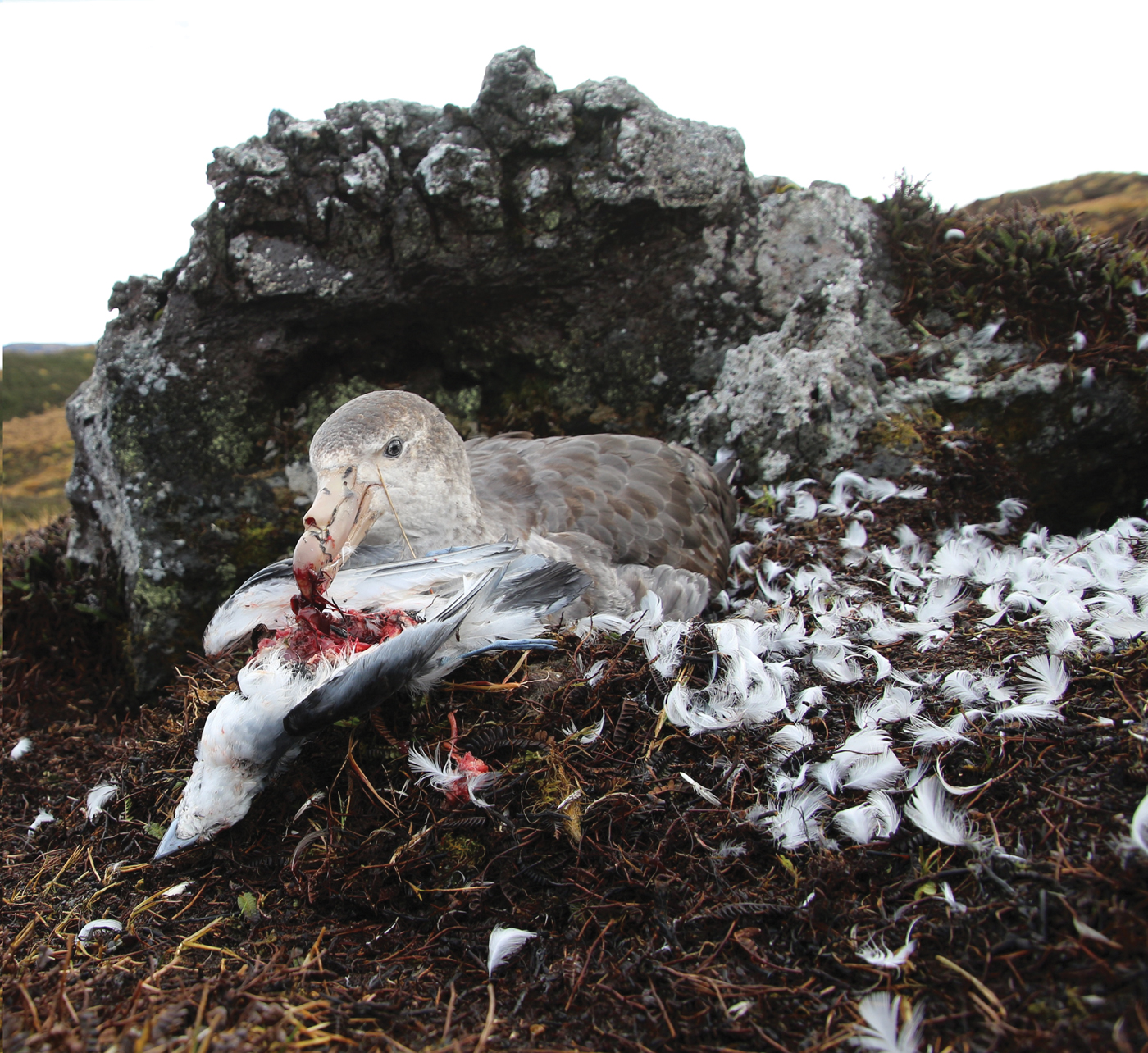
On 22 August 2017, an incubating female northern giant petrel was observed with a dead Salvin's prion (Pachyptila salvini) at its nest near Trypot Beach on Marion Island. The prion carcass already had a substantial amount of feathers plucked from its breast, with these feathers strewn about the immediate vicinity of the nest (Fig. 1). After we observed the scene for several minutes, the female proceeded to break the skin of the carcass with the hook of its bill, using the ground for leverage. Once the body cavity was opened, the northern giant petrel started feeding on the prion's viscera whilst remaining on its nest in an incubating position (Fig. 1). Feeding ceased after c. 10 minutes and several mouthfuls, although the prion carcass still had ample flesh left on it. On the next visit on 25 August 2017, the male partner was incubating and the prion carcass was no longer present. This pair had a successful breeding attempt and their chick fledged in February 2018.
The incubating female northern giant petrel actively feeding on the freshly opened carcass of the Salvin's prion with plucked feathers scattered next to the nest (photograph by Christopher W. Jones).
Discussion
At Marion Island, penguins are the most important component in the diet of northern giant petrels. However, burrowing petrels also form part of their diet, more so for females than males: Salvin's prions are the most prevalent burrowing petrel species in diet samples (Hunter & Brooke Reference Hunter and Brooke1992). During the breeding season, female northern giant petrels forage mainly at sea, where at times they actively hunt burrowing petrels and even albatrosses (Copello et al. Reference Copello, Quintana and Pérez2008 and references therein). Thus, these prey species are typically included in the marine component of their diet (Hunter & Brooke Reference Hunter and Brooke1992), whereas males feed on penguins, seals and, to a lesser extent, and more recently, albatross chicks, depredated or scavenged on or near the shore (de Bruyn et al. Reference De Bruyn, Cooper, Bester and Tosh2007, Dilley et al. Reference Dilley, Davies, Connan, Cooper, De Villiers and Swart2013).
Our observation appears to be the first record of a procellariiform seabird feeding on a prey item at its nest whilst still incubating. González-Solís et al. (Reference González-Solís, Croxall and Wood2000) found that female giant petrels are significantly closer to the desertion mass threshold than males, suggesting greater incubation costs for females than for males. Perhaps this is partly why the female northern petrel engaged in feeding at its nest. It is unknown how the prion carcass arrived at the giant petrel nest. It is possible that the bird was killed by the giant petrel during the previous night when it came too close to the nest en route to its burrow. It is also possible that the prion died accidentally by colliding against the lava outcrop adjacent to the nest (Fig. 1), or it was abandoned or dropped by a brown skua (Stercorarius antarcticus). However, the presence of the many feathers scattered close to the nest (see Fig. 1) suggests that the female northern giant petrel was responsible for plucking the feathers and not a skua. Furthermore, in 2014, while surveying blue petrels (Halobaena caerulea) on Gough Island (Ryan et al. Reference Ryan, Dilley, Jones and Bond2015), two nearby (c. 1 m distance) incubating southern giant petrels (Macronectes giganteus) showed elevated interest, moving their heads towards birds temporarily removed from burrows for examination (C.W. Jones, personal observation), which suggests that giant petrels may capitalize on burrowing petrels as opportunistic prey available at their nests.
Given the long-term monitoring and large numbers of northern giant petrel nests closely inspected at Marion Island and at several other important breeding colonies since the 1960s (Cooper et al. Reference Cooper, Brooke, Burger, Crawford, Hunter and Williams2001 and references therein), this behaviour must be rare, probably occurring only opportunistically and not forming part of the typical foraging strategy of the species. Nonetheless, it is remarkable that this northern giant petrel showed such flexibility in feeding behaviour compared to other procellariiform seabirds.
Acknowledgements
Logistical and financial support was provided by the South African Department of Environmental Affairs and the National Research Foundation through the South African National Antarctic Programme (SANAP). The Department of Environmental Affairs provided permission to conduct research on Marion Island. Dedicated to the memory of David Walton, Antarctic Science's inaugural and long-standing Chief Editor.
Author contributions
CWJ and MMR made the field observations. CWJ wrote the first draft. JC and MMR contributed to the overall editing and organization of the manuscript.