Understanding the interplay between genes and the environment on the development of externalizing problems has been an important objective for developmental researchers. Externalizing behavior problems during childhood are associated with a variety of negative outcomes later in life, such as psychopathology, relationship difficulties, criminality, and poor parenting (Card, Isaacs, & Hodges, Reference Card, Isaacs, Hodges, Zins, Elias and Maher2007; Coie & Dodge, Reference Coie, Dodge, Damon and Eisenberg1998; Neppl, Conger, Scaramella, & Ontai, Reference Neppl, Conger, Scaramella and Ontai2009). Research has identified child behavioral precursors of externalizing and related problem behaviors beginning as young as late infancy and toddlerhood (e.g., Sanson, Hempill, & Smart, Reference Sanson, Hempill and Smart2004; Shaw, Gilliom, Ingoldsby, & Nagin, Reference Shaw, Gilliom, Ingoldsby and Nagin2003), including overreactive parenting (e.g., Calkins, Reference Calkins2002; Maccoby, Reference Maccoby2000; Rothbaum &Weisz, Reference Rothbaum and Weisz1994; Shaw et al., Reference Shaw, Gilliom, Ingoldsby and Nagin2003; Tremblay et al., Reference Tremblay, Nagin, Śeguin, Zoccolillo, Zelazo and Boivin2004) and temperamental characteristics such as negative emotionality (Rothbart & Bates, Reference Rothbart, Bates, Damon and Eisenberg1998; Sanson et al., Reference Sanson, Hempill and Smart2004). In addition, there is accumulating evidence for genetic influences (Burt, Reference Burt2009; Rhee & Waldman, Reference Rhee and Waldman2002), and in particular, for interactions between genetic and environmental factors in predicting externalizing behaviors. Some studies indicate that children's inherited characteristics can render them more or less susceptible to the impact of environmental circumstances while others suggest that children's environments can alter the effects of their genetic backgrounds (Belsky & Pluess, Reference Belsky and Pluess2009; Rutter, Moffitt, & Caspi, Reference Rutter, Moffitt and Caspi2006; Rutter & Silberg, Reference Rutter and Silberg2002; Shanahan & Hofer, Reference Shanahan and Hofer2005). The current study is focused on identifying how parental behavior (overreactivity) is related to infant's development of negative emotionality, and how both contribute to externalizing problems in toddlers. By using a sample of adoptive parents, adopted children, and birth parents, all followed longitudinally, genetic and environmental contributions and interactions are also examined. Specifically, associations between birth parent characteristics and child behavior represent genetic influences, and associations between adoptive parent behaviors (from rearing parents who are genetically unrelated to their child) and child behavior provide an estimate of environmental effects (Rutter, Pickles, Murray, & Eaves, Reference Rutter, Pickles, Murray and Eaves2001; Stams, Juffer, & van IJzendoorn, Reference Stams, Juffer and van IJzendoorn2002).
Negative Emotionality and Externalizing Problems
Research evidence consistently shows that children with elevated levels of negative emotionality during early childhood tend to have more difficulties with emotion regulation and externalizing problems in childhood and adolescence (Bates, Pettit, Dodge, & Ridge, Reference Bates, Pettit, Dodge and Ridge1988; Eisenberg et al., Reference Eisenberg, Valente, Spinrad, Cumberland, Liew and Reiser2009; Rothbart & Bates, Reference Rothbart, Bates, Damon and Eisenberg1998; Sanson et al., Reference Sanson, Hempill and Smart2004; Shaw, Bell, & Gilliom, Reference Shaw, Bell and Gilliom2000; Vitaro, Barker, Boivin, Brendgen, & Tremblay, Reference Vitaro, Barker, Boivin, Brendgen and Tremblay2006; Vitaro, Brendgen, & Tremblay, Reference Vitaro, Brendgen and Tremblay2002). For example, Eisenberg and colleagues (Reference Eisenberg, Valente, Spinrad, Cumberland, Liew and Reiser2009) recently found that negative emotionality assessed at 6 years of age, especially anger and frustration, was related concurrently to children's externalizing problems in early elementary school and longitudinally to changes in externalizing problems over a 3-year period.
Given that specific dimensions of temperament, including negative emotionality, have consistently been shown to be genetically influenced (Buss & Plomin, Reference Buss and Plomin1984; Goldsmith, Buss, & Lemery, Reference Goldsmith, Buss and Lemery1997; Lemery & Goldsmith, Reference Lemery and Goldsmith2003; Rothbart & Bates, Reference Rothbart, Bates, Damon and Eisenberg1998), temperament has often been initially measured in early childhood and linked to subsequent child problem behavior, including externalizing problems, and considered as a proxy for genetic influences. Yet current research also indicates that although temperament is, in part, biologically based, it develops gradually and is likely influenced by children's experiences with their environments, particularly during early childhood when children spend more time interacting with their parents than they do later in life (Bates et al., Reference Bates, Pettit, Dodge and Ridge1998; Rothbart & Bates, Reference Rothbart, Bates, Damon and Eisenberg1998). Heritability estimates for temperamental characteristics from twin and adoption studies of children and adolescents range from 20% to 60% (Saudino, Reference Saudino2005), indicating that although there are significant and sizable genetic influences on temperament, environmental influences also are substantial, accounting for 40% to 80% of the total variance. In infancy and early childhood, however, main effects of genetic influences on temperament are often small and nonsignificant, with heritability estimates near zero (e.g., Goldsmith, Lemery, Buss, & Campos, Reference Goldsmith, Lemery, Buss and Campos1999; Plomin, Coon, Carey, DeFries, & Fulker, Reference Plomin, Coon, Carey, DeFries and Fulker1991; Plomin, DeFries, & Fulker, Reference Plomin, DeFries and Fulker1988).
The way temperament is measured (e.g., parent ratings, observation, teacher ratings) appears to have some relation to the variation found for estimates of heritability (Hwang & Rothbart, Reference Hwang and Rothbart2003; Plomin et al., Reference Plomin, Coon, Carey, DeFries and Fulker1991). For example, at least two studies have examined the validity of parent-report measures of temperament as a result of unusual patterns of correlations in twin studies; parent ratings of temperament show contrast effects exaggerating differences between dizygotic compared to monozygotic twins, thus inflating heritability estimates (Plomin et al., Reference Plomin, Coon, Carey, DeFries and Fulker1991; Saudino, Reference Saudino2005). However, parent ratings have been found to be valid and objective assessments of temperament in studies using subscales (compared to global scales of temperament; Goldsmith et al., Reference Goldsmith, Buss and Lemery1997, Reference Goldsmith, Lemery, Buss and Campos1999), and in adoption studies with young children, particularly in studies such as the present one, that do not compare siblings (Saudino, Reference Saudino2005). This line of work also reveals only modest to moderate stability in temperament during infancy and early childhood and has begun to suggest that genetic influences may be most useful in explaining the stability that is observed during this period, whereas environmental characteristics may be more predictive of individual differences in changes in temperament (Saudino, Reference Saudino2005; Saudino, Plomin, & Defries, Reference Saudino, Plomin and Defries1996).
Development of Negative Emotionality and Effects of Overreactive Parenting
Recent evidence suggests that negative emotionality increases during the first 2 years of life (Bridgett et al., Reference Bridgett, Gartstein, Putnam, McKay, Iddins and Robertson2009; Lipscomb et al., Reference Lipscomb, Leve, Harold, Neiderhiser, Shaw and Ge2011; Partridge & Lerner, Reference Partridge and Lerner2007). For example, one recent study detected a linear increase in parent-rated child negative emotionality from 1 to 2 years of age, coupled with a leveling off in negative emotionality through age 5 (Partridge & Lerner, Reference Partridge and Lerner2007). Another study found support for a linear increase from 4 to 12 months of age (Bridgett et al., Reference Bridgett, Gartstein, Putnam, McKay, Iddins and Robertson2009), and a recent analysis with the current adoption sample detected linear increases from 9 to 27 months of age (Lipscomb et al., Reference Lipscomb, Leve, Harold, Neiderhiser, Shaw and Ge2011). Increases in negative emotions in the first 2 years of life are likely a result of the enhanced mobility and drive for independence that young children experience during the progression from infancy to toddlerhood, coupled with parents' increasing expectations for compliance (see Shaw et al., Reference Shaw, Bell and Gilliom2000).
Overreactive (harsh, irritable, or angry) parenting has been consistently linked with negative outcomes such as externalizing problems during childhood and adolescence (e.g., Calkins, Reference Calkins2002; Maccoby, Reference Maccoby2000; Rothbaum & Weisz, Reference Rothbaum and Weisz1994; Shaw et al., Reference Shaw, Gilliom, Ingoldsby and Nagin2003; Tremblay et al., Reference Tremblay, Nagin, Śeguin, Zoccolillo, Zelazo and Boivin2004). This line of research suggests that when parents fail to control their own emotions during their interactions with their children, such as when they yell, threaten, and use aggression, children experience difficulties with emotion regulation, negative emotionality, and externalizing behaviors (Chang, Schwartz, Dodge, & McBride-Chang, Reference Chang, Schwartz, Dodge and McBride-Chang2003; Eisenberg, Fabes, Shepard, Guthrie, Murphy, & Reiser, Reference Eisenberg, Fabes, Shepard, Guthrie, Murphy and Reiser1999; Scaramella, Sohr-Preston, Mirabile, Robison, & Callahan, Reference Scaramella, Sohr-Preston, Mirabile, Robinson and Callahan2008). Individual differences in the rates of change in negative emotionality also have been linked with developmental trajectories of overreactive parenting in the same sample employed in the present analyses (Lipscomb et al., Reference Lipscomb, Leve, Harold, Neiderhiser, Shaw and Ge2011). This finding is consistent with the conceptualization of the origins of the coercive cycle in which child behavioral problems and harsh parenting practices reinforce one another (e.g., Larsson, Viding, Rijsdijk, & Plomin, Reference Larsson, Viding, Rijsdijk and Plomin2008; Patterson, Reference Patterson1982; Patterson & Fisher, Reference Patterson, Fisher and Bornstein2002; Scaramella, Neppl, Ontai, & Conger, Reference Scaramella, Neppl, Ontai and Conger2008; Shaw et al., Reference Shaw, Winslow, Owens, Vondra, Cohn and Bell1998; Tremblay et al., Reference Tremblay, Nagin, Śeguin, Zoccolillo, Zelazo and Boivin2004), and suggests that these processes become intertwined very early in development (Shaw & Bell, Reference Shaw and Bell1993). The current study bridges these lines of evidence by examining overreactive parenting and the development of negative emotionality during the infant and toddler years and linking these developmental processes with individual differences in externalizing problems early in the third year of life.
Parenting as a Moderator of Genetic Influences
Results from both behavioral genetic and molecular genetic studies suggest that parenting can moderate genetic influences on young children's negative emotionality and subsequent behavioral problems (Feinberg, Button, Neiderhiser, Reiss, & Hetherington, Reference Feinberg, Button, Neiderhiser, Reiss and Hetherington2007; Hemphill & Sanson, Reference Hemphill and Sanson2001; Natsuaki et al., Reference Natsuaki, Ge, Leve, Neiderhiser, Shaw and Conger2010; Sheese, Voelker, Rothbart, & Posner, Reference Sheese, Voelker, Rothbart and Posner2007). Very little behavioral genetic research has examined parenting as a moderator of genetic effects for emotional or behavioral problems during early childhood. The only other prospective full adoption study that examines genetic and environmental effects on toddler behavior is the Colorado Adoption Project (CAP; Plomin et al., Reference Plomin, DeFries and Fulker1988), which documents Genotype × Environment interaction on psychopathology during later childhood (e.g., Hershberger, Reference Hershberger, DeFries, Plomin and Fulker1994; O'Connor, Caspi, DeFries, & Plomin, Reference O'Connor, Caspi, DeFries and Plomin2003) but not during the first years of life.
However, findings from the current adoption study, which has a strong focus on parenting practices in infancy and toddlerhood, are beginning to show Genotype × Environment interactions during toddlerhood. For example, Natsuaki and colleagues (Reference Natsuaki, Ge, Leve, Neiderhiser, Shaw and Conger2010) found that infants with birth mothers (BMs) who had Major Depression Disorder only showed elevated levels of negative emotionality when adoptive mothers (AMs) exhibited low levels of responsivity. A second recent study with the current adoptive sample found that structured parenting buffered the negative effect of genetic influence on toddler behavioral problems at 18 months of age (Leve et al., Reference Leve, Harold, Ge, Neiderhiser, Shaw and Scaramella2009). Neither of the aforementioned studies detected main effects of genetic influence on either negative emotionality or behavioral problems.
However, this line of research is still quite new, and related work shows that many different forms of Genotype × Environment interplay are possible in the development of psychopathology (Rutter et al., Reference Rutter, Moffitt and Caspi2006). For example, the bioecological model proposes that genetic influences have a greater impact in low-risk environments (Bronfenbrenner & Ceci, Reference Bronfenbrenner and Ceci1994; Raine & Venables, Reference Raine and Venables1984). One study found evidence for greater heritability of antisocial behavior among families with low levels of family dysfunction than among those with high levels of dysfunction (Button, Scourfield, Martin, Purcell, & McGuffin, Reference Button, Scourfield, Martin, Purcell and McGuffin2005). Another detected stronger effects of genetic risk on adolescents' negative emotionality in families with lower rates of parental conflict (Krueger, South, Johnson, & Iacono, Reference Krueger, South, Johnson and Iacono2008). According to these models, the impact of genetic risk for negative emotionality should be most pronounced when overreactive parenting is low.
The Current Study
The current study extends this line of work in two ways. First, we address both genetic (birth parent negative affectivity) and environmental (overreactive parenting) antecedents of negative emotionality during infancy, as well as the interaction between the two. Second, we link genetic and environmental antecedents, their interaction, and developmental trajectories of negative emotionality, to individual differences in externalizing problems during toddlerhood. Unlike molecular genetic studies, in which the effects of specific gene variants are examined in relation to specific outcomes, this study employs a behavioral genetic approach in which the expressed effects of the genome are captured through measuring associations between birth parents and the adopted child. Because the birth parents are not rearing the child, when they place the child for adoption soon after birth, any associations between birth parent characteristics and adopted child characteristics are necessarily due to either genetic or prenatal influences and cannot be due to postnatal environmental influences. When controlling for prenatal influences (as in the current study), any association between the birth parent and adopted child can be inferred to reflect the phenotypic expression of the whole genome. Although a less precise proxy for genetic influences than DNA collection in molecular genetic studies, the behavioral genetic approach of the adoption design has proven fruitful in detecting gene–environment interplay in the present sample and other adoption studies (Cadoret et al., Reference Cadoret, Winokur, Langbehn, Troughton, Yates and Stewart1996; Leve et al., Reference Leve, Harold, Ge, Neiderhiser, Shaw and Scaramella2009; O'Connor, Deater-Deckard, Fulker, Rutter, & Plomin, Reference O'Connor, Deater-Deckard, Fulker, Rutter and Plomin1998; O'Connor et al., Reference O'Connor, Caspi, DeFries and Plomin2003).
Prior work with the current sample indicated that overreactive parenting is positively associated with negative emotionality and that children exhibit increases in negative emotionality from 9 to 27 months of age (Lipscomb et al., Reference Lipscomb, Leve, Harold, Neiderhiser, Shaw and Ge2011). Building upon this prior work, we test the following four new hypotheses here: (a) parents' perceptions of their overreactive parenting would positively predict children's levels of negative emotionality at 9 months of age and rates of change in negative emotionality from 9 to 27 months of age, (b) the effects of birth parent negative affect on children's negative emotionality would vary depending on the children's exposure to overreactive parenting (environmental moderation of genetic influences), (c) levels and rates of change in negative emotionality would predict higher levels of externalizing problems at 27 months of age, and (d) parents' perceptions of their overreactive parenting and the interaction between overreactive parenting and birth parent negative affect would have indirect effects on externalizing problems through the effects on children's negative emotionality. Mothers' and fathers' self-reported parenting behaviors were considered in separate sets of analyses, each coupled with the other parents' reports of child negative emotionality and externalizing to minimize potential rater bias issues.
Methods
Participants
The sample consisted of 361 adoptive families participating in the Early Growth and Development Study (Leve, Neiderhiser, Scaramella, & Reiss, Reference Leve, Neiderhiser, Scaramella and Reiss2008). The enrollment of participants occurred between 2003 and 2006, beginning with the recruitment of adoption agencies (N = 33 agencies in 10 states located in the Northwest, Mid-Atlantic, and Southwest regions of the United States). The participating agencies reflected the full range of adoption agencies operating in the United States: public, private, religious, secular, those favoring open adoptions, and those favoring closed adoptions. Agency staff identified participants who completed an adoption plan through their agency and met the following eligibility criteria: (a) the adoption placement was domestic, (b) the infant was placed within 3 months postpartum, (c) the infant was placed with a nonrelative adoptive family, (d) the infant had no known major medical conditions such as extreme prematurity or extensive medical surgeries, and (e) the birth and adoptive parents were able to read or understand English at the eighth-grade level. Each participating agency recorded demographic information (e.g., age, education, income, marital status) about all birth and adoptive parents who made an adoption plan through their agency during the time period of recruitment; no meaningful differences were detected between parents who participated in the study and those who declined to participate (Leve et al., Reference Leve, Neiderhiser, Ge, Scaramella, Conger and Reid2007).
Trends in adoption practices such as selective placement (agency matching of birth and adoptive parent characteristics) and openness (contact and knowledge between birth and adoptive families) can pose a threat to assumptions in the adoption design and can bias model estimates. For example, adopted children might be more likely to resemble their birth parents (inflating genetic estimates) if birth parents are in direct contact with the child. We examined selective placement and adoption openness in the present study and found no systematic influences of either (Leve et al., Reference Leve, Neiderhiser, Ge, Scaramella, Conger and Reid2007). For example, the number of significant correlations between adoption openness and birth and adoptive family measures approximated chance levels, suggesting negligible impact of openness (Leve et al., Reference Leve, Neiderhiser, Ge, Scaramella, Conger and Reid2007). Similarly, none of the correlations between birth and adoptive parent demographic characteristics was significant, suggesting a lack of systemic selective placement (Leve et al., Reference Leve, Neiderhiser, Ge, Scaramella, Conger and Reid2007).
The children were 9 months old at the first assessment (T1, M = 9.24, SD = 0.96 months; N = 358), 18 months old at the second assessment (T2, M = 18.00, SD = 1.32 months; N = 354), and 27 months old at the third assessment (T3, M = 27.36, SD = 1.56 months; N = 340). Forty-three percent of the children were female. Fifty-eight percent of the children were Caucasian, 11% were African American, 21% percent were multiethnic, 9% were Hispanic/Latino, and the remaining children were of other or unreported ethnic status. The median child age at the adoption placement was 2 days (SD = 13 days). The adoptive families were typically college-educated, middle-class families. The mean ages of adoptive mothers (AMs) and adoptive fathers (AFs) at T1 were 38 and 38, respectively, and 90% of the AFs and 91% of the AMs were Caucasian. At T1, the adoptive parents had been married an average of 18.16 years (SD = 5.2 years).
Adoptive families participated in an in-person assessment at T1, T2, and T3 that ranged in length from 2.5 to 4 hr. The assessments consisted of computer-assisted questions, a mailed questionnaire battery, and videotaped observations of the child during temperament tasks and of parent–child dyads during structured interaction tasks. Because of funding constraints, the majority of the observations have not yet been coded. Participants were compensated for their time. Interviewers completed a minimum of 40 hr of training prior to administering interviews with study participants. All interviews were videorecorded and feedback was provided by a trained evaluator on 15% of the interviews to ensure adherence to standardized protocols.
BMs participated in an in-person assessment at T1 and T2 that ranged in length from 2.5 to 4 hr. The relevant adult temperament measures used in the present study were only collected at T2; however, the BM measure is intended to reflect genetic influences, and is therefore not systematically time dependent, just as DNA collection would not be time sensitive. Further, there is no theoretical reason why adult temperament measured at T1 (mean age = 24 years old) would be any more likely to be associated with child temperament than adult temperament measured at T2 (mean age = 25 years old). Behavior typically becomes increasingly stable over time, and as such, later measures of birth parent characteristics may be more reliable than measures assessed earlier in adult development (for the purposes of examining associations with child characteristics to estimate genetic influences). Therefore, the timing of collection of the BM measure in the present study should have little impact on the analyses.
On average, the BMs had high school or trade school education and household incomes of less than $25,000. Her mean age at T2 was 25. Seventy-eight percent of the BMs were Caucasian, 11% were African American, 5% percent were multiethnic, 4% were Hispanic/Latino, and the remaining participants did not self-identify or were of other ethnic status. Additional details on the Early Growth and Development Study study recruitment procedures, sample, and assessment methods can be found in Leve et al. (Reference Leve, Neiderhiser, Ge, Scaramella, Conger and Reid2007).
Measures
Genetic influences
Birth parent negative affect. Genetic influences were measured via BM negative affectivity, using the negative affect factor scale of the Adult Temperament Questionnaire—Short Form (ATQ; Rothbart, Ahadi, & Evans, Reference Rothbart, Ahadi and Evans2000) measured at T2. The ATQ is a self-report measure of temperament that was adapted from the Physiological Reactions Questionnaire developed by Derryberry and Rothbart (Reference Derryberry and Rothbart1988). The negative affect dimension of the ATQ short form consists of 26 items measuring fear, frustration, sadness, and discomfort; it had acceptable interitem alpha in the present sample (α = 0.82).
Adoptive parent overreactivity
Adoptive parent self-reported overreactivity was measured at T1 using a modified seven-item version of the overreactivity subscale from the Parenting Scale (Arnold, O'Leary, Wolf, & Acker, Reference Arnold, O'Leary, Wolf and Acker1993). The scale was designed to identify parental discipline mistakes that relate theoretically to externalizing problems, with higher scores indicating more overreactivity. Each identified mistake was paired with its more effective counterpart to form the anchors for a 7-point scale (e.g., when I'm upset or under stress … 1 = I am no more picky than usual, 7 = I am picky and on my child's back. When my child misbehaves … 1 = I speak to my child calmly, 7 = I raise my voice or yell). Three items were omitted from the original 10-item scale because they were not considered to be appropriate for parents of infants. Interitem alphas were acceptable (AM α = 0.71, AF α = 0.65).
Child negative emotionality
Child negative emotionality was measured at T1, T2, and T3 using the nine-item fussy–difficult–demanding subscale from the Infant Characteristics Questionnaire (ICQ; Bates, Freeland, & Lounsbury, Reference Bates, Freeland and Lounsbury1979). This subscale was designed to assess parental perceptions of temperamental difficulty and negative emotionality (e.g., amount of fuss and cry in general, changeable mood, how easily upset, how difficult to soothe). Items were rated separately by mothers and fathers on a 7-point, Likert-type scale, with higher scores indicating greater child negative emotionality. Interitem alphas were acceptable (AM, α = 0.84, 0.82, 0.80 at each measurement occasion, respectively; AF, α = 0.86, 0.82, 0.81).
The fussy–difficult–demanding subscale of the ICQ (Bates et al., Reference Bates, Freeland and Lounsbury1979) was designed for 13-month-old infants, with slightly different versions of the scale for older and younger children (6–24 months of age). To preserve consistency in measurement and to allow for analysis of change over time using latent growth curve modeling, the same nine-item version of the scale was used across all three waves. Prior to conducting latent growth modeling it was necessary to test for measurement invariance (Muthén, Reference Muthén2002; Vandenberg & Lance, Reference Vandenberg and Lance2000; Widaman, Reference Widaman1995) across the three waves to verify that this scale assessed a consistent construct of “child negative emotionality” during a time of rapid growth among young children. Evidence was detected for both configural invariance (same pattern of fixed- and free-factor loadings specified for each wave) and metric invariance (equal factor loadings for like items across each time point; Horn & McArdle, Reference Horn and McArdle1992). Constraining the factor loadings to be equal across time did not significantly worsen the fit of the model to the data, evident by nonsignificant likelihood ratio test statistics for ICQ ratings completed by both mothers, χ2 (16) = 20.36, p = .20, and fathers, χ2 (16) = 17.24, p = .37. Current practice suggests that the likelihood ratio test statistic, calculated as the difference between the deviance statistics of alternative models (which is equivalent to twice the difference in the log likelihood values for the nested models), is the preferred indicator of relative model fit when comparing nested models where the variables are the same but constraints are applied to some parameters (Singer & Willett, Reference Singer and Willett2003).
Child externalizing problems
Child externalizing problems were measured at T3 using the 24-item, broadband Externalizing factor from the Child Behavior Checklist (CBCL; Achenbach & Rescorla, Reference Achenbach and Rescorla2000). The CBCL consists of 99 behaviors rated on a 3-point scale with values of 0 (not true), 1 (sometimes true), and 2 (very true). The Externalizing factor comprises all items from the narrow-band aggression and attention subscales (AM, α = 0.87; AF, α = 0.90) and was selected over specific narrow-band factors in the present analyses for two reasons. First, we were concerned with children's development of self-regulation difficulties at a general level (regulation of emotion, behavior, and attention), rather than specific components of regulation such as aggression, oppositionality, or attention-deficit/hyperactivity disorder symptoms. Second, prior research supports the use of this broadband scale, particularly for very young children whose behaviors may not have differentiated as completely as older children's (e.g., Leve et al., Reference Leve, Harold, Ge, Neiderhiser, Shaw and Scaramella2009).
Covariates
Adoption openness and BM substance use were included as covariates because they are two key factors that when controlled, minimize the potential for spurious relationships resulting from prenatal exposure (BM substance use) and adoptive parent behavior (adoption openness) in adoption designs. Although not significantly associated with the independent or dependent variables in the current study, it is standard practice in adoption studies to include them as covariates because they fully confound genetic estimates with environmental estimates when not considered. In contrast, demographic characteristics of the families were only considered in preliminary analyses, in which it was determined that their inclusion did not affect the current results. Therefore, because of the lack of a strong theoretical rationale for inclusion of demographic variables, they are not further considered in the present study.
Adoption openness
To control for similarities between birth and adoptive families that might result from contact between parties, openness in the adoption was measured at T1 using a composite of BM, AM, and AF ratings of perceived adoption openness, contact with their counterpart, and knowledge about their counterpart (Ge et al., Reference Ge, Natsuaki, Martin, Leve, Neiderhiser and Shaw2008). Interrater agreement was high (r = .66–.81, all ps < .001).
BM prenatal substance use
Because prenatal alcohol, tobacco, and other drugs (ATOD) use can confound estimates of genetic influences, the BM retrospectively reported her prenatal use of 10 substance classes (i.e., tobacco, alcohol, sedatives, tranquilizers, amphetamines, painkillers, inhalants, cocaine, heroin, and hallucinogens) at T1, using a pregnancy history calendar (Caspi et al., Reference Caspi, Moffit, Thornton, Freedman, Amell and Harrington1996). All 10 items were dichotomized (use vs. no use), and the Cronbach α (KR-20) was 0.67. The sum of dichotomous indicators was positively skewed and collapsed into a 5-point scale: 0 (prenatal use of no substances) to 4 (prenatal use of four or more substances).
Results
Data analysis
Data analysis proceeded in two steps. First, latent growth curve modeling was used to examine mean trajectory shape and variability in trajectory shape for child negative emotionality, and to estimate the effects of adoptive parent overreactivity, BM negative affect, and their interaction on both the intercept (mean level at 9 months of age) and slope (change per 9-month interval from 9 to 27 months) of negative emotionality. Second, externalizing problems at 27 months of age were added as an outcome of the intercept and slope of negative emotionality. Both direct and indirect effects of adoptive parent overreactivity, BM negative affect, and their interaction on externalizing problems were estimated. Mothers' and fathers' parenting were considered in separate sets of analyses, each coupled with the other parents' reports of child negative emotionality and externalizing to minimize potential rater bias. Error terms were allowed to covary freely.
All models were estimated using full-information maximum likelihood under the missing at random assumption with Mplus V4.0 (Muthén & Muthén, Reference Muthén and Muthén2006). Full-information maximum likelihood provides accurate estimations of models with missing data on the dependent variable, given that the missing-data patterns are not related to the dependent variable (Schafer & Graham, Reference Schafer and Graham2002). This assumption was tested and upheld for the present sample. Families with missing data for the third measurement occasion (less than 10% of the sample) did not differ significantly on any of the dependent variables at the first occasion from families with complete data. The only demographic characteristic related to attrition was household income. Families with only one data point had slightly higher income levels than other families; this does not violate the assumptions of the analysis procedures. Details regarding these analyses are available from the first author. In addition, all models included adoptive openness and adoptive mother prenatal ATOD use as covariates.
Overview of results
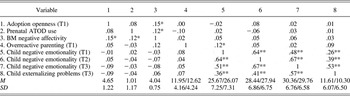
Correlational analyses indicated that externalizing problems at 27 months of age were positively associated with negative emotionality at earlier points in time but not with overreactive parenting, BM negative affect, or any of the covariates (Table 1). Negative emotionality at 9 months of age was positively correlated with overreactive parenting from mothers but not from fathers. BM negative affect was not significantly associated with adoptive mother overreactive parenting, suggesting a negligible role of evocative genotype–environment correlation as an explanatory mechanism for the association between overreactive parenting and child outcomes. Similarly, BM negative affect had no significant associations with child negative emotionality or externalizing behaviors, suggesting that any effect of genotype would likely be an interactive effect rather than a main effect. Mothers and fathers ratings of child negative emotionality were positively correlated within wave (r = .57–.73, p < .01), as were ratings of externalizing behaviors (r = .39, p < .01).
Means, standard deviations, and correlations among variables

Note: Correlations displayed above/below the diagonal are associations between mothers'/fathers' reports of their children and father/mother self-reported parenting. Means and standard deviations shown before/after the slash mark are mother/father reports. ATOD, alcohol, tobacco, and other drugs; BM, birth mother.
*p < .05. **p < .01.
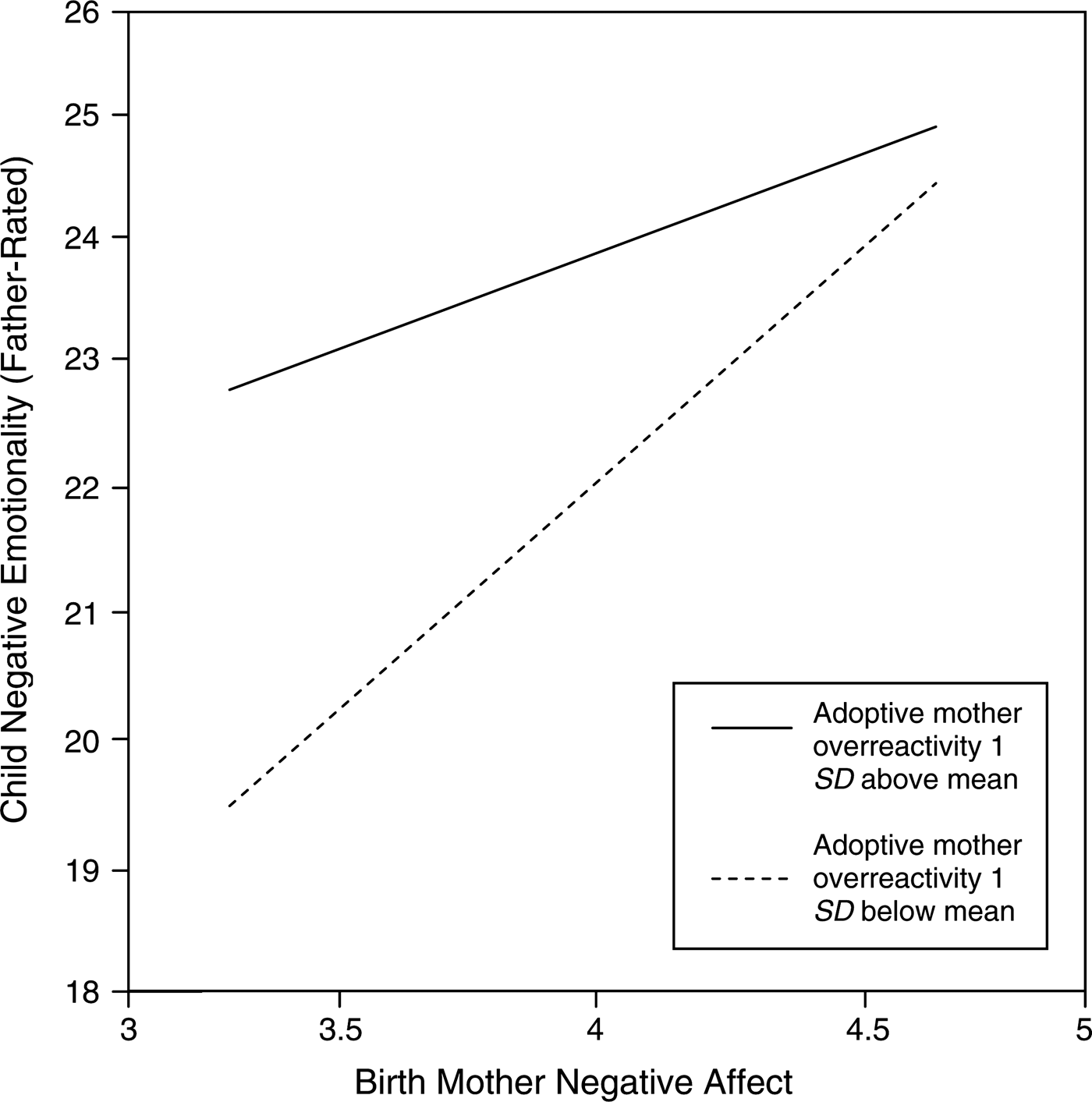
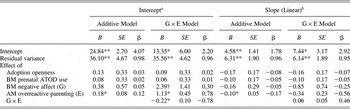
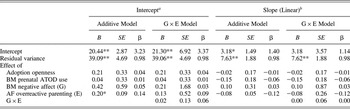
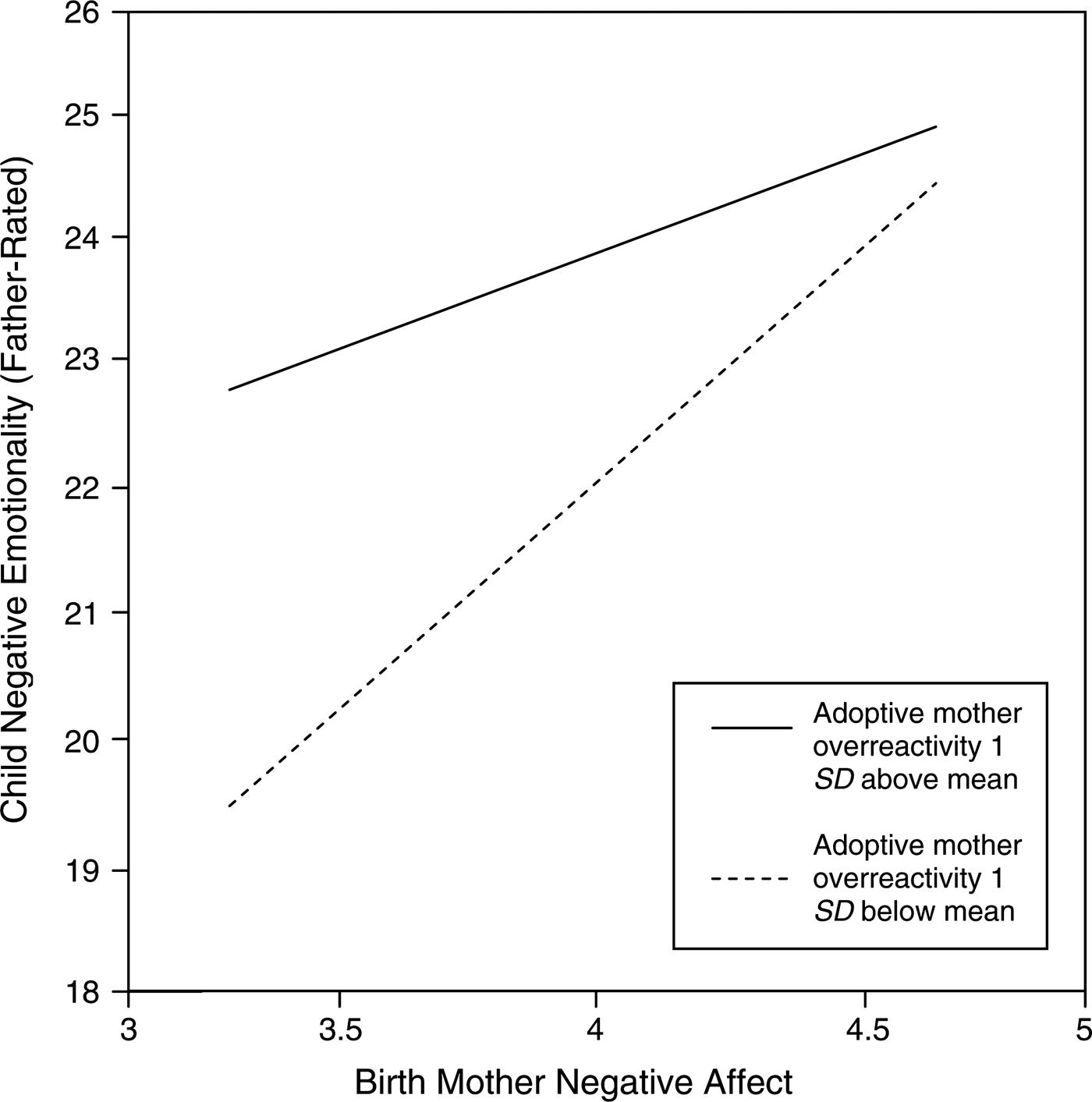
Table 2 presents the results from the latent growth curve models predicting father-rated child negative emotionality from mother overreactive parenting, BM negative affect, and their interaction. Table 3 presents the results from the latent growth curve models predicting mother-rated child negative emotionality from father overreactive parenting (environment), BM negative affect (genotype), and Genotype × Environment interaction. Independent variables were centered at the sample mean. Figure 1 illustrates the Genotype × Environment interaction on negative emotionality. Figures 2 and 3 summarize the results from the final models that include externalizing problems as an outcome at T3.
The environmental moderation of genetic influences as indicated by the interaction between birth mother (BM) negative affect and adoptive mother (AM) overreactive parenting on child negative emotionality at 9 months of age.
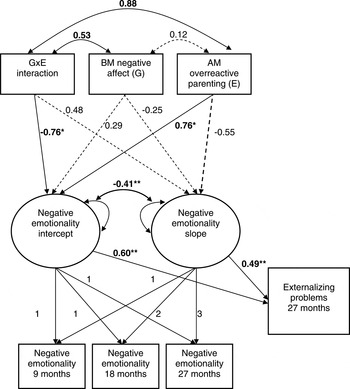
The full model of the development of negative emotionality and externalizing behavior using adoptive mother (AM) overreactivity, birth mother (BM) negative affectivity, and adoptive father (AF) rating of child negative emotionality and externalizing. Path coefficients are standardized estimates. A significant indirect effect of AM overreactive parenting on externalizing (mediated through negative emotionality intercept) was detected (β = 0.46, p < .05), as was a significant indirect effect of interaction effect on externalizing behavior (mediated through negative emotionality intercept; β = −0.46, p < .05). The R 2 values for the intercept and slope of negative emotionality and for externalizing were .04, .05, and .34, respectively.

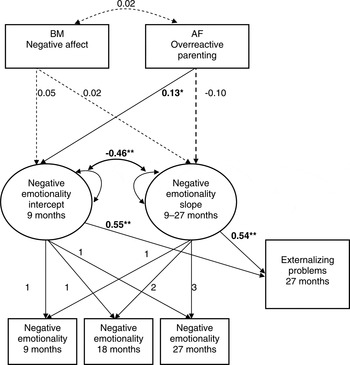
The full model of the development of negative emotionality and externalizing problems using adoptive father (AF) overreactivity, birth mother (BM) negative affectivity, and adoptive mother (AM) rating of child negative emotionality and externalizing. Path coefficients are standardized estimates. A significant indirect effect of AF overreactive parenting on externalizing problems (mediated through negative emotionality intercept) was detected (β = 0.07, p < .05). The R 2 values for the intercept and slope of negative emotionality and for externalizing were .02, .02, and .31, respectively.

Latent growth curve model of child negative emotionality using adoptive mother's parenting and adoptive father's rating of the child's negative emotionality

Note: G × E, Gene × Environment interaction between BM negative affect and AM overreactive parenting; BM, birth mother; ATOD, alcohol, tobacco, and other drugs; AM, adoptive mother.
aAt 9 months.
bChange per 9 months from 9 to 27 months.
†p < .10. *p < .05. **p < .01.
Latent growth curve model of child negative emotionality using adoptive father's parenting and adoptive mother's rating of the child's negative emotionality.

Note: G × E, Gene × Environment interaction between BM negative affect and AF overreactive parenting; BM, birth mother; ATOD, alcohol, tobacco, and other drugs; AF, adoptive father.
aAt 9 months.
bChange per 9 months from 9 to 27 months.
*p < .05. **p < .01.
Hypotheses 1 and 2: Effects of adoptive parent overreactivity, BM negative affect, and their interaction on the development of negative emotionality
As expected, a significant mean slope for negative emotionality emerged, indicating a linear increase from 9 to 27 months of age (Tables 2 and 3). Significant variability in both the level and the slope of negative emotionality also was revealed, indicating individual differences in both initial levels and rates of change in negative emotionality. Higher levels of overreactive parenting by AMs (Table 2) and AFs (Table 3) predicted more negative emotionality at 9 months of age (intercept) but did not predict increases (slope) of negative emotionality over time. BM negative affect did not have a significant main effect on either children's levels or rates of change in negative emotionality. However, a significant negative interaction effect between BM negative affect and overreactive parenting in relation to the intercept of child negative emotionality was detected for the model using adoptive mother overreactivity (Table 2). When this interaction term was included in the model, the effect of BM negative affect on the intercept of child negative emotionality became marginally significant.
To better understand this interaction effect, the effect of BM negative affect on child negative emotionality for adoptive mother overreactive parenting 1 SD above/below the mean values was calculated and plotted, according to procedures outlined by Preacher, Curran, and Bauer (Reference Preacher, Curran and Bauer2006). The interaction, shown in Figure 1, demonstrates that having a BM high in negative affect was associated with greater child negative emotionality when levels of overreactivity by AMs were low (B = 2.39, p < .05) but not when they were high (B = 1.46, p = .86). Analysis of the region of significance (see Preacher et al., Reference Preacher, Curran and Bauer2006) showed that the effect of BM negative affect on child negative emotionality was significant for all levels of overreactivity more than 0.028 units below the mean of overreactivity. No interactions were noted in the model using adoptive father overreactivity. This difference between the effects of mother and father overreactivity appeared to be primarily the result of differences in the effect of overreactive parenting between mothers and fathers, rather than due to the source of the ratings for child outcomes because models using the same (rather than opposite) informant for parenting and child outcomes also revealed the same pattern of differences between mothers and fathers. The covariates of adoption openness and prenatal ATOD use were not significant in any of the models.
Hypothesis 3: Negative emotionality as a predictor of externalizing problems at 27 months of age
Consistent with our hypotheses, both the level of negative emotionality at 9 months of age and the rate of change in negative emotionality from 9 to 27 months of age predicted individual differences in externalizing problems at 27 months of age, while accounting for BM negative affect, overreactive parenting, adoption openness, and BM prenatal ATOD use (Figures 2 and 3). In each model, negative emotionality and externalizing problems were rated by the same parent and overreactive parenting was measured by the opposite parent. This cross-rater approach was used to minimize inflation of correlations between parenting and child outcomes due to common rater effects.
Hypothesis 4: Indirect effects on externalizing problems
Indirect effects of BM negative affect (genotype), overreactive parenting (environment), and Genotype × Environment interaction on externalizing problems were estimated simultaneously with the full models presented in Figures 2 and 3 using the “model indirect” command of Mplus V4.0 (Muthén & Muthén, Reference Muthén and Muthén2006). Direct effects of BM negative affect, overreactive parenting, adoption openness, and BM prenatal ATOD use on externalizing problems also were estimated; because none of the direct effects were statistically significant, the direct effects are not shown in Figures 2 and 3. Captions for Figures 2 and 3 note that adoptive parent overreactivity had a significant indirect effect on externalizing problems for both mothers (β = 0.46, p < .05) and fathers (β = 0.07, p < .05) through its effect on negative emotionality.
A significant indirect interaction effect on externalizing problems, mediated through child negative emotionality, was found for the model using adoptive mother overreactivity (β = −0.46, p < .05). The pattern of estimates for overreactive parenting, BM negative affect, and their interaction for this indirect effect was similar to those for prediction of negative emotionality (illustrated in Figure 1), again indicating stronger effects of genotype in the presence of low overreactive parenting.
Discussion
Findings from the current study contribute to our understanding of the development of parent-reported negative emotionality and externalizing problems during early childhood in several ways. Results documented links between both individual levels and change in negative emotionality during infancy and toddlerhood to externalizing problems early in the third year of life, and also identified interactions between genetic influence (as measured via birth parent negative affect) and overreactive parenting in the development of both infant/toddler negative emotionality and toddler externalizing problems. This section addresses some of the implications of these findings for the research literature.
Effects of negative emotionality on externalizing problems
Results from the current study support previous research that has consistently documented links between children's levels of negative emotionality and individual differences in externalizing problems during early childhood (e.g., Rothbart & Bates, Reference Rothbart, Bates, Damon and Eisenberg1998; Sanson et al., Reference Sanson, Hempill and Smart2004). Current findings expand this line of work by suggesting that not only is negative emotionality an antecedent of externalizing problems but also that negative emotionality has its own developmental process. It is interesting that larger increases in negative emotionality during the first 2 years of life predict higher levels of externalizing problems during toddlerhood above and beyond initial levels of negative emotionality during infancy. This pattern of effects held across mother-report parenting to father-reported child externalizing, and vice versa (see Figures 2 and 3). Although none of the predictor variables were significantly related to individual differences in children's rates of change in negative emotionality over time, prior work with this sample indicates that increases in negative emotionality are linked with increases in parents' self-reported overreactivity and decreases in parent efficacy (Lipscomb et al., Reference Lipscomb, Leve, Harold, Neiderhiser, Shaw and Ge2011). Taken together, results suggest that the ways in which infants and their parents adapt to toddlerhood (which is typically marked by increased mobility, independence, and expectations) have important implications for the developmental course of negative emotionality and also for toddlers' externalizing problems.
Environmental moderation of genetic influences
The current findings also contribute to the growing literature on Genotype × Environment interactions in the development of both negative emotionality and externalizing problems. The only other prospective full adoption study that examines genetic and environmental effects on toddler behavior, The CAP (Plomin et al., Reference Plomin, DeFries and Fulker1988), documents Genotype × Environment interaction on psychopathology during later childhood (e.g., Hershberger, Reference Hershberger, DeFries, Plomin and Fulker1994; O'Connor et al., Reference O'Connor, Caspi, DeFries and Plomin2003) but not during the first years of life. Consistent with the CAP, the current study did not identify a main effect of genotype on negative emotionality during toddlerhood. In contrast to CAP, a significant Genotype × Environment interaction emerged. Differences in the nature and focus of the assessments for adoptive and birth parents across the two adoption studies may have contributed to the ability to detect an interaction effect during very early childhood in the present study, whereas interaction effects were not detected until later in childhood in the CAP. Specifically, the present study has a strong focus on parenting practices in infancy and toddlerhood, whereas the CAP study has a strong focus on measurement of cognitive influences on early development. The findings from the current study therefore contribute unique information about interactions between genetic influences and self-reported parenting influences in toddlerhood.
Results indicated that genotype (BMs high in negative affect) only had an effect on negative emotionality, and indirectly on externalizing behaviors, when children had relatively low exposure to self-reported overreactive parenting from their mothers. Correlations between BM negative affect and child negative emotionality were small and nonsignificant; no main effects of BM negative affect were detected. In other words, genetic risk for negative emotionality predicted infant/toddler negative emotionality only under low levels of environmental adversity. When taken together, BM negative affect, overreactive self-reported parenting, and their interaction only accounted for up to 5% of the variance in child negative emotionality. Other factors, including high stability coefficients, also are important to the development of negative emotionality during early childhood.
The direction of the interaction is consistent with the bioecological model, in which genetic influences have a greater impact in low-risk environments (Bronfenbrenner & Ceci, Reference Bronfenbrenner and Ceci1994; Raine & Venables, Reference Raine and Venables1984), but is inconsistent with additive models of Genotype × Environment interaction (e.g., Hicks, South, DiRago, Iacono, & McGue, Reference Hicks, South, DiRago, Iacono and McGue2009; Moffit, Caspi, & Rutter, Reference Moffitt, Caspi and Rutter2005; Rutter et al., Reference Rutter, Moffitt and Caspi2006; Sheese et al., Reference Sheese, Voelker, Rothbart and Posner2007), and with the differential susceptibility hypothesis in which positive environments buffer and negative environments exacerbate individual risk (see Belsky & Pluess, Reference Belsky and Pluess2009; Rutter et al., Reference Rutter, Moffitt and Caspi2006). As noted by Rutter and colleagues (Reference Rutter, Moffitt and Caspi2006), there are many different forms of Genotype × Environment interplay in the development of psychopathology. Although much of the prior empirical support for the bioecological model has come from studies of positive attributes (for a review, see Rutter et al., Reference Rutter, Moffitt and Caspi2006), support for the bioecological model also comes from studies of problem behavior (for a review, see Button et al., Reference Button, Scourfield, Martin, Purcell and McGuffin2005; Krueger et al., Reference Krueger, South, Johnson and Iacono2008; Schonberg & Shaw Reference Schonberg and Shaw2007). Thus, this emerging body of work suggests that the bioecological model (stronger genetic effects in low risk environments) may not only apply to positive outcomes but also may contribute to our understanding of negative outcomes such as negative emotionality and problem behaviors.
An alternative explanation would be that the current study, and others documenting similar findings (e.g., Button et al., Reference Button, Scourfield, Martin, Purcell and McGuffin2005; for a review, see Schonberg & Shaw, Reference Schonberg and Shaw2007), actually measured constructs on the positive rather than the negative end of the spectrum (lack of behavioral problems; an even temperament). This explanation cannot be ruled out, although all measures used in the current study were validated instruments used in previous research on negative emotionality and externalizing. Future research could explore this possibility by simultaneously including instruments designed to measure positive (even temperament; good behavioral control) and negative (negative emotionality; behavioral problems) aspects of behavior, and examining Genotype × Environment interactions in both areas.
In sum, the present findings suggest that, in addition to continuing the study of the types of Genotype × Environment interactions that have typically been reported in the literature on problem behaviors (e.g., negative environments amplifying genetic risk; positive environments buffering genetic risk), researchers also should be cognizant of the possibility for other types of interactions between genetic and environmental risks (e.g., stronger genetic effects under conditions of low environmental adversity). Future research that continues the work begun by Rutter and colleagues (Reference Rutter, Moffitt and Caspi2006) is needed in order to catalog these different types of Genotype × Environment interactions and the circumstances in which they emerge across development. Until more of this type of work is completed, the generalizability of findings supporting the bioecological model, such as those from the present study to other aspects of temperament, and genetic and environmental risks, remains unknown.
The present study also contributes to a growing body of literature on similarities and differences between mother–child and father–child relationships (e.g., Lamb, Reference Lamb2004). Consistent with recent studies, additive models (no interaction term) indicated that fathers' reports of their overreactive parenting predicted child negative emotionality and externalizing in a similar way to mothers' reports of their overreactive parenting; the magnitude and significance of the effects for father overreactivity were similar to the magnitude and significance of the effects for mother overreactivity. However, the environmental moderation effects differed across models for adoptive parents. For fathers, overreactive parenting predicted negative emotionality (and in turn, externalizing problems) across the entire sample but did not moderate the effect of genotype. For mothers, both main and moderation effects of overreactive parenting were present.
Most of the prior work in Genotype × Environment interaction has either assessed parenting as a combination of mothers' and fathers' behavior or has examined mothers' parenting alone. There is some evidence that parenting moderates the effect of genetic risk on externalizing problems similarly for mothers and fathers in late adolescence (Hicks et al., Reference Hicks, South, DiRago, Iacono and McGue2009). Results from the current study suggest differences in environmental moderation for mothers and fathers during early childhood, with respect to perceptions of overreactive parenting and negative emotionality, and highlight the need for further research in this area.
Strengths, limitations, and conclusions
Several methodological strengths were incorporated into the present study. Most importantly, the prospective adoption design, where infants are adopted at birth and placed with nonrelative adoptive parents, allowed the effects of parenting, genetic influences, and their interaction to be disentangled without contamination by passive Genotype × Environment correlation (Rutter et al., Reference Rutter, Pickles, Murray and Eaves2001). Second, the longitudinal design and statistical modeling allowed for detection of effects of changes in negative emotionality over time to individual differences in externalizing problems. In addition, the inclusion of adoption openness and BM's prenatal ATOD use as covariates in the analyses reduced the likelihood that the findings were influenced by prenatal drug exposure or from sharing of information between birth parents and adoptive parents.
Some caveats of the study need to be noted. First, genotype was inferred from the phenotype of BMs. The number of birth fathers participating in this study was only one-third that of the number of BMs. Considering the complexity of the analytic models for this study, we were most confident reporting findings from the BM data. We also conducted analyses using a combination of BM and birth father data (averaging negative affect across birth parents but using BM report only when there was no birth father). The pattern of beta coefficients was very similar to those reported for just the BM data. However, the standard errors for these analyses were very large, likely due to the low numbers of birth fathers participating and the low correlations between BM and father negative affect (r = .01, p = .90). In future years, the current study will have increased statistical power for detecting Genotype × Environment interactions with birth father data, due to an enlarged sample size via the recruitment of a second cohort of adoptive and birth families (Neiderhiser & Reiss, Reference Neiderhiser and Reiss2007).
Second, the adoptive families had limited ethnic and sociodemographic diversity, which affects the generalizability of findings. Nonetheless, the demographic characteristics of the sample were similar to those reported in CAP, the other large US-based adoption study (Plomin & DeFries, Reference Plomin and DeFries1983). Another limitation was the use of parent-report data for all study measures; we used a cross rater approach to minimize inflation of correlations due to common rater effects. However, self-reports of overreactive parenting would have ideally been corroborated by direct observations of parent–child interactions that were coded for overreactive parenting. Unfortunately, such data were not available in the present study.
In conclusion, the current investigation highlights the dynamic nature of negative emotionality during the first 2 years of life and demonstrates the importance of individual differences in rates of change in negative emotionality over time to externalizing problems in toddlerhood. Moreover, results documented an environmental moderation pattern that is consistent with the bioecological model, with genetic risk having a larger effect for children in less adverse parenting environments. Additional work in this area will help to identify the multiple mechanisms through which specific environments might offset or exacerbate genetic influences on child outcomes, potentially providing guidance to intervention studies in terms of environmental contexts that might be targeted in studies aimed at preventing the development of maladaptive child outcomes (cf, Leve, Harold, Ge, Neiderhiser, & Patterson, Reference Leve, Harold, Ge, Neiderhiser and Patterson2010).