

Academic research and media coverage tend to emphasize what is new and disruptive about China's growing engagement in the global economy. Convergence, “socialization”Footnote 1 and internationalization are more easily overlooked. Hence, analyses frequently circumvent the striking similarities between the ways in which Chinese and Western companies conduct their businesses within power structures in the developing world that have often been historically shaped through stages of colonialism, post-colonialism and structural adjustment. Sometimes unintentionally, this has created the perception that there exists an insurmountable gap between the ways in which China and Western countries conduct their international businesses, failing to acknowledge the increased internationalization of the Chinese state and companies.Footnote 2 With regards to mining, this is translated in a view that China has a uniquely geostrategic approach to natural resource extraction, that Chinese mining companies operate more comfortably in coalition with authoritarian rulers, and that together they antagonize the purportedly high social and environmental mining standards of Western companies.
This article conducts a quantitative analysis of China's overseas mining investment that refutes such hypotheses, showing that Chinese mining companies invested primarily in mature liberal mining economies during the 2000–10 period. These quantitative data are combined with insights acquired through qualitative interviews conducted in China and Peru during 2008–11, together with secondary sources. Instead of favouring a centralized macro perspective where central government geostrategic criteria are the major investment driver, Chinese overseas mining investment in Latin America is best explained with a micro perspective that takes into consideration the particular corporate strategies and the perceptions of risks and opportunities gauged by individual firms.
The article begins by reviewing the internationalization of China's mining industry and some of its particularities as reflected in existing literature. It then discusses whether Chinese foreign direct investment (FDI) responds to political and geostrategic interests or whether it is best explained as a market process. Crucially, “the market” is not presented here as neutral, but as an uneven political institution to which mainstream norms Chinese mining companies are increasingly (yet not linearly) adapting. The following section presents and analyses data on the global allocation of Chinese mining investment, addressing in more detail the intricacies of Chinese investment in Latin America. The article then focuses on Chinese mining investment in Peru specifically to offer a discussion of the ways in which different Chinese mining companies integrate their transnational operations within wider strategies of corporate development. It shows that while China Minmetals and some smaller Chinese mining companies view minerals trading as an end itself, other large state-owned enterprises (SOEs) develop vertical integration strategies to benefit from metallurgical capacity, distribution networks and high demands for raw materials in China. A conclusion summarizes the findings and briefly reflects on their developmental implications.
The Internationalization of China's Mining Industry
Technical assistance from the USSR played an important role in the development of China's mining during Mao's era. It was however with the open-door policy initiated in 1978 that China's mining industries started to integrate in the international capitalist system, most significantly through the trading of minerals and an initial shy receptiveness towards inward FDI.Footnote 3 In the 1990s, a small number of Chinese companies pioneered outward FDI in mining sectors, starting with the Shougang Corporation's acquisition of an iron ore mine in Peru in 1992. However, the most vigorous push for the internationalization of China's mining industries was given by the “Going Out” strategy, which began to be implemented in the 2000s. This strategy encourages Chinese firms to invest abroad, at times through financial incentives such as low interest loans from state-owned policy banks. Its main objective is to prepare Chinese businesses to compete internationally, hoping to serve as both a springboard for successful internationalization and a preparation for Chinese firms to resist competition from transnational firms domestically as China opens up to international investment.
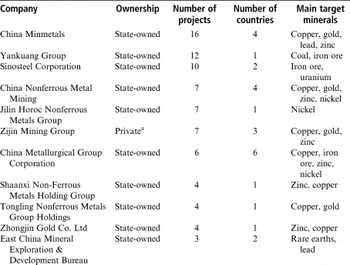
Currently, around 24 per cent of China's outward FDI is concentrated on extractive sectors,Footnote 4 and mining firms have been particularly active in acquiring overseas assets during the late 2000s economic recession. The Chinese economy's growing demand for commodities is another underlying reason for the internationalization of its mining firms, as China is now the world's major consumer of iron ore, steel, coal, zinc, lead, tin, nickel, copper and aluminium.Footnote 5 Following decentralizationFootnote 6 and privatization trends in China, there is now a wide range of companies conducting overseas direct investment, including major SOEs (some of them partially listed in stock markets), provincial and township level SOEs, and privately owned firms. Table 1 provides a ranking of the top Chinese mining companies by number of overseas projects.Footnote 7
Top Chinese Mining Companies by Number of Controlled Overseas Projects (2000–2010)

Notes:
a32% state-owned.
Source:
Raw Materials database (2011) and various media. Author's elaboration.
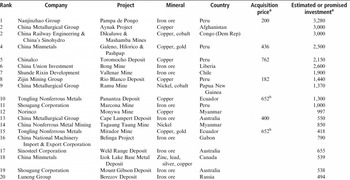
A quick survey of existing literature reveals three characteristics of Chinese mining investment that distinguishes it from Western mining investment. The first is Chinese investors' capacity to undertake significant infrastructural development to accompany their mining projects, in certain cases easily outbidding other transnational competitors in countries where infrastructural development is deemed a priority. This model of investment, most prevalent in Africa and Asia, is facilitated by the close ties between different Chinese SOEs in the mining, construction and engineering sectors. Table 2 ranks the top 20 Chinese overseas mining projects by estimated or promised investment. Among these top positions are projects in developing countries where Chinese investment is accompanied by infrastructural development, such as Afghanistan, Democratic Republic of Congo, Ecuador, Gabon, Liberia, Myanmar and Papua New Guinea. Interestingly, infrastructural projects are often part of package offers that emulate the deals offered by Japan and the West to tap China's resources decades ago.Footnote 8
Top 20 Chinese Overseas Mining Projects by Acquisition Price and Promised Investment (2000–2010)

Notes:
aAmounts in US$million.
bPaid to buy Canada's Corriente Resources.
Sources:
Raw Materials database (2011) and various media. Author's elaboration.
A second particularity of Chinese mining firms is their limited reliance on stock markets, which allows them to undertake projects where profits will only materialize in the medium and long term. As Ha-Joon Chang explains, the increased power of shareholders in Western firms is detrimental to long-term corporate development, as shareholder value maximization forces managers to deliver short-term results.Footnote 9 Large Chinese mining firms do not share these operational constraints, and in fact benefit from easy access to credit from state-owned policy banks in China. For example, in the case of Zijin in Peru, this long-term perspective enables the company to halt a project and postpone further decisions until the social and political contexts affecting its interests have improved.Footnote 10 Finally, and precisely because of this access to easy credit from policy banks, Chinese investment choices are not constrained by civil society campaigns in the same ways as major transnational companies.
These last two particularities can be further categorized for analytical purposes. A World Resources Institute report published in 2007 distinguishes seven types of risk to which extractive companies are exposed: financial, construction, operational, reputation, credit/corporate, host government, and host country political risk,Footnote 11 to which I would add home country legal risk. Because of their organizational structures, Chinese companies are less exposed to some of these risks than Western companies are. Financial and corporate risks are limited, as companies are at most only partially listed, and it is unprecedented that Chinese policy banks reprimand major Chinese SOEs by cutting their financial lines, despite the existence of regulatory procedures which grant central state authorities the power to halt overseas investment projects. Reputational risks exist, yet the negative impacts of public opinion on market value are less important than potential objections to the future projects of a company. In this sense, Chinese firms in Peru have been to date reluctant to participate in multilateral initiatives of transparency such as the Extractive Industries Transparency Initiative, or to integrate groups such as the International Council on Mining and Metals, while at the same time developing corporate social responsibility programmes of their own to address demands for local development. Finally, home country legal risk is currently virtually nonexistent, as there are no cases of Chinese mining companies being sued in Chinese courts for social or environmental failures in their overseas operations.Footnote 12
These differences highlight some limitations in the conventional modes adopted by civil society to pressure mining firms. Civil society organizations, in weak states in developing settings and making use of transnational networks, often pursue campaigns in the country where a company is based. This approach is very limited in the case of China, except for constructive criticism and campaigns for capacity building and raising awareness of potential risks. This is not to deny the potential for civil society engagement with Chinese mining firms. In interviews that I have conducted, Chinese companies and academics show a sincere concern about the adaptation of Chinese businesses to Latin American contexts. But the particularities of Chinese firms call for the need of a restructuring of the ways in which mining conflicts are “rescaled”Footnote 13 by civil society.
Politics or Market?
As Chinese mining FDI becomes an important source of revenue for natural resource-endowed economies, it raises important questions regarding the nature, criteria and objectives of these investments. Political economy and international relations analyses that emphasize the political nature of Chinese investment focus on what they reckon are China's unique internal ideological burdens and geostrategic expansion in the developing world. The relevance of these views and perceptions lies in their ability to transcend scholarship and inform politics and nationalistic attitudes, as observed in the heated reactions against certain attempts by Chinese firms to purchase Western companies.Footnote 14 Many criticisms of Chinese companies' alleged political priorities have been produced by think tanks and media commentators in the United States, a country where government and businesses have historically looked out for each other on international ventures,Footnote 15 but where mainstream discourses routinely attack governmental involvement in “the” market. Regarding mining specifically, Wilson summarizes some of the uneasiness towards Chinese investment by pointing out that “concerns have thus been raised by both the Australian government and some business interests over the risk that these state-owned firms would act in a policy-driven manner and distort market processes by prioritising the economic interests of the Chinese state.”Footnote 16 From this perspective the economic interests of the Chinese state appear to be political and obscure, while those of other transnational firms are credited as “within the market” and hence benign. This is surprising, especially when one considers that Australia's mining industry recently spent 22 million AUD in a successful campaign that contributed to bring down prime minister Kevin Rudd after he had proposed a 40 per cent tax on mining “super profits,” to give but one example of Western mining companies' political lobbying.Footnote 17
These analyses tend to portray China as a political and ideological entity that disrupts the natural functioning of apolitical markets. Such orientalizing discourse needs to be critically assessed and challenged, a task in which a critical geopolitics approach can prove useful. Critical geopolitics alerts against polarizing Western perspectives that perpetuate the image of the “other” as a villain, hence rejecting “the realist ontologies of traditional geopolitical analysis.”Footnote 18 Much in line with Gramscian critiques of “common sense,” critical geopolitics scrutinizes the discursive techniques or “epistemological enforcers”Footnote 19 by which certain institutions are naturalized (such as the market) and others are vilified. While I present Chinese mining companies as market-driven entities, this is not to reject the argument that they react to the political opportunities and constraints set by the Chinese government and others. Instead, I wish to stress Chinese companies' growing integration in the international capitalist market, which they navigate following market ideologies and corporate development strategies that build upon their specific characteristics and understandings of risk.
Business literature offers an alternative view of Chinese outward FDI, adopting a micro perspective that takes into consideration the benefits and challenges gauged by individual firms in their internationalization strategies. On their study of Chinese outward direct investment (ODI) between 1984 and 2001, Buckley et al. find that while standard FDI theory explains some trends apparent in Chinese multinationals' investments, there are certain particularities to Chinese ODI. Specifically, the authors explain cultural and geographical proximity as ordinary ODI vectors, and underscore high levels of political risk as a differential variable specific to the Chinese case. They explain that this can be due, among other factors, to the concentration of Chinese investment in developing countries and, most importantly, to the limitations of familiar measures of political risk, “which are typically calculated from the point of view of industrialised country firms.”Footnote 20 Kaplinsky and Morris also emphasize the importance of the learning driver in Chinese outward FDI, pointing to how “Chinese firms are distinctive in their use of [Sub-Saharan Africa] as a test bed for overseas investments in general.”Footnote 21 In the main, business literature sees Chinese firms as market agents making decisions with a shorter or longer-term profitability target. While it is accepted that there may be specific criteria determining Chinese investment patterns, little doubt is placed on the ultimately economic outlook of Chinese firms.
But before proceeding with the rest of the analysis, a cautionary note should be included on business literature's conceptual naturalization or neutralization of “the market,” the “rules of the market” (which Chinese businesses are seemingly internalizing), and the firm as a purely technical and indispensable agent of development. As Nally puts it, “the assumption that markets are ‘natural systems’ operating outside of power and politics is itself an invention of the 19th century that takes for granted the violent manner in which the state must eliminate all behaviour that is now deemed aberrant or undesirable.”Footnote 22 In a similar vein, Timothy Mitchell calls for the need to rethink the economy, suggesting that it is not a static supra-social ideal, but “a series of competing projects, or rival attempts to establish metrological regimes, based upon new technologies of organization, measurement, calculation, and representation.”Footnote 23 Therefore, in adapting to the international capitalist system and in following market criteria for FDI, Chinese firms are taking a very particular political stance, one that accepts the mainstream Western conceptualization of the “right” world economic order.Footnote 24
The Distribution of Chinese Mining FDI in the World and in Latin America
This analysis of the allocation of Chinese mining investment follows a methodology elaborated by Gavin Bridge on a 2004 article for The Professional Geographer.Footnote 25 While Bridge chooses to rely on the Metal Economics Group's MineSearch database, the Raw Materials database is selected in this study for its wide coverage of 30 different mineral commodities, which allows identification of the kind of commodities that Chinese firms seek in their international operations. This database is organized by the Raw Materials Group, based in Sweden, which contains more than 24,000 mining industry entities, and includes specific information on 5,088 mines and 2,807 mergers and acquisitions since 1995.Footnote 26 The Raw Materials Group uses a wide range of sources to compile its data, including company and country sources, newsletters and research. Additional research was undertaken to complement these data, with an internet search of Chinese mining investment on a country-by-country basis, as well as an examination of the websites of all the main Chinese mining companies.
In order to analyse the first decade of mining investment following China's “Going Out” policy, the data presented here correspond to Chinese overseas mining investment in the 2000–10 period. Instead of focusing on investment size, the analysis addresses the number of projects. This is in order to account for the investment predilections of various kinds of Chinese investors, rather than tracing just the wealthiest companies. Early exploration activities are not covered, as these are often undertaken by companies (juniors) other than those that will eventually construct and operate the mines.Footnote 27 Only mining projects (from the conceptual study onwards), mines in construction and mines in operation are included.
As Figure 1 illustrates, the global allocation of the 112 recorded instances of Chinese-controlled overseas mining investment shows a marked tendency towards two mature and developed mining economies (Australia and Canada), countries in the geographical proximity of China, and a group of African and South American destinations. Mining projects where the Chinese mining company holds a minority non-controlling share through capital investment and joint ventures in which the Chinese company is not the major shareholder are excluded from the list.
Allocation of Chinese Overseas Mining Investment (2000–2010)

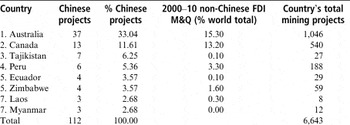
Table 3 focuses on the countries with a higher number of Chinese-controlled projects, and compares this figure with the world's percentage of non-Chinese mergers and acquisitions in each given country, and with the total number of projects in the country. Australia and Canada top the list, jointly hosting more than 44 per cent of the overseas mining projects controlled by Chinese mining companies. The major reason behind their high ranking is evidently their abundant resource stocks. But the large number of Chinese mining companies in these countries also reflects the fact that they operate comfortably in Western countries with liberal resource regimes and democratic institutions. Chinese firms emulate other transnational investors in their predilection for Australia and Canada, as the Engineering and Mining Journal's Annual Survey of Global Investment indicates that in 2009 these were the two preferred destinations for global mining investment, absorbing 11 per cent of the world's mining investment each.Footnote 28
Top Destinations for Chinese Mining FDI 2000–2010 (by number of controlled projects)

Source:
Raw Materials database (2011) and various media. Author's elaboration.
Focusing on Latin American countries, Peru ranks fourth in the list by number of projects, but the size of the mining projects that Chinese companies are undertaking in the Andean country is much larger than those in Tajikistan, which ranks third. Peru is also a more typical destination for mining investment than the Central Asian country, ranking fifth in the world according to the Engineering and Mining Journal's Annual Survey of Global Investment.Footnote 29 Chinese mining investment in Peru therefore needs to be considered within the wider trends of privatization and transnationalization of the country's mining industries since the early 1990s.Footnote 30 Peru's liberal mining regime and its location in the Pacific Rim are undoubtedly attractive to Chinese firms, but equally important is the history of Chinese investment in the country prior to the 2000s. Shougang Corporation became the first Chinese SOE to undertake an overseas mining project when it acquired the Marcona mine in Peru as early as 1992. China National Petroleum Corporation followed shortly afterwards when it was granted a service contract in the Talara field in 1993. This early background of Chinese investment is key for the recent boost in Chinese investment in the country. As the general manager of a Chinese mining company operating in Peru said: “You need to understand Chinese culture … The main reason why there are more and more Chinese companies in Peru is because of Shougang. Nobody wants to be the first to arrive to a country. If there are more Chinese people and companies already there, this will attract others who will find it easier.”Footnote 31 Chinese mining investment in Peru during the 2000s therefore responds to previously existing business relations, availability of resources and opportunities for green field investment, geographical advantages, a highly liberal mining investment regime, stable political relations, and to a certain extent the large Chinese community present in the country since the 19th century.
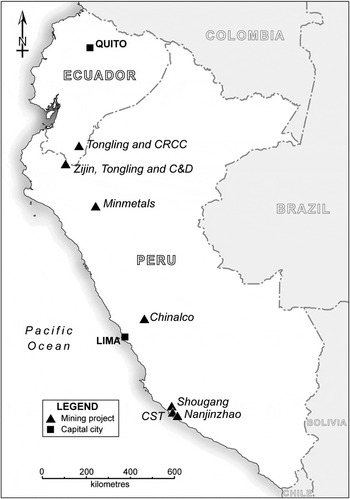
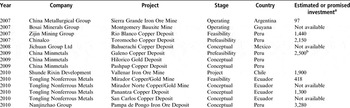
The high number of Chinese mining projects in Ecuador is, on the other hand, a result of the recent acquisition of Canada's Corriente Resources by a joint venture formed by Tongling Nonferrous Metals Group and China Railway Construction Corporation. The joint venture controls 17 deposits organized in four mining projects in the Corriente Copper Belt in south-east Ecuador.Footnote 32 Ecuador is a country also geographically located in the Pacific Rim, with a consolidated oil extraction industry and a mining sector with significant development potential, even though social resistance to mining expansion remains high.Footnote 33 While President Correa's current government initially appeared to hold a “post-neoliberal” attitude towards the governance of natural resources, receptive to the views of environmentalists, fiscal concerns and internal and external pressures have in fact underpinned the expansion of extractive activities.Footnote 34 Moreover, Chinese mining investment in the country is preceded by important investment in the oil sector undertaken by Sinopec and China National Petroleum Corporation.Footnote 35 But also very importantly, the location of Tongling's Ecuador deposits across the border with Peru and the geographical proximity to the company's Rio Blanco project suggests that an important reason for investment in Ecuador has been precisely the clustering of Chinese projects around Peru. In fact, a look at the geographical distribution of Chinese mining projects in Peru and Ecuador reveals that, except for Minmetals and Chinalco (the largest Chinese mining SOEs operating in the Andean region), they are clustered around two locations (see Figure 2). This confirms the perspective quoted above that Chinese investors are attracted to areas where other Chinese companies operate and where they can share knowledge and networks that could facilitate the adaptation to new settings.
Allocation of Chinese Mining Projects in Peru and Ecuador

While Peru and Ecuador receive the bulk of Chinese mining FDI in Latin America, Chinese mining firms also acquired rights to exploit mines in Argentina, Chile, Guyana and Mexico during the 2000–10 period, as illustrated in Table 4. The fact that all these projects were acquired from other transnational mining companies and that Chinese companies eluded direct dealings with national governments for the acquisition of concessions shows the preference given by Chinese mining companies in Latin America to market mechanisms, as well as reflecting the political economies of mining investment in the region. In addition to the projects on the list, Peru and Chile each host a Chinese project which was acquired before the 2000s. Furthermore, Chile (where state-owned Codelco has also an important joint venture with Minmentals) and Brazil are major exporters of minerals to China. But countries with important mineral reserves such as Bolivia, Colombia and Brazil do not currently host Chinese controlled projects.
Chinese Mining Projects in Latin America (acquired 2000–2010)

Notes:
aAmounts in US$ million.
bTotal investment planned for the Galeno, Hilorico and Pahspap deposits.
Sources:
Raw Materials database (2011) and various media. Author's elaboration.
Chinese mining investment in the region responds to similar perceptions to those of other transnational companies. The Fraser Institute published a survey of mining companies' perceptions towards investment destinations in 2010 which, while biased in its views about what makes a good mining destination, reflects some general perceptions among (mostly Western) mining companies.Footnote 36 The survey ranks a number of Latin American mining destinations from best to worst as follows: Chile (82.5 points), Mexico (62), Peru (59.1), Colombia (56.9), Brazil (56.5), Argentina (44), Venezuela (12.5), Bolivia (10.2) and Ecuador (3.8). Except for Ecuador, described in more detail above, Chinese mining companies have invested or made important attempts to invest in high ranked countries and have so far avoided Venezuela and Bolivia. This remains in contrast to the situation in Africa, a region where Chinese mining companies have not invested in the two highest ranked countries (Botswana and Ghana) but have done so significantly in the two lowest ranking ones (Zimbabwe and Democratic Republic of Congo). Chinese perceptions of mining investment risk in Latin America are hence more attuned to those of other transnational investors, focusing on microeconomic policies and potential tax rises. As a Chinese manager in a Chinese mining company investing in Peru explained when asked about the potential political shifts following the Peruvian 2011 presidential elections: “I don't worry about the election process …. But we have to worry about the microeconomic policy. We don't care who will be the elected candidate, but we do care about their future policies. It is the decision of Peruvians. … I can only 100 per cent agree with the Peruvians' decision.”Footnote 37
This resonates with the findings of interviews with other Chinese mining companies in Peru, which indicate that their primary objective in Latin America is to increase profits, whether by the direct sale of minerals or by granting a steady supply of ore to their metallurgical businesses. Such findings contradict some mainstream views about the ways in which China's overseas resource acquisition works. While the central government plays an indispensable role by facilitating the investment process through easy credit and smoothing diplomatic relations through various means, firm profitability – not security concerns – lies at the heart of investment strategy. Summarizing the requirements imposed by China's central government for mining FDI, the general manager of a Chinese firm explained: “There are mainly two concerns: one is the ability of a company to invest, the other is whether the project is worthy.”Footnote 38
However, the relationship between companies and central government is more complex than this quotation seems to indicate. While at a practical level firms only need to conform to basic common-sense profit requirements, Chinese SOEs reflect the evolution of state ideologies in China. Hence, companies must not only attain profits but also endorse the new entrepreneurial rationales that characterize much of the official modernization discourse and elites' political thought in the reform era.Footnote 39 While this is not necessarily done through administrative mechanisms or direct rules, China's central government's rhetoric favours business behaviours. Top executives in SOEs are actively encouraged to embrace business rationales, as the China's State-owned Assets Supervision and Administrative Commission “grants rewards or inflicts punishments based on their performances … in accordance with the requirements of the socialist market economy system and modern enterprise system.”Footnote 40
Understanding China's Overseas Mineral Quest: Corporate Strategies as an Investment Driver
This section uses case studies from Peru to illustrate how Chinese mining investment in Latin America is best explained by analysing the independent corporate strategies and backgrounds of particular firms. This analysis complements my work on the impacts of Chinese investment on resource governance in South America,Footnote 41 the mining-centred political economy of Sino-Peruvian relationsFootnote 42 and case studies of Chinese extractive investment in South America.Footnote 43
Peru is singled out for analysis here because it is the Latin American country which received the largest amount of mining investment and the largest number of Chinese mining companies during the first decade of the 21st century. While Ecuador follows closely in number of projects according to the Raw Materials database, the only Chinese mining investor in Ecuador is Tongling Nonferrous Metals, which is also present in Peru through a joint venture with Zijin and Xiamen C&D. Furthermore, Peru is interesting for analytical purposes for it hosts a variety of Chinese investors in control of large-scale mining projects, including two large national-level SOEs, a municipality-level SOE, a semi-private firm, a fully private firm, and a project controlled by a Hong Kong public listed company, CST Mining Group, which operates the Mina Justa Copper Deposit. According to law firms interviewed in Lima, there is also an increasing number of mainland Chinese investors – with limited experience in the mining business – seeking to participate in the development of new mines, as well as Chinese migrants involved in artisanal mining in the Madre de Dios region.
While these cases could convincingly illustrate variation within Chinese mining investment, the next paragraphs focus on the corporate strategies in the five cases of mainland Chinese-controlled large-scale mining projects, as these are the ones that more often raise suspicions of homogeneity and adherence to Beijing's geopolitical vision. Moreover, it should be noted that Peru represents the paradoxical case of a poster child for neoliberal reforms. Having privatized its mining industry in the 1990s because of its inefficiency, it now receives Chinese investment (mostly state-owned) with open arms as a confirmation of the success of its macroeconomic transformation. To some extent, and given its marked dependence on mining revenues, Peru might not be a paradigmatic case of mining governance in Latin America, but it is certainly illustrative of the kind of business climate to which Chinese investors have given preference in their first two decades of investment ventures in the region following Shougang's early arrival in 1992.
Shougang Hierro Peru
The Shougang Iron and Steel Corporation became China's first state-owned investor in Peru in 1992, when it acquired the Marcona mining concession from the Peruvian government. While I discuss the intricacies of this case elsewhere,Footnote 44 I wish to recapitulate here the particular stage of corporate development that prompted Shougang's Peruvian acquisition. The need to supply the company's core iron ore metallurgic business spurred the interest in the Marcona mine, responding to the attractiveness of reserves with an iron ore content of 55 per cent as compared to average 30–35 per cent of Chinese domestic supply. It was around US$10 per ton cheaper to import iron ore from Marcona than to import it from Australia.Footnote 45 However, Shougang made a series of mistakes, partly a result of its lack of international experience, which tarnished its reputation in Peru. In a context of non-transparent privatizations in the early 1990s, its acquisition of the Marcona concession raised important questions about corruption and access to privileged information.Footnote 46
Unaware of the complex labour dynamics in Marcona and the incapacity of the Peruvian state to control social conflict, Shougang developed a strained relationship with its work force in Peru. Importantly, the company also lacked support from Chinese governmental bodies, given its managerial autonomy from Beijing's municipality which had been achieved through allegiance to an experimental profit-responsibility system in the 1980s,Footnote 47 among other factors. In the first half of the 1990s, Shougang overinvested in diversified projects, enhancing the accumulation of short-term debt and making the company financially insolvent by 1995.Footnote 48 This had repercussions in Shougang Hierro Peru, as the company was unable to fulfil its investment promises. Shougang acquired a bad reputation as a company unable to stimulate local development or adequately fulfil its economic commitments. According to interviewees in Peruvian regulatory bodies, this image persists today:
Their machinery is old, their buses are 30 or more years old and they do not change them. They provide their workers with security equipment once a year, while these are not supposed to be used for more than three months. In this sense the company is very irresponsible. They control the water, energy production and energy distribution. They only provide the people with water two hours a day. … The problem lies in the poor management of the people they have there. When the general manager arrives they are eager to show how much money they have saved, without taking into account how that can damage their operations in the long term.Footnote 49
Xiamen Zijin Tongguan Investment Development Consortium
The Xiamen Zijin Tongguan Investment Development Consortium, which acquired concession rights for the Rio Blanco copper project in 2007 from Monterrico Metals, is currently immersed in an emblematic case of resistance against mining activities. The consortium is formed by the Zijin Mining Group (a partially private company which holds a 45 per cent share of the project), Tongling Nonferrous Metals (an Anhui based state-owned company that holds a 35 per cent share of the project) and Xiamen C&D (20 per cent).Footnote 50 Zijin is finalizing the construction of a 200,000-tonne capacity refinery plant in ChinaFootnote 51 which it hopes to supply in part with copper from Peru. Moreover, the Rio Blanco project is key in the company's 2005 strategic goal of becoming a global mining leader, following its consolidation within China in the 2001–05 period.Footnote 52 Tongling, on the other hand, is a more established metallurgic firm in China and its interest in copper concentrate aims to provide its core refining business.Footnote 53 C&D is a more diversified industrial and investment conglomerate whose interest in the project is merely commercial.
While the three companies are large and well established players in China, they showed a lack of knowledge of the Peruvian context in their deal for the Rio Blanco concession. As the acquisition was made in the London stock exchange, several interviewees within Peru's mining industry concur that the Zijin-led consortium did not pay enough attention to the “non market” aspects of the transaction and arrived to Peru with little knowledge about the social dynamics in Rio Blanco. Not only is Monterrico Metals (the consortium's predecessor in the project) being sued in an English court for alleged responsibility in the deaths and torture of a number of peasants in 2005,Footnote 54 but the community relations team and its philosophy has changed at least four times in the previous ten years, confusing the local population and increasing distrust in the company. Zijin has not found solutions to these problems, and the Rio Blanco project remains halted as a result of social opposition. Interviewees within the company acknowledge that the successful development of the project cannot be achieved in the short term.
Zijin's project is deemed by many mining industry insiders in Peru a failed investment choice, or at best a poorly calculated risk. In this sense the sale of the Rio Blanco concession is often viewed as an example of an outstandingly profitable junior exploration business. Monterrico Metals had only invested between US$15 and 30 million in exploration activities, according to different interviewees, when it sold the project to Zijin for US$182 million. While overpriced acquisitions have raised suspicions that such deals may be overwritten by Beijing, interviewees often explain them as mistaken decisions which are the consequence of the limited experience of newly internationalizing companies. In fact, overpayment becomes much less common once Chinese companies gain experience and seek the advice of consultancies that can better guide their investment decisions.
Chinalco
In contrast to these first two examples, Chinalco has a good – in fact the best – reputation among Chinese mining investors in Peru. As described by a Peruvian mining engineer with ample experience in mining management, Chinalco has “acquired the most advanced mining technology … [and thus] we can expect a large-scale operation very similar to those of Western enterprises.”Footnote 55 Chinalco bought the Toromocho project from Peru Copper in 2007 as a key step in its strategy to become a multi-metal company, expanding from its early focus on aluminium. Instead of relying on Chinese expatriates, Chinalco has maintained Peru Copper's team, composed mainly of North American and Peruvian staff, and only three Chinese managers were initially deployed to Peru to oversee the project's finances. Corporate policies of localization of human resources and management practice are increasingly common among Chinese companies “not only to adapt to local regulations and the business environment, but also to merge with local business culture.”Footnote 56 In the case of Chinalco, this can also be observed in its collaboration with other companies. While Chinese investment in Africa is often accompanied by parallel businesses in construction and engineering, or by infrastructure aid, Chinalco is instead collaborating with other local and transnational companies to develop infrastructures. It is currently negotiating with Ferrocarril Central to improve railway facilities in central Peru,Footnote 57 and it is involved in a 7 per cent stake in a multinational consortium for the development of port facilities in the city of Callao.Footnote 58
The Toromocho project is vital in Chinalco's strategy of business integration, which seeks to make profits from the metallurgical end, benefiting from high demand in the Chinese market. Horizontal integration was first achieved through Chinalco's acquisition in 2007 of 49 per cent of Yunnan Copper Ltd Group, the third largest copper producer in China, which significantly expanded Chinalco's copper smelting capacity.Footnote 59 Conversely, access to the Toromocho deposit allows for vertical integration, guaranteeing secure copper ore supplies. Together, these two acquisitions aim at creating economies of scale that ensure profit in the domestic market, where Chinalco has a comparative advantage given its experience and distribution networks. The political background of the “Going Out” strategy and subsequent easy access to credit, and economic momentum in China are essential to understand Chinalco's rationale for international resource acquisition: “Chinalco is working to … capitalis[e] on the competitive advantages of operating in China, the top consumer of most major commodities.”Footnote 60
China Minmetals and Jiangxi Copper
China Minmetals and Jiangxi Copper's joint venture in the Galeno project, acquired in 2009, further illustrates variation among Chinese firms. According to Table 1, Minmetals is the Chinese mining company with the richest international experience. However, most of its experience has historically been limited to minerals and metals trading. Jiangxi Copper, on the other hand, is the most important copper mining company in China, but it has little international experience. The two companies view the Galeno project in different but complementary ways. Minmetals is looking for an expansion of its main line of business, hoping to develop a green field mine project, while Jiangxi Copper is attempting to acquire international experience and to strengthen the supply of copper concentrate for its metallurgical plants:
Minmetals is a leading trading company …. Minmetals had a lot of overseas experience, but not the knowledge about mining operations, especially green field operations. Minmetals wants to expand its business model to handle more mining operations. One of the reasons for this is that the margin for profit in trading business is more challenging.Footnote 61
The interest of Jiangxi Copper is to have its benefits in refining in China …. So it does not mean they want no benefits: they want to expand their benefits in China.Footnote 62
According to interviewees in Minmetals, the copper concentrate will probably be shipped to China. This is far from being a geopolitical move: Minmetals and Jiangxi Copper see China as the world's largest market for copper, one where they have the appropriate contacts with buyers and distribution networks that could ensure sustained profits.
Nanjinzhao
Nanjinzhao is a smaller private company. Nevertheless, analysts estimate that it will need to invest US$3.2 billion to develop the Pampa de Pongo mine,Footnote 63 making it one of the largest planned investments in Peru. While Nanjinzhao has some metallurgical business in China, Pampa de Pongo is without doubt the company's largest project. Therefore, as highlighted by its general manager in Peru in a number of interviews, the company seeks to create profits directly from its mining business: “Chinalco or Minmetals really need the products. We need benefits. This is a big difference.”Footnote 64 Nanjinzhao is hence planning to sell its product wherever it is most profitable to do so, whether this is Peru, Mexico, the US or China. While the company predicts that much of its production will go to China, this is simply due to the fact that China is the world's major consumer of iron ore.
Vertical integration and distribution networks
The strategies of Chinese mining companies with projects in Peru reflect a market logic where the companies aim to benefit from their comparative advantage of privileged access to Chinese consumers. The companies, without political or market incentives to add value to their production in Peru, will export directly to China, where most large SOEs will link their overseas mining with their refining capacity. There are three key factors that determine the integration of mining projects in Peru within larger business strategies. First, Peru's liberal resource governance regimes make it easy to invest at a low cost in this resource-rich country, and unnecessary to process the minerals onsite, apart from minimum processing for transportation purposes. Second, China's “Going Out” strategy encourages a close relationship between policy banks and large Chinese mining companies that grants access to soft loans which ease the investment process. Third, companies devise their business strategies around the Chinese market, sometimes seeking to capitalize their advantage in distribution networks within China, or alternatively aiming to provide their core metallurgic businesses with minerals.
Vertical integration strategies are therefore essential to the overseas projects of most large SOEs in the mining sector. For example, in terms of its steel industry, China is said to have been “on a decade-long drive to break the stranglehold of Rio, BHP and Vale.”Footnote 65 By developing iron ore mines overseas, Chinese companies are attempting to break away from the quasi-monopolistic control of prices by this group of companies, often referred to as the iron ore cartel. In a similar vein, although there is no international monopoly on copper supply, Chinese companies in the copper sector seek to reduce costs by expanding their mining capacity overseas. Ultimately, the cost reduction attained through economies of scale and the vertical integration of overseas mines in larger production processes will guarantee higher profits on the domestic front.
Conclusions
This article has explored the drivers behind the internationalization of the Chinese mining industry, with specific reference to the strategies of Chinese mining companies in Latin America, taking Peru as a case study. It has presented a quantitative analysis of the global allocation of Chinese mining investment that shows important convergences with international mining investment overall. Market risk and opportunity, gauged at the firm level, have been identified as the main criteria determining Chinese mining investment allocation. However, markets are not natural or neutral playing fields, but dynamic institutions produced, contested and reproduced by the political preferences of competing actors. Chinese firms benefit from specific polices of the Chinese government, but this is of course not something uniquely Chinese. It can be compared to the benefits that American firms receive at times to invest in countries allied to the US, or the ways in which international organizations underwrite business environments that are beneficial to the preferences of companies which adopt an Anglo-American model of corporate governance.
Regarding resource extraction, there is a well recorded track of Western interventionism to open up new frontiers for mining and oil extraction in the developing world, starting from the colonial period and most recently through structural adjustment programmes or the everyday lobbying of mining companies. In the same way that Western governments have in the last decades underwritten through various means a liberal international business climate that is favourable to world leading corporations and finance capital, the Chinese government is currently nurturing its mining industry through domestic and foreign policies that seek to prepare it to face competition in the international economy. In rough terms, it could be argued that while in the West politicians and corporations have encouraged an “international legal order in which specific rights to trade and invest are made to trump all other rights,”Footnote 66 the Chinese central government has focused on nurturing the marketization of state entities and businesses and facilitating their international expansion through soft loans and other means.
Finally, the article has observed that a key aspect about Chinese mining investment in Latin America is that, most often, the investment strategy envisages China as a final destination for commodities. It is in this way that companies aim to capitalize their comparative advantage in accessing Chinese markets. In their investment projects, companies seek to combine the financial benefits given by the “Going Out” strategy with specific advantages of investing in liberalized economies in Latin America. This article's findings shed new light into the ways in which China's overseas resource acquisition works. While most international relations literature puts China's central government and foreign policy at the centre of mineral resources acquisition, my interviews and data analysis suggest that most companies have an independent incentive to acquire mineral resources, as they seek to capitalize vertical integration and their privileged access to Chinese markets.
The obvious question that emerges from this analysis is how the particularities of Chinese mining investment will affect developmental trajectories in Latin America and elsewhere. The answer is not a straightforward one. With decisions at the level of the firm becomingly increasingly important, we can expect China's various mining companies to behave very differently in their foreign ventures. The internationalization plans drawn by a central state wary of increased domestic and international market competition, the growing autonomy of firms that design their own internationalization strategies, and the contingencies encountered in different countries all shape the decentred internationalization of the Chinese state and of China's mining industry.Footnote 67 Nevertheless, it is important for policy makers in Latin America to understand markets as politically constructed through internal and external intervention. Only in this way they can make sense (and use) of particularities of different Chinese mining companies. For example, Latin American countries may consider including in their concession deals the kind of infrastructural developments that Chinese mining investment has funded in certain African countries, but also any further inputs that the host country deems necessary, and which the specific capacities of Chinese firms allows them to pursue. Given the ownership and financing characteristics of Chinese mining companies, relying on transnational activism and a governmental emphasis on maintaining a “good business climate” is not enough to achieve the maximum development potential of Chinese investment. Governmental planning, integrated industrial policies, sound resource governance regimes and government-society synergies are more likely to impel positive developmental outcomes.