The 2014–2016 West Africa Ebola outbreak was the largest since the discovery of the virus in 1976. 1 Transmission of Ebola virus in healthcare settings from patients to personnel has been documented and is of significant concern for hospital preparedness.Reference Fischer, Hynes and Perl 2 , Reference McCarty, Basler and Karwowski 3 Coordinated efforts to develop regional US treatment centers emerged as the outbreak progressed away from an initial framework of preparing all hospitals to manage Ebola patients and toward a tiered-approach with designated frontline, assessment, and treatment facilities.Reference Polgreen, Santibanez and Koonin 4 , 5
Children’s Hospital & Medical Center (CHMC) in Omaha, Nebraska, is a freestanding children’s hospital that is academically affiliated with the University of Nebraska Medical Center and the Nebraska Biocontainment Unit (NBU). With shared pediatrician staffing and geographic proximity to the dedicated NBU with Ebola expertise,Reference Smith, Boulter and Hewlett 6 CHMC preparations did not incorporate education, training, or supply purchases intended to support becoming a treatment center from the outset. Thus, our preparedness journey was unique among US acute-care hospitals.
The CHMC created an interdisciplinary Ebola Task Force (ETF) responsible for developing and executing Ebola protocols, personnel education, supply and contract procurement, and facilitating training and drills. The ETF was cochaired by the Chief Nursing Officer and Physician Hospital Epidemiologist and involved key clinical and administrative stakeholders. Efforts were coordinated with NBU leadership as well as state and local public health officials, and local processes were formalized to safely manage a person under investigation, transport with pediatric expertise, and provide ongoing pediatric care at NBU for confirmed Ebola disease in a child.
Financing of hospital preparedness is an identified area in which US disaster and response efforts have lagged behind other preparedness priorities.Reference DeLorenzo 7 The attributable costs for Ebola preparedness during the peak outbreak period at our freestanding children’s hospital were retrospectively analyzed using an ETF member survey.
METHODS
In March 2015, work effort and resource utilization surveys were collected from the 16 ETF members. Direct supply costs and compensated work hours attributable to Ebola preparedness activities during the peak period of October 1, 2014, through February 28, 2015, were measured. Individual responses were collected electronically, and results were analyzed descriptively in Excel (Microsoft, Redmond, WA). The University of Nebraska Medical Center Institutional Review Board reviewed the project and classified it as a quality improvement project.
RESULTS
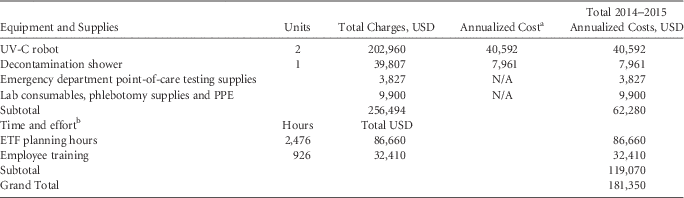
Among 16 ETF team members, 11 of 16 (69%) responded to the survey. Ebola preparedness activities resulted in substantial time investments, with 3,402 hours logged for ETF members and their direct reports (Table 1). Most of these hours (ie, 2,476) were for ETF members in dedicated preparedness activities such as leading drills, educational sessions, and developing organizational policy. ETF members reached 1,474 employees across the organization to participate in specific Ebola training. These employees contributed another 926 personnel hours spent on preparedness. The ETF delivered courses specific to trainee job function including 9 live, web-based, written, and video courses for distinct employee groups and 8 staff informational newsletters. Additional tools developed included 17 policies and protocols and 1 electronic medical record physician order entry set.
Pediatric Ebola Assessment Hospital Expenses During Peak Preparedness Time Frame (October 1, 2014 through February 28, 2015)

NOTE. UV, ultraviolet; PPE, personal protective equipment; ETF, Ebola Task Force; NA, not available.
a Annualized cost with 5-year lifespan to full depreciation, no residual value.
b Assessed using a $35 per hour mean wage.
Survey respondents recorded time spent with external collaborators necessary to facilitate policy and protocol development. Task force members collaborated with 15 external local, regional, and national agencies, and ETF physician leaders provided 4 regional and national educational presentations describing Ebola preparedness efforts.
Direct supply costs and employee salary estimates for time attributable to Ebola preparedness activities while at work were calculated (Table 1). Material and equipment purchased specifically for Ebola preparedness were included in the direct cost estimates. Durable equipment purchases included 2 ultraviolet C (UV-C) robots and a dedicated decontamination shower. Only modest investment was required for small lab equipment and consumables including dedicated point-of-care laboratory testing equipment, prepositioned phlebotomy kits, and extra personal protective equipment necessary for training exercises and for patient care. Equipment expenditures accounted for the largest direct investment in preparedness by the organization resulting in $256,494 in unbudgeted costs during the evaluation period, or an annualized cost of $62,280. Personnel wages were estimated using an average staff-member hourly pay rate of $35 per hour, resulting in $86,660 in preparedness costs for the ETF members. Training hours for non-ETF staff requiring education added an additional $32,410. Overall, Ebola preparedness annualized expenditures totaled $181,350 during the evaluation period (Table 1).
DISCUSSION
Resource utilization is significant at assessment centers, within a tiered approach to US national preparedness for high consequence pathogens like Ebola, with an annualized total of $181,350 in our pediatric facility. Initial unbudgeted supply purchases for durable equipment including UV robots for enhanced environmental cleaning were the single greatest preparedness cost, but once allocated, these resources have been utilized in an expanded role during routine operations. Human resources and training also required significant investment, and they will necessitate enduring costs and commitments for ongoing readiness. The investment by the hospital was uncompensated extramurally, but it was supported internally in response to the global call for action and the knowledge that lack of preparedness could have potentially devastating consequences for patients, staff, and the community.
The current study adds to our understanding of the specific preparedness costs for high-risk pathogens necessary for a robust national system of hospitals prepared to identify, diagnose, and treat patients in the United States. The study setting provided a unique opportunity to define costs purely attributable to assessment center capabilities; the affiliation with the NBU precluded planning for treatment capabilities from the initiation of Ebola preparedness activity. Additionally, pediatric considerations required additional dedicated time for planning and discussions that may not have been as extensive in adult settings.
Unique aspects of pediatric preparedness include management of family units who may have shared exposures, parental bedside presence considerations, and the impact of normal pediatric developmental stages on medical care. These considerations include age-related continence issues, behavioral cooperation with necessary medical interventions such as phlebotomy, and verbal understanding of staff member instructions, potentially leading to increased patient and staff risks requiring mitigation. In addition, limited national guidance was available during the 2014–2016 Ebola outbreak period, and institutional efforts occurred in tandem with local, state, and national efforts to define pediatric best practices.Reference Jelden, Gibbs and Smith 8 – Reference Davies and Byington 12
Limitations of the current study include potential recall bias from ETF members who completed the survey at the end of the evaluation period and may not have kept precise records of their work activities. Specific opportunity costs were not calculated in the survey, but a high percentage of respondents indicated that the Ebola preparedness activities altered their typical work assignments and resulted in other projects being delayed or deferred. These findings support those observed in a national survey of hospital epidemiologists and infection prevention experts surveyed during the Ebola response period.Reference Morgan, Braun and Milstone 13 Data were missing from ETF members (n=5) who did not complete the survey; thus, our unadjusted estimates of personnel time and wages are conservative based on the available data.
Assessment centers must provide the capability to identify, isolate, and diagnose patients with high-risk infections like Ebola, and such centers may not have expended comparable time or resource allocation in comparison to treatment centers. Although developing and maintaining a robust system of treatment centers for Ebola and other high-risk pathogens is an urgent national priority, assessment centers also have the potential for significant risk. Investment across the continuum of care is required to develop and sustain national preparedness objectives. Ongoing investments in hospital preparedness for personnel and supplies is critical to maintaining a national system of readiness for future outbreaks of Ebola or other high-risk infectious diseases.
ACKNOWLEDGMENTS
Financial support: No financial support was provided relevant to this article.
Potential conflicts of interest: All authors report no conflicts of interest relevant to this article.