Introduction
The criminalization of persons suffering from a mental illness continues to be a urgent public health concern, a resource-draining criminal justice problem, and an overarching societal issue, not only in the state of California, but also across the United States and the world. With the advent of deinstitutionalization, which was codified by the Lanterman-Petris-Short Act (Cal. Welf & Inst. Code, sec. 5000 et seq.) in 1967 in the State of California and subsequent legislations across the nation, states could no longer simply lock a person with mental illness away in a mental health facility or sanitarium, which violated their constitutional right to due process. The intent of the Lanterman-Petris-Short Act was to move away from the numerous state-run institutions and create a community-based treatment model, providing mental health services in least restrictive environments. Although the intent of de-institutionalization had its merits, it created an unfunded mandate and then a capacity crisis at most Psychiatric Emergency Departments and Medical Emergency Rooms across the country. De-institutionalization shifted access to mental health services and treatment predominantly to “first responders,” who became the primary means by which persons in a mental health crisis were contacted, de-escalated, detained, and transported for mental health treatment.Reference Dunn, Dempsey, Zeller, Nordstrom and Wilson 1
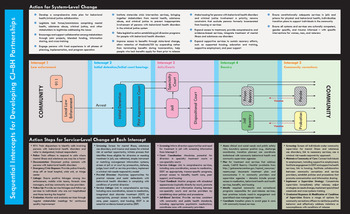
Proposed levels of care of the Behavioral Health Justice Center: diversion of mentally ill individuals from the criminal justice system into treatment in San Francisco

The Sequential Intercept Model at first identified 5 key intercepts: Intercept 1—law enforcement; Intercept 2—initial detention/initial court hearings; Intercept 3—jails/courts; Intercept 4—re-entry; and Intercept 5—community corrections.

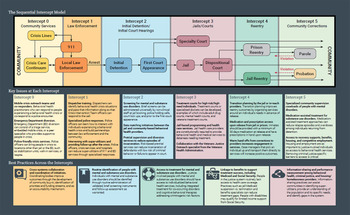
The revised Sequential Intercept Model with Intercept 0: Intercept 0—community services; Intercept 1—law enforcement; Intercept 2—initial detention/initial court hearings; Intercept 3—jails/courts; Intercept 4—re-entry; and Intercept 5—community corrections.

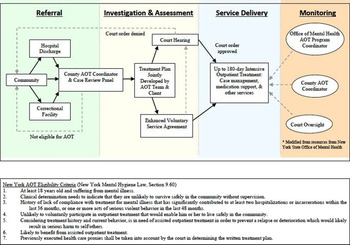
New York-assisted outpatient treatment process and eligibility criteria.

Law Enforcement/First Responder Diversion Models
Many states modified their laws giving law enforcement the power to detain and involuntarily transport those persons with a serious mental illness from their homes or the street to facilities in order to treat their mental illness. 2 Across the United States and in many other nations, these powers are based in the legal standard of probable cause, wherein the person contacted is believed to be suffering from a mental disorder that is acute, and as a result the person is a danger to self, others, and or gravely disabled and unable to care for their basic needs. The shift to deinstitutionalization has led to the criminalization of those with a serious mental illness and the role law enforcement plays in this process is well-documented. Most law enforcement agencies, who were now codified by state laws to handle calls involving persons with mental illness, were ill-prepared to manage this shift of responsibility. The lack of promised community supports and services left officers with few choices in the management of these calls involving persons with serious mental illness, resulting in their arrests and subsequent housing in jails and prisons. 3
This shift in the role of the first responder in managing crisis mental health calls ultimately led to several tragedies in which a person with a mental illness died as a result of the involvement of law enforcement. These tragedies led to the inception of two law enforcement-based response strategies or Specialized Policing Responses. 4
The first strategy is the Crisis Intervention Team (CIT) model (more commonly known as the “Memphis Model”), a “first responder” law-enforcement based model. This model (developed in 1988 in Memphis, Tennessee) is widely accepted nationally and has become an important safety net and crisis intervention strategy in many communities, where access to mental health services or the lack thereof has fallen on first-responders. 5 Now available in 2700 communities nationwide, CIT programs create connections between law enforcement, other first responders (eg, paramedics, dispatchers), mental health professionals, and persons suffering from a serious mental illness and their family members. A typical CIT program involves an intensive 40 hour/week training during which participants learn how to recognize symptoms of major mental illness, interact, and gain perspective from those who have experienced mental health crises and their families, engage in role-playing exercises that help enhance verbal de-escalation skills, and visit sites in the community where follow-up care is provided after a law enforcement referral is made for treatment services.
Research on the effectiveness of CIT training has examined changes in outcomes before and after CIT training and compared outcomes of crisis calls for officers with CIT training to those without training. CIT training increases the likelihood that an officer will divert a person suffering from a mental illness who has committed low-level offenses to mental health services as opposed to jail.Reference Bakeman, Broussard, D’Orio and Watson 6 – Reference Brink, Broer and Tholen 8 Referrals for treatment rather than arrest can be effective in re-establishing regular mental health contact in persons experiencing mental health crises, many of whom have disengaged from mental health care in the year prior to the crisis.Reference El-Mallakh , Kiran and El-Mallakh 9 Diverting and reconnecting individuals to community mental health services rather than making an arrest is cost-effective because it avoids expensive inpatient referrals from a jail to a psychiatric facility for competency restoration.Reference Compton, Demir Neubert and Broussard 10
Research has shown that CIT training changes officer attitudes more favorably toward persons with a mental illness, Reference Bakeman, Broussard, D’Orio and Watson 6 enhances knowledge about mental health conditions, Reference Compton, Bakeman and Broussard 7 and improves skill in de-escalating crisis situations using verbal engagement and negotiation.Reference Brink, Broer and Tholen 8 These important learning strategies are designed to increase empathy toward persons suffering from a mental illness. When dealing with persons exhibiting psychotic agitation, CIT-trained officers have increased awareness that physical interventions are likely to be ineffective and are less likely to use force, Reference Compton, Broussard and Reed 11 , Reference Demir, Broussard and Goulding 12 as well as an appreciation that the behaviors exhibited by persons with schizophrenia have biological causes.Reference Silverstone, Krameddine and DeMarco 13 A training approach that is widely accepted as effective in CIT training programs are role-playing exercises during which police officers interact with actors presenting with psychiatric-related behaviors commonly encountered in the field.Reference Krameddine, Demarco and Hassel 14 Law enforcement officers who have received feedback during role-playing exercises have an increased ability to recognize mental health issues as a reason for a call, deal with mental health issues more efficiently, and decrease their use of weapons use physical force in interactions with persons with mental illness.Reference Gur 15
Although the CIT training model has been a useful tool in diversion of persons with serious mental illness from criminal justice settings, a major limitation is the CIT officer’s lack of formal mental health training. In a study comparing ability to recognize signs and symptoms of mental illness in a variety of clinical scenarios, graduate students in mental health fields recognized the presence of mental disorders twice as often as CIT-trained officers.Reference Dempsey 16 Furthermore, CIT officers do not have clinical backgrounds and connections to mental health resources in the community that can facilitate linking the appropriate treatment to an individual with mental illness encountered in the field. Lastly, even when officers recognize the symptoms of a mental illness and are familiar with the resources within their communities, it is the lack of those resources which can limit the ability of officers to divert the person who is suffering from a mental illness from the criminal justice system.
The second law enforcement response strategy that evolved shortly after CIT is known as the “Co-Responder Team (CRT).” This is a “secondary” response model, in which a specially trained officer and a mental health clinician respond to the person in crisis, after being contacted by uniformed patrol officers. Typically, these teams are dispatched and ride together in a police vehicle. This strategy was first employed by the Los Angeles County Sheriff’s Department in 1992, known as Mental Evaluation Team, and in 1993 by the Los Angeles Police Department (LAPD), when it began deploying the Systemwide Mental Assessment Response Teams (SMART).Reference Lamanna, Shapiro and Kirst 17 CRT provides emergency assessment and referral for individuals with mental illness who come to the attention of law enforcement through phone calls from community members or in-field law enforcement requests for emergency assistance. The mental health clinician has access to the information from the community’s mental health system and the law enforcement officer can access past contacts with law enforcement and the local jail. The CRT evaluates the crisis, assesses the individual’s mental health condition and current needs, and, as indicated, transports persons to a hospital, or refers them to a community-based resource or treatment program.
The addition of a skilled and experienced mental health clinician at the scene of a crisis call has been shown to enhance positive outcomes for persons with mental illness. Compared to police-only interactions with those in mental health crises, CRT interactions had lower rates of injury and arrest, more voluntary transports to a hospital, less time at the hospital during handover to staff, Reference Kisely, Campbell and Peddle 18 as well as less time spent on-scene.Reference Lee, Thomas and Doulis 19 In contrast to police- only response, CRT teams can admit individuals directly to inpatient psychiatric unitsReference McKenna, Furness and Oakes 20 , Reference Evangelista, Lee and Gallagher 21 and are significantly better able to manage mental health crises in outpatient mental health settings, avoiding unnecessary hospitalization.Reference Kisely, Campbell and Peddle 18
Service users of CRTs see the benefit of a joint mental health professional/police officer team response to crisis calls in the community.Reference Lopez 22 Compared to the police-only response, CRTs offered improved communication, de-escalation skills, information sharing, interagency collaboration, and a greater likelihood of consumers achieving a preferred outcome to their mental health crisis.Reference McKenna, Furness and Oakes 20 A Los Angeles County study examined differences in treatment outcomes of 15,454 mentally individuals encountered by LAPD patrol officers and LAPD’s CRT (SMART team) over a 1-year time period. The overwhelming majority (90%) of persons with mental illness contacted by LAPD patrol officers were taken to Los Angeles County psychiatric facilities; in contrast, 60% of those in a mental health crisis seen by SMART were taken to a private psychiatric facility or urgent care center. 23 This clearly demonstrates the ability of CRTs to provide better placements for those experiencing a mental health crisis. CIT and Co-Responder models are widely accepted as “best practices” across the United States and the world in the ongoing effort to reduce the population of those suffering from a serious mental illness from being housed in our city jails and prisons. Unfortunately, despite these successes, the criminalization rate of persons with mental illness has continued to rise over time.
Sequential Intercept Model/Community-Based Mapping
As communities continued to struggle with this insidious public health and public safety issue, there was no clear understanding of how, when, and where persons with a serious mental illness engaged, entered into, traversed, and exited the criminal justice system (usually worse -off than before criminal justice involvement). It was at this point that the Sequential Intercept Model was introduced (Figure 1) 24 developed as a conceptual model to inform community-based responses to the involvement of people with mental and substance use disorders in the criminal justice system. Developed over several years in the early 2000s by Mark Munetz, MD and Patricia A. Griffin, PhD, along with Henry J. Steadman, PhD, of Policy Research Associates, Inc the Sequential Intercept Model identified 5 key intercepts in which an individual suffering from a mental illness intersects and navigates the criminal justice system. Intercept 1 is law enforcement in the community setting, which involves the initial 911 call for service and a law enforcement response. Intercept 2 is the initial arrest/detention and first court appearance. Intercept 3 is the process through the jails and courts to include sentencing. Intercept 4 is re-entry from jail or prison. Finally, Intercept 5 involves community correction, such as probation and parole.
The Sequential Intercept Model became the road map many communities utilized, for those who were engaged in the process of diversion, assuming that diversion begins with Intercept 1 and a law enforcement contact. Recently, the developers of the Sequential Intercept Model added an Intercept 0, which focused on community-based services being the first or preferred contact with a person who is suffering from a serious mental illness, hopefully in a pre-crisis situation (Figure 2). 25 By adding Intercept 0, this reinforced the pre law enforcement contact and understanding that community engagement is a valid intercept, preventing that initial law enforcement contact in the first place. Early intervention points in the community include crisis hotlines, coordination of community dispatchers with law enforcement, mobile and peer crisis services, devoted psychiatric emergency rooms, and short-term crisis residential stabilization units.
Community Education
In his Master’s thesis paper titled, “A Descriptive Study of LAPD’s Co-Response Model for Individuals with Mental Illness” Hector Lopez made a fascinating observation. He noted that the African-American community in the City of Los Angeles disproportionately relied on 911 to access mental health services, and usually after a crisis had occurred. 23 What he discovered was that (in an effort to promote public safety) governments and communities have created a default response to mental health-related crises, thus assuring a de-facto first responder/law enforcement response to all community mental health-related situations. This, in turn, leads the public to believe that this is the appropriate best response. Because of this finding, the LAPD, with the cooperation of the Los Angeles County Department of Mental Health (LACDMH) and with feedback from the National Alliance on Mental Illness (NAMI), created its 911 checklist. This checklist provided the community and family members 3 basic messages: (1) if they must call 911, what information the dispatcher needs; (2) what to expect when the police respond; and (3) if it is not a true emergency refrain from calling 911. In addition to the 911 checklist, they are also provided the LAPD—LACDMH Community Mental Health Resource Guide. 26 These are distributed by responding officers to 911-related mental health crisis calls, at community meetings, and at NAMI support group meetings. Los Angeles is not alone in this effort of educating communities; others such as Dallas and Houston have developed similar efforts and tools. 27 – 29 The goal is to educate community members, families, and others to address the needs of a person suffering from a mental illness in the community pre-crisis setting, Intercept 0. It is believed that collaboration, awareness, and education of the community and families will result in fewer contacts between law enforcement and those suffering from a serious mental illness and increase awareness of those community mental health and housing resources available to those who suffer from a serious mental illness.
911 Call Diversion and Other Non-Law Enforcement Strategies
In addition, some communities such as Houston and Harris County, Texas have come to realize that not all mental health crisis calls are equal, and many do not require the response of law enforcement. The Houston Police Department has partnered with the Harris County Crisis Line, having a crisis worker housed in the public safety answering point who triages and manages many calls that would have previously been dispatched to uniformed officers. 30 Lieutenant Brian Bixler, the Mental Illness Project Coordinator for the LAPD and Officer in Charge of the Crisis Response Support Section was quoted in an article, stated, “What if somebody called 911, and we had [the person speak to someone] who could de-escalate [the situation] or talk to them in an appropriate way to get them the help they needed, instead of sending a police car?”Reference Bernstein 31
Other communities such as Eugene and Portland, Oregon have similar programs, diverting calls from police response, utilizing dispatch questionnaires and algorithms to determine if the call can be diverted to a crisis line or community crisis response team. 32 Crisis Assistance Helping out on the Streets, which is a unique program in Eugene, Oregon is funded through the police departments general budget to provide an outreach and engagement team, consisting of a social worker and emergency medical technician. This program, which is primarily for homeless outreach, has been in existence for over 20 years and is positively received by the community, families, and those who suffer from a mental illness. 33
De-Escalation of the Incident by Disengaging Law Enforcement from the Crisis
The strategic disengagement of barricaded persons, who have been determined to be a danger only to themselves, is another successful method of diverting persons suffering from a mental illness away from the criminal justice system. There are some 911 calls which require an immediate response and tactical management by law enforcement, while others allow officers the opportunity to communicate with the suspect/subject, refine tactical plans, and call for additional resources.Reference Wogan 34 The actions of first responders will be weighed against the information known, the gravity of the situation, the subject’s actions, and efforts to de-escalate the situation. Tactical Disengagement is a strategy that may be considered when continued contact may result in an undue safety risk to the suspect/subject, the public, and/or department members, especially in situations involving a barricaded suspect, a suicidal subject, or a person suspected of experiencing a mental health crisis. In conjunction with this Tactical Disengagement, it is prudent to develop a plan to re-engage that person at a later time or date, when the crisis has passed, to refer and/or provide them with mental health services. This is an important concept, understanding that the continued engagement by law enforcement may escalate the situation and result in person committing a crime, such as battery on a peace officer, or a justifiable use of force by officers, creating a “Lawful but Awful” outcome.Reference Biasotti 35
The focus of the effort to decriminalize those suffering from a serious mental illness has its greatest impact at Intercept 0, community services. This is accomplished by educating the community, caregivers, families, and those with a mental illness on how to access those promised community-based services, without relying on the 911 system. In those communities, which lack services, the leveraging of existing resources and advocacy for additional resources must be included in the overall strategy. In California with the passage of Proposition 63 and the establishment of the Mental Health Services Act, dedicated funding for these services was established. Proper screening of 911 calls for service and diverting those, when appropriate, to crisis lines, prevents unnecessary law enforcement responses. Lastly, when law enforcement is engaged, weighing the necessity of that response to the seriousness of the incident, and developing protocols to disengage, when appropriate, and providing the person in crisis an opportunity calm down and to de-escalate. This allows for the possibility of contacting the person at later date for follow-up, and then connecting the person to mental health services.
The criminalization of persons suffering from a serious mental illness, and their journey through the criminal justice system is a symptom of the lack of those community-based mental health services and the funding that was promised years ago, when the de-institutionalization of persons with a serious mental illness from state-run hospitals began. Continuing to heavily invest in the design and development of law enforcement-based first responder strategies as opposed to funding these critical community-based services, is like treating a fever; it may temporarily alleviate the symptom, but does not address the underlying illness.
Assisted Outpatient Treatment: A Community-Based Approach
In 2011, a national online survey of more than 2400 senior law enforcement officials was conducted querying the officials as to how their interaction with persons with mental illness has changed over the course of their careers.Reference Biasotti 35 The vast majority of respondents agreed that over the course of their careers: the amount of time their department spends on calls for service involving persons with mental illness has increased, that officers spend more time on calls involving mental illness compared to noncrisis calls—especially when violent behavior is involved, that the population of persons with mental illness has been steadily growing over time and become more criminal-justice involved, and that most police officer injuries and fatalities that occur in the line of duty involve encounters with persons experiencing symptoms of mental illness at the time of the incident.
When asked what they attribute the increase in law enforcement resources devoted to calls involving persons with mental illness, most respondents cited 2 primary root causes: the inability to get acutely ill people into the hospital and/or to keep them there until they are stable enough to rejoin the community, and, that the public doesn’t have access to effective referral routes into mental health treatment programs. Notably, one survey respondent commented that law enforcement officials will often arrest and book persons with mental illness to give them access to mental health treatment: “Our jail system provides more bed space for mentally ill subjects than the local state services. Law enforcement recognize the potential for individuals to access these services if the subject is booked for a crime, particularly when other treatment resources are unavailable.”
When asked about the main obstacles that prevent them from making a referral into effective treatment that would prevent future crisis contacts with a mentally ill person, the respondents mentioned their inability to refer obviously psychotic persons to treatment programs unless they meet the “danger to self or others” criteria and the limited or lack of availability of mental health services in the field (for example, mobile crisis teams, community crisis teams, and other community-based services) as primary reasons. The author further elaborates on the consequences of waiting until an obviously psychotic person becomes dangerous before detaining and transporting them for treatment, “The vast majority of individuals in the early stages of psychiatric crisis or in a nonviolent psychiatric crisis are required to deteriorate to a point at which they are notably dangerous or until they enter the criminal justice system as a result of antisocial behavior, which may include acts of violence and/or self-harm, crimes against property, misdemeanors such as vagrancy, or any of a variety of other chargeable offenses. Because immediate family members most commonly call for emergency services to intervene in a psychiatric emergency and are typically rebuffed pending the development of danger, family members are often at risk of becoming victims of violence, and the individual in crisis is left at risk of self-harm.”
The significant difficulty the senior law enforcement officials reported in getting subjects with serious mental illness in their communities into effective mental health treatment reflects a feature of serious mental illnesses that is now widely accepted. Approximately 50% of persons with a serious mental illness (schizophrenia, schizoaffective, and severe bipolar disorder) lack insight into their illness.Reference Sevy, Nathanson and Visweswaraiah 36 – Reference Fennig, Everett and Bromet 40 Lack of insight is a cardinal feature of serious mental illness that prevents the sufferer from understanding they are ill and that the symptoms they are experiencing are part of the illness. It is the single largest reason why people with serious mental illness refuse medications and fail to seek out treatment voluntarily. Without awareness of the illness, declining treatment appears rational, no matter how clear the need for treatment might be to others.
In 2000, the American Psychiatric Association recognized that lack of insight into illness is a prevalent feature of serious mental illness and that those who lack insight have a poorer prognosis than those who do not. In Schizophrenia and Related Disorders Section of the Diagnostic and Statistical Manual of Mental Disorders, Fourth Edition, Text Revision (DSM-IV-TR, APA Press, 2000): “Most individuals with schizophrenia have poor insight regarding the fact that they have a psychotic illness. Evidence suggests that poor insight is a manifestation of the illness rather than a coping strategy. It may be comparable to the lack of awareness of neurological deficits seen in stroke, termed anosognosia. This symptom predisposes the individual to noncompliance with treatment and has been found to be predictive of higher relapse rates, increased number of involuntary hospital admissions, poorer psychosocial functioning, and a poorer course of illness.” page 304, DSM-IV (American Psychiatric Association Press, 2000).”Reference Arango and Amador 41 Subsequent research has clearly demonstrated that persons with a serious mental illness and poor insight are likely to be nonadherent to psychiatric medications and go untreated for a longer period of time than those who retain insight.Reference Misdrahi, Tessier and Swendsen 42 – Reference Hill, Crumlish and Whitty 49 Fortunately, insight can improve if treatment is initiated and sustained over time.Reference Pijnenborg, Timmerman and Derks 50 – Reference Wiffen, Rabinowitz and Fleischhacker 52 Over the past decade, a number of research studies have been conducted comparing the brains of individuals with a serious mental illness with and without anosognosia. The results have demonstrated that anosognosia has a neurological cause involving damage to a network of brain structures including the anterior insula, anterior cingulate cortex, medial frontal cortex, and inferior parietal cortex. 53
Further, though most individuals living with a serious mental illness do not engage in violent behavior and are more likely to be victims rather than perpetrators of violence, those with the most severe forms of illness are at increased risk of violence when not in treatment and are experiencing specific symptoms, specifically paranoid delusions with or without command auditory hallucinations. Lack of insight or anosognosia is associated with nonadherence to psychiatric treatment, physical aggression, and violent offending, criminal conviction, and recidivism. 54 Law enforcement first-responders repeatedly encounter persons with a serious mental illness who lack insight when responding to calls for service and it is important they understand these individuals are suffering from a brain disease.
The survey’s findings and high prevalence of persons with a serious mental illness who lack insight into their illness helps inform the types of services and programs that should be made available in Intercept 0 in the new Sequential Intercept Model that may help prevent persons with mental illness from becoming entangled in the criminal justice system. The senior law enforcement officials’ concerns that they can’t refer obviously psychotic persons for inpatient treatment unless they meet the strict “danger to self and others” criterion and the public’s inability to find care referrals for persons with mental illness could be addressed through expanded use of Assisted Outpatient Treatment (AOT). AOT is a form of civil commitment that mandates adherence to mental health treatment in the community. The overarching purpose of this intervention is to prevent psychotic decompensation, criminal justice and hospital recidivism, and other outcomes associated with nonadherence to treatment, including violent behaviors.Reference Tsai, Quanbeck, Rosner and Scott 55 Because AOT is a civil commitment that aims to prevent criminal justice involvement, it is an Intercept 0 intervention in the recently updated Sequential Intercept Model. AOT programs target adults with a serious mental illness who have a history of nonadherence to psychiatric treatment that has resulted in repeated hospitalizations, jailing and/or violent behavior (see Figure 3 for New York’s AOT Criteria). Mental health professionals, family members, cohabitants, and a peace, parole, or probation officer assigned to supervise a person with mental illness can make an AOT referral. AOT program participants are primarily comprised of seriously mentally ill persons diagnosed with schizophrenia, schizoaffective, and bipolar I disorder who lack insight into their illness and decline recommended voluntary outpatient treatment despite clear evidence they would likely benefit from it.Reference Swartz, Swanson and Steadman 56 AOT programs attempt to engage this challenging population who would otherwise not agree to voluntary care by using a multidisciplinary treatment team combined with judicial oversight to ensure that the program participant and providers are following the treatment plan.
Multiple research studies have demonstrated that, compared to standard outpatient care, AOT programs produce positive outcomes for participants including the following: less frequent hospitalizations, shorter lengths of stay if hospitalized, fewer days spent homeless, a reduced risk of violence behavior and criminal arrest, decreased harmful behaviors, a reduced risk of being victimized, and significantly improved medication adherence.Reference Swartz, Swanson and Hiday 57 – Reference Swanson, Swartz and Elbogen 61 The positive outcomes that AOT programs produce continues to increase the longer a participant remains engaged in AOT or continues in intensive outpatient services after the court order expires (based on data comparing outcomes at 6 months to 1 year after entering the program).Reference Wagner, Swartz and Swanson 62 , Reference Van Dorn, Swanson and Swartz 63 Cost-analysis studies have found AOT programs to be cost-effective for public mental health systems by shifting the pattern of service utilization from psychiatric emergency care, acute psychiatric hospitalizations, arrest, and jailing to routine outpatient encounters.Reference Swanson, Van Dorn and Swartz 64 , Reference Swartz and Swanson 65 Most of the research on the effectiveness of AOT was based on program outcomes in New York and North Carolina. In 2013, California passed Senate Bill 585 which provided a funding source of AOT programs; consequently, 20 of California’s 58 Counties have implemented AOT, for example, “Laura’s Law” programs, including the majority of California’s most populous Counties. A recent report found that all California AOT programs for which outcome data are available, program participants have experienced significant decreases in psychiatric hospitalizations, crisis contacts, homelessness, as well as arrests and jailings. 66
Many believe that the positive outcomes of AOT programs are largely due to enhanced community services as opposed to the fact that the services are judicially mandated. Several recent studies have shown that it is not just the lack of enhanced intensive care services that prevents some people with a serious mental illness from accepting and benefitting from mental health treatment.Reference Cripps and Swartz 67 A study compared the severity of psychotic symptoms in people with a serious mental illness participating in intensive outpatient services in an AOT program to those receiving the same services on a voluntary basis. Those in the AOT program had greater improvement in the severity of their symptoms and greater use of mental health services than those receiving the same services voluntarily. Other recent studies demonstrated that most people with a serious mental illness who had been offered and failed to adhere to Assertive Community Treatment alone became adherent to the same services after a judicial order was introduced into their treatment plan. Another study showed that patients in an AOT program were more likely to accept both mental health as well as physical health care compared to patients engaged in voluntary treatment. Some individuals with a serious mental illness may not need intensive outpatient services coupled with AOT to derive benefits; a 2019 study found that AOT combined with standard outpatient clinic care experienced significantly reduced hospitalizations and fewer hospital days during and after the court order.Reference Munetz, Ritter and Teller 68
The federal government has given broad support to AOT programs. The Office of Justice Programs, an agency of the United States Department of Justice, has designated AOT “an effective crime prevention intervention” for people living with a serious mental illness. 69 In 2016, the Substance Abuse and Mental Health Services Administration (SAMHSA) and Interdepartmental Serious Mental Illness Steering Committee announced plans to award $54 million to fund 17 new AOT programs nationwide for 4 years with the goal of “improving the health and well-being of those with a serious mental illness and to identify evidence-based practices to reduce psychiatric emergency care, hospitalizations, homelessness, and interactions with the criminal justice system. 70
Meldrum et al used a qualitative design and analysis to describe the actual operation of Assisted Outpatient (AOT) programs in practice nationally in 2014.Reference Meldrum, Kelly and Calderon 71 Twenty states had active, operational, and documented AOT programs. The study found that people were referred to AOT via 3 pathways: (1) community gateway into services or advocates trying to engage a person into treatment who is having difficulties; (2) hospital transition or discharge into an AOT program from an involuntary inpatient hospitalization or jailing; and (3) as method of community surveillance or monitoring persons thought to be a danger to others. The hospital transition gateway was the best studied and most effective way a participant entered an AOT program; the community gateway and surveillance pathways were not as well-studied. Nearly all states cited inadequate resources as barrier in the implementation of AOT, with only 4 state legislatures having authorized devoting funding for AOT programs. The study also identified a lack of communication and coordination between mental health agencies, law enforcement, and the courts as a major problem area. Resistance of providers to accepting AOT patients, courts declining cases due to overloaded dockets, and inadequate monitoring of participants were also noted to be problematic. Despite these challenges, when properly implemented and resourced, AOT has been shown to be a useful tool to improve treatment adherence, reduce relapse and re-hospitalization, and decrease likelihood of dangerous behavior or deterioration among the subset of patients with a serious mental illness who lack insight. Data collected from AOT programs funded by the 2016 SAMHSA grants will help inform which and for whom AOT can be most effective, to help avoid poor outcomes for this vulnerable population.
Treatment Beds versus Jail Beds
The national survey of senior law enforcement officials finding that increased service calls is due to an inability to keep persons with mental illness hospitalized long enough to achieve clinical stability reflects the current reality that the number of psychiatric beds is grossly inadequate to serve the population’s needs. Experts estimate a need for a minimum of 1 publicly funded acute psychiatric bed for every 2000 people for hospitalization for individuals with serious psychiatric disorders; according to the most recent national data are from the American Hospital Association’s Annual Survey of Hospitals, there is currently 1 acute publicly funded psychiatric bed for every 5053 people nationwide. 72 The number of long-term publicly funded hospital beds that remain for patients who are so ill they have become involved in the criminal justice setting after being charged with a felony crime, has fallen to fewer than 12 publicly funded beds per 100 000 population in the United States, the lowest level since these data have been tracked. 73 It has also resulted in inmates in psychiatric crisis in jail settings waiting weeks and months for transfer to a long-term publicly funded state hospital bed to receive necessary treatment. The shortage of long-term publicly funded beds has led to unacceptably lengthy delays for competency restoration services. The United States District Court in the state of Washington ruled that a delay of more than 7 days between a finding of incompetency to stand trial and the commencement of competency restoration services is unconstitutional. 74 Several other states, including Oregon, Louisiana, Pennsylvania, Alabama, and Colorado, have been successfully sued over this issue and face court orders, settlement agreements, or consent decrees. The shortage of publicly funded psychiatric beds in both acute community and long-term settings make increasing the use of diversion strategies that reduce hospital and criminal justice recidivism critical. 75
California, despite being among the wealthiest States in the country, falls well below the national average with only 1 public psychiatric bed for every 5856 people, significantly lower than the nation’s average of 1 bed for every 4959 people. 72 This shortage of public acute psychiatric beds creates crisis situations in California’s cities. To illustrate, San Francisco’s total number of psychiatric beds (acute, nonacute, private pay and uninsured) is 153. With a population of 837 442, San Francisco has 1 bed for every 5473 and is at a deficit of 266 acute psychiatric beds to meet minimum quality standards for its size. 74 In 2018, 50 400 mental health-related 911 calls were made to dispatchers in San Francisco, an average of 4200 each month. In response to the calls for service, police officers responded and contacted the mentally person in most cases (66%) which led to detainment for an involuntary psychiatric assessment (64%). A small but significant fraction of calls for service (3%) led to criminal charges being filed. When a person commits a misdemeanor crime and suffers from mental illness, officers have limited options for diverting people out of the criminal justice system because of overcrowding in the 1 devoted psychiatric emergency room at San Francisco’s County hospital and the lack of acute psychiatric beds to admit involuntarily detained persons for further treatment.
Consequently, even though San Francisco’s County Jail population has declined in recent years, those with mental illness remain overrepresented. 76 Between 35% and 40% of San Francisco County Jail inmates receive care from Behavioral Health Care services and 17% receive treatment for a serious mental illness. Providing mental health care in correctional institutions is challenging; the settings are fundamentally punitive environments where control and security are the top priority. There is extensive research that demonstrates that persons with mental illness are harmed, not helped, by incarceration.Reference Bewley and Morgan 77 When incarcerated, they are likely to engage in self-harm behaviors, Reference Kaba, Lewis and Glowa-Kollisch 78 incur disciplinary infractions which can lead to placement in solitary confinement, Reference Lamb and Weinberger 79 be targets of use of force by correctional officers, and are victimized by other prisoners.Reference Blitz, Wolff and Shi 80 , Reference Wolff, Blitz and Shi 81 These persons are released into the community without adequate follow-up into programs suited to their needs and in some cases, are released without needed medications. Negative experiences in the jail environment and the failure to provide for community reentry with ongoing psychiatric services worsens the likelihood of a return into substance abuse, homelessness, and criminal recidivism.
The San Francisco Budget and Legislative Analyst’s Office on Jail Population, Costs, and Alternatives reported that the jail houses 240 inmates with serious mental illness who would benefit from psychiatric beds appropriate to their needs rather than incarceration. 74 A Behavioral Health Justice Center which provides mental health services designed to interrupt the cycle has been proposed to break the cycle of homelessness, addiction, and criminal recidivism for the persons with severe mental illness population involved in the criminal justice system. The center is based on a system of interconnected programs that creates a continuum of mental health care treatment options for individuals with mental illness in the justice system specifically designed to prevent recidivism. The proposed Behavioral Health Justice Center is similar in design to Miami’s Mental Health Diversion Facility (MHDF) which is scheduled to open in 2020.Reference Eide 82 The MHDF is designed to be part of a larger continuum of services for people with mental illness in the criminal justice system in Dade County, Florida. The MHDF will provide a continuum of care, ranging from intensive treatment in the crisis-stabilization unit on the second floor (to which some will be involuntarily committed), to dental and primary care, basketball in the gym, and employment training in the culinary arts. In terms of bed count, 3 levels will be available: 40 beds for the crisis-stabilization unit, 120 for short-term residential treatment (stays of about 90 days), and 48 for the residential-treatment facility (180-day stays). The MHDF will further expand upon the efforts of Judge Steve Leifman whose Eleventh Judicial Circuit Criminal Mental Health Project (CMHP), which includes prearrest and postarrest mental health diversion programs, and has dramatically reduced recidivism rates for people involved. Since implementation, recidivism rates for people accused of misdemeanors dropped from 75% to 20%, and people accused of felonies have a recidivism rate of only 6%. 76
In early 2019, the Los Angeles County Board of Supervisors made a decision that represents a “paradigm shift” in the treatment of inmates and efforts to seek alternatives to incarceration.Reference Lau 83 Supervisors voted down a 2.2-billion proposal to build a Consolidated Correctional Treatment Facility to replace the dilapidated Central Jail, which was built in 1963. Instead, the money will be used to fund construction of a Mental Health Treatment Center comprised of series of smaller mental health centers rather than a single, large hospital. The new complex would offer inmates reentry programs, supportive housing, community-based services, and other alternatives. The Los Angeles County Department of Health Services would oversee the new facility, rather than the Sheriff’s Department, which currently manages all jail operations. The Mental Health Treatment Center would house a greater number of persons with mental illness than are currently housed in all the County hospitals combined. The plan marks a landmark shift in philosophy toward the care of inmates and a recognizes the reality of the current jail population: inmates who have medical or mental illness now make up an estimated 70% of people held in the county jail system and they need treatment services to successfully break free from the criminal justice system.
Conclusion
Measurement of the benefit effects of CIT, and co-responding teams, is an expectedly challenging endeavor, yet one we are obliged to undertake given patient well-being, officer well-being, and use of huge swaths of public money related to the intersection of these 3 realms. Co-responding is a natural progression of professional collaboration between police and expert mental health professionals. Both police and mental health professionals carry analogous duties that involve deeply intimate and intrusive interactions with mental health patients: police use degrees of force, and psychiatric medical professionals use degrees of restraint. These teams both take on responsibility for public safety. Both have the legal power to limit another human’s freedom to move about as that human wishes. Both ask deeply personal questions of individuals who are at an inherent disadvantage by being in a position of losing ordinary control from a social level to bodily and mental levels. Both teams work in fractured systems that carry risk for harm to the professional—an issue especially marked for police—and in which these teams witness very ill patients struggle in for up to decades. Police and expert mental health professionals share much common ground, from the field to the emergency department, and, so far, co-responding teams appear to help patients and may also bode well for multiplying the beneficial effects of the efforts of mental health experts and police. The entire goal of this work is to help patients and mitigate their languishing in ineffective care. Progress is being made, but there are still many improvements needed.
Whether or not officers are CIT trained, psychiatric emergency service units and emergency rooms in medical hospitals are frequently the de facto endpoint for police who are managing acute mental health patient calls. Once an officer hands off a psychiatrically acute patient in an emergency department, the duty of the police in response to a psychiatric call has been completed, and the patient is then in a setting ostensibly designed for his or her psychiatric needs.
When police arrive at an emergency room with a detained patient on an involuntary hold, 3 parties are directly involved: the patient, the emergency room staff, and the police officers. Each of these parties is in a position of being outside their usual element. The patients are outside their usual element by having some of their rights taken away and facing various configurations of police and psychiatric professionals. The police are out of their element by being in a medical environment. And finally, the emergency room staff are out of their element by now being partnered with police during an often lengthy hand-off process, when an acute patient is in custody on the unit. Police and psychiatric professionals in the emergency room usually are not formally trained to work together, despite the need. Although this broad problem warrants being addressed, the implementation of CIT does create configurations of police and mental health professionals, proximal to the emergency room setting, that may improve outcomes for patients and lead to better safety for police and mental health responders.Reference Kubiak, Comartin and Milanovic 84
From the Memphis Model in 1988 to current CIT-related mental health skills training, there are numerous national efforts to optimize police expertise regarding mental health signs and symptoms, and reduce the risk of harm. Co-responding police/mental health programs, in the form of mobile response, shows benefits through the combined expertise of these professionals. Co-responding teams are finding success in a variety of measures: aborting crises-related harm, linkage to more effective follow-up care, better follow-up adherence, diversion from the criminal justice system, lower admissions, increased mental health acumen among officers, cost savings, and a more sophisticated perception of persons with mental illness by officers.Reference Shapiro, Cusi and Kirst 85
To be clear, the police portion of co-responding teams appear to be moving toward better optimization with use of CIT. CIT training helps police, while working with dispatch, to identify when CRTs are indicated. In one study, officers involved in co-responding teams reported a sense of better understanding of mental illness and improved collaboration in the field Police shared the frustration of their mental health colleagues when needed mental health resources were not available in the community they both serve.Reference Shapiro, Cusi and Kirst 85 Outcome reviews have shown that, compared to police emergency contacts, the use of co-responding teams increased the number of 911 calls identified as warranting a mental health response. Co-responding teams are more can successful at linking individuals to mental health services who had not received carepreviously, facilitate greater engagement in outpatient care after the emergency contact and spend less time on-scene compared to police only contacts. Finally, patients who have received services from a co-responding team express that they have been heard, received meaningful advice, and feel a decreased sense of isolation.
Acknowledgments
The authors wish to thank Randall Hagar, Director of Government Affairs at the California Psychiatric Association for his long-standing dedication toward improving care for persons with serious mental illness in California and his ongoing efforts to expand services under Intercept 0.
Disclosure
The authors have nothing to disclose.