Do strong and active political parties enhance women's representation, or do they contribute to the ongoing inequality in men's and women's candidacy rates? Studies have examined this question by looking at a variety of measures of party strength, focusing particularly on the role parties play in candidate emergence. For qualified individuals in the pool of potential candidates, being encouraged to run for office by a political actor is the most important step in considering a candidacy (Lawless and Fox Reference Lawless and Fox2005). Such encouragement is especially important in increasing the typically lower political ambition among women in the candidate pool (Fox and Lawless Reference Fox and Lawless2010). Yet the limited research examining the effects of party recruitment on men's and women's candidacies finds negative (Niven Reference Niven1998; Reference Niven2006) or no (Sanbonmatsu Reference Sanbonmatsu2006) effects of recruitment on women's representation. Some studies even find evidence that parties more often run female than male candidates as “sacrificial lambs” in unwinnable races (Carroll Reference Carroll1994; Stambough and O'Regan Reference Stambough and O'Regan2007).
In this article, I expand our understanding of the effects of recruitment on women's candidacies by examining a key source of recruitment at the start of the political pipeline: local party organizations.Footnote 1 I use evidence from a nationwide survey of county party leaders first to show that these rarely examined political actors play a significant role in the candidate emergence process. Then, I draw on a unique variable measuring the recruitment intentions of party leaders to evaluate how the choices made by party leaders about where to seek candidates influence the effect of their recruitment on women's candidacies. I demonstrate that while recruitment can and does increase women's candidacies in some circumstances, both the sex of party leaders and the choices they make about recruitment networks can result in negative effects of party recruitment activity on women's representation. Party leaders who use a traditional, insular recruitment network focused on people already active within the party are less likely to recruit female candidates, while women are more often recruited by parties that seek candidates from broader networks of groups, occupations, and other contacts. Additionally, I uncover several important differences in the recruitment networks of Democratic and Republican party leaders—differences that help explain women's unequal candidacy rates between the parties. Finally, I show that the sex of candidate recruiters matters. While male and female party leaders use similar recruitment networks, party leader sex has a significant effect on how often female candidates are recruited. These results clarify conflicting hypotheses regarding the direction of the relationship between recruitment and women's representation, highlighting the complexities of this relationship and the specific circumstances in which recruitment hinders or improves women's candidacy rates.
GENDER, POLITICAL AMBITION, AND RECRUITMENT
Explaining women's political underrepresentation is important because evidence demonstrates that this inequality is problematic for the American political system. With women holding only 18% of congressional seats, 24% of state legislative positions, and fewer than a third of mayoral and county council positions, many women in the electorate lack descriptive representation (CAWP 2012; ICMA 2007). A multitude of studies shows that this absence diminishes women's trust in government and political engagement (e.g., Hansen Reference Hansen1997; Reingold and Harrell Reference Reingold and Harrell2010; but see Dolan Reference Dolan2006), and hinders the substantive representation of women's interests in the policymaking process (e.g., Carroll Reference Carroll2001; Swers Reference Swers2002; Thomas Reference Thomas1994). Scholars have examined the possibility that voter bias, gender stereotyping, the incumbency advantage, or many other factors explain the gender disparity in elected office (e.g., Burrell Reference Burrell1994; Huddy and Terkildsen Reference Huddy and Terkildsen1993; Palmer and Simon Reference Palmer and Simon2006). Recent research points to two particularly compelling explanations for women's lower levels of political candidacy: gender differences in political ambition and gender differences in candidate recruitment.
Many studies confirm the existence of differences between men and women in how they consider and pursue political candidacies. Surveys demonstrate that even women with the educational and occupational backgrounds that most often lead to candidacy underrate their achievements and abilities more often than do similarly situated men, and this affects women's propensity to seek political office (Kling et al. Reference Kling, Hyde, Showers and Buswell1999; Lawless and Fox Reference Lawless and Fox2005; Pajares Reference Pajares2002). Men are more likely than women to self-start their candidacies while women more often require a suggestion from someone else before they pursue office (Bledsoe and Herring Reference Bledsoe and Herring1990; Carroll and Sanbonmatsu Reference Carroll and Sanbonmatsu2010; Moncrief, Squire, and Jewell Reference Moncrief, Squire and Jewell2001). Thus, even similarly situated men and women view their qualifications to run and chances of success differently, leading to gender differences in candidacy rates.
Some research suggests that recruitment can minimize the effects of these gender differences. Fox and Lawless (Reference Fox and Lawless2010) find that although women who have not been recruited are half as likely as similar men in the candidate pool to be open to the idea of political candidacy, this gender gap disappears among those who have been recruited by a political actor. In fact, for each measure of ambition examined in their study, “sex remains a significant predictor of political ambition, but recruitment by a gatekeeper partially closes the gender gap” (Fox and Lawless Reference Fox and Lawless2010, 321). But other studies of candidate recruitment—particularly those examining party activities—find that recruitment does not enhance women's representation. Sanbonmatsu's (Reference Sanbonmatsu2006) study of women's state legislative candidacies finds no effects of party recruitment on women's representation and negative effects of party efforts to influence the nomination process. Niven's (Reference Niven2006) examination of declared state legislative candidates in Florida reveals that women running in districts favorable for their party were discouraged from running by party elites more often than similar men. Even the recruitment that Fox and Lawless identify as increasing women's ambition occurs less often for the women than men they survey.
Thus, studies of gender differences in political ambition highlight the potential for recruitment to increase women's political representation, but research on recruitment outcomes demonstrates how poorly recruitment is meeting that potential. Why? One possibility is that recruitment can alleviate gender differences in political ambition but is simply not taking place often enough to do so. This argument would likely find support from parties scholars who argue that the role of parties in candidate emergence has sharply diminished in recent decades as parties have become mostly service providers in a candidate-centered political world (Bibby Reference Bibby, Weber and Brace1999; Schlesinger Reference Schlesinger1991; but see Sanbonmatsu Reference Sanbonmatsu2006). As I show in this article, though, local parties are very active in candidate recruitment.
Accordingly, I propose that explaining the inconsistent findings in previous studies regarding recruitment's effect on women's representation demands that we examine the particulars of the recruitment process. Specifically, I argue that the effects of party recruitment depend on party leaders' beliefs and choices about how broadly to cast the recruitment net. Some party leaders look for candidates primarily within a traditional, insular network—for example, by focusing only on those people already active within the party—while other leaders look in a broader network of groups, occupations, and social contacts. Because of gender differences in the activities, affiliations, and self-perceptions of potential candidates (Baer Reference Baer1993; Burns, Schlozman, and Verba Reference Burns, Schlozman and Verba2001; Lawless and Fox Reference Lawless and Fox2005), I generate three initial hypotheses, which I describe more extensively later in this article:
H1:
Party leaders who seek candidates within a more insular network—including party activists, current officeholders, business organizations, and financial donors—will be less likely to find female candidates than those leaders who seek candidates from a broader network.
H2:
Party leaders' use of some recruitment tools—particularly mass appeals for candidates—will have a detrimental effect on women's candidacies by enhancing mostly the political ambitions of men in the candidate pool.
H3:
Recruitment from broader social networks, sub-county officeholders, and education or child-related organizations will result in the recruitment of more female candidates.
I also argue that recruiter characteristics will affect women's recruitment. First, female chairs should be more likely than male chairs to come into contact with female potential candidates in every network from which they recruit because social networks, particularly for women, are often largely sex-segregated (Marsden Reference Marsden1988; McPherson and Smith-Lovin Reference McPherson and Smith-Lovin1986). Moreover, Niven's (Reference Niven1998) examination of county party chairpersons in four states demonstrates that outgroup bias—the preference of party chairs for candidates superficially like themselves—influences political recruitment such that party chairs tend to recruit candidates who share their gender. Consequently, I expect that:
H4:
Recruitment by women party leaders will yield more female candidates than recruitment by male party leaders.
Additionally, because more women identify as Democrats than Republicans (Box-Steffensmeier, De Boef, and Lin Reference Box-Steffensmeier, Boef and Lin2004), Democratic party leaders have access to a greater pool of female potential candidates. Furthermore, Republicans and Democrats have substantially different ideologies about how to promote the success of groups within the population, with Republicans most often focusing on the success of individuals and Democrats promoting intervention on the behalf of specific demographic groups (Freeman Reference Freeman1986). This difference should lead Democratic party leaders to be more likely than Republican leaders to seek out female candidates in an effort to promote the candidacies of women as a group. Therefore, I hypothesize that:
H5:
Democratic party leaders will recruit more women than will Republican party leaders.
DATA
In the analyses that follow, I draw on original data from a 2008 survey of 5,111 county party leaders across the United States.Footnote 2 I supplement the survey data with semi-structured interviews I conducted with party leaders in several states in 2007 and 2010.Footnote 3 I focus this article and my data collection on local party leaders for two main reasons. First, though the vast majority of studies examining parties and candidate emergence focus on the state and national levels, I argue that explaining women's representation throughout the political system requires explaining their representation at the start of the political pipeline. Given women's lower self-perceived qualifications (Lawless and Fox Reference Lawless and Fox2005), their political careers should be especially likely to start at a lower level of office. Second, understanding the processes shaping local office holding is important because these offices often serve as the foundation for political careers and the development of progressive ambition (Black Reference Black1972). In fact, 42% of party leaders in my survey report that some or most of the state legislative candidates in their area held county or local office before they ran for higher office. Furthermore, many local offices hold a great deal of political and policymaking power (Flanagan Reference Flanagan2004; NACO 2008; Weber and Brace Reference Weber, Brace, Weber and Brace1999). Consequently, I collected data on local parties in order to test hypotheses about women's recruitment at this level—something impossible to do with previously existing data. This provides one key contribution of this research, illuminating the process that determines who holds office in the tens of thousands of local governments across the United States.
LOCAL PARTIES AND CANDIDATE EMERGENCE
These data first reveal that the typical characterization of candidate emergence as a process driven by self-starters does not apply at the local level. Responses to my survey of party leaders demonstrate that many county parties focus a great deal on local candidate recruitment. More than 80% of county party leaders report commonly recruiting candidates for county legislative offices; 65% commonly recruit candidates for other county offices like sheriff, treasurer, or clerk; and between 31% and 42% recruit candidates for sub-county offices, like town council or school board, and legal offices, like judge or prosecutor.Footnote 4 Comparing these figures to those from the foundational survey of local parties conducted by Cotter et al. (Reference Cotter, Gibson, Bibby and Huckshorn1984) suggests that county party recruitment activity may actually have increased since that 1979 survey, perhaps assisted by the growing network of informal party organizations, interest groups, and other political actors whom scholars have confirmed work with and beyond formal party organizations to influence elections and policymaking (Cohen et al. Reference Cohen, Karol, Noel and Zaller2008; Masket Reference Masket2009). Furthermore, examining party leader responses regarding other campaign activities reveals that recruitment is at least as common among local parties as is making financial contributions to candidates, publicizing the party and candidates through ads and free media, and providing campaign advice, expertise, and training (Crowder-Meyer Reference Crowder-Meyer, Green and Coffey2010b).
Although it is possible that party leaders responding to my survey overstated the level of party activity in candidate emergence, my party leader interviews and responses to the open-ended questions on my survey offer many reasons for high levels of local party recruitment activity. Party leaders report that recruitment is necessary first, to fill ballots and ensure electoral competition, even though “the hours, the demands, the exposure, the risk, the time away from family, [and] the stresses are great, and the financial rewards are low for these positions;” second, because “you build your farm team [for higher offices] from the lowest level;” and third, because “if you get the people to vote for your local candidates, they'll vote [for your party] up the line.” Local party leaders have many reasons to seek out candidates. So, a lack of recruitment appears not to be responsible for women's lower candidacy rates. Instead, to understand why women run for office less often than men, I undertake an examination of the specific ways parties recruit and the traits of recruiters.
THE SHAPE OF RECRUITMENT NETWORKS
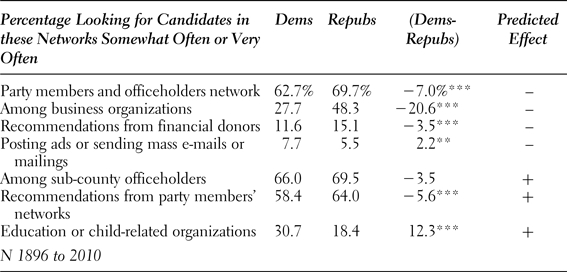
Where do parties find candidates for initial-level offices? My party leader survey reveals a number of common recruitment locations. Table 1 displays the percentages of Democratic and Republican county party leaders who rely on a variety of recruitment networks when seeking candidates. The table also notes the directions of my expectations for how the use of each recruitment location should influence whether women are recruited.Footnote 5
The candidate recruitment network

Notes: Significance levels: *p < .10; **p < .05; ***p < .01 for two-tailed t-tests for differences between Democrat and Republican means. Predicted Effect indicates whether I expect party leader use of this recruitment network to have a positive or negative effect on women's recruitment. Party members and officeholders network is an index combining the sources “People active in the party” and “Recommendations from current officeholders”, created because party leaders regularly mentioned these two sources together in interviews and because these measures are highly collinear.
I hypothesize some recruitment locations will have a negative effect on women's candidacies, beginning with the most commonly used recruitment networks within the party itself. More than half of party leaders indicate that they look for candidates somewhat or very often in a Party members and officeholders network like the one described by Arizona Republican party leader Cecil Boelts, in which selected members of the party “got people that had managed campaigns and some who were former elected officials … together [to] meet at Brownie's restaurant … Somebody would recruit [a potential candidate] and bring them in and tell them what they could expect and what they needed to do.”
I expect that party leaders using a network like this one will be less likely to recruit women because women make up a smaller proportion than men of party members, party leaders, and the typically partisan county and higher level officeholders. Specifically, in my survey, I find women comprise 42% of Republican and just under 50% of Democratic party committees and hold only 23% of Republican and 32% of Democratic party chair positions.Footnote 6 Further, women hold less than one-fifth of county legislative offices and less than one-third of all elected county positions (Crowder-Meyer Reference Crowder-Meyer2010a; ICMA 2007). These gender disparities within party networks were also highlighted throughout my interviews. As one California Republican county party leader noted, “I think it's really hard for women to break into the good old boy network. We still have it.” Janice Kovach, a New Jersey Democrat, elaborated: “Politics I think has traditionally been the old boys network … especially in districts that are—where there's machines already in place. … If you look at who their [line of] succession is … the heir apparent, a lot of times you'll see it's a man.” An Idaho Republican offered this explanation for women's underrepresentation: “Generally speaking, the party machine … [that] directs the candidacies is composed of men, mostly of men.”
Party leaders, particularly those heading Republican parties, also commonly seek candidates using financial and business connections. These kinds of groups have incentives to try to promote candidates who support their interests, perhaps even by recommending members from their groups to run. And recent work suggests they are often successful in these efforts (Bawn et al. Reference Bawn, Cohen, Karol, Masket, Noel and Zaller2012). As the U.S. Census Bureau's 2002 Survey of Business Owners demonstrates that more men than women own businesses, I expect party leaders who seek candidates among Business organizations to be less likely to name female potential candidates. Because women are less likely than men to make campaign contributions (Schlozman, Burns, and Verba Reference Schlozman, Burns and Verba1994), I also expect that relying on Recommendations from financial donors should make party leaders less likely to recruit women. This proposition is supported by my interview subjects, including a California Democratic leader who suggested that women's political underrepresentation was partly due to “the money factor—you know—and where the money comes from … a lot of the money comes from trial lawyers, who happen to be white guys, who like to support people [like them].”
In addition to active recruitment, some parties search for candidates simply by Posting ads or sending mass e-mails or mailings. Research demonstrates that women are less likely than men to self-start a run for political office (Duerst-Lahti Reference Duerst-Lahti, Thomas and Wilcox1998; Fulton et al. Reference Fulton, Maestas, Stone and Maisel2004; Lawless and Fox Reference Lawless and Fox2005). Mass requests for candidates are most likely to draw self-starters and do nothing to ameliorate gender differences in self-perceived qualifications. Thus, I expect that party leaders who rely on these means to find candidates should be less likely to run women.
While the preceding types of candidate outreach may decrease women's recruitment, I argue that recruitment can be beneficial to women—when it includes networks where women are more often present. For example, while looking among typically partisan higher officeholders may work against women's recruitment, seeking candidates from Among sub-county officeholders could benefit women. While research on these typically nonpartisan, lower-level officeholders is sparse and the gender composition of these officeholders is unknown, existing work does suggest that more women hold sub-county offices than higher level offices.Footnote 7 Women are more likely than men to get involved in politics due to concerns about policy issues that are often decided at lower levels (Darcy, Welch, and Clark Reference Darcy, Welch and Clark1994; Dolan, Deckman, and Swers Reference Dolan, Deckman and Swers2007; Fox Reference Fox1997), suggesting they may be more likely to hold sub-county offices than even county office. As Kovach, a New Jersey Democratic party leader, notes, “The men look bigger picture. The women are more concerned with what's happening to communities, to families, understanding from that perspective … That's why PTA organizations are almost all women. School boards a lot of times are women. You've got men on them, but not as much as you do women.” Indeed, a recent study of local boards in Iowa found that women composed nearly half (44%) of observed board members and held a majority of positions on several types of local boards (Hannagan and Larimer Reference Hannagan and Larimer2011). As early as the late 1990s, studies of school boards found nearly 40% of candidates and members were women (Deckman Reference Deckman2006; Hess Reference Hess2002). If party leaders who report looking for candidates among sub-county officeholders look for candidates outside partisan offices, in positions like school board or other local commissions for which women may be more likely than men to run, then this should have a positive effect on women's recruitment. Furthermore, given women's higher self-imposed standards for the qualifications required to run for political office (Lawless and Fox Reference Lawless and Fox2005), women holding sub-county offices may be more open to pursuing higher offices than women who have not held office at any level, enhancing this positive effect.
More than half of party leaders also report somewhat or very often seeking candidates based on Recommendations from people in party members' networks. Though this method of finding candidates also begins with party members, it has the potential to help party leaders identify a broader group of potential candidates—including more women—than simply relying on party members themselves. Party leaders described using their social networks to find candidates, saying things like,
We had little focus groups … About ten of us [in the party] made a promise to bring in ten people … We just sat around there and just said “Throw out names. Just throw out names of people that you respect. Doesn't matter what color. Doesn't matter who they are.” And I mean, we came up with about, altogether, about 180 names … and [our party recruiters] went through every one of those names … We had attorneys, and a couple of judges, a couple of moms, stay-at-home moms and just asked them, you know, “Someone you ran into in the gym that you think would be an awesome candidate—give us their name.”
As this quote demonstrates, by relying on people in the social networks of party members, party leaders can be exposed to a much more diverse set of potential candidates than when they rely simply on people within the party or elected office.
Finally, data from the Social Capital Community Benchmark study (Putnam Reference Putnam2000) demonstrate that women make up a higher proportion than men of participants in both youth organizations and school support groups. Thus, I expect that party leaders who include Education or child-related organizations in their recruitment network should be more likely to name female potential candidates.
THE EFFECTS OF RECRUITMENT PROCESSES ON THE SEX OF RECRUITED CANDIDATES
The results presented in Table 1 highlight that recruitment does not occur the same way in every county by every party leader. In order to understand the effects of recruitment on women's representation, I test the effects of use of different recruitment networks on a dependent variable that measures the sex of the potential candidates party leaders are considering for upcoming county and sub-county elections. I asked party leaders in my survey to list up to three names of potential candidates the party expected to run in the next local election. These responses enable me to identify the sex of potential candidates with whom the party leader is in contact—quite likely candidates being recruited by the party leader or other members of the party organization. By measuring the sex of potential candidates whom the party leader is encouraging to run, rather than the sex of candidates whom actually run or win, I can more precisely measure the effects of party leader beliefs on who they choose to recruit while minimizing the potential effects of any gender differences in candidate ambition that might yield differences in receptivity to recruitment or actual candidacies.
Only about one-fifth of my survey respondents provided candidate names I could use in these tests, although the subsample who did is largely representative of party leaders overall. T-tests reveal no evidence that Democrats or Republicans were more likely to trust me with potential candidate names, and the party leaders who provided names and those who did not come from areas with similar social and demographic profiles, across 47 states. The only notable differences are that party leaders who reported more candidate recruitment activity, as one would expect, were more likely to provide namesFootnote 8 and that female party leaders were more likely than their male counterparts to list potential candidate names.Footnote 9
Among those leaders who named any potential candidates, 34% named one candidate, 25% named two, and 41% named three candidates. There are no differences by political party or leader sex in the number of potential candidates named. The likelihood of naming a woman, however, increased as the number of named candidates increased. Among those who named three candidates, 59% named at least one woman, while 42% of those who named two candidates named a woman, and only 24% of those who named one candidate named a woman.Footnote 10 Due to this variation in the number of potential candidates named, I created a variable that measures the Percent women named out of all of the potential candidates named by each respondent. I use this measure as the dependent variable in the analyses that follow.
I include a few additional variables in these analyses. First, to test my hypothesis that Democratic parties recruit more women than Republican parties, I include a variable indicating whether the party is Republican or Democratic. This also ensures that any effects of different recruitment networks that I find are not due to the party differences revealed in Table 1. Additionally, because leaders of parties that are more active in recruitment list more potential candidate names (and thus are more likely to list a woman) and because research suggests that party recruitment may otherwise affect the proportion of female candidates (Fox and Lawless Reference Fox and Lawless2010), I include a measure of party Recruitment activity.Footnote 11 This measure also helps me control for the fact that parties that recruit more are more likely to recruit from many networks, meaning that a party leader's propensity to use one recruitment network is related to his or her propensity to use another network.Footnote 12
Finally, I include several control variables. Research suggests that parties in a more favorable electoral position may be less likely to recruit women, while some parties facing tougher electoral prospects are more likely to encourage women to run (Niven Reference Niven2006; Stambough and O'Regan Reference Stambough and O'Regan2007). To address this possibility, I include a variable indicating whether a party leader is from the Minority party in his or her county, which should be positively related to my dependent variable if the “women as sacrificial lambs” hypothesis is supported.Footnote 13 I also include a variable indicating the county's Population (logged) according to the 2010 census. County offices in more populous counties may be more powerful and desirable, which may lead party leaders to be less likely to recruit women for these offices.Footnote 14 I also include measures of each county's Median household income in $1000s, Percent Hispanic or Latino, and Percent non-white according to the 2010 census, as previous research has revealed that women are more often elected in wealthier and more racially and ethnically diverse areas (Hogan Reference Hogan2001; Ondercin and Welch Reference Ondercin and Welch2009; Palmer and Simon Reference Palmer and Simon2006; Trounstine and Valdini Reference Trounstine and Valdini2008). If party leaders are aware of these trends, then they may be more likely to recruit women in areas where they seem to have a better chance of success.Footnote 15
To provide an initial test of H4—that female party leaders should recruit more female candidates than male party leaders—I first ran my analysis on the pooled data set and included an indicator variable for party chair sex (results available from the author). I found that the presence of a female party leader was positively related to the proportion of female candidates named, even in the face of strong controls.Footnote 16 As I focus on the effects of each recruitment network on women's representation in the remainder of this article, I examine my model separately for male and female chairs, a procedure that is equivalent to interacting each independent variable with party chair sex. Though two-tailed t-tests demonstrate that male and female chairs use very similar recruitment networks, separating my analyses in this way enables me to test whether the effects of any of my variables on women's recruitment differ by party chair sex.
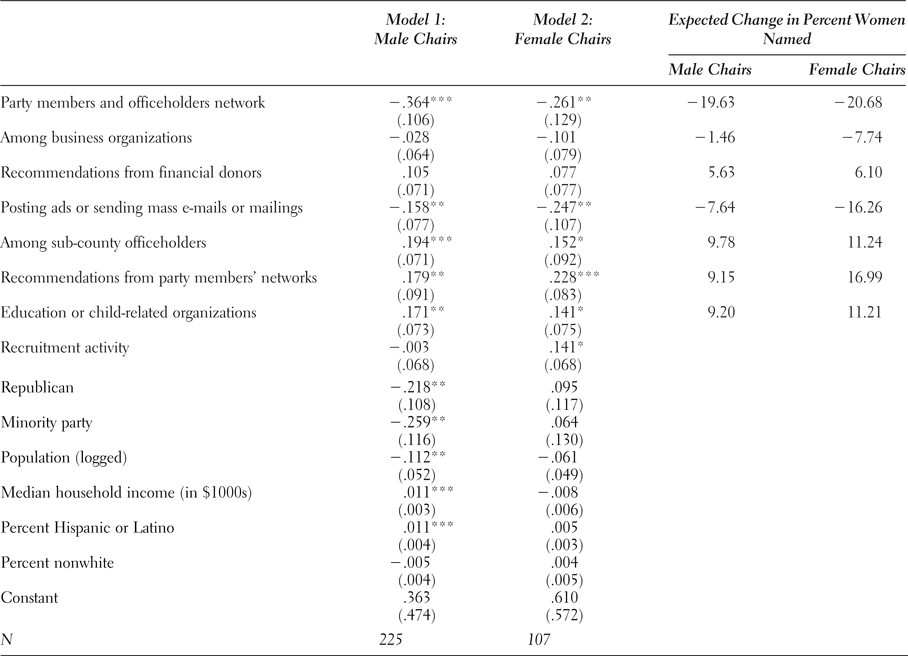
Table 2 contains the results of two tobit regressions testing how the proportion of female potential candidates named by a party leader is affected by party leader reliance on various recruitment networks.Footnote 17 I display both the tobit coefficients, and for easier interpretation, the changes in expected percent women named as a party moves from not using a particular recruitment network (the minimum) to using it very often (the maximum), holding all other variables at their mean values. These results demonstrate that not all recruitment is equal when it comes to candidate sex, which clarifies the current lack of consensus regarding the effects of recruitment on women's candidacies. In short, when parties actively recruit from some networks, their recruitment activities diminish women's candidacies, while seeking candidates from other networks increases women's representation. When female party leaders recruit, they find more female candidates than when male party leaders recruit. Finally, male Republicans recruit fewer women than do male Democrats. I turn now to a closer examination of these results.
The effects of recruitment networks on naming female potential candidates
Notes: Coefficients are from two tobit regressions, one for male chairs and one for female chairs, with robust standard errors in parentheses. Significance levels: *p < .10; **p < .05; ***p < .01. Expected Change in Percent Women Named is the predicted increase or decrease in the percent women named as potential candidates by a party chair if a party's use of a recruitment source changed from 1 (not at all) to 4 (very often), holding all other variables at their means. These values were calculated conditional on exceeding the tobit model censoring threshold (not allowing less than 0% female candidates).
My first hypothesis predicted that parties using a traditional network of party members, business organizations, and party donors would recruit fewer female candidates. Table 2 reveals support for the first part of this hypothesis, namely that reliance on party activists and the party's officeholders has a negative effect on the proportion of female candidates recruited to run for local office. Whether this is because fewer women than men are active in and lead political parties, as my survey demonstrates, or because women within parties are marginalized by party and officeholder “old boys clubs,” as my interviews suggest, it is clear that parties dominated by party activist recruitment networks are less likely to run women. The expected percent women named by party leaders as potential candidates decreases by about 20 percentage points as a party organization moves from not using this recruitment source to using it very often. This provides a strong explanation for women's underrepresentation as candidates, as a significant majority of all county parties somewhat or very often use party recruitment networks when looking for candidates (Table 1). It also highlights one reason for women's particularly low rates of candidacy as Republicans, as significantly more Republican than Democratic party leaders report using this recruitment source.
I also expected that party leaders who seek candidates from among business organizations and financial donors would recruit fewer women. Interestingly, I find little evidence for these relationships at the local level. It may be that women's extraordinary entrance into business in recent years—exemplified by the increase in the proportion of master's degrees in business fields awarded to women from only 4% in 1970 to 46% in 2011—has made this recruitment network a better source of candidates of both sexes (NCES 2012). Additionally, while political donors are generally less likely to be women, this gender difference may be negligible at the local level. My survey data demonstrate that most local races are fairly inexpensive. Party leaders in my survey report that candidates would typically need only $550 to $5000 to win various local offices. Perhaps there is less of a disparity between men and women in local political donations because the donation amounts needed are smaller and because local candidates may work more often on issues of greater importance to female potential donors than candidates for higher offices (Dolan, Deckman, and Swers Reference Dolan, Deckman and Swers2007).
Turning to my second hypothesis, Table 2 reveals that when party leaders frequently use mass e-mails, mailings, or ads to find candidates, the proportions of female candidates named decrease by 8 to 16 percentage points. This confirms my hypothesis that party leaders who rely on self-starting candidates to fill their ballot spots will be less likely to run female candidates, likely because mass requests for candidates do little to increase the lower political ambition present among women in the candidate pool.
On the other hand, I also find support for my third hypothesis—that the use of some recruitment networks yields more female candidates. When party leaders recruit candidates from groups less likely to be associated with the party machinery—sub-county officeholders and party members' personal networks—they are significantly more likely to recruit women. In fact, moving from not using sub-county officeholder or personal recruitment networks to very often using one of these networks increases the expected percent women named by 9 to 17 percentage points. This positive result for sub-county officeholders suggests that women's representation at this level may be fairly high, and could have important implications for women's representation as officeholders. Not only are recruiters seeking candidates from sub-county offices more likely to find female recruits, but they may also be more likely to convince these women to pursue office, as they can draw on the substantive political experience these offices provide to assuage women's lower self-perceptions of their qualifications (Lawless and Fox Reference Lawless and Fox2005). Finally, I find that those who look for candidates among education or child-related groups are more likely to name female potential candidates. The use of these networks increases the percent women named as potential candidates by about 10 percentage points. As Democratic parties are so much more likely than Republican parties to use this recruitment source (Table 1), this result may also contribute to why women more frequently run for office as Democrats than Republicans.
Several other interesting findings stand out in Table 2. First, these results highlight the very significant effect of party leader sex. The coefficient for overall recruitment activity is positive and statistically significant (at p = .06) for female chairs, but not male chairs. Thus, controlling for the various recruitment sources a party leader might use, working to identify and recruit candidates generally has a positive effect on women's representation for parties led by women, but not men. This result confirms my fourth hypothesis and suggests that outgroup bias (Niven Reference Niven1998) may still be at play in candidate recruitment, as may be effects based on sex-segregated social networks (Marsden Reference Marsden1988; McPherson and Smith-Lovin Reference McPherson and Smith-Lovin1986).
My final hypothesis proposed that Democratic party leaders should recruit more women than Republican party leaders because of differences in party culture and in the pool of women available to each party. Table 2 provides confirmation of this hypothesis, but only among male party chairs. Among female party chairs, there is no statistically significant effect of party on the percent of female potential candidates named. This provides further confirmation that female party leaders are particularly likely to recruit female candidates, and also suggests that one reason for women's continued underrepresentation as Republican candidates may be that male Republican chairs are especially unlikely to recruit women compared to male Democratic chairs. As men hold 77% of Republican and 68% of Democratic party chair positions, this is a particularly consequential finding for women's recruitment.
The control variables in Table 2 also reveal some interesting results. First, some research suggests that women are more likely to be encouraged to run in areas where their party is weak than in areas where their party is electorally strong (Niven Reference Niven2006). My results suggest that male county party leaders follow the opposite pattern; being in the minority party decreases the proportion of female potential candidates named by male party leaders. It may be that this reflects greater difficulties (male) party leaders have recruiting women to run in challenging races, as some research at higher levels of office suggests women are more strategic than men when evaluating a potential run (Fulton et al. Reference Fulton, Maestas, Stone and Maisel2004; Palmer and Simon Reference Palmer and Simon2001). Alternatively, this may indicate that men leading strong parties are more willing than men leading minority parties to take a chance on running less-traditional female candidates. This is somewhat supported by models (available from the author) containing a variable indicating that a party is dominant, with 75 to 100% of seats in their county safe for their party. While coefficients for this measure do not consistently reach conventional levels of statistical significance, there is some evidence of a positive relationship between being chair of a dominant political party and recruiting a higher proportion of women. Certainly, this finding suggests the need for additional research on how electoral strength influences party recruitment of male and female candidates, and provides further evidence of the complexity of the relationship between recruitment and women's representation.Footnote 18
CONCLUSION
These results of my survey demonstrate that it is not only the existence of recruitment that matters; its effect on women's representation depends on the specific characteristics and choices of party leaders. Party leaders who look for candidates using traditional party member and officeholder networks will be more likely to find male candidates, while those who look beyond the party in sub-county offices and social networks of party members will be more likely to find female candidates. Seeking simply self-starters, through mass advertisements and mailings, continues to yield a field of mostly male candidates. Furthermore, female recruiters are more likely to recruit female candidates than male recruiters, and among men, Democratic chairs recruit more women than do Republican chairs.
These findings offer some predictions for women's recruitment in the future. If the recruitment networks of party leaders do not change significantly over time, then we should expect to see few increases in the proportion of women recruited. The most commonly used recruitment network—the party member and officeholder network—has a substantial negative effect on women's recruitment, though recruitment from sub-county offices may moderate this outcome. Further, relying on female party leaders to recruit more women seems unlikely to produce much change. Women hold few party leadership positions, and their representation in these positions has only minimally increased over the past three decades.
My results also suggest a likely continuation or growth in the gender gap between Democratic and Republican candidates. A significantly higher proportion of Republican than Democratic parties rely on party members and current officeholders when seeking candidates, suggesting that the negative effect of this recruitment network should be more likely to depress women's recruitment by Republican party leaders than Democratic party leaders. An effect of this size is unlikely to be countered by Republican parties' greater use of party members' social networks. Furthermore, Democratic parties are significantly more likely than Republican parties to use education and child-related organizations to recruit candidates, and the most commonly used Democratic network is sub-county officeholders. Therefore, Democratic women will benefit much more than Republican women from the positive effects of the use of these networks. The only recruitment technique that has a negative effect on women's recruitment and is more commonly used by Democratic parties than Republican parties—ads and mass mailings—is used by fewer than 10% of parties and is less likely to impact women's recruitment overall. So, if party recruitment networks remain consistent over time, then higher numbers of women should be recruited by Democratic parties than Republican parties. Furthermore, because male Republican chairs are less likely to recruit women than are male Democratic chairs, their prominence is likely to heighten this party distinction.
Clearly, the details of the recruitment process matter a great deal for women's candidacies. Thus, despite recent research that highlights the potential of recruitment to enhance women's likelihood of seeking political office, we may not see women's candidacy rates increase much over time. If parties continue to recruit candidates using the networks that currently dominate the recruitment process, and if parties continue to be led by male party chairs, then high levels of party recruitment may be more likely to increase rather than decrease the gender disparity among those seeking political office, particularly within the Republican party.