Introduction
Mental health effects in the Chernobyl accident (April 26, 1986) survivors are internationally recognized as the most significant public health consequence of the disaster that as yet has not been resolved. The UN Chernobyl Forum (2006) experts1 have outlined the four principal neuropsychiatric consequences of the disaster: (1) stress-related disorders, (2) effects on a developing brain, (3) organic brain damage in the Chernobyl accident cleanup workers, and (4) suicide. The cardiovascular and cerebrovascular morbidity increase is recognized now in cleanup workers who were exposed to high radiation doses.
If the long-term unfavorable impact of the Chernobyl disaster on mental health is recognized worldwide,1–Reference Bromet, Havenaar and Guey3 the causes of these neuropsychiatric effects still remain debatable.Reference Loganovsky4 Contemporary experimental, clinical, and epidemiological evidence disproves the canonical statement regarding central nervous system (CNS) radioresistance. In this article, precise analysis of the ionizing radiation neuropsychiatric effects, new data on the molecular–biologic pathways of radiation impact on a brain, review of contemporary evidence of the “low-dose” radiation effects and the debatable issues regarding radiation, and stress role in the genesis of neuropsychiatric effects of the Chernobyl disaster are outlined.Reference Loganovsky4
Recent studies show that in the cleanup workers, the rates of depression and posttraumatic stress disorder (PTSD) remain elevated two decades after the disaster.Reference Bromet, Havenaar and Guey3, Reference Loganovsky, Havenaar and Tintle5 Thus, a significant increase of the prevalence of depression (18.0% vs. 13.1% in control) and suicidal ideation (9.2% vs. 4.1%, respectively) was revealed in the cleanup workers after the accident. There was an increase of the prevalence of depression (14.9% vs. 7.1%), PTSD (4.1% vs. 1.0%), and headache (69.2% vs. 12.4%) in the cleanup workers in the year preceding the interview. The cleanup workers with depression and PTSD lost more working days (i.e., temporary disablement) compared to the control. The level of exposure to the disaster is associated with the severity of somatic symptoms and PTSD.Reference Loganovsky, Havenaar and Tintle5 General population studies report increased rates of poor self-rated health as well as clinical and subclinical depression, anxiety, and PTSD.Reference Bromet and Havenaar2, Reference Bromet, Havenaar and Guey3
Ionizing radiation is the most powerful “invisible” psychological stressor.Reference Speckhard6 Radiation accidents and radiological terrorist attacks, both with nuclear conflicts and wars, are quite different from natural disasters and wars with no mass destruction weapon use. The radiation emergencies entail the greatest mental response of people involved. Such emergencies have a beginning, but they have no end. They are rather unpredictable because environmental radioactive contamination can remain very long, and so the extent of detriment does not necessarily decline with time. Because decontamination of radioactively polluted territories requires huge resources, it is not routinely available. The “nontherapeutic community” appears in a society after the radiation emergencies and is characterized by proneness to conflict, negativism, dysadaptation reactions, behavioral disorders, and annuity (pensionary) drives/sets.Reference Rumyantseva7 The prevalence and clinical features of PTSD depend on the type of stressor, its duration, and semantic meaning.Reference Rumyantseva and Stepanov8
The long-term mental health consequences of the Chernobyl disaster continue to be a concern. The unmet need for mental health care in affected regions remains an important public health challenge 25 years later. Future research that combines physical and mental health outcome measures is needed to complete the clinical picture.Reference Bromet, Havenaar and Guey3
In patients with PTSD but without exposure to ionizing radiation, morphological changes in the brainReference Wang and Neylan9 and cognitive impairmentReference Qureshi, Long and Bradshaw10 have been shown. At the same time, in the Chernobyl cleanup workers, the brain damage according to neurophysiological, neuropsychological, and neuroimaging surveys was found in the course of independent evidence-based studies.Reference Loganovsky and Loganovskaja11–Reference Kholodova and Zhavoronkova22 However, in patients with PTSD who had been exposed to ionizing radiation, neither neurophysiological characteristics nor neurocognitive functioning were assessed. Moreover, their cerebral hemodynamics were not surveyed, including the thickness of brahiocephalic vessels complex “intima-media,” which is a predictor of transient ischemic attacks and stroke,Reference Vinychuk and Fartushna23 and the internal carotid arteries, which are the targets of ionizing radiation exposure.Reference Denisuk18
The aim of the study was to determine the psychological features, comorbidity with depression, neurocognitive functions, cerebral hemodynamics and brain bioelectric activity in the cleanup workers of the Chernobyl disaster with PTSD exposed to ionizing radiation as a result of the Chernobyl disaster.
Subjects and Methods
Design
The study was designed as a cross-section of the clinical samples (cleanup workers of the Chernobyl accident with PTSD) with a parallel external control.
Participants
The participants included 241 individuals: 152 men (63%) and 89 women (37%) aged 36–75 years (M ± SD: 52.9 ± 7.8 years old). Among them, 219 patients were diagnosed with PTSD according to the criteria of the Diagnostic and Statistical Manual of Mental Disorders (fourth edition, text revision) (DSM-IV-TR). In addition, 115 cleanup workers of the Chernobyl accident with PTSD were examined. They are divided into two subgroups: (A) 34 persons who were diagnosed with probable acute radiation sickness (ARS) (58.3 ± 6.3 years old) in 1986, and (B) 81 cleanup workers without ARS (55.5 ± 6.5 years old). We also examined 76 people who had been evacuated from the Chernobyl exclusion zone and were also diagnosed with PTSD (50.7 ± 8.0 years old). The comparison group includes 28 veterans of the Afghanistan war (50.7 ± 6.3 years old) with PTSD and mild closed head injury. The control group consists of 22 healthy persons who had never been exposed to ionizing radiation (49.3 ± 6.0 years old).
In the unique subgroup A of the patients with PTSD who had ARS, which included 16 persons (47%) with internationally nonconfirmed ARS (ARS-0) in 1991 and later; 6 people (18%) with the mild ARS (ARS-I) [according to the United Nations Scientific Committee on the Effects of Atomic Radiation (UNSCEAR) Report to the General Assembly, 2000 (Annex J),Reference Loganovsky, Loganovskaja and Nechayev24 the external exposure to ionizing radiation of the whole body was less than 2.1 Gy]; 9 (26%) with moderate ARS or ARS-II (2.2–4.1 Gy), and 3 (9%) with severe ARS or ARS III (4.2–6.4 Gy). According to the assessments by the Institute of Biophysics (Moscow, Russian Federation), persons of subgroup A were exposed to ionizing radiation at the dose range of 0.1–7.1 Gy (M ± SD: 2.0 ± 1.9 Gy). The cleanup workers of the subgroup B were exposed to ionizing radiation at the dose range of 3.1–856.0 mSv (M ± SD: 247.2 ± 224.1 mSv), but this subgroup also includes 10 patients with radiation doses more than 1 Gy, according to their medical records.
Measures and analysis
Clinical neuropsychiatric diagnosis was provided by classical methods. Psychometric examination included the following: Brief Psychiatric Rating Scale (BPRS); General Health Questionnaire (GHQ-28); Zung Self-Rating Depression Scale (SDS); Spilberger–Khainin anxiety scale; and the PTSD scales Irritability, Depression, Anxiety (IDA), Impact of Events Scale (IES and IES-R), and Mississippi PTSD Scale; as well as the questionnaire designed by us for the “Radiation” PTSD. Neurometric examination was performed using the neurological diagnostic scales proposed by JF. Kurtzke (1955)Reference Kurtzke25 to assess neurological deficit in multiple sclerosis: the scale of neurological deficit (Functional System Scale, FSS) and the scale of disability (Expanded Disability Status Scale, EDSS). Cognitive functions were assessed by the Rey Auditory Verbal Learning Test (RAVLT) and the Short Cognitive Performance Test (SKT). Neurophysiologic studies included 16-channel quantitative electroencephalography (qEEG) with brain mapping of the main frequency ranges spectral analysis. Ultrasound scans of cerebral and neck vessels by Medison 9900 and 8000 (Korea) were performed. MS Excel was used to structure the data. Statistical analysis was done using the Statistica 7.0 (StatSoft) using parametric and nonparametric criteria.
Results and Discussion
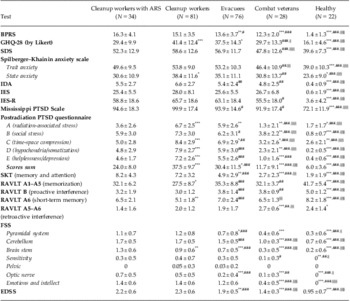
The results of psychometric and neurometric assessments are presented in Table 1. The severity of psychopathology and neurological deficit in the Chernobyl disaster survivors who suffer with PTSD is higher than that in the veterans of the war in Afghanistan with PTSD and mild closed head injury (see Table 1). The traumatic psychological impact of the Chernobyl accident is not due to so much to the exposure of the trauma of the disaster itself, but rather by a perception of possible health effects that can be realized in the future. PTSD in the victims of the Chernobyl accident, unlike the veterans of the war in Afghanistan, is characterized by the projection of fear and danger in the future. So, in contrast to combat PTSD, where there are “flashbacks” psychopathological phenomena, at radiation emergencies the sufferers experience “flashforwards.” This is consistent with the concept of “anticipatory stress,” or the stress of expectations and predictions. Moreover, the “Radiation” PTSD consists of both the components associated with radiation and also the social and psychological components, as reflected in the developed questionnaire. The radiation-associated part of this PTSD includes anxiety and hypochondriacal fixation concerning possible cancer and noncancer diseases, children's health disorders, and birth defects in offspring in the future. The socio-psychological component of this PTSD includes the following:
Psychometric and neurometric characteristics (means and standard deviations)

*,**,*** Significance of differences as P < .05; P < .01, and P < .001, respectively, related to the cleanup workers with ARS.
#,##,### Significance of differences as P < .05; P < .01, and P < .001, respectively, related to the cleanup workers.
§,§§,§§§ Significance of differences as P < .05; P < .01, and P < .001, respectively, related to the evacuees.
• Insecurity of the future: Fear of losing one's social status, the emergence of socioeconomic problems, the disintegration of families, heightened sense of injustice attitude of society to the people affected by the Chernobyl accident
• Subjective time-space compression: Lack of time to solve the problems of ordinary life, a sense of constant time trouble, lack of perspective on life
• Escape to the disease: Poor health self-estimation, low functioning, reduction in range of interests, disability due to illness, expectation of a serious illness
• Learned helplessness: Feeling helpless because of the Chernobyl accident, reduction in activity, shifting duties and responsibilities to others, worsening of mood with a sense of inferiority in their lives
As is shown in Table 1, the severity of psychopathology as determined by the BPRS was higher in all cleanup workers than that in the Chernobyl evacuees, war veterans, and healthy individuals.
Self-assessment of health (GHQ-28) was the worst in the cleanup workers without ARS: they evaluated their own health as worse than in people who had been diagnosed with ARS, evacuees, war veterans, and healthy individuals. Also, the veterans self-assessed themselves as healthier than the cleanup workers and evacuees, but worse than healthy persons.
Depression (SDS) in all subjects with PTSD affected by the Chernobyl disaster, whether or not they had been diagnosed with ARS, was more pronounced than in the war veterans and the healthy individuals.
Trait and state anxiety (Spilberger–Khainin anxiety scale test) in all the Chernobyl disaster survivors with PTSD was also more pronounced than in the war veterans and the healthy individuals. Moreover, state anxiety in the cleanup workers without ARS was higher than in the cleanup workers who had been diagnosed with ARS. The cleanup workers without ARS and the evacuees had a higher level of trait anxiety than the war veterans and the healthy persons.
According to the traditional scales for assessing PTSD (IDA, IES, and Mississippi scale), the cleanup workers without ARS somewhat differed from the war veterans in that the cleanup workers showed more pronounced indices.
The “Radiation” PTSD questionnaire that we designed allowed us to effectively separate the different categories of victims of the Chernobyl accident from the war veterans and healthy persons (see Table 1). The greatest severity of postradiation PTSD was in the cleanup workers without ARS and the Chernobyl evacuees. At the same time, the lowest severity of “Radiation” PTSD was found among the cleanup workers who had been diagnosed with ARS; this could be explained by their highly professional training. All the victims, especially the cleanup workers without ARS and the evacuees, significantly differed from the war veterans and the healthy persons regarding increased rates of radiation-associated and social stress, subjective sense of time-space compression, hypochondria and somatization, learned helplessness, and depression. The questionnaire designed allows to distinguish the quite specific PTSD in the Chernobyl disaster survivors from the combat veterans. The questionnaire has been validated in this study.
Cognitive impairment was more pronounced in those affected by the Chernobyl disaster with PTSD than in the veterans (and the healthy subjects). Memory and attention (SKT) were the worst in the cleanup workers who had been diagnosed with ARS. Auditory-verbal memorization (RAVLT A1–A5), proactive verbal interference (RAVLT B), and short-term verbal memory (RAVLT A6) were the worst in the cleanup workers. However, verbal retroactive interference (RAVLT A5–A6) was most affected in those who has been diagnosed with ARS.
Neurologic deficit in the Chernobyl accident survivors with PTSD, especially in the cleanup workers, was more severe than in the veterans (and the healthy subjects). The pattern of neurological disorders in the survivors consisted mainly of stem and cerebellar symptoms and intellectual changes, while in the veterans, pyramidal symptoms dominate.
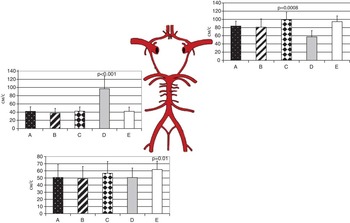
Cerebral hemodynamics disorders were more pronounced in all the Chernobyl accident survivors with PTSD, especially in the cleanup workers, in comparison with the veterans and the healthy subjects. The thickness of the complex intima-media in the common carotid arteries was the largest (M ± SD: 1.2 ± 0.2 mm) in the cleanup workers (P < .05), which may indicate an increased risk of acute disorders of cerebral blood circulation (ie, stroke). The highest indices of the right common carotid artery stenosis were registered in the cleanup workers with ARS (18.4 ± 22.1), in comparison with the cleanup workers without ARS (9.1 ± 180; P < .05), the evacuees (4.7 ± 12.5; P < .001), and the veterans (6.3 ± 150; P < .05). Also, the cleanup workers with ARS showed higher rates of a stenosis in the left common carotid artery (12.0 ± 19.2) than the evacuees (4.6 ± 13.3; P < .05) and the veterans (2.0 ± 10.4; P < .02). Moreover, the subjects who had been diagnosed with ARS had the highest indicators of a stenosis of the left internal carotid artery (3.2 ± 10.4) among all the Chernobyl survivors (P < .05). This testifies to an increased risk of cerebral atherosclerosis after ARS. The most significant changes of the linear systolic velocity of the brain blood vessels (right middle cerebral, left posterior cerebral, and left vertebral artery) were found in the cleanup workers, as is shown in Figure 1.
Reduction of linear systolic blood velocity (means and standard deviations) at the Circle of Willis in cleanup workers of the Chernobyl disaster with PTSD. A – cleanup workers with ARS, B – cleanup workers without ARS, C – of evacuees, D – veterans of war in Afghanistan, E – healthy individuals.

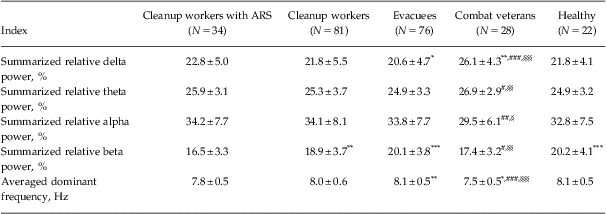
The brain bioelectrical activity in the Chernobyl accident survivors with PTSD has certain peculiarities, as is shown in Table 2. The most characteristic neurophysiologic feature of all the patients with PTSD, especially in the cleanup workers who had been diagnosed with ARS, was a reduction of the spectral power of beta-activity of qEEG. A general slowing of the EEG-pattern was registered in the veterans, but that could be explained by the remote consequences of mild closed head injury. The Chernobyl accident survivors with PTSD in comparison with the veterans of war had a decreased theta-power and an increased alpha-power. The current neurophysiological interpretation of these results is an abnormal communication between the pyramidal cells of the neocortex and the hippocampus and deep brain structures in with Chernobyl accident survivors with PTSD.Reference Qureshi, Long and Bradshaw10
Cerebral bioelectrical activity by quantitative EEG (means and standard deviations)
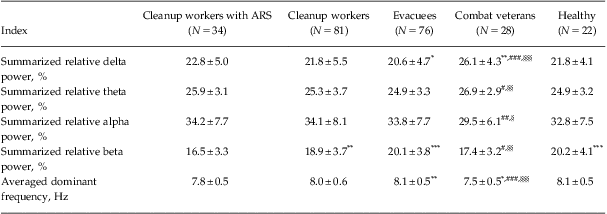
*,**,*** Significance of differences as P < .05; P < .01, and P < .001, respectively, related to the cleanup workers with ARS.
#,##,### Significance of differences as P < .05; P < .01, and P < .001, respectively, related to the cleanup workers.
§,§§,§§§ Significance of differences as P < .05; P < .01, and P < .001, respectively, related to the evacuees.
The psychiatric legacy of the Chernobyl disaster remains a global burden for the society; however, the causes of these psychiatric symptoms are at issue. A well-designed epidemiological psychiatric study has revealed the excess of depression, anxiety, PTSD, suicidal ideation, and severe headache in proportion to the level of radiation exposure in the Chernobyl disaster cleanup workers. The current psychiatric assessment of the representative samples of liquidators and evacuees testifies to the excess of organic mental disorders, alcohol abuse, depressive disorders, and stress-related and somatoform disorders. Survivors who were exposed to radiation during the period of intense brain development (in utero and 0–1 years at the time of the accident) currently are at the increased risk for epilepsy and, probably, schizophrenia. They also demonstrate an excess of psychoactive drug usage.
The main psychological and neuropsychiatric lessons of Chernobyl are as follows:
1. Those affected will exhibit radiation anxiety, panic reactions, psychosomatic disorders, social disintegration, victimization, learned helplessness, pathological flight into illness, and disability at the inadequacy of social protection.
2. Both radiological and socio-psychological factors must be taken into account at decision making on the resettlement of victims.
3. Survivors may suffer from postradiation posttraumatic stress disorder (PTSD), and may exhibit hypochondriacal fixation regarding the future (fear of premature death, cancer, congenital abnormalities in children, etc.).
4. Radiation will show effects on the developing brains of very young survivors.
5. Survivors will suffer long-term mental disorders.
6. Suicides will be more prevalent.
7. Survivors will exhibit cerebrovascular pathology.
8. There will be radiocerebral effects due to low doses of ionizing radiation.
The organization of international studies on the psychiatric consequences of the Chernobyl accident and their biological bases are of great importance. There is a necessity to develop and implement government-led mental health care systems for the survivors of radiation accidents and radiological terrorist attacks. It is strongly recommended that a system of emergency and long-term psychological and psychiatric care be organized immediately for the nuclear disaster survivors in Fukushima, Japan.Reference Loganovsky, Loganovskaja and Nechayev24, Reference Loganovsky and Loganovkaja26–Reference Matsuoka, Nishi and Nakaya34
Conclusions
The main psychological feature of “Radiation” PTSD is “flashforward” phenomena, or “anticipatory stress” regarding possible dire or negative expectations and predictions, ie, the projection of fear and danger regarding the future. “Radiation” PTSD includes radiation-associated and social psychological components.
PTSD in the Chernobyl disaster survivors is characterized by more severe psychopathology than the veterans of the war in Afghanistan with PTSD and mild closed head injury. The victims, especially cleanup workers, evaluate their own health as being worse; they also have more signs of depression, as well as trait and state anxiety.
The “Radiation” PTSD questionnaire that we designed, in contrast to the traditional scales for PTSD assessment, effectively separates the different categories of survivors of a radio-ecological disaster from war veterans and healthy individuals. The questionnaire assesses radiation-associated and social stress, subjective sense of time-space compression, hypochondria and somatization, learned helplessness, and depression. Our questionnaire was shown to be valid for the diagnosis of PTSD after radiation emergencies.
Neurocognitive deficit is especially pronounced in the cleanup workers of the Chernobyl accident, and includes impaired memory and attention, auditory-verbal memory, proactive and retroactive interference, and short-term verbal memory, as well as physical changes in the cerebellum, brainstem symptoms, and intellectual changes.
The cleanup workers with PTSD have an increased risk of cerebrovascular disorders including stroke. The cleanup workers with PTSD following ARS have an increased risk of cerebral atherosclerosis.
The bioelectrical activity of the brain in the Chernobyl accident survivors, especially in the cleanup workers, is characterized by a decrease of beta-power, a reduction of theta-power, and an increase of alpha-power.
PTSD following a radiological emergency is characterized by a comorbidity of anxiety and depression, disorders of personality, neurocognitive deficit, cerebrovascular pathology, and organic brain damage. The management of this disorder must include the treatment and correction of all these items, involving psychotherapy and psychopharmacology.
The cerebral basis of PTSD comorbid with depression following the Chernobyl disaster is an abnormal communication between the pyramidal cells of neocortex and hippocampus, and deep brain structures.