


Introduction
CHD is the most common congenital anomaly, affecting approximately 1–2% of live births worldwide. Reference van der Linde, Konings and Slager1 Advances in prenatal diagnosis, neonatal intensive care, and surgical and catheter-based techniques have substantially improved survival, particularly among infants with critical forms of CHD. As a result, an increasing number of children treated for CHD in the neonatal period are now reaching preschool and school age, shifting the clinical focus from survival alone to long-term functional outcomes and health-related quality of life.
Health-related quality of life is a multidimensional construct encompassing physical, emotional, and social well-being, and it has become a key patient-reported outcome in the follow-up of individuals with chronic cardiovascular conditions. Reference Rumsfeld, Alexander and Goff2 Children with CHD may be exposed to early-life stressors such as prolonged hospitalisation, repeated procedures, and family-related psychosocial burden, which can affect not only physical health but also psychosocial development. Prior studies have reported that children with heart disease may experience lower perceived quality of life compared with healthy peers, although the magnitude and domains of impairment may vary by age and clinical context. Reference Uzark, Jones, Slusher, Limbers, Burwinkle and Varni3
Evidence specifically focusing on children with CHD also supports a measurable health-related quality of life gap relative to healthy controls, with impacts extending across physical and psychosocial domains. Reference Amedro, Dorka and Moniotte4 The preschool period represents a critical developmental window characterised by rapid cognitive, emotional, and social maturation. Yet, data addressing health-related quality of life in preschool-aged children who required surgical or catheter-based intervention for CHD during the neonatal period remain limited, particularly in settings where socio-economic gradients may strongly influence long-term outcomes.
Therefore, the aim of this study was to evaluate health-related quality of life in preschool-aged children who underwent surgical or interventional treatment for CHD during the neonatal period, compared with healthy age-matched peers, using the Kiddy-KINDL questionnaire, and to identify clinical and sociodemographic factors associated with health-related quality of life outcomes. Reference Eser, Yüksel and Baydur5
Materials and methods
Study design and setting
This study was designed as a retrospective, cross-sectional, case–control investigation. All patients received neonatal care and initial follow-up at Dr Sami Ulus Maternity and Children’s Health and Diseases Training and Research Hospital, where participants were diagnosed with CHD in the neonatal period and underwent surgical or catheter-based intervention. In 2022, Dr Sami Ulus Hospital was closed, and its patient records were transferred to Ankara Etlik City Hospital. Accordingly, the long-term follow-up evaluations and data collection for this study were conducted at Ankara Etlik City Hospital.
Study population
The study group consisted of children aged 4–7 years who were diagnosed with CHD during the neonatal period and underwent surgical or catheter-based intervention in the neonatal period. A total of 50 eligible children were included. The control group comprised 100 age-matched healthy children with no history of chronic illness or congenital anomalies, who were recruited from among patients presenting for routine paediatric outpatient visits at Ankara Etlik City Hospital after 2022.
Inclusion and exclusion criteria
Inclusion criteria (CHD group):
-
• Diagnosis of CHD in the neonatal period
-
• Surgical or catheter-based intervention during the neonatal period
-
• Current age between 4 and 7 years at the time of assessment
-
• Availability of parental consent
Exclusion criteria: Children with untreated CHD, major non-cardiac congenital anomalies, known genetic syndromes, neurodevelopmental disorders, or incomplete medical records were excluded from the CHD group. Additionally, any child in the control group with a chronic medical condition was excluded.
Data collection
Demographic and clinical data were obtained retrospectively from hospital medical records. Collected variables included sex, gestational age, birth weight, type of cardiac intervention, and surgical risk category. Socio-economic data, including parental education level and household income, were collected through structured parental interviews conducted in person, by telephone, or via online communication platforms using standardised data collection forms.
Assessment of health-related quality of life
Health-related quality of life was assessed using the Turkish version of the KINDL instrument for preschool children, applying the age-appropriate Kiddy-KINDL module together with the parent form to obtain a comprehensive proxy assessment of health-related quality of life. Reference Ravens-Sieberer and Bullinger6 The instrument covers six subdomains: physical well-being, emotional well-being, self-esteem, family relations, social functioning, and kindergarten/school adjustment. Items were scored according to the KINDL manual, with negatively worded items reverse-coded as required. Raw subscale scores and total scores were transformed to a 0–100 scale, with higher scores indicating better health-related quality of life. Reference Ravens-Sieberer, Erhart, Wille and Bullinger7 The Turkish KINDL questionnaire has demonstrated satisfactory validity and reliability in paediatric populations. Reference Eser, Yüksel and Baydur5 Questionnaires were administered via telephone in the CHD group, whereas controls completed the questionnaires in person or via a web-based format; therefore, mode-of-administration bias cannot be excluded.
Clinical severity assessment
Clinical disease severity and operative risk were characterised using the Society of Thoracic Surgeons–European Association for Cardio-Thoracic Surgery (STAT) Mortality Categories, a validated consensus-based risk stratification system for congenital heart surgery. STAT categories were assigned according to the primary surgical procedure and reflect increasing expected operative mortality risk from lower (STAT 1–2) to higher complexity groups (STAT 3–5). In the present study, STAT classification was used to describe baseline surgical risk and case-mix within the CHD cohort; because the control group did not undergo cardiac surgery, STAT categories were evaluated and reported only for participants in the CHD group. Reference Jacobs, He and Mayer8
Statistical analysis
Statistical analyses were performed using IBM SPSS Statistics (version 22.0). Continuous variables were assessed for normality using the Shapiro–Wilk test and inspection of distributional plots, and are presented as mean ± standard deviation or median (interquartile range), as appropriate. Categorical variables are summarised as frequencies and percentages. Between-group comparisons were conducted using the independent-samples Student’s t test for normally distributed continuous variables and the Mann–Whitney U test for non-normally distributed continuous variables. Categorical variables were compared using the chi-square test or Fisher’s exact test, as appropriate. Correlations between health-related quality of life subscale scores and STAT category were evaluated using Spearman’s rank correlation analysis. Given the use of multiple health-related quality of life subscales, false discovery rate correction (Benjamini–Hochberg procedure) was applied for subscale-level comparisons to control for Type I error. Because parental education and household income differed between groups, the primary between-group analysis for total health-related quality of life was conducted using a multivariable linear regression model (analysis of covariance framework) with group (CHD vs. control) as the main predictor and prespecified socio-economic covariates (maternal and paternal education levels and household income) entered a priori; child age and sex were included as additional covariates. Mode of questionnaire administration (telephone vs. in-person/web) was further included in a sensitivity model. To identify factors associated with health-related quality of life within the CHD cohort, multiple linear regression analysis was performed with total health-related quality of life score as the dependent variable; candidate independent variables included parental education, household income, STAT category (for surgical cases), birth weight, and sex. Model assumptions were assessed by residual diagnostics and multicollinearity checks. Statistical significance was defined as a two-tailed p-value<0.05.
Sample size and power analysis
An a priori power analysis was performed to determine whether the study sample size was sufficient to detect a clinically meaningful difference in total health-related quality of life between children with CHD and healthy controls. Based on prior KINDL-based studies in paediatric CHD populations, we assumed a moderate standardised effect size (Cohen’s d = 0.50) for the between-group difference in total health-related quality of life. Using a two-sided alpha of 0.05, power (1–β) of 0.80, and an allocation ratio of 1:2 (CHD:control), the minimum required sample size was approximately 48 participants in the CHD group and 96 participants in the control group. With 50 children with CHD and 100 controls, the present study met these requirements (estimated power ≈ 0.82 for d = 0.50). Power calculations were performed using G*Power (version 3.1; Heinrich Heine University, Düsseldorf, Germany).
Ethical considerations
The study protocol was approved by the Health Sciences University of Türkiye, Dr Sami Ulus Children’s Health and Diseases Clinical Research Ethics Committee (decision date: 15 June 2022; approval no.: 2020-KAEK-141/364). Written informed consent was obtained from the parents or legal guardians of all participating children. The study was conducted in accordance with the Declaration of Helsinki and Good Clinical Practice guidelines.
Results
Participant characteristics
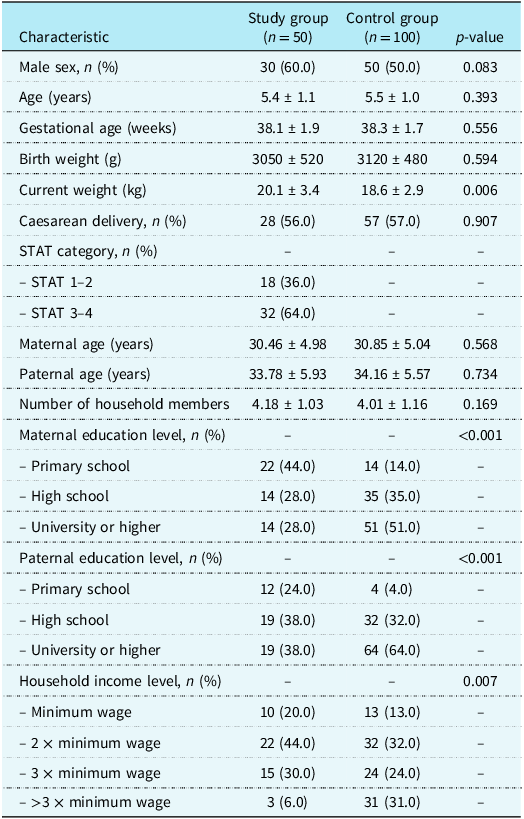
A total of 150 children were included in the study, comprising 50 children with CHD who had undergone surgical or catheter-based intervention in the neonatal period and 100 healthy age-matched controls. There was no significant difference between the CHD and control groups with respect to sex distribution (60% vs. 50% male; p = 0.083) or mean age at assessment (5.4 ± 1.1 vs. 5.5 ± 1.0 years; p = 0.393). Gestational age, birth weight, mode of delivery, and parental age were also comparable between groups (all p > 0.05). Current body weight was significantly higher in the CHD group compared with controls (20.1 ± 3.4 kg vs. 18.6 ± 2.9 kg; p = 0.006). Demographic and clinical characteristics of the study population are summarised in Table 1.
Demographic, clinical, and socioeconomic characteristics of the study and control groups

Data are presented as mean ± standard deviation or n (%), as appropriate. Continuous variables were compared using the Student-t test, and categorical variables were compared using the chi-square test. A p value < 0.05 was considered statistically significant. STAT categories were evaluated only in the study group.
Socio-economic characteristics
Parental education levels differed significantly between the groups. Mothers and fathers of children in the CHD group had lower educational attainment compared with those in the control group (both p < 0.001). In addition, household income levels were significantly lower in families of children with CHD, with a higher proportion of families reporting income at or below twice the minimum wage (p = 0.007). Detailed socio-economic characteristics are presented in Table 1. Because parental education and household income differed significantly between groups, socio-economic status was considered a potential confounder in health-related quality of life comparisons. Accordingly, the primary between-group difference in total health-related quality of life was evaluated using an adjusted linear regression model incorporating prespecified socio-economic covariates (maternal and paternal education and household income).
Health-related quality of life outcomes
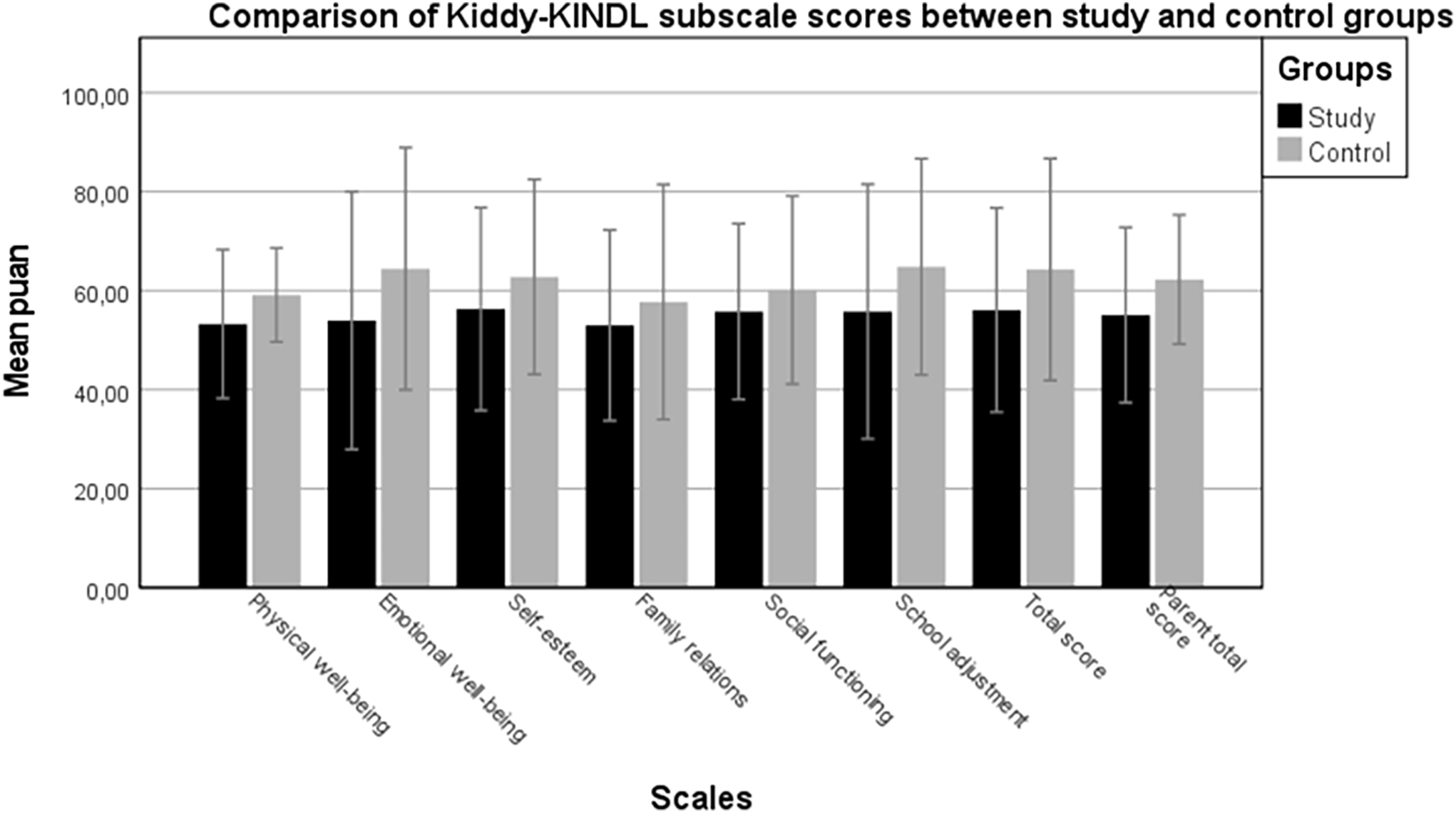
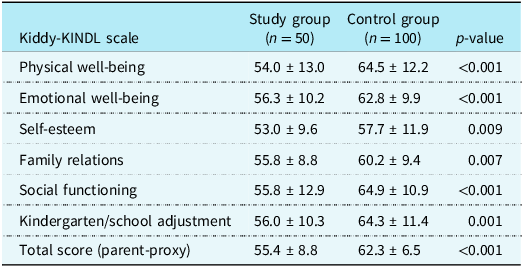
All participants completed the Kiddy-KINDL questionnaire in its entirety, resulting in no missing health-related quality of life data. As measured by parent-proxy report, total Kiddy-KINDL scores were significantly lower in children with CHD compared with healthy controls (55.4 ± 8.8 vs. 62.3 ± 6.5; p < 0.001), as illustrated in Figure 1. Analysis of individual subdomains demonstrated significantly lower scores in the CHD group across all six dimensions—physical well-being, emotional well-being, self-esteem, family relations, social functioning, and kindergarten adjustment (all p < 0.05). The largest between-group differences were observed in the physical well-being and social functioning subdomains. Health-related quality of life outcomes are summarised in Table 2.
Comparison of Kiddy-KINDL total and subscale scores between the study and control groups. Bars represent mean scores and error bars indicate ±1 standard deviation. Higher scores reflect better health-related quality of life.

Comparison of Kiddy-KINDL total and subscale scores between the study and control groups

Data are presented as mean ± standard deviation. Groups were compared using the independent-samples Student’s t test. p values for Kiddy-KINDL subscale-level comparisons were adjusted using the Benjamini–Hochberg false discovery rate (FDR) procedure; the total score comparison was not adjusted.
Association between clinical severity and quality of life
Within the CHD group, clinical severity was assessed using STAT mortality categories. Spearman correlation analysis revealed a weak positive association between STAT category and physical well-being scores and a weak negative association with emotional well-being scores (both p < 0.05). No significant correlations were observed between the STAT category and other health-related quality of life subdomains.
Predictors of health-related quality of life
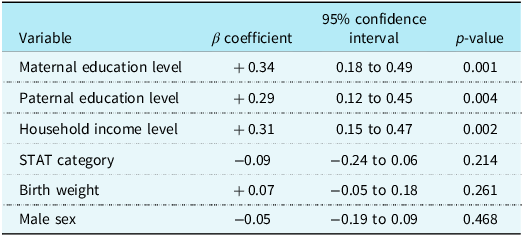
Multiple linear regression analysis was performed to identify factors associated with total health-related quality of life scores in the CHD group. Maternal education level (β = 0.34, p = 0.001), paternal education level (β = 0.29, p = 0.004), and household income (β = 0.31, p = 0.002) were identified as independent predictors of health-related quality of life. Clinical variables, including STAT category, birth weight, and sex, were not significantly associated with health-related quality of life outcomes in the adjusted model. Results of the regression analysis are presented in Table 3.
Multiple linear regression analysis of factors associated with total quality of life score (study group)

The dependent variable was the total Kiddy-KINDL score. The regression model included maternal education level, paternal education level, household income level, STAT category, birth weight, and sex as independent variables. Standardised regression coefficients (β) are presented. A p-value < 0.05 was considered statistically significant.
Discussion
In this retrospective cross-sectional study, preschool children (4–7 years) with CHD who required surgical or interventional treatment in the neonatal period exhibited significantly lower health-related quality of life compared with age-matched healthy peers, as measured by the Kiddy-KINDL instrument. Reference Uzark, Jones, Slusher, Limbers, Burwinkle and Varni3 Importantly, the impairment was not limited to a single domain but extended across all Kiddy-KINDL subscales, suggesting a broad, multidimensional impact that persists into early childhood despite improved survival after neonatal CHD care. Reference Oster, Lee, Honein, Riehle-Colarusso, Shin and Correa9
The observed reduction in total health-related quality of life scores aligns with prior work demonstrating that children with CHD often experience lower health-related quality of life than healthy controls, though the magnitude and the affected domains vary by age, disease spectrum, and measurement tool. Reference Amedro, Dorka and Moniotte4 Systematic reviews similarly emphasise that health-related quality of life in paediatric CHD is shaped by a complex interplay of clinical, developmental, and psychosocial determinants rather than by cardiac anatomy alone. Reference Drakouli, Petsios, Giannakopoulou, Patiraki, Voutoufianaki and Matziou10 Studies focusing on younger age brackets, including early school age, also report measurable health-related quality of life disadvantages in children with CHD, supporting the plausibility of early-life vulnerabilities extending into the preschool period. Reference Abassi, Huguet and Picot11
In Türkiye, available evidence likewise indicates that health-related quality of life can be compromised in children with CHD across multiple dimensions, reinforcing the relevance of evaluating outcomes beyond morbidity and mortality. Reference Sertçelik, Alkan, Sapmaz, Coşkun and Eser12 More recent regional data further highlight the frequent co-occurrence of psychosocial challenges alongside reduced health-related quality of life in paediatric CHD, strengthening the external consistency of our findings. Reference Bulbul Oztoprak, Bilici and Dogac13
A key interpretive issue in our cohort is the marked between-group imbalance in socio-economic indicators. Because parental education and household income differed significantly between the CHD and control groups, unadjusted mean differences in health-related quality of life may reflect, in part, socio-economic context rather than CHD status alone. A key contribution of our study is the demonstration that parental education levels and family income were independent predictors of health-related quality of life in multivariable analysis. This is clinically meaningful because it frames health-related quality of life as a “modifiable-by-system” outcome, sensitive to family resources and support structures, not merely surgical success. Prior studies have described socio-economic status as a major determinant of health-related quality of life in children with critical CHD, influencing access to follow-up services, health literacy, and the family’s capacity to navigate chronic care demands. Reference Xiang, Su and Liu14 Our findings extend this socio-economic gradient to the preschool period, a developmental window where caregiving environments and family coping patterns may be especially influential.
Parental education is plausibly linked to health-related quality of life through multiple pathways, including care coordination skills, adherence to complex follow-up, early identification of developmental or behavioural concerns, and advocacy within educational settings. Broader paediatric literature supports maternal education as a correlation of children’s overall quality-related outcomes. Reference Yu15 Likewise, studies examining health-related quality of life in children aged 5–7 years in general paediatric samples identify family-level and environmental drivers that parallel our observations. Reference Dağtekin and Canbulat Şahiner16
Family structure and stressors can also intersect with health-related quality of life during early childhood. Although our dataset was not designed to disentangle all family-dynamic mechanisms, prior evidence suggests that major family transitions, such as divorce, may reduce quality-of-life outcomes in children, offering a plausible contextual lens for interpreting variability within CHD cohorts. Reference Eymann, Busaniche, Llera, De Cunto and Wahren17 Similarly, acute illness episodes and hospitalisation experiences can shape behavioural and psychosocial responses in early childhood, potentially influencing parent-reported health-related quality of life. Reference Başbakkal, Sönmez, Şen and Esenay18
We did not identify the STAT category as an independent predictor of total health-related quality of life in the regression model. This finding is conceptually coherent: surgical risk stratification tools capture perioperative mortality risk and technical complexity, but they do not necessarily map onto long-term psychosocial functioning, school adaptation, or family burden. Contemporary cardiovascular outcomes frameworks increasingly emphasise that patient-reported health status and health-related quality of life represent distinct outcome domains that require direct measurement rather than inference from clinical severity. Reference Rumsfeld, Alexander and Goff2
Notably, some literature suggests that intensive care exposure, procedure burden, or repeated interventions may correlate with poorer long-term health-related quality of life, depending on the instrument and cohort characteristics. Reference Marino, Cassedy and Brown19 The apparent discrepancy across studies likely reflects differences in age at assessment, health-related quality of life instruments, sample case-mix, and the extent to which socio-economic factors are measured and modelled.
Using a validated, age-appropriate health-related quality of life instrument is a strength, particularly in preschool children, where direct self-report may be limited, and proxy reporting becomes central. The KINDL family of tools has established psychometric properties, including Turkish validation work supporting its use in local contexts. Reference Eser, Yüksel and Baydur5 In this sense, our study leverages a measurement strategy aligned with best practices for early childhood health-related quality of life research.
Our results support the integration of structured psychosocial screening and family-centred support into routine post-discharge follow-up for neonatal CHD survivors. Given the independent association of parental education and household income with health-related quality of life, follow-up pathways should incorporate targeted resource linkage, caregiver education tailored to health literacy, and proactive coordination with early childhood educational services. From a health system perspective, these data argue for “risk stratification beyond the heart,” where social determinants are actively assessed alongside clinical variables.
Strengths of this study include the focus on an under-studied developmental window (preschool years), the use of a validated generic health-related quality of life instrument with a Turkish adaptation, and the availability of socio-economic variables that allow explicit consideration of social determinants in the interpretation of outcomes.
Several limitations should be acknowledged. First, the retrospective design and reliance on parent-proxy reporting may introduce information bias related to caregiver stress, expectations, and family coping styles. Second, the CHD and control groups differed substantially in socio-economic status; although SES was incorporated as a prespecified covariate in adjusted analyses, residual confounding by unmeasured social and environmental factors remains possible. Third, the single-centre setting and the clinical spectrum of included CHD diagnoses may limit generalizability. Finally, questionnaires were administered via telephone in the CHD group, whereas controls completed the questionnaires in person or via a web-based format; therefore, mode-of-administration bias cannot be excluded.