Adisaster has been defined as a serious disruption of the functioning of a community or a society involving widespread human, material, economic, or environmental losses and impacts that exceed the ability of the affected community or society to cope using its own resources.Reference Quarantelli
1
Disasters always arise from a fundamental disequilibrium between hazards in the environment and the vulnerabilities of human communities. In contemporary academia, disasters are seen as a consequence of inappropriately managed risk. This has led most researchers to believe that disasters were human-made, their reasoning being that human actions taken before a hazard strikes can prevent it from developing into a disaster.Reference Wisner, Blaikie and Cannon
2
Disasters typically cause property damage, injuries, and death. Compared with industrialized countries, developing countries suffer greater costs when a disaster hits. More than 95% of all deaths caused by disaster occur in developing countries.
3
As the world’s country with the largest population and biggest development, China is one of the countries most affected by disasters. In 1556, during the Ming Dynasty, the most powerful earthquake (Magnitude 8.0–8.3, Intensity 11)—more than 30 times more powerful than the 2010 Haiti earthquake—struck Hua County of the Shanxi Province in China. According to statistics, that earthquake resulted in 830 000 lives lost; this makes it the strongest earthquake in history in terms of the number of fatalities.Reference Shan
4
The Tangshan earthquake (Magnitude 7.8, Intensity 11), which struck in 1976, claimed the lives of over 240 000 people, making it the deadliest earthquake of the 20th century.Reference Sheng
5
When the earthquake struck Tangshan, many people were asleep, unaware of the great disaster that would follow. Upon entering the 21st century, major earthquakes struck China in 2008 and 2010. The 2008 Wenchuan earthquake (Magnitude 8.0, Intensity 11) caused 69 227 deaths, 374 643 injuries, and resulted in 7923 missing people.Reference Zhang, Liu and Li
6
The 2010 Yushu earthquake (Magnitude 7.1, Intensity 10) caused 2698 deaths, over 12 000 injuries, and left 270 people missing.Reference Liu, Liu and Zhang
7
Other types of disasters—such as floods, fires, infectious disease outbreaks, accidents, and terrorist attacks—also result in numerous deaths and injuries in China.
Disaster medicine is an area of medical specialization with the dual purposes of providing health care to disaster survivors and providing medically related disaster preparation, planning, response, and recovery leadership throughout the disaster life cycle.Reference Ciottone
8
Although the concept of “disaster medicine” was first proposed by Karl H. Houghton in 1955,
9
the capability of the emergency medical system to respond to disasters remained weak in China through the end of the 20th century. The severe acute respiratory syndrome (SARS) crisis of 2003, which infected more than 5300 people and killed 349 in China,Reference Jia, Feng and Fang
10
prompted the Chinese government to reconsider its traditional reactive approach to emergency management and develop a permanent emergency management bureau, the Emergency Management Office (EMO). In December 2005, a national EMO was officially established. This office serves as an interagency liaison for all emergency management and national security program activities through the State Council. In the same year, a framework was proposed for a comprehensive emergency management program to direct planning. In this framework, national emergency incidents were divided into natural disasters, accident disasters, public health incidents, and social security incidents.
11
On November 1, 2007, the Emergency Response Law of the People’s Republic of China became effective
12
; this law further confirmed the emergency management system (EMS), accelerated the establishment of different kinds of rescue teams at national and local levels, and promoted the rapid development of disaster medicine education and research in China.
Emergency Management System In China
The Emergency Response Law of the People’s Republic of China stipulates that “the state shall establish an emergency response management system mainly featuring the uniform leadership, comprehensive coordination, categorized management, graded responsibility, and territorial management.” At the same time, China also established coverage of 2 aspects of the central and local emergency management agencies: hierarchy and clear responsibilities. After the Wenchuan earthquake, the Emergency Management System made a complete improvement in multiple aspects, including the following: (1) clarify government emergency management system: unified leadership, comprehensive coordination; classified management and graded responsibility; localization management-oriented; nongovernmental support and public participation; (2) set up a group of professional emergency rescue team; (3) establish and perfect an emergency management system of laws and regulations; and (4) establish and develop the emergency preparedness and response plans at all levels of government.
The Chinese emergency management system has its own advantages:
∙ Conducive to unified command, quick response and efficient linkage: under unified coordination and organization of central government, the whole nation copes with a catastrophe together.
∙ Conducive to the advantage of concentrating resources to accomplish large undertakings. China’s biggest advantage is that there is a strong central government, and in the entire government organization system, local governments are subordinate to the central government, and the central government can carry out effective command and coordination on local governments at all levels, focusing on integration of the different parts of the country’s power to deal with major events, to realize “when disaster struck, help came from all sides.” For example, for the Wenchuan earthquake, the central government took out 70 billion yuan as the post-disaster reconstruction fund and raised 1 trillion yuan as a reconstruction fund over the next 3 years through various channels, determining 19 provinces as counterpart support units; thus, a big performance for post-disaster reconstruction was achieved within less than 2 years.
∙ Efficiency advantage: Rapid and effective treatment for sudden events not only needs a strong organization and leadership system but also a sound and efficient mobilization, participation, and response mechanism. It has been found that under the framework of the current emergency management system in our country, response, mobilization, and response mechanism requires that the government is the main body, with army support and wide participation of the whole society being robust and efficient. It is helpful to exert the central and local enthusiasm: the central government unified leadership of the central government and localization management of governments at all levels cooperate with each other, with governments at all levels having their own responsibilities and authorities. After SARS, a national network-based infectious disease reporting system was quickly set up. By the end of 2008, it is basically universal at the township level. The system has been tested in treatment of emergencies in recent years, especially after Wenchuan earthquake in Sichuan in 2008 and the Yushu earthquake in Qinghai in 2010, with the central government organized to carry out efficient and rapid earthquake relief activities, winning the acceptance of many organizations at home and abroad.
Leadership
The State Council is the highest administrative leadership level of emergency management in China. Under the leadership of the Premier, the State Council shall study, decide, and deploy the response to an especially serious emergency incident; as needed in reality, it shall form a state emergency response command body responsible for responding to emergency incidents and, when necessary, may send a task force to manage the relevant work.
12
Offices
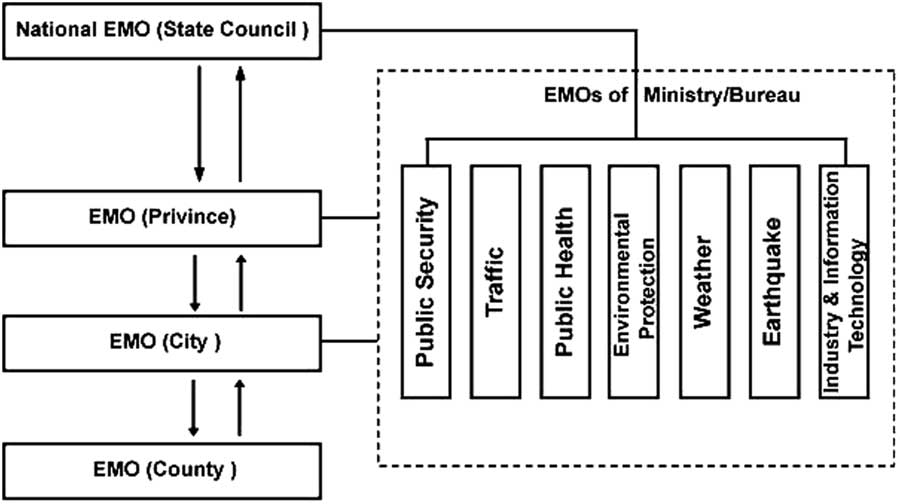
The general office of the State Council set up the national Emergency Management Office (EMO), which is in charge of emergency duty, information collection, and comprehensive coordination. Moreover, the Chinese government established two types of EMOs: (1) comprehensive EMOs, which are supposed to support the Chief Executive at each level of government, such as the Premier, governors, mayors and county heads, in managing emergencies in their jurisdictions comprehensively; and (2) specialized EMOs, which are designed to support ministers or department heads at the national level and departments or bureaus in local governments to cope with the four categorized emergenciesReference Hong
13
(Figure 1). For example, on August 12, 2015, Tianjin port explosions required the national EMO to assign a functional department (EMOs of ministry/bureau) to take the lead in setting up an accident treatment team to investigate the cause of the accident, as well as coordinate the army, police, and public for emergency rescue and support in Tianjin. The Tianjin Municipal EMO is responsible for organization and leadership of onsite emergency rescue, organization of public security, civil affairs, health, and other industries in orderly participation in the disaster relief, and engaging in restoration and reconstruction as soon as possible, coordinating efficiently, and promoting relief work timely and scientifically.
Figure 1Organization of Emergency Management Office (EMO) in China.
The Working Organization
The relevant departments of the State Council, in accordance with the relevant laws, administrative regulations, and their respective duties, are responsible for their relevant categories of emergency incident management, the drafting of special and emergency department emergency plans, and the implementation of the relevant decisions of the State Council.
Local Institutions
According to the principle of territorial management, local peoples’ governments at various levels serve as the executive leadership of emergency incident management and are responsible for managing all kinds of incidents in the administrative region. In cases in which two or more administrative regions are involved, the common peoples’ government at the next higher level shall be responsible, or the people’s governments at the next higher level of the relevant administrative regions shall be jointly responsible.
12
The Expert Group
The State Council and the EMOs at all levels shall establish all kinds of professional talent pools and employ relevant experts to provide policy recommendations for the normal and orderly conduct of the emergency management work and, if necessary, participate in the emergency response operations.
Education And Training For Disaster Medicine In China
Disaster Medicine Degree Education
To address the increasingly severe situation of Chinese disaster medicine and solve the problems of effectively training traditional emergency medicine professionals,Reference Huang, Li and Li
14
more and more Chinese medical colleges and universities—such as Xuzhou Medical College, Chongqing Medical College, Jiangsu University, Jinan University, and Tongji University—have added first-aid medicine, disaster medicine, and rescue medicine to undergraduate and postgraduate education programs based on clinical medicine and emergency medicine from 2000. This increases the talent pool in disaster medicine and also means that China has taken a historic step toward establishing a disaster medicine discipline and training professionals.
The Logistics University of Chinese People’s Armed Police Force (PAP), the only comprehensive university for training provided to military logistics professionals of PAP, set up disaster medicine undergraduate education and a disaster medicine department in China in 2006 with the approval of the Ministry of Education and the General Staff. Since 2009, a variety of postgraduate education courses—including disaster medicine management and organization, onsite medical treatment, and psychological stress interference—have been established. We began postgraduate enrollment in related specialties and have created a series of innovative teaching methods. Combining theoretical teaching with rescue practice, we give postgraduates some practical domestic rescue tasks so they can develop their scientific research consciousness regarding the demand for disaster medicine training. To date, we have cultivated 250 undergraduates in rescue medicine, 51 master degree candidates, and 8 doctoral candidates, contributing to the reserve of Chinese military emergency rescue talent.
Disaster Medical Training Base
In recent years, China has built many national rescue-training bases to meet the need for continuing medical education on disaster medicine training; these include the National Earthquake Emergency Rescue Training Base, Chinese Emergency Rescue Training Base, National Mine Rescue Training Center in Pingdingshan, and the National Rescue Medical Training Base in the Logistics University of PAP.
The National Earthquake Emergency Rescue Training Base is located at the foot of Phoenix Range in the western suburbs of Beijing with a total area of 130 000 square meters. It is a simulation-training base specializing in disaster emergencies, rescue commanders, and search-and-rescue. With its earthquake field rescue simulation system and controllable earthquake ruins, this base can simulate various disaster relief environments to allow for various training courses, such as search-and-rescue and emergency response, management, and organization, to be carried out easily.
The National Rescue Medical Training Base focuses on 7 areas: physical rescue medicine diagnoses, earthquake disaster simulation scenes, chemical plant explosion scenes, rescue worker and equipment exhibitions, virtual endoscope, virtual ICU, and specialist training. It is equipped with 10 training rooms, giving priority to generic, basic, and professional rescue skills. While assuming the training tasks of the Faculty of Medicine, Department of Clinical Medicine students, all corps, motorized divisions in vocational training and rescue medicine teams, the rescue training base also accommodates the rescue medicine training mission from the National Rescue Medicine Team of the Ministry of Health and Armed Forces; more than 4500 people have been trained to date.
Practices in Disaster Medicine
In recent years, to adapt to the international and domestic situation and keep up with the pace of development, some emergency preplans, policies, and forces have been established by the National Ministry of Health, the Army, and the Ministry of Civil Affairs. The Emergency Management Office, which has responsibility for the unified command of national disaster emergency management, was set up in 2005 under the General Office of the Chinese State Council. To date, 1 Chinese International Search and Rescue Team (CISAR) and 27 national medical rescue teams have been set up in 20 provinces. Moreover, PFPF corps are the main forces that respond to disasters. Rescue and relief works were classified as central works by PAP law in 2009. To date, the PAP corps have set up 152 emergency rescue teams, including 120 teams from the hydropower and traffic troops, 32 teams from the internal security forces, and 48 disaster medical rescue teams. These teams have built a nationwide network of emergency rescuers to perform emergency medical rescue missions.
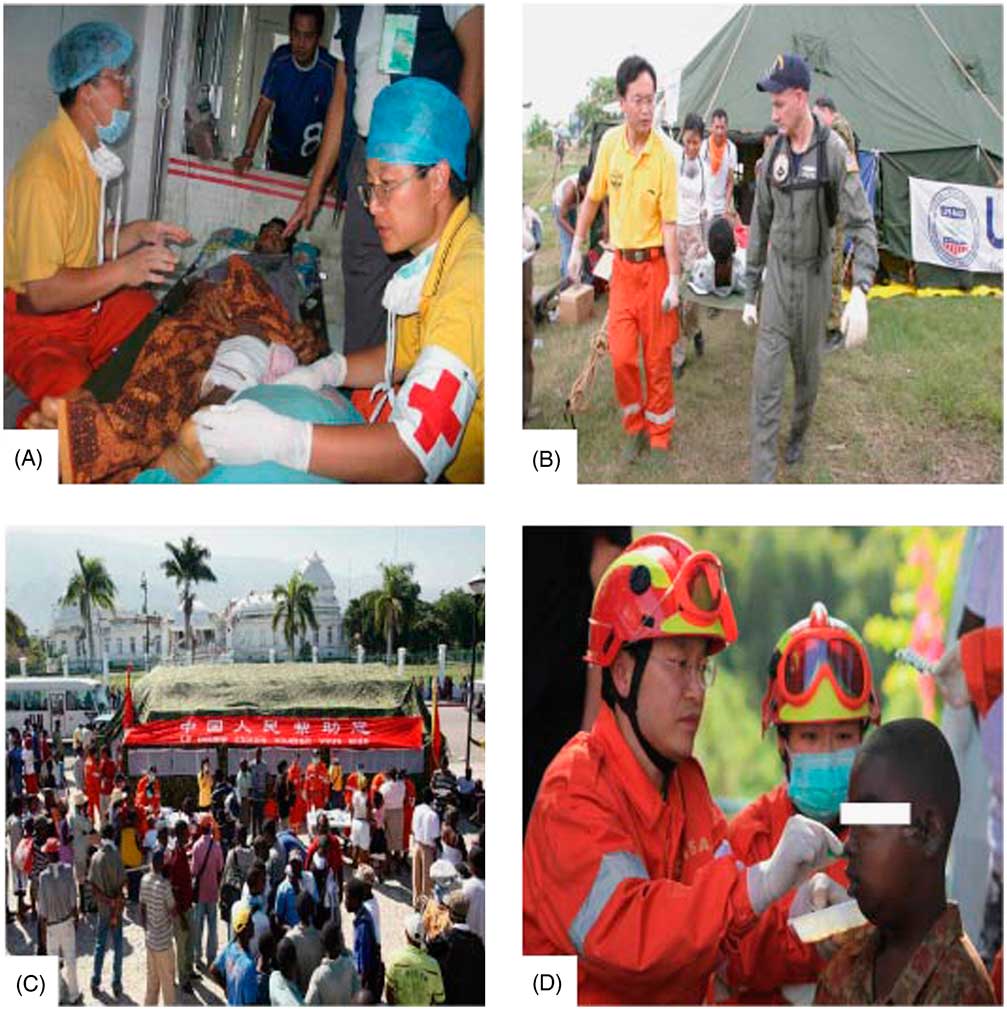
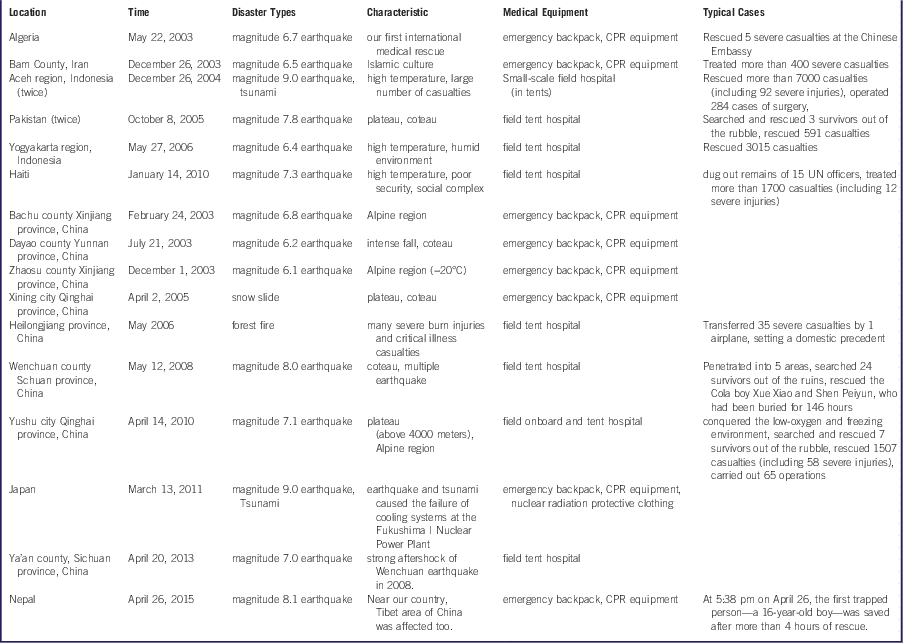
The author (HS) co-established the CISAR in 2001 and led multiple international disaster medical rescues, including the Indonesia tsunami, Haiti earthquake, Wenchuan earthquake, Yushu earthquake, and other domestic and external large-scale disaster relief missions (Figure 2). Table 1 provides more detail on the disaster medical rescue experiences of CISAR in recent years. They have successfully completed rescue work and received recognition from the public, disaster victims, and affected countries, and have also provided valuable experience and reference for the development of disaster medicine and the construction of medical rescue teams.Reference Hou
15
–
Reference Fan, Hou and Zhang
17
Figure 2Practices of Chinese International Search and Rescue Team (CISAR) in international disaster rescues. Tsunami rescue in Indonesia in 2004: (A) rescue critical patient & (B) combined transport of the injured patient with American army. Earthquake rescue in Haiti in 2010: (C) set up a tent hospital at the front of presidential palace & (D) treat patient with ocular trauma.
Table 1Disaster Medical Rescue Experiences of China International Search and Rescue (CISAR) in Recent Years
Research In Disaster Medicine
Currently, especially after the Wenchuan earthquake, Chinese governments have increased budgets for the construction and improvement of emergency response systems. Each year, more universities, academic institutes, and enterprises join in the research efforts on disaster medicine and other aspects of the emergency response system.
Disaster Medical Management
Emergency incidents have been characterized as sudden, mass, or serious harm incidents. Regardless of type, emergency incidents pose a great threat to public health, economic development, and social stability. The research on disaster medicine management focuses on the following three levels:
Strategic Level
On the national level, various contingency plans for emergencies, emergency management mechanisms, systems, and legal research have been carried out. Other research includes prediction of casualties after a disaster, disaster warning forecasts, decision-making mechanisms, and the rational distribution of rescue resources.
Campaign Level
On provincial and local government levels, the research has focused on disaster site emergency coordination command systems, medical evacuation systems based on a three-tiered treatment mode, disease spectrums, and rescue plans in different disasters.
Tactical Level
On the rescue team and emergency rescue organization level, research has mainly focused on developing emergency capability assessment standards, methods, and indicators of emergency medical emergency capability assessment. This research will provide the theoretical basis for construction standards for the national disaster relief system and rescue teams, establish scientific rescue organization systems, and improve the efficiency of disaster rescues.
Disaster Medical Technology
The treatment environment and objective of disaster medicine are different from those of emergency medicine in the hospital. The rescue staff needs to treat patients and injuries under adverse circumstances in disaster scenes. Based on modern medical disaster technology—trauma emergency, cardiopulmonary resuscitation (CPR), emergency treatment, triage, and medical evacuation—we researched the pathophysiological mechanisms, diagnosis, and treatment of several diseases and injuries that happen at the scene of different disasters. The combination of basic research clinical transformation, rescue technology, and clinical work has enhanced treatment ability of medical rescue teams in the field.
Disaster Medical Equipment
Emergency medical equipment is the basic equipment necessary for emergency rescue and disease prevention and control. With a guiding principle of “portable small equipment, modular conventional equipment, motorized large equipment,”Reference Fan, Fan and Hou
18
three kinds of emergency medical requirements were developed: search-and-rescue equipment, medical and health care equipment, and logistics equipment. The national search-and-rescue teams are equipped with multiple types of emergency medical equipment, including portable equipment, box-grouped equipment, tent hospitals, mobile hospitals, and shelter hospitals.Reference Lei, Haitao and Xin
19
Disaster Medical Psychology
One-third or more of individuals exposed to a disaster may develop posttraumatic stress disorder (PTSD) or other psychological disorders.Reference North and Pfefferbaum
20
Moreover, rescue workers may experience changes in their psychology and mental status due to continuous work and lack of adequate sleep and rest. Many issues of disaster medical psychology need to be resolved, such as how best to identify individuals in need of disaster mental health services and triage them to appropriate care and how to estimate the prevalence of PTSD and assess the determinants related to PTSD symptoms among survivors after major disasters.
At present, China has established several national psychological rescue teams, with most of the members having professional psychology or medical background, and receiving regular professional training and communication. Our research institute led to establish a national Red Cross psychological rescue team, which has participated in the psychological intervention of disaster relief task for many times, such as the Ya’an earthquake, adenovirus major outbreaks of certain military camps, and the August 12, 2015 Tianjin port explosions. In the most recent Tianjin port major explosion accident, our hospital received 322 wounded patients, among them 90 seriously injured patients needing hospitalized treatment. The psychological rescue team went into the ward for the first time to conduct psychological assessment and intervention for injured patients, which effectively reduced and prevented the occurrence of PTSD.
Environmental Medicine
China is the world’s third-largest country; located in the Northern Hemisphere, it extends over multiple climate zones, including tropical, subtropical, temperate, and frigid zones. Moreover, the plateau area accounts for a quarter of this country’s territory. The highest step of the typical “ladder topography” is formed by the Qinghai-Tibet Plateau at an average height of over 4000 meters. The world’s tallest peak, Mt. Everest (8848 m), in the Himalayas on the border with Nepal, is known as the “Roof of the World.” Extremes of heat and cold, high altitude, and other environmental factors increase the difficulty of rescue efforts. The clinical characteristics and pathological disease or injury processes are different under these extreme conditions. Specialized medications, treatment methods, personal protection, and rescue equipment need to be researched and developed to increase the capability of medical rescue teams in multiple types of complex environments.
Future Concern For Disaster Medicine In China
Basic knowledge of the type of injuries and illness caused by disasters is essential to determine the appropriate relief supplies, equipment, and personnel needed in these situations. In the past, data collected on damage following disasters were usually crude estimates based on superficial observations of limited technical and statistical validity. Disaster medicine researchers seek to provide more disciplined study into the exact nature of immediate disaster needs in terms of traumatic injuries, illness, mortality and their relationships to the demographic factors of the population. The results of such studies make significant contributions toward the development of cohesive disaster preparedness plans for communities, methods of rapid needs assessment for relief aid, and public worker training for disaster situations. Other important research priorities include the following: (1) development of earthquake casualty estimation models for improved preparedness and response, (2) determination of resuscitation potentials for improved methods of triage, and (3) operational analysis to determine which medical supplies are actually needed based on the number and nature of anticipated casualties and standard acceptable treatments. Additional studies should cover the effects on health care facilities, how evacuation decisions should be made and executed, and alternative methods of medical care delivery in situations where hospitals are rendered inoperative. Further studies of human behavior and ways to integrate existing data from the social science literature into disaster planning are critical. Finally, other areas that need to be examined include the actual risk of increased disease transmission following disasters, the cost-effectiveness of deploying field medical teams, the effectiveness or problems associated with the influx of large quantities of relief supplies and relief personnel into a disaster-affected community, and the development of a standard nomenclature for disaster-related activity.
There has been great financial investment and much professional interest within the academic community of the physical sciences (eg, geology, meteorology, engineering) regarding disasters. However, when research within these disciplines receives priority funding without commensurate emphasis on medical science, the preservation of a population’s health following a disaster may be at risk, while the survival of physical structures, such as bridges and roads, may be ensured. Consequently, our specialty must make a commitment to acquire adequate funding and provide professional education and mentoring to foster the necessary research that forms the foundation of disaster medicine. The viability of such scholarly activity depends on proper recognition of disaster medicine research through a committed forum for presentation and publication and opportunities for our physicians to receive ongoing scientific training. Finally, academic collaboration with nontraditional partners—such as engineers, geologists, social scientists, and government planners—is important if we are to further our knowledge in this multidisciplinary field.
The following recommendations are made:
∙ Explore the occurrence rules and injury characteristics of various disasters, carry out scientific and systematic fundamental research on disaster, and establish health emergency security plans combining traditional Chinese and Western medicine. Organize health care training of the simulated disaster field, optimize health emergency organization, and improve disaster medical emergency plans.
∙ Research, develop, and import the techniques combining traditional Chinese and Western medicine on disaster prevention. Reduce the number of casualties, decrease injuries, speed up casualty evacuation, and improve medical care capacity.
∙ Study medical equipment during casualty evacuation. Research and equip with small and highly portable emergency rescue equipment, which should be the most advanced, lightweight, compatible, modular, and standardized to achieve rapid exchange, rapid recharge, rapid maintenance, and joint training.
∙ Research and improve the forecasting model for the types, amount and distribution of casualties, provide a foundation for establishing a health care plan, predict the demand for treatment, evacuation and logistical support, and predict the working scale, operating environment, and geographical location of the rescue teams.
∙ Strengthen the fundamental research on disaster injury to include the body’s response to trauma, disaster severity injury assessment, the mechanism, prevention, and treatment of multiple organ dysfunction syndrome (MODS), trauma prevention research, mechanism of trauma cell molecular biology and cell molecular bioremediation biology, and research on tissue engineering. We should not only pay attention to the functional recovery of the body but also attach importance to the recovery from psychological trauma, develop functional recovery equipment, promote psychological treatment after disasters, reduce the rate and degree of disability, and improve social productivity.
∙ Rapidly create an efficient disaster medical network system. Ensure that the medical rescue, communication, and transportation networks run efficiently. Improve the disaster rescue content of medical science and technology.
∙ Set up portable ICUs and bring the emergent treatment to the field. This will play an important role in reducing the disability and death rates associated with disaster accidents and local warfare.
∙ Study disaster epidemiology. This research will promote the innovation and constant development of effective disaster medicine.
∙ View organization and management in disaster medicine as an integrated system. We must reinforce the organization and management of emergency medical services, build a strong command department to direct the work of emergency search-and-rescue, and improve the rescue medical system to guarantee successful rescue operations.
∙ To set up a triage system for disaster victims, build an elite rescue team, train a group of key members for self and mutual medical aid, strengthen onsite treatment, increase the efficiency of medical evacuation, shorten the time from trauma to surgery, and emphasize that the key to improving the efficiency of rescue is improving basic treatment technology.
∙ Medical and health departments and other disaster medical sections should be well prepared in theory, organization, equipment, and personnel—always ready to successfully implement rescue activities for disaster emergency incidents.
∙ Concentrate on the principles of scientific treatment. Organize a professional rescue team as soon as possible to provide early rescue and to enhance treatment and nursing care. Some severely wounded victims need timely surgical treatment, and if a hospital in good condition is available, they should be managed with surgery in the Emergency Department based on “fast, accurate, early, and effective” principles.Reference Li, Pei and Shen
21
∙ Pay attention to psychological impairment of the public. Sudden disaster events can induce psychological stress; statistics show that approximately three-fourths of people have so-called “terror syndrome” in varying degrees after trauma. Some suffer from mental disorders, show fear, or easily trust rumors. Psychological trauma is obvious, and we must employ proper tactics and measures.
∙ Attach importance to long-term effects on victims caused by disasters. Since the emergence of the psychological syndrome caused by the Gulf War in 1991, victims have attracted widespread attention and demonstrated that rescue treatment should be provided earlier and faster. Additionally, preventive care should be considered while the wounded receive overall treatment.
∙ According to the problems identified in many disasters, reformation and restructuring of related measures are necessary for improving emergency capacity to address a variety of disasters and sudden events to protect people’s health, life, and security. We should carry out research on disaster prevention and control to lower the incidence of disasters and the associated disability and fatality rates.
∙ Provide technical assistance, training and education programs, exercise support, and planning guidance for public health emergency preparedness and response activities.
In conclusion, Disaster Medicine is an emerging cross-discipline, but there are still many problems to be solved. Emergency rescue and disaster relief is one of the central tasks of Disaster Medicine, relying on the development of related clinical, research, and teaching efforts. We will do our best to contribute to the construction and development of the Rescue Medicine discipline in China.





 You have
Access
Adisaster has been defined as a serious disruption of the functioning of a community or a society involving widespread human, material, economic, or environmental losses and impacts that exceed the ability of the affected community or society to cope using its own resources.Reference Quarantelli 1 Disasters always arise from a fundamental disequilibrium between hazards in the environment and the vulnerabilities of human communities. In contemporary academia, disasters are seen as a consequence of inappropriately managed risk. This has led most researchers to believe that disasters were human-made, their reasoning being that human actions taken before a hazard strikes can prevent it from developing into a disaster.Reference Wisner, Blaikie and Cannon 2
Disasters typically cause property damage, injuries, and death. Compared with industrialized countries, developing countries suffer greater costs when a disaster hits. More than 95% of all deaths caused by disaster occur in developing countries. 3 As the world’s country with the largest population and biggest development, China is one of the countries most affected by disasters. In 1556, during the Ming Dynasty, the most powerful earthquake (Magnitude 8.0–8.3, Intensity 11)—more than 30 times more powerful than the 2010 Haiti earthquake—struck Hua County of the Shanxi Province in China. According to statistics, that earthquake resulted in 830 000 lives lost; this makes it the strongest earthquake in history in terms of the number of fatalities.Reference Shan 4 The Tangshan earthquake (Magnitude 7.8, Intensity 11), which struck in 1976, claimed the lives of over 240 000 people, making it the deadliest earthquake of the 20th century.Reference Sheng 5 When the earthquake struck Tangshan, many people were asleep, unaware of the great disaster that would follow. Upon entering the 21st century, major earthquakes struck China in 2008 and 2010. The 2008 Wenchuan earthquake (Magnitude 8.0, Intensity 11) caused 69 227 deaths, 374 643 injuries, and resulted in 7923 missing people.Reference Zhang, Liu and Li 6 The 2010 Yushu earthquake (Magnitude 7.1, Intensity 10) caused 2698 deaths, over 12 000 injuries, and left 270 people missing.Reference Liu, Liu and Zhang 7 Other types of disasters—such as floods, fires, infectious disease outbreaks, accidents, and terrorist attacks—also result in numerous deaths and injuries in China.
Disaster medicine is an area of medical specialization with the dual purposes of providing health care to disaster survivors and providing medically related disaster preparation, planning, response, and recovery leadership throughout the disaster life cycle.Reference Ciottone 8 Although the concept of “disaster medicine” was first proposed by Karl H. Houghton in 1955, 9 the capability of the emergency medical system to respond to disasters remained weak in China through the end of the 20th century. The severe acute respiratory syndrome (SARS) crisis of 2003, which infected more than 5300 people and killed 349 in China,Reference Jia, Feng and Fang 10 prompted the Chinese government to reconsider its traditional reactive approach to emergency management and develop a permanent emergency management bureau, the Emergency Management Office (EMO). In December 2005, a national EMO was officially established. This office serves as an interagency liaison for all emergency management and national security program activities through the State Council. In the same year, a framework was proposed for a comprehensive emergency management program to direct planning. In this framework, national emergency incidents were divided into natural disasters, accident disasters, public health incidents, and social security incidents. 11 On November 1, 2007, the Emergency Response Law of the People’s Republic of China became effective 12 ; this law further confirmed the emergency management system (EMS), accelerated the establishment of different kinds of rescue teams at national and local levels, and promoted the rapid development of disaster medicine education and research in China.
Emergency Management System In China
The Emergency Response Law of the People’s Republic of China stipulates that “the state shall establish an emergency response management system mainly featuring the uniform leadership, comprehensive coordination, categorized management, graded responsibility, and territorial management.” At the same time, China also established coverage of 2 aspects of the central and local emergency management agencies: hierarchy and clear responsibilities. After the Wenchuan earthquake, the Emergency Management System made a complete improvement in multiple aspects, including the following: (1) clarify government emergency management system: unified leadership, comprehensive coordination; classified management and graded responsibility; localization management-oriented; nongovernmental support and public participation; (2) set up a group of professional emergency rescue team; (3) establish and perfect an emergency management system of laws and regulations; and (4) establish and develop the emergency preparedness and response plans at all levels of government.
The Chinese emergency management system has its own advantages:
∙ Conducive to unified command, quick response and efficient linkage: under unified coordination and organization of central government, the whole nation copes with a catastrophe together.
∙ Conducive to the advantage of concentrating resources to accomplish large undertakings. China’s biggest advantage is that there is a strong central government, and in the entire government organization system, local governments are subordinate to the central government, and the central government can carry out effective command and coordination on local governments at all levels, focusing on integration of the different parts of the country’s power to deal with major events, to realize “when disaster struck, help came from all sides.” For example, for the Wenchuan earthquake, the central government took out 70 billion yuan as the post-disaster reconstruction fund and raised 1 trillion yuan as a reconstruction fund over the next 3 years through various channels, determining 19 provinces as counterpart support units; thus, a big performance for post-disaster reconstruction was achieved within less than 2 years.
∙ Efficiency advantage: Rapid and effective treatment for sudden events not only needs a strong organization and leadership system but also a sound and efficient mobilization, participation, and response mechanism. It has been found that under the framework of the current emergency management system in our country, response, mobilization, and response mechanism requires that the government is the main body, with army support and wide participation of the whole society being robust and efficient. It is helpful to exert the central and local enthusiasm: the central government unified leadership of the central government and localization management of governments at all levels cooperate with each other, with governments at all levels having their own responsibilities and authorities. After SARS, a national network-based infectious disease reporting system was quickly set up. By the end of 2008, it is basically universal at the township level. The system has been tested in treatment of emergencies in recent years, especially after Wenchuan earthquake in Sichuan in 2008 and the Yushu earthquake in Qinghai in 2010, with the central government organized to carry out efficient and rapid earthquake relief activities, winning the acceptance of many organizations at home and abroad.
Leadership
The State Council is the highest administrative leadership level of emergency management in China. Under the leadership of the Premier, the State Council shall study, decide, and deploy the response to an especially serious emergency incident; as needed in reality, it shall form a state emergency response command body responsible for responding to emergency incidents and, when necessary, may send a task force to manage the relevant work. 12
Offices
The general office of the State Council set up the national Emergency Management Office (EMO), which is in charge of emergency duty, information collection, and comprehensive coordination. Moreover, the Chinese government established two types of EMOs: (1) comprehensive EMOs, which are supposed to support the Chief Executive at each level of government, such as the Premier, governors, mayors and county heads, in managing emergencies in their jurisdictions comprehensively; and (2) specialized EMOs, which are designed to support ministers or department heads at the national level and departments or bureaus in local governments to cope with the four categorized emergenciesReference Hong 13 (Figure 1). For example, on August 12, 2015, Tianjin port explosions required the national EMO to assign a functional department (EMOs of ministry/bureau) to take the lead in setting up an accident treatment team to investigate the cause of the accident, as well as coordinate the army, police, and public for emergency rescue and support in Tianjin. The Tianjin Municipal EMO is responsible for organization and leadership of onsite emergency rescue, organization of public security, civil affairs, health, and other industries in orderly participation in the disaster relief, and engaging in restoration and reconstruction as soon as possible, coordinating efficiently, and promoting relief work timely and scientifically.
Organization of Emergency Management Office (EMO) in China.
The Working Organization
The relevant departments of the State Council, in accordance with the relevant laws, administrative regulations, and their respective duties, are responsible for their relevant categories of emergency incident management, the drafting of special and emergency department emergency plans, and the implementation of the relevant decisions of the State Council.
Local Institutions
According to the principle of territorial management, local peoples’ governments at various levels serve as the executive leadership of emergency incident management and are responsible for managing all kinds of incidents in the administrative region. In cases in which two or more administrative regions are involved, the common peoples’ government at the next higher level shall be responsible, or the people’s governments at the next higher level of the relevant administrative regions shall be jointly responsible. 12
The Expert Group
The State Council and the EMOs at all levels shall establish all kinds of professional talent pools and employ relevant experts to provide policy recommendations for the normal and orderly conduct of the emergency management work and, if necessary, participate in the emergency response operations.
Education And Training For Disaster Medicine In China
Disaster Medicine Degree Education
To address the increasingly severe situation of Chinese disaster medicine and solve the problems of effectively training traditional emergency medicine professionals,Reference Huang, Li and Li 14 more and more Chinese medical colleges and universities—such as Xuzhou Medical College, Chongqing Medical College, Jiangsu University, Jinan University, and Tongji University—have added first-aid medicine, disaster medicine, and rescue medicine to undergraduate and postgraduate education programs based on clinical medicine and emergency medicine from 2000. This increases the talent pool in disaster medicine and also means that China has taken a historic step toward establishing a disaster medicine discipline and training professionals.
The Logistics University of Chinese People’s Armed Police Force (PAP), the only comprehensive university for training provided to military logistics professionals of PAP, set up disaster medicine undergraduate education and a disaster medicine department in China in 2006 with the approval of the Ministry of Education and the General Staff. Since 2009, a variety of postgraduate education courses—including disaster medicine management and organization, onsite medical treatment, and psychological stress interference—have been established. We began postgraduate enrollment in related specialties and have created a series of innovative teaching methods. Combining theoretical teaching with rescue practice, we give postgraduates some practical domestic rescue tasks so they can develop their scientific research consciousness regarding the demand for disaster medicine training. To date, we have cultivated 250 undergraduates in rescue medicine, 51 master degree candidates, and 8 doctoral candidates, contributing to the reserve of Chinese military emergency rescue talent.
Disaster Medical Training Base
In recent years, China has built many national rescue-training bases to meet the need for continuing medical education on disaster medicine training; these include the National Earthquake Emergency Rescue Training Base, Chinese Emergency Rescue Training Base, National Mine Rescue Training Center in Pingdingshan, and the National Rescue Medical Training Base in the Logistics University of PAP.
The National Earthquake Emergency Rescue Training Base is located at the foot of Phoenix Range in the western suburbs of Beijing with a total area of 130 000 square meters. It is a simulation-training base specializing in disaster emergencies, rescue commanders, and search-and-rescue. With its earthquake field rescue simulation system and controllable earthquake ruins, this base can simulate various disaster relief environments to allow for various training courses, such as search-and-rescue and emergency response, management, and organization, to be carried out easily.
The National Rescue Medical Training Base focuses on 7 areas: physical rescue medicine diagnoses, earthquake disaster simulation scenes, chemical plant explosion scenes, rescue worker and equipment exhibitions, virtual endoscope, virtual ICU, and specialist training. It is equipped with 10 training rooms, giving priority to generic, basic, and professional rescue skills. While assuming the training tasks of the Faculty of Medicine, Department of Clinical Medicine students, all corps, motorized divisions in vocational training and rescue medicine teams, the rescue training base also accommodates the rescue medicine training mission from the National Rescue Medicine Team of the Ministry of Health and Armed Forces; more than 4500 people have been trained to date.
Practices in Disaster Medicine
In recent years, to adapt to the international and domestic situation and keep up with the pace of development, some emergency preplans, policies, and forces have been established by the National Ministry of Health, the Army, and the Ministry of Civil Affairs. The Emergency Management Office, which has responsibility for the unified command of national disaster emergency management, was set up in 2005 under the General Office of the Chinese State Council. To date, 1 Chinese International Search and Rescue Team (CISAR) and 27 national medical rescue teams have been set up in 20 provinces. Moreover, PFPF corps are the main forces that respond to disasters. Rescue and relief works were classified as central works by PAP law in 2009. To date, the PAP corps have set up 152 emergency rescue teams, including 120 teams from the hydropower and traffic troops, 32 teams from the internal security forces, and 48 disaster medical rescue teams. These teams have built a nationwide network of emergency rescuers to perform emergency medical rescue missions.
The author (HS) co-established the CISAR in 2001 and led multiple international disaster medical rescues, including the Indonesia tsunami, Haiti earthquake, Wenchuan earthquake, Yushu earthquake, and other domestic and external large-scale disaster relief missions (Figure 2). Table 1 provides more detail on the disaster medical rescue experiences of CISAR in recent years. They have successfully completed rescue work and received recognition from the public, disaster victims, and affected countries, and have also provided valuable experience and reference for the development of disaster medicine and the construction of medical rescue teams.Reference Hou 15 – Reference Fan, Hou and Zhang 17
Practices of Chinese International Search and Rescue Team (CISAR) in international disaster rescues. Tsunami rescue in Indonesia in 2004: (A) rescue critical patient & (B) combined transport of the injured patient with American army. Earthquake rescue in Haiti in 2010: (C) set up a tent hospital at the front of presidential palace & (D) treat patient with ocular trauma.
Disaster Medical Rescue Experiences of China International Search and Rescue (CISAR) in Recent Years
Research In Disaster Medicine
Currently, especially after the Wenchuan earthquake, Chinese governments have increased budgets for the construction and improvement of emergency response systems. Each year, more universities, academic institutes, and enterprises join in the research efforts on disaster medicine and other aspects of the emergency response system.
Disaster Medical Management
Emergency incidents have been characterized as sudden, mass, or serious harm incidents. Regardless of type, emergency incidents pose a great threat to public health, economic development, and social stability. The research on disaster medicine management focuses on the following three levels:
Strategic Level
On the national level, various contingency plans for emergencies, emergency management mechanisms, systems, and legal research have been carried out. Other research includes prediction of casualties after a disaster, disaster warning forecasts, decision-making mechanisms, and the rational distribution of rescue resources.
Campaign Level
On provincial and local government levels, the research has focused on disaster site emergency coordination command systems, medical evacuation systems based on a three-tiered treatment mode, disease spectrums, and rescue plans in different disasters.
Tactical Level
On the rescue team and emergency rescue organization level, research has mainly focused on developing emergency capability assessment standards, methods, and indicators of emergency medical emergency capability assessment. This research will provide the theoretical basis for construction standards for the national disaster relief system and rescue teams, establish scientific rescue organization systems, and improve the efficiency of disaster rescues.
Disaster Medical Technology
The treatment environment and objective of disaster medicine are different from those of emergency medicine in the hospital. The rescue staff needs to treat patients and injuries under adverse circumstances in disaster scenes. Based on modern medical disaster technology—trauma emergency, cardiopulmonary resuscitation (CPR), emergency treatment, triage, and medical evacuation—we researched the pathophysiological mechanisms, diagnosis, and treatment of several diseases and injuries that happen at the scene of different disasters. The combination of basic research clinical transformation, rescue technology, and clinical work has enhanced treatment ability of medical rescue teams in the field.
Disaster Medical Equipment
Emergency medical equipment is the basic equipment necessary for emergency rescue and disease prevention and control. With a guiding principle of “portable small equipment, modular conventional equipment, motorized large equipment,”Reference Fan, Fan and Hou 18 three kinds of emergency medical requirements were developed: search-and-rescue equipment, medical and health care equipment, and logistics equipment. The national search-and-rescue teams are equipped with multiple types of emergency medical equipment, including portable equipment, box-grouped equipment, tent hospitals, mobile hospitals, and shelter hospitals.Reference Lei, Haitao and Xin 19
Disaster Medical Psychology
One-third or more of individuals exposed to a disaster may develop posttraumatic stress disorder (PTSD) or other psychological disorders.Reference North and Pfefferbaum 20 Moreover, rescue workers may experience changes in their psychology and mental status due to continuous work and lack of adequate sleep and rest. Many issues of disaster medical psychology need to be resolved, such as how best to identify individuals in need of disaster mental health services and triage them to appropriate care and how to estimate the prevalence of PTSD and assess the determinants related to PTSD symptoms among survivors after major disasters.
At present, China has established several national psychological rescue teams, with most of the members having professional psychology or medical background, and receiving regular professional training and communication. Our research institute led to establish a national Red Cross psychological rescue team, which has participated in the psychological intervention of disaster relief task for many times, such as the Ya’an earthquake, adenovirus major outbreaks of certain military camps, and the August 12, 2015 Tianjin port explosions. In the most recent Tianjin port major explosion accident, our hospital received 322 wounded patients, among them 90 seriously injured patients needing hospitalized treatment. The psychological rescue team went into the ward for the first time to conduct psychological assessment and intervention for injured patients, which effectively reduced and prevented the occurrence of PTSD.
Environmental Medicine
China is the world’s third-largest country; located in the Northern Hemisphere, it extends over multiple climate zones, including tropical, subtropical, temperate, and frigid zones. Moreover, the plateau area accounts for a quarter of this country’s territory. The highest step of the typical “ladder topography” is formed by the Qinghai-Tibet Plateau at an average height of over 4000 meters. The world’s tallest peak, Mt. Everest (8848 m), in the Himalayas on the border with Nepal, is known as the “Roof of the World.” Extremes of heat and cold, high altitude, and other environmental factors increase the difficulty of rescue efforts. The clinical characteristics and pathological disease or injury processes are different under these extreme conditions. Specialized medications, treatment methods, personal protection, and rescue equipment need to be researched and developed to increase the capability of medical rescue teams in multiple types of complex environments.
Future Concern For Disaster Medicine In China
Basic knowledge of the type of injuries and illness caused by disasters is essential to determine the appropriate relief supplies, equipment, and personnel needed in these situations. In the past, data collected on damage following disasters were usually crude estimates based on superficial observations of limited technical and statistical validity. Disaster medicine researchers seek to provide more disciplined study into the exact nature of immediate disaster needs in terms of traumatic injuries, illness, mortality and their relationships to the demographic factors of the population. The results of such studies make significant contributions toward the development of cohesive disaster preparedness plans for communities, methods of rapid needs assessment for relief aid, and public worker training for disaster situations. Other important research priorities include the following: (1) development of earthquake casualty estimation models for improved preparedness and response, (2) determination of resuscitation potentials for improved methods of triage, and (3) operational analysis to determine which medical supplies are actually needed based on the number and nature of anticipated casualties and standard acceptable treatments. Additional studies should cover the effects on health care facilities, how evacuation decisions should be made and executed, and alternative methods of medical care delivery in situations where hospitals are rendered inoperative. Further studies of human behavior and ways to integrate existing data from the social science literature into disaster planning are critical. Finally, other areas that need to be examined include the actual risk of increased disease transmission following disasters, the cost-effectiveness of deploying field medical teams, the effectiveness or problems associated with the influx of large quantities of relief supplies and relief personnel into a disaster-affected community, and the development of a standard nomenclature for disaster-related activity.
There has been great financial investment and much professional interest within the academic community of the physical sciences (eg, geology, meteorology, engineering) regarding disasters. However, when research within these disciplines receives priority funding without commensurate emphasis on medical science, the preservation of a population’s health following a disaster may be at risk, while the survival of physical structures, such as bridges and roads, may be ensured. Consequently, our specialty must make a commitment to acquire adequate funding and provide professional education and mentoring to foster the necessary research that forms the foundation of disaster medicine. The viability of such scholarly activity depends on proper recognition of disaster medicine research through a committed forum for presentation and publication and opportunities for our physicians to receive ongoing scientific training. Finally, academic collaboration with nontraditional partners—such as engineers, geologists, social scientists, and government planners—is important if we are to further our knowledge in this multidisciplinary field.
The following recommendations are made:
∙ Explore the occurrence rules and injury characteristics of various disasters, carry out scientific and systematic fundamental research on disaster, and establish health emergency security plans combining traditional Chinese and Western medicine. Organize health care training of the simulated disaster field, optimize health emergency organization, and improve disaster medical emergency plans.
∙ Research, develop, and import the techniques combining traditional Chinese and Western medicine on disaster prevention. Reduce the number of casualties, decrease injuries, speed up casualty evacuation, and improve medical care capacity.
∙ Study medical equipment during casualty evacuation. Research and equip with small and highly portable emergency rescue equipment, which should be the most advanced, lightweight, compatible, modular, and standardized to achieve rapid exchange, rapid recharge, rapid maintenance, and joint training.
∙ Research and improve the forecasting model for the types, amount and distribution of casualties, provide a foundation for establishing a health care plan, predict the demand for treatment, evacuation and logistical support, and predict the working scale, operating environment, and geographical location of the rescue teams.
∙ Strengthen the fundamental research on disaster injury to include the body’s response to trauma, disaster severity injury assessment, the mechanism, prevention, and treatment of multiple organ dysfunction syndrome (MODS), trauma prevention research, mechanism of trauma cell molecular biology and cell molecular bioremediation biology, and research on tissue engineering. We should not only pay attention to the functional recovery of the body but also attach importance to the recovery from psychological trauma, develop functional recovery equipment, promote psychological treatment after disasters, reduce the rate and degree of disability, and improve social productivity.
∙ Rapidly create an efficient disaster medical network system. Ensure that the medical rescue, communication, and transportation networks run efficiently. Improve the disaster rescue content of medical science and technology.
∙ Set up portable ICUs and bring the emergent treatment to the field. This will play an important role in reducing the disability and death rates associated with disaster accidents and local warfare.
∙ Study disaster epidemiology. This research will promote the innovation and constant development of effective disaster medicine.
∙ View organization and management in disaster medicine as an integrated system. We must reinforce the organization and management of emergency medical services, build a strong command department to direct the work of emergency search-and-rescue, and improve the rescue medical system to guarantee successful rescue operations.
∙ To set up a triage system for disaster victims, build an elite rescue team, train a group of key members for self and mutual medical aid, strengthen onsite treatment, increase the efficiency of medical evacuation, shorten the time from trauma to surgery, and emphasize that the key to improving the efficiency of rescue is improving basic treatment technology.
∙ Medical and health departments and other disaster medical sections should be well prepared in theory, organization, equipment, and personnel—always ready to successfully implement rescue activities for disaster emergency incidents.
∙ Concentrate on the principles of scientific treatment. Organize a professional rescue team as soon as possible to provide early rescue and to enhance treatment and nursing care. Some severely wounded victims need timely surgical treatment, and if a hospital in good condition is available, they should be managed with surgery in the Emergency Department based on “fast, accurate, early, and effective” principles.Reference Li, Pei and Shen 21
∙ Pay attention to psychological impairment of the public. Sudden disaster events can induce psychological stress; statistics show that approximately three-fourths of people have so-called “terror syndrome” in varying degrees after trauma. Some suffer from mental disorders, show fear, or easily trust rumors. Psychological trauma is obvious, and we must employ proper tactics and measures.
∙ Attach importance to long-term effects on victims caused by disasters. Since the emergence of the psychological syndrome caused by the Gulf War in 1991, victims have attracted widespread attention and demonstrated that rescue treatment should be provided earlier and faster. Additionally, preventive care should be considered while the wounded receive overall treatment.
∙ According to the problems identified in many disasters, reformation and restructuring of related measures are necessary for improving emergency capacity to address a variety of disasters and sudden events to protect people’s health, life, and security. We should carry out research on disaster prevention and control to lower the incidence of disasters and the associated disability and fatality rates.
∙ Provide technical assistance, training and education programs, exercise support, and planning guidance for public health emergency preparedness and response activities.
In conclusion, Disaster Medicine is an emerging cross-discipline, but there are still many problems to be solved. Emergency rescue and disaster relief is one of the central tasks of Disaster Medicine, relying on the development of related clinical, research, and teaching efforts. We will do our best to contribute to the construction and development of the Rescue Medicine discipline in China.
Acknowledgments
This work was supported by grants from National Natural Science Foundation of China (WHTD201305-1, 71173232), Major Projects of the National Health and Family Planning Commission of China (201302003), and Key Program of National Natural Science Foundation of China (71533008).