Background
Healthcare-associated infections (HAIs) remain a major challengeReference Gilbert and Kerridge1,Reference Weiner-Lastinger, Abner and Edwards2 ; they are associated with increased morbidity and mortality.Reference Klevens, Edwards and Richards3 The total annual cost for the major HAIs is ~$10 billion in the United States.Reference Zimlichman, Henderson and Tamir4 In the last few decades, various strategies have been tried to prevent or control HAIs.Reference Yokoe, Mermel and Anderson5 National collaboratives of HAI programs have recognized many social and adaptive challenges encountered by participants.Reference Welsh, Flanagan, Hoke, Doebbeling and Herwaldt6
The Positive Deviance Collaborative notes, “Positive deviance is based on the observation that in every community there are certain individuals or groups whose uncommon behaviors and strategies enable them to find better solutions to problems than their peers, while having access to the same resources and facing similar or worse challenges.”9 This technique has been used since the 1960s in vulnerable communities to enhance the best practices for problems such as genital mutilation, malnutrition, education, contraception, and vaccinations, and more recently for HAI prevention and control.Reference Zeitlin10–Reference Marsh, Schroeder, Dearden, Sternin and Sternin14
In positive deviance, changes start at the bottom of a particular community then spread upward with initial permission from leadership.Reference Sreeramoju13 For example, employees of a particular organization would be screened looking for a positive deviant, for example, someone good at performing hand hygiene. After a specific period of positive deviance implementation, those positive deviants recruit others through regular meetings and discussions in a just culture with leadership presence.Reference Dekker and Breakey15 A social network starts to form that can be analyzed for collaboration enhancement.Reference Marra, Guastelli and de Araujo16
Positive deviance has been used in many infection prevention initiatives. Although the change occurs “from the bottom,” positive deviance interventions specifically aim to find and empower positive deviants. Positive deviance was included in the methicillin-resistant Staphylococcus aureus (MRSA) initiative (ie, MRSA bundle) at the US Department of Veterans’ Affairs (VA) medical centers in August 2006 after a successful pilot study. It was included as a modality for encouraging culture change.Reference Perencevich17
Our systematic literature review evaluates the existing evidence for using positive deviance to improve and enhance practices such as hand hygiene to prevent and control HAIs.
Methods
Systematic review and inclusion and exclusion criteria
This review was conducted according to the Preferred Reporting Items for Systematic Reviews and Meta-Analysis (PRISMA) statement.Reference Moher, Liberati, Tetzlaff, Altman and Group18 This study was registered on Prospero on November 5, 2019 (https://www.crd.york.ac.uk/PROSPERO/, registration no. CRD42019137784). Institutional review board approval was not required. We included studies that met the following criteria: original quantitative research manuscripts; published in peer-reviewed, scientific journals; involved human inpatients; and conducted in hospital settings that evaluated positive deviance as a single intervention or part of an initiative as a strategy to prevent or control HAIs. The literature search was conducted from database inception to May 31, 2020. There were no language restrictions. Qualitative studies, editorials, and commentaries were excluded.
Search strategy
The search strategies were developed in collaboration with a health sciences librarian (R.J.S.) trained in systematic review searching. The search focused on finding studies evaluating positive deviance as a single intervention or as part of an initiative to prevent or control healthcare-associated infections.
Using subject headings and keywords, systematic search strategies were created for PubMed, Embase (Elsevier), CINAHL (EBSCO), and Scopus (Elsevier). Search terms included subject headings (when available) and key words for the following terms: positive deviance, infection, infection control, epidemiology, communicable disease control, hand hygiene, hand washing, cross-infection, healthcare-associated infection, hospital infection, and nosocomial infection. The searches were conducted in May 2020, and no search filters (including date range) were used during the search process. All identified studies were combined into a citation management program (EndNote), and duplicates were identified and discarded. The detailed search strategies can be reviewed in Appendix 1 (online).
Data abstraction and quality assessment
Titles and abstracts of all articles were screened to assess whether they met inclusion criteria. The reviewers (M.A.A.1, A.R.M., and M.A.A.2) retrieved data on study design, population and setting, and the positive deviance intervention definition using paper-based forms. We also collected information about the year of intervention, study design (quasi-experimental, case-control, cohort study, or randomized clinical trial), positive deviance interventions (definition and single or part of an initiative), HAI intervention (HAIs interventions overall, and specifically hand hygiene [HH] and MRSA prevention), type of infection, and the outcome measures.
We used the scale employed by Downs and BlackReference Downs and Black19 to evaluate study quality. This tool is a checklist that has 27 items regarding reporting, external validity, bias, confounding, and power, with items scored 0–1 (except for 1 item in the reporting subscale, which is scored 0–2), where 1 is “yes” and 0 is “no” or “unable to determine.” Each reviewed paper was assessed, and the total score was calculated. We used all the questions as written except for question #27 (a single item on the power subscale, which was scored 0–5), which we changed to a yes/no answer. The score for each article was categorized as “excellent” (24–28 points), “good” (19–23 points), “fair” (14–18 points), or “poor” (<14 points).Reference O’Connor, Tully, Ryan, Bradley, Baxter and McDonough20 The authors (M.A., A.R.M., and M.A.A.) performed component quality analyses independently and reviewed all inconsistent assessments. When divergent opinions arose, consensus was achieved by discussion.Reference Alderson, Green and Higgins21
Results
Characteristics of included studies
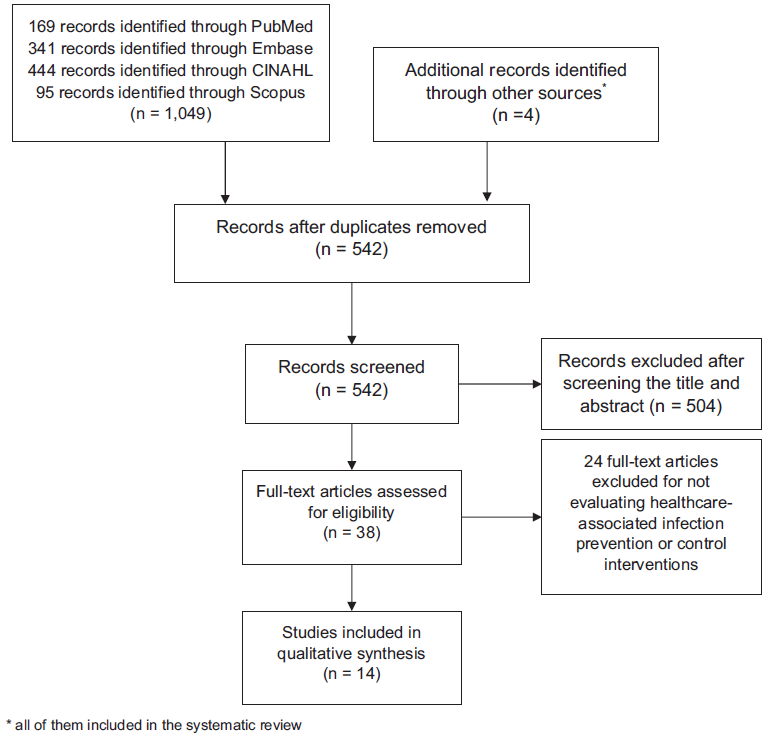
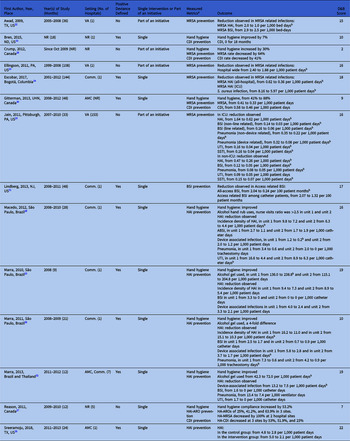
Of 38 full-text articles potentially eligible for full review (Fig. 1), 14 articles met the inclusion criteria and were included in the systematic review (Table 1).Reference Awad, Palacio and Subramanian22–Reference Sreeramoju, Dura and Fernandez35 All studies were observational, quasi-experimental (before-and-after intervention) studies.Reference Awad, Palacio and Subramanian22–Reference Sreeramoju, Dura and Fernandez35 Of the 11 studies that reported the type of healthcare setting,Reference Awad, Palacio and Subramanian22–Reference Marra, Guastelli and de Araújo26,Reference Macedo Rde, Jacob and Silva29–Reference Marra, Noritomi and Westheimer Cavalcante32,Reference Escobar, Márquez and Quiroga34,Reference Sreeramoju, Dura and Fernandez35 3 studies (27%) had at least 1 academic medical center included.Reference Gitterman, Reason and Gardam30,Reference Marra, Noritomi and Westheimer Cavalcante32,Reference Sreeramoju, Dura and Fernandez35 A quarter of the studies (3 of 11, 27%) were conducted in the Veterans’ Affairs (VA) Health Care System.Reference Awad, Palacio and Subramanian22,Reference Ellingson, Muder and Jain24,Reference Jain, Kralovic and Evans25 Few studies (3 of 12, 25%) were multicenterReference Jain, Kralovic and Evans25,Reference Reason, Rykert and Gardam27,Reference Marra, Noritomi and Westheimer Cavalcante32 ; the number of involved centers was 165 (range, 5–153 per study).Reference Awad, Palacio and Subramanian22–Reference Sreeramoju, Dura and Fernandez35 The United States (6 of 14, 43%) and Brazil (4 of 14, 29%) had the most studies among the 6 countries represented. Only 2 studies were published after 2015.Reference Escobar, Márquez and Quiroga34, Reference Sreeramoju, Dura and Fernandez35 The median duration of an intervention was 28 months (range, 9–144 months).Reference Awad, Palacio and Subramanian22–Reference Sreeramoju, Dura and Fernandez35
Literature search for articles on positive deviance in infection prevention and control.

Summary of Characteristics of Studies Included in the Systematic Review (n=14)

Note. VA, Veterans’ Affairs hospital; AMC, academic medical center; comm., community hospital; MRSA, methicillin-resistant Staphylococcus aureus; HAI, healthcare-associated infections; BSI, bloodstream infections; UTI, urinary tract infection; SSTI, skin and soft-tissue infection; QE, quasi-experimental; ICU, intensive care unit; HA, healthcare associated; ARO, antibiotic-resistant organism; CDI, Clostridioides difficile infection;
a MRSA initiative components: universal nasal surveillance for MRSA colonization, contact precautions for patients who were carriers of MRSA, hand hygiene, and an institutional culture change whereby infection control became the responsibility of everyone who had contact with patients.
b Statistically significant (P < .05).
Regarding the quality assessment of included studies, 4 studies (4 of 14, 29%) scored poorly (<14 of 28 possible),Reference Reason, Rykert and Gardam27,Reference Crump, Bryce, Ko and Busto28,Reference Gitterman, Reason and Gardam30,Reference Bren, Anderson, Gillett, Grassel, Swendseid and Hansen33 whereas 3 studies (21%) scored between 19 and 23 (good).Reference Marra, Guastelli and de Araujo16,Reference Marra, Noritomi and Westheimer Cavalcante32,Reference Sreeramoju, Dura and Fernandez35 The median score was 16 (range, 2–22). The median score for the internal validity section of the Downs and Black tool was only was only 7 of 13, while the median score for the external validity section was 3 out of 3 for the included studies. We did not observe any changes in the efficacy of the intervention in comparison to the quality of the article.
Outcome measures
Hand hygiene
Most of the studies that evaluated the effect of positive deviance on HH implemented it as a single intervention (6 of 8, 75%).Reference Marra, Guastelli and de Araújo23,Reference Marra, Guastelli and de Araújo26,Reference Macedo Rde, Jacob and Silva29,Reference Gitterman, Reason and Gardam30,Reference Marra, Noritomi and Westheimer Cavalcante32,Reference Bren, Anderson, Gillett, Grassel, Swendseid and Hansen33 All of these noted that there was an improvement in HH compliance by direct observation or indirect measures (calculating product usage, or by electronic monitoring of sink or alcohol gel dispenser use),Reference Pittet, Hugonnet and Harbarth37, Reference Haas and Larson38 yet the results of only 2 studies achieved statistical significance.Reference Marra, Guastelli and de Araujo16,Reference Marra, Noritomi and Westheimer Cavalcante32 Half of the studies (4 of 8) mentioned direct HH observation differences or rates.Reference Reason, Rykert and Gardam27,Reference Crump, Bryce, Ko and Busto28,Reference Gitterman, Reason and Gardam30,Reference Bren, Anderson, Gillett, Grassel, Swendseid and Hansen33 Although the other 4 studies (4 of 8, 50%) mentioned indirect HH measures (eg, alcohol hand gel use), the number of aliquots of alcohol gel dispensed per 1,000 patient days, and chlorhexidine used electronically.Reference Marra, Guastelli and de Araujo16,Reference Marra, Noritomi and Westheimer Cavalcante32,Reference Marra, Guastelli and de Araujo36,Reference Macedo Rde, Jacob and Silva39
Marra et alReference Marra, Guastelli and de Araújo23 (2010) found a significant increase in the use of alcohol gel from 136 to 249.5 L per 1,000 patient days (P < .01) in an intervention unit where positive deviance was used as a single intervention to enhance HH when compared to a control unit.Reference Marra, Guastelli and de Araújo23 In another study in 2011, Marra et alReference Marra, Guastelli and de Araújo26 reported a 4-fold increase in the use of alcohol hand gel after introducing positive deviance.
From the Canadian positive deviance project, Reason et alReference Reason, Rykert and Gardam27 reported that HH compliance increased by 53%. Crump et alReference Crump, Bryce, Ko and Busto28 also reported that HH compliance increased by >30% through a bundle that included positive deviance. Gitterman et alReference Gitterman, Reason and Gardam30 reported a >2-fold increase in HH compliance in a multicenter study from 2008 to 2013.
In 2012, Macedo et alReference Macedo Rde, Jacob and Silva29 reported that the ratio of alcohol hand rub use to nurse visits increased from 1 to >2.5 in 2 units after implementing positive deviance. In 2013, Marra et alReference Marra, Noritomi and Westheimer Cavalcante32 confirmed in a multicenter study that HH compliance improved by direct observation (46.5 to 62.0%; P < .001) and indirectly by the alcohol hand gel usage (42.3 to 72.0 L per 1,000 patient days; P < .05).
Bren et alReference Bren, Anderson, Gillett, Grassel, Swendseid and Hansen33 found mean HH compliance to be 72% prior to a positive deviance intervention, with a gain of 7% in 18 months with increased HH awareness due to positive deviance (Table 1).
HAI general incidence
In studies that reported overall HAI rates, positive deviance was used as a single intervention.Reference Marra, Guastelli and de Araújo23,Reference Marra, Guastelli and de Araújo26,Reference Macedo Rde, Jacob and Silva29,Reference Marra, Noritomi and Westheimer Cavalcante32,Reference Sreeramoju, Dura and Fernandez35 In 2010, Marra et alReference Marra, Guastelli and de Araújo23 found an observed reduction in HAI incidence density (9.4 to 6.5 infections per 1,000 patient days in a positive deviance intervention unit vs 8.9 to 12.7 in a control unit, P < .05). In 2011, Marra et alReference Marra, Guastelli and de Araújo26 again reported a decrease in HAI incidence density in 2 units (16.2 to 11.0 and 15.1 to 10.3 per 1,000 patient days; P < .05) following a positive deviance intervention between 2007 and 2009.
Macedo et alReference Macedo Rde, Jacob and Silva29 found that HAI incidence density trended downward in 2 units (9.8 to 7.2 and 6.3 to 4.4 per 1,000 patient days; P, nonsignificant).Reference Macedo Rde, Jacob and Silva29 From Brazil and Thailand in 2013, Marra et alReference Marra, Noritomi and Westheimer Cavalcante32 reported no significant difference in positive deviance before and after an intervention to reduce HAI incidence density.Reference Marra, Noritomi and Westheimer Cavalcante32
In 2018, Sreeramoju et alReference Sreeramoju, Dura and Fernandez35 evaluated positive deviance with randomly selected units and found no significant difference between intervention and control units, but both experienced a statistically significant decrease in the rate of HAIs over time after implementing positive deviance.
BSI incidence
All studies reporting overall BSI incidence used positive deviance as a single intervention,Reference Marra, Guastelli and de Araújo23,Reference Marra, Guastelli and de Araújo26,Reference Macedo Rde, Jacob and Silva29,Reference Marra, Noritomi and Westheimer Cavalcante32 and 1 study reported access-related BSIs in hemodialysis centers.Reference Lindberg, Downham, Buscell, Jones, Peterson and Krebs31 In 2011, Marra et alReference Marra, Guastelli and de Araújo26 reported a reduction in the BSI in 1 of 2 units that were studied (2.5 to 1.7 and 0.7 to 0.9 per 1,000 catheter days; P, nonsignificant). Macedo et alReference Macedo Rde, Jacob and Silva29 reported a trend toward reduction, but the changes were not statistically significant. In 2013, Marra et alReference Marra, Noritomi and Westheimer Cavalcante32 found a decrease in BSI (1.6 to 0.0 per 1,000 catheter days; P nonsignificant) in 7 participating centers.
In 2013, Lindberg et alReference Lindberg, Downham, Buscell, Jones, Peterson and Krebs31 evaluated the effect of positive deviance on BSI in hemodialysis patients. They found a statistically significant reduction in access-related BSIs (2.04–0.24 per 100 patient months; P < .01).Reference Lindberg, Downham, Buscell, Jones, Peterson and Krebs31
MRSA prevention
Positive deviance was used as part of the initiative in 4 studies (4 of 6, 67%) that reported on MRSA-related HAIs.Reference Awad, Palacio and Subramanian22,Reference Ellingson, Muder and Jain24,Reference Jain, Kralovic and Evans25,Reference Crump, Bryce, Ko and Busto28 Awad et alReference Awad, Palacio and Subramanian22 reported a reduction in MRSA-related HAIs (2.0 to 1.0 per 1,000 bed days; P < .05). In 2011, Ellingson et alReference Ellingson, Muder and Jain24 found a decrease in hospital-wide MRSA infection or colonization (2.40 to 1.88 per 1,000 patients days; P < .01).
From the largest study of positive deviance, a Veterans’ Affairs initiative, Jain et alReference Jain, Kralovic and Evans25 reported a significant reduction in MRSA-related HAIs (1.64 to 0.62 per 1,000 patient days; P < .001 for trend) in intensive care units (ICU), a decline in the rate of MRSA BSI not related to a device (0.16 to 0.06 per 1,000 patient days; P < .001 for trend), and a decline in the rate of MRSA device-related BSIs (0.14 to 0.03 per 1,000 patient days; P < .001 for trend). In the same study, there was also a reduction in MRSA-related HAIs in non-ICUs (0.47 to 0.26 per 1,000 patient days; P < .001 for trend) and for MRSA BSI (0.12 to 0.05 per 1,000 patient days; P = .11).Reference Jain, Kralovic and Evans25
From Colombia, Escobar et alReference Escobar, Márquez and Quiroga34 noted a reduction in MRSA-related HAIs across a single hospital (4.43 to 2.69 per 1,000 patient days; P < .001) and in ICUs (0.77 to 0.45 per 1,000 patient days; P < .05) using positive deviance a single intervention.Reference Escobar, Márquez and Quiroga34
Other specific HAI outcomes
In 2010, Marra et alReference Marra, Guastelli and de Araújo23 observed a nonsignificant reduction in device-associated infections in 2 units (4.0 to 2.4 and 3.3 to 2.1 per 1,000 patient days; P nonsignificant). In 2011, they found a statistically significant difference (5.8 to 2.8 and 3.7 to 1.7 per 1,000 patient days; P < .05).Reference Marra, Guastelli and de Araújo26 Similar findings were reported by Macedo et al,Reference Macedo Rde, Jacob and Silva29 from 1.2 to 0.2 per 1,000 patient days (P < .05).Reference Macedo Rde, Jacob and Silva29 From a multicenter study in Brazil and Thailand in 2013, Marra et alReference Marra, Noritomi and Westheimer Cavalcante32 found a reduction in device-associated infection from 13.2 to 7.2 per 1,000 patient days; P < .05).Reference Marra, Noritomi and Westheimer Cavalcante32
In 2011, Jain et alReference Jain, Kralovic and Evans25 found a reduction in pneumonia in ICUs; the non–ventilator-associated rate dropped from 0.35 to 0.22 per 1,000 patient days (P < .05), and the ventilator-associated rate fell from 0.32 to 0.08 per 1,000 patient days (P < .05).Reference Jain, Kralovic and Evans25 They noted a similar reduction in non-ICUs from 0.08 to 0.05 per 1,000 patient days (P < .05).Reference Jain, Kralovic and Evans25 From Brazil in 2011, Marra et alReference Marra, Guastelli and de Araújo26 reported a decrease in pneumonia rates in 2 units (from 7.3 to 0.6 and 4.2 to 0.9 per 1,000 tracheostomy days; P < .05 for both).Reference Marra, Guastelli and de Araújo26 Macedo et alReference Macedo Rde, Jacob and Silva29 showed a decrease in 2 units in pneumonia rates (from 3.4 to 0.6 and 2.0 to 0.0 per 1,000 tracheostomy days; P, nonsignificant). Subsequently in 2013, Marra et alReference Marra, Noritomi and Westheimer Cavalcante32 showed a decline in pneumonia rates in a multicenter study (from 13.4 to 7.4 per 1,000 ventilator days; P, nonsignificant).
With regard to urinary tract infection (UTI), Jain et alReference Jain, Kralovic and Evans25 demonstrated a reduction in UTI in both the ICU (from 0.16 to 0.04 per 1,000 patient days; P < .05) and non-ICU settings (from 0.09 to 0.05 per 1,000 patient days; P, nonsignificant). In 2012, Macedo et alReference Macedo Rde, Jacob and Silva29 reported a decrease in the UTI rate in 2 units (from 16.6 to 4.4 and from 8.9 to 6.3 per 1,000 catheter days; P < .05 for both). Other studies were not able to demonstrate any significant decreases in their rates.Reference Marra, Guastelli and de Araújo23,Reference Marra, Guastelli and de Araújo26
Discussion
Our systematic literature review showed a tendency toward the benefit of positive deviance to reduce healthcare-associated infections. The positive deviant assists the group in achieving goals through discussion, empowerment, and role modeling.Reference Sreeramoju13 It reverses the flow of influence and authority, as the learning pyramid is not top-down but bottom-up with the front-line worker now occupying the top position.Reference Marsh, Schroeder, Dearden, Sternin and Sternin14 The principles of diffusion of innovations are very useful to comprehend the spread of a new practice or change through an institution or a community.Reference Greenhalgh, Robert, Macfarlane, Bate and Kyriakidou40,Reference Rogers41
In this review, we found that positive deviance may help different institutions in different countries around the world to achieve improvements in infection prevention and control. Positive deviance is an innovative method that does not require a strong infrastructure and thus is useful in underdeveloped countries.Reference Goldstein, Hazy and Lichtenstein42,Reference Marsh, Pachón and Schroeder43
For HH, when positive deviance was used as a single intervention, it improved the compliance rate by direct and indirect observation.Reference Marra, Guastelli and de Araújo23,Reference Marra, Guastelli and de Araújo26,Reference Macedo Rde, Jacob and Silva29,Reference Marra, Pavão Dos Santos, Cendoroglo Neto and Edmond44 It is possible that positive deviance improved HH compliance by developing a sense of ownership among healthcare workers and by demonstrating that HH is the most important tool for decreasing HAIs.Reference Marra, Guastelli and de Araujo36
Regarding HAIs, a significant reduction in overall incidence was observed in many studies included in this review.Reference Marra, Guastelli and de Araujo16,Reference Marra, Noritomi and Westheimer Cavalcante32,Reference Marra, Guastelli and de Araujo36,Reference Macedo Rde, Jacob and Silva39 In the studies by Sreeramoju et al,Reference Sreeramoju13,Reference Sreeramoju, Dura and Fernandez35,Reference Spreitzer and Sonenshein45 there was no difference between the randomly selected intervention units and control units, but there was an overall reduction in HAIs for both units combined after the positive deviance intervention, which could be explained by a contiguous effect of positive deviance once started in an institution.
The VA Health System started an MRSA reduction intervention in which positive deviance was used as a component of a VA infection prevention initiative.Reference Jain, Kralovic and Evans25 This could be attributed to the other elements of the structured initiative like MRSA nasal screening with contact precautions and standardized hand hygiene, but positive deviance was a new addition at that point and it might have enhanced the other components of this initiative.
Our study has several limitations. First, all of the included studies were nonrandomized, before-and-after, quasi-experimental observational studies (14 studies), which are subject to multiple biases.Reference Awad, Palacio and Subramanian22–Reference Escobar, Márquez and Quiroga34 This design is the most common study design in the infection prevention literatureReference Morgan, Murthy and Munoz-Price46 and is frequently used when it is not logistically feasible or ethical to conduct a randomized, controlled trial.Reference Eliopoulos, Harris, Lautenbach and Perencevich47 However, study quality regarding compliance rates, bias and confounding, and failure to adjust for confounders and confirm equivalency between before-and-after test groups is a limitation of this review. Thus, it does not allow us to draw stronger conclusions from this evidence.Reference Stroup, Berlin and Morton48 Second, the effect of positive deviance cannot be limited to defined units or locations as the involved employees may share their success and enable positive effects in the nonintervention arm, as observed by Sreeramoju et al.Reference Sreeramoju, Dura and Fernandez35 Third, some studies that used positive deviance as a part of a bundle did not define the exact process of positive deviance implementation, positive deviant recruitment process, and social networking analysis, which may limit the impact of these studies on the effect of positive deviance on HAI prevention and control. Lastly, we could not perform a meta-analysis for the measured metrics because there were no reported absolute numbers in some studies and different metrics were used in different units with a limited number of included studies.
In conclusion, our systematic review included the best available evidence to support the use of positive deviance as a promising social empowering tool to achieve improvements in infection prevention. Higher-quality studies are needed given the overall low quality of available data identified in this systematic review. We suggest that future studies carefully define the positive deviant initial and subsequent recruitment processes.Reference Marsh, Schroeder, Dearden, Sternin and Sternin14 Those studies should show the initial and improved social networking and how that impacted and enabled front-line personnel.Reference Dekker and Breakey15,Reference Sreeramoju49 positive deviance is particularly relevant in the context of COVID-19; resource constraints affect the implementation of infection prevention recommendations and individuals within healthcare facilities must generate local solutions to address shortages, uncertainty, and stress.
Acknowledgments
Financial support
No financial support was provided relevant to this article.
Conflicts of interest
All authors report no conflicts of interest relevant to this article.
Appendix 1. Detailed search strategies
PubMed
(“positive deviance”[tw]) OR (positive[tw] AND devian*[tw]) AND (“infection”[MeSH Terms] OR infection*[tw] OR “Infection Control”[Mesh] OR Epidemiology[mesh] OR Epidemiology[tw] OR “Communicable Disease Control”[Mesh] OR “Communicable Disease Control”[tw] OR “Hand Hygiene”[Mesh] OR “hand hygiene”[tw] OR “Cross Infection”[Mesh] OR “Cross Infection” [tw] OR “Cross Infections” [tw] OR “Health Care Associated Infection” [tw] OR “Health Care Associated Infections” [tw] OR “Healthcare Associated Infection” [tw] OR “Healthcare Associated Infections” [tw] OR “Hospital Infection” [tw] OR “Hospital Infections” [tw] OR “Nosocomial Infection” [tw] OR “Nosocomial Infections” [tw])
Embase
(‘positive deviance’ OR ‘positive deviance’:ab,ti (positive AND deviance) OR (positive AND devian*)) AND (‘infection’/exp OR infection OR ‘infection’:ab,ti OR ‘infections’:ab,ti OR ‘infection control’/exp OR ‘infection control’ OR ‘epidemiology’/exp OR epidemiology OR ‘communicable disease control’/exp OR ‘communicable disease control’ OR ‘communicable disease control’:ab,ti OR ‘hand washing’/exp OR ‘hand washing’ OR ‘hand washing’:ab,ti OR ‘hand hygiene’:ab,ti OR ‘cross infection’/exp OR ‘cross infection’ OR ‘cross infection’:ab,ti OR ‘healthcare associated infection’/exp OR ‘healthcare associated infection’ OR ‘healthcare associated infection’:ab,ti OR ‘health care associated infections’:ab,ti OR ‘health care associated infection’:ab,ti OR ‘hospital infection’/exp OR ‘hospital infection’ OR ‘hospital infections’:ab,ti OR ‘hospital infections’:ab,ti OR ‘nosocomial infection’:ab,ti OR ‘nosocomial infections’:ab,ti)
CINAHL
(TI (“positive deviance”) OR (positive AND devian*)) OR (AB (“positive deviance”) OR (positive AND devian*)) AND (((MH “Infection+”) OR (MH “Cross Infection+”) OR (MH “Epidemiology+”) OR (MH “Infection Control+”) OR (MH “Handwashing+”)) OR (TI (infection OR infection* OR Epidemiology OR “Communicable Disease Control” OR “hand hygiene” OR “Cross Infection” OR “Cross Infections” OR “Health Care Associated Infection” OR “Health Care Associated Infections” OR “Healthcare Associated Infection” OR “Healthcare Associated Infections” OR “Hospital Infection” OR “Hospital Infections” OR “Nosocomial Infection” OR “Nosocomial Infections”)) OR (AB (infection OR infection* OR Epidemiology OR “Communicable Disease Control” OR “hand hygiene” OR “Cross Infection” OR “Cross Infections” OR “Health Care Associated Infection” OR “Health Care Associated Infections” OR “Healthcare Associated Infection” OR “Healthcare Associated Infections” OR “Hospital Infection” OR “Hospital Infections” OR “Nosocomial Infection” OR “Nosocomial Infections”)))
SCOPUS
(TITLE-ABS-KEY ((‘positive AND deviance’ OR (positive AND deviance) OR (positive AND devian*)))) AND ((((TITLE-ABS-KEY ((infection) OR (‘infection AND control’) OR (epidemiology) OR (‘communicable AND disease AND control’) OR (‘hand AND washing’) OR (‘hand AND hygiene’) OR (‘cross AND infection’) OR (‘cross AND infections’) OR (‘healthcare AND associated AND infection’) OR (‘healthcare AND associated AND infections’) AND (‘health AND care AND associated AND infection’) AND (‘health AND care AND associated AND infections’) OR (‘hospital AND infection’) OR (‘hospital AND infections’) OR (‘nosocomial AND infection’) OR (‘nosocomial AND infections’)))) OR (INDEXTERMS (“infection” OR “infection control” OR “epidemiology” OR “communicable disease control” OR “hand washing” OR “cross infection” OR “healthcare associated infection” OR “hospital infection”))))