War, although devastating, offers a matchless opportunity to transform the state. The magnitude of resources a country must amass to finance the means of war offers rulers the incentives to invest in state making while reducing domestic resistance to taxation. War clears the path to fiscal centralization,Footnote 1 the professionalization of the tax administration,Footnote 2 and the adoption of new taxes—from excisesFootnote 3 to progressive income taxes.Footnote 4 Fiscal innovations are often accompanied by complementary organizations, including treasuries and central banks,Footnote 5 and improved budgeting technologies.Footnote 6 Far from disappearing, the financial innovations that make war possible are expected to exert lasting effects on the extractive capacity of the state;Footnote 7 that is, states make war as much as war makes states.Footnote 8
This argument, known as the bellicist theory of state formation, draws heavily from the history of state building in Europe from the fifteenth to the eighteenth century.Footnote 9 But the evidence is mixed outside the European continent. Why did war make states in Europe but not in the so-called periphery (i.e., Asia, Africa, and Latin America)? Modern states outside Europe were created only in the nineteenth century, coinciding with or following the first globalization of international finance.Footnote 10 Readily available external finance weakened the incentives to expand taxation and develop domestic credit institutions, breaking the connection between war and state making.
Others have revisited the bellicist hypothesis by focusing on initial conditions: urbanization and regime type,Footnote 11 and initial state capacity and social composition.Footnote 12 Insightful as they are, these studies omit the fundamental change that increased liquidity in international credit markets in the nineteenth century represented for state formation. That is the focus of this study. Centeno and Thies, the two closest contributions, rightfully argue that international loans limited state capacity in Latin America;Footnote 13 however, they leave the theoretical mechanism by which rulers preferred external finance over taxation unspecified. If taxation is as beneficial in the long run as previous works suggest, why would rulers not prefer to finance war with tax money? The mechanism of transmission that connects warfare (or lack thereof) in the nineteenth century to the present day is also absent. Another issue involves the Ricardian equivalence—that loans act as deferred taxes. The implication for state building is that financing war one way or another should not make a difference in the long run; however, the empirical evidence in Centeno and Thies suggests that loan-financed war in Latin American did not build capacity (i.e., did not “make states”). An explanation for the reason that the Ricardian equivalence does not always hold is missing. Finally, their empirics suffer from the limitations of purely observational work.
I fill these vacuums by advancing a political economy of war finance. Exerting a fiscal effort to finance war with tax revenue expands the future share of private income that the ruler can tax. However, taxation requires political concessions to overcome taxpayers’ resistance to higher rates, which explains the ruler's reservations to finance war with taxes, let alone if alternative sources of funding like external loans are available. A simple decision-theoretic model suggests that the ruler's preference for foreign loans relative to taxes depends on a combination of domestic and international conditions. First, shorter time horizons strengthen the ruler's preference for external finance because gains in fiscal capacity are realized only in the long run. Shorter time horizons are consistent with political instability and scenarios in which political survival depends on winning war, hence the ability to mobilize resources in a timely manner. Second, low levels of initial state capacity make external finance more appealing because the latter secures funds that exceed the short-run possibilities of taxation. Third, low levels of initial power-sharing institutions strengthen preference for external finance because the alternative—taxation—involves higher political concessions. Fourth, cycles of high liquidity in the international credit market favor external finance. High liquidity implies more favorable loan terms even for countries with dubious fundamentals, thus increasing the present value of external finance. Fifth, an extended practice of external debt relief and the exchange of old bonds for nontax revenue and state monopolies limit the future cost of default, strengthening the preference for external loans over taxes. This battery of domestic and international conditions suggests that the scope conditions to finance war with taxation, even if only partially, are rather narrow, hence the opportunities to build long-run fiscal capacity.
I address the other gaps in the literature as follows. First, I advance (and show empirically) a mechanism of transmission of war finance's effect that builds on its political economy. Financing war with taxes facilitates political compromise between the ruler and taxpayers. In turn, these power-sharing institutions transform taxation into a non-zero-sum game, carrying on the effect of warfare into long-term fiscal capacity. Second, I show that the Ricardian equivalence does not necessarily hold in the presence of external debt relief or if defaulters can exchange war debt for nontax revenue and state monopolies. When that is the case, war does not necessarily make states. Third, I address threats to identification by exploiting unannounced systemic shocks in international capital markets known as sudden stops of credit. These global crises created time windows in which, for exogenous reasons, warring states could not rely on external loans to finance the means of war. To cope with endogeneity in war participation, I concentrate on a subsample of wars that were initiated while credit still flowed but suddenly dried up, thus disconnecting the decision to go to war or the type of war to fight from the availability of external finance.
The empirical analysis draws on a sample of over 100 countries as early as 1816. Holding a host of initial economic and political characteristics constant, results show that war is conducive to stronger states in the short and long run if it is waged in the absence of external finance, that is, when incentives to tax were strong. On the contrary, making war while having access to international capital markets tends to be inconsequential—even detrimental—for state building. Consistent with the often-oversimplified original work of Charles Tilly, results confirm that state building is not merely a function of war making but also of access to domestic capital, namely taxes or domestic loans.Footnote 14
The last section of the empirical analysis offers evidence of the transmission mechanism. Tax-financed war in the long ninteenth century strengthened executive constraints in the short and long run, facilitating transmission of the fiscal effort of war into future tax capacity. The conclusion compares state building in the periphery with that of European countries in early modern times.
A Political Economy of War Finance
Modern warfare is funded by a combination of loans and taxes.Footnote 15 Resorting to one or the other is as much a matter of possibility (has the state enough capacity to tax and access to credit markets?) as of political opportunity (who benefits from borrowing and taxing?). For a decision-theoretic account that incorporates both types of considerations, I model an incumbent's decision to finance the cost of war, W, with taxes T or loans L, which, for the sake of exposition, are assumed mutually exclusive.Footnote 16 I also assume that war, which begins and ends in Period 1, is exogenous and that the incumbent seeks to maximize war funds and minimize political concessions. This stylized set-up seeks to identify how the incumbent's incentives to resort to external finance vary as a function of domestic political calculus and the liquidity of international credit markets. The result of this exercise informs the empirical design. I discuss other forms of war finance later.
Taxation is politically delicate because it involves some form of extraction from elites, the masses, or both. Rulers can rarely impose new taxes on elites without their consent, consultation, and negotiation.Footnote 17 In return for newer taxes, elites may demand veto powers over spending decisions. Consistently, tax increases to finance the means of war yielded major advances in parliamentary representation in early modern Europe.Footnote 18 Taxing the masses may not be easier, especially when the tax increase is accompanied by a military draft. In such circumstances political concessions may be required to prevent tax revolts from below.Footnote 19 One way or another, power-sharing institutions “were the price and outcome of bargaining with different members of the subject population in overcoming resistance to financing with taxation the means of war.”Footnote 20 Throughout, ct denotes the ruler's political concessions from financing war with taxes.
Financing war with taxes requires some capacity to assess wealth and monitor compliance, namely fiscal capacity. Tax revenue is bounded above by the present stock of fiscal capacity κ ∈ [0, 1]. Tax capacity can be expanded via institutional investment at the cost of forgone public consumption.Footnote 21 Here I take a different route where tax collection improves over time as a result of the tax administration accumulating know-how, for example, tax collectors learn common avoidance schemes over time.Footnote 22 Know-how expands future fiscal capacity by η < 1 units, which captures the ratchet effect of taxation in a reduced form. Future payoffs are discounted at a rate δ 1. Together, the present discounted value of financing war with taxes is
 $$\kappa T-W-c_t + \delta [{(\kappa + \eta )T-c_t}] $$
Expression 1 captures in a stylized fashion the intrinsic dilemma of fiscal capacity building. It expands permanently the volume of resources that can be mobilized for national defense, κ + η, but it does so by increasing executive constraints, ct. It is not obvious that the ruler will always prefer to finance war with taxation, particularly if other options are available.Footnote 23
The political consequences associated with taxation—power-sharing institutions—are crucial to understanding the persistence of fiscal effects of war mobilization, κ + η. Limited government is conducive to “quasi-voluntary compliance” by taxpayers because political accountability grants credibility to the promised returns for taxes.Footnote 24 Besley and Persson formalize the opportunities of sustained cooperation in tax policy created by power-sharing institutions.Footnote 25 In “common-interest states”—where government revenue is used in the common interest (e.g., national defense)—taxation becomes a positive-sum self-enforcing game. The ruler secures a constant stream of funds to produce the public good while taxpayers are protected from arbitrary expropriation.Footnote 26 Power-sharing institutions, in sum, carry on the fiscal effect of warfare in the long run.
Financing war with domestic loans is expected to carry political concessions similar to taxation;Footnote 27 however, domestic borrowing requires levels of capital accumulation that cannot be taken for granted, especially not in the developing world.Footnote 28 When domestic credit is tight, states finance externally.
Compared to taxation and domestic finance, external finance carries lower political costs, cl < ct. First, rulers do not need to concede political rights or representation to international lenders—a good margin suffices. Second, loans have low public visibility, which preempts social contestation during wartime.Footnote 29 Third, external finance decreases domestic accountability. Not having to depend on their citizens for tax revenue, rulers have a freer hand in enacting war policy.Footnote 30
Loans operate as deferred taxes—the Ricardian equivalence states.Footnote 31 Debt is repaid in Period 2 out of tax revenue, which carries political concessions ct. Repayment, however, is often uncertain; default happens with probability d, and carries a sanction, β ≥ 0. This parameter reflects the stringency of a future default settlement. Together, the ruler's present discounted value of financing war externally is
 $$L-W-c_l + \delta [ {(1-d)(\kappa T-(1 + i)L-c_t)\; -d\beta} ] \; \; \; \; $$
where (1 + i)L denotes repayment of the standing principal plus interest. The interest is set in the international capital market, where loans are floated. Countries with a history of default are expected to pay a premium p for their lack of reputation.Footnote 32 Let i = r + p, where r is the interest rate of a risk-free sovereign bond (e.g., the British Consol) and p = (1 + r)d/(1 − d), which is strictly increasing in the probability of default.Footnote 33
When does the ruler prefer to finance war with external loans? When tax revenue is lower than the cost of war, κT < W ; or when κT ≥ W provided that
 $$L\; \ge \displaystyle{{\kappa T-\Delta c + \delta [ {\eta T + d(\kappa T\; -c_t + \beta )} ] } \over {\; 1-\delta (1 + r{^\ast})}}$$
where ∆c = (ct − cl). We can draw several lessons from Expression 3. First, the preference for external finance strengthens as the costs of political concessions ∆c grow relative to the discounted value of fiscal capacity expansion, κ + δη. This result illuminates why common-interest states characterized by sustained taxation and political accountability are harder to reach when initial fiscal capacity κ is low.Footnote 34 The preference for loans over taxes decreases as cl approaches ct, that is, as ∆c shrinks. This gap narrows when some form of power-sharing institutions are already in place in Period 1. Empirically, these results recommend controlling for initial fiscal capacity and political conditions whenever possible.
Second, Expression 3 suggests that the preference for external finance depends on the cycle of the international capital market. To see this point, let's assume that r is set in equilibrium in the international market in which capital supply is defined by the inverse linear function rs = αs + ϕsqs, where qs denotes the global supply of capital, and ϕs > 0. Without loss of generality, global loan demand is given by the inverse function rd = 1 − ϕdqd, ϕd > 0. The international market clears at r* = 1 − ϕd(1 − αs)/(ϕd + ϕs), the price of the risk-free asset (e.g., British Consols). When international capital markets experience a positive shock—for instance, following a capital surplus in a major economy—the international credit supply shifts to rs = αs' + ϕsq, αs' < αs, hence (r')* < r*, p((r')*) < p(r*), and i((r')*, p((r')*)) < i(r*, p(r*)). That is, in expansive cycles, more and cheaper credit is available even for countries with a history of default.Footnote 35 And vice versa, international capital market contractions—for instance, following a global financial crisis—make credit tighter and more expensive across the board, weakening preference for external finance. For a large enough negative shock, αs' > 1, international lending ceases, strengthening incentives to finance war with taxes. The empirical design builds from this result to identify periods in which incentives to tax are strongest.
Third, preference for external finance is stronger in the presence of short time horizons, or low δ. These may reflect individual time preferences, general political instability, or the importance of winning war for political survival. Either way “borrowing provides the current leader with resources today, while repayment typically has to be made by a future government. From the national perspective, loans are not free resources, but unless the leader is fortunate enough to have a long tenure, they are from the leader's perspective.”Footnote 36
Fourth, the effect of the probability of default d depends on the magnitude of the default sanction. For β > ct − κT, preference for external finance weakens with the probability of default.Footnote 37 This is driven by aversion to sanction β associated with default. When β < ct − κT, the disutility of defaulting is smaller than the disutility of taxing. Those with a high probability of default will most prefer external finance, potentially creating a lending-and-default cycle. To prevent this scenario, international investors can increase the severity of default sanctions β. However, the opposite often happened in the first globalization of credit. Despite recurrent default,Footnote 38 “haircuts” were frequent and substantial, reaching 40 and 50 percent of war debt.Footnote 39 When debt was unforgiven, default settlements included reductions in interest rates and extensions of maturities, which further weakened the incentives to enhance fiscal capacity after default. Some default settlements did not even involve a transfer of tax money for war debt. Instead, defaulters would exchange old bonds for nontax revenue (e.g., land) and state monopolies.Footnote 40 The exchange of these assets for old bonds explains why lending to serial defaulters took place in the first globalization of finance. And specific to state building, it allowed defaulters to regain access to international credit markets without enhancing tax capacity, precluding the Ricardian equivalence.Footnote 41
Empirical Implications
The previous discussion suggests that having access to external credit is consequential to understanding the conditions under which war makes states precisely because taxes and loans may not exert the same transformative effects on fiscal capacity. The bellicist hypothesis assumes the Ricardian equivalence, namely, that loans operate as deferred taxes. Accordingly, rulers assume responsibility for war debt, (1 − d) = 1, and enhance taxation to service debt after military conflict, thus contributing to state making. However, generalized debt relief and the exchange of war debt for equity may unravel that causal chain, thus the equivalence of taxes and loans for the purpose of state building.Footnote 42 Based on the uncertain effects of loan-financed war on fiscal capacity and the positive impact of financing war with taxes, I expect that the more war is financed with taxes relative to loans, the stronger fiscal capacity should be after military conflict, holding everything else constant.
Finally, war may be (partially) financed with tools other than taxes and loans. Rulers might rely on nontax revenue (e.g., royalties from state monopolies),Footnote 43 expand the money supply,Footnote 44 exert financial repression,Footnote 45 expropriate, or sell offices.Footnote 46 Choosing taxation rather than any of these routes is, again, a matter of capacity and political calculus. In terms of state building, any alternative path to taxation is expected to exert effects similar to external finance. That is, these revenue alternatives do not require building a tax apparatus capable of assessing wealth and securing a stable stream of revenue—namely enhancing fiscal capacity—nor activate a key mechanism of transmission of the ratchet effect of war, namely strengthening power-sharing institutions. In sum, this discussion implies that the scope conditions of the bellicist hypothesis are somewhat narrow. Easier access to foreign credit following the globalization of capital in the nineteenth century made those conditions narrower.
Design
To investigate the lasting effect of war finance on fiscal capacity, one could rely on war-specific finance data. That is, what was the proportion of taxes relative to external loans that country i mobilized to finance war j, and how did that shape i’s long-term fiscal capacity? This design is unfeasible and inadequate. First, cross-national conflict-specific data regarding the manner in which war is financed are unavailable in any systematic way. Second, even if such data existed, that design would raise concerns of endogeneity because access to international capital markets is not randomly assigned.
Alternatively, I propose comparing the relative effect of war waged when countries have and lack access to the international capital markets for exogenous reasons. The logic of this test is based on the political economy of war finance elaborated earlier. Access to external finance structures incentives to tax. When rulers cannot borrow externally, the incentives to raise taxes to finance the means of war should be strongest. By contrast, having access to external loans should weaken the incentives to strengthen the tax apparatus because loans allow the ruler to finance war while eluding the political costs of taxation. Next I specify the time period, unit of analysis, and nature of credit shocks.
Time Period
To test for legacies, I estimate the effect of war taking place between 1816 and 1913 on various proxies for fiscal capacity circa 2000. This strategy mimics Dincecco and Prado, who find that countries that fought more wars and suffered the largest number of casualties between 1816 and 1913 had higher ratios of direct taxes to GDP by 1995.Footnote 47 The lower cut-off, 1816, is deliberately chosen to maximize the number of cases in the sample. Most countries in the periphery were created only in the nineteenth century. The upper cut-off, 1913, serves two purposes. First, it guarantees that fiscal efforts are driven by military need. The boom in welfare spending following World War I makes it harder to isolate the effect of war on fiscal capacity because the newly created social programs also pushed for higher taxation. Second, the financial costs of both world wars are unprecedented. Most participants were countries with high fiscal capacity to begin with. Including total war in the analysis would exacerbate problems of selection.
Whereas Dincecco and Prado emphasize the lasting effect of war making, I focus on war finance. I use finer proxies of long-term fiscal capacity while showing evidence of short-term effects of war finance, its transmission, and transmission mechanisms. In addition, I address endogeneity in war participation as well as credit access.
Unit of Analysis
Most wars from 1816 to 1913 were interstate, involving European powers as well as internationally unrecognized states. Wars were fought against both colonial powers and between neighboring countries in Africa, Latin America, and Southeast Asia.Footnote 48 In an effort to move beyond the experience of war making in the developed world, I work with Wimmer and Min war data, which includes all military disputes exceeding 1,000 casualties and involving internationally recognized and unrecognized states around the world since 1800.Footnote 49
With the use of internationally unrecognized states in the analysis, I assume that these political entities exerted a fiscal effort in financing war comparable to recognized states. This is the case in, for instance, the wars of independence in Latin America,Footnote 50 the African wars before and after the arrival of the Europeans,Footnote 51 or interstate wars over succession disputes in Southeast Asia.Footnote 52 One caveat is the extent to which internationally unrecognized states could issue loans in the international markets. They did: Stone finds that in the mid-1860s government bodies and enterprises in sixty-five countries, sovereign and non-sovereign, sought funds in Great Britain; by 1914, this number had risen to 120.Footnote 53
Significantly, results do not hinge on the inclusion of internationally unrecognized units. Table 5, which considers only states recognized by the international system by the time they go to war, and Table 7, which replaces Wimmer and Min data by Correlates of War (COW) data, which includes only internationally recognized states, yield the same results.
Wimmer and Min data stand out in three additional ways. First, wars mapped onto current state boundaries make it possible to track which state inherits the legacy of war making, as well as to investigate the effect of fighting war within national territories or elsewhere.Footnote 54 Second, Wimmer and Min distinguish civil from secessionist war. As part of the robustness tests, I consider secessionist war (defined as fights against the political center with the aim of establishing an independent state). After all, secessionist war may contribute to revenue maximization in a fashion similar to interstate war.Footnote 55 Third, in Wimmer and Min nonproxy wars waged by colonial subjects against third territories are attributed to the colonial subject and not to the metropolis, thus maximizing the match between war makers and fiscal outcomes.
Altogether, I consider 147 armed conflicts between 1816 and 1913, of which 114 are interstate wars and thirty-three are secessionist.Footnote 56 War participants and locations are evenly distributed across space, with the exception of Oceania, which remained peaceful. Eight percent of the interstate war years between 1816 and 1913 involved African countries, 23 percent Asian, 48 percent European, 20 percent Latin American, and 1 percent North American.Footnote 57 Little military conflict occurred in the European territory (consistent with the characterization of the Hundred Years’ Peace), while in other regions, most prominently Asia and Latin America, war was pervasive (and often involved European powers).Footnote 58
For every war, I establish whether it was waged while having access to international lending. A natural way to proceed is to focus on default periods. However, this measure—or interest spreads or gold standard adoption—is endogenous.Footnote 59 To gain leverage on identification, I exploit shocks in the international lending markets throughout the long nineteenth century. As it will become clear, these credit crunches, also known as “sudden stops” of credit,Footnote 60 dried up capital flows at once on a global scale. Key for the identification strategy, sudden stops precluded countries from external borrowing irrespective of their (un)observed characteristics. In other words, “banking crises in global financial centers (and the credit crunches that accompany them) produce a ‘sudden stop’ of lending to countries at the periphery … Essentially, capital flows from the “north” dry up in a manner unrelated to the underlying economic fundamentals in emerging markets.”Footnote 61
The empirical section exploits sudden stops as a form of exogenous variation in access to external credit, which in turn structures the incentives to invest in fiscal capacity for countries at war. Notice that these shocks are captured by the loan supply shifter αs introduced earlier. Contractions of global credit, αs < αs', increase equilibrium interest rate and weaken incentives to finance war externally. When international lending suddenly ceases, αs' > 1, incentives to finance war with tax money are strongest. Next, I elaborate on the nature and timing of these shocks.
The Globalization of Capital
The nineteenth century witnessed the first globalization of financial markets that resulted from excess savings generated by the industrial revolution in Western Europe.Footnote 62 Relative to world GDP, the volume of cross-border loans was three times larger in the 1880s than a hundred years later.Footnote 63 Old and newly created states financed externally at very favorable conditions. Although countries in the periphery paid a premium for their lack of reputation,Footnote 64 this was historically low. Drawing on annual interest rates from 1870 to 1914, Bordo and Rockoff show that developing nations paid between 2 and 3 percent premium relative to British Consols;Footnote 65 for reference, the United States paid a 1 percent premium. By the eve of World War I, the gap between British Consols and sovereign debt from the periphery had closed by half.Footnote 66 Spreads between developed and developing nations were between two and four times smaller in 1877–1913 than in 1994–2000.Footnote 67 That is, capital was significantly cheaper for developing economies at the turn of the nineteenth century than at the turn of the twentieth century.
Rates that new states in the nineteenth century paid were also significantly smaller than those European powers paid in premodern times when they lacked strong economic fundamentals. The average nominal yield between the fifteenth and the seventeenth centuries in Castile, France, and the UK were 8.75, 7.25, and 7.78, respectively.Footnote 68 In stark contrast, no Latin American economy paid nominal interests above 6 percent by the turn of the nineteenth century.Footnote 69 Given the relative low price of money in the nineteenth century, it is not surprising that peripheral countries financed war externally.Footnote 70
A detailed account of what made money relatively inexpensive in the nineteenth century far exceeds the limits of this piece. Briefly put, the literature points to four nonmutually exclusive factors. First, at the margin, the higher premium charged on developing nations worked as a pull factor, while low interest rates in the UK also pushed capital out.Footnote 71 Second, the “lending frenzy” was sustained on strong information asymmetries, speculative operations, and blatant fraud.Footnote 72 Investors would inform their decisions based on the economic press published in London, but this press did not establish full-time correspondents overseas until late in the game.Footnote 73 Third, over time investors received more and more guarantees from foreign governments—presumably in response to a context of frequent default. Loans increasingly incorporated clauses by which governments committed entire revenue sources to the payment of foreign debt. Fourth, default settlements increasingly involved the exchange of war debt for land, state monopolies, and other assets, which also minimized risk for investors.Footnote 74
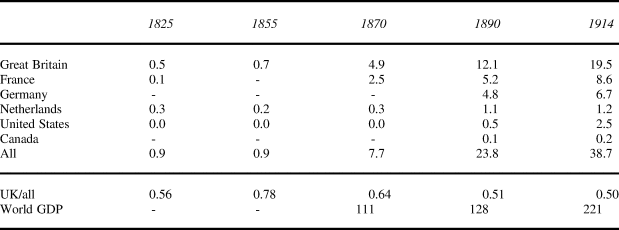
Most of the international credit was channeled through the London Stock Exchange (LSE). Its leadership was consolidated throughout the nineteenth century when it became the world's leading capital exporter, far exceeding the combined capital exports of its nearest competitors—France and Germany. Table 1 reports the best approximation of the market shares in lending throughout this period. At its peak, the British share of total global foreign investment was almost 80 percent. This contrasts with the US share of global assets of 25 percent in 2000 and even with the US maximum share of 50 percent circa 1960. Consistently, at that time Britain was known as the “World's Banker.”Footnote 75
External capital stock by country in the long nineteenth century

Notes: Values represent gross foreign assets in current USD billion. Source: Table 2.1 in Obstfeld and Taylor Reference Obstfeld and Taylor2004.
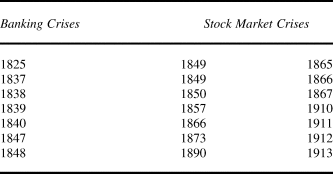
The LSE was not immune to crisis. Table 2 enumerates the onset of all banking panics and stock crashes that Great Britain experienced in the long nineteenth century as listed in Reinhart and Rogoff.Footnote 76 Given Great Britain's central position in the international lending market, crashes in London rapidly spread to Paris, Berlin, and New York. Contagion took different routes, including arbitrage in commodities and securities and movement of money in various forms (specie, bank deposits, bill of exchange), cooperation among monetary authorities, and pure psychology.Footnote 77 One way or another, financial crashes in London dried up international lending on a global scale.Footnote 78
Banking crises and stock market crashes in London, 1816–1913

Notes: The source is Reinhart and Rogoff Reference Reinhart and Rogoff2009. 1873 banking panic added. Results robust to its exclusion (see Appendix I).
Importantly for exogeneity purposes, the causes of the British financial collapses in the nineteenth century are domestic. This is certainly the case for the major crises of 1825, 1847, 1857, and 1866 but less true for the 1890 panic, in which a large financial imbalance in Argentina halted British lending.Footnote 79 More importantly, British panics did not respond to defaults by borrowers, which would cast doubt on the exogeneity of these shocks. Most of the countries that defaulted in the nineteenth century were in the periphery. Although the defaulted quantities were significant relative to their home economies from a global prospective, they were a “sideshow” for the British economy.Footnote 80 All things considered, the periods of sudden stops can be safely treated as exogenous to every country except Great Britain and, arguably, 1890 Argentina.
For the purposes of illustration, Figure 1 shows the evolution of British capital exports since the earliest date while indicating the years of banking panics and stock crises as dated by Reinhart and Rogoff.Footnote 81 It reflects the boom-and-bust cycles preceding and following a banking crisis as exemplified by the financial crises of 1873 and 1890. Prior to each bust, lending was ferocious. Once the debt bubble burst, international capital flows temporarily dried up across the board. Precisely, during periods of sudden stop, I expect rulers to have strong incentives to finance military campaigns by means other than external borrowing, namely taxes.Footnote 82
British capital exports from 1865 to 1914

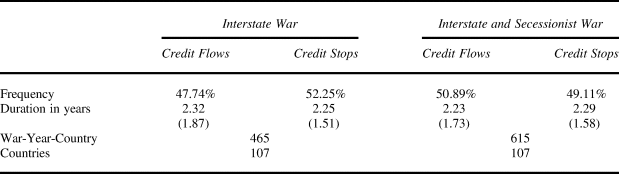
To assess the unanticipated nature of sudden stops, Table 3 shows the frequency and duration of war during periods in which international loans flow and dry up.Footnote 83 If sudden stops are predictable, more war should occur in periods in which credit flows; yet 52 percent of war years coincide with periods in which the international lending market is down.Footnote 84 In addition, Figure A-7 in Appendix W shows no increase in war right before the onset of credit crunches, consistent with the unanticipated nature of sudden stops.
Frequency and duration of war as a function of exogenous credit access

Notes: Credit stops refer to periods of sudden stop. Standard deviation in parentheses. Refer to Appendix W for a visual illustration.
Finally, consider the decision to end wars. A weak state that finances war with external credit may be more prone to surrender during sudden stops. If that is the case, weak states would end up with a higher proportion of war years when credit flows and a lower proportion of war years during sudden stops. This would bias the estimation results toward finding a negative effect of war for years when credit flows. If this pattern was systematic, on average, we should observe shorter wars during sudden-stop periods. However, Table 3 suggests that the duration of war in and outside sudden stops is balanced: 2.24 years in periods of sudden stop compared to 2.31 years when credit flows. When secessionist wars are also considered (columns 3 and 4), duration is virtually balanced.
If war is judged by its frequency and duration, Table 3 suggests a comparison of apples to apples when tackling war waged during periods in which international lending flowed and war was waged in episodes of sudden stop of credit. A final caveat involves the source of the variation of warfare and capital access. Earlier I showed that warfare took place all around the world, with the exception of Oceania. Capital imports from Britain were also a pervasive phenomenon, involving sovereign countries and colonial dominions, British and non-British. Africa received 12 percent of all government loan disbursements for the period from 1865 to 1914; Asia 20 percent, Europe 18 percent, Latin America 18 percent, Oceania 15 percent, and North America 15 percent.Footnote 85 Thirteen percent of these loans were intended for military ends (the rest being invested in public works and transportation). All things considered, the nineteenth century offers an ideal setting in terms of geographic distribution of warfare and capital imports to study the effect of war making and external finance on state making.
Specification
Sudden stops in the nineteenth century lasted, on average, four years.Footnote 86 Accordingly, I establish four-year windows following the onset of each sudden stop and assume that within these windows countries had no access to external loans.Footnote 87 For each of these periods of time, I count the number of years that country i is at war. To fully test the theoretical expectation, I also compute the number of years that a country is at war while credit flows in the international market.Footnote 88 Then, I regress various proxies of fiscal capacity circa 2000 on the number of years at war in the long nineteenth century having and lacking access to external finance as exogenized by sudden stops:Footnote 89
 $$\eqalign{ {\rm Long \hyphen run\ Fiscal\ Capacit}{\rm y}_i & = \cr&\quad\alpha + \beta _1(\# {\rm years\ at\ war\ between\ 1816\ and\ 1913} \vert \cr & \quad {\rm no\ access\ to\ foreign\ loans}) \cr & \quad + \beta _2(\# {\rm years\ at\ war\ between\ 1816\ and\ 1913} \vert \cr & \quad {\rm access\ to\ foreign\ loans}) + X_i\delta + \gamma + \rho + \varepsilon _i} $$
I consider three proxies for long-run fiscal capacity. First, personal income tax (pit). Implementing a PIT requires a sophisticated bureaucratic apparatus capable of assessing a highly atomized tax base, enforcing compliance, and sanctioning defectors. In light of its administrative challenges, this tax is considered to be the end point of fiscal capacity building.Footnote 90 Accordingly, it sets a clear benchmark to establish how far each country has gone in building tax capacity. In the empirical analysis, I work with average PIT to GDP ratios between 1995 and 2005 to minimize the effect of anomalous observations.Footnote 91
Because PIT might capture both capacity and willingness to tax, I consider a second outcome variable that emphasizes the infrastructural component of fiscal capacity: the size of the tax administration circa 2005, measured as the number of staff employed by the tax administration per thousand capita. Finally, I also proxy long-term fiscal capacity with value-added taxes (vat), now standard also in the developing world.Footnote 92
Following the discussion at the beginning of this section, I expect war making to strengthen the ruler's incentives to invest in fiscal capacity whenever the country cannot finance externally, contributing to long-term fiscal capacity, β 1 > 0.Footnote 93 By contrast, in light of the commitment problems in war debt repayment, I expect a null (if not negative) effect of war making when countries wage war having access to external credit, β 2 ≤ 0. A negative sign for β 2 would suggest that the fiscal disequilibrium associated with excess borrowing combined, potentially, with the exchange of state monopolies for default settlements, may fully reverse the effect of war on state making.Footnote 94
Three clarifications are in order. First, the expectation β 2 ≤ 0 works against the Ricardian equivalence, which assumes no commitment problem in debt repayment. Based on that logic, borrowing and taxes are equivalent in the long run, implying β 1 ≈ β 2 > 0, everything else constant. Second, in the absence of external credit, rulers might resort to printing money, domestic loans, or financial repression to finance the means of war. If any, these alternatives introduce a downward bias on β 1 because they weaken the incentives to enhance taxation in times when external credit dries up.Footnote 95 Third, crucial for the quasi-experimental setting, sudden stops are predictable only ex post, as I discussed earlier. But suppose that some rulers had inside information and banked external loans in anticipation of sudden stops. Then one should expect no investment in fiscal capacity when financial markets are down. If any, anticipation creates an attenuation bias on β 1.
As part of Expression 4, all models below include a battery of region fixed effects, γ, that account for continent-specific characteristics in the frequency of war, access to credit, and statehood timing;Footnote 96 and a battery of colonial origins indicators, ρ, because I expect the colonies’ opportunities to go to war, the tax structure that they build up, and the terms of external credit to be conditioned by the metropolis.Footnote 97 Relatedly, Appendix N reruns the analysis after dropping former British colonies (and military allies) from the sample, given their privileged relationship with the financial capital of the world. Results hold.
In addition, all models include a vector of potential confounders, X, affecting fiscal capacity today as well as war participation, credit access, or both, back in the nineteenth century. First, I consider a measure of initial wealth because wealthier countries are more likely to go to war and have stronger fiscal capacity in the first place.Footnote 98 In the absence of systematic GDP data for the early nineteenth century, I include a measure of population density as of 1820, which is argued to be the best proxy of a country's wealth in the early nineteenth century.Footnote 99 Second, I also include two geographic characteristics that could affect both sides of the equation. The first one, sea access, is the percentage of the land surface area of each country that is within 100 kilometers of the nearest ice-free coast. I expect sea access to correlate with trade activity (thus access to international lending) and monetization, a precondition for modern taxation.Footnote 100 By the same token, I expect territories with sea access to be militarily valuable, thus increasing their likelihood of experiencing war. The second geographic control is the percentage of territory that is desert. I expect deserts to inhibit industrial growth and preempt monetization, but desert territory might also work as a natural barrier to foreign invasion, thus reducing the frequency of war. Finally, I control for an important source of nontax revenue that could also shape the incentives to go to war (or suffer attack): being an oil producer. Arguably, this variable gains relevance for the later years of the period under consideration. Two additional geographic conditions, terrain ruggedness and land area, are evaluated in Appendix L, where they are interpreted as geographic determinants of initial political conditions.Footnote 101
Addressing Endogeneity in External Credit Access
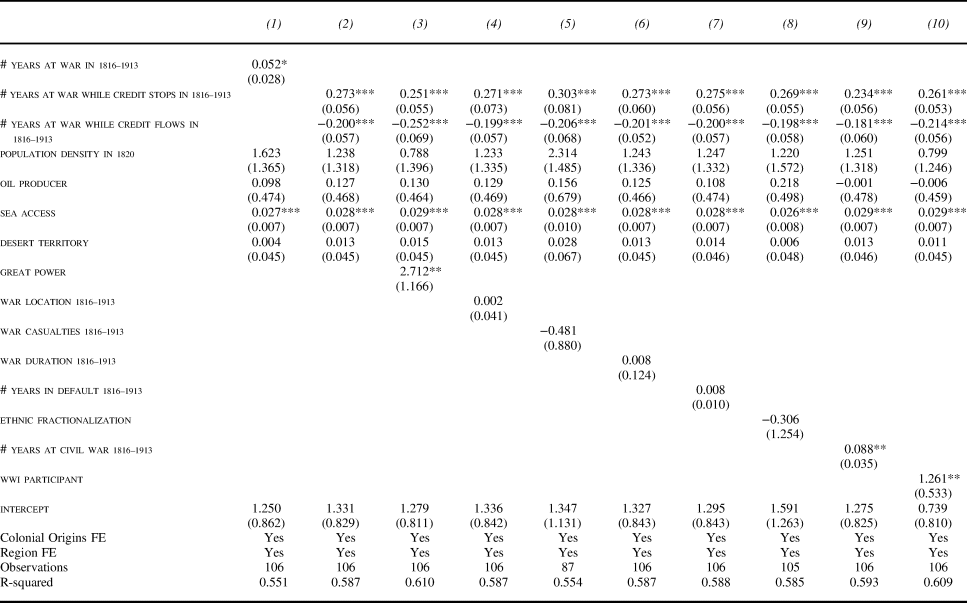
In Table 4, I use episodes of sudden stop to identify periods in which rulers of warring states have stronger incentives to enhance their fiscal foundations. Great Britain—the banker of the world—is excluded from every model to maximize exogeneity.Footnote 102
War, international finance, and fiscal capacity in the long run

Notes: These table reports models of personal income tax today (as % of GDP) as a function of war and exogenous credit access in the long nineteenth century. Great Britain is excluded. Robust standard errors in parentheses. *p < .10; **p <.05; ***p <.01. See appendix H for Wild-Woostrap cluster standard errors at the region level.
To establish a benchmark, column 1 tests for the unconditional version of the bellicist hypothesis. That is, does long-term fiscal capacity increase with the number of years at war in the long nineteenth century? Or more generally, does war make states? With a 90 percent confidence interval, personal income tax today increases in the number of years at war in the long ninteenth century, holding everything constant. This result confirms those in Dincecco and Prado.Footnote 103
Column 1 should be compared to column 2, in which I distinguish the effect of war fought without access to external credit, β 1, from war fought with access to international lending markets, β 2. Consistent with the political economy of war finance, β̂ 1 is positive and significantly different from zero. A one standard deviation increase in the number of years at war while international lending stops increases PIT today by 49 percent with respect to the sample mean. By contrast, a one standard deviation increase in the number of years at war when credit flowed decreases average PIT today by 31 percent. This result suggests that debt-financed war might create fiscal imbalances that are too hard to fix. These should be strongest among states that hand over state monopoly revenues to lenders in order to regain market access after defaulting.Footnote 104
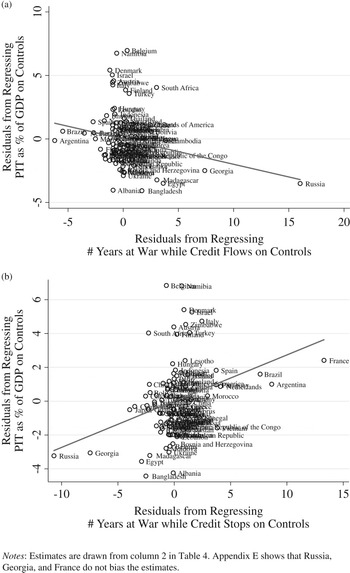
The opposite signs of β̂ 1 and β̂ 2, plotted in Figure 2, suggest that the effect of war estimated in column 1, the unconditional hypothesis, is the average of two radically different worlds. This result advances understanding of the conditions under which war makes states. More important than war itself is the way that it is financed. The remaining columns in this and subsequent tables establish how robust this result is to endogeneity bias, sample selection, and measurement decisions, while making sure not to control for endogenous covariates to war making (e.g., per capita GDP).Footnote 105
Partial correlations of personal income tax and exogenous war finance

The first potential confounder, being a great power in the nineteenth century, is examined in column 3. This control accounts for the idiosyncratic paths of state and war making in Great Britain, France, Germany, Italy, Austria–Hungary, and Russia.Footnote 106 These countries were major military and economic powers in the nineteenth century and could drive results. The coefficient of this indicator variable is positive and statistically significant. Importantly, β̂ 1 and β̂ 2 remain the same.
War causes destruction, but damages vary greatly depending on the location of military engagement. The tax base can be badly hurt when military conflict takes place within national boundaries, thus inhibiting investment in fiscal capacity. The location of war is thus likely to be a confounding variable. To address this logic, column 4 in Table 4 controls for the location of conflict. In particular, war location is the sum of the years at war fought abroad minus the years at war fought at home from 1816 to 1913. This variable is positive when a country fights more wars abroad than at home; negative when military disputes at home are more frequent than abroad; or 0 when countries never go to war.Footnote 107 The coefficient for this variable is positive, as one would expect, but not statistically significant. The coefficients β̂ 1 and β̂ 2 remain unchanged.
All wars are not created equal. Bloodier and longer wars might overcome resistance to taxation while maximizing the ruler's incentives to invest in fiscal capacity. To address this possibility, columns 5 and 6 include a control for the intensity of warfare, measured by the number of battle deaths during the period, casualties from 1816 to 1913,Footnote 108 and the average war duration during the period. These variables are not statistically significant even though their presence, if only marginally, pushes up the magnitude of β̂ 1, the effect of war fought while having no access to external credit. Drawn from a different data set, war outcome is addressed in Table 7.
Next, I consider the reputation of each country in the international market. That is, on top of capital flowing in London, a state's ability to finance war with external loans might depend on its reputation of default.Footnote 109 To account for that, column 7 adjusts for the number of years in default between 1816 and 1913 of each country. This variable is not statistically different from 0, which is consistent with the “lending frenzy” that characterizes this period.Footnote 110 Importantly, the two coefficients of interest remain unchanged.
Columns 8 and 9 control for ethnic fractionalization and nonsecessionist civil wars. Ethnic fractionalization might be an impediment to invest in fiscal capacityFootnote 111 while increasing vulnerability to foreign intervention. In the absence of better data, ethnic fractionalization is measured as of the 2000s and is potentially endogenous to war.Footnote 112 A long history of civil war is a strong predictor of negative patterns of development,Footnote 113 but lacking political stability might be penalized by the credit markets. Controlling for civil war, however, is far from ideal because sometimes it results from interstate war. At the risk of causing posttreatment bias, columns 8 and 9 control for the level of ethnic fractionalization today and the number of years at civil wars between 1813 and 1916, respectively.Footnote 114 The marginal effect of both controls is positive and in the case of civil wars, also statistically different from 0. Key for the theoretical argument, the inclusion of these variables does not modify the point estimates of β 1 and β 2.
Scheve and Stasavage show that progressive taxation, including PIT, accelerated dramatically among World War I participants.Footnote 115 Including the latter covariate in the empirical model might lead to posttreatment bias if countries that frequently went to war in the nineteenth century and developed higher fiscal capacity by 1913 selected into WWI. Still, one might be tempted to include a wwi participant indicator to check whether the coefficients of interest survive this control. Column 10 indicates that they do. The coefficient for WWI sets a meaningful benchmark with which to compare conventional war making in the long nineteenth century. WWI's marginal effect on fiscal capacity is 1.3 points, whereas a one standard deviation increase in the number of years at war while having no access to external credit increases average PIT today by 1.4 points. Results are virtually equivalent, meaning that sufficient years of conventional warfare—as long as they are (at least partially) financed with taxes—exert lasting effects equivalent to participation in total war.
Finally, under a median voter framework, one should observe higher tax rates in democracies than in autocracies, everything else constant. Democracies also present a comparative advantage in external financing.Footnote 116 Earlier I showed that the ruler's decision also depended on initial political institutions. Either reason recommends controlling for initial democracy levels. Except for a handful of cases, however, democracy scores by 1820 are unavailable in any systematic way. In view of this limitation, Appendix L shows results for the subsample of cases for which these data are available. Despite the reduced sample size, results hold.
To sum up, Table 4 suggests that war does not necessarily make states. It all depends on the incentives that rulers have to invest in fiscal capacity, which, I argue, are weaker when they have access to external loans and strong when they do not. Before discussing the implications of this result, Tables 5 to 7 address additional measurement and endogeneity considerations.
Sensitivity analysis

Notes: This table reports models of fiscal capacity in the long run as a function of war and exogenous credit access in the long nineteenth century. These models account for sample changes, conservative statehood definition, secessionist war, and an alternative outcome variable. Great Britain is always excluded.  $^\dagger $ Great powers plus USA, Canada, Netherlands, and Japan. Robust standard errors in parentheses.
 $^\ddagger $ Full sample includes great powers, wealthy countries, sovereign and nonsovereign states. *p < .10; **p < .05; ***p < .01.
Military Powers, Sovereign States, Secessionist War, and Alternative Outcome Variables
Are results driven by big military powers? Is the effect of war equivalent in sovereign and nonsovereign states? Does the theory apply to wars of independence? Does war finance shape infrastructural transformations in the long run?
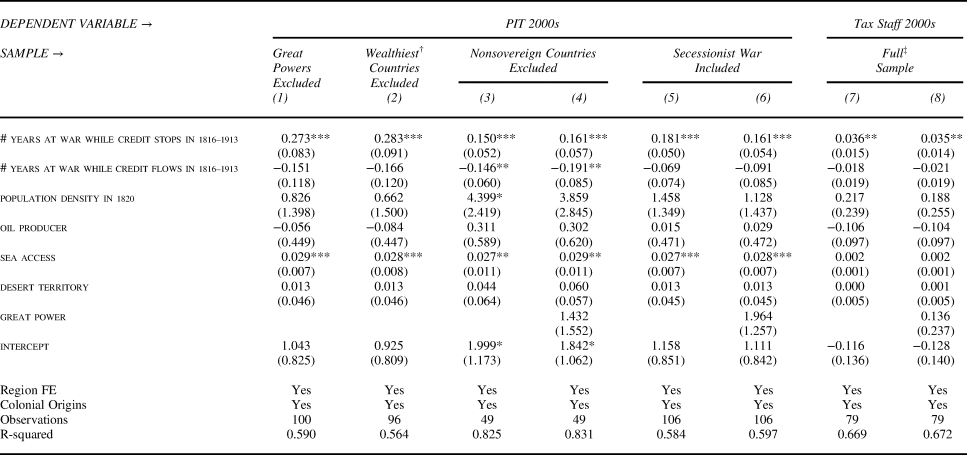
Rulers decide whether to finance the means of war with taxes or foreign loans. This decision is a function of opportunity (i.e., the political economy of war finance) and possibility. In that respect, less capable states should be most tempted to finance the means of war externally, especially in a context of massive cross-border lending. By the same token, they should be particularly exposed to the perverse incentives of external financing. To address this point, columns 1 and 2 in Table 5 rerun the baseline models, dropping first the great powers, and then, four additional wealthy countries: the Netherlands, the United States, Canada, and Japan. In both specifications, the point estimate for β 1 remains unchanged with respect to Table 4, suggesting that war makes states in the periphery as long as it is not financed with external loans.Footnote 117
So far, wars are attributed to the corresponding 2001 nation-state regardless of whether that territory had achieved statehood by 1913. One could argue that war fought by states unrecognized by the international system exerts a different (or null) effect on fiscal capacity. For instance, colonies might not invest in their military campaigns as much as the metropolis does.Footnote 118 To address this possibility, columns 3 and 4 in Table 5 rerun the analysis considering only countries that were sovereign by war time. Results, despite the reduction of the sample size, are similar to those reported in Table 4. Sovereign states that waged war while international lending flowed are not associated with high fiscal capacity today. To the contrary, sovereign states that waged war in the midst of a sudden stop have, on expectation, higher tax capacity today.
Some countries in the periphery waged secessionist war in the nineteenth century. The object of these wars was the formation of an independent modern nation-state. Financing secessionist war might exert effects similar to regular warfare; moreover, including them in the analysis might better reflect the universe of states at war during the period under consideration. Consistently, columns 5 to 6 in Table 5 suggest that waging war, either interstate or secessionist, when international lending stops, is associated with long-run fiscal capacity.
A fourth battery of sensitivity tests addresses the choice of the outcome variable. PIT ratios arguably capture both capacity and willingness to tax and they vary with the economic cycle. To address both issues, I use an alternative proxy of fiscal capacity that emphasizes administrative capacity over willingness: the size of the tax administration. This variable is a strong predictor of tax yields as shown in Appendix B. Unlike tax ratios, the size of the tax administration does not change with the economic cycle, not in the short run. Tax bureaucracies are filled with public servants, subject to stricter controls, and relatively sheltered from spurious fleeting interests of passing incumbents. These characteristics suggest that the size of the tax apparatus genuinely captures the underlying capacity to monitor and assess private income.Footnote 119
Next, I regress the size of the tax administration, measured by the tax staff per thousand capita circa 2005, on the same set of covariates used to model long-term income tax ratios. Results in columns 7 and 8 in Table 5 mimic previous ones. Waging war without access to external credit (exogenized by instances of sudden stops) is associated with a more staffed tax administration today; war waged while credit flows is not. For additional robustness tests, Appendix Table A-18 shows models of VAT as a percentage of GDP. Results are equivalent.
Addressing Endogeneity in War Participation
The decision to go to war can also be endogenous. Countries that go to war might have greater administrative capacity to begin with (i.e., omitted variable bias). Also, the type of country that goes to war when credit is tight may differ in ways that are relevant to future tax capacity from those that wait until loans are available (i.e., selection bias). I address both issues stepwise.
Initial State Capacity
Countries that are frequently at war may have greater capacity to conscript and tax. The ruler's foregone utility of financing war with tax revenue is smaller when initial state capacity is higher—as shown in the theory section. These capacities may already be captured by the great power indicator and the proxy of initial wealth: population density as of 1820. After all, we know that the income level is a strong predictor of war participation.Footnote 120 Next, I further minimize bias by considering two covariates associated with initial state capacity: Bockstette, Chanda, and Putterman's state antiquity index;Footnote 121 and census capacity. The former should correlate with cumulative military and administrative capacity because older states exist as a result of winning war in the past. The latter should correlate (if not facilitate) preparation for war if only because modern censuses tend to follow earlier enumerations in which taxable wealth and the conscription base are assessed. To this end, I have coded the date of the first modern census ever conducted for every country in the sample. To control for initial administrative capacity, I create the indicator variable modern census by 1820, which equals 1 if country i has conducted a modern census by 1820.
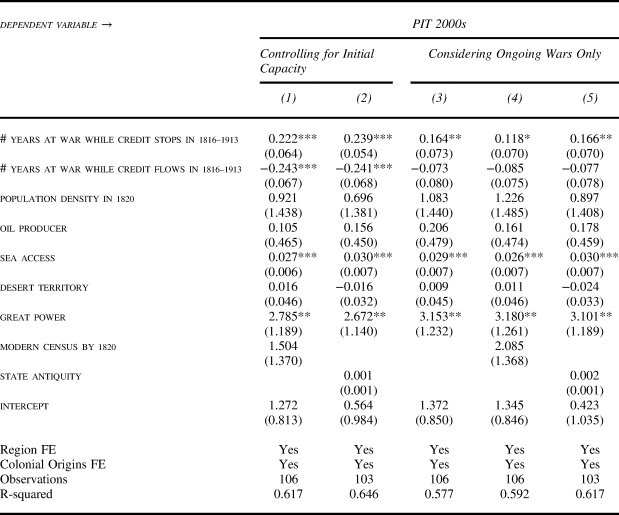
Results are reported in columns 1 and 2 of Table 6. The two new covariates hold positive coefficients, as expected, but are not statistically significant.Footnote 122 Once I control for both proxies of initial state capacity, β̂ 1 and β̂ 2 remain positive and negative, respectively, and statistically significant. That is, independent of observable initial capacity to prepare for war and raise taxes, only war waged when the international lending market was down contributed to build fiscal capacity in the long run.
Addressing endogeneity in war participation I: Initial conditions and ongoing war

Notes: This table reports models of personal income tax today (as % of GDP) as a function of war and exogenous credit access in the long nineteenth century with special attention to omitted variable bias and selection into war. Refer to Appendix O for additional models using the Ongoing War filter. Great Britain is excluded. Robust standard errors in parentheses. *p < .10; **p < .05; ***p < .01.
Ongoing Wars
Countries that go to war despite the credit crunch may differ from countries that wait for markets to lend again. Table 3 and Appendix Figure A-7 show no evidence of strategic timing of war making once credit access is exogenized. The frequency and duration of war inside and outside sudden stop periods are virtually balanced (and war participation does not increase immediately before the onset of credit crunches). Still, following the onset of a sudden stop, states might choose whether to wage war or what kind of war to fight. Alternatively, peripheral states might have more leeway in deciding which war to fight when the metropolis is experiencing a financial crisis.Footnote 123 I address these forms of selection bias by considering only wars that are initiated while the market is still lending and eventually dries up as a result of a financial crisis. These are wars that are initiated without the expectation of a sudden stop. Thus, the decision to go to war or what type of war to fight is disconnected from external credit access.Footnote 124
Columns 3 to 5 in Table 6 show the results of this test. The estimate for β̂ 1 decreases with respect to Table 4, suggesting that β̂ 1 may be somewhat upward biased. Based on the new estimate, a one standard deviation increase in the number of ongoing wars increases long-term average PIT by 12.5 percent, a sizable effect. By contrast, β̂ 2 is no longer negative but 0, which is still inconsistent with the unconditional interpretation of the bellicist hypothesis (and the Ricardian equivalence).Footnote 125
Noninitiators, War Outcome, and COW data
Another route to minimize selection is to study the effect of war making and credit access for states that choose not to go to war but are dragged into it. One could argue that countries that initiate war are different from those that are attacked in ways that shape long-term fiscal capacity. Based on this logic, I estimate separately the effect of war making and credit access for countries that are attacked, namely the noninitiators. The identification assumption is that initiators do not strike first in anticipation of a likely attack.
To conduct this test, I rely on the COW data set, which identifies the initiator of each military conflict.Footnote 126 The COW data set includes fewer interstate wars than Wimmer and Min do because it follows stricter criteria about the definition of a state in the nineteenth century.Footnote 127 Accordingly, the sample of interstate wars is now made of thirty-seven conflicts, and 172 country-year-wars in total. Seventy-eight were fought when credit flowed, and ninety-six when credit had suddenly stopped. Average war duration was 1.57 (sd = 1.04) and 1.76 (sd = 1.23) years, respectively.
COW facilitates information to control for war outcome. This is substantively compelling because military outcomes potentially affect the incentives to invest in fiscal capacity. For example, winners might extract from losers. To this end, net victory indicates the number of wars won between 1816 and 1913 by country i net of wars lost during the same period. Countries that fought no war receive a value of 0.Footnote 128
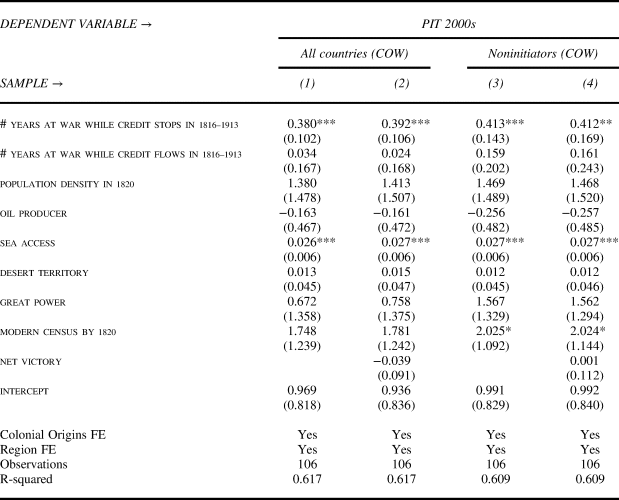
Table 7 begins by replicating the effect of war and credit access for the entire COW sample, including initiator and noninitiators. The effects reported in columns 1 and 2 are slightly lower than those estimated in Table 4. Based on column 1, a one standard deviation increase in the number of years at war fought while having no access to credit increases average PIT today by 25.7 percent. Most likely, the decrease of this estimate with respect to Table 4 results from sample selection in COW, which overrepresents wealthier countries, for which additional years at war should exert a relatively smaller effect. Columns 1 and 2 imply that results are robust to sample change.
Addressing endogeneity in war participation II: noninitiators and war outcome

Notes: This table reports models of personal income tax today (as % of GDP) as a function of war and exogenous credit access in the long nineteenth century, with war data drawn from COW's Interstate Military Conflict Database, and accounting for war outcome. Great Britain is excluded. Robust standard errors in parentheses. *p < .10; **p < .05; ***p < .01.
In columns 3 and 4, I estimate the effect of war and credit access for countries that did not choose to go to war but were pushed into it. Results are similar to the preceding ones, only bigger. Countries that were dragged into war in the midst of a sudden stop of credit present higher levels of fiscal capacity today. The effect vanishes when countries are allowed to borrow external loans to finance war. Results are robust to war outcome: winning or losing wars does not significantly modify the differential effect of war making and credit access on long-term fiscal capacity.
Appendix P reports an additional test in which I address selection bias in war participation in a reduced-form format. Specifically, war participation by country i is replaced by that of adjacent countries, a design inspired in Gennaioli and Voth.Footnote 129 Results hold.
One final caveat: war is assumed exogenous in the decision-theoretical model, yet rulers may strategically initiate war to overcome resistance to taxation without granting policy concessions—a rally-round-the-flag strategy so to speak. The fiscal effect of this strategy should be transient. Maintaining high levels of taxation is hard if taxpayers cannot constrain the ruler's discretion on fiscal matters.Footnote 130 If the ruler initiates war to avoid policy concessions, the mechanism that sustains high levels of taxation over time—power-sharing institutions—will not be set in motion either. Empirically, we should not observe long-term persistence of war's effect on fiscal capacity. Endogeneity of war of this sort introduces a downward bias on the main coefficient of interest, β 1.
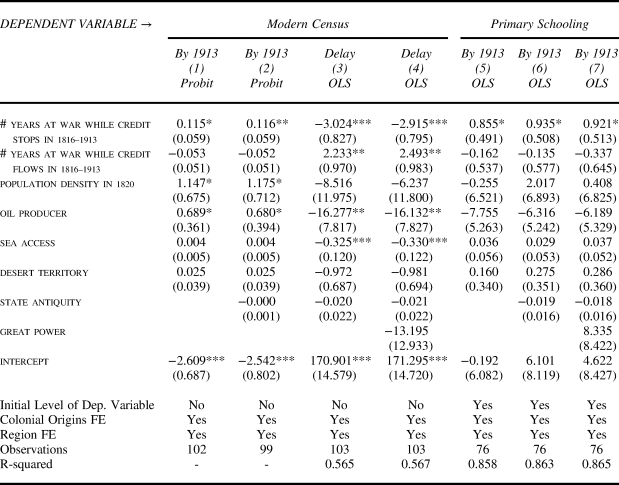
Short-Term Effects
I have argued that tax-financed war exerts long-term effects on fiscal capacity because it pushes rulers to conduct fiscal reform. If fiscal capacity building is gradual, one should observe some evidence of this in the short term. In the absence of tax data for current developing economies in the early twentieth century, I work with two measures of state capacity that correlate with tax capacity: the ability to conduct a modern census and primary school enrollment, both dated as of 1913. The former measure is clearly a requirement to adopt modern forms of direct taxation because it establishes the potential tax base. The latter measure captures a cornerstone characteristic of the modern state: public-funded mass education, which requires a solid bureaucratic structure to recruit instructors and standardize curricula.Footnote 131 We can expect different dimensions of state capacity to correlate: they are presumed complementary, not substitutes.Footnote 132
Columns 1 and 2 in Table 8 report a probit model in which having a modern census by 1913 is regressed on war making and exogenous credit access between 1816 and 1913 plus controls. Results suggest that waging war during the long ninteenth century increases the probability of having a modern census by 1913 only in the absence of external finance.
Short-term effects of war making on state capacity

Notes: This table reports models of state capacity in the short run as a function of war and exogenous credit access in the long nineteenth century. Great Britain is excluded. The Great Power indicator in columns 1 and 2 cannot be estimated because of perfect collinearity.  $^\dagger $ Initial Value of Primary Schooling in 1820 is logged to account for ceiling effects. Robust standard errors in parentheses. * p < .10; ** p < .05; *** p < .01.
Columns 3 and 4 fit an OLS model in which the date of adoption of the first modern census is regressed on the baseline covariates. In this model high values of the dependent variable imply delays in census adoption. Results show that fighting wars in times of sudden stop accelerates adoption. Fighting wars having access to credit does not. If anything, it increases delay.
Appendix R runs duration models of census adoption as a function of war and credit access between 1816 and 1913. Those models, which exploit longitudinal variation in credit access, war, and key covariates, yield similar results. Capital access discourages the adoption of census technology—a requirement of modern taxation—in war time, whereas lack of access to capital speeds up adoption.
Results in columns 5 to 7, in which I model the primary school enrollment by 1913, mimic previous results: war making while credit flows does not predict higher enrollment ratios by 1913, whereas war making while credit stops does. Results are robust to initial enrollment ratios and state antiquity controls.Footnote 133
Evidence of Transmission
Does the effect of war finance travel over time, and why? I show transmission by studying the effect of nineteenth-century war finance on post-World War II tax capacity. Given data constraints, I rely on the share of total tax revenue that is not accrued from trade taxes to proxy fiscal capacity. This share measures the effort to raise revenue through sophisticated taxes (e.g., the income tax) instead of tariffs, a tax handle that low-capacity countries often use.
To assess transmission, I compute decennial averages of nontrade taxes as a percent of total taxation from 1945 to 1995. Then I regress those ratios on the number of years at war having and lacking access to external loans in the nineteenth century plus controls (i.e., Expression 4).Footnote 134 Figure 3 summarizes results.
Evidence of transmission

The left plot shows that waging war in the nineteenth century with access to credit is not associated with post-World War II fiscal capacity, whereas waging war lacking access to external finance is (right plot). Approximately, an additional year at war in the nineteenth century lacking external finance increases post-World War II nontrade tax revenue by 1 percent, everything else constant. This result suggests that the effects reported in Tables 4 to 8 persist throughout the twentieth century.
Transmission Mechanism
The fiscal effect of war travels over time. Why? The theory explored how the effect of war on long-run fiscal capacity is transmitted via a political channel. The connection between war finance and political reform has a long tradition in the literature.Footnote 135 To finance the means of war, rulers may willingly share power over spending decisions to overcome taxpayers’ resistance to increased taxation.
Power-sharing institutions facilitate transmission of the war effect because they transform taxation into a non-zero-sum game—revenue is secured by the ruler, whom taxpayers hold fiscally accountable—facilitating sustained investment in tax capacity.Footnote 136 The findings so far suggest, however, that incentives to finance war with taxes—thus chances of observing movements toward power-sharing institutions—are weak when countries have access to external finance. By contrast, war should contribute most decisively to political reform—and activate the political mechanism of transmission—when it is waged while having no access to external finance. This argument is consistent with the resource curse literature, and specifically with Downing's interpretation of state making and political reform in early modern Europe. Countries that systematically relied on ore from colonies to finance military campaigns (e.g., Spain) bypassed parliament and did not develop tax capacity.Footnote 137
Figure 4 lends support to the political mechanisms. It shows that executive constraints—the expected outcome of the political bargaining over taxation—are positively associated with waging war while lacking external finance, both in the short and long run. A one standard deviation increase in the number of years at war while credit is tight in the nineteenth century increases average executive constraints by 16 percent in 1913 and 4.5 percent in the 2000s.Footnote 138 By contrast, war waged while having access to external credit is not associated with political change in the short or long run. If any, that relationship is negative.
The political mechanism of transmission

In sum, Figure 4 suggests that war facilitates political reform when incumbents cannot escape the political costs of domestic taxation, namely when they lack external finance. Political reform, in turn, transforms taxation into a win–win game, facilitating long-term persistence.Footnote 139
Discussion
Contrary to the unconditional characterization of the bellicist hypothesis, that is, more war, more state, I argue—alongside Tilly's original work—that the effect of war on state building ultimately depends on how warfare is financed. Specifically, I claim that financing war with taxes is conducive to state making, whereas financing wars with external loans may not because of two extended practices to dodge the Ricardian equivalence: debt relief and the exchange of old bonds for state monopolies and nontax revenue.
Building on Centeno and Thies, I emphasize the radically different international context in which countries in the periphery are created compared to that faced by European nations in early modern times.Footnote 140 Most states in the periphery were founded only after 1815, coinciding with the globalization of financial markets that resulted from the income growth in the wake of the industrial revolution and Britain's capacity to spin off excess savings to the rest of the world. Unlike European states, from their very inception the new states in the periphery had access to unprecedented inexpensive external finance despite their weak institutionalization, frequent government turnover, and lack of reputation in the international markets. The lending frenzy stopped abruptly in 1914. By then, however, many externally financed wars had already been fought.
Cheap external credit strengthened incentives to finance war externally while preempting the development of domestic credit markets, thus the formation of a corpus of domestic lenders with whom to strike bargains conducive to political reform and long-term fiscal capacity.Footnote 141 Debt relief and the exchange of old bonds for nontax revenue minimized the cost of default for developing nations; however, it precluded the Ricardian equivalence, and thus state building. Counterintuitively, countries in the periphery may have benefited from less dynamic international lending markets because that would have strengthened the incentives to raise taxes to finance the means of war, stimulate domestic borrowing, and conduct the political reform associated with long-term fiscal capacity—namely, what Europeans were compelled to do only centuries before, when international credit markets were oligopolistic and expensive.Footnote 142
The perverse or unanticipated effects of inexpensive external credit resonate with Tilly's original hypothesis by emphasizing the conditional effect of war on credit access. In Europe, frequent war making and the absence of cheap external credit propelled domestic lending and eventually political reform that addressed commitment problems in debt repayment.Footnote 143 Interstate war combined with domestic lending allowed territorial states to pursue the “coercive-capital intensive” (or fiscal–military) strategy that ended in the modern tax state.Footnote 144 By contrast, states that kept relying on external loans to finance war found it much harder to capitalize the effect of war on state making, for example, Spain under Phillip II.Footnote 145 Access to cheap external credit—which countries in the periphery had since their inception—distorted the causal chain of the original bellicist hypothesis. Readily available external loans and the extended practice of debt relief and exchange of old bonds for nontax revenue and state monopolies weakened the incentives to finance war with taxes and ultimately preempted the opportunity to capitalize war efforts and conduct political reform. The perverse incentives associated with cheap loans are similar to those derived from other forms of nontax revenue: foreign aid,Footnote 146 oil,Footnote 147 and ore from colonies.Footnote 148 Altogether, I shed light on the scope conditions under which war exerts positive and lasting effects on state building in the era of global credit markets.
Supplementary Material
Supplementary material for this article is available at <https://doi.org/10.1017/S0020818319000250>.
Acknowledgments
This manuscript was formerly titled “The Legacy of War on Fiscal Capacity.” I am grateful to the editor and two anonymous reviewers for their insightful suggestions, and to Francesc Amat, Ben Ansell, Laia Balcells, Tim Besley, Carles Boix, Thomas Brambor, Lawrenze Broz, Allan Dafoe, Alexandre Debs, Mark Dincecco, Ruben Enikolopov, Hector Galindo, Aina Gallego, Francisco Garfias, Scott Gates, Maria Jose Hierro, Margaret Levi, Johannes Lindvall, Jordi Munõz, Pilar Nogues-Marco, Maria Petrova, Shanker Satyanath, Peter Schram, Laura Seelkopf, Ken Scheve, David Stasavage, Hans-Joachim Voth, Tianyang Xi, and seminar participants at Barcelona University, Columbia, Carlos III, Duke, EUI, Lund, NYU, NYU-AD, Peking, Princeton, Sciences Po, Stanford, University City of London, Vanderbilt, and Yale for comments and suggestions.