Introduction
As the widespread use of combined antiretroviral therapies has reduced the incidence of HIV-associated dementia, more subtle neurocognitive deficits and insidious neurological complications persist. HIV-associated neurocognitive disorder (HAND) and distal sensory polyneuropathy (DSP) are the two most prevalent neurological conditions reported in the context of HIV infection (Vivithanaporn et al., Reference Vivithanaporn, Heo, Gamble, Krentz, Hoke, Gill and Power2010). An estimated 39–69% of HIV-seropositive (HIV+) individuals continue to show neurocognitive impairment, despite suppressed HIV RNA (Heaton et al., Reference Heaton, Clifford, Franklin, Woods, Ake and Vaida2010; Robertson et al., Reference Robertson, Smurzynski, Parsons, Wu, Bosch, Wu and Ellis2007; Simioni et al., Reference Simioni, Cavassini, Annoni, Rimbault Abraham, Bourquin, Schiffer and Du Pasquier2010). Similarly, HIV-associated DSP remains common, with prevalence estimated at 56% (Ellis et al., Reference Ellis, Rosario, Clifford, McArthur, Simpson and Alexander2010; Schifitto et al., Reference Schifitto, McDermott, McArthur, Marder, Sacktor and Epstein2002). Considering the concurrently high rates of HIV-associated DSP and neurocognitive disorders, the impact of peripherally mediated neurological abnormalities on neuropsychological performance is critically understudied.
DSP is the most common neurological condition associated with HIV-infection and is characterized by pain and diminished sensory perception in the peripheral extremities (for a review, see Keswani, Pardo, Cherry, Hoke, & McArthur, Reference Keswani, Pardo, Cherry, Hoke and McArthur2002). Typically, dysesthesias are first evident in the soles of the feet and gradually progress up the leg, usually abating below the knee. Symptoms may then begin to occur in the fingertips and progress into the hands. Conceptually, diminished sensory perception in the hands during neuropsychological assessment with tests requiring varying degrees of dexterity, would compromise the utility of these tests to identify central nervous system dysfunction. For example, the Grooved Pegboard test (Matthews & Kløve, Reference Matthews and Kløve1964), a commonly used neuropsychological measure of fine motor speed and dexterity, requires efficient tactility to manipulate small metal pegs into the correct position before being placed into slots in a metal board. If an individual is experiencing DSP-related decrease in sensory perception in the hands, it may take longer to position each peg to correctly place it in the slot, resulting in worse performance. If researchers and clinicians do not consider the contribution of peripherally mediated abnormalities, such as DSP, they may overestimate neurocognitive impairment in HIV+ cohorts.
Psychomotor dysfunction is a sensitive indicator of HIV-associated neurocognitive impairment, but the mechanisms of dysfunction have not been fully elucidated (Becker et al., Reference Becker, Sanchez, Dew, Lopez, Dorst and Banks1997; Heaton et al., Reference Heaton, Grant, Butters, White, Kirson, Atkinson and Ellis1995; Llorente et al., Reference Llorente, Miller, D'Elia, Selnes, Wesch, Becker and Satz1998; Parsons, Rogers, Hall, & Robertson, Reference Parsons, Rogers, Hall and Robertson2007; Reger, Welsh, Razani, Martin, & Boone, Reference Reger, Welsh, Razani, Martin and Boone2002; Selnes et al., Reference Selnes, Galai, Bacellar, Miller, Becker, Wesch and McArthur1995; Stern et al., Reference Stern, McDermott, Albert, Palumbo, Selnes and McArthur2001). One study that examined the utility of using a motor based assessment to predict neurocognitive impairment in HIV+ individuals found that three motor tests (Timed Gait, Grooved Pegboard, and Finger Tapping) predicted 52% of the variance in a comprehensive neuropsychological evaluation (Parsons et al., Reference Parsons, Rogers, Hall and Robertson2007). Adding the WAIS-R Digit Symbol subtest and Trail Making Tests to the motor based assessment accounted for 73% of the variance in the total neuropsychological battery. Similarly, to develop a brief but sensitive screening measure, another study explored the diagnostic accuracy of neuropsychological test pairs to predict global impairment. The authors found that a verbal learning test (Hopkins Verbal Learning Test – Revised) paired with either a fine motor test (Grooved Pegboard) or a psychomotor/processing speed test (WAIS-III Digit Symbol subtest) provided the best balance between sensitivity and specificity, among 14 test pairs, to predict impairment using clinical ratings from a larger neurocognitive battery (Carey et al., Reference Carey, Woods, Rippeth, Gonzalez, Moore and Marcotte2004). Moreover, there is evidence that the Grooved Pegboard alone is comparable to a modified HIV Dementia Scale in classifying and staging HIV-associated neurocognitive impairment (Davis, Skolasky, Selnes, Burgess, & McArthur, Reference Davis, Skolasky, Selnes, Burgess and McArthur2002). These findings suggest that psychomotor tests account for a large proportion of variance in neuropsychological assessments of HIV+ adults.
In the initial conceptualization of HIV-associated cognitive disorders by the Working Group of the American Academy of Neurology (AAN) AIDS Task Force (1991), motor impairment, which was considered characteristic of HIV-associated neurological dysfunction, was included as one of the diagnostic criteria for HIV-associated dementia and less severe minor cognitive motor disorder. A more recent neurocognitive nosology, developed by a working group assembled in Frascati, Italy that aimed to refine the classification of HIV-associated neurocognitive disorders is focused less on primary measures of motor function and more on other neurocognitive domains, in part to adjust for a more diffuse pattern of impairment that has emerged since the advent of highly active antiretroviral therapies (Antinori et al., Reference Antinori, Arendt, Becker, Brew, Byrd, Cherner and Wojna2007). Diagnostic criteria for neurocognitive impairment in this Frascati system require impairment in at least two domains, one of which must be a non-motor or sensory/perceptual domain to qualify for neurocognitive impairment classification. However, other domains that commonly comprise tests with a motor component, such as information processing speed [i.e., Digit Symbol, Trail Making Test Part A (TMT-A)] or executive functioning [i.e., Trail Making Test Part B (TMT-B)], may be susceptible to peripherally mediated sensory dysfunction in addition to more straight-forward measures of motor function (i.e., Grooved Pegboard).
Motor function is also a critical domain in the progression of HIV-associated impairments. Disease progression from early to late stages of HIV infection is associated with declines in motor ability, information processing speed, and executive function (Baldewicz et al., Reference Baldewicz, Leserman, Silva, Petitto, Golden, Perkins and Evans2004; Reger et al., Reference Reger, Welsh, Razani, Martin and Boone2002). Declines in psychomotor performance have been consistently associated with HIV disease progression, both before and after the widespread use of combined antiretroviral therapies (Baldewicz et al., Reference Baldewicz, Leserman, Silva, Petitto, Golden, Perkins and Evans2004; Bornstein, Nasrallah, Para, Whitacre, & Fass, Reference Bornstein, Nasrallah, Para, Whitacre and Fass1993; Heaton et al., Reference Heaton, Grant, Butters, White, Kirson, Atkinson and Ellis1995; Reger et al., Reference Reger, Welsh, Razani, Martin and Boone2002; Selnes et al., Reference Selnes, Galai, Bacellar, Miller, Becker, Wesch and McArthur1995), with little exception (Basso & Bornstein, Reference Basso and Bornstein2000). A meta-analysis of 41 studies that compared neuropsychological performance in 10 domains, stratified by HIV disease stage, found that motor function had the largest change in effect size from asymptomatic to symptomatic HIV disease stage and from symptomatic HIV to AIDS (Reger et al., Reference Reger, Welsh, Razani, Martin and Boone2002). The authors also reported advancing HIV disease was associated with incremental executive functioning and information processing speed deficits (Reger et al., Reference Reger, Welsh, Razani, Martin and Boone2002). Incidentally, domains that demonstrated the largest change in effect size by disease stage are also more likely to contain timed psychomotor tests, which may be susceptible to peripherally mediated neurological abnormalities such as DSP. Given that the rates of neurological abnormalities and neurocognitive impairment increase as HIV disease progresses, the potential association between DSP and HAND requires further study.
The only study we identified that considered the effects of peripheral neuropathy on psychomotor speed revealed that removing individuals with peripheral neuropathy from the analyses ameliorated significant differences on the Grooved Pegboard test between asymptomatic HIV+ participants and HIV-seronegative (HIV−) participants (Llorente et al., Reference Llorente, Miller, D'Elia, Selnes, Wesch, Becker and Satz1998). It is important to note that only a relatively small percentage (approximately 6%) of HIV+ participants was identified with peripheral neuropathy which limits generalizability to cohorts with much higher prevalence rates. Nevertheless, this study demonstrated that even though a relatively small proportion of participants were identified with DSP, removing them from the analyses eradicated an otherwise significant effect. Furthermore, clinicians have been encouraged to use caution when interpreting psychomotor tests for neurocognitive diagnostic classification if peripheral neuropathy is present in the upper extremities (Woods et al., Reference Woods, Rippeth, Frol, Levy, Ryan, Soukup and Heaton2004); yet, to date, no published studies have systematically identified an association between neuropathic signs in the hands and poor neuropsychological test performance in the context of HIV.
Given the high rates of HIV-related neurocognitive impairment (particularly on tests with a psychomotor component) and increased prevalence of DSP among HIV+ individuals, there is a need to better understand the association between DSP and neuropsychological test performance. To isolate the impact of HIV on neurocognition, it is necessary to identify the amount of variability in test performance associated with peripherally mediated abnormalities. The purpose of this study was to determine the degree of association between DSP and performance on neurocognitive tests, particularly on those domains assessed with measures requiring fine motor dexterity and psychomotor speed. We hypothesized that participants with DSP would perform significantly worse than participants without DSP in domains with timed psychomotor tests (i.e., motor, information processing speed, and executive functioning). We also hypothesized that neurological signs of DSP in the hands would confer a greater risk of psychomotor impairment than participants without DSP. Finally, we hypothesized participants with DSP would have higher rates of impairment limited to domains with psychomotor tests than the No DSP group.
Method
Participants
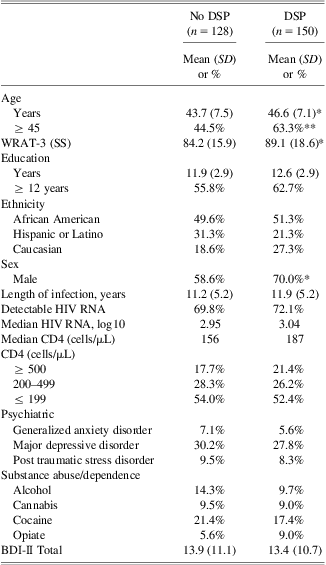
Table 1 summarizes participant demographic and medical characteristics. All 278 participants were enrolled in the Manhattan HIV Brain Bank (MHBB; U01MH083501) study, a member of the National NeuroAIDS Tissue Consortium, which was approved by the Mount Sinai School of Medicine Institutional Review Board. All participants provided informed consent. Upon study enrollment, participants underwent comprehensive neurological, neuropsychological, and psychiatric assessments typically conducted on the same day. Baseline data collected from February 1999 to April 2011 were used in the current study. Eligibility criteria for the Manhattan HIV Brain Bank have been described in a previously published study (Morgello et al., Reference Morgello, Estanislao, Simpson, Geraci, DiRocco and Gerits2004). Briefly, the MHBB is a prospective study in which participants must be HIV+, consent to postmortem organ donation, and have a disease indicative of advanced HIV infection or other intractable medical disorder. As the MHBB is an organ donation study, broadly defined inclusion criteria were applied to capture a range of psychiatric comorbidities common in the multifactorial assessment of individuals with HIV. The proportion of psychiatric conditions, including substance abuse and dependence, was equally distributed among groups in the present analyses (see Table 1). Therefore, we did not examine the potential independent effects of substance use. Exclusion criteria for the current study included nonstandard assessment procedures, major neurological illness other than DSP likely to confound results (e.g., Huntington's disease, chronic inflammatory demyelinating polyneuropathy, blindness), or incomplete neurological or neuropsychological assessment.
Characteristics of Study Participants by DSP Status
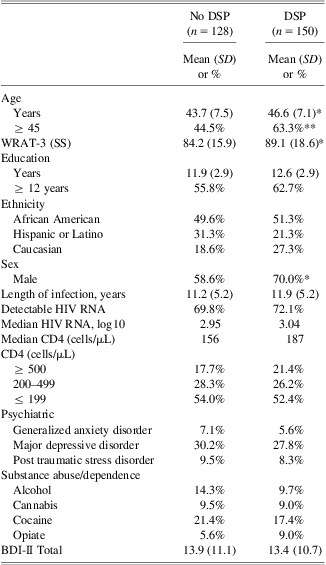
Note. BDI-II data were only available for a subset of the study sample (n = 141); WRAT-3 (SS) is the Wide Range Achievement Test – Reading 3rd Edition reading subtest standard score; *p < .05; **p < .01
Of the 278 participants in the sample, the mean age was 45.3 (SD = 7.4). More than half (59.7%) of the participants had at least a high school education and the mean years of education was 12.3 (SD = 2.9). The average Wide Range Achievement Test-3rd Edition (WRAT-3) Reading subtest standard score was 86.9 (SD = 17.6). Participant racial/ethnic identification was collected by self-report and 50.7% were non-Hispanic Black or African American, 25.9% were Hispanic or Latino, and 23.4% were non-Hispanic White. The mean duration of known HIV infection was 11.6 (SD = 5.2) years. HIV immunologic indicators were only available for a subset of the sample (CD4, n = 239; plasma HIV RNA, n = 238), but the proportion with missing data did not differ by DSP status.
Procedure
Neuropsychological assessment
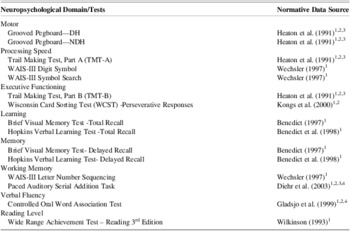
All participants were assessed by trained psychometrists supervised by a neuropsychologist experienced in classifying HIV-associated neurocognitive disorders. The neuropsychological battery assessed the following domains known to be sensitive to HIV-related neurocognitive impairment: verbal fluency, working memory, executive functioning, learning, memory, information processing speed, and motor ability (Antinori et al., Reference Antinori, Arendt, Becker, Brew, Byrd, Cherner and Wojna2007; Woods et al., Reference Woods, Rippeth, Frol, Levy, Ryan, Soukup and Heaton2004). The specific tests used to assess each domain are presented in Table 2, along with normative data sources and demographic corrections. Raw scores were converted into t scores which adjusted for the following demographic factors, as available: age, gender, education, and ethnicity using normative data for each test. Individual test scores were summed and averaged to create domain t scores. Domain t scores were used in analyses, rather than individual tests, to provide a more balanced estimate of neurocognitive ability and to reduce the number of analyses. Consistent with previous studies, a t score greater than one standard deviation below normative estimates was considered impaired (e.g., Antinori et al., Reference Antinori, Arendt, Becker, Brew, Byrd, Cherner and Wojna2007; Woods et al., Reference Woods, Rippeth, Frol, Levy, Ryan, Soukup and Heaton2004).
Neuropsychological Tests and Normative Data Sources

Note. Wechsler Adult Intelligence Scale (WAIS). Normative data provides adjustments for the following demographic characteristics, as indicated: 1Age; 2Education; 3Gender; 4Ethnicity
Psychiatric evaluation
The Psychiatric Research Interview for Substance and Mental Disorders (PRISM) was used to assess current psychiatric and substance use disorders using DSM-IV criteria (Hasin et al., Reference Hasin, Trautman, Miele, Samet, Smith and Endicott1996). Depressive symptoms were evaluated using the Beck Depression Inventory, 2nd Edition (BDI-II). The BDI-II is a 21-item self-report questionnaire designed to assess recent cognitive and somatic depressive symptoms. Each item is scored on a scale ranging from 0 to 3, with higher scores indicating greater severity (Beck, Brown, & Steer, Reference Beck, Brown and Steer1996).
Neurological examination
A comprehensive neurological examination was performed by an experienced neurologist assessing sensory and motor function. Both upper and lower extremities were examined for signs consistent with DSP. A diagnosis of DSP was assigned if two or more of the following abnormalities were present in a distal and symmetric pattern: decreased or absent ankle deep tendon reflexes as compared to the knee, diminished vibratory sense, or reduced pin perception (England et al., Reference England, Gronseth, Franklin, Miller, Asbury, Carter and Sumner2005). These diagnostic criteria have been used in prior studies (e.g., Cherry, Wesselingh, Lal, & McArthur, Reference Cherry, Wesselingh, Lal and McArthur2005; Morgello et al., Reference Morgello, Estanislao, Simpson, Geraci, DiRocco and Gerits2004).
DSP group classification
For the first hypothesis, participants were divided into two groups (No DSP, n = 128 or DSP, n = 150) based on the above-mentioned criteria. To examine the effect of DSP anatomical distribution on neuropsychological test performance, participants were classified into three groups: No DSP (n = 128), lower extremity (n = 97), or upper extremity (n = 53). The lower extremity group was operationally defined as bilaterally distributed signs limited to the lower extremities. The upper extremity group was defined as at least one bilaterally distributed neuropathic sign present in the hands. Due to the progression of DSP from lower to upper extremities, all participants with neuropathic signs in the upper extremities also had signs in the lower extremities. For the purpose of this study, participants with signs in both upper and lower extremities are referred to as the upper extremity group.
Statistical Analyses
Independent t test and χ2 analyses were used to compare demographic and medical factors between groups. As shown in Table 2, the DSP diagnostic groups were comparable on most demographic, psychiatric, and medical factors, except the DSP group was older, had more males, and higher WRAT-3 Reading standard scores. To determine whether to include any demographic variables as covariates in further analyses, Pearson's product-moment correlations coefficients were calculated for the individual neuropsychological domains and the demographic factors that differed significantly by DSP status: age, WRAT-3 Reading standard score, and gender.
A multivariate analysis of covariance (MANCOVA) with DSP status (No DSP/DSP) as the independent variable was conducted to examine the effect of DSP on neuropsychological performance. All seven neuropsychological domains were included in this analysis to ensure that groups did not differ beyond the hypothesized domains. Analyses of covariance (ANCOVA) were computed to assess the independent effect of anatomical distribution status (No DSP/DSP Lower/DSP Upper) on those individual neuropsychological domains that demonstrated significance in the MANCOVA. Univariate ANCOVAs were only conducted if omnibus models were statistically significant. In addition, because the executive functioning domain consisted of one test with a timed psychomotor component (TMT-B) and one test without (WCST), univariate analyses were computed to examine individual test performance differences by DSP status. A Pearson's χ2 analysis was used to compare the proportion of participants with impairment limited to domains with at least one psychomotor component (i.e., motor, information processing speed, executive functioning) as a function of DSP status. For all analyses, results with a p value < .05 were considered statistically significant, while trend level significance was set at<.10.
Results
Participant Characteristics
To determine the inclusion of participant characteristics that differed by DSP status as covariates in further analyses, correlations between these variables and domain scores were examined. Within the No DSP group, even after normative corrections, age correlated significantly with information processing speed, r(128) = .175, p = .048, and executive functioning, r(128) = .256, p = .004. Gender was significantly associated with motor functioning, r(128) = .338, p < .001; WRAT-3 Reading standard score correlated with information processing speed, r(128)=.365, p < .001, and executive functioning, r(128) = .342, p < .001. Among the DSP group, gender correlated with motor functioning, r(150) = .268, p = .001; WRAT-3 Reading standard score correlated with motor, r(150) = .221, p < .007, information processing speed, r(150) = .391, p < .001, and executive functioning, r(150) = .241, p = .003. Therefore, these variables were included as covariates in relevant analyses.
DSP versus No DSP
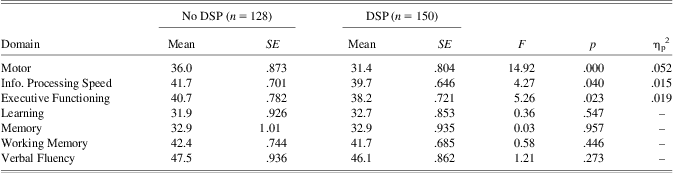
A planned MANCOVA, including all seven neuropsychological domains as dependent variables, revealed significant differences between groups with and without DSP, F(7,267) = 3.066, p = .004. Adjusted domain marginal means are presented in Table 3. As hypothesized, participants with DSP performed significantly worse in motor (p < .001), information processing speed (p = .040), executive functioning (p = .023), but not in any other domains. Additionally, an examination of the individual tests within the executive functioning domain was completed with univariate tests adjusting for age and WRAT-3. Results revealed that participants with DSP performed significantly worse on TMT-B, F(1,269)=6.345, p = .012, but not on the WCST preservative responses score, F(1,269) = 0.527, p = .468.
Neuropsychological Performance by DSP Status
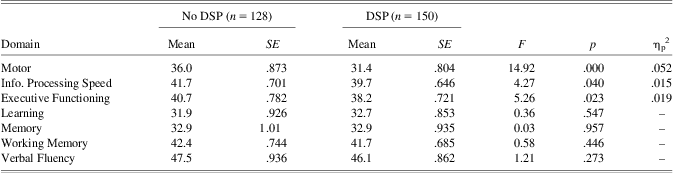
Note. Marginal means and standard errors are presented. Age, gender, and WRAT-3-Reading subtest standard scores were used as covariates in univariate analyses.
DSP Anatomic Distribution
As a follow-up to the significant domain differences related to the presence of DSP, a series of post hoc ANCOVAs, with anatomic distribution (No DSP/DSP Lower/DSP Upper) as the independent variable, were calculated, controlling for age, WRAT-3 Reading standard score, and gender as appropriate. The ANCOVA with motor functioning as the dependent variable was significant, F(2,273) = 8.133, p < .001, ηp2 = .056. Post hoc pairwise comparisons indicated that the DSP group with upper extremity signs [M = 29.62, 95% CI, (26.99, 32.25)] performed significantly worse in the motor domain than the No DSP group [M = 35.81, 95% CI, (34.11, 37.51)], p < .001. Similarly, the DSP group with neuropathic signs limited to the lower extremities had significantly worse motor performance [M = 32.61, 95% CI, (30.65, 34.56)] compared to the No DSP group [M = 35.81, 95% CI, (34.11, 37.51)], p = .017. There was a trend for worse motor performance in the upper extremity group compared to the lower extremity group (p = .074), but this p value did not did not reach the set threshold (p < .05) for significance. Additional ANCOVAs revealed trends for information processing speed (p = .090) and executive functioning (p = .098).
Patterns of Isolated Impairment Associated With DSP
While impairment in many domains is common in this advanced HIV+ cohort, we were interested in whether DSP was associated with a pattern of neurocognitive impairment that was limited to the three domains of interest. Figure 1 presents rates of impairment limited to one or more of the following domains: motor, processing speed, and executive functioning. Limited impairment was more common in the DSP group (17.3%), χ2 = 5.554, p = .018, OR = 2.47, 95% CI [1.14 – 5.35] when compared to the No DSP group (7.8%).
Rates of impairment limited to motor, information processing speed, and/or executive functioning domains. *p < .05

Discussion
The primary purpose of this study was to examine the association between distal sensory polyneuropathy and neuropsychological test performance. We found that participants with DSP performed significantly worse than those without DSP in the domains of motor, information processing speed, and executive functioning. As hypothesized, DSP status was not associated with neuropsychological performance in domains without a psychomotor speed test (i.e., verbal fluency, learning, memory, and working memory). Among the three domains with a psychomotor component, the executive functioning domain is the only one that pairs a test requiring psychomotor speed (TMT-B) with an untimed test that does not (WCST), which may make this domain appear to be less susceptible to the effects of peripherally mediated sensory dysfunction. However, univariate analyses confirmed that worse performance in the executive functioning domain was due to poor performance on the TMT-B and not the WCST. These findings implicate a peripherally mediated mechanism of poor neuropsychological performance in HIV+ individuals, rather than pure neurocognitive impairment, in some domains. Therefore, researchers and clinicians should exercise caution when interpreting psychomotor performance in the context of known DSP, or unknown neurological status.
As hypothesized, analyses revealed that the DSP group with upper extremity signs performed significantly worse than the No DSP group in the motor domain. Similarly, the DSP group with clinically detectable neuropathic signs limited to the lower extremities performed worse in the motor domain compared to those without DSP. Analyses used to examine the effect of anatomic distribution of neuropathic signs on information processing speed and executive functioning revealed a trend-level association. Nonetheless, the combined DSP group performed significantly worse in these domains. The small but statistically significant difference between groups in executive functioning and processing speed may be because the tests that comprise these domains require more complex cognitive processes in addition to motor ability. As deficits in motor ability, information processing speed, and executive functioning are common in HIV infection, the results from the current study suggest further deviation among HIV+ individuals with DSP within these domains.
While the association between motor performance and upper extremity disease is conceptually more straightforward, a possible explanation for association with lower extremity signs is that these participants have subclinical upper extremity involvement below limits of detection by neurological exam. Clinical progression of DSP is typically from lower to upper extremity; even in HIV-seronegative individuals, there may be nerve damage demonstrated on nerve conduction velocity testing that is not clinically detectable (Bromberg & Jaros, Reference Bromberg and Jaros1998). In fact, nerve conduction studies are often used to explore signs of DSP in upper and lower extremities specifically because subtle abnormalities may be present, but not overtly detectable by clinical examination (Preston & Shapiro, Reference Preston and Shapiro2005). A prospective analysis might be useful to determine if individuals with DSP signs limited to the lower extremities that exhibit psychomotor slowing are more likely to develop upper extremity signs at subsequent visit intervals.
Alternatively, the association of DSP with cognitive impairment may represent parallel trajectories of central and peripheral nervous system disease in the context of HIV infection. Worse psychomotor performance by participants with DSP may be indicative of central nervous system dysfunction that is characteristic of HIV infection, as HIV preferentially infiltrates brain regions associated with voluntary motor control (e.g., basal nuclei). This supports previous research that has demonstrated slowed information processing associated with HIV infection, after minimizing the effects of peripheral neuropathy on neuropsychological performance (Llorente et al., Reference Llorente, Miller, D'Elia, Selnes, Wesch, Becker and Satz1998). However, among individuals with HIV, the association between subcortical gray matter atrophy and neuropsychological performance is inconsistent (e.g., Ances, Ortega, Vaida, Heaps, & Paul, Reference Ances, Ortega, Vaida, Heaps and Paul2012; Castelo et al., Reference Castelo, Courtney, Melrose and Stern2007; Di Sclafani et al., Reference Di Sclafani, Mackay, Meyerhoff, Norman, Weiner and Fein1997; Paul et al., Reference Paul, Ernst, Brickman, Yiannoutsos, Tate and Cohen2008). As DSP and HAND share common risk factors, it is likely that both central and peripheral nervous systems contribute, perhaps synergistically, to neuropsychological performance, thus making independent effects difficult to ascertain. One of the most challenging issues in interpreting the results of this study is that DSP may be a peripheral indicator of the amount of neuronal damage sustained. However, it is important to acknowledge that even if brain damage and peripheral nerve damage co-occur, the additive effect of peripheral nerve damage will likely exacerbate poor performance on motor-based tests.
An important result from this study was that participants with DSP had significantly higher rates of impairment limited to domains with timed psychomotor tests than participants without DSP did. This finding has important implications for the presumed causes, and diagnosis of HIV-related neurocognitive disorders such as HIV-associated dementia, particularly when diagnostic batteries assess a limited number of cognitive domains. According to the widely used research nosology for HAND diagnoses, impairment in at least two domains must be evident to be classified as neurocognitively impaired (Antinori et al., Reference Antinori, Arendt, Becker, Brew, Byrd, Cherner and Wojna2007). A critical caveat of these classification criteria is that impairment must not be limited to motor and sensory-perceptual skills. Of note, in the present study we found that participants with DSP not only performed worse in domains with timed psychomotor tests (i.e., motor, processing speed, and executive functioning), but were also more likely to be impaired only in these domains. These results provide evidence that DSP is associated with neurocognitive impairments limited to specific domains. If peripherally mediated dysfunction, such as DSP, differentially impacts neuropsychological performance, as we found in this study, the rate of neurocognitive disorders may be overestimated if the contribution of DSP is not considered. These results also suggest caution in implementing brief or motor based screening assessments to determine neurocognitive impairment in HIV+ cohorts considering that the prevalence of DSP increases as HIV disease progresses. Furthermore, evidence suggests that DSP is associated with impaired daily living skills, unemployment, and reduced quality of life (Ellis et al., Reference Ellis, Rosario, Clifford, McArthur, Simpson and Alexander2010). Interestingly, self-reported impairment in daily living skills is considered an important factor in the symptomatic classification of HAND. To clearly identify daily living skill dysfunction attributable to neurocognitive impairment, future studies should control for the potential contribution of peripherally mediated abnormalities such as DSP.
While there is substantive empirical evidence identifying an association between advanced HIV infection and impairment in motor, information processing, and executive functioning domains, the mechanism of dysfunction is not clear (e.g., Reger et al., Reference Reger, Welsh, Razani, Martin and Boone2002). In this advanced HIV cohort, we demonstrated that the groups were comparable on HIV disease indicators (i.e., CD4 and HIV RNA), yet the DSP group still performed worse in all three domains with psychomotor tests. However, we did not account for the role of nadir CD4 count, which has shown to be an important factor in both DSP and HAND. Nadir CD4 count was not used in this study because this information has not been continuously collected and verified since the inception of the Manhattan HIV Brain Bank. Additionally, there is some evidence suggesting an association between symptomatic DSP and substance use (e.g., Morgello et al., Reference Morgello, Estanislao, Simpson, Geraci, DiRocco and Gerits2004). More research is needed to examine the potential correlation between symptomatic DSP and neurocognition, while considering other associated conditions (e.g., substance use). Future research may benefit from examining DSP orthogonal groups (i.e., lower/asymptomatic, lower/symptomatic, upper/asymptomatic, upper/symptomatic) to isolate the contribution of each factor to neuropsychological performance. Unfortunately, the size of the current sample precluded such analyses.
As antiretroviral therapy has increased life expectancy among those living with HIV infection, a more diffuse pattern of neurocognitive impairment has emerged. There is debate in the scientific literature as to whether aging with HIV confers a unique risk of greater impairment. Evidence indicates that older HIV+ adults are more likely to have DSP (e.g., Ellis et al., Reference Ellis, Rosario, Clifford, McArthur, Simpson and Alexander2010; Evans et al., Reference Evans, Ellis, Chen, Yeh, Lee, Schifitto and Clifford2011; Morgello et al., Reference Morgello, Estanislao, Simpson, Geraci, DiRocco and Gerits2004; Nakamoto et al., Reference Nakamoto, McMurtray, Davis, Valcour, Watters, Shiramizu and Shikuma2010) and perform more poorly on neuropsychological measures of psychomotor ability, information processing speed, and executive functioning compared to younger HIV+ individuals (Becker et al., Reference Becker, Sanchez, Dew, Lopez, Dorst and Banks1997; Cherner et al., Reference Cherner, Ellis, Lazzaretto, Young, Mindt and Atkinson2004; Sacktor et al., Reference Sacktor, Skolasky, Selnes, Watters, Poff, Shiramizu and Valcour2007, Reference Sacktor, Skolasky, Cox, Selnes, Becker and Cohen2010; Scott et al., Reference Scott, Woods, Carey, Weber, Bondi and Grant2011; Woods et al., Reference Woods, Rippeth, Frol, Levy, Ryan, Soukup and Heaton2004). Even though dementia occurs more frequently in older adults with HIV infection (Sacktor et al., Reference Sacktor, Skolasky, Cox, Selnes, Becker and Cohen2010; Valcour et al., Reference Valcour, Shikuma, Shiramizu, Watters, Poff, Selnes and Sacktor2004), evidence for an interaction between age and neurocognitive impairment is limited (Valcour, Paul, Neuhaus, & Shikuma, Reference Valcour, Paul, Neuhaus and Shikuma2011). However, older HIV+ adults demonstrate higher intra-individual variability across neuropsychological domains (Morgan et al., Reference Morgan, Woods, Delano-Wood, Bondi and Grant2011), which is a risk factor for dementia in HIV-seronegative older adults (Wetter et al., Reference Wetter, Delis, Houston, Jacobson, Lansing, Cobell and Bondi2006). Interestingly, older adults tend to have higher current CD4 counts than younger HIV+ adults, which has been independently correlated with the presence of DSP and worse motor performance among HIV+ individuals (Castelo et al., Reference Castelo, Courtney, Melrose and Stern2007; Morgello et al., Reference Morgello, Estanislao, Simpson, Geraci, DiRocco and Gerits2004). There is evidence that motor deficits persist even after the initiation of antiretroviral therapy, despite increased CD4 count and improvement in other neurocognitive domains (Obiabo, Ogunrin, & Ogun, Reference Obiabo, Ogunrin and Ogun2012). Considering that participants with DSP in the current study were older and had a higher rate of impairment limited to domains with psychomotor tests, it is possible that increased intra-individual score dispersion among older HIV+ individuals with neurocognitive impairment in other studies is exacerbated by peripherally mediated sensory loss in the upper extremities. This hypothesis could be tested in larger aging cohorts with HIV.
In summary, our results indicate that DSP is associated with poor performance in domains with timed psychomotor tests, and that effects may be present even when neuropathy is clinically confined to the lower extremities. We also identified that DSP was associated with a unique pattern of impairment limited to neuropsychological domains with a timed psychomotor component. The relative contributions of central and peripheral deficits to tests of cognitive performance are critical to the accurate assessment of HIV impacts on the nervous system. More research is needed to delineate the neuroanatomical origins and pathophysiologic mechanisms of neuropsychological performance abnormalities among HIV+ individuals.
Acknowledgements
The authors thank the staff and participants of the Manhattan HIV Brain Bank. This research was supported by the National Institutes of Health (S.M., grant numbers U01MH083501, UL1RR029887). The authors report no conflicts of interest.