Internalizing symptoms among children and adolescents are serious and often chronic problems that are associated with significant distress and impairment throughout the lifespan (Abela & Hankin, Reference Abela, Hankin, Abela and Hankin2008; Rudolph, Hammen, & Daley, Reference Rudolph, Hammen, Daley, Wolfe and Mash2006). Depressive and internalizing symptoms demonstrate substantial continuity over time (e.g., Tram & Cole, Reference Tram and Cole2006), yet the mechanisms that contribute to this continuity are less well understood (Rutter, Kim-Cohen, & Maughan, Reference Rutter, Kim-Cohen and Maughan2006). Adolescent social and emotional functioning derives from various multilevel factors and processes converging and transacting in social contexts over time (Steinberg et al., Reference Steinberg, Dahl, Keating, Kupfer, Masten, Pine, Cicchetti and Cohen2006). Interpersonal theories of depression postulate that depressed individuals’ behaviors elicit rejection, conflict, and stress in their relationships, and in turn, these problematic relationships lead to the maintenance or exacerbation of internalizing problems over time (Coyne, Reference Coyne1976; Hammen, Reference Hammen1992, Reference Hammen2006; Joiner & Coyne, Reference Joiner and Coyne1999; Rudolph, Flynn, & Abaied, Reference Rudolph, Flynn, Abaied, Abela and Hankin2008). These interpersonal theories are inherently transactional, although most of the supporting evidence for these interpersonal influences has not employed appropriate multiwave longitudinal designs or examined transactional effects adequately.
The purpose of the present research was to examine transactional influences and accumulating effects among corumination, a recently proposed interpersonal process of extensively discussing and self-disclosing emotional problems within a dyadic relationship (Rose, Reference Rose2002), internalizing symptoms, and stressful life events among adolescents. Based on transactional (e.g., Sameroff, Reference Sameroff2000; Sameroff & Chandler, Reference Sameroff, Chandler, Horowitz, Hetherington, Scarr-Salapatek and Siegal1975; Sameroff & MacKenzie, Reference Sameroff and MacKenzie2003) and developmental cascade models (Masten et al., Reference Masten, Roiseman, Long, Burt, Obradovic and Riley2005) and drawing from interpersonal theories of depression (e.g., Joiner, Coyne, & Blalock, Reference Joiner, Coyne, Blalock, Joiner and Coyne1999), this multiwave study examined the overarching hypothesis that youth who tend to coruminate would be more likely to exhibit prospective trajectories of internalizing symptoms because the process of corumination, while providing emotional support and leading to closer friendships (Rose, Reference Rose2002), would also generate additional interpersonal stressors (i.e., stress generation; Hammen, Reference Hammen1991, Reference Hammen2006), and greater interpersonal stressors, in turn, would contribute to elevations in internalizing symptoms. In addition and consistent with a developmental cascade model, the accumulating effects of greater stressors and higher levels of internalizing symptoms over time would be more likely to predict greater corumination in the future, and this would transactionally continue the dynamic, escalating cycle of corumination, interpersonal stress generation, and increasing internalizing symptoms that may have the potential to account for the strong continuity in depressive and internalizing symptoms over time.
Transactional perspectives emphasize the complex interchanges occurring between youth and others over time. From a transactional viewpoint, there is a dynamic chain of influences in which social experiences, such as within one's peer group, are posited to shape, and in turn, be shaped by adolescents’ characteristics (Caldwell, Rudolph, Troop-Gordon, & Kim, Reference Caldwell, Rudolph, Troop-Gordon and Kim2004; Ladd & Troop-Gordon, Reference Ladd and Troop-Gordon2003). The principle of dynamic interactionism suggests that youth actively select, process, and contribute to their social contexts such that their individual characteristics are maintained, or exacerbated, over time (Caspi, Elder, & Bem, Reference Caspi, Elder and Bem1987, Reference Caspi, Elder and Bem1988; Lerner, Reference Lerner, Lerner and Foch1987). Masten and colleagues (2005) note that there are “surprisingly few longitudinal studies that control for preexisting and ongoing concurrent associations so that models of bidirectional influences and progressive effects from one domain of adaptation to another can be evaluated in a developmental perspective” (p. 733). They delineated a developmental cascade model, which posits that “functioning in one domain of adaptive behavior spills over to influence functioning in other domains in a lasting way” (Masten et al., Reference Masten, Roiseman, Long, Burt, Obradovic and Riley2005, p. 735). This cascade model thus incorporates several testable developmental processes: (a) maladaptive functioning (e.g., symptoms or stressors) will accumulate over time, (b) problems in one arena (e.g., corumination) likely spill over to other domains (e.g., stressors in interpersonal domains, internalizing symptoms), and (c) one process (e.g., corumination) can undermine functioning in another domain (e.g., interpersonal relationships), which in turn, increases internalizing symptoms. As such, transactional and developmental cascade models are complementary perspectives for understanding the unfolding of corumination, interpersonal stressors, and internalizing symptoms over time. These models propose complex, dynamic chains of influence over time and across different domains that affect, and are affected by, each other. These models provide the conceptual framework for the present study.
Corumination
Developmental research shows the increasing role that interpersonal influences, especially with peers in contrast to parents, play during adolescence (Brown, Reference Brown, Feldman and Elliot1990; Furman & Buhrmester, Reference Furman and Buhrmester1992; Harter, Stocker, & Robinson, Reference Harter, Stocker and Robinson1996; Hergovich, Sirsch, & Felinger, Reference Hergovich, Sirsch and Felinger2002). With enhanced interactions with peers comes greater potential for positive and negative trade-offs associated with stronger and closer peer relationships. Corumination is a process that is hypothesized to be a social manifestation of rumination (Rose, Reference Rose2002) that involves such trade-offs. Corumination is defined as an extreme form of negative self-disclosure in which individuals extensively discuss their problems within a dyadic relationship (Rose, Reference Rose2002). Corumination combines aspects of self-disclosure and rumination, such that by mutually promoting talk about problems and the negative affective aspects of problems, corumination may operate as a vulnerability to emotional difficulties. Further, the current literature on corumination delineates both positive and negative aspects of peer friendships, (e.g., increased friendship quality, and elevated internalizing symptoms, respectively), consistent with the perspective that close peer relationships involve some inherent trade-offs. In this way, corumination, especially over time and potentially across multiple relationships, may result in more emotional costs than benefits.
Corumination and Internalizing Symptoms
Corumination has been shown to be associated concurrently (Rose, Reference Rose2002; Rose Schwartz, & Carlson, 2005) and prospectively (Rose, Carlson, & Waller, Reference Rose, Carlson and Waller2007) with internalizing symptoms of anxiety and depression (see summary by Bukowski, Adame, & Santo, Reference Bukowski, Adams and Santo2006). Rose's (2002) cross-sectional analysis found that corumination correlated with internalizing symptoms as well as with higher friendship quality. Further, girls reported higher levels of corumination, and this effect increased with age in Rose's sample of youth from late childhood to early adolescence. These findings were replicated in a cross sectional study of mothers and daughters (Rose et al., Reference Rose, Schwartz and Carlson2005). In addition, initial evidence suggests that there is a reciprocal relationship between corumination and internalizing symptoms as Rose and colleagues (2007) demonstrated in their two-time point prospective study (over 6 months) that baseline corumination predicted later internalizing symptoms, and initial internalizing symptoms predicted later reports of corumination. This suggests a transactional relationship exists between corumination and internalizing symptoms and sheds light on a plausible larger framework for understanding the development of internalizing symptoms during the adolescent years.
One aim of this study was to replicate and extend Rose's initial work suggestive of a reciprocal, transactional relationship using a multiwave design. Given the methodological limitations with two-time point studies (Curran & Willoughby, Reference Curran and Willoughby2003), we wanted to examine prospectively these potentially dynamic, transactional phenomena (Sameroff & MacKenzie, Reference Sameroff and MacKenzie2003). In addition, we sought to advance knowledge on accumulating effects by including stressors in the model along with corumination and internalizing symptoms in order to study a more comprehensive transactional cascade model.
Stress Generation
Negative life events predict prospective increases in internalizing symptoms (Grant et al., Reference Grant, Compas, Stuhlmacher, Thurm, McMahon and Halpert2003, Reference Grant, Compas, Thurm, McMahon, Gipson and Campbell2006; Grant & McMahon, Reference Grant, McMahon, Hankin and Abela2005), but the reverse, in which initial symptoms predict later stressors, has also been shown (for a review, see Hammen, Reference Hammen2006). The process of stress generation, whereby individuals contribute to negative events in their lives (Hammen, Reference Hammen1991), has illuminated the role that individuals actively play in contributing to stressors in their lives. Stress researchers have differentiated between different kinds of stressors, including dependent and independent events, as well as stressors in different developmentally salient domains, including interpersonal and achievement. Dependent events are those that are at least partially attributable to the characteristics or actions of the individual, whereas independent, or fateful events, occur outside of the individual's behavior or control.
Stress generation theories (e.g., Hammen, Reference Hammen1991, Reference Hammen2006; Hankin & Abramson, Reference Hankin and Abramson2001) postulate that various individual difference characteristics can lead to stress generation. These stress generation models are broadly consistent with earlier transactional, developmental psychopathological theories of depression (e.g., Cicchetti & Schneider-Rosen, Reference Cicchetti and Schneider-Rosen1984, Reference Cicchetti, Schneider-Rosen, Rutter, Izard and Read1986). Most commonly, elevated levels of depressive symptoms have been studied as one set of characteristics and behaviors that predict later dependent stressors. Since Hammen's (1991) original study showing that depressed women's behaviors and characteristics contributed to their experiencing more interpersonal-dependent events, many investigations have found that individuals with elevated depressive symptoms experience more dependent stressors, especially in the interpersonal domain (e.g., Adrian & Hammen, Reference Adrian and Hammen1993; Daley et al., Reference Daley, Hammen, Burge, Davila, Paley and Lindberg1997; Davila, Hammen, Burge, Paley & Daley, 1995; Hankin, Mermelstein, & Roesch, Reference Hankin, Mermelstein and Roesch2007; Rudolph et al., Reference Rudolph, Hammen, Burge, Lindberg, Herzberg and Daley2000; Wingate & Joiner, Reference Wingate and Joiner2004).
In addition to elevated depression, other individual characteristics have been studied as potential factors that may generate additional stressors (Hammen, Reference Hammen2006; Pettit & Joiner, Reference Pettit and Joiner2006). Several interpersonal variables and personality traits related to interpersonal functioning such as reassurance seeking (Potthoff, Holahan, & Joiner, Reference Potthoff, Holahan and Joiner1995), poor interpersonal problem solving (Davila et al., Reference Davila, Hamen, Burge, Paley and Daley1995), self-perceived social skills (Segrin, Reference Segrin2001), sociotropy (Shih, Reference Shih2006), autonomy (Daley et al., Reference Daley, Hammen, Burge, Davila, Paley and Lindberg1997; Nelson, Hammen, Daley, Burge, & Davila, Reference Nelson, Hammen, Daley, Burge and Davila2001), and insecure attachment style (Bottonari et al., Reference Bottonari, Roberts, Kelly, Kashdan and Ciesla2007; Hankin, Kassel, & Abela, Reference Hankin, Kassel and Abela2005) have been found to contribute to future interpersonal stress.
Yet, the relation between corumination and stressors has not been examined. Corumination, as a social process with adjustment trade-offs, may be another individual difference characteristic that contributes to dependent stressors, especially those in the interpersonal domain. We hypothesized that corumination would prospectively predict higher levels of dependent events, especially interpersonal stressors in contrast to noninterpersonal events. Finally, given that corumination has been shown to predict internalizing symptoms and given our hypothesis that corumination would predict additional interpersonal-dependent stressors, we also examined whether interpersonal-dependent stressors would mediate the link between initial corumination and prospective elevations in internalizing symptoms.
Sex and Age Influences on Corumination, Stress Generation, and Internalizing Symptoms
Sex differences in internalizing problems, such as depression and anxiety, become more pronounced throughout adolescence, although the reasons for this are not understood well (Hankin, Wetter, & Cheely, Reference Hankin, Wetter, Cheely, Abela and Hankin2008; Rutter, Caspi, & Moffitt, Reference Rutter, Caspi and Moffitt2003; Zahn-Waxler, Crick, Shirtcliff, & Woods, Reference Zahn-Waxler, Crick, Shirtcliff, Woods, Cicchetti and Cohen2006). Traditionally, close relationships have been seen as a protective barrier from developing emotional difficulties (Bukowski, Newcomb, & Hartup, Reference Bukowski, Newcomb and Hartup1996). Adolescent girls report higher levels of self-disclosure than boys (e.g., Camarena, Sarigiani, & Peterson, 1990; Furman & Buhrmester, Reference Furman and Buhrmester1985; Zarbatany, McDougall, & Hymel, Reference Zarbatany, McDougall and Hymel2000), which in turn, is associated with higher levels of friendship quality (Camarena et al., Reference Camarena, Sarigiani and Petersen1990). Thus, it is somewhat puzzling that adolescent girls, who report more support from their peer relationships (Buhrmester, Reference Buhrmester, Bukowski, Newcomb and Hartup1996; Cross & Madson, Reference Cross and Madson1997) and whose relationships are marked by intimacy and closeness (Rose & Rudolph, Reference Rose and Rudolph2006), are not buffered from internalizing problems. Corumination offers one way to address this seeming paradox by suggesting that girls may ruminate on and rehash their emotional problems within their intimate friendships more so than boys. Girls and older adolescents have been shown to exhibit higher levels of all of the constructs examined in this study: corumination, stressors, and internalizing symptoms.
Rose (Reference Rose2002) found that girls reported higher levels of corumination, which increased with age, whereas boys’ levels were lower and did not increase with age. Further, in their prospective study, corumination predicted increases in prospective anxiety and depressive symptoms marginally only for adolescent girls (Rose et al., Reference Rose, Carlson and Waller2007). Girls not only report higher levels of corumination, they also generate more stressors, especially interpersonal events (e.g., Daley et al., Reference Daley, Hammen, Burge, Davila, Paley and Lindberg1997; Davila et al., Reference Davila, Hamen, Burge, Paley and Daley1995; Hankin et al., Reference Hankin, Mermelstein and Roesch2007; Rudolph & Hammen, Reference Rudolph and Hammen1999). Girls exhibit a greater relational orientation and emphasize friendships more than boys (Buhrmester, Reference Buhrmester, Bukowski, Newcomb and Hartup1996; Cross & Madson Reference Cross and Madson1997), and girls’ relational orientation may increase their vulnerability to interpersonal stressors and their likelihood of generating interpersonal stressors. We sought to replicate these age and sex effects in corumination, and we investigated whether sex moderated the prospective associations among corumination, stressors, and internalizing symptoms.
Current Study
Question 1: Corumination and internalizing symptoms
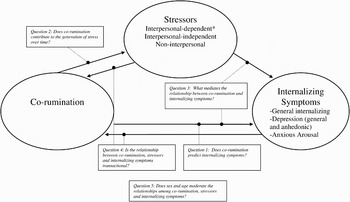
The current study examined the longitudinal associations among corumination, stress generation, and internalizing symptoms. We first sought to replicate Rose's (2002) cross-sectional and two-time point longitudinal (Rose et al., Reference Rose, Carlson and Waller2007) findings by investigating whether baseline corumination predicts prospective internalizing symptoms. In addition to examining the previously established relationship between corumination and internalizing symptoms, we also investigated whether corumination would predict internalizing symptoms compared with externalizing symptoms. Further, we evaluated which of the different aspects of broad internalizing symptoms (i.e., anxiety, general depression, specific anhedonic depression, broad internalizing symptoms) are most strongly associated concurrently and prospectively with corumination based on recent conceptual models (Mineka, Watson, & Clark, Reference Mineka, Watson and Clark1998; Watson, Reference Watson2005) and evidence (Lahey, Applegate, Waldman, Hankin, & Rick, 2004; Lahey et al., Reference Lahey, Rathouz, Van Hulle, Urbano, Krueger and Applegate2008) on the hierarchical structure of internalizing disorder symptoms. For example, in this study we separated general depressive symptoms, which research has shown to be generally saturated with levels of broad negative affect and may be nonspecific to depression, from anhedonic depression, which is a theoretically and empirically supported facet that is hypothesized to be a relatively purer factor of depression (Clark & Watson, Reference Clark and Watson1991; Watson, Reference Watson2005; Watson et al., Reference Watson, Weber, Assenheimer, Clark, Straus and McCormick1995). We then sought to address four additional and novel research questions (see Figure 1).
A representation of the hypothesized relationships among corumination, stressors, and internalizing symptoms.

Question 2: Stress generation
Does corumination contribute to the generation of interpersonal stressors over time? Here, we hypothesized that baseline corumination would predict more dependent stressors prospectively and that the relationship would be stronger for events classified as interpersonal than for noninterpersonal.
Question 3: Mediation
What mediates the prospective relationship between corumination and internalizing symptoms? Specifically, we hypothesized that interpersonal-dependent stressors would mediate the relationship between corumination and the later experience of internalizing symptoms. In other words, youth who tend to coruminate would be more likely to generate additional interpersonal stressors, and as a result, would exhibit greater internalizing symptoms over time. This hypothesis is consistent with the developmental cascade model in which there is a progression of effects and spill over from one domain to others, such that in the course of this snowballing, one process (i.e., corumination) undermines functioning in another domain (i.e., generating interpersonal stressors), which in turn, increases growth in internalizing symptoms over time.
Question 4: Transaction and accumulation of influences over time
Is the association among corumination, stressors, and internalizing symptoms transactional? Here, we explored the potential reciprocal, transactional relations among these factors and hypothesized that initial internalizing symptoms and stressors would also contribute to prospective changes in corumination. Thus, given that we also hypothesized that corumination would contribute to interpersonal stress generation and prospective trajectories of internalizing symptoms, we postulated that there will be a developmental cascade effect involving the accumulation of corumination, interpersonal stressors, and internalizing symptoms. Cascade effects build and accumulate over time, so there may be smaller initial effects between corumination and internalizing symptoms at the start of the cycle, but this association should amplify, or become stronger in relations, over time. We posited the likelihood of both transactional and cascade effects largely because we also expected that stressors and symptoms would contribute to increased levels of corumination over time, and in turn, more corumination would predict later internalizing symptoms such that both chains, or streams, of influence in this transactional cycle would be supported.
Question 5: Sex and age differences
Last, we examined the potential moderating effects of sex and age on these hypotheses. Based on previous findings, we expected that (a) adolescent girls and older adolescents would report more corumination; and (b) sex and age would have moderating effects on the associations among corumination, interpersonal-dependent stressors, and prospective internalizing symptoms, such that these relations would be stronger for girls and middle adolescents relative to boys and early adolescents, respectively.
Method
Participants
Participants were youth who were recruited from five Chicago area schools. Four hundred sixty-seven students were available in the appropriate grades (6th–10th) from these schools and were invited to participate. Parents of 390 youth (83.5%) provided active consent; all 390 youth were willing to participate. Three hundred fifty-six youth (91%) completed the baseline questionnaire. The 34 students who were willing to participate but did not complete the baseline visit were sick or absent from school and were unable to reschedule. We examined data from 350 youth who provided complete data (symptoms, stressors, and corumination) at baseline. Rates of participation in the study were as follows: Wave 2 (N = 303), Wave 3 (N = 308), and Wave 4 (N = 345). Attrition analyses showed that missing data were not related to demographic characteristics (age, sex, ethnicity, or any initial symptom or stressor scores). Data were thus viewed as missing at random for analyses.
The age range at baseline was 11–17 (M = 14.5; SD = 1.40); 9% were in 6th grade, 9% in 7th grade, 9% in 8th grade, 27% in 9th grade, and 46% in 10th grade. Fifty-seven percent were female; 53% White, 21% African American, 13% were Latino, 6% were Asian or Pacific Islander, and 7% bi- or multiracial. The rationale for studying 6th–10th graders is that this is when the sex difference in internalizing symptoms diverges and when youth place increasing emphasis on peer relationships, so this may be an optimal age window for studying the relations among corumination, internalizing symptoms, stress generation, and age and sex influences.
Procedures
Students participated in this study with active parental informed consent. Permission to conduct this investigation was provided by the school districts and their institutional review boards, school principals, the individual classroom teachers, and university institutional review board. Trained research personnel visited classrooms in the schools and briefly described the study to youth, and letters describing the study were sent home to parents. Specifically, students and parents were told that this study was about adolescent mood and experiences, and participation would require completion of questionnaires at four different time points. Students, who agreed to participate and had returned active parental consent, read and signed their own informed consent form after having the opportunity to ask any questions about the study. Youth completed a battery of questionnaires during class time for the four waves of assessment. They were debriefed at the end of the study.
Participants completed questionnaires at four time points over a 5-month period, with approximately 5 weeks between each time point for these four waves of data. The spacing for the follow-up intervals was chosen to provide enhanced, accurate recall of symptoms (see Costello, Erkanli, & Angold, Reference Costello, Erkanli and Angold2006, for evidence that shorter time frames provide more accurate, less biased findings). These four waves of the study took place during a single academic year, and there was no obvious developmental transition (e.g., change of grade) for most youth. Youth were compensated $10 for their participation at each wave in the study, for a possible total of $40 for completing all four assessments.
Measures
Corumination Questionnaire
The original measure (Rose, Reference Rose2002) to assess corumination included 27 items that measure the extent to which youth typically coruminate with same-sex friends. Nine content areas are covered, including (a) frequently discussing problems, (b) discussing problems rather than doing other activities, (c) friend encouraging discussion of problems, (d) target child encouraging friend to discuss problems, (e) discussing repetitively the same problem, (f) speculating cause of problems, (g) speculating consequence of problems, (h) trying to understand parts of problems, and (i) focusing on negative affective feelings. The items focus on assessing a more extreme form of discussing problems beyond mere self-disclosure. For the present study, 9 items (1 for each of the content areas) was used to assess corumination at Times 1, 2, and 4. Rose (Reference Rose2002) reported that her 27-item measure was unifactorial, and a factor analysis of the 9 items used in the present study (those listed in the appendix of Rose, Reference Rose2002) similarly revealed a single factor. Internal consistency in this sample with 9 items was α = 0.89 at Time 1, α = 0.91 at Time 2, and α = 0.91 at Time 4. Youth responded to the items using a 5-point Likert scale, and scores were the mean rating of the 9 items. Rose and colleagues (2007) reported excellent internal consistency, good test–retest reliability, and validity.
Mood and Anxiety Symptom Questionnaire (MASQ)
The MASQ (Watson et al., Reference Watson, Weber, Assenheimer, Clark, Straus and McCormick1995) for this study was modified from the original MASQ, which contains 90 items to assess the general distress and specific anxiety and depressive symptoms based on the tripartite theory of anxiety and depression (Clark & Watson, Reference Clark and Watson1991). For this study, only the anxious arousal (ANX) subscale was used to assess relatively specific anxious symptoms that are not overly saturated with general negative affect. Youth responded to 10 ANX items on a Likert scale from 1 to 5, and reported scores are the average item scores of all items (range = 1 – 5). Reliability and validity of the MASQ has been demonstrated in research with adolescents (e.g., Hankin, Reference Hankin2008a; Hankin, Wetter, Cheely, & Oppenheimer, Reference Hankin, Wetter, Cheely and Oppenheimer2008). For example, internal consistencies (αs = 0.83–0.86) and test–retest reliabilities (rs = .53–.63 from 1 to 5 months) have been good. Validity (convergent, predictive, discriminant) has been shown in that anxious arousal symptoms, assessed via the MASQ, correlated significantly with other internalizing symptoms, less so with externalizing symptoms, and were predicted by stressful life events (Hankin, Reference Hankin2008b; Hankin et al., Reference Hankin, Wetter, Cheely and Oppenheimer2008) and rumination (Hankin, Reference Hankin2008b). The MASQ was given at all four time points. Internal reliability for ANX in this sample was α = 0.86 at Time 1, α = 0.85 at Time 2, α = 0.83 at Time 3, and α = 0.85 at Time 4.
Strengths and Difficulties Questionnaire (SDQ)
The SDQ (Goodman, Reference Goodman2001) is a brief 25-item questionnaire that assesses general internalizing and externalizing emotional and behavioral problems. A five-factor structure, consisting of emotional, conduct, hyperactivity–inattention, peer, and prosocial factors, has been supported in past research with large samples of youth and parents (Goodman, Reference Goodman2001). The conduct factor was used for the present study as a measure of broad externalizing problem behaviors, and the emotional factor was used as a measure of general internalizing symptoms. We included the conduct factor to evaluate whether corumination was specifically associated with internalizing symptoms only versus externalizing symptoms, and the general internalizing factor was included to have a broad assessment of general emotional problems so that a more nuanced understanding of the associations among corumination with various internalizing symptoms (i.e., general depression, specific anhedonic depression, specific anxious arousal, and general emotional problems) could be obtained.
Reported scores on these factors are the average item scores of all items (range = 0 – 2). Normative data are available for the SDQ based on The National Health Interview Survey (NHIS). The descriptive statistics (see Table 1) from the present sample match the descriptive data from the normative database closely. The SDQ has been shown to be reliable and valid in past research (Goodman, Reference Goodman2001). The SDQ was given at all four time points. Internal reliability for the conduct/externalizing factor in this sample was α = 0.75 at Time 1, α = 0.70 at Time 2, α = 0.63 at Time 3, and α = 0.68 at Time 4, and for general emotional/internalizing symptoms α = 0.66 at Time 1, α = 0.63 at Time 2, α = 0.72 at Time 3, and α = 0.58 at Time 4.
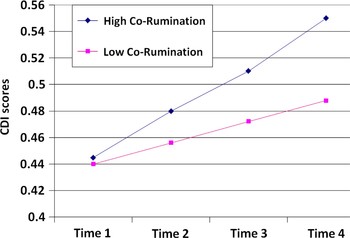
Baseline corumination predicts prospective trajectories of depressive symptoms over time. High and low levels of corumination are plotted as ±1.5 SD from the corumination mean. [A color version of this figure can be viewed online at journals.cambridge.org/dpp]

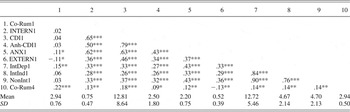
Descriptive statistics and correlations among main measures

Note: N = 350. Co-Rum, Co-Rumination Questionnaire; INTERN, internalizing, general emotional distress symptoms; CDI, Children's Depression Inventory; Anh-CDI, anhedonic factor of the CDI; ANX, anxious arousal; Extern, externalizing behaviors; IntDep, interpersonal dependent stressors; IntInd, interpersonal independent stressors; NonInt, noninterpersonal stressors.
*p < .05. **p < .01. ***p < .001.
Children's Depression Inventory (CDI)
The CDI (Kovacs, Reference Kovacs1985) is a self-report measure that assesses depressive symptoms in children and adolescents using 27 items. Each item is rated on a scale from 0 to 2. Reported scores are mean of all items and range from 0 to 54. Higher scores indicate more depressive symptoms. The CDI has been shown to have good reliability and validity as a measure of depressive symptoms in youth (Klein, Dougherty, & Olino, Reference Klein, Dougherty and Olino2005). Internal reliability in this sample was α = 0.90 at Time 1, α = 0.91 at Time 2, α = 0.91 at Time 3, and α = 0.90 at Time 4.
Although the CDI is one of the most commonly used measure of assessing depressive symptoms among youth (Fristad, Emery, & Beck, Reference Fristad, Emery and Beck1997), its construct validity and specificity as a measure of depression has been questioned (e.g., Chorpita, Moffitt, & Gray, Reference Chorpita, Moffitt and Gray2005; King, Ollendick, & Gullone, Reference King, Ollendick and Gullone1991) given that it appears to contain many items tapping broad negative affect (Chorpita, Albano, & Barlow, Reference Chorpita, Albano and Barlow1998). Thus, although the CDI is often and widely used to assess general depressive symptoms, the questionable specificity and construct validity led to the decision to select particular anhedonia items from the CDI, based on past work (e.g., Chorpita et al., Reference Chorpita, Albano and Barlow1998; Joiner, Catanzaro, & Laurent, Reference Joiner, Catanzaro and Laurent1996) to examine both the full CDI as the commonly used measure of general depressive symptoms and the relatively more specific anhedonic depressive symptoms. In sum, analyses for depressive symptom specificity are reported for the full CDI to assess general depressive symptoms and for anhedonic CDI items (#4, 12, 15, 20, 21, and 22; Chorpita et al., Reference Chorpita, Albano and Barlow1998). This approach has been successfully and validly used in past work (Chorpita et al., Reference Chorpita, Albano and Barlow1998; Hankin, Reference Hankin2008b; Hankin et al., Reference Hankin, Wetter, Cheely and Oppenheimer2008).
Adolescent Life Events Questionnaire (ALEQ)
The ALEQ (Hankin & Abramson, Reference Hankin and Abramson2002) assesses a broad range of negative life events that typically occur among adolescents, including school/achievement problems, friendship and romantic difficulties, and family problems. Examples of items from the ALEQ include “got a bad report card” to assess school events, “had an argument with a close friend” for friendship events, “boyfriend/girlfriend broke up with you but you still want to go out with them” for romantic events, and “your parents grounded you” for family events. Youth were asked to indicate how often (Likert scale ranging from 0 = never to 4 = always) these negative events had occurred to them over the past 5 weeks. These ratings were then transformed into dichotomous count of stressors (0 = no event, 1 = event occurred). The dichotomized ALEQ were used to assess a count of stressors with higher scores indicating more exposure to negative events at a particular time point over the past 5 weeks. The ALEQ demonstrated good validity in past research (Hankin, Reference Hankin2008b; Hankin et al., Reference Hankin, Wetter, Cheely and Oppenheimer2008).
The 57 different negative life events included in the ALEQ can be categorized into events occurring in an interpersonal (e.g., peers, romantic partners, family) and noninterpersonal (e.g., academics, work) domains (see Hankin & Abramson, Reference Hankin and Abramson2002) as well as independent versus dependent types of events. Independent events are those that are believed to befall individuals and are not expected to be related to a person's characteristics (e.g., close friend moves, death of a relative), whereas dependent events are those that the individual's characteristics or behaviors may have contributed to the occurrence of these events (e.g., fight with friend, romantic breakup). To create variables for interpersonal and noninterpersonal events as well as independent and dependent events, the list of 57 stressors was categorized independently by the authors with 100% agreement. This resulted in 39 interpersonal events (26 of these as dependent, 13 of these as independent) and 11 as noninterpersonal events (all were categorized as dependent). Seven events were not clearly interpersonal or noninterpersonal, and so they were not included in these categorized variables. Examples for the interpersonal-dependent category of event include “You had an argument with a close friend,” “Your parents grounded you,” “Your boyfriend/ girlfriend criticized you,” and “A boyfriend/ girlfriend broke up with you but you still wanted to be with them.” For interpersonal-independent, examples include “A close friend moved away,” “A close family member couldn't work due to injury or illness,” and “close family member (parent, sibling) died.” For noninterpersonal events, examples include “Did poorly on, or failed, a test or class project,” “You didn't complete the required homework for class,” and “You had to do chores or work you didn't want to do.” The ALEQ was given at all four time points. For the present study, the following variables, interpersonal-dependent, interpersonal-independent, and noninterpersonal, at each of the four time points, were used in analyses to test our hypothesis that corumination would predict interpersonal-dependent stress generation better than interpersonal-independent or noninterpersonal events.
Results
Preliminary analyses
Using the different recommended clinical cutoffs for the CDI revealed that 24.3% (CDI cutoff > 19; Stark & Laurent, Reference Stark and Laurent2001) or 32.3% (CDI cutoff > 16; Timbremont, Braet, & Dreesen, Reference Timbremont, Braet and Dreesen2004) of youth were above cutoff scores for the CDI. Similarly, for the SDQ, 12.3% of youth were above cutoff scores (Goodman, Reference Goodman2001) for the internalizing scale and 15.1% for the conduct factor.
Table 1 reports the descriptive statistics and the intercorrelations among corumination at Time 1 and 4 as well as symptoms (general depressive, anhedonic depressive, anxious, general internalizing, and general externalizing) and stressor types (interpersonal-dependent, interpersonal-independent, and noninterpersonal) at baseline.Footnote 1 As seen in Table 1, Time 1 corumination was associated with three constructs at baseline: positively with anxious symptoms and interpersonal-dependent stressors and negatively with externalizing behaviors. Corumination at Time 4 was significantly correlated with all baseline variables. Corumination at baseline was significantly associated with general internalizing symptoms for three out of four time points (rs = .02 to .15, r average = .12 with p < .05 at Times 2, 3, and 4 but not Time 1), anxious arousal at all four time points (rs = .10 to .17, r average = .13), externalizing problems at two out of four time points (rs = .00 to –.16, r average = −.07 with p < .05 at Times 1 and 3 but not Times 2 or 4), anhedonic depressive symptoms at one time point (at Time 2, rs = .02 to .13, r average = .06) but not with general depressive symptoms bivariately at any time point (rs = .04 to .06, r average = .05). Also, baseline corumination was significantly associated with interpersonal-dependent events across three out of four time points (rs = .06 to .15, r average = .12 with p < .05 at Times 1, 3, and 4 but not Time 2). Corumination was less strongly associated with interpersonal-independent events (rs = .06 to .11, r average = .07 with p < .05 at Time 3 only) and with noninterpersonal events (rs = .03 to .13, r average = .07 with p < .05 at Time 4 only).
Overview of statistical approach
Hierarchical linear modeling (HLM; Bryk & Raudenbush, Reference Bryk and Raudenbush1992; HLM 5.04; Raudenbush, Bryk, Cheong, & Congdon, Reference Raudenbush, Bryk, Cheong and Congdon2001) was used to address several of the primary hypotheses: (a) does baseline corumination predict prospective increases in internalizing symptoms (general depression, anhedonic depression, anxiety, general internalizing, but not externalizing behaviors) over the four time points? (b) Does baseline corumination predict interpersonal-dependent stressors but not interpersonal-independent or noninterpersonal events over the four time points? (c) Do interpersonal-dependent stressors mediate the prospective association between baseline corumination and later internalizing symptoms?
The analysis of multiple levels of data is accomplished in HLM by constructing Level 1 and 2 equations. At Level 1, regression equations are constructed that model separately the variation in the repeated measures (e.g., internalizing symptoms, stressors) as a function of time (e.g., the four waves of data for internalizing and externalizing symptoms). Each equation includes various parameters to capture features of an individual youth's level of symptoms and stressors over time, such as an intercept that describes an individual's average level on the variable, a slope that describes an individual's linear growth on the variable over time, and a time-varying covariate that describes the strength of association between within-person fluctuations in one construct (e.g., symptoms of depression) and within-individual changes in another construct (e.g., stressors) over the waves of data. At Level 2, equations are specified that model individual differences in the Level 1 parameters as a function of between-subjects’ variables (i.e., corumination). To test whether baseline corumination predicts prospective elevations in internalizing symptoms over time, baseline symptom levels were entered so that the overlap of baseline symptoms with corumination are controlled, and prospective elevations in symptoms can be examined beyond the main effects of initial symptoms given the strong continuity in symptom levels over time during adolescence (cf. Cole & Tram, 2006; e.g., average test–retest r for CDI over time was .70 in this study). Thus, this data analytic approach is a conservative and risky test of our hypotheses and examines both concurrent association (i.e., intercept) and longitudinal relations (i.e., slope) among corumination, symptoms, and stressors.
Corumination predicts prospective trajectories of internalizing symptoms and stressors
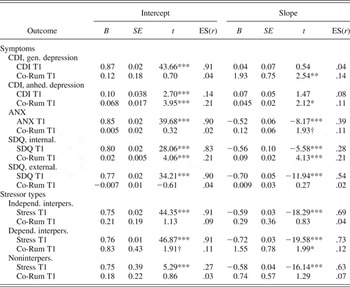
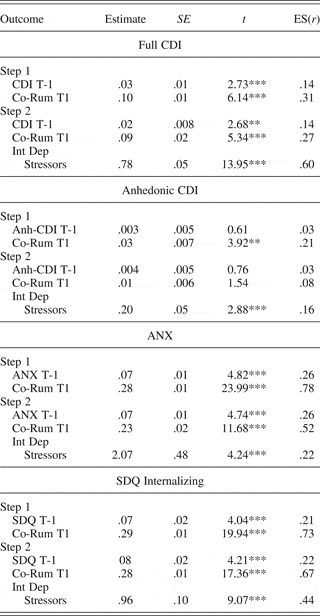
To test the first main hypothesis that corumination would predict prospective elevations in internalizing symptoms over time, HLM was used to predict intercepts and slopes in symptoms of general depression, anhedonic depression, anxiety, and internalizing and externalizing behaviors over the four waves. The primary predictors of these outcomes were (a) baseline symptom levels to control for individual differences in symptom levels and enable examination of prospective elevations of symptoms over time and (b) baseline corumination. Results are presented in Table 2 for the various models predicting different symptoms. Several significant results emerged. First, baseline levels of any given symptom strongly predicted intercepts in that symptom over time. Second, corumination was associated significantly with intercepts for anhedonic depression and general internalizing symptoms but not general depression or anxious arousal. Third, and consistent with the cascade and specificity hypotheses, the main effect of baseline corumination significantly predicted internalizing symptom trajectories, but not externalizing problems, over time. Figure 2 illustrates these effects graphically by plotting prospective change in general depressive symptoms over the four waves as a function of corumination (±1.5 SD). Greater corumination predicted elevated trajectories in general depressive symptoms over time, whereas lower corumination levels were associated with relatively flatter slopes in depressive symptoms. The same pattern was found for anhedonic depressive, general internalizing, and anxious arousal symptoms.
Longitudinal analyses of baseline corumination predicting trajectories of internalizing symptoms and stressor types

Note: N = 350. CDI, Children's Depression Inventory; T1, Time 1; Co-Rum, Co-Rumination Questionnaire; ANX, anxious arousal symptoms; SDQ, Strengths and Difficulties Questionnaire.
†p < .06. *p < .05. **p < .01. ***p < .001.
To test the second main hypothesis, similar HLM analyses were conducted with stressors over the four time points as the outcome. Results, as shown in the bottom portion of Table 2, revealed that baseline corumination predicted prospective trajectories of interpersonal-dependent stressors only over time and was marginally associated with intercepts for these stressors. However, and consistent with our hypothesis, corumination was not significantly associated with intercepts or slopes for interpersonal-independent or noninterpersonal events.
Interpersonal-dependent stressors mediate the relationship between corumination and prospective internalizing symptoms
Given that corumination significantly predicted only interpersonal-dependent stressors, as hypothesized, mediation analyses proceeded with an exclusive focus on interpersonal-dependent stressors. The third main question was examined using HLM in which internalizing symptoms over the four time points were predicted by stressors over the four time points entered as a time-varying covariate at Level 1 along with baseline corumination and initial internalizing symptoms at Level 2 to evaluate whether interpersonal-dependent stressors generated by corumination mediate the association between corumination and later internalizing symptoms over time. To ensure that the longitudinal direction of effects were tested, rather than merely epiphenomenon of symptoms and stressors at the same time point, we used analyses with lagged effects in which symptoms at the prior wave (T − 1) were controlled to create prospective increases in symptoms from one time point to the next. In addition, baseline levels of stressors were controlled to adjust for initial stress levels and examine change in stressors over time as a predictor of prospective elevations in symptoms.Footnote 2 The equation used for the Level 1 model for symptoms over four time points is

The equations for Level 2 models are
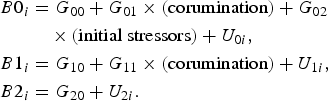
Following Baron and Kenny's (1986) and Holmbeck's (Reference Holmbeck2002) logic for demonstrating mediation, the following conditions must be met: (a) corumination must predict internalizing symptoms, (b) corumination must predict stressors, (c) stressors must predict prospective elevations in internalizing symptoms over time, and (d) the significant association between corumination and later internalizing symptoms will be reduced after including stressors in the analysis. The findings reported above demonstrated Conditions 1 and 2: baseline corumination predicted prospective trajectories of symptoms and stressors. Conditions 3 and 4 were tested with the equations above. The cross-level interaction of baseline corumination at Level 2 with stressors entered at Level 1 (the effect of G 11) was not significant in any of the models for predicting prospective elevations in symptoms, so only the main effect of corumination (G01) predicting symptom changes was considered.
As shown in Table 3, interpersonal-dependent stressors appeared to mediate, at least in part, the association between baseline corumination and prospective changes in internalizing symptoms, based on Baron and Kenny's (1986) criteria, because these stressors, as a time-varying covariate, significantly predicted prospective changes in internalizing symptoms from Time T – 1 to Time T. The effect of corumination became nonsignificant for anhedonic depression only, whereas corumination continued to predict general depressive, anxious arousal, and general internalizing symptoms, albeit less so with the inclusion of stressors. Typically, Sobel tests would be used to indicate whether these indirect effects for mediation were significant, yet doing so with multiwave and multilevel data is likely to be underpowered and insensitive (Bauer, Preacher, & Gil, Reference Bauer, Preacher and Gil2006), so Sobel tests were not used. Moreover, typically the amount that a mediator explains of the total effect would usually be examined, yet this approach can also be problematic for multilevel data and modeling (Nezlek, Reference Nezlek, Robins, Fraley and Krueger2007).
Mediational analyses examining generated stressors accounting for the prospective association between baseline corumination and internalizing symptoms trajectories

Note: N = 350. CDI, Children's Depression Inventory; Co-Rum, Co-Rumination Questionnaire; T1, Time 1; Anh, anhedonic symptoms from CDI; ANX, anxious arousal symptoms; SDQ, Strengths and Difficulties Questionnaire; IntDep, interpersonal dependent stressors.
**p < .01. ***p < .001.
Bauer and colleagues (2006) reported a method to test indirect effects and mediation using multilevel models that is more powerful and sensitive and does not violate the traditional assumptions made in testing mediation (e.g., Baron & Kenny, Reference Baron and Kenny1986) that likely occur when using nested models in multilevel models. Bauer and colleagues’ (2006) approach provides output that gives the full covariance matrix of random effects, full asymptotic covariance matrix of fixed effects, and variance components, and all of these are important for evaluating random indirect and total effects to test mediation more accurately in multilevel models. Using Bauer and colleagues’ procedures, the average indirect effects were found to be significant for general depressive, anhedonic depressive, anxious arousal, and general internalizing symptoms. Finally, dependent interpersonal stressors accounted for 16% of the association between corumination and general depressive symptoms, 64% of the association between corumination and anhedonic depressive symptoms, 35% of the link between corumination and anxious arousal, and 12% of the relation between corumination and general internalizing symptoms. Thus, dependent interpersonal stressors partially mediated the longitudinal association between baseline corumination and later internalizing symptoms.
Reciprocal, transactional influence of corumination on later internalizing symptoms
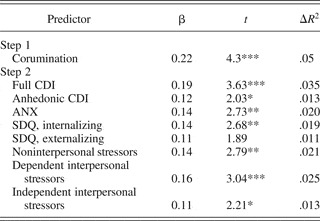
To investigate the potential of the first strand of a reciprocal, transactional influence between initial internalizing symptoms and/or stressors as predicting prospective changes in corumination levels over time from Time 1 to Time 4, several hierarchical regression analyses were performed in which corumination at Time 1 was entered in the first step, and then different symptoms or stressor types were entered in the second step, each in independent models, as predictors of corumination at Time 4 as the dependent variable. Multiple imputation was used to impute values for the small missing data (N = 5) so that the full N = 350 could be used. Table 4 shows the results. Consistent with hypotheses, prospective changes in corumination were predicted by baseline levels of internalizing symptoms as well as stressors.
Hierarchical regression analyses testing prospective changes in corumination levels at Time 1 as a function of different baseline symptoms and stressors

Note: N = 350. CDI, Children's Depression Inventory; ANX, anxious arousal symptoms; SDQ, Strengths and Difficulties Questionnaire.
*p < .05. **p < .01. ***p < .001.
To test the other side of the stream in the transactional, reciprocal chain of influence given the analyses showing that initial symptoms and stressors predicted change in corumination, we then examined whether corumination at Time 2 predicted prospective changes in symptoms from Time 1 to Time 3. After controlling for Time 1 symptoms, corumination at Time 2 predicted Time 3 general depressive symptoms (β = 0.12, t = 2.73, p < .001), anhedonic depressive symptoms (β = 0.20, t = 3.73, p < .001), and general internalizing symptoms of the SDQ (β = 0.13, t = 2.90, p < .001), but not anxious arousal symptoms (β = 0.03, t = 0.69, p = .49).
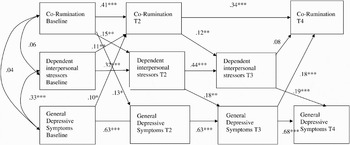
Finally, given that each of these analyses separately supported each strand of the transactional model, a more comprehensive structural equation model (SEM) using AMOS 6.0 (Arbuckle, Reference Arbuckle2006) was advanced to examine both strands of influence in the transactional model simultaneously using the most critical variables from the four waves of data. Figure 3 shows the SEM estimated along with the final standardized beta results for the full CDI. This model for general depressive symptoms provided an adequate fit to the data: χ2 (17) = 102.15, p < .01, comparative fit index (CFI) = 0.94, normed fit index (NFI) = 0.93, and similar models fit adequately for anhedonic depressive symptoms, χ2 (17) = 101.16, p < .01, CFI = 0.94, NFI = 0.92, and general internalizing symptoms, χ2 (17) = 94.89, p < .01, CFI = 0.93, NFI = 0.91. Inspection of the individual paths for the full CDI (see Figure 3) reveals that initial levels of interpersonal-dependent stressors and initial CDI predicted change in corumination from Time 1 to Time 2, and in turn, elevated corumination at Time 2 predicted increases in interpersonal-dependent stressors at Time 3, which finally predicted increases in general depressive symptoms at Time 4 after controlling for all necessary levels of variables measured earlier in the chain. Likewise, the other side of the transactional chain was supported in that baseline corumination predicted change in depressive symptoms from Time 1 to Time 2 as well as change in interpersonal-dependent stressors from Time 1 to Time 2. Then, these additional interpersonal stressors predicted increases in general depressive symptoms at Time 3, and elevated symptom levels were associated with greater corumination at Time 4 after controlling for all necessary levels of variables measured earlier in the chain. The same pattern of pathways was observed for general internalizing symptoms. A similar set of pathways was found for anhedonic depressive symptoms for all paths with the exception that anhedonia at Time 1 and Time 3 did not predict downstream elevations in co-rumination at Times 2 and 4, respectively.
Structural equation model results of the bidirectional, cascading model of the development of internalizing symptoms: testing both streams of influence over time in a transactional model to understand general depressive symptoms (i.e., full CDI).

No single statistical analysis, and often no single study, can fully and completely evaluate a hypothesized transactional model (e.g., Sameroff & Mackenzie, Reference Sameroff and MacKenzie2003; Shanahan & Bauer, Reference Shanahan and Bauer2004), but these multiple analyses converge on a similar picture and appear to support a transactional process. The HLM analyses showed that baseline corumination predicted prospective trajectories of internalizing symptoms from Time 1 through Time 4, baseline corumination predicted prospective increases in interpersonal-dependent stressors, and these additional interpersonal-dependent stressors predicted prospective elevations in internalizing symptoms (from Time T − 1 to Time T). Then, more specific analyses intended to examine the particular strands of each side of the reciprocal, transactional chain of influence were conducted. On one side of the stream, initial stressors and symptoms predicted increases in corumination from Time 1 to Time 4. On the other side of the transactional strands intended to test the downstream effects and feedback to increases in later internalizing symptoms, we found that corumination at Time 2 predicted prospective changes in internalizing symptoms at Time 3. Finally, the SEM testing both strands simultaneously provided additional support for the individual analyses consistent with each side of the transactional strand. Thus, taken together, these various analyses converge to support a transactional chain of influence in which a developmental cascade of effects over time accumulates to contribute to elevated levels of internalizing symptoms over time.
Age and sex influences on corumination and potential moderation
We used an analysis of variance (ANOVA) to examine whether corumination levels at baseline differed by age and sex. Consistent with our hypothesis that adolescent girls would report higher levels of corumination than boys, and older youth would exhibit more corumination than younger youth, results from ANOVA revealed significant main effects for sex, F (1, 349 = 27.11, p < .01, and age, F (5, 345 = 5.22, p < .001, but no Age × Sex interaction, F (5, 345 = 0.69).Footnote 3 Specifically, girls’ levels of corumination (M = 3.20, SD = 0.74) were higher than boys (M = 2.61, SD = 0.67), and middle adolescents (9th and 10th graders; M = 3.03, SD = 0.77) reported greater corumination than early adolescents (6th–8th graders; M = 2.65, SD = 0.67). Last, exploratory analyses investigating possible ethnic differences showed no significant effects on corumination (Caucasian versus non-Caucasian).
Finally, we examined whether sex moderated the association between corumination and prospective internalizing symptoms or between corumination and stressors using HLM in which sex, at Level 2, was entered to examine the Sex × Corumination interaction term predicting internalizing symptoms and stressors over time. None of the Sex × Corumination interactions was significant for any of the internalizing symptoms measures or any of the stressors types for either intercepts or slopes (all ts < 0.3). Age × Corumination interactions were all similarly nonsignificant in predicting internalizing symptoms and stressor types. Finally, we did exploratory analyses with ethnicity as a potential moderator, and the Ethnicity (Caucasian, non-Caucasian) × Corumination interactions were nonsignificant. Thus, the results reported above with respect to the association between corumination and internalizing symptoms and between corumination and stressors do not appear to differ by sex or age.
Summary of results
This study found evidence for transactional associations among corumination, internalizing symptoms, and interpersonal stressors and accumulation of interpersonal influences to internalizing symptoms over time (i.e., slopes more than intercepts). We replicated the findings of Rose et al. (Rose, Reference Rose2002; Rose et al., Reference Rose, Carlson and Waller2007) and showed that corumination related positively to internalizing, but not externalizing, symptoms, especially over time. We extended these findings by using HLM to analyze separately average symptom levels over time from trajectories of symptom levels over time, and these results showed that corumination significantly predicted prospective trajectories of general depressive, anhedonic depressive, anxious arousal, and general internalizing symptoms as well as average levels of anhedonic depression and general internalizing, but not average levels of general depressive or anxious arousal, symptoms.
In addition, we obtained several new findings that were consistent with a transactional model and a developmental cascade model. First, corumination predicted the generation of dependent interpersonal stressors but not independent interpersonal or noninterpersonal stressors. Second, dependent interpersonal stressors partially mediated the relationship between corumination and later internalizing symptoms, especially for anhedonic depression. Third, the relationship between corumination, interpersonal stress generation, and internalizing symptoms was transactional: baseline levels of internalizing symptoms and dependent interpersonal stressors predicted prospective elevations of corumination, and in turn, greater corumination levels predicted more interpersonal stressors and later internalizing symptoms downstream. Fourth, the expected main effects of sex and age were obtained, but no moderation was found.
Discussion
These findings largely supported our primary hypotheses and suggest that the associations among corumination, interpersonal stressors, and internalizing symptoms are transactional over time and produce cumulative and cascading effects that may contribute to the development and continuity of internalizing symptoms among adolescents. We comment on each aspect of this accumulating, transactional process and discuss how a developmental cascade model can help to explain the ontogeny and stability of internalizing symptoms over time.
Corumination and a hierarchical dimensional structure of internalizing symptoms
Corumination can be considered a reliable predictor of various aspects of symptoms of the internalizing spectrum in both male and female adolescents. We replicated Rose's (2002) cross-sectional and Rose et al.'s (2007) two time point longitudinal findings that corumination at baseline was correlated positively and predicted prospective changes in aspects of internalizing symptoms. We also extended these findings by showing that corumination was related positively to anhedonic depression and anxious arousal symptoms.
Of interest, and somewhat unexpected, was the finding that initial corumination was not significantly correlated with general depressive symptoms, as measured by the overall CDI, at any particular measurement wave. However, corumination did predict intercepts and slopes for specific anhedonic depressive symptoms and internalizing symptoms as well as increasing prospective trajectories of general depressive symptoms. We comment later on these findings and implications for our suggestion that corumination and interpersonal-dependent stressors transact and accumulate in a developmental cascade to contribute to increasing internalizing trajectories. To the lack of concurrent and prospective bivariate associations between corumination and overall depressive symptoms, Rose, in her past research, decomposed the overall CDI into two of its factors: internalizing/affective symptoms and behavioral symptoms. She analyzed separately the association of corumination with affective symptoms versus behavioral symptoms of the CDI to obtain her results that corumination relates to internalizing symptoms. Thus, the set of apparently contradictory results obtained in the present research may be resolved with findings from Rose's research in that general internalizing symptoms, assessed here via the SDQ—emotional distress scale, anhedonic depression, and anxious arousal symptoms were associated with corumination, whereas externalizing, behavioral problems, as assessed via SDQ—conduct factor, were not.Footnote 4
This pattern of results (i.e., Rose's findings using the two separate factors of the CDI and our findings with different measures of internalizing symptoms) can be profitably considered and understood from the perspective of an emerging hierarchical model of the internalizing and externalizing problem dimensions (Krueger & Markon, Reference Krueger and Markon2006; Mineka, Watson, & Clark, Reference Mineka, Watson and Clark1998; Watson, Reference Watson2005). Current theory and research suggests that there is a hierarchical structure to the internalizing distress dimension that includes overlapping factors of broad negative affect, anhedonia/low positive affect specific to depression, and anxious arousal specific to anxiety/fear problems (Lahey et al., Reference Lahey, Applegate, Waldman, Loft, Hankin and Rick2004, Reference Lahey, Rathouz, Van Hulle, Urbano, Krueger and Applegate2008; Mineka et al., Reference Mineka, Watson and Clark1998; Watson, Reference Watson2005). Thus, depending on which level of the internalizing distress hierarchy is of interest, assessed, and analyzed, different results and interpretations could be obtained. In this study, we intentionally used multiple measures to assess different facets of internalizing symptoms, including the CDI to assess general depressive symptoms and specific anhedonic depressive symptoms, anxious arousal to assess specific symptoms of anxiety that would relate most strongly to fear problems, and general emotional distress (from the SDQ) to assess the broad internalizing dimension, given this emerging hierarchical dimensional structure to the internalizing disorders spectrum.
Understanding the amplification of effects over time
HLM enabled us to move beyond bivariate correlational findings and showed that corumination predicted prospective trajectories (i.e., slopes) of general depressive, specific anhedonic depressive, and general internalizing symptoms as well as intercepts of anhedonic depression and general internalizing symptoms for the sample as a whole. Finding prediction of prospective slopes, in particular, contributes to our interpretation of this model as transactional and cumulative over time. That corumination was not associated with intercepts in general depressive symptoms but did predict prospective slopes of internalizing symptoms over time is consistent with a developmental cascade model in which the effect of corumination builds and accumulates over time.
The relationship between corumination and internalizing symptoms may be dynamic. As a youth's levels of internalizing symptoms become more elevated over time, there may be a feedback process, in which the tendency to coruminate with others over these increasing levels of emotional distress problems begins to slowly accumulate, spills over into worsening and more stressful interpersonal relationships, and contributes to the growth seen in internalizing symptoms trajectories over time. That prospective increases in internalizing symptom trajectories (i.e., slopes) were predicted by baseline corumination is consistent with our hypothesis that a dynamic, transactional, vicious cascading cycle may exist for some youth who tend to coruminate frequently such that they generate interpersonal stressors, experience more internally emotionally distressing symptoms, and in turn, these stressors and symptoms contribute downstream to additional elevations in later corumination. However, it is worth noting that these effects and cascade processes may apply to a portion of the sample, and not necessarily to all the youth, as some youth likely exhibited various other trajectories (e.g., decrease or curvilinear) of symptoms over time. As such, this hypothesized cascade process may not apply to other subsets of youth in the sample who did not exhibit increasing linear growth in internalizing symptoms over time. It is possible that different processes and sets of factors may account for different trajectories in symptoms over time for the subset of youth who did not demonstrate the significant linear growth trajectory in symptoms (i.e., slopes) as seen for the sample on average.
As just discussed, corumination contributed to the generation of only interpersonal- dependent, but not interpersonal-independent or noninterpersonal, stressors over time. This suggests that the process of corumination contributes to youth experiencing additional interpersonal stressors that the individual had some hand in creating (i.e., dependent events). This finding is consistent with the developmental cascade model in which maladaptive processes in one domain can spill over into other domains. It also provides additional evidence that corumination has both positive and negative trade-offs because the generation of additional interpersonal stressors is another negative aspect of excessively rehashing and overdiscussing emotional problems within close relationships. That corumination predicted only interpersonal-dependent, but not noninterpersonal, events, is consistent with stress generation theories (e.g., Hammen, 2007; Hankin & Abramson, Reference Hankin and Abramson2001) and prior transactional depression models (e.g., Cicchetti & Schneider-Rosen, Reference Cicchetti and Schneider-Rosen1984, Reference Cicchetti, Schneider-Rosen, Rutter, Izard and Read1986), and the notion that individual differences in social factors (e.g., corumination, insecure attachment, reassurance seeking, sociotropy) predict later interpersonal stressors. Because this relationship is transactional and cumulative over time, the process of corumination likely amplifies the stressors experienced and chips away at individuals’ ability to effectively cope with and problem solve the stressors that are accumulating in their lives. This type of snowballing and exacerbation over time of social factors, especially within the same conceptual domains (i.e., interpersonal), are trademark signs of cascade effects in development (Masten et al., Reference Masten, Roiseman, Long, Burt, Obradovic and Riley2005) and lends additional evidence to our hypothesis that interpersonal influences to internalizing problems accumulate over time.
As hypothesized, interpersonal-dependent stressors partially mediated the association between baseline corumination and trajectories of internalizing symptoms, and this indirect effect was strongest for anhedonic depressive symptoms. This represents a novel finding consistent with our hypothesis and sheds important light on at least one mechanism of influence by which corumination contributes to later internalizing symptoms. Still, full mediation was not obtained for any type of internalizing problems examined. This raises the question of what other processes and factors contribute to the transactional relationship between corumination and internalizing symptoms. Some research indicates that interpersonal influences, such as reassurance seeking (Potthoff et al., Reference Potthoff, Holahan and Joiner1995), poor interpersonal problem solving (Davila et al., Reference Davila, Hamen, Burge, Paley and Daley1995), and self-perceived social skills (Segrin, Reference Segrin2001) play a role in this relationship. Future research to test these social processes together, as well as with other risks to internalizing symptoms, as part of a multiple mediating pathways model would be helpful to explain more of the transactional association between corumination and internalizing symptoms.
Multiple pathways connecting corumination, stressors, and symptoms
Although these findings indicate one potential transactional process with accumulating effects that can contribute to increasing trajectories of internalizing symptoms over time, the results need to be considered in the context of other evidence from research examining potential transactional influences of internalizing distress and interpersonal relationship difficulties among youth. Prospective longitudinal research shows that interpersonal relationship difficulties, including low peer acceptance or popularity (Kistner, Reference Kistner, Joiner, Brown and Kistner2006; Kistner, David-Ferdon, Repper, & Joiner, Reference Kistner, David-Ferdon, Repper and Joiner2006), high peer rejection (Nolan, Flynn, & Garber, Reference Nolan, Flynn and Garber2003), peer victimization (Olweus, Reference Olweus, Rubin and 1993), problematic close friendships (Allen et al., Reference Allen, Insabella, Porter, Smith, Land and Phillips2006), romantic relationship stress (Monroe, Rohde, Seeley, & Lewinsohn, Reference Monroe, Rohde, Seeley and Lewinsohn1999), and episodic peer stressors (Hankin et al., Reference Hankin, Mermelstein and Roesch2007) all predict later internalizing symptoms, especially depression. Likewise, initial symptoms can lead to later interpersonal relationship dysfunction as depressed individuals’ behaviors make it difficult for them to have positive, rewarding interactions with others. Longitudinal evidence also exists that a consequence of depression can be problematic relationships as depression predicts later peer rejection (Little & Garber, Reference Little and Garber1995; Prinstein, Borelli, Cheah, Simon, & Aikins, Reference Prinstein, Borelli, Cheah, Simon and Aikins2005), less stable reciprocal friendships (Prinstein et al., Reference Prinstein, Borelli, Cheah, Simon and Aikins2005), diminished friendship quality (Prinstein et al., Reference Prinstein, Borelli, Cheah, Simon and Aikins2005), decrements in peer popularity or acceptance (Kistner et al., Reference Kistner, David-Ferdon, Repper and Joiner2006), generation of romantic stressors over time (Hankin et al., Reference Hankin, Mermelstein and Roesch2007), and poorer quality in family relationships (Lewinsohn, Rohde, Seeley, Klein, & Gotlib, Reference Lewinsohn, Rohde, Seeley, Klein, Gotlib, Joiner, Brown and Kistner2006).
These lines of evidence are consistent with different developmental pathways connecting internalizing problems and interpersonal relationships (i.e., equifinality and multifinality; Cichetti & Rogosch, 1996). In sum, results from this study and past research, in concert with the developmental psychopathology principle of multiple developmental pathways (Pickles & Hill, Reference Pickles, Hill, Cicchetti and Cohen2006), suggest interesting new avenues to investigate other trade-offs associated with corumination as well as additional transactional processes and cascading effects that may connect internalizing problems and interpersonal influences over time.
Sex and age differences: Remaining questions
This study found the expected sex and age effects in corumination. Older adolescents and girls reported higher levels of corumination, but contrary to our hypothesis, neither sex nor age moderated the associations among corumination, stressors, and internalizing symptoms. This is in contrast to Rose and colleagues’ past work (2007) that found marginally significantly higher associations between corumination and internalizing symptoms for girls than boys. The discrepancy in findings could be explained by her larger sample size (N = 813) to detect very small gender moderation effects in comparison to our moderate sample size (N = 350). The lack of age moderation is consistent with Rose and colleagues’ (2007) work with a sample of third, fifth, seventh, and ninth graders in which corumination did not interact with grade level to predict internalizing symptoms. We had hypothesized that there might be moderation by age because peer relationships become more important during adolescence and youth have more time inside and outside of school to engage in corumination compared with earlier grade levels when activities are more proscribed. Yet, no age or grade moderation from this study and Rose's work (2007) suggests that this hypothesis is not supported.
Findings from this study suggest that corumination's contributing to internalizing symptoms is a broad interpersonal influence that is applicable across gender and adolescence (at least early and middle adolescence). Our results do not support a contextual explanation for potentially sex-specific developmental pathways, at least with respect to corumination, leading to the development of internalizing symptoms in adolescence. Some theorists have advocated a general developmental psychopathological theory that is applicable to both boys and girls, while also postulating factors and processes capable of explaining the sex difference in adolescent depression (e.g., Hankin & Abramson, Reference Hankin and Abramson2001). In contrast, others (e.g., Keenan & Hipwell, Reference Keenan and Hipwell2005; Zahn-Waxler et al., Reference Zahn-Waxler, Crick, Shirtcliff, Woods, Cicchetti and Cohen2006) have highlighted the value of potentially sex-specific models that posit different factors and processes contributing to depression for boys versus girls. Overall, reasons for the stark sex difference in adolescent depression remain elusive (Hankin et al., Reference Hankin, Wetter, Cheely, Abela and Hankin2008).
Strengths and limitations
The present results need to be interpreted with certain limitations in mind. First, all of the data come from youth who self-reported symptom levels, stressor occurrence, and corumination. Clearly, given the likely mono-operation bias of same informant and method for assessing the central constructs in this study, use of multiple methods (e.g., observational methods to assess corumination, diagnostic interviews) and multiple informants (e.g., parents, peers) would be an important next step for future research in this area. Initial research, based on coding videotaped observations of target youth and peers’ interactions, suggests good concordance with the youths’ self-reported corumination scores (Rose et al., Reference Rose, Schwartz and Carlson2005).
Second, this study did not investigate clinical levels of anxiety, depression, or externalizing problems through structured diagnostic interviews, so it is unclear whether the present findings would generalize to more severe levels of psychopathology. Most research suggests that anxiety, depression, and externalizing problems can be represented and conceptualized best as dimensional continua, rather than discrete categories (e.g., Fergusson, Horwood, Ridder, & Beautrais, Reference Fergusson, Horwood, Ridder and Beautrais2005; Hankin, Fraley, Lahey, & Waldman, Reference Hankin, Fraley, Lahey and Waldman2005; Osgood, McMorris, & Potenza, Reference Osgood, McMorris and Potenza2002; Vollebergh et al., Reference Vollebergh, Iedema, Bijl, de Graaf, Smit and Ormel2001), so it is most likely that the etiological factors that contribute to subclinical levels of psychopathology may also predict clinical levels as well (c.f., Gotlib et al., Reference Gotlib, Lewinsohn and Seeley1995). Structured diagnostic interviews can address this issue. Still, novel and interesting questions can be examined in a more severely distressed sample. For example, it may be that among a more distressed sample, in which many peers exhibit elevated levels of internalizing symptoms and rumination, there could be more corumination and greater potential for amplifying, transactional effects in such a distressed peer context. In such a peer context, there could be stronger peer contagion and socialization or selection effects that involve corumination and thus snowball into more interpersonal problems and exacerbation of internalizing symptoms. There might be individual differences in peers’ willingness to participate in corumination with a target youth and in the peers’ abilities to cope with the sharing of negative affect before the peer withdraws and potentially rejects the target youth (cf., Coyne, Reference Coyne1976; Joiner et al., Reference Joiner, Coyne, Blalock, Joiner and Coyne1999). Future research can investigate how different peer contexts, including varying levels of internalizing symptom distress and coping abilities of different youth in the peer group, affects individual trajectories of internalizing symptoms and the transactional, developmental cascades involving corumination, interpersonal stressors, and symptoms.
Third, self-report of stressors has been criticized because depressed mood, personality, or cognitive vulnerability may bias assessment of stressors (e.g., Cohen, Towbes, & Flocco, Reference Cohen, Towbes and Flocco1988; Simons, Angell, Monroe, & Thase, Reference Simons, Angell, Monroe and Thase1993). Although baseline levels of symptoms were controlled for in analyses to remove potential symptom bias, future research with use of contextual stress interviews to assess for more objective stressors in the achievement and interpersonal domains would be helpful (Monroe & Roberts, Reference Monroe and Roberts1990; Monroe & Simons, Reference Monroe and Simons1991; Rudolph & Hammen, Reference Rudolph and Hammen1999). Also, we categorized stressors into interpersonal-dependent, interpersonal-independent, and noninterpersonal events to test a specificity hypothesis that corumination would predict interpersonal-dependent stressors most strongly. This effect was found, yet it is noteworthy that the different stressor categories were highly correlated and the magnitude of relations between interpersonal-dependent compared with the other stressor types was not very strong. Future research should continue to investigate specificity of stressors and effects using other methods that do not yield such overlapping stressor categories.
Fourth, effect sizes were fairly small, although significant, for corumination predicting later internalizing symptoms, interpersonal-dependent stressors, and partial mediation of the link between corumination and prospective symptoms through interpersonal stressors. The modest relations found in this study are consistent with the relatively small effect sizes observed in past corumination research (e.g., Rose, Reference Rose2002; Rose et al., Reference Rose, Carlson and Waller2007). Multiple etiological influences will need to be studied to understand more fully the onset and stability of internalizing symptoms.
Despite these various limitations, the present research had several strengths. These include a multiwave assessment of various commonly occurring psychopathological symptoms, use of a psychometrically reliable and construct valid measure of corumination, and data analytic methods best suited for multilevel longitudinal repeated measures data. A modestly large sample of early and middle adolescence youth was also assessed, so there was sufficient power to detect even small effect sizes. The sample was relatively racially and ethnically diverse and represented a wide socioeconomic range, as opposed to predominantly White, middle-class samples used in much past research. Finally, a community sample, as opposed to outpatient or inpatient samples, was used so the study's results should be more generalizable, and the effect sizes should be more appropriately and accurately estimated as compared with a purely clinic-referred sample (Cohen & Cohen, Reference Cohen and Cohen1984). Still, replication of these results from a sample with diagnoses of internalizing disorders would help to confirm whether these findings apply to youth with more severe, clinically significant problems and to evaluate the practical, clinical implications of the relatively small effect sizes.
Conclusion
In summary, the picture that emerges from these findings is that of a cumulative and transactional relationship among these social influences contributing to the continuity and increasing trajectory of internalizing problems over time. In our study, corumination predicted prospective internalizing symptoms and prospective generation of interpersonal stressors. Symptoms and stressors, in turn, also predicted greater corumination over time, and interpersonal-dependent stressors partially meditated the relationship between corumination and internalizing symptoms. Ultimately, these findings suggest a dynamic, complex, and interlocking set of relationships over time, such that the existence of any of these interpersonal influences at different points in time contribute to the likelihood of the existence and amplification of other risk-inducing interpersonal factors that ultimately culminate in increasing internalizing symptoms over time. This depicts a picture of interpersonal risks accumulating over time, such that excessively rehashing emotionally problems with others, exhibiting initial internalizing symptoms and/or stressors, all likely contribute to the likelihood that these issues will continue to be increasingly more problematic for some individuals moving through adolescence.
Given the strong continuity in internalizing symptoms that begins in adolescence and progresses through adulthood (Schulenberg, Sameroff, & Cicchetti, Reference Schulenberg, Sameroff and Cicchetti2004), as well as the variability in manifestation of internalizing symptoms, seeking to identify risk processes early in the developmental pathways progressing to first onset of depression and preventing this first onset in adolescence (Horowitz, Garber, Ciesla, Young, & Mufson, Reference Horowitz, Garber, Ciesla, Young and Mufson2007) and later recurrences (Monroe & Harkness, Reference Monroe and Harkness2005) is clearly a priority. There are clear and early risk factors for the ontogeny and increasing stability of internalizing problems over time, and this study has identified corumination and transactional interpersonal stress generation as such processes.