


Introduction
Most people recover from the loss of a loved one without problems (Bonanno, Reference Bonanno2004; Forstmeier and Maercker, Reference Forstmeier and Maercker2007). Yet, in a significant minority, this event gives rise to the development of depressive and anxious symptoms and syndromes as defined in the Diagnostic and Statistical Manual of Mental Disorders (DSM; APA, 2000) or precipitates the development of complicated grief (CG; Jacobs, Reference Jacobs1999). As currently defined, CG is a disorder that encompasses grief-specific symptoms including separation distress, a sense of disbelief regarding the death, preoccupation with the deceased, and recurrent images of the lost person that occur for at least 6 months, to the point of functional impairment (Prigerson, Vanderwerker and Maciejewski, in press). CG has been found to be distinct from uncomplicated grief and from disorders such as depression and posttraumatic stress disorder (PTSD). For example, studies have shown that CG, but not uncomplicated grief, is associated with distress and disability (Boelen and Van den Bout, in press; Prigerson et al., Reference Prigerson, Maciejewski, Reynolds, Bierhals, Newsom, Fasiczka, Frank, Doman and Miller1995) and that CG symptoms predict mental health impairments even when controlling for concomitant depression and PTSD (Bonanno et al., Reference Bonanno, Neria, Mancini, Coiffman, Litz and Insel2007; Prigerson et al., in press). Phenomenologically, the unique core symptoms of CG are those of functionally impairing separation distress (yearning, searching), symptoms that are more benign in uncomplicated grief and not among the criteria for depression and PTSD (APA, 2000).
Although it is only recently that the nature of CG is becoming clear, the bereavement literature has a long tradition of research on coping responses and intra-psychic mechanisms that predict maladjustment to bereavement. Among other things, considerable attention has been paid to the role of avoidant vs. confrontational ways of dealing with the consequences of loss. One view that has dominated thinking about grief has been known as the “grief work hypothesis” (Bonanno and Kaltman, Reference Bonanno and Kaltman1999; Stroebe and Stroebe, Reference Stroebe and Stroebe1991). This hypothesis holds that, for recovery to occur, people have to confront and “work through” their feelings, thoughts, and memories related with the loss. Implicated in the grief work hypothesis is the notion that avoiding stimuli that are reminders of the loss interferes with the process of coming to terms with loss.
Although the notion that avoidance blocks recovery is appealing and simple, studies that have addressed the role of avoidance in grief have yielded mixed results (cf. Bonanno and Kaltman, Reference Bonanno and Kaltman1999). This reflects the complexity of the matter. That is, on the one hand, it indeed makes sense to say that mourners have to confront the loss for emotional processing to occur, and that deliberate attempts to avoid this confrontation (by means of, for instance, situational avoidance or thought suppression) block recovery. Consistent with this notion, composite measures of deliberate avoidance have been found to be linked with grief intensity in cross-sectional (Boelen, van den Bout and van den Hout, Reference Boelen, van den Bout and van den Hout2003) and prospective studies (Bonanno, Keltner, Holen and Horowitz, Reference Bonanno, Keltner, Holen and Horowitz1995). On the other hand, it seems equally plausible that turning attention away from reminders of the loss at some points in the grieving process can be helpful. That is, as is noted in influential theories of grief (Horowitz, Reference Horowitz1997; Stroebe and Schut, Reference Stroebe and Schut1999), deliberately taking a time out from grieving may protect against emotional overload and may provide the time needed to adjust one's circumstances, thereby fostering recovery. In line with this view, a recent study among bereaved parents showed that actively looking toward the future was associated with less CG and depression (Wijngaards-de Meij et al., in press). In addition, a study by Nolen-Hoeksema, McBride and Larson (Reference Nolen-Hoeksema, McBride and Larson1997) among bereaved men showed that heightened bereavement-related self-reflection was related to poorer adjustment over time. Both studies suggest that turning attention away from the loss may indeed sometimes have a helpful rather than a debilitating effect on grief.
All in all, it appears that avoidance not always exacerbates grief. Hence, it is important to identify factors that influence the effect of avoidance on grief. There is some evidence that, in coping with stressful life events in general, the effect of avoidance is influenced by variables such as the time elapsed since the stressor occurred and the nature of the stressor itself (Bonanno et al., Reference Bonanno, Keltner, Holen and Horowitz1995). Yet, research has not yet examined factors affecting avoidance in grief. The current study sought to do so, building on a recent cognitive behavioural model of CG that offers an account of factors that may influence the impact of avoidance in recovery from loss (Boelen, van den Hout and van den Bout, Reference Boelen, van den Hout and van den Bout2006).
The model proposes that avoidance behaviours can include all wilful behavioural and cognitive attempts mourners can engage in to divert attention away from the reality of the loss and emotions linked with this reality. Examples include physical avoidance of external reminders of the loss, as well as cognitive strategies such as suppressing unpleasant thoughts and memories. In addition, rumination about experiences surrounding the loss (e.g. how it could have been prevented) rather than the loss itself, as well as efforts to maintain a connection with the lost person, can also be considered examples of avoidance. The model postulates that, although such avoidance behaviours in themselves may have a debilitating effect on grief, these behaviours are particularly detrimental when mourners fear their own grief-reactions and think that doing the opposite (i.e. confronting the loss) will lead to loss of control, madness, or otherwise disastrous consequences. Stated otherwise, the model proposes that threatening misinterpretations of one's own grief-reactions qualify the impact of avoidance behaviours, such that these behaviours are more strongly tied with grief intensity in people who endorse such misinterpretations than in those who do not. The reasoning is that when avoidance behaviours are accompanied by threatening misinterpretations about the consequences of confronting the loss, these behaviours prevent the correction of such misinterpretations and prevent mourners from focusing on their thoughts and feelings long enough for elaboration and integration of the loss to occur (Boelen, van den Hout et al., Reference Boelen, van den Hout and van den Bout2006).
The aim of the present study was to examine the role of threatening misinterpretations, avoidance behaviours, and their interaction in CG and depression after loss. In doing so, we distinguished between four types of avoidance behaviour: situational avoidance, thought suppression, ruminative avoidance, and deliberate attempts to keep attention away from the separation by continuing bonds with the deceased (i.e. cherishing linking objects and having inner conversations with him/her). As the bereavement-literature is inconclusive with respect to the impact of avoidance on grief, we had no specific hypotheses about how these behaviours would be linked to CG and depression, independent from other variables. Yet, in keeping with our cognitive behavioural model (Boelen, van den Hout et al., Reference Boelen, van den Hout and van den Bout2006), we did hypothesize that threatening misinterpretations would influence the role of avoidance in grief. Specifically, we expected that these behaviours would be more strongly associated with CG and depression in mourners with high levels of misinterpretations than in mourners with low levels of misinterpretations. As demographic variables and characteristics of the loss (cause, time from loss) may qualify the role of avoidance and misinterpretations in grief, these variables were also examined. We expected the interaction of threatening misinterpretations and avoidance to be associated with CG and depression, even when controlling for these variables.
Method
Participants and procedure
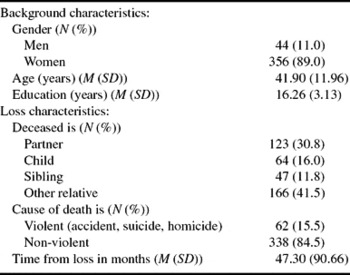
Participants were recruited through an advertisement on a Dutch Internet site that was specifically designed to provide information about grief and bereavement to the general public (e.g. information about what grief constitutes, information about sources of support, and personal experiences of mourners). The advertisement briefly explained the aims of the study and invited people who had suffered a loss to participate, which would take about 20 minutes. Individuals were asked to communicate their willingness to participate by sending an e-mail to the first author. On receipt of their e-mail, interested participants were sent a digital version of the questionnaire, together with instructions; participants were, however, asked to indicate if they preferred to receive a paper-and-pencil version. In total, 568 questionnaires were sent out to potential participants, both in digital and paper format, 404 of which (71%) were returned. Data of two participants below 18 years of age and two participants whose losses had occurred less than one month previously were not included. (Those bereaved less than one month were excluded because the Inventory of Complicated Grief-revised asks participants to rate the occurrence of CG symptoms in the preceding month.) The final sample encompassed 400 mourners. Table 1 summarizes background characteristics of the participants. Most participants were women. Two-thirds of all participants had lost a partner, child, or sibling. Losses mostly had a non-violent cause.
Demographic and loss-related background variables of the sample (N = 400)

All participants completed an informed consent form to declare that they were informed about the study purposes and procedures, the fact that participation was voluntary, and the fact that data generated from the study would be processed anonymous. Participants were not compensated in any way.
Measures
Inventory of Complicated Grief-revised (ICG-r)
The ICG-r is a 30-item questionnaire developed by Prigerson and Jacobs (Reference Prigerson, Jacobs, Stroebe, Hansson, Stroebe and Schut2001) that taps symptoms of CG. Participants rate the presence of symptoms in the last month on a 5-point scale ranging from 1 (never) to 5 (always). Example items are “Memories of the lost person upset me”, “I feel drawn to places and things associated with the lost person”, “I feel unable to imagine life being fulfilling without the lost person”.
The Dutch version differs slightly from the original version in that two items of the original version (items 26, representing lessened sense of safety, and 27, representing lessened sense of control) were combined into one item. The 29-item Dutch ICG-r has demonstrated good psychometric properties (Boelen, van den Bout, de Keijser and Hoijtink, Reference Boelen, van den Bout, de Keijser and Hoijtink2003). In all analyses the item that represents avoidance was removed to avoid overlap in content between predictor and dependent variables. Cronbach's α of this 28 item ICG-r in the present sample was 0.96.
Symptom Checklist (SCL-90) subscale Depression
The 16-item subscale Depression of the SCL-90 (Derogatis, Reference Derogatis1983) was used to assess depressive symptoms. Participants rate how often they experienced symptoms in the preceding week on a 5-point scale ranging from 1 (never) to 5 (always). The Dutch SCL-90 has demonstrated adequate psychometric properties (Arrindell and Ettema, Reference Arrindell and Ettema2003). In this study, the Depression subscale yielded an α of 0.94.
Grief-related Threatening Misinterpretations Questionnaire (GTMQ)
The GTMQ was specially designed for this study. It contains six items, representing threatening misinterpretations of what would happen on confrontation with the reality of the loss and related emotions (e.g. If I would confront the consequences of his/her death, I would go crazy) as well as more generic fear of one's own grief reactions (Since [–] is dead, I fear my own thoughts and emotions). The items were based on earlier studies on misinterpretations in grief (Boelen, van den Bout and van den Hout, Reference Boelen, van den Bout and van den Hout2003) and PTSD (Steil and Ehlers, Reference Steil and Ehlers2000) and interviews with mourners suffering from CG.
Participants rated the degree to which items applied to them on a scale ranging from 1 (not at all true for me) to 8 (completely true for me). An overall threatening misinterpretations score was calculated as the summed item scores. Cronbach's α of the GTMQ was 0.92. Confirmatory Factor Analysis (CFA) confirmed that the six items formed a single scale. The fit-indices for the unitary model all reflected adequate model fit: e.g. the Comparative Fit Index (CFI) was 0.99, the Tucker Lewis Index (TLI) was 0.98, and the Root Mean Square Error of Approximation (RMSEA) was 0.08.
Measure of Avoidance Strategies (MAS)
The MAS was specifically constructed for this study to assess four different avoidance strategies mourners can engage in. The subscale Situational Avoidance includes three items (α = 0.59) assessing the tendency to avoid situational reminders of the loss (I avoid the place where [–] died; I avoid particular objects in my surrounding that remind me of his/her death; When people talk about him/her, I urge to bring on another topic). The subscale Ruminative Avoidance (two items, α = 0.68) taps the inclination to ponder on the cause of the loss and why it occurred (I ponder about the question why [–] died; I ponder on about the events that preceded [–] death). The subscale Suppression included three items (α = 0.74) assessing the tendency to keep unpleasant feelings, thoughts or memories about the loss out of awareness (I try to keep my feelings and thoughts about the loss under control; I suppress memories of emotional events that surrounded the death of [–]; I do my best to keep thoughts or memories related to his/her death that elicit painful feelings out of awareness) Finally, the subscale Continuing Bonds included two items (α = 0.50) that reflected efforts to maintain ties to the deceased (I cherish particular objects that are closely linked with [–]; I have inner conversations with [–] in which I turn to him/her for support or advice).
The items resembled items from an earlier measure of avoidance in grief (Boelen, van den Bout and van den Hout, Reference Boelen, van den Bout and van den Hout2003) but were adjusted based on literature on avoidance in grief and PTSD (e.g. Bonanno et al., Reference Bonanno, Keltner, Holen and Horowitz1995; Horowitz, Reference Horowitz1997) and interviews with mourners suffering from CG. Participants rated how often they usually engaged in these behaviours on an 11-point scale ranging from 0 (never) to 10 (all the time). Subscale total scores were calculated as the summed subscale item scores.
CFA was conducted to examine if it was statistically justified to treat the avoidance items as separate scales. We compared the fit of a unitary model, in which all 10 items loaded on one factor with the fit of a 4-factor model in which items constituted four distinct but correlated avoidance factors. Outcomes showed that the 4-factor fit considerably better than a unitary model (χ2 difference = 212.46, Δdf = 6, p < 0.001) and that it had good fit-estimates (CFI = 0.96, TLI = 0.94, RMSEA = 0.06). Although this indicates that items indeed represented distinct manifestations of avoidance, we also conducted analyses with the total avoidance scale that had an α of 0.74. The summed scores of all avoidance scale items represented the “Avoidance Composite Score”.
Statistical analyses
It was our intention to take into account the role of background variables and loss-characteristics that affected one or more of the dependent or independent variables. Therefore, as a first step, we examined associations of background/loss variables with misinterpretations, avoidance, CG, and depression. To reduce the chance of Type II error, we did not control for number of statistical tests in these analyses.
In the second step, hierarchical regressions were used to examine the unique and interactive effects of misinterpretations and avoidance strategies on CG and depression. Ten regressions were conducted; one for each of the four avoidance strategies and avoidance composite score, with CG and depression consecutively treated as dependent variables. In the first step of these regressions, we included all relevant background/loss variables – that is: those variables that were found to affect dependent and/or independent variables. In the second step, we included the main effects of misinterpretations and the avoidance strategy. In the third step, we included the two-way interaction between misinterpretations and the avoidance strategy. Significant interaction effects were examined using simple slope analysis as described by Aiken and West (Reference Aiken and West1991). The variable Situational Avoidance was skewed to the left and was log-transformed in all analyses. As recommended by Aiken and West, in all regression analyses, predictors were centred to reduce multicollinearity.
Results
Descriptive statistics
The mean total scores on the ICG-r and SCL-90 Depression scale were M = 73.0 (SD = 24.3) and M = 38.0 (SD = 15.1) respectively. The mean ICG-r score was significantly lower than the mean score of M = 97.3 of 54 patients who sought therapy for CG and who participated in a treatment study (Boelen, De Keijser, van den Hout and van den Bout, Reference Boelen, de Keijser, van den Hout and van den Bout2007) (t(398) = −20.0, p < .001). The Depression score was lower than the mean score of M = 42.8 from a Dutch outpatient reference group (t(398) = −6.3, p < .001) but higher than the average score of M = 21.6 found in a non-clinical reference group (t(398) = 21.7 p < .001; reference groups are from Arrindell and Ettema, Reference Arrindell and Ettema2003).
Associations of background and loss-related variables with dependent and independent variables
CG and depression were only associated with time from loss and number of years of education. Time from loss was negatively associated with both CG (r = −0.15, p < .01) and depression (r = −0.11, p < .05). Duration of education was also negatively associated with CG (r = −0.24, p < .001) and depression (r = −0.14, p < .01). Symptom levels were not influenced by gender, age, cause of loss, and kinship to the deceased.
With respect to the influence of background/loss variables on avoidance strategies, it was found that Situational Avoidance was significantly associated with age of the respondent (r = −0.19, p < .001) and education (r = −0.11, p < .05). It was also affected by kinship (F(3, 396) = 3.56, p < .05), such that those who lost a sibling engaged in situational avoidance more than those confronted with other losses. Ruminative Avoidance was affected by education (r = −0.21) and time from loss (r = −0.19, ps < .001). Suppression was affected by age of the respondent (r = −0.21, p < .001). Manifestations of Continuing Bonds were only related to education (r = −0.18, p < .001). The Avoidance Composite Score was affected by age (r = −0.18, p < .001), education (r = −0.21, p < .001), and time from loss (r = −0.11, p < .05).
With respect to the influence of background/loss variables on misinterpretations, it was found that the GTMQ was significantly associated with age of the respondent (r = −0.18, p < .001) and education (r = −0.20, p < .05).
Regression analyses
Situational Avoidance
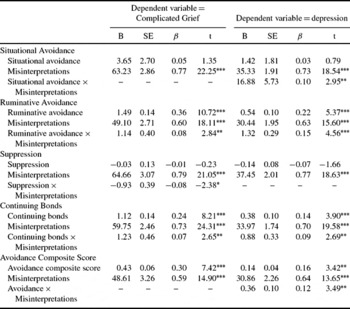
The regression analysis for CG revealed that relevant background/loss variables (age, education, time from loss, and kinship) entered in step 1 explained 7% of the variance (F change (6, 385) = 4.94, p < .001). Adding misinterpretations and Situational Avoidance in step 2 led to an increase in explained variance of 59% (F change (2, 382) = 327.35, p < .001). The two-way interaction of Situational Avoidance and misinterpretations did not explain additional variance. Thus, the second model was the final model, with a total explained variance of 66% (F(8, 391) = 91.82, p < .001, R 2 = 66%, f 2 = 1.94). Table 2 summarizes the unique contributions of the cognitive behavioural variables to the explained variance in CG and depression in all final models. As can be seen, misinterpretations (β = 0.77, p < .001) but not Situational Avoidance explained unique variance.
Summary of regression analyses with avoidance, misinterpretations and their interaction predicting ICG-r and SCL depression scores, controlling for the influence of relevant background variables

Note:. βs are βs of the final models. ICG-r = Inventory of Complicated Grief-revised. SCL = Symptom Checklist.
*p < .05. **p < .01. ***p < .001
The regression analysis for depression revealed that relevant background/loss variables (step 1) explained 4% of the variance (F change (6, 384) = 2.77, p < 0.05). Adding misinterpretations and Situational Avoidance led to an increase in explained variance of 51% (F change (2, 382) = 217.91, p < .001) and entering the two-way interaction of these variables improved explained variance to 56% (F change (1, 381) = 8.67, p < .01). As summarized in Table 2, in the final model (F(9, 390) = 54.37, p < .001, R 2 = 56%, f 2 = 1.27) Misinterpretations (β = 0.73, p < .001) and the interaction between Situational Avoidance and misinterpretations (β = 0.10, p < .01) explained unique variance.
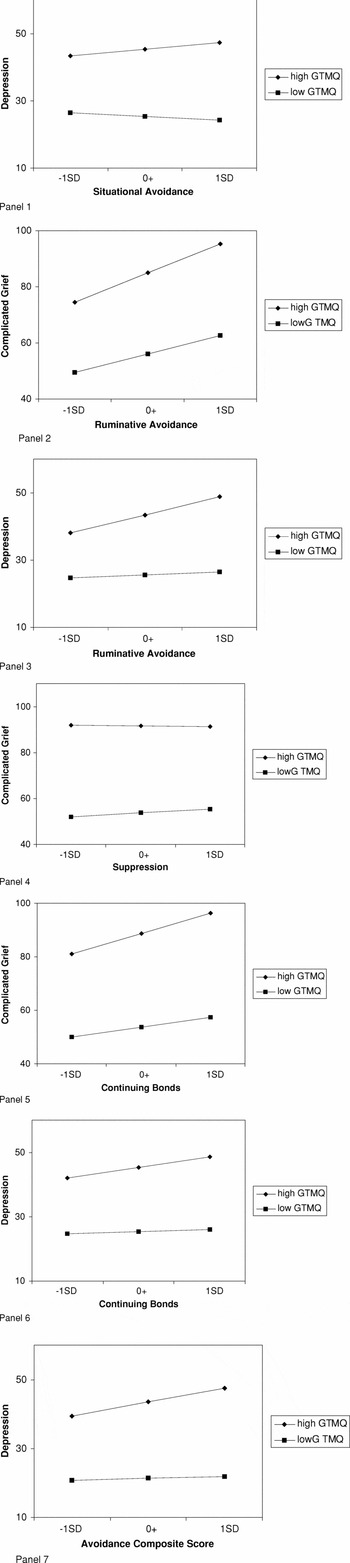
The source of the interaction was examined using simple slope analysis (Aiken and West, Reference Aiken and West1991). We calculated the slope of the regression of depression on Situational Avoidance twice, for participants low in misinterpretations (i.e. 1 SD below the mean of the GTMQ) and those high in misinterpretations (i.e. 1 SD above the mean). Outcomes revealed that Situational Avoidance was unrelated to depression when the value of misinterpretations was low (β = −0.08, p = .18) and positively associated with depression when the value of misinterpretations was high (β = 0.14, p < .01). Figure 1 (panel 1) shows the regression lines of the regression of depression on Situational Avoidance for low and high levels of misinterpretations. As can be seen, Situational Avoidance was positively linked with depression in mourners with high GTMQ scores, but not in those with low GTMQ scores.
Complicated Grief and depression as functions of different avoidance strategies and threatening misinterpretations. GTMQ = Grief-related Threatening Misinterpretations Questionnaire

Ruminative Avoidance
The regression analysis for CG revealed that relevant background/loss variables (education and time from loss) entered in step 1 explained 7% of the variance (F change (3, 3.88) = 9.03, p < .001). Adding misinterpretations and Ruminative Avoidance in step 2 led to an increase in explained variance of 66% (F change (2, 386) = 462.55, p < .001), and the two-way interaction in step 3 added 1% extra variance (F change (1, 385) = 8.05, p < .01). In the final model (F(6, 391) = 173.87, p < 0.001, R 2 = 74%, f 2 = 2.84), there were main effects for Ruminative Avoidance (β = 0.35) and misinterpretations (β = 0.60, ps < .001). These were qualified by a significant Ruminative Avoidance × misinterpretations interaction effect (β = 0.08, p < .01).
With respect to depression, relevant background/loss variables (step 1) explained 4% of the variance (F change (3, 387) = 5.01, p < .01). Explained variance increased significantly by adding misinterpretations and Ruminative Avoidance in step 2 (F change (2, 385) = 243.69, p < .001, ΔR 2 = 54%) and their interaction in step 3 (F change (1, 384) = 20.78, p < .001, ΔR 2 = 2%). In the final model (F(6, 390) = 94.80, p < .001, R 2 = 60%, f 2 = 1.50) there were main effects for Ruminative Avoidance (β = 0.22) and misinterpretations (β = 0.63), qualified by a significant Ruminative Avoidance × misinterpretations interaction effect (β = 0.15, ps < .001).
Simple slope analysis showed that for participants low in misinterpretations, Ruminative Avoidance was positively linked with CG (β = 0.28, p < .001) but unrelated to depression (β = 0.06, p = 0.24). For participants high in misinterpretations Ruminative Avoidance was similarly positive, but more strongly related to CG (β = 0.44, p < 0.001) and significantly positively associated with depression (β = 0.38, p < 0.001). Panels 2 and 3 in Figure 1 show that the association of Ruminative Avoidance with CG and depression was stronger in those with high levels of misinterpretations.
Suppression
Relevant background/loss variables (age, education, and time from loss) entered in step 1 explained 7% of the variance (F change (3, 388) = 9.03, p < .001) in CG severity. Explained variance increased by adding misinterpretations and Suppression in step 2 (F change (2, 386) = 318.63, p < .001, ΔR 2 = 58%) and their interaction in step 3 (F change (1, 385) = 5.67, p < .02, ΔR 2 = 1%). In the final model (F(6, 391) = 120.49, p < .001, R 2 = 66%, f 2 = 1.94) there were main effects for misinterpretations (β = 0.79, p < .001) and the interaction term Suppression × misinterpretations (β = −0.08, p < .05).
Simple slope analysis showed that in mourners with low levels of misinterpretations, Suppression was unrelated to CG (β = 0.07, p = .21). Unexpectedly, in mourners with high levels of misinterpretations, Suppression was inversely related with CG (β = −0.09, p < .05). Panel 4 in Figure 1 depicts that misinterpretations and Suppression interacted in contributing to CG.
In the regression for depression relevant background/loss variables (step 1) explained 4% of the variance (F change (3, 387) = 5.01, p < .01). Adding misinterpretations and Suppression in step 2, but not their interaction in step 3, significantly increased explained variance to 55% (F change (2, 385) = 220.15, p < .001), such that the second model was the final model (F(5, 390) = 94.46, p < .001, R 2 = 55%, f 2 = 1.22). The main effect for misinterpretations was significant (β = 0.77, p < .001)
Continuing Bonds
Relevant background/loss variables (education and time from loss) entered in step 1 explained 6% of the variance (F change (3, 387) = 9.07, p < .001) in CG. Adding misinterpretations and Continuing Bonds in step 2 led to an increase in explained variance of 63% (F change (2, 385) = 403.83, p < .001). Entering the two-way interaction of these variables in step 3 added 1% extra variance (F change (1, 384) = 7.03, p < .01). In the final model (F(6, 390) = 152.09, p < .001, R 2 = 70%, f 2 = 2.33) there were main effects for Continuing Bonds (β = 0.24, p < .001) and misinterpretations (β = 0.73, p < .001). These were qualified by a significant Continuing Bonds × misinterpretations interaction effect (β = 0.08, p < .01).
Relevant background/loss variables (step 1) explained 3% of the variance (F change (3, 386) = 5.08, p < .01) in depression. Explained variance increased by adding misinterpretations and Continuing Bonds in step 2 (F change (2, 384) = 230.33, p < .001, ΔR 2 = 53%) and their interaction in step 3 (F change (1, 383) = 7.26, p < .01, ΔR 2 = 1%). In the final model (F(6, 389) = 84.88, p < .001, R 2 = 57%, f 2 = 1.33) there were main effects for Continuing Bonds (β = 0.14, p < .001) and misinterpretations (β = 0.70, p < .001) which were qualified by their two-way interaction (β = 0.09, p < .01).
Simple slope analysis showed that, for participants low in misinterpretations, Continuing Bonds was positively linked with CG (β = 0.16, p < .001) but unrelated to depression (β = 0.05, p = .38). For participants high in misinterpretations, Continuing Bonds was similarly positive but more strongly related to CG (β = 0.32, p < .001) and positively associated with depression (β = 0.23, p < .001) (see Figure 1, panels 5 and 6).
Avoidance Composite Score
The regression for CG revealed that relevant background/loss variables (age, education, and time from loss) entered in step 1 explained 7% of the variance (F change (3, 387) = 9.07, p < .001). Adding misinterpretations and the Avoidance Composite Score in step 2, but not their interaction in step 3, led to an increase in explained variance of 63% (F change (2, 385) = 389.42, p < .001). In the final model (F(5, 390) = 172.14, p < .001, R 2 = 70%, f 2 = 2.33) both the Avoidance Composite Score (β = 0.30, p < .001) and misinterpretations (β = 0.59, p < .001) contributed unique variance.
With depression, it was found that relevant background/loss variables explained 4% of the variance (F change (3, 386) = 5.08, p < .01). The amount of explained variance increased by adding misinterpretations and the Avoidance Composite Score in step 2 (F change (2, 384) = 226.31, p < .001, ΔR 2 = 52%) and their interaction in step 3 (F change (1, 383) = 12.15, p < .01, ΔR 2 = 1%). In the final model (F(6, 389) = 85.31, p < .001, R 2 = 57%, f 2 = 1.33) there were main effects for the Avoidance Composite Score (β = 0.16, p < .01) and misinterpretations (β = 0.64, p < .001). These were qualified by a significant Avoidance × misinterpretations interaction effect (β = 0.12, p < .01).
Simple slope analysis showed that in mourners with low GTMQ scores, the Avoidance Composite Score was unrelated to depression (β = 0.04, p = .54). In those with high GTMQ scores, there was a significantly positive link between the Avoidance Composite Score and depression (β = 0.29, p < .001). Panel 7 in Figure 1 depicts that misinterpretations and this avoidance score interacted in contributing to depression.
Additional regression analyses including time from loss
As noted above, time from loss was significantly associated with the dependent variables (CG and depression) and some of the avoidance measures. In the hierarchical regression analyses described above, time from loss was included as a control variable in the first step of the analyses. Yet, given that some avoidance behaviours may be adaptive at some point in the grieving process but not other points, it was possible that time interacted with some of the avoidance behaviours in affecting CG and depression. To examine this possibility, we reran all regression analyses described above, in which we added the two-way interactions between time from loss and the avoidance strategy that was under investigation and between time from loss and misinterpretations to the third step of the equation, and in which the three-way interaction between time, the avoidance strategy, and misinterpretations was entered as a fourth step.
Outcomes revealed that the two-way interactions time × avoidance and time ×misinterpretations, and the three-way interactions time × avoidance × misinterpretations did not make a significant contribution to the explained variance in CG and depression, in any of these additional regression analyses. Thus, time from loss did not exert an influence on the associations of the avoidance behaviours, misinterpretations, and their interaction with CG and depression.
Discussion
The current study examined the role of avoidance behaviours, misinterpretations about the consequences of confronting the loss, and their interaction in CG and depression after the death of a loved one. Our key hypothesis was that avoidance behaviours would be more strongly associated with CG and depression in mourners with high levels of misinterpretations than in mourners with low levels of misinterpretations.
Findings showed that situational avoidance (i.e. avoiding places and people that remind of the loss) was unrelated to CG, regardless of the level of misinterpretations. Situational avoidance was associated with depression, but only in mourners who strongly endorsed misinterpretations. Findings are inconsistent with earlier studies that suggested that situational avoidance is detrimental by its very nature (Bonanno et al., Reference Bonanno, Keltner, Holen and Horowitz1995) and support the notion that threatening misinterpretations qualify the association of situational avoidance with at least some forms of emotional problems after loss (in this study, depression).
Outcomes showed that Ruminative Avoidance and Continuing Bonds were significantly associated with CG severity, both in mourners with weak misinterpretations as well as in those with strong misinterpretations. Findings link up with earlier studies which have shown the negative effects of rumination (Nolen-Hoeksema et al., Reference Nolen-Hoeksema, McBride and Larson1997) and Continuing Bonds (Boelen, Schut, Stroebe and Zijerveld, Reference Boelen, Schut, Stroebe and Zijerveld2006) on grief. Importantly though, the associations of these strategies with CG were stronger in mourners with strong misinterpretations, further supporting our hypothesis. Also consistent with our hypothesis, Ruminative Avoidance and Continuing Bonds correlated significantly and positively with depression in mourners with high levels of misinterpretations, but not in those with low levels of misinterpretations.
Outcomes concerning Suppression were unexpected. Specifically, suppression was unrelated with CG in mourners low in misinterpretations and negatively associated with CG in those reporting high levels of misinterpretations. So, in contrast with what we expected, high suppression coincided with less severe grief, particularly in mourners who feared their own grief reactions. Although these results were not predicted, they are not incompatible with findings that suppression is sometimes a successful strategy to keep unpleasant emotional experiences out of awareness (cf. Kelly and Kahn, Reference Kelly and Kahn1994).
Findings with the avoidance composite score partially supported our key hypothesis. Inconsistent with this hypothesis, misinterpretations and the avoidance composite score, but not their interaction, contributed to the explained variance in CG. Yet, in keeping with what was expected, threatening misinterpretations qualified the association of the avoidance composite score with depression.
Several limitations should be kept in mind when interpreting outcomes. First, the cross-sectional design does not allow us to draw conclusions about the direction of causality between misinterpretations and avoidance on the one hand, and CG and depression on the other. According to our model, the interplay of misinterpretations and avoidance causes the development of CG and depression by blocking necessary processes of elaboration and integration of the loss (Boelen, van den Hout et al., Reference Boelen, van den Hout and van den Bout2006). Although some of the current findings are consistent with this view, future prospective and experimental studies are needed to further examine causality. In a related vein, the current findings suggest that avoidance and misinterpretations have a non-additive effect on CG and depression after loss and, as such, can be considered partially overlapping risk factors (Kraemer, Stice, Kazdin, Offord and Kupfer, Reference Kraemer, Stice, Kazdin, Offord and Kupfer2001). It would be relevant for future prospective studies to document whether or not misinterpretations temporally precede avoidance and to examine the possibility that avoidance mediates the association of misinterpretations with emotional problems following loss. It is also noteworthy that it is uncertain, based on the current design, whether or not the depression that participants reported was due to their loss or was already present before the loss. Future studies could include pre-loss assessments of depression to examine the development of depression after loss and the impact of the proposed cognitive behavioural variables on this development.
A second limitation is that the instruments that were used to assess independent variables were specially created for this study. The reason for this is that validated measures of these constructs are not yet available. Although several outcomes were consistent with our predictions, it is conceivable that some of the associations between variables were underestimated due to low reliability of some of the measures. Hence, the current findings should be considered preliminary, pending replication with validated measures of avoidance and misinterpretations. In a related vein, the current study focused on deliberate avoidance and not on less deliberate forms of avoidance such as emotional avoidance (Bonanno et al., Reference Bonanno, Keltner, Holen and Horowitz1995) and experiential avoidance (Hayes, Strosahl and Wilson, Reference Hayes, Strosahl and Wilson1999), and related concepts such as safety behaviour (Salkovskis, Reference Salkovskis1991) and distraction (Nolen-Hoeksema, Reference Nolen-Hoeksema1991). It would be interesting for future studies to examine the differential role of all these behavioural strategies in recovery from loss.
A third limitation is that, with the current study design, it cannot be precluded that mourners who had a tendency to engage in avoidance behaviours may have had difficulties accurately reporting CG and depression symptoms because of this avoidance. It would be useful for future studies to use methods other than self-report measures to further examine the association of avoidance with these problems. A fourth limitation concerns the generalizability of the current findings. Because all participants were recruited through the Internet, and Internet users and non-users still differ on demographic and psychological dimensions (e.g. Kraut et al., Reference Kraut, Olson, Banaji, Bruckman, Cohen and Couper2004) generalization of the current findings to the general population of bereaved individuals should be done with some caution. For instance, the educational level of the present participants is likely higher than that of the general population of bereaved individuals, which limits the generalizability of the current findings. The need for caution in the generalization of findings is strengthened by the fact that participants were all self-selected and that women were overrepresented in the current sample. Future studies with a more balanced inclusion of men and women are needed to further examine whether the role of misinterpretations and avoidance in grief varies as a function of gender.
Notwithstanding these limitations, a number of conclusions can be drawn based on the current findings. First, the findings that different avoidance behaviours differed in their association with CG and depression (in magnitude as well as in direction) indicates that it is useful to distinguish between different kinds of avoidance behaviours, both in clinical and research settings. Second, consistent with our cognitive behavioural model (Boelen, van den Hout et al., Reference Boelen, van den Hout and van den Bout2006), the data suggest that threatening misinterpretations about the consequences of confronting the loss qualify the linkages of at least some types of avoidance behaviours with CG and depression after loss. Several findings were consistent with the idea that these behaviours are more strongly related to emotional problems in mourners reporting high levels of misinterpretations than in those reporting low levels of misinterpretations. Third, it is noteworthy that misinterpretations made a considerably larger contribution to CG and depression than did avoidance. These findings complement earlier findings demonstrating the importance of misinterpretations in recovery from loss (Boelen, van den Bout and van den Hout, Reference Boelen, van den Bout and van den Hout2003).
If future prospective studies confirm that misinterpretations and avoidance behaviours act in concert to cause or magnify problems after loss, then a number of clinical implications are apparent. First, in the treatment of bereavement-related depression, therapists should be careful in trying to lessen situational avoidance, ruminative avoidance, and manifestations of continuing bonds, unless these behaviours coincide with a fear to confront the loss and its related emotions. Second, in the treatment of CG, it may be useful to curb tendencies to avoid confrontation with the loss (except perhaps situational avoidance) as these may contribute to CG severity. Exposure interventions could be useful in targeting this avoidance. In addition, therapists could use cognitive restructuring to alter threatening misinterpretations that potentially inflate the debilitating effect of some avoidance behaviours and, independent from avoidance, contribute to emotional problems after loss. A recent study has shown that such cognitive behavioural interventions are indeed useful in the treatment of those who fail to recover from loss (Boelen et al., Reference Boelen, de Keijser, van den Hout and van den Bout2007).



Comments
No Comments have been published for this article.