


1. Introduction
In recent decades, international migration has expanded on a global scale (McAuliffe and Oucho, Reference McAuliffe and Oucho2024), and immigration has become an increasingly salient political issue across diverse national contexts.Footnote 1 In this context, authoritarian-populist politicians have often mobilized anti-immigrant discourse by portraying immigration as a threat to the nation and its identity (Norris and Inglehart, Reference Norris and Inglehart2019). The victory of Donald Trump in the United States presidential election under the banner of ‘America First’, the electoral advance of far-right parties across Europe, and the recent rise of Sanseito in Japan all illustrate this broader trend. At first glance, these developments appear to indicate that a stronger sense of national identity is associated with more negative attitudes toward immigrants.Footnote 2 This expectation is consistent with Social Identity Theory (Tajfel and Turner, Reference Tajfel, Turner, Austin and Worchel1979, hereafter SIT). According to this theory, individuals are motivated to evaluate their ingroup positively, which can lead them to view relevant outgroups less favourably. From this perspective, stronger national identity is expected to correspond to more negative attitudes toward immigrants.Footnote 3
Yet accumulating empirical evidence suggests that this relationship is not consistent across countries (Jackson et al., Reference Jackson, Brown, Brown and Marks2001; Pehrson et al., Reference Pehrson, Vignoles and Brown2009). In some societies, national identity is clearly associated with exclusionary attitudes toward immigrants. In others, however, the relationship is weak, statistically insignificant, or reversed. In other words, the link between national identity and anti-immigrant attitudes appears to be conditional rather than universal. This raises the central question of this study: Under what national conditions is national identity associated with exclusionary attitudes toward immigrants?
Existing research identifies two broad ways in which national contexts moderate the relationship between national identity and attitudes toward immigrants. First, citizenship policies and widely shared criteria of national belonging shape whether national identity carries inclusive or exclusionary implications for who belongs to the nation (Pehrson et al., Reference Pehrson, Vignoles and Brown2009; Ariely, Reference Ariely2012a). Second, rapid refugee inflows and exclusionary elite discourse heighten the salience of the citizen–immigrant boundary, making national identity more consequential for attitudes toward immigrants (May and Czymara, Reference May and Czymara2024; Bessen et al., Reference Bessen, Connell and Stallman2025). Although these studies have made significant progress, they pay limited attention to a core assumption of SIT, namely that positive distinctiveness depends on comparisons with relevant outgroups (Tajfel and Turner, Reference Tajfel, Turner, Austin and Worchel1979). Both lines of explanation generally assume that citizens and immigrants are constituted as comparable groups. I argue that this comparability varies systematically across national contexts because ethnic diversity shapes the clarity of the national prototype. In more homogeneous societies, a clearer national prototype makes citizens and immigrants more readily comparable, strengthening the positive association between national identity and anti-immigrant attitudes. By contrast, in more diverse societies, a less sharply defined prototype reduces such comparability, weakening this association. Accordingly, I expect ethnic diversity to attenuate the positive relationship between national identity and anti-immigrant attitudes.
To test this argument, I conduct a multilevel analysis using data from 57,940 respondents in 39 countries drawn from the International Social Survey Programme (ISSP) National Identity II module (2003) and III module (2013) (ISSP Research Group, 2012, 2015). The results provide evidence consistent with the theoretical expectations. First, national identity is, on average, positively associated with anti-immigrant attitudes. Second, the strength of this relationship varies substantially across countries, and it becomes significantly weaker as ethnic diversity increases. This pattern remains robust across different operationalizations and models that account for contextual explanations. To probe the proposed process, I supplement the main analysis with six waves of Eurobarometer data covering 142,702 respondents in 25 European countries (European Commission, 2019, 2020, 2021, 2022, 2023, 2024). I use perceived lack of national commonality as a theoretically proximate indicator of ambiguity in the national prototype. The Eurobarometer results provide partial but theoretically coherent evidence. The interaction between ethnic diversity and national identity is directionally consistent with the ISSP result, although it is estimated imprecisely. Greater ethnic diversity also tends to be associated with lower perceived national commonality. Most clearly, lower perceived commonality significantly weakens the positive association between national identity and negative feelings toward immigration from outside the European Union.
A central contribution of this study is to show that the attitudinal implications of national identity are context-dependent. Building on the SIT, I argue that ethnic diversity conditions the extent to which citizens and immigrants are perceived as comparable groups, thereby shaping when national identity is more strongly associated with anti-immigrant attitudes. This contribution is important because the existing literature on national identity has paid limited attention to the contextual conditions under which its attitudinal effects vary. As Schmidt and Quandt (Reference Schmidt and Quandt2018) noted, most studies centre primarily on individual-level data, while relatively few incorporate contextual factors through multilevel analysis, and systematic tests of cross-level interactions remain limited. This study addresses this limitation by examining ethnic diversity as a country-level moderator and shows that the effects of national identity cannot be adequately understood without considering the social structure in which it operates.
The remainder of this paper is organized as follows. The next section reviews the literature on national identity and attitudes toward immigrants, with particular attention to contextual moderators. The third section develops the theoretical argument. The fourth section describes the data, variables, and empirical strategy. The fifth section presents the main ISSP results, robustness checks, and analyses of alternative contextual accounts. The sixth section uses Eurobarometer data to probe the individual-level process implied by the argument. The final section concludes by discussing the theoretical implications, limitations, and directions for future research.
2. National identity and attitudes toward immigrants: a review of contextual moderators
National identity is a form of social identity that refers to an individual’s sense of belonging to a particular nation (Huddy and Khatib, Reference Huddy and Khatib2007). Since national identity is a multidimensional concept, existing research distinguishes between conceptions of who belongs to the nation and subjective orientations toward it (Yogeeswaran and Verkuyten, Reference Yogeeswaran, Verkuyten, Sibley and Osborne2022). The latter dimension can be further differentiated. Early measurement research distinguished patriotism, understood as affective love, pride, and attachment toward the nation, from nationalism, understood as a belief in national superiority and dominance (Kosterman and Feshbach, Reference Kosterman and Feshbach1989).Footnote 4 Building on this distinction, Gustavsson and Stendahl (Reference Gustavsson and Stendahl2020) further disaggregate positive orientations toward the nation into national attachment and national pride, while referring to beliefs in national superiority as national chauvinism.Footnote 5 Attachment and pride concern affective ties to and positive evaluations of the national ingroup, whereas chauvinism introduces a comparative judgment that places the nation above other groups. Because the latter incorporates an evaluative orientation toward national outgroups rather than merely the strength of identification with the national ingroup, this study treats national attachment and national pride as the core indicators of national identity.
National identity has been linked to a wide range of social outcomes, including preferences for redistribution (Johnston et al., Reference Johnston, Banting, Kymlicka and Soroka2010; Wright and Reeskens, Reference Wright and Reeskens2013), social trust (Gustavsson and Stendahl, Reference Gustavsson and Stendahl2020), political participation (Huddy and Khatib, Reference Huddy and Khatib2007), charitable donations (Hart and Robson, Reference Hart and Robson2019), and well-being (Khan et al., Reference Khan, Garnett, Hult Khazaie, Liu and Gil de Zúñiga2020). Among these outcomes, attitudes toward immigrants have received extensive scholarly attention. A substantial body of research examines whether national identity is associated with exclusionary attitudes toward immigrants.
The SIT provides a foundational framework for understanding this relationship (Schildkraut, Reference Schildkraut2014; Mangum and Block, Reference Mangum and Block2018). It posits that individuals who identify strongly with a particular social group are motivated to enhance the positive evaluation of their ingroup and to achieve positive distinctiveness relative to relevant outgroups. In the context of immigration, the national community constitutes the ingroup, whereas immigrants are the outgroup (Sides and Citrin, Reference Sides and Citrin2007). Consequently, the baseline theoretical expectation is that stronger national identity is associated with more negative attitudes toward immigrants.
Despite these theoretical foundations, the empirical record remains notably inconsistent across national contexts. Cross-national analyses have shown that the association between national identity and attitudes toward immigrants varies substantially across countries (Jackson et al., Reference Jackson, Brown, Brown and Marks2001; Pehrson et al., Reference Pehrson, Vignoles and Brown2009; Jeong, Reference Jeong2016). Some studies report that stronger national identity correlates with more exclusionary attitudes toward immigrants (Mayda, Reference Mayda2006; Pettigrew et al., Reference Pettigrew, Wagner and Christ2007; Barceló, Reference Barceló2016; Chang and Kang, Reference Chang and Kang2018; Konings et al., Reference Konings, De Coninck and d’Haenens2023), whereas others show the opposite pattern (Jeong, Reference Jeong2013; Bilodeau et al., Reference Bilodeau, Gagnon, White, Turgeon and Henderson2021) or no statistically significant relationship (Lawrence, Reference Lawrence2011; Kim and Kim, Reference Kim and Kim2021; Górska et al., Reference Górska, Stefaniak, Marchlewska, Matera, Kocyba, Łukianow, Malinowska and Lipowska2022). Furthermore, a recent meta-analysis indicates that the average effects of national identification and national pride are not statistically significant (Bartasevičius and Trunov, Reference Bartasevičius and Trunov2024).
This cross-national variation in observed associations raises a central question for this study: Under what national conditions is national identity associated with exclusionary attitudes toward immigrants?
Although a substantial body of scholarship has examined the relationship between national identity and attitudes toward immigrants, most of this work focuses on individual-level sources of variation, while country-level contextual moderators have received comparatively less attention.Footnote 6 Among studies that consider contextual variation, existing explanations generally follow two main approaches. One explains cross-national variation through differences in the meaning and normative content of national identity, whereas the other attributes it to differences in the salience of national categories in intergroup evaluations. The first perspective suggests that the direction and strength of the link between national identity and attitudes toward immigrants depend on how citizens conceptualize the meaning of their nationality. In this sense, the norm-based moderators influence the evaluative content associated with national identity. This approach draws on the concept of deindividuation, in which individuals behave as if they are absorbed into a group (Festinger et al., Reference Festinger, Pepitone and Newcomb1952). Under conditions of deindividuation, individuals ‘become more sensitive and responsive to the norm implied by the context’ (Hornsey, Reference Hornsey2008: 210). Consequently, when prevailing national norms emphasize inclusiveness, individuals with a strong national identity are more likely to view immigrants positively.
From this perspective, a central contextual factor is the definition of nationhood. Ariely (Reference Ariely2012a) demonstrates that in countries where citizenship policies are more inclusive, the association between national identification and xenophobic attitudes is significantly weakened. Additionally, Pehrson et al. (Reference Pehrson, Vignoles and Brown2009) examine how citizens’ subjective definitions of nationhood condition the relationship between individual-level national identification and prejudice toward immigrants. Specifically, they examine country-level averages in the importance that respondents attach to three criteria for being considered a true national: holding the country’s citizenship, speaking its language, and having national ancestry. Their findings indicate that in countries where citizens emphasize citizenship, national identification is less strongly related to prejudice. By contrast, in national contexts where language proficiency is widely viewed as a prerequisite for belonging, the link is significantly stronger.
Historical factors also shape norms. In settler countries, which were historically built through large-scale immigration, inclusivity can become a core component of nationhood itself (Verkuyten, Reference Verkuyten2021; Bartasevičius and Trunov, Reference Bartasevičius and Trunov2024). In addition, global factors have an influence on norms. Since globalization can blur national boundaries, it facilitates the formation of national identities whose meanings differ from historical precedents. Consequently, the relationship between national identity and attitudes toward immigrants varies according to the degree of globalization (Ariely, Reference Ariely2012b).
The second explanation concerns the conditions under which national categories become politically and psychologically active in intergroup evaluations. Exclusionary associations are unlikely to develop unless the distinction between citizens and immigrants becomes a meaningful basis for social judgment. From this perspective, country-level factors can moderate the relationship between national identity and attitudes toward immigrants by increasing the salience of citizen–immigrant boundaries, thereby making national identity a more influential framework for intergroup evaluations.
Various contextual cues can heighten the salience of citizen–immigrant boundaries. One such cue is the increased visibility of immigrants. Bessen et al. (Reference Bessen, Connell and Stallman2025) argue that the rapid inflow of refugees has activated national categories. They show that in Latin American countries experiencing large changes in refugee populations, individuals with stronger nationalistic attitudes are more likely to express anti-immigrant sentiments.Footnote 7 Political discourse is also a key source of such cues. In the European context, far-right politicians frequently invoke anti-immigrant rhetoric, thereby reinforcing the relevance of citizen–immigrant boundaries in political judgment (Lubbers and Coenders, Reference Lubbers and Coenders2017). Consistent with this view, the association between national identity and far-right voting is stronger in countries where exclusionary elite discourse is more prevalent (May and Czymara, Reference May and Czymara2024).
These two perspectives are often linked. For instance, political discourse can make national identity more salient and redefine its underlying meaning. Citrin et al. (Reference Citrin, Johnston and Wright2012) observed that national pride was associated with positive attitudes toward immigrants in Canada, whereas no such relationship appeared in the United States. They attribute this difference to Canadian political discourse, which has framed the national identity as more inclusive.
Existing studies have made important progress by showing that national contexts shape the relationship between national identity and attitudes toward immigrants through social norms and through the salience of intergroup boundaries. However, an important theoretical issue remains insufficiently specified. Existing studies pay limited attention to one of SIT’s fundamental assumptions, which is that ingroup favouritism depends on comparisons between ingroup and outgroup. Prior studies have largely assumed the basic premise that citizens and immigrants constitute comparable social groups, which this study reconsiders.
3. Intergroup comparability and ingroup diversity
To explain why national identity is more strongly associated with anti-immigrant attitudes in some countries than in others, I focus on the psychological availability of intergroup comparisons. According to Tajfel and Turner, (Reference Tajfel, Turner, Austin and Worchel1979), the SIT is based on three fundamental assumptions. First, individuals strive to maintain or enhance their self-esteem. Second, social identity is constituted by group membership and the evaluations attached to these groups. Third, following the theory of social comparison processes (Festinger, Reference Festinger1954), the evaluation of one’s own group is established by comparison with a relevant outgroup. I argue that the third assumption is particularly important for the operation of the SIT mechanism. When social comparison is readily available, that is, when intergroup comparability is high, the SIT mechanism is more likely to operate, such that ingroup identity translates into ingroup favouritism and relatively negative attitudes toward outgroups. By contrast, when comparability is low, this link is expected to weaken.Footnote 8 In this sense, ingroup identity provides the ‘fuel’ for negative attitudes toward outgroups, while comparability functions as a ‘valve’ that regulates its expression.
Previous research has supported the importance of intergroup comparisons. For example, Brown et al. (Reference Brown, Hinkle, Ely, Fox-Cardamone, Maras and Taylor1992) demonstrate that the link between ingroup identity and favouritism is stronger when individuals view their groups in relation to other groups. Similarly, Mummendey et al. (Reference Mummendey, Klink and Brown2001) find that positive evaluations of one’s own country lead to negative views of foreigners only when the perspective of comparison with other nations is explicitly emphasized. Although these studies suggest that the act of comparison triggers the SIT mechanisms, the specific social contexts determining the ease of such comparison remain largely unexplored.
According to the SIT, intergroup comparisons require a social context that enables the selection and evaluation of relevant relational attributes (Tajfel and Turner, Reference Tajfel, Turner, Jost and Sidanius2004). Considering this perspective, I focus on ingroup diversity as a social context that conditions the possibility of intergroup comparisons. For such comparison to occur, ingroup members must be able to invoke ‘groupness’ as a reference point. I argue that increasing ingroup diversity blurs this groupness, making it more difficult to identify the attributes that define a national ingroup, thereby attenuating the level of intergroup comparability.
The concept of groupness is subject to various interpretations, but it can be understood in two ways. The first perspective treats groupness as something that is perceived. Campbell (Reference Campbell1958) introduced the concept of entitativity to describe the degree to which a group is perceived as a coherent and unified whole. From this viewpoint, groupness indicates the extent to which a group is intuitively recognized as a single, solid entity. The second perspective treats groupness as something recognized. From this perspective, a group prototype represents the groupness. A prototype is formed through information processing and is defined as a set of typical, shared attributes that distinguishes one group from another (Rosch, Reference Rosch, Rosch and Lloyd1978; Hogg and Terry, Reference Hogg and Terry2000). Intergroup comparisons require a cognitive judgment regarding which specific features should be compared between the groups. Therefore, this study defines groupness as a group prototype, which is a cognitive concept, rather than a perceptual concept.Footnote 9
Applied to the national ingroup, this concept yields a national prototype, which represents the attributes perceived to characterize a typical national. It therefore corresponds to the descriptive ‘what is’ of national character, rather than to the prescriptive ‘what should be’.Footnote 10 Among the dimensions along which this descriptive representation can be formed, the present study focuses on ethnicity. Because ethnic categories are organized around attributes associated with descent (Chandra, Reference Chandra2006), they provide visible and socially durable cues for forming an image of the typical national.
I argue that the extent to which this image can serve as a clear reference point for social comparison depends on how clearly a particular set of ethnic attributes can be associated with the nation. This clarity, in turn, is shaped by the ethnic diversity of the national ingroup.Footnote 11 In ethnically homogeneous societies, the attributes associated with a dominant ethnic group can readily be regarded as characteristic of the nation, providing a clear image of the typical national. As ethnic diversity increases, however, the national category encompasses multiple ethnic subcategories, each of which provides a plausible instantiation of national membership. It therefore becomes more difficult to identify any single set of ethnic attributes as characteristic of the national ingroup. Consequently, the ethnic content of the national prototype becomes less determinate, weakening its usefulness as a reference point for comparison with immigrants.
Research on group perception provides a cognitive basis for this argument. Using artificially constructed groups, Lambert et al. (Reference Lambert, Barton, Lickel and Wells1998) show that greater within-group variability makes it harder to form an overall characterization of the group, as participants took longer and reported less ease in judging heterogeneous groups than homogeneous groups. More directly, Chattopadhyay et al. (Reference Chattopadhyay, George and Lawrence2004) examine the clarity of group prototypes in organizational settings and argue that a group prototype becomes more difficult to discern when group membership cuts across demographic categories. Although neither study concerns national ethnicity specifically, both support the general proposition that internal heterogeneity makes the attributes characterizing a group less clearly specified.
Evidence from national settings suggests that this logic also applies to the ethnic content of national prototypes. Dominant ethnic groups are often perceived as especially representative of the nation, making their attributes likely to anchor the national prototype (Waldzus et al., Reference Waldzus, Mummendey, Wenzel and Boettcher2004; Devos and Banaji, Reference Devos and Banaji2005; Wang et al., Reference Wang, Wang and Kou2018). In the United States, however, the implicit tendency to associate American identity with Whites is weaker in metropolitan areas with greater ethnic diversity (Devos and Sadler, Reference Devos and Sadler2019). Similarly, in England, White British Christian respondents living in more ethnically diverse neighbourhoods perceived less overlap among their national, ethnic, and religious ingroup memberships (Schmid et al., Reference Schmid, Hewstone and Ramiah2013). Although these studies do not directly measure prototype clarity, they indicate that ethnic diversity weakens the extent to which the national category is cognitively anchored in membership in the dominant ethnic group. As this anchoring weakens, the ethnic attributes associated with the typical national become less uniquely specified.
The studies discussed above focus on ethnic diversity in citizens’ residential environments, whereas the present argument concerns the composition of the national category. Citizens’ understandings of who constitutes the nation are shaped not only by local encounters but also by nationally circulating representations of nationhood elaborated through public debate and state policies (Andreouli and Chryssochoou, Reference Andreouli, Chryssochoou, Andreouli, Gaskell, Sammut and Valsiner2015). National ethnic diversity therefore indicates the range of ethnic subcategories that can be recognized as constituents of the nation and shapes the environment in which citizens form national prototypes.
Although the clarity of the national prototype is not directly observed, ethnic diversity is an observable contextual condition expected to shape it. In countries with lower ethnic diversity, a more clearly specified national prototype should provide a more determinate reference point for evaluating immigrants. This should make intergroup comparison more readily available and strengthen the association between strong national identity and negative attitudes toward immigrants. In countries with higher ethnic diversity, a less clearly specified national prototype should make such comparison less readily available and weaken this association. These expectations yield the following hypotheses:
Hypothesis 1. As a baseline average expectation, national identity is positively associated with anti-immigrant attitudes.
Hypothesis 2. The relationship between national identity and anti-immigrant attitudes is stronger in countries with lower ethnic diversity and weaker in those with higher ethnic diversity.Footnote 12
4. Data and method
Primary data are drawn from the ISSP National Identity II module (2003) and III module (2013) (ISSP Research Group, 2012, 2015).Footnote 13 The ISSP is appropriate for this study because it provides broad cross-national coverage outside Europe and utilizes consistent survey items across different periods, which enables multi-wave analysis. The sample used for the analysis comprises 57,940 individuals in total, including 28,519 respondents from 30 countries in the 2003 wave and 29,421 respondents from 29 countries in the 2013 wave.Footnote 14
To test the hypotheses, this study employs multilevel modelling to account for variation at both the individual and country levels. This approach is appropriate given the hierarchical structure of the data, in which individuals are nested within countries. Hypothesis 1 is tested by examining the coefficients of national identity. Hypothesis 2 is evaluated by introducing an interaction term between national identity and ethnic fractionalization. This allows the marginal effect of national identity to vary across different levels of ethnic diversity. As prior research suggests that the effect of national identity varies across countries, a random intercept and random slope model is employed to allow the effect of national identity to vary across countries. Regarding data transformation, following the recommendations of Enders and Tofighi (Reference Enders and Tofighi2007), individual-level continuous variables are group-mean-centred, and country-level variables are grand-mean-centred. The dummy variables are left uncentered for ease of interpretation.
4.1. Measurement
4.1.1. Individual-level variables
The dependent variable, anti-immigrant attitudes, is constructed from five items, all of which are measured on a 5-point scale. The first four items ask respondents to indicate the extent to which they agree or disagree with the following statements: ‘Immigrants increase crime rates’, ‘Immigrants are generally good for [COUNTRY’S] economy’, ‘Immigrants take jobs away from people who were born in [COUNTRY]’, and ‘Immigrants improve [COUNTRY’S NATIONALITY] society by bringing new ideas and cultures’. The fifth item evaluates policy preferences regarding the volume of immigration by asking, ‘Do you think the number of immigrants to [COUNTRY] nowadays should be…increased a lot – reduced a lot’. To ensure a consistent direction of measurement, the first and third items are recoded such that higher values indicate more negative attitudes toward immigrants. These five items are then averaged to create an index, which shows acceptable internal consistency (Cronbach’s α = 0.75). Exploratory factor analysis supports a one-factor structure.Footnote 15 The distribution of the anti-immigrant attitudes is presented in Figure A1 in the supplementary material.
The individual-level independent variable of interest is national identity, measured with two items capturing national attachment and national pride. The first item asks, ‘How close do you feel to your [COUNTRY]?’ and the second asks, ‘How proud are you of being [COUNTRY NATIONALITY]?’ Both items are reverse-coded on a 4-point scale ranging from 1 (not close at all/not proud at all) to 4 (very close/very proud). The two items are averaged to construct an index capturing the affective dimensions of national identity. This operationalization follows Pehrson et al. (Reference Pehrson, Vignoles and Brown2009).
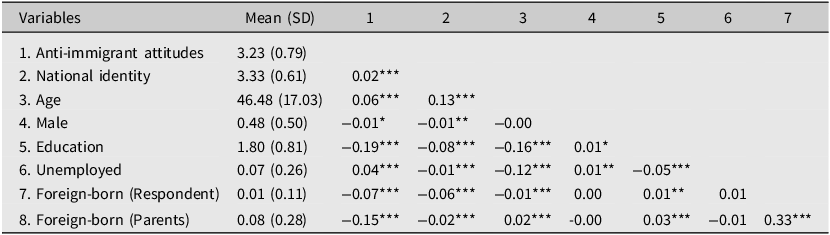
To mitigate the risk of spurious correlations, I incorporate a set of control variables that capture demographic and socioeconomic factors. The model controls for age, measured as a continuous variable; gender, coded 1 for male and 0 for female; educational attainment, measured on a four-point scale ranging from 0 (no formal schooling) to 3 (upper-level education)Footnote 16 ; employment status, coded 1 for unemployed and 0 otherwise; respondents’ foreign-born status, coded 1 if the respondent was born abroad and 0 otherwise; and parental foreign-born background, coded 1 if either parent was born abroad and 0 otherwise. The means and Pearson correlation coefficients among individual-level variables are presented in Table 1.
Means and Pearson correlations among individual-level variables

Table 1. Long description
The table reports means, standard deviations, and Pearson correlations for individual-level variables. The mean of anti-immigrant attitudes is 3.23, and the mean of national identity is 3.33. Age averages 46.48 years, male is 0.48, education is 1.80, unemployment is 0.07, respondent foreign-born status is 0.01, and parental foreign-born background is 0.08. National identity is positively correlated with anti-immigrant attitudes. Age and unemployment are positively correlated with anti-immigrant attitudes, and education, respondent foreign-born status, while parental foreign-born background are negatively correlated.
Note: Authors’ calculations based on ISSP 2003 and 2013. ***p < 0.001, **p < 0.01, *p < 0.05.
4.1.2. Country-level variables
The country-level independent variable of interest is ethnic diversity, which is used as a proxy for country-level contextual conditions that may shape how clearly the national prototype is recognized and, in turn, how readily citizens and immigrants become comparable social groups. This measure is sourced from the Historical Index of Ethnic Fractionalization (HIEF) developed by Dražanová (Reference Dražanová2019) and Dražanová (Reference Dražanová2020). The HIEF represents the probability that two randomly selected individuals within a country belong to different ethnic groups, and is calculated as one minus the Herfindahl-Hirschman Index.Footnote 17 Compared with widely used alternatives such as Alesina et al., (Reference Alesina, Devleeschauwer, Easterly, Kurlat and Wacziarg2003) and Fearon (Reference Fearon2003), the HIEF provides annual data from 1945 to 2013, enabling the measure to account for changes in ethnic composition over time. The ethnic fractionalization index ranges from 0.016 in Japan to 0.818 in the Philippines in 2003, and from 0.019 in Japan to 0.856 in South Africa in 2013.Footnote 18 To distinguish the effect of ethnic diversity from broader economic conditions at the country level, I control for the log of GDP and the unemployment rate, which are drawn from the World Bank’s World Development Indicators (World Bank, 2025).
5. Results
As a prerequisite for conducting multilevel analysis, it is necessary to confirm that the association between national identity and anti-immigrant attitudes varies across countries. Figure 1 illustrates the coefficients and statistical significance of national identity in predicting anti-immigrant attitudes, estimated through separate bivariate regressions for each country.
Cross-national variation in the coefficient of national identity on anti-immigrant attitudes. Estimated coefficients of national identity on anti-immigrant attitudes from separate country-specific bivariate regressions. Each point represents the coefficient for a given country, with markers indicating statistical significance.

Figure 1. Long description
The figure plots country-specific bivariate regression coefficients for the association between national identity and anti-immigrant attitudes. Countries are listed on the y-axis and ordered from the largest positive coefficient to the most negative coefficient. Denmark has the largest positive coefficient, above 0.4. Switzerland, Austria, Norway, Germany, Latvia, Australia, Finland, India, the Netherlands, Spain, Bulgaria, Georgia, Iceland, France, Croatia, Poland, Japan, Sweden, Slovenia, Israel, Slovakia, Czech Republic, the United States, the United Kingdom, and Turkey show positive and statistically significant coefficients. Mexico, Ireland, Hungary, Uruguay, Portugal, Estonia, Lithuania, the Philippines, Russia, South Korea, Chile, South Africa, Taiwan, and New Zealand have coefficients close to zero and statistically insignificant., Canada, Venezuela, and Belgium have negative and statistically significant coefficient.
As shown in Figure 1, the coefficients vary substantially across countries. While a statistically significant positive association (p < .05) is observed in more than half of the countries, the coefficients are statistically indistinguishable from 0 in 14 countries. Furthermore, Canada, Venezuela, and Belgium exhibit statistically significant negative relationships, indicating that stronger national identity is associated with weaker anti-immigrant attitudes. These divergent patterns substantiate the initial problem statement that national identity does not necessarily translate into anti-immigrant attitudes. These results underscore the need for a multilevel approach to investigate the country-level contextual factors.
I begin with a multilevel analysis by estimating a null model that includes no predictors. The intraclass correlation coefficient is 0.117, indicating that 11.7% of the variance in anti-immigrant attitudes is attributable to differences between countries. This result provides empirical justification for using a multilevel framework in the subsequent analysis.
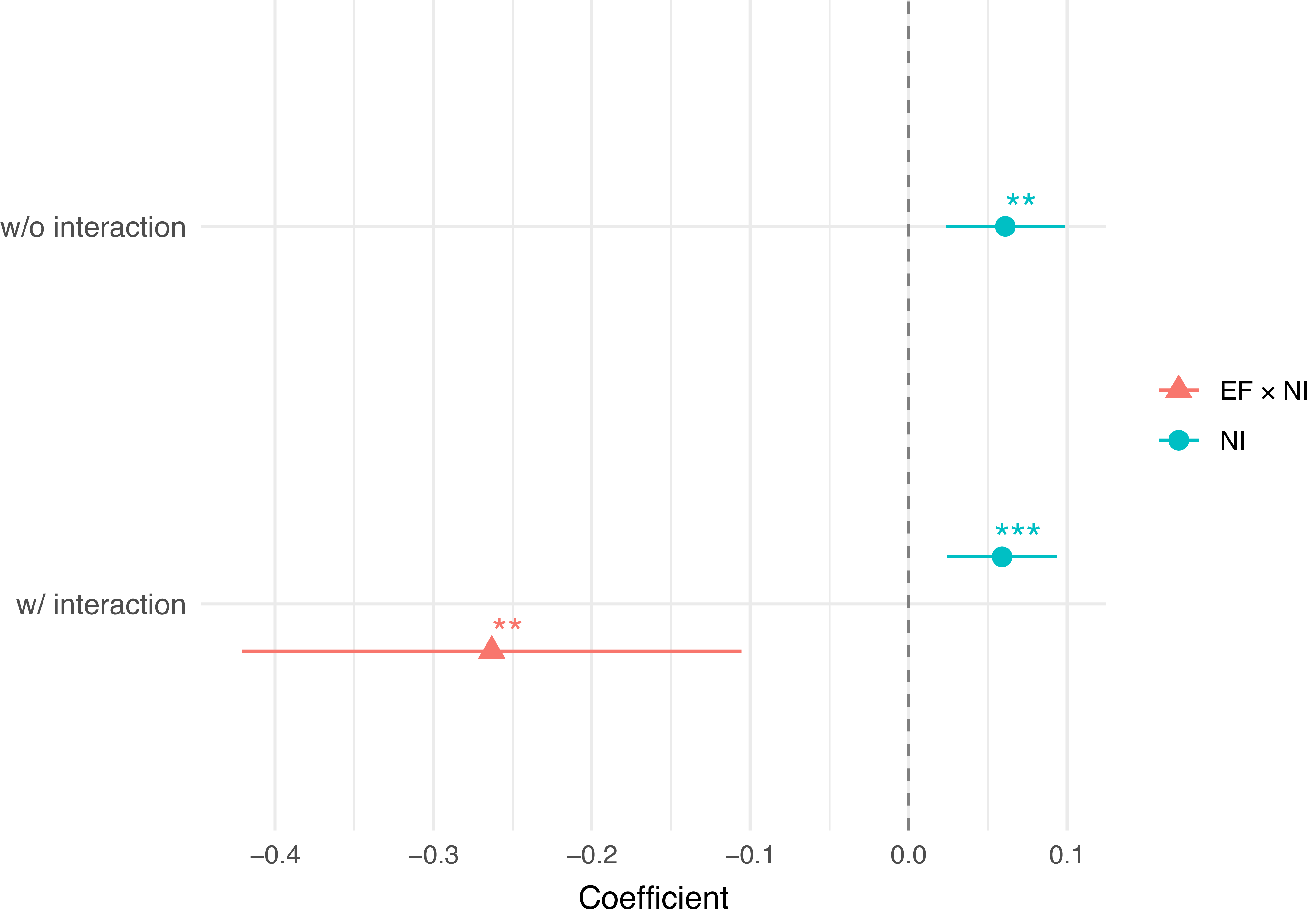
Next, I estimate a random intercept and random slope model that includes only national identity and ethnic fractionalization. In this baseline specification, national identity is positively associated with anti-immigrant attitudes, and the relationship is statistically significant (b = 0.092, p < .001). To test Hypothesis 2, I add an interaction term between national identity and ethnic fractionalization. This specification significantly improves model fit relative to the model without the interaction, according to a likelihood ratio test (p < .001). In this model, the coefficient of national identity remains positive and statistically significant, and the interaction term is negative and statistically significant (b = −0.297, p < .001). Finally, I estimate the models with the full set of control variables. In the model without the interaction term, the coefficient of national identity remains positive and significant (b = 0.061, p < .01). When the interaction term is added, model fit again improves significantly according to a likelihood ratio test (p < .01). In this full specification, national identity continues to have a positive and statistically significant association with anti-immigrant attitudes (b = 0.059, p < .001), and its interaction with ethnic fractionalization remains negative and statistically significant (b = −0.263, p < .01).
These results indicate that the positive relationship between national identity and anti-immigrant attitudes is weaker in countries with greater ethnic diversity. Figure 2 presents the results of the multilevel analyses that include a full set of control variables. It displays the coefficient of national identity from a model without the interaction term, as well as the coefficients of national identity and its interaction with ethnic fractionalization from a model that includes the interaction. The full results are presented in Table C1 in the supplementary material.
Coefficients of national identity and its interaction with ethnic fractionalization on anti-immigrant attitudes. *p < .05, **p < .01, ***p < .001. Error bars represent 95% confidence intervals. Coefficient estimates from the models including all control variables. EF = Ethnic fractionalization.

Figure 2. Long description
The figure presents coefficient estimates from multilevel models with and without the interaction between national identity and ethnic fractionalization. A vertical dashed line marks zero. Without the interaction, the national identity coefficient is positive and statistically significant at p < .01. With the interaction included, the national identity coefficient remains positive and statistically significant at p < .001, while the interaction between ethnic fractionalization and national identity is negative and statistically significant at p < .01. Error bars show 95% confidence intervals.
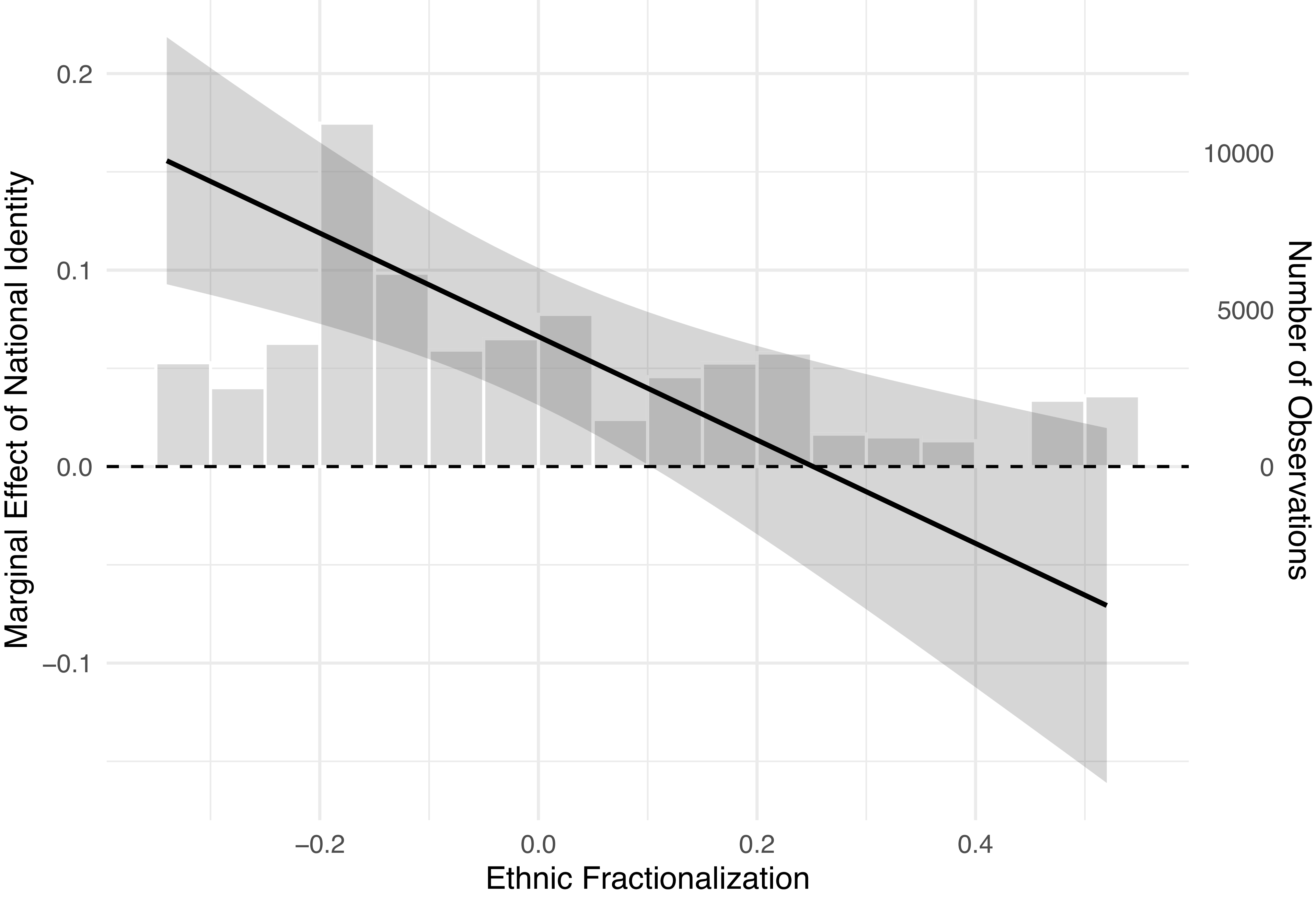
Although the interaction coefficient indicates an overall trend, a marginal effects analysis is necessary to fully assess the conditional nature of the relationship (Brambor et al., Reference Brambor, Clark and Golder2006). Figure 3 illustrates the marginal effect of national identity on anti-immigrant attitudes across varying levels of ethnic fractionalization, using a model with the interaction term and the full set of control variables. In countries with low ethnic fractionalization, as shown on the left side of the graph, national identity has a positive and statistically significant effect on anti-immigrant attitudes. However, as ethnic fractionalization increases toward the right side of the graph, the magnitude of this effect gradually diminishes and eventually becomes statistically insignificant. This pattern demonstrates that the link between national identity and anti-immigrant attitudes is most pronounced in ethnically homogeneous countries and weakens as diversity increases. These findings provide empirical support for Hypothesis 2.
Marginal effect of national identity by the level of ethnic fractionalization. Estimated marginal effects are based on the model with the interaction term and all control variables. The solid line represents the estimated marginal effect. The grey shaded area indicates the 95% confidence interval. The grey histogram along the x-axis indicates the distribution of individual observations.

Figure 3. Long description
The figure shows that the marginal effect of national identity on anti-immigrant attitudes declines as ethnic fractionalization increases. The solid line is positive at low levels of ethnic fractionalization, crosses the zero line around the middle of the observed range, and becomes negative at higher levels. The gray 95% confidence interval is above zero at low diversity, overlaps zero at moderate and high diversity, and widens at the extremes. A gray histogram along the x-axis shows the distribution of country-wave observations.
5.1. Robustness checks
To assess the robustness of the findings, several robustness checks are conducted. The coefficient estimates from these checks are reported in Table C2, and the corresponding marginal effects of variables capturing national identity are presented in Figures C1–C6 in the supplementary material. First, I examine whether the interaction between national identity and ethnic fractionalization differs between the two survey waves by estimating a model that includes a three-way interaction among national identity, ethnic fractionalization, and survey waves. The results indicate that the hypotheses are supported for both 2003 and 2013. In both waves, the positive association between national identity and anti-immigrant attitudes is strongest in ethnically homogeneous countries and weakens as the level of fractionalization increases (Figure C1). Although the overall pattern is similar across the two waves, the slope appears steeper in 2003 than in 2013, suggesting a possible temporal trend in which the proposed mechanism has weakened over time. However, additional surveys would be required to determine whether this pattern reflects a systematic temporal shift.
Second, I examine whether the results depend on how the dependent variable, national identity, and ethnic diversity are measured. Replacing the anti-immigrant attitude index with the first factor score derived from the confirmatory factor analysis in Appendix B produces a negative and statistically significant interaction between national identity and ethnic fractionalization (b = −0.291, p < .01; Figure C2). The interaction also remains negative and significant when national attachment (b = −0.157, p < .01; Figure C3) and national pride (b = −0.181, p < .01; Figure C4) are entered separately, indicating that the result is not specific to either component of the national identity index. Finally, I replace the HIEF with two alternative ethnic fractionalization indices developed by Alesina et al. (Reference Alesina, Devleeschauwer, Easterly, Kurlat and Wacziarg2003) and Fearon (Reference Fearon2003), both obtained from the Quality of Government Standard Dataset (Teorell et al., Reference Teorell, Sundström, Holmberg, Rothstein, Alvarado Pachon, Dalli, Valverde, Phiri and Gerber2025).Footnote 19 Because these indices do not provide annual estimates, the same values are assigned to both survey waves. The interaction remains negative and statistically significant when ethnic diversity is measured using the indices developed by Alesina et al. (Reference Alesina, Devleeschauwer, Easterly, Kurlat and Wacziarg2003) and Fearon (Reference Fearon2003) (b = −0.199, p < .05, and b = −0.190, p < .05, respectively), with the marginal effects displaying the same conditional pattern (Figures C5–C6).
Across all specifications, the measures of national identity are positively associated with anti-immigrant attitudes, while their interactions with ethnic fractionalization are negative and statistically significant. The positive association is consistently concentrated in countries with lower ethnic diversity and weakens as diversity increases. Therefore, the main findings are not specific to a particular operationalization of anti-immigrant attitudes, national identity, or ethnic diversity.
5.2. Alternative contextual accounts
To assess whether the estimated moderating association is robust to rival contextual accounts, I introduce moderators derived from norm-based and salience-based explanations. A norm-based perspective suggests that ethnically diverse societies may foster more inclusive conceptions of nationhood, thereby weakening the association between national identity and anti-immigrant attitudes. A salience-based perspective suggests that immigrants may be less likely to become salient as a threat or that pluralistic elite discourse may weaken the citizen–immigrant boundary. Under either account, the estimated interaction could reflect processes other than the intergroup-comparability mechanism proposed here.
I therefore consider two norm-based factors – immigration policy inclusiveness and aggregate perceptions of national-belonging criteria – and two salience-based factors – the immigrant share of the population and pluralistic political discourse. For each factor, I estimate a multilevel model including both its interaction with national identity and the interaction between national identity and ethnic fractionalization. These models do not directly identify the underlying psychological mechanism. Rather, they assess whether the ethnic diversity interaction remains significant and whether the marginal effect of national identity continues to decline as diversity increases after accounting for measured alternative contextual processes.
As an indicator of immigration-policy inclusiveness, I use the overall score from the Migrant Integration Policy Index (Solano and Huddleston, Reference Solano and Huddleston2020, hereafter MIPEX). Because MIPEX is available only at five-year intervals and, for most sampled countries, only from 2010, I match the 2003 and 2013 ISSP waves to the 2010 and 2015 scores, respectively. Although this temporal matching is imperfect, these are the closest available cross-national observations. To capture aggregate perceptions of national belonging, I follow Pehrson et al. (Reference Pehrson, Vignoles and Brown2009). Respondents rated the importance of citizenship, language proficiency, and national ancestry for being a true member of the national community on four-point scales. I recode the items so that higher values indicate greater importance, calculate country-wave means, and enter all three aggregated measures simultaneously.
Immigrant presence is measured using the share of immigrants in the population from the UN International Migrant Stock dataset (United Nations Department of Economic and Social Affairs, Population Division, 2024). Because the data are compiled at five-year intervals, I match the 2003 and 2013 ISSP waves to the 2005 and 2015 observations, respectively. To measure pluralistic political discourse, I use Comparative Manifesto Project data (Lehmann et al., Reference Lehmann, Franzmann, Al-Gaddooa, Burst, Ivanusch, Regel, Riethmüller, Volkens, Weßels and Zehnter2025). I focus on ‘Multiculturalism: Positive’, which captures favourable references to cultural diversity, and ‘Multiculturalism: Negative’, which captures support for cultural integration and homogeneity. For each election, I calculate vote-share-weighted country scores for both categories and use their difference. When a survey wave falls between elections, I assign the score from the most recent national election.
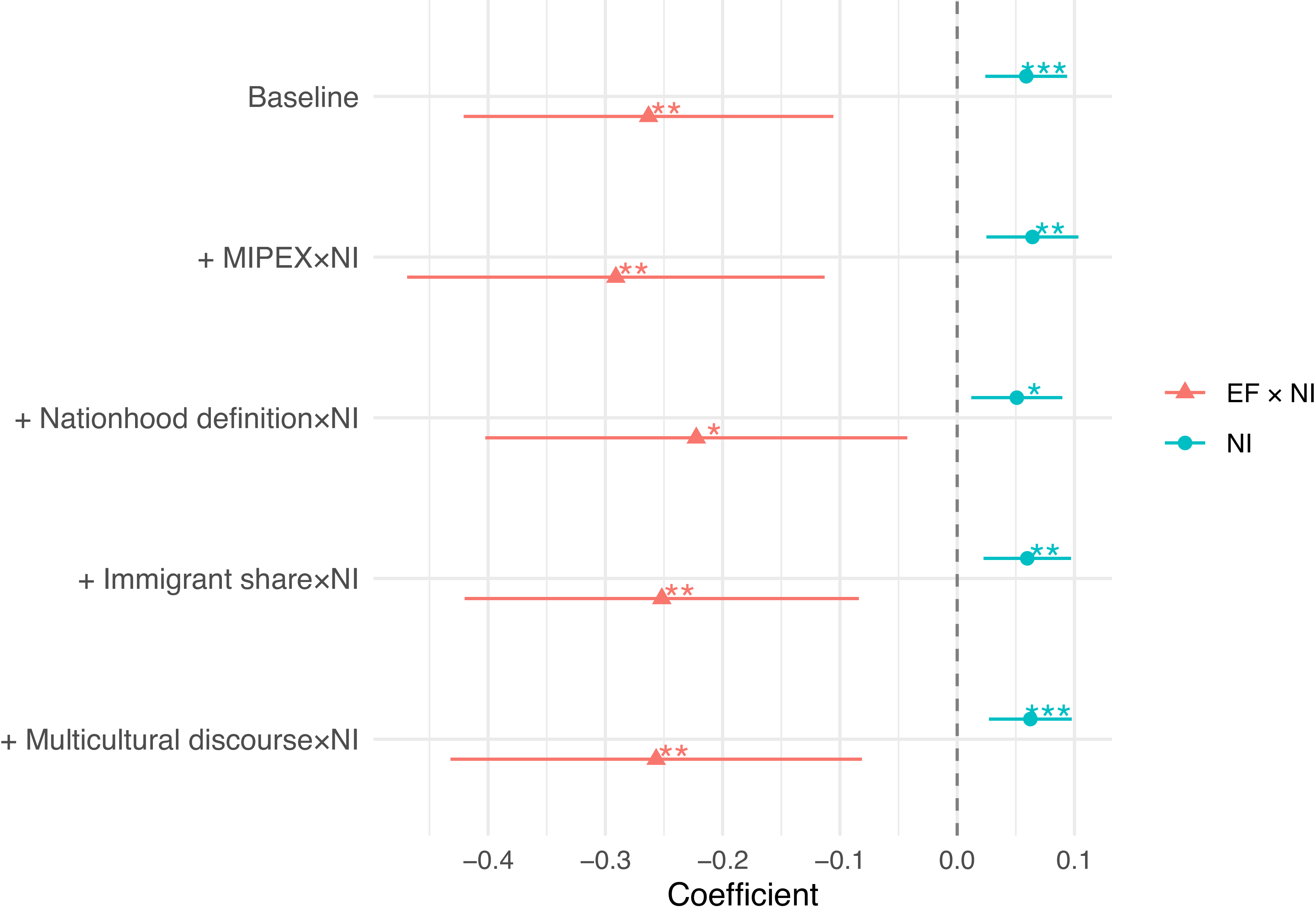
The results further support the robustness of the main findings while showing that some rival contextual accounts have limited explanatory power. The coefficient estimates for models examining alternative explanations are reported in Table D1, and the corresponding marginal effects of national identity are presented in Figures D1–D4 in the supplementary material. Across all specifications, the interaction between national identity and ethnic fractionalization remains negative and statistically significant (Figure 4). In the model that includes MIPEX, the coefficient of the interaction between national identity and ethnic fractionalization remains negative (b = −0.291, p < .01), whereas the coefficient of the interaction between national identity and MIPEX is statistically significant but substantively negligible (b = −0.003, p < .05), and the likelihood ratio test indicates no significant improvement in model fit. Similarly, in the model including the immigrant share, the coefficient of the interaction between national identity and ethnic fractionalization remains negative and significant (b = −0.252, p < .01), whereas the coefficient of the interaction between national identity and immigrant share is not significant. These results suggest that neither immigration policy inclusiveness nor immigrant population accounts for the conditioning effect. The model that includes aggregate perceptions of national belonging yields a more mixed pattern. The coefficient of the interaction between national identity and ethnic fractionalization remains negative and statistically significant (b = −0.222, p < .05), but some coefficients of the rival interactions are also significant. The coefficient of the interaction involving citizenship-based definitions of national belonging is negative and statistically significant (b = −0.357, p < .001), and the coefficient of the interaction involving ancestry-based definitions of national belonging is positive and statistically significant (b = 0.106, p < .05). This finding suggests that country-level perceptions of national belonging account for part of the cross-national variation in the relationship between national identity and anti-immigrant attitudes. However, as the interaction between national identity and ethnic fractionalization remains significant, these perceptions do not fully explain the moderating role of ethnic diversity. Finally, in the model that includes pluralistic political discourse, the coefficient of the interaction between national identity and ethnic fractionalization remains negative and significant (b = −0.257, p < .01). The coefficient of the interaction between national identity and political discourse is not statistically significant (b = −0.010, p > .05), although the likelihood ratio test suggests that adding the discourse term improves model fit.
Coefficients of national identity and its interaction with ethnic fractionalization across alternative models. *p < .05, **p < .01, ***p < .001. Error bars represent 95% confidence intervals. Coefficient estimates from the models including alternative contextual moderators. EF = Ethnic fractionalization; NI = National identity.

Figure 4. Long description
The figure plots coefficients for national identity and for the interaction between ethnic fractionalization and national identity across five models: baseline, MIPEX interaction, nationhood definition interaction, immigrant population interaction, and multicultural discourse interaction. In every model, the national identity coefficient is positive and statistically significant, and the coefficient of the interaction between national identity and ethnic fractionalization is negative and statistically significant. Error bars show 95% confidence intervals.
Taken together, these results indicate that some contextual variables capture part of the cross-national variation in how national identity relates to anti-immigrant attitudes. However, the negative coefficient of the interaction remains statistically significant after accounting for these rival explanations. In addition, in all specifications, the marginal effect of national identity is positive and statistically significant at low levels of ethnic diversity, but declines as ethnic diversity increases and eventually becomes statistically insignificant (Figures D1–D4). This pattern strengthens the claim that the alternative explanations do not fully account for the moderating role of ethnic diversity.
6. Probing empirical implications of the proposed process with eurobarometer data
The preceding analyses do not provide evidence for the individual-level process proposed in this study. A direct test would require an individual-level measure of the clarity of citizens’ image of the typical national, but no such measure is available in existing cross-national surveys. I therefore use perceived lack of national commonality as a theoretically proximate indicator of prototype ambiguity, while recognizing that it does not directly measure national prototype clarity. This measure captures the extent to which members of the national ingroup are perceived as having little in common. Because a national prototype consists of attributes seen as characteristic of the group (Rosch, Reference Rosch, Rosch and Lloyd1978; Hogg and Terry, Reference Hogg and Terry2000), the basis for specifying a coherent image of the typical national should accordingly be weaker.
To assess whether perceived lack of national commonality fits the broader pattern of associations implied by the proposed account, I conduct supplementary analyses using Eurobarometer data. I pool six pre-pandemic Eurobarometer waves, from Eurobarometer 84.3 through Eurobarometer 90.3 (European Commission, 2019, 2020, 2021, 2022, 2023, 2024), all of which include measures of national commonality, national identity, and attitudes toward immigration.Footnote 20 Perceived lack of national commonality is measured using an item asking respondents how strongly they agree that ‘People in [COUNTRY] have a lot of things in common’. Responses range from 1 (totally agree) to 4 (totally disagree), such that higher values indicate a greater perceived lack of national commonality. Because the Eurobarometer does not include the combination of national attachment and national pride used to construct the national identity measure in the ISSP analysis, I use national attachment as the available indicator of national identity.Footnote 21 To measure attitudes toward immigration, I use negative feelings toward immigration from outside the European Union.Footnote 22 The Eurobarometer also measures feelings toward immigration from other EU member states, but such immigrants may be incorporated into a broader European ingroup (Curtis, Reference Curtis2014). Because the proposed argument concerns evaluations of immigrants as an outgroup, I focus on non-EU immigration, which more consistently captures an outgroup relative to the national ingroup.
The analyses examine three observable associations implied by the argument. If the proposed account is empirically coherent, the Eurobarometer data should exhibit three related patterns. First, the interaction between ethnic diversity and national attachment should resemble the interaction observed in the ISSP data. Second, greater ethnic diversity should be associated with a stronger perceived lack of national commonality. Third, the positive association between national attachment and negative feelings toward immigration from outside the EU should be smaller at higher levels of perceived lack of national commonality.
The first analysis examines whether the interaction between ethnic diversity and national attachment can be reproduced in the Eurobarometer data. I measure ethnic diversity using the HIEF.Footnote 23 I estimate a multilevel model that controls for age, gender, employment status, the log of GDP, and the unemployment rate, includes survey-wave fixed effects, and allows the slope of national attachment to vary across countries.Footnote 24 The point estimates are directionally consistent with the ISSP findings, but the interaction is estimated imprecisely. National attachment is positively and statistically significantly associated with negative feelings toward immigration from outside the EU (b = 0.041, p < .01). The interaction between national attachment and ethnic fractionalization is negative, as expected, but is not statistically distinguishable from zero (b = −0.048, p > .10). The estimated marginal effects nevertheless trace the pattern predicted by the argument (Figure E1). At the 10th percentile of ethnic fractionalization, national attachment is positively and statistically significantly associated with negative feelings toward immigration. By the 90th percentile, the estimated association is smaller and no longer statistically distinguishable from zero.Footnote 25 Thus, the shape of the marginal-effects estimate resembles that found in the ISSP analysis.
The second analysis examines the first theorized association in the proposed process: whether ethnic diversity is associated with perceived lack of national commonality. I estimate an OLS model with the same control variables, clustering standard errors by country. The estimated association is positive and statistically significant under conventional country-clustered inference (b = 0.339, p < .05).Footnote 26
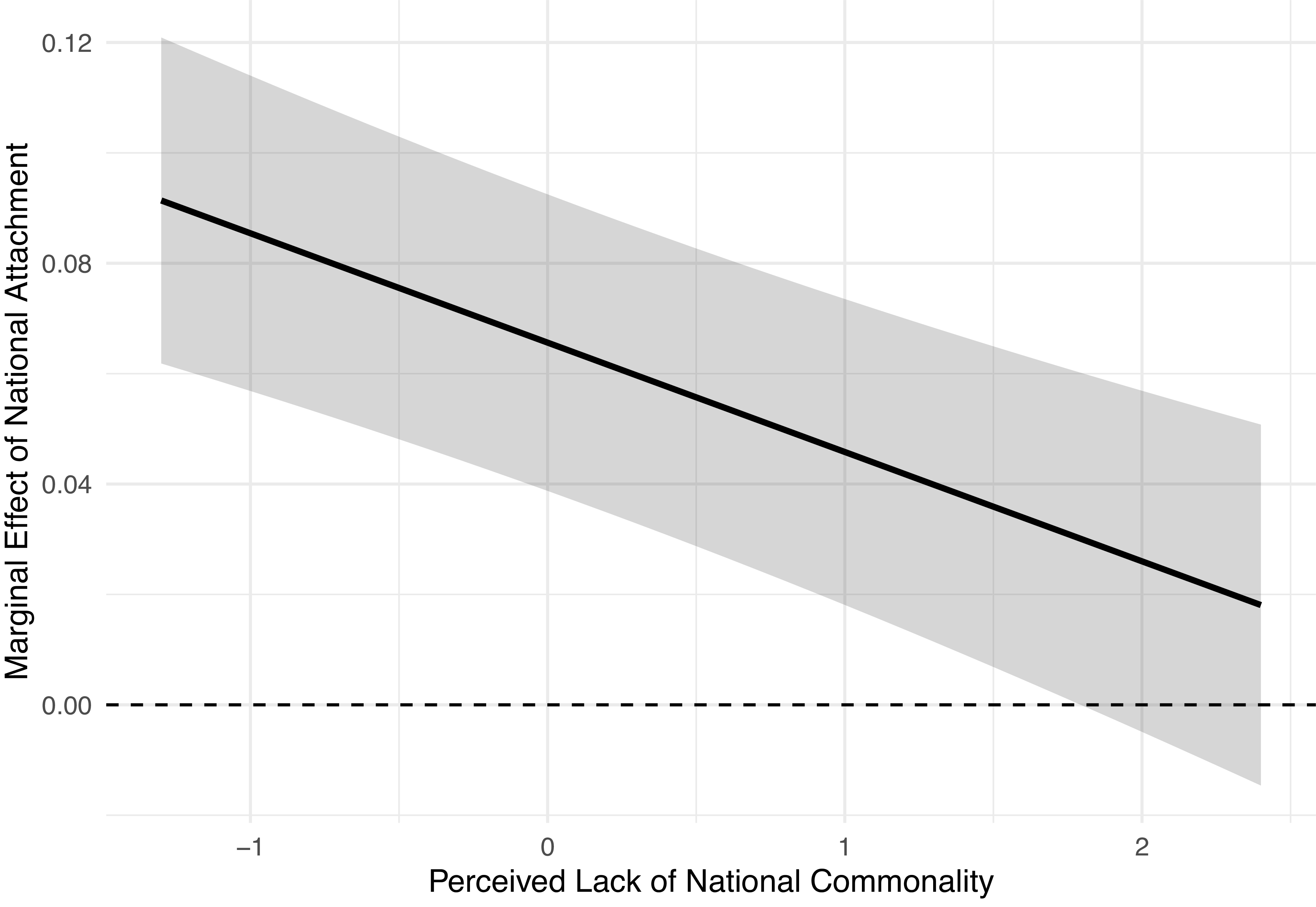
The third analysis examines the second theorized association: whether perceived lack of national commonality conditions the association between national attachment and negative feelings toward immigration. I estimate a multilevel model that includes an interaction between national attachment and perceived lack of national commonality. National attachment is positively and statistically significantly associated with negative feelings toward immigration (b = 0.066, p < .001), whereas the interaction is negative and statistically significant (b = −0.020, p < .001). The marginal effects presented in Figure 5 display the predicted pattern. The positive association between national attachment and negative feelings toward immigration becomes progressively weaker as perceived lack of national commonality increases. Thus, respondents who perceive fewer shared attributes among members of their national community exhibit a weaker association between national attachment and negative evaluations of immigration.
Marginal effect of national attachment by perceived lack of national commonality. The grey shaded area indicates the 95% confidence interval.

Figure 5. Long description
The figure plots the estimated marginal effect of national attachment on negative feelings toward immigration from outside the European Union across perceived lack of national commonality. The solid line declines from about 0.09 at the low end of the centered commonality measure to about 0.02 at the high end. The gray band is the 95% confidence interval. It remains above zero through most of the range but overlaps zero near the highest levels, indicating that the positive association between national attachment and negative immigration attitudes weakens as perceived lack of national commonality increases.
Taken together, the three analyses provide partial but theoretically coherent associational evidence. The interaction between ethnic fractionalization and national attachment is directionally consistent with the ISSP result, although estimated imprecisely. Ethnic fractionalization is also positively associated with perceived lack of national commonality. The clearest result is that perceived lack of national commonality significantly weakens the positive association between national attachment and negative feelings toward immigration from outside the EU.Footnote 27 Therefore, the three findings are ordered as the theory anticipates, but they do not provide equally strong support for each link.
Two limitations of the data should be noted. First, the earliest usable Eurobarometer wave was fielded in 2015, whereas the HIEF ends in 2013. I therefore assign each country its 2013 HIEF value in all subsequent survey waves. This procedure assumes that the cross-national differences recorded in 2013 remain sufficiently informative during the Eurobarometer period and prevents the analysis from exploiting the temporal variation that constitutes a major advantage of the HIEF. Second, because the analysis is restricted to EU member states, the sample covers a narrower range of ethnic diversity than the ISSP sample and excludes several highly diverse countries. This restricted variation makes the interaction between ethnic fractionalization and national attachment more difficult to estimate precisely. The imprecision of the corresponding Eurobarometer estimate should be interpreted in light of these constraints.
7. Conclusion
This study examines why the relationship between national identity and anti-immigrant attitudes varies across countries. Although the SIT suggests that stronger national identity should be associated with more negative attitudes toward outgroups such as immigrants, this relationship does not appear consistently across national contexts. I argue that the association is conditioned by ethnic diversity and that greater internal diversity makes the national prototype less clear, thereby weakening intergroup comparability. Multilevel analyses of ISSP data from 2003 and 2013 show that national identity is, on average, positively associated with anti-immigrant attitudes, but that this association declines as ethnic fractionalization increases and becomes statistically indistinguishable from zero at high levels of diversity. This pattern is robust across alternative specifications, measures, and controls for rival contextual explanations. The ISSP analysis does not directly observe the individual-level process. To narrow this gap, I supplement the main analysis with Eurobarometer data, using perceived lack of national commonality as a theoretically proximate indicator of prototype ambiguity. When members of the national community are perceived to have little in common, there is a weaker basis for specifying the characteristics of a typical national. As the argument predicts, the positive association between national identity and negative feelings toward immigration weakens as perceived lack of national commonality increases. This finding provides individual-level associational evidence for one implication of the proposed account and complements the cross-national evidence from the ISSP analysis. The findings suggest that the attitudinal implications of national identity depend not only on individual psychology but also on the structural context in which the national ingroup is situated.
The perspectives presented in this study open several avenues for future research. One important direction concerns how different groups within the national ingroup relate to one another. This study does not examine whether relationships among ethnic groups within a country are cooperative, hierarchical, or conflictual. However, countries with similar levels of ethnic diversity may differ sharply in the nature of intergroup relations. In some cases, ethnic groups may coexist on relatively equal terms, whereas in others, relations may be marked by hierarchy, exclusion, or longstanding conflict. These differences are likely to affect how clearly national prototypes are formed and understood. This possibility is consistent with earlier studies of subgroup relationships within larger ingroups. For example, Doosje et al. (Reference Doosje, Ellemers and Spears1995) show that when an ingroup consists of multiple subgroups, members of a low-status subgroup that identify strongly with the superordinate ingroup are more likely to perceive the superordinate ingroup as homogeneous. Applied to the present argument, this finding suggests that socially marginalized ethnic minorities or economically insecure groups are likely to form a clear image of a typical national member. If so, comparability with immigrants may become stronger among these groups, and the association between national identity and anti-immigrant attitudes may be stronger among low-status groups than among secure high-status groups.
The second direction concerns changes over time. A robustness check using a three-way interaction suggests that the moderating effect of ethnic diversity may have weakened over time. One possible interpretation is that the relative salience of national and ethnic identities may have shifted. Individuals can hold multiple identities, and the relative importance of these identities may vary across individuals and contexts (Roccas and Brewer, Reference Roccas and Brewer2002). From a constructivist approach, ethnic identity is context-dependent and can be activated differently across contexts (Chandra, Reference Chandra2012). Thus, even when two individuals have equally strong national identity, they may differ in the strength of their ethnic identity. Those with a stronger ethnic identity may be more attentive to internal differences within the nation, which can make it more difficult for them to converge on a clear national prototype. By contrast, those for whom ethnic identity is weaker may be more likely to understand the nation as a common identity that subsumes ethnic distinctions, thereby perceiving a clearer national prototype. From this perspective, the apparent weakening of the moderating role of ethnic diversity may reflect a broader shift from ethnic to national attachment through modernization (Robinson, Reference Robinson2014). If national belonging increasingly overrides ethnic attachments, ethnic diversity may become less significant as a contextual moderator of the relationship between national identity and anti-immigrant attitudes. However, this hypothesis remains speculative. Properly testing such a claim requires large-scale longitudinal data spanning a much longer period than is available here.
This study has two important limitations. First, the proposed mechanism is not directly observed. The supplementary Eurobarometer analysis provides suggestive individual-level evidence, but it does not directly assess either the clarity of citizens’ image of the typical national or the perceived comparability of citizens and immigrants. A more definitive test therefore requires measures that directly capture these psychological constructs and evaluate the sequence linking ethnic diversity, prototype clarity, intergroup comparability, and attitudes toward immigrants.
Second, the analysis does not identify causality. Because the main findings are based on observational cross-national survey data, they cannot establish whether ethnic diversity causally attenuates the association between national identity and anti-immigrant attitudes. The contrasting responses of Canada and Japan to the Syrian refugee crisis, discussed in Appendix F, do not overcome this limitation, but they show how differences in the descriptive content of the national category coincided with different public representations of Syrian refugees. Canadian leaders invoked the nation’s internal diversity to portray Syrian refugees as prospective ‘new Canadians’. By contrast, Japanese official rhetoric did not similarly portray Syrian refugees as prospective members of the national community and instead centred the country’s demographic future on the existing population.Footnote 28 More rigorous tests would require quasi-experimental designs that exploit plausibly exogenous changes in ethnic diversity, alongside experiments that manipulate national prototype clarity and assess its consequences for intergroup comparability and attitudes toward immigrants.
Despite these limitations, the main implications of this study are clear. The relationship between national identity and anti-immigrant attitudes is not constant across countries but is conditioned by the level of ethnic diversity. The findings provide a basis for understanding why, in some countries, political appeals to patriotism are more associated with exclusionary responses to immigrants, whereas in others such appeals are less likely to carry the same force.
Supplementary material
The supplementary material for this article can be found at https://doi.org/10.1017/S1468109926100498.
Data availability statement
All data used in this study are shared at Harvard Dataverse (https://dataverse.harvard.edu/dataset.xhtml?persistentId=doi:10.7910/DVN/8EOR4A).
Acknowledgements
I am grateful to Yuriko Takahashi and the participants in her seminar, Keiichi Kubo and the participants in his seminar, Airo Hino, Ryo Nakai, and two anonymous reviewers for their helpful comments on earlier drafts of this paper. An earlier version of this paper was presented at the 2025 Annual Meeting of the Japanese Political Science Association, held at the University of Tokyo, Tokyo, Japan. I also thank the participants at the conference for their valuable comments and suggestions. AI tools were used for spelling and language checking. All remaining errors are my own.
Funding statement
This research received no specific grant from any funding agency, commercial, or not-for-profit sectors.
Competing interests
The author declares no competing interests.
Ethical statement
This study relies on publicly available and anonymized secondary data and does not require ethical approval.




 Open access

