Introduction
Tonsillectomy remains one of the most common otolaryngology operations performed in paediatric practice. Between 2012 and 2013, 38 575 tonsillectomies were performed in Australia on people aged 17 years and under, representing a rate of 724 admissions per 100 000. 1 Common indications for tonsillectomy include sleep-disordered breathing and recurrent tonsillitis. 2 – Reference Pinder, Wilson and Hilton 4
Post-tonsillectomy bleeding is the most extensively investigated post-operative complication. Post-tonsillectomy bleeding can be defined as any degree of haemorrhage following tonsillectomy (e.g. blood stained sputum or saliva) through to profuse arterial bleeding and haemorrhagic shock. Post-tonsillectomy bleeding is classically labelled as primary or secondary haemorrhage.Reference Rogers, Fraunfelder, Woods, Wee and Carney 5 Primary post-tonsillectomy bleeding occurs within 24 hours of surgery, whereas secondary post-tonsillectomy bleeding can occur anywhere from 24 hours to over 2 weeks post-operatively.Reference Pinder, Wilson and Hilton 4 , Reference Hessén Söderman, Ericsson, Hemlin, Hultcrantz, Månsson and Roos 6
The rate of primary post-tonsillectomy bleeding is perhaps easier to capture, given that patients undergoing tonsillectomy are often admitted overnight. However, in recent years there has been a move towards tonsillectomy being performed as a day-case procedure.Reference Hessén Söderman, Ericsson, Hemlin, Hultcrantz, Månsson and Roos 6 An accurate rate of secondary post-tonsillectomy bleeding is more difficult to gauge. Secondary post-tonsillectomy bleeding may be identified by: direct questioning on routine follow up, presentation to an emergency department or general practice, specialist admission for observation, intervention under topical anaesthesia, or a return to the operating theatre in an urgent or emergent manner.Reference Rogers, Fraunfelder, Woods, Wee and Carney 5 A return to the operating theatre usually involves local control of haemorrhage, with more extreme measures far more rare.Reference Windfuhr, Schloendorff, Baburi and Kremer 7
Variations in the definition of post-tonsillectomy bleeding have no doubt led to inconsistencies in reported rates and they continue to hamper comparative analysis. A 2009 meta-analysis, which looked at 63 studies, suggests the average incidence of post-tonsillectomy bleeding to be approximately 4.5 per cent.Reference Blakley 8 However, given the volume of tonsillectomies being performed, the absolute number of children with such complications may be relatively high. Rates of re-admission and return to operating theatre for post-tonsillectomy bleeding are probably the most reliable indices of clinical significance.Reference Rogers, Fraunfelder, Woods, Wee and Carney 5
Risk factors for post-tonsillectomy bleeding can be conceptualised as pre-, peri- and post-operative. Considering the relatively low bleed rate, elucidating risk factors requires large studies. Established pre-operative factors include gender, age, indication for surgery, history of bleeding diathesis, and use of anticoagulant and antiplatelet medications.Reference Hessén Söderman, Ericsson, Hemlin, Hultcrantz, Månsson and Roos 6 , Reference Walker and Gillies 9 Peri-operative factors include anaesthetic agents and intra-operative drugs used (including steroids), surgical technique employed, and the experience of the operating surgeon.Reference Walker and Gillies 9 Post-operative factors involve analgesic control, antimicrobial therapy and the length of time since surgery.Reference Hessén Söderman, Ericsson, Hemlin, Hultcrantz, Månsson and Roos 6 , Reference Cardwell, Siviter and Smith 10 , Reference Isaacson 11 In more recent years, research has focused on the impact of surgical technique on post-tonsillectomy haemorrhage rates.
There are a number of surgical techniques described for tonsillectomy. Cold steel or blunt dissection, with the use of surgical ties, is considered the ‘classic’ technique, and is often the benchmark for comparison to newer technologies.Reference Burton and Doree 3 , Reference van der Meulen 12 Electrical cautery techniques, with either monopolar and bipolar currents, are known as ‘hot’ techniques. They are associated with thermal injury to the tissue, proportionate to the magnitude of current, duration of contact and surface area involved. The use of electrocautery for dissection or intra-operative haemostasis has been associated with an increased risk of post-operative bleeding. 2 Indeed, the use of diathermy has been associated with a higher secondary bleed rate, according to the UK National Prospective Tonsillectomy Audit. 2 However, its advantages purportedly include quicker surgical time and less intra-operative blood loss.Reference Pinder, Wilson and Hilton 4 A 2011 Cochrane review examined diathermy versus cold steel dissection, and found that diathermy resulted in less intra-operative bleeding but more post-operative pain.Reference Pinder, Wilson and Hilton 4 A recent study by Söderman et al. of more than 15 000 patients found that the secondary post-tonsillectomy bleed rate was significantly higher for all ‘hot’ techniques than for cold steel dissection.Reference Söderman, Odhagen, Ericsson, Hemlin, Hultcrantz and Sunnergren 13
Coblation is a more recent technique, utilising plasma field technology.Reference Burton and Doree 3 It uses radiofrequency to ablate tissue and coagulate vessels, and it does this at a lower temperature than traditional diathermy.Reference Amir, Belloso, Broomfield and Morar 14 The reduction of thermal collateral damage was thought to be associated with better post-operative recovery.Reference Amir, Belloso, Broomfield and Morar 14 – Reference Belloso, Chidambaram, Morar and Timms 16 However, this was not supported in a 2007 Cochrane review examining the post-operative complications of coblation in comparison to other surgical techniques.Reference Burton and Doree 3 The authors found limited differences in post-operative pain or bleeding between coblation and other surgical methods. There are some data to suggest that coblation bleed rates are higher than those for cold steel, 1 but estimates vary considerably, and there are contradictory outcomes. 2 Despite the frequency with which tonsillectomy is performed, there is a relative paucity of large-scale randomised trials comparing techniques.
It is reasonable to expect a learning curve in the development of any skill, but this has received limited attention in the surgical literature for this most basic of otolaryngology procedures. Whilst a learning curve has been postulated with regard to competence with new technologies,Reference Amir, Belloso, Broomfield and Morar 14 , Reference Walner, Miller, Villines and Bussell 17 some previous studies have found no statistically significant relationship between level of surgeon experience and post-tonsillectomy bleed rates. 2 , Reference Gallagher, Wilcox, McGuire and Derkay 18 However, an audit of Australian ENT surgeons performing coblation tonsillectomy found evidence of a learning curve for both primary and secondary post-tonsillectomy bleed rates.Reference Carney, Harris, MacFarlane, Nasser and Esterman 19 Primary rates dropped to an acceptable level within 50 procedures, whereas secondary post-tonsillectomy bleed rates continued to decline for up to 250 procedures.
We investigated the post-tonsillectomy bleed rate in a paediatric population treated through a major metropolitan tertiary paediatric hospital. The primary aim of this study was to compare the rates of post-tonsillectomy bleeding leading to re-admission and return to the operating theatre between surgical trainees and consultant surgeons. A secondary aim was to examine the bleed rates for different surgical techniques.
Materials and methods
Study design and patient selection
The study comprised patients, aged 16 years or younger, who had undergone tonsillectomy between December 2010 and August 2011 inclusive. Surgeons that consulted publically through the Princess Margaret Hospital for Children (Perth, Western Australia) were assessed over the study period for all tonsillectomies, re-admissions and returns to the operating theatre, in both private and public hospitals.
The public hospital operating theatre prospectively recorded all procedures involving the ‘tonsil’, including arrest of haemorrhage. Private rooms prospectively recorded operations performed under the Medicare Benefits Scheme codes 41789 (tonsillectomy in those aged less than 12 years), 41793 (tonsillectomy in those aged over 12 years; those older than 16 years were excluded), and 41797 (tonsils, arrest of haemorrhage). The public hospital prospectively recorded admissions for post-tonsillectomy haemorrhage.
Consultant surgeons performed their preferred method of tonsillectomy, which included cold steel (n = 2), monopolar diathermy (n = 1) and coblation (n = 3). In the current study, each consultant surgeon had over five years of consultant experience. Otolaryngology trainees all used cold steel dissection and bipolar haemostasis.
Any cases of post-tonsillectomy bleeding that presented to the Princess Margaret Hospital for Children during the study period were included, thus more minor bleeds not leading to presentation were excluded. Any case of post-tonsillectomy bleeding where the original procedure was performed by a consultant surgeon at the Princess Margaret Hospital for Children that led to a private re-admission was also included in the analysis.
Data analysis
Data insertion and descriptive statistical analysis were conducted using MedCalc statistical software, version 12 (MedCalc Software, Ostend, Belgium). For data with continuous outcomes, we used analysis of variance with post-hoc comparisons. The Fisher's exact test was employed for nominal data. Odds ratios were reported for consultant versus trainee comparisons, for contextual interpretation. Statistical significance was set at less than 5 per cent (p < 0.05; two-tailed).
Ethics
Ethics approval was obtained from the internal review board at the Princess Margaret Hospital for Children.
Results
Patient population
A total of 1396 patients underwent tonsillectomy during the period of data acquisition; 389 of the tonsillectomies (28 per cent) were performed in the public hospital and 1007 (72 per cent) by consultant surgeons privately.
Surgical technology
Coblation was used in 699 cases (50 per cent) by 3 consultant surgeons. Monopolar diathermy was used in 232 cases (17 per cent) by 1 consultant surgeon. Cold steel dissection with bipolar haemostasis was used in 186 cases (13 per cent) by 2 consultant surgeons. The remaining 279 cases (20 per cent) were performed by registrars rotating through the Princess Margaret Hospital for Children.
Consultant surgeons who employed coblation techniques used Arthrocare™ wands with settings of 7 for coblation and 3 for coagulation. Monopolar settings were 25 for cutting and 25 for coagulation. Bipolar settings were between 15 and 20.
Separating groups by technology, irrespective of surgical experience, yielded a statistically significant difference for patient age (p < 0.001). The coblation group (5.4 ± 3.3 years) was statistically younger than the other two groups (monopolar group = 6.2 ± 3.3 years, cold steel group = 6.5 ± 3.2 years). Sex was balanced across the groups (p = 0.06) (coblation group = 50.8 per cent males, monopolar group = 59.7 per cent males, cold steel group = 51.8 per cent males).
Post-tonsillectomy bleeding
The overall bleed rate was 5.0 per cent, with a primary bleed rate of 0.36 per cent, secondary bleed rate of 4.66 per cent, and return to operating theatre rate of 0.36 per cent. No deaths were recorded. There were two blood transfusions recorded.
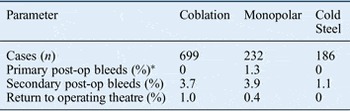
Examination of the consultant surgeon data revealed that the coblation and monopolar groups only differed on primary bleed rate (Table I). The coblation and cold steel groups did not differ on any bleeding outcome. There was no statistically significant difference in either secondary post-tonsillectomy bleeding or returns to the operating theatre between surgical techniques in the consultant group. However, heterogeneity was noted within the coblation group. Surgeon A was found to have a statistically higher secondary bleed rate when compared to surgeons B and C (6.37 per cent vs 2.23 per cent, p < 0.02).
Consultant surgeon post-tonsillectomy bleed rates by technique

* Coblation versus monopolar, p < 0.05. Monopolar versus cold steel, p < 0.05. Post-op = post-operative
Consultants versus trainees
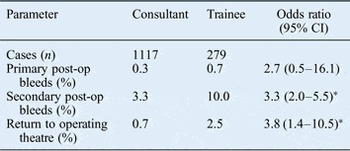
Table II presents the bleeding outcome statistics for consultant surgeons versus trainees (Surgical Education and Training years 1–5). Examining the trainee data, 59 tonsillectomies were performed by Fellows or Surgical Education and Training year 5 individuals, 138 by Surgical Education and Training year 4 individuals, 40 by Surgical Education and Training year 3 individuals, 34 by Surgical Education and Training year 2 individuals, and 8 by the resident medical officer. When trainees were separated into seniors (Surgical Education and Training years 4 and above) and juniors (Surgical Education and Training years 3 and below), there was no difference in overall bleed rate (Fisher's exact test p = 0.83).
Consultant surgeon and trainee post-tonsillectomy bleed rates

* p < 0.05. CI = confidence interval; post-op = post-operative
When comparing consultant cases (n = 1117) with trainee cases (n = 279), both overall secondary bleed rates (p < 0.001) and return to operating theatre rates (p < 0.02) were higher for trainees. Odds ratios indicated that patients who underwent tonsillectomies performed by trainees were 3.3 times more likely to have a secondary bleed and 3.8 times more likely to have a return to the operating theatre, when compared to those who underwent tonsillectomies performed by consultant surgeons (Table II).
Given the potential confound between experience and technology in the preceding analysis, a sub-analysis was carried out to compare only those cases where cold steel dissection was performed (consultants n = 186, trainees n = 279). Using the Fisher's exact test, primary post-tonsillectomy bleed rates were equivalent for the two groups (0 per cent and 0.7 per cent, not significant). However, the secondary post-tonsillectomy bleed rate (1.1 per cent and 10 per cent, p < 0.001) and return to operating theatre rate (0 per cent and 2.5 per cent, p < 0.05) were significantly higher for trainees compared to consultants. Thus, the sub-analysis results were not different to the larger group analyses shown in Table II.
Discussion
The current study sought to evaluate the post-tonsillectomy bleed rates between consultant and trainee surgeons. We found that trainees had higher secondary bleed rates, higher return to operating theatre rates and comparable primary bleed rates when compared with consultant surgeons using their preferred technique. The role of technique had little influence on the incidence of post-tonsillectomy bleeding amongst the consultant group, excluding a higher primary bleed rate for monopolar tonsillectomy.
Overall haemorrhage rates
The overall bleed rate of 5 per cent was similar to that reported in a recent meta-analysis.Reference Blakley 8 The reported rates of tonsillectomy bleeds are extremely varied in the literature. The largest study to date is the National Prospective Tonsillectomy Audit, which demonstrated an overall post-tonsillectomy bleed rate of 3.5 per cent. 2
In another large study, Sarny et al. audited the data from Austria of 9405 patients and found an overall bleed rate of 15 per cent,Reference Sarny, Ossimitz, Habermann and Stammberger 20 higher than that commonly reported. The author's explanation of the higher bleed rate in that study was a stricter definition of post-tonsillectomy bleeding, and higher awareness amongst surgeons and in the community.
Conflicting definitions of what constitutes secondary post-tonsillectomy bleeding are also apparent in the literature, and regional variations will influence both the presentation and management of complications. This inevitably affects the reported rates of bleeding and return to operating theatre. We concur that a standard approach to indexing post-tonsillectomy bleeds should be used, examining re-admission and returns to the operating theatre as a minimum.Reference Rogers, Fraunfelder, Woods, Wee and Carney 5
Technique
The most common method of tonsillectomy in the present study was coblation. This result is in contrast to the findings of the Australian tonsillectomy audit published in 2008, where coblation accounted for less than 10 per cent of consultant surgeons’ preferences for dissection and haemostasis.Reference MacFarlane, Nasser, Coman, Kiss, Harris and Carney 21 Monopolar and cold steel accounted for the majority of dissections, with monopolar and bipolar techniques being preferred for haemostasis. Nonetheless, the haemorrhage rates for consultants were comparable across techniques, with the exception of a higher primary post-tonsillectomy bleed rate for monopolar diathermy.
In the current cohort of consultant surgeons, using their preferred method of tonsillectomy, these data suggest that post-tonsillectomy bleed rates for coblation did not differ significantly from those for cold steel dissection, which is consistent with a number of prior studies.Reference Temple and Timms 15 – Reference Walner, Miller, Villines and Bussell 17 However, the literature surrounding operation technique demonstrates inconsistent findings. Studies that have found coblation to have a higher post-tonsillectomy bleed rate than cold steel include the UK National Prospective Tonsillectomy Audit 2 and Sarny et al.,Reference Sarny, Ossimitz, Habermann and Stammberger 20 the two largest studies to date. Tomkinson et al.Reference Tomkinson, Harrison, Owens, Harris, McClure and Temple 22 and Söderman et al.Reference Söderman, Odhagen, Ericsson, Hemlin, Hultcrantz and Sunnergren 13 also found significantly higher rates of secondary post-tonsillectomy bleeding for all ‘hot’ techniques when compared to cold steel dissection. Divi and BenningerReference Divi and Benninger 23 found no significant difference in bleed rates between coblation and non-coblation techniques, and neither did Amir et al.Reference Amir, Belloso, Broomfield and Morar 14 One study by Al-Qahtani found a statistical benefit of monopolar compared to cold techniques.Reference Al-Qahtani 24
The variation in reported rates most likely depends on more than surgical technique alone. Even within a particular technology, there can be differences in the way the tissue is handled, the degree of diathermy for haemostasis and the power settings of the devices.
Experience
Trainee surgeons had significantly higher secondary post-tonsillectomy bleeding and return to operating theatre rates compared to consultants. The same findings were apparent in the sub-analysis comparing trainees to consultants using cold steel dissection. We interpret these data to suggest that experience is more significant than technique in the stratification of risk factors for post-tonsillectomy bleeding.
Whilst there is extensive literature on different surgical techniques for tonsillectomy, very few studies have addressed level of surgical experience. Previous multivariate analysis of post-tonsillectomy bleeding outcomes has suggested no difference between trainee and consultant surgeons. 2 , Reference Gallagher, Wilcox, McGuire and Derkay 18 In many instances, the experience of the surgeons, in terms of the numbers of tonsillectomies performed, is not clear. This may have influenced post-tonsillectomy bleed rates for investigations of the newer coblation technique.
Accordingly, the relatively higher rate of post-tonsillectomy bleeding for trainee surgeons probably represents a learning curve. Awad et al. were able to model a learning curve for tonsillectomy with regard to operation time for nine otolaryngology trainees, but found that post-tonsillectomy bleed rates did not follow the same trajectory.Reference Awad, Unadkat, Ziprin, Tolley, Taghi and Darzi 25 In contrast, Carney et al. found a clear learning curve for coblation post-tonsillectomy bleeding when considering the number of procedures carried out, with secondary rates continuing to drop even after over 200 procedures.Reference Carney, Harris, MacFarlane, Nasser and Esterman 19 Moreover, the number of tonsillectomies needed to reach proficiency may vary from one individual to another.
Strengths and limitations
A key strength of this study is the source of our data collection. It is the usual practice for all paediatric tonsillectomy bleeds in Perth to be managed at the Princess Margaret Hospital for Children, as this is the only hospital with experienced paediatric anaesthetists on-call and a paediatric intensive care unit. We consider the rates for the outcomes of interest documented in this study to be accurate, given that all procedures were accounted for by all surgeons involved, with admission and operating theatre records cross-checked for validation.
Given that post-tonsillectomy bleed rates are generally low, it can be difficult to adequately statistically power a study. This is even more problematic if multiple factors are of interest. For example, the sample sizes required to find significant differences (power = 0.80, p < 0.05) between the consultant surgeons with the present estimates would be n > 5700 for primary bleeds, n > 2950 for secondary bleeds and n > 6100 for returns to the operating theatre. Only a few studies have come close to generating such power, 2 , Reference Söderman, Odhagen, Ericsson, Hemlin, Hultcrantz and Sunnergren 13 , Reference Sarny, Ossimitz, Habermann and Stammberger 20 outside of meta-analyses.
Other than an inadequate sample size for small effects, the current study was not run prospectively. In addition, many details of interest, including procedure duration, intra-operative bleeding and post-operative pain, were not considered.
A standardised classification of post-tonsillectomy bleeding severity was also not recorded at the time of data collection. Although in the current hospital, the vast majority of children presenting with a post-tonsillectomy bleed are admitted for observation, this method of data collection would no doubt have missed smaller bleeds that did not lead to presentation or admission. The variations in defining post-tonsillectomy bleeding are no doubt reflected in the wide range of rates reported in the literature.
This study amounts to level IIb evidence, as it was observational: consultant surgeons used their technology of choice, meaning that surgical technique was not randomised. Moreover, it is not possible to randomise experience.
Given the relatively low rates of post-tonsillectomy bleeding, the absolute number of outcomes (i.e. bleeds) examined was small. Hence, one should be cautious regarding the generality of conclusions drawn from these data.
Our results reflect a nine-month period in this hospital's otolaryngology department, where trainees rotate through every six months. It is possible that variation in trainee cohorts may influence rates and the subsequent interpretation of differences between consultants and registrars. Additionally, it is not clear why one experienced consultant using coblation had a higher rate of post-tonsillectomy bleeding than the other two consultants. However, it is also important to note that the absolute number of post-tonsillectomy bleeds for all consultants was low.
Implications
Overall, the results of our study highlight the importance of surgical experience. Tonsillectomy is one of the first surgical procedures that trainees will learn and perform independently. The point at which a trainee becomes proficient not only with a particular operation but also with the technology will vary between individuals and over time. Given this evidence, we are faced with the dilemma of potentially exposing patients to the learning curve of trainee surgeons who perform the procedure, whilst simultaneously attempting to provide adequate training experience and improve surgical skills.Reference MacFarlane, Nasser, Coman, Kiss, Harris and Carney 21
Ongoing supervision is essential, even for basic procedures and particularly when introducing new technology. With a variety of tools available, it is important for trainees to master fundamental techniques before tackling new technology. Internal auditing processes, such as morbidity and mortality meetings, are a crucial part of monitoring adverse events that affect patient outcomes.
-
• Tonsillectomy is a common paediatric otolaryngology procedure, learnt early on by trainee surgeons
-
• In contrast to post-tonsillectomy bleed rates, surgical experience has been given little consideration
-
• In this study, post-tonsillectomy bleed rates leading to re-admission or return to operating theatre were over three times greater for trainees than consultant surgeons
-
• These data suggest the need for ongoing supervision, regular auditing and appropriate consent
Departmental post-tonsillectomy bleed rates should be transparent, and any problems experienced by trainees or even surgeons should be identified and actioned if appropriate. The results of our study are particularly relevant when considering the consent process. As outlined in the National Prospective Tonsillectomy Audit, 2 risk of post-tonsillectomy bleeding should be clearly outlined to the patient and family using the surgeon's or departmental post-tonsillectomy bleed rates. As a trainee, it would be preferable to quote one's own individual figures, but in the early stages these figures would likely be unreliable and thus departmental figures might be preferable over literature averages.
Conclusion
The results of our study suggest that surgical experience may be more important than technology as a risk factor for post-tonsillectomy bleeding. There were no significant differences in secondary post-tonsillectomy bleeding or returns to the operating theatre across techniques for consultant surgeons, but an increase in primary post-tonsillectomy bleeding was observed for monopolar cautery. Trainees had significantly higher rates of secondary post-tonsillectomy bleeding and return to operating theatre compared to consultant surgeons. Our study reinforces the importance of ongoing supervision, to refine basic skills and limit potential harm associated with learning curves.