Introduction
The Diagnostic and Statistical Manual of Mental Disorders, 5th edition (DSM-5; American Psychiatric Association, 2013) includes two approaches to the conceptualization of personality disorder (PD). The official ‘Diagnostic Criteria and Codes’ (embedded in section II of DSM-5) were retained in unaltered form from DSM-IV (American Psychiatric Association, 1994). A second approach, included in section III that includes ‘Emerging Measures and Models’, presents a substantially revised ‘alternative model’ for conceptualizing and diagnosing PDs. This model, proposed by the DSM-5 Personality and Personality Disorders (P&PD) Work Group, and endorsed by the DSM-5 Task Force, was ultimately relegated to section III by a vote of members of the American Psychiatric Association's Board of Trustees (Skodol et al. Reference Skodol, Morey, Bender and Oldham2015).
Similar to the DSM-IV/DSM-5 section II definitions, the section III alternative model for PDs provides diagnostic criteria for various specific PD diagnoses. However, unlike the DSM-IV model that viewed PDs as comprised of 10 discrete categories defined by a polythetic combination of various diagnostic criteria, the alternative model defines specific diagnoses as combinations of characteristic core impairments in personality functioning (represented in criterion A for these disorders), in combination with particular numbers and configurations of pathological personality traits (criterion B). Taken together, these elements provide a novel way of conceptualizing the features of a PD, while continuing to provide the information needed to assign the six DSM-IV PD concepts retained in the alternative model.
Within the alternative model, the features described by criterion A convey a dimensional specification of patient personality functioning, with problems reflecting core impairments in self (including issues involving identity and self-directedness) and interpersonal functioning (including issues involving empathy and intimacy). Deficits in these broad areas are thought to be found across all variants of PD. Stylistic variants of PD are articulated using criterion B of the alternative model, which is composed of five broad, maladaptive trait domains, broken down into 25 trait facets (see Table 1). These facets were selected from a larger set of proposed facets using a three-wave community survey process that involved examining the structure of these traits as measured by a self-report questionnaire, the Personality Inventory for DSM-5 (PID-5; Krueger et al. Reference Krueger, Derringer, Markon, Watson and Skodol2012). From this taxonomy of traits, the DSM-5 P&PD Work Group initially proposed specific clusters of traits to represent each of retained DSM-IV diagnostic concepts – antisocial, avoidant, borderline, narcissistic, obsessive–compulsive and schizotypal. This initial selection process was informed by an extensive empirical literature relating various trait domains and facets to particular DSM PD concepts, as summarized in meta-analyses (Saulsman & Page, Reference Saulsman and Page2004; Samuel & Widiger, Reference Samuel and Widiger2008), but also involved instances of conceptual mapping of lower-order trait facets onto specific DSM-IV PD diagnostic criteria. A goal of trait assignment was to adequately represent DSM-IV PDs using the new trait criteria, to facilitate continuity in PD diagnosis and be minimally disruptive to clinical practice and research.
DSM-IV PD criterion count sums associated with DSM-5, section III trait domains, trait facets and generalized severity a
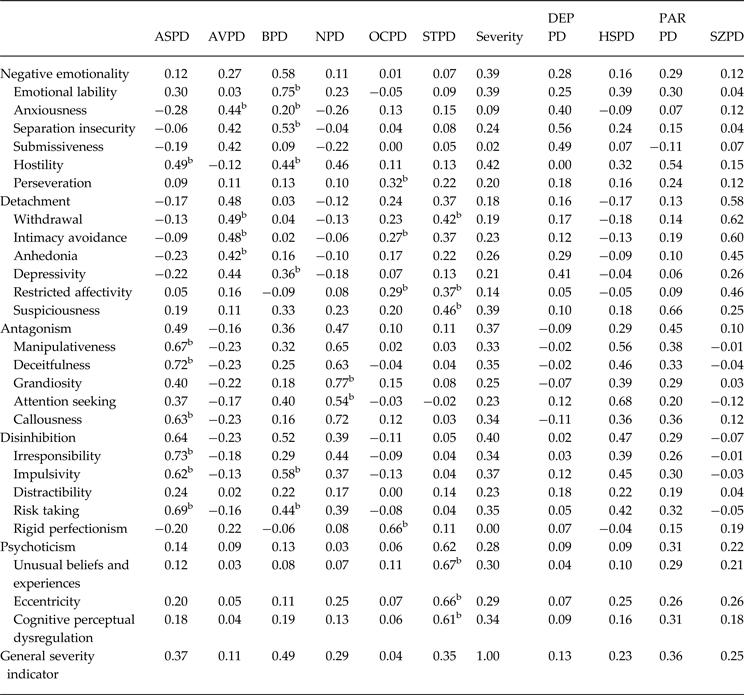
DSM-IV, Diagnostic and Statistical Manual of Mental Disorders, 4th edition; PD, personality disorder; DSM-5, Diagnostic and Statistical Manual of Mental Disorders, 5th edition; ASPD, antisocial PD; AVPD, avoidant PD; BPD, borderline PD; NPD, narcissistic PD; OCPD, obsessive–compulsive PD; STPD, schizotypal PD; DEP PD, dependent PD; HSPD, histrionic PD; PAR PD, paranoid PD; SZPD, schizoid PD.
a All correlations above 0.11 are significant at p < 0.05. All correlations above 0.14 are significant at p < 0.01.
b Trait facets specified as PD-specific diagnostic indicators within DSM-5's alternative model.
One study that influenced this process of refining these trait assignments was conducted by Hopwood et al. (Reference Hopwood, Thomas, Markon, Wright and Krueger2012), which examined the empirical relationships between the proposed traits and DSM-IV PDs in an undergraduate sample of 808 students (mean age = 19.92 years, s.d. = 2.04; 70.7% women). The 25 alternative model traits were assessed with the PID-5 questionnaire, and the 10 DSM-IV PD constructs were assessed by self-report with the Personality Diagnostic Questionnaire-4 (PDQ-4; Hyler, Reference Hyler1994). Findings from both correlational and hierarchical regression analyses were presented between the alternative model's trait domains and facets and the 10 DSM-IV disorders, as well as a severity composite designed to reflect core personality dysfunctions. The hierarchical regression models were constructed to (1) determine the percentage of variance in each retained DSM-IV disorder that was accounted for by the trait facets proposed for that disorder, and (2) to examine the extent to which the remaining trait facets incremented the proposed traits. Findings from Hopwood et al. (Reference Hopwood, Thomas, Markon, Wright and Krueger2012) suggested that the remaining (i.e. non-proposed) traits provided incremental information in predicting avoidant, narcissistic and obsessive–compulsive PDs, with no incremental information observed for traits beyond those proposed for borderline, antisocial and schizotypal PDs. Examination of trait–disorder correlations suggested that, for the avoidant PD construct, additional DSM-IV-relevant diagnostic information may be provided by the trait facets of depressivity and perseveration. Narcissistic PD showed significant associations with all facets of the antagonism domain (range r = 0.47–0.54), as well as the trait facet of hostility (r = 0.48). For obsessive–compulsive PD, supplemental trait associations were weaker, but observed for anxiousness and for some facets of the psychoticism domain. Examination of models combining the generalized severity indicator with the proposed traits suggested that the severity indicator significantly incremented the proposed trait clusters for each of the six retained PDs – supporting the inclusion of both impaired personality functioning and pathological personality traits in the alternative model's criteria for PDs.
Subsequent to the publication of DSM-5, a few other studies have made similar efforts to examine the hypothesized relationships between section II disorders and section III traits (see Few et al. Reference Few, Miller, Rothbaum, Meller, Maples, Terry, Collins and MacKillop2013; Fossati et al. Reference Fossati, Krueger, Markon, Borroni and Maffei2013; Anderson et al. Reference Anderson, Snider, Sellbom, Krueger and Hopwood2014; Sellbom et al. Reference Sellbom, Sansone, Songer and Anderson2014; Jopp & South, Reference Jopp and South2015; Miller et al. Reference Miller, Few, Lynam and MacKillop2015), with results generally indicating appreciable associations between disorders and hypothesized traits. The goal of the current article was to report the associations between clinician-judged DSM-5 section II PD diagnostic criteria and judgments about the presence of pathological section III traits. These data, gathered by members of the Work Group, helped to inform the decision-making surrounding trait assignments to DSM-IV PDs retained within the alternative model, and involved associations between clinician-judged DSM-5 section II PD diagnostic criteria and judgments about the presence of pathological section III traits, as provided by the same clinician on the same patient. The correspondence between the Work Group data, detailed by the results of this current investigation, and those data described in the aforementioned studies extends insight into the validity of the trait assignments by studying the use of these features as clinical judgments in a patient sample, in contrast to the self-report assessment in student samples that characterizes much previous work in this area. The presentation of these findings follows those of previous studies, such as Hopwood et al. (Reference Hopwood, Thomas, Markon, Wright and Krueger2012), to facilitate comparisons of the results. As in those studies, analyses focus upon: (a) the association of section II/DSM-IV PDs with DSM-5 section III traits that were specified as criterion B characteristics of those disorders; (b) an examination of the degree to which the remaining section III traits might increment the traits specified for each PD; and (c) an exploration of the incremental contribution of the specified criterion B traits and the criterion A core personality dysfunctions for each PD in the alternative model.
Method
The institutional review board of Texas A&M University approved the study protocol, and all participants provided responses to indicate their informed consent to participate in the study.
Subjects and sampling
The sample utilized in this study was collected as part of the development of the DSM-5 alternative model for PDs proposed by the DSM-5 P&PD Work Group; it has been described in detail in earlier reports (Morey & Skodol, Reference Morey and Skodol2013; Morey et al. Reference Morey, Skodol and Oldham2014). The data were obtained from a national sample of 337 mental health clinicians who provided diagnostic information on one of their patients, using an online survey located on a secured server. The clinicians were solicited via email membership lists of various professional mental-health organizations. Across the various mailing lists, 1829 email addresses were targeted to receive the initial invitation email. Although it is not known how many of these addresses were active at the time of the mailing, of the 1829 potential invitations, 444 clinicians clicked on the invitation email and proceeded to the survey website (response rate = 18.4%), and 337 of these completed the survey (response rate = 75.9%). Clinicians received a $75 gift certificate to an online merchant for participating. Participants included 88 MD/DO psychiatrists, 213 PhD/PsyD psychologists, 10 DSW/MSW social workers, 13 master's-level counselors and 13 clinicians with other degrees. Survey invitations were tied to specific email addresses such that only the invitee could complete the survey, and no invitee could complete it more than once.
Clinicians were asked to provide an anonymous diagnostic formulation of one of their patients with whom they had a minimum of 5 h of contact during the preceding year. The 5-h contact requirement was imposed to maximize the likelihood that clinicians were sufficiently familiar with the patient to address diverse areas of personality functioning. Although the invitation indicated that the study involved PD diagnosis, it was made explicit that target patients did not need to have a PD diagnosis to qualify. The sample of identified patients included more women (57%) than men, and these individuals ranged in age from 15 to 79 years, with an average age of 39 (s.d. = 13.9) years. The distribution of PD diagnoses according to DSM-IV/DSM-5 section II criteria was as follows: borderline, 40.1%; avoidant, 27.0%; paranoid, 21.1%; schizoid, 14.8%; narcissistic, 14.2%; dependent, 12.5%; antisocial, 11.3%; schizotypal, 9.5%; obsessive–compulsive, 8.9%; histrionic, 8.3%; PD not otherwise specified (13.6%); and no PD (16.3%). The sum of these values is greater than 100% due to the considerable overlap usually found among the PD categories.
Materials
Data from clinicians were collected by using an online survey questionnaire designed for the purposes of the project. Included in this survey were ratings about all diagnostic requirements pertinent to both DSM-IV (including all specific diagnostic criteria, presented in randomized order) and the alternative model diagnostic system [i.e. diagnostic criteria, trait facets, and Level of Personality Functioning Scale (LPFS) ratings for the alternative model]. With respect to DSM-5 personality trait judgments, clinicians were asked to provide ratings for the 25 trait facets that compose this model: a one- or two-sentence definition of each trait was provided and clinicians were asked to rate patients on a four-point scale ranging from very little or not at all descriptive to extremely descriptive of their patients, as suggested in applying the DSM-5 section III trait rating scale (Krueger et al. Reference Krueger, Eaton, Clark, Watson, Markon, Derringer, Skodol and Livesley2011). These 25 traits were presented to clinicians in alphabetical order to avoid any artifactual associations that might arise from grouping traits that are presumably theoretically related (i.e. in the same trait domain).
Analyses
To determine the associations between section III pathological trait facets and section II PDs, bivariate correlations were computed between domain ratings, dimensional trait facet ratings, and LPFS ratings, and the summed criterion count of the 10 section II PDs. Next, hierarchical regression analyses examined: the first block examining the extent to which the specified traits (included in criterion B for the six retained PDs) captured variance in the criteria for their target section II diagnosis; and the second block examining the extent to which any of the remaining traits provided additional information beyond that provided by the specified traits. For example, in the analyses for narcissistic PD, the traits specified in section III criterion B – grandiosity and attention seeking – were entered in block 1, followed by the remaining 23 traits in block 2. To fully document the partitioning of variance explained in these models, the hierarchical regressions were also conducted in reverse order, with the non-specified traits entered in block 1 and the specified traits (for a given diagnosis) entered in block 2.
Additional analyses were performed to examine the section III indicators of general personality pathology (i.e. criterion A of the alternative model). In order to examine the veracity of the alternative model as a whole, examination of criterion A (i.e. problems in identity, self-directedness, empathy and intimacy) was undertaken in conjunction with examination of criterion B, to determine the extent to which these indicators of general dysfunctions in personality provide incremental information beyond the traits, as well as the overall percentage of variance accounted for by the combination of criterion A core dysfunctions and criterion B pathological traits in describing section II PD diagnostic concepts. For these purposes, hierarchical regression models were constructed for each of the six PD diagnoses retained in the section III alternative model. First, dimensional ratings of criterion B specified traits were entered in block 1, followed by clinician ratings of the four specified core functional areas in block 2. For example, the specified traits for avoidant PD – anxiousness, withdrawal, anhedonia and intimacy avoidance – were entered in block 1, followed by the four criterion A indicators of core dysfunctions (indicated as present/absent) associated with that disorder. As above, the hierarchical models were then examined in reverse order of entry, with the indicators of core dysfunctions entered in block 1 and the specified traits entered in block 2, to more fully describe the relative contributions of these parts of the section III model for representing section II concepts.
Results
Table 1 presents the bivariate correlations for the section III specified traits with the criterion counts for the 10 section II PDs, as well as with the section III LPFS severity rating. For the six PDs retained within the section III alternative model, the specific traits used as diagnostic indicators for these disorder concepts are indicated. All correlations in this table above 0.11 are significant at p < 0.05 and correlations above 0.14 are significant at p < 0.01. Median correlations for the specified traits and the corresponding diagnostic entity ranged from 0.31 to 0.67 (average = 0.52), whereas median correlations for the remaining, non-specified traits ranged from 0.03 to 0.16 for the different disorders. For antisocial, obsessive–compulsive and schizotypal PDs, respectively, all of the traits specified in section III as diagnostic indicators for these disorders demonstrated higher correlations than the remaining traits. Antisocial PD showed general elevations along the antagonism and disinhibition domains. Borderline PD showed generally elevated trait levels across the domain of negative emotionality, with emotional lability showing the strongest association of the specified trait facets (r = 0.75) and anxiousness the weakest (r = 0.20). The specified facets from the disinhibition domain – impulsivity and risk taking – also demonstrated substantial associations (r = 0.58 and r = 0.44, respectively). Schizotypal PD showed elevations almost exclusively in the detachment and psychoticism domains. In contrast to the domain-level associations seen above, obsessive–compulsive PD demonstrated noteworthy associations in only the specified facets, rather than across any particular domain/s. Avoidant PD showed similar correlations for each of its specified facets (anxiousness r = 0.44, withdrawal r = 0.49, anhedonia r = 0.42, and intimacy avoidance r = 0.48), although additional facets showed noteworthy associations for avoidant PD including submissiveness (r = 0.42) and depressivity (r = 0.44). Finally, narcissistic PD showed moderate to strong associations for the two facets specified for its assessment – grandiosity (r = 0.77) and attention seeking (r = 0.54); however, several additional traits also showed appreciable associations – callousness (r = 0.72), manipulativeness (r = 0.65), deceitfulness (r = 0.63), hostility (r = 0.46) and impulsivity (r = 0.37).
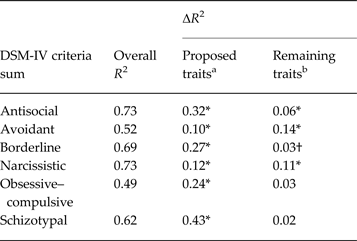
Table 2 presents the results for the hierarchical regression analyses that examined the ability of the section III traits, both those specified as indicators of the particular disorders as well as the remaining traits, to predict the section II PD criterion counts. The first column of data in Table 2 presents the overall percentage of variance (R 2) that is accounted for by all of the 25 trait facets. The second column of data details the extent to which the specified traits increment the remaining traits in predicting the variance associated with the particular DSM-IV diagnostic entity. The final column describes the extent to which the non-specified traits provide additional information beyond that provided by the specified traits. Thus, for example, 73.4% of the variance in the section II antisocial PD criterion count was accounted for by the full 25 section III trait facet model; the seven specified traits together accounted for 67% of the variance (which is 0.73 minus 0.06), while the remaining traits explained 6% of the variance.
Incremental validity of DSM-5 alternative model specified and remaining traits regressed on DSM-IV/DSM-5 section II criterion counts

DSM-5, Diagnostic and Statistical Manual of Mental Disorders, 5th edition; DSM-IV, Diagnostic and Statistical Manual of Mental Disorders, 4th edition.
a Extent to which the specified traits increment all remaining traits.
b Extent to which the remaining traits increment the specified traits.
* p < 0.001.
† p = 0.056.
Consistent with the correlations presented in Table 1, for each of the disorders examined, the specified traits accounted for a majority of the explained variance and significantly incremented the remaining traits. In contrast, the remaining traits failed to significantly increment prediction of schizotypal, obsessive–compulsive and borderline PDs, although additional information was provided by the remaining traits for avoidant, narcissistic and antisocial PDs.
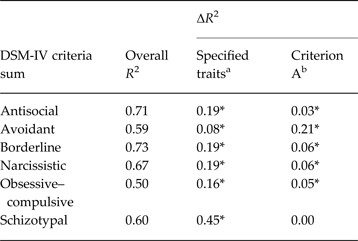
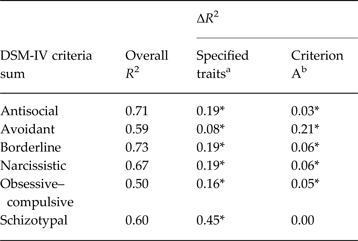
Table 3 presents the results for the hierarchical regression analyses, which examined the predictive and incremental validity of the section III criterion A core dysfunctions, in combination with the criterion B pathological traits, relative to the section II PD criterion counts for the six PDs retained within the alternative model. As in Table 2, the first column of data describes the overall percentage of variance (R 2) accounted for by both criterion A and criterion B combined. Column 2 conveys the extent to which the specified traits incremented the clinician ratings of the specified core dysfunctions (criterion A). Column 3 conveys the extent to which the specified severity indicators incremented the specified traits. For each of the six PDs examined, the specified trait clusters significantly (p < 0.001) incremented the specified severity indicators. The traits associated with schizotypal PD showed the largest incrementation (ΔR 2 = 0.4445), followed by narcissistic PD (ΔR 2 = 0.19). When the regression models were examined in reverse, the specified severity indicators significantly incremented the specified trait clusters for all PDs but schizotypal PD. Avoidant PD showed the largest incrementation (ΔR 2 = 0.21), followed by narcissistic PD (ΔR 2 = 0.06).
Incremental validity of DSM-5 alternative model specified traits and clinician-assigned criterion A ratings regressed on DSM-IV/DSM-5 section II criterion counts
DSM-5, Diagnostic and Statistical Manual of Mental Disorders, 5th edition; DSM-IV, Diagnostic and Statistical Manual of Mental Disorders, 4th edition.
a Extent to which the specified traits increment clinician-assigned criterion A ratings for each disorder.
b Extent to which the criterion A ratings increment the specified traits.
* p < 0.001.
Discussion
This study described relationships specified between DSM-5 section III pathological personality traits and DSM-IV/DSM-5 section II PD diagnoses in a sample of 337 clinicians, each of whom rated one of his or her patients. The goal of the study was to describe the links between the section III pathological trait model and section II PD diagnoses, helping to provide a basis for designating those trait facets that are of particular use in identifying PDs as traditionally defined. The trait assignments specified for these disorders in the DSM-5 alternative model (indicated in Table 1) demonstrated substantial correlations with the corresponding DSM-IV diagnoses, with an average trait–disorder correlation of 0.52. It is interesting to note that such associations of DSM-5 alternative model features with DSM-IV criterion-derived diagnoses are roughly comparable with the κ's (median κ = 0.50) obtained when comparing DSM-IV criterion-derived diagnoses with the global DSM-IV clinical diagnoses made by these same clinicians (Morey & Benson, Reference Morey and Benson2015). Furthermore, in most instances, the assigned traits demonstrated higher correlations than the traits not assigned to that diagnosis.
For most of the disorders retained in the section III model, links between traits and disorders followed expected patterns. For example, the B criterion for antisocial PD in the section III alternative model includes four traits from the antagonism domain (manipulativeness, callousness, deceitfulness and hostility), which demonstrated correlations with section II antisocial PD between 0.72 and 0.49. An additional three traits from the disinhibition domain (risk taking, impulsivity and irresponsibility) are used in the assessment of antisocial PD, and these demonstrated correlations between 0.73 and 0.62. Similarly, the section III diagnostic rules for schizotypal PD include three traits from the psychoticism domain (cognitive and perceptual dysregulation, unusual beliefs and experiences, and eccentricity), which demonstrated correlations between 0.67 and 0.61, and another three traits from the detachment domain (restricted affectivity, withdrawal and suspiciousness) with correlations which ranged between 0.47 and 0.37.
The two disorders that demonstrated the greatest differences from those patterns initially hypothesized by the PD&D Work Group were narcissistic and obsessive–compulsive PDs. For narcissistic PD, a number of non-assigned traits demonstrated noteworthy associations with this disorder, but all of these traits – mostly from the antagonism trait domain – were assigned to and correlated strongly with antisocial PD. The statistical association of antagonism traits to both narcissistic and antisocial PDs was also found in the study by Hopwood et al. (Reference Hopwood, Thomas, Markon, Wright and Krueger2012) – an investigation which used self-report personality measures in a large student sample. However, the overlap in these trait associations is being observed in two traditional DSM PD diagnoses – antisocial and narcissistic – that have demonstrated discriminant validity problems (e.g. Morey, Reference Morey1988b ). In fact, the recognition of such problems factored in the initial recommendation of the DSM-5 P&PD Work Group to eliminate narcissistic PD as a specific PD diagnosis (Morey & Stagner, Reference Morey and Stagner2012; Skodol et al. Reference Skodol, Bender and Morey2014). Given the subsequent retention of narcissistic PD, inclusion of overlapping traits for both narcissistic and antisocial PDs would have exacerbated overlap between the categories. Therefore, the B criterion for narcissistic PD was restricted to include only the traits of grandiosity and attention-seeking, both of which were also highly correlated with narcissistic PD in the Hopwood et al. (Reference Hopwood, Thomas, Markon, Wright and Krueger2012) study and with grandiose narcissism in another study of an online volunteer sample conducted by Miller et al. (Reference Miller, Gentile, Wilson and Campbell2013). In so doing, the section III criterion B for narcissistic PD leans toward the grandiose form of narcissism, consistent with the approach taken in DSM-IV/DSM-5 section II. In comparison, Miller et al. (Reference Miller, Gentile, Wilson and Campbell2013) found that traits from the negative affectivity and detachment domains correlated with ‘vulnerable narcissism’, but not with grandiose narcissism. To address such concerns, depressivity, anxiousness, anhedonia or withdrawal could have been added to the criteria for narcissistic PD, in order to capture its vulnerable aspects. However, adding these traits would have appreciably changed the nature of the diagnosis compared with DSM-IV by markedly increasing its prevalence, and also would have decreased the internal consistency of the narcissistic PD criteria set, and decreased discriminant validity with respect to borderline and schizotypal PDs (Skodol et al. Reference Skodol, Bender and Morey2014). Instead, in the alternative model, additional traits can be used to specify variants such as ‘malignant narcissism’ (e.g. manipulativeness, deceitfulness, callousness) or ‘vulnerable narcissism’ (e.g. depressivity, anxiousness) in a patient with narcissistic PD.
For obsessive–compulsive PD, rigid perfectionism demonstrated the largest association. However, three additional traits (perseveration, restricted affectivity and intimacy avoidance) also demonstrated noteworthy associations. As such, these traits were also included in the diagnostic formulation in criterion B for obsessive–compulsive PD, bringing the disorder conceptually closer in many ways to the DSM-III/DSM-III-R definition, which included features of restricted expression of affection and focus on productivity at the expense of relationships, in contrast to the DSM-IV's focus on symptoms of anxiety that resulted in increased overlap with avoidant PD.
In these data, the trait of depressivity was substantially correlated with avoidant PD but was not specified as a criterion B trait for this disorder in the alternative model. Hopwood et al. (Reference Hopwood, Thomas, Markon, Wright and Krueger2012) also noted that depressivity incremented the specified traits in predicting PDQ-4 avoidant PD scores, and Few et al. (Reference Few, Miller, Rothbaum, Meller, Maples, Terry, Collins and MacKillop2013) found that avoidant PD was the only one of the six section III PD diagnoses to be incremented by non-specified traits. Although there was recognition of this association by the DSM-5 Work Group, as in the case of narcissistic PD there were concerns about the discriminant validity of the avoidant PD diagnosis, and there was concern that the inclusion of the depressivity trait in both borderline and avoidant PD conceptualizations would have artifactually increased the co-morbidity of these diagnoses.
The results of this study also indicated a consistent positive association between the core personality dysfunction described by the clinician ratings of the LPFS and the pathological traits that comprise criterion B of the model (median r = 0.37). The only other studies utilizing the version of the LPFS provided in DSM-5 section III have reported similar associations between the LPFS and the pathological traits (Few et al. Reference Few, Miller, Rothbaum, Meller, Maples, Terry, Collins and MacKillop2013; Zimmermann et al. Reference Zimmermann, Altenstein, Krieger, Holtforth, Pretsch, Alexopoulos, Spitzer, Benecke, Krueger, Markon and Leising2014). Few et al. (Reference Few, Miller, Rothbaum, Meller, Maples, Terry, Collins and MacKillop2013) found that, although the LPFS rating accounted for a significant proportion of the variance in eight of 10 DSM-IV PDs (excluding histrionic and obsessive–compulsive), it failed to significantly increment the section III pathological traits for any of the DSM-IV PDs. Some have suggested that, given this apparent lack of incremental validity, the core dysfunctions specified by the LPFS may be unnecessary as a diagnostic indicator for PD, perhaps being redundant with the traits. However, in this study the four criterion A core dysfunctions (in identity, self-direction, empathy and intimacy) specified for each disorder were studied for incremental associations, rather than the single-item LPFS rating, and our results demonstrated incremental validity for the core dysfunctions beyond the criterion B traits for all six section III PD diagnoses. Furthermore, the finding that virtually all pathological traits, across factorial domains, are positively associated with LPFS ratings supports the contention that the core dysfunctions reflected in the LPFS are found in all manifestations of PD. Given those dysfunctions, it is then the pathological trait domains that are anticipated to provide incremental information that describes the specific forms (i.e. PD types) in which these issues will manifest. The pervasive positive associations with the LPFS across all traits suggest that the DSM-5 pathological trait domains are associated (i.e. non-orthogonal) by virtue of a degree of saturation of PD severity that appears to be driving the relationship between the pathological trait domains – unlike the theoretically orthogonal personality trait dimensions found in the general population in structures such as the five-factor model (e.g. Costa & McCrae, Reference Costa and McCrae1992; Goldberg, Reference Goldberg1993).
In general, the trait descriptors provided in the DSM-5 section III alternative model have been shown to be associated with traditional PD concepts such as those found in DSM-5 section II. These data helped inform the Work Group process of finalizing trait assignments, but it should be noted that comparable results have been found in other studies conducted after publication of DSM-5. Given these associations, it is possible to render traditional PD concepts using these traits in combination with core impairments in personality (self and interpersonal) functioning. For example, working with the same dataset described here, Morey & Skodol (Reference Morey and Skodol2013) found strong convergence between section II and section III diagnostic assignments (median correlation of criteria for the six PDs of 0.75). In fact, the changes in characteristics such as prevalence rates were smaller when comparing DSM-IV with DSM-5 section III diagnoses (Morey & Skodol, Reference Morey and Skodol2013) than was the case, for example, in the transition from DSM-III to DSM-III-R (Morey, Reference Morey1988a ).
However, it must be realized that recapturing traditional PD diagnostic concepts was not the sole aim of the DSM-5 Work Group, and, as such, continuity with the traditional model should not be considered as the ‘gold standard’ in evaluating progress towards the goals of the reformulation of personality pathology represented by the alternative model. This reformulation sought to redefine PDs as hybrids of core dimensional impairments in personality functioning and of pathological personality traits. Such an articulation of component processes potentially provides a means to link PD concepts to the various motivational, cognitive and social mechanisms that may underlie these disorders. Thus, while the findings of associations between traditional and alternative model PD constructs described in this paper provide a means to maintain continuity of extant diagnoses, this issue and these data represent only a part of the mosaic required to evaluate the promise of the alternative model's hybrid approach.
Acknowledgements
None.
Declaration of Interest
None.