Introduction
Urbanisation − that is the increasing number of people living in urban areas − constitutes a major trend in the development of mankind and has accelerated without precedent since the second half of the twentieth century. Half of the world’s population now lives in urban areas. The United Nations (2014) predicts that by 2050, 64.1% of the developing world and 85.9% of the developed world will be urbanised. But urbanisation does not limit itself to the city’s physical boundaries: it is a new organisational model for societies and for their interaction with their wider environment that is changing the human presence on Earth by creating trans-local linkages that impact our definition of spaces, places and connections (Brickell & Datta, Reference Brickell and Datta2011).
The Arctic region − which here follows the AMAP (Arctic Monitoring and Assessment Programme) definition, including some places below the Arctic Circle, such as Anchorage − is not exempt from this global process. In the polar context, a city is defined not so much by the presence of a certain number of inhabitants (these numbers vary by country: in the US, a city is usually more than 100,000 inhabitants and a town between 20,000 and 100,000, while in Russia a town is more than 12,000) or a particular population density as by the fact that people living in this settlement do not produce their means of subsistence through agriculture or hunting but through industrial, services, or administrative work. It also means that their social connections are not limited to the city context but extend beyond it. Under such a definition, which excludes villages where traditional ways of life still predominate, one can count about 60 cities in the Arctic region (PIRE Index of Arctic Sustainability, n.d.). These cities vary dramatically in terms of population. In Alaska, Canada and Greenland, the maximum is around 10,000 people; indeed, Alaska’s northern coastline hosts only one city of over 4,000 people: Barrow, now renamed Utqiagvik. The Scandinavian North combines small settlements of around 10,000 people with a dense network of medium-size cities that have populations of 50,000−100,000, while Russia displays the whole spectrum, from small and medium-size cities to Arctic “megalopolises” with around 300,000 inhabitants. Of the twelve Arctic cities with populations greater than 100,000 people, eight are in Russia, while Finland, Iceland, Sweden and the U.S. have one apiece.
Despite the diversity of forms of urbanism visible in the Arctic region, comparatively little is known about this phenomenon. The 2014 Arctic Human Development Report (edited by Larsen & Fondahl) identified “Arctic settlements, cities, and communities” as one of the main gaps in knowledge of the region (pp. 24−25). Indeed, research on the Arctic population has largely focused on indigenous peoples and their traditional way of life, often to the exclusion of the urban context, which has been seen as an artificial and external import to a region that has thus far been protected from global trends. This stance is no longer legitimate, given that about two-thirds of the Arctic population lives in urban conditions and that indigenous peoples themselves are progressively moving into urban settlements.
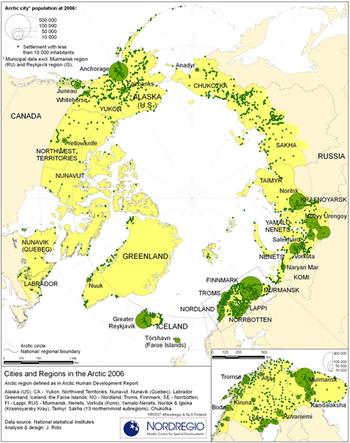
There has been a gradual accumulation of literature on Arctic cities, from the first documentation of permanent settlements in the Northwest Territories in the 1960s−1970s (J. Honigmann & I. Honigmann, Reference Honigmann and Honigmann1965) to studies of indigenous peoples’ adaptation to big cities since the 2000s, with the focus of the latter primarily on Inuits in Canada and Sámi in Scandinavia (Fienup-Riordan et al., Reference Fienup-Riordan, Tyson, John, Meade and Active2000; Fogel-Chance, Reference Fogel-Chance1993; Kishigami, Reference Kishigami2002a, Reference Kishigami2002b, Reference Kishigami, Stern and Stevenson2006). On the Russian side, the ethnographical school of Dmitri Funk at the Miklukho-Maklay Institute of Anthropology and Ethnology has been following both the urbanisation of indigenous people and their interaction with energy firms since the 1990s, while Alexander Pelyasov, Nadezhda Zamyatina, and several others have been looking at the fate of the big industrial cities in Russia’s Far North (Laruelle and Orttung, Reference Laruelle and Orttung2017). Yet a “big picture” perspective on Arctic urbanisation that would go beyond case studies is still lacking, with the exception of a few articles by Susanne Dybbroe (Dybbroe, Reference Dybbroe2008; Dybbroe, Dahl, & Müller-Wille, Reference Dybbroe, Dahl and Muller-Wille2010) and Torill Nyseth (Reference Nyseth, Korber, MacKenzie and Stenport2017). This article hopes to partially fill the gap and follow the path of the two aforementioned authors by looking at circumpolar urbanisation trends (see Fig. 1).
Arctic urbanisation emerged from what can be broadly defined as colonial situations. The arrival of Europeans in regions previously inhabited only by indigenous peoples launched the dynamic of urbanisation. Yet the dividing line between “natives” and “non-natives”, while meaningful for defending indigenous rights, is blurry: many Europeans have been in the Arctic for several generations and consider themselves as local as the indigenous population, even if they are not “native” in the sense of First Nations. In the past few decades, the picture has been further blurred as the indigenous inhabitants of Arctic villages have increasingly moved to Arctic cities and become urbanites: 90% of the indigenous population is urban in Greenland, 60% in Alaska, 50% in Canada, an average of 45% in Russia, and 36% in Scandinavia (Larsen & Fondahl, Reference Larsen and Fondahl2014; Rosstat, 2010).
This article dissociates three historical waves of Arctic urbanisation: from the sixteenth century to the early twentieth century (the “colonial” wave); from the 1920s to the 1980s in the specific case of the Soviet urbanisation of the Arctic (the “Soviet” wave); and from the 1960s−70s to the present as a circumpolar trend (the “globalized” wave). The article then discusses the three drivers of the latest urbanisation wave (resources, militarisation, and public services) and the prospects for Arctic cities in the near future.
The colonial wave: Europeans on the move
The first wave can be called “colonial”, as it is inscribed into the dynamic of European expansion to new territories that began around the fifteenth century. The conquest of new territories means both settling among and establishing control over the indigenous peoples of an area and appropriating a place and its resources for one’s own use.
This colonial wave actually began earlier in Russia: from the twelfth century, the Novgorod and then Moscow principalities sent merchants east and north, mostly for the fur trade, and established monasteries to spread Orthodox Christianity among the Finno-Ugric and Sámi indigenous populations. Several small outposts along the Kola Peninsula and the White Sea began trading with the Hanseatic League (Tiberg, Reference Tiberg1995).
Yet it was only in the fifteenth century, during the reign of Ivan III (1440−1505) − nicknamed the “gatherer of the Russian lands” because he tripled the territory of the state and ended the dominance of the Mongol Golden Horde − that Russia’s expansion to the north and the east took on a more official cast. The outpost of Pustozyorsk, in today’s Nenets autonomous district, toward the lower reaches of the Pechora River, was founded in 1499 and can be considered the first town inside the Arctic Circle. It was particularly active in the early seventeenth century, with an estimated 200 households, or about one thousand people (GBUK “Istoriko-kul’turnyi i landshaftnyi muzei-zapovednik” Pustozersk, n.d.), before beginning a slow decline that saw it become a ghost town by the mid-twentieth century (Russia Beyond the Headlines 9 April 2013; author’s fieldwork on Pustozyorsk, July 15, 2018). Arkhangelsk, founded in 1584, would enjoy a brighter future as the outpost of Russia’s advances into the Far North: it remains one of the largest cities in the Arctic to this day, with 350,000 inhabitants. Russia’s first example of a “Gold Rush” city was Mangazeya on the Taz river in West Siberia (Bobrick, Reference Bobrick1992). Founded in 1601, the fortified trading post quickly grew to reach several thousand inhabitants, only to decline a few decades later, exemplifying the fate of many Arctic prospectors’ cities.
In the same period, Moscow’s victory over the khanate of Sibir opened the door to the rapid conquest of Siberia: the Urals were crossed in 1581, the Yenisei River traversed in 1628, the Pacific Ocean reached in 1680, and Alaska brought under Russian authority in 1741. This multidirectional advance, to the north, east and south, was not actually driven by the Russian state itself, but by diverse groups: the Arkhangelsk region was conquered by fur merchants − the Pomors, Russians from the White Sea region, who had navigated Arctic waters since the seventeenth century; Siberia was traversed by the Cossacks and by agents of important merchant families; and Alaska was run by the private Russian−American Company. As it advanced, the Russian state subjugated native peoples, forcing them to pay a fur tribute (yasak), and secured its expanding borders by building outposts and forts at the confluences of major rivers (Kappeler, Reference Kappeler2001). Less than a century after beginning its conquest of Siberia, in 1632, Russia created the settlement of Yakutsk: by the end of the seventeenth century, it had about 600 inhabitants, mostly Russian Cossacks in charge of tribute collection, as well as a few clergy supervising the Spassky Monastery, the largest in north-eastern Russia and a major centre for missionary work. Another town, Zhigansk, on the Lena River, was Russia’s most northerly city until 1917, when it was demoted to rural status (see more on Russia’s history of conquest and its relationship to indigenous people in Slezkine, Reference Slezkine1996.) Russia also maintained a presence in Alaska until selling it to the United States in 1867 (Gibson, Reference Gibson1976).
For two centuries, Russia’s conquest of Arctic regions resulted in few, sporadic acts of resistance from indigenous peoples, low-intensity demographic colonisation, and a pre-industrial exploitation of local wealth, mostly fur, timber, and minerals. It was only at the end of the nineteenth century, with the construction of the Trans-Siberian Railway, that massive contingents of Europeans began to move into Southern Siberia (about five million newcomers; Gilbert, Reference Gilbert2002), and even then, Europeans remained scarce in more northerly regions. Murmansk (at that time Romanov-na-Murmane) was dedicated in 1916, making it the last town founded by the Tsarist regime.
Russia’s early urbanisation of Arctic territories was followed by the two Scandinavian powers of that time, Sweden (which then encompassed Norway and Finland) and Denmark, which advanced into Arctic territories mostly in the eighteenth and nineteenth centuries (Derry, Reference Derry2000). Earlier, as part of the Hanseatic realm, a church in the future location of Tromsø had been erected in 1252, and a small town emerged as a Norwegian outpost and frontier city toward Russia in an area mainly populated by the Sámi. Another trading post of the late Middle Ages, Molde, was given formal trading rights in 1614 and incorporated as a city in 1742. Outside Scandinavia, Reykjavík was founded in the early eighteenth century to relocate a missionary and merchant colony; it was given town status in 1786. In Greenland, Denmark began establishing small trading posts of seal products along the coast at the end of the eighteenth century (Sejersen, Reference Sejersen2010).
By the nineteenth century, several of the above-mentioned Scandinavian cities were quite developed considering their northern location: Tromsø was a major centre of Arctic hunting and Molde a hub for textiles and the garment industry, while the village of Bodø, granted township status in 1816, was renowned for smuggling. Alta, today the largest city in Norway’s Finnmark county, gained notoriety following the 1852 revolt of the Sámi people against local merchants. New company towns based on mining and the arrival of railways, such as Kirkenes, Kiruna, and Narvik, emerged around 1900 (Dale, Reference Dale2002).
On the North American continent, the conquest of Arctic territories took place fairly late, at the end of the nineteenth century, even if some parts of the region had already been crossed during explorations (Delgado, Reference Delgado1999). Alaska was the first to see urban settlements take form, as the continuation of the booming Gold Rush to the north: in 1880, Juneau became the first European American settlement founded on this territory after the United States purchased Alaska from Russia, and was long occupied mostly by gold prospectors. Fairbanks was founded in 1901 as a trading post along the Chena and Tanana rivers, and later populated by miners looking for new resources (Berton, Reference Berton1958). Anchorage was formed in 1914 as a settlement for the headquarters of the Alaska Railroad. In Canada, Whitehorse, future capital of the Yukon territory, followed the same pattern: it was founded at the end of the nineteenth century due to a combination of gold prospectors settling there and the arrival of railways (Dobrowolsky, Johnson, Cameron, Firth, & Genest, Reference Dobrowolsky, Johnson, Cameron, Firth and Genest2013).
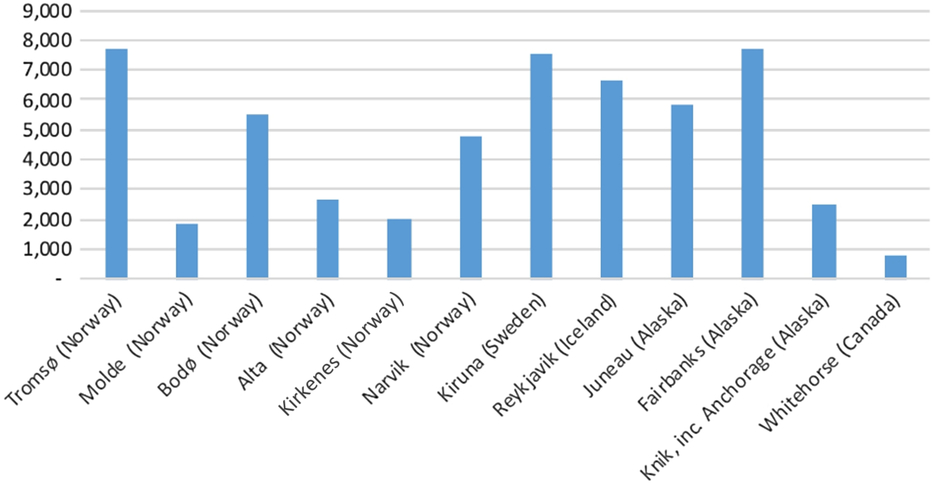
As we see from this brief historical sketch and from Fig. 2, until the early 1920s, Europeans living in urban settlements were a comparatively marginal feature of Arctic regions, since there were less than two dozen small towns across the entire Arctic. Many of them, such as Tromsø, Rovaniemi and Yellowknife, developed first as indigenous hunting and trading centres. They then became early trading outposts or company towns tied to mining activities, with very limited urban planning and whose life expectancy was fairly short − many towns were abandoned as soon as the resource they were originally constructed to exploit had been depleted (Petrov, Reference Petrov, Hansen, Rasmussen and Weber2013).
Cities in the Arctic region, 2006. Source: http://archive.nordregio.se/en/Maps/08-Urban-and-regional-divisions/Cities-and-Regions-in-the-Arctic-2006/index.html.

Number of inhabitants of Arctic towns (excluding those in Russia) in the early twentieth century (between 1900 and 1920, depending on census). Source: author’s compilation based on https://www.rhd.uit.no/folketellinger/reg_komm_e.html; http://www.eco.gov.yk.ca/pdf/Yukon_census_population_historical_2016.pdf; http://www.kiruna.se/Kommun/Samlingssidor/English/History/; http://px.hagstofa.is/pxen/pxweb/en/Ibuar/Ibuar__mannfjoldi__2_byggdir__sveitarfelogeldra/MAN02120.px/table/tableViewLayout1/?rxid=54b18e6e-bc59-4b56-bced-b5bad1b2dabe; and http://live.laborstats.alaska.gov/cen/histpdfs/1910aksup.pdf.

The Soviet wave: Forced mobility and hyper-industrialization
The second wave of urbanisation extends from the 1930s to the 1980s and remains specific to Soviet Russia. The way the Soviet regime decided to conquer and industrialise its Arctic regions, first with forced labour and then with costly incentives, is unique in world history. Nevertheless, far from being disconnected from European history, it has its roots in Europe’s pursuit of economic progress through industrialisation and the exploitation of natural resources (Hill & Gaddy, Reference Hill and Gaddy2003).
From the early 1920s, the Bolshevik elites developed a robust interest in the Far North. They endowed the indigenous populations with cultural and linguistic rights, attempted to solidify Russia’s sovereignty − then under threat in the Far East − and sought to enhance the Northern Sea Route (NSR, or Sevmorput’). The Murmansk research station, which had been chiefly focused on fishing, was rapidly transformed into the Northern Scientific Industrial Expedition (Sevekpeditsiia), and a Floating Sea Research Institute (Plavmornin) was tasked with cataloguing all Siberian rivers and their connections to the Arctic Ocean. Rapid aeronautical progress fostered Arctic discoveries and the young Soviet Union did not want to lag behind in the developing field of trans-Arctic aviation. The rescue expedition organised by the Krasin in 1928 to save the second Italian Polar Expedition confirmed the effectiveness of Soviet icebreakers and boosted Moscow’s interest in establishing control over the Northern Sea Route.
Moscow’s interest in the Arctic grew steadily during the First Five-Year Plan, launched in 1928, which signalled the entry of Stalin’s Soviet Union into a period of forced collectivisation and massive industrialisation. The latter presupposed the possession of a large quantity of mineral resources, which marked the beginning of perceiving the Arctic as being mainly a rich subsoil region. In the 1930s, priority was given to the exploitation of oil and gas from Ukhta (founded in 1929), coal from Vorkuta (founded in 1932) (Barenberg, Reference Barenberg2014), and metals from the Kola Peninsula and Taimyr Peninsula (Norilsk was founded in 1935). The Committee of the Northern Sea Route (Komseveroput’) then began to support Arctic navigation, first around the Kara Sea and later further east. The first shipments of timber and minerals were organised along the Northern Sea Route: Igarka (founded in 1929) was developed as a sawmill and timber-exporting port on the Yenisei River, followed by other towns in the Kolyma-Indigirka region. With the USSR’s entrance into the war against Germany in 1941 and the Nazi occupation of Soviet territories, many industries vital to the war effort were relocated far from the front lines, in the Far North, Siberia, and Central Asia.
The idea that the Arctic was a specific region, to be run by a sole organ with supreme power over all its aspects, in order to exploit it in accordance with Stalinist standards, gave rise to the Main Administration of the Northern Sea Route, or Glavsevmorput’ (Glavnoe upravlenie severnogo morskogo puti). Launched in 1932, and quite appropriately described by John McCannon (Reference McCannon1998) as “one of the Soviet Union’s greatest experiments in hypercentralisation” (p. 6), the Glavsevmorput’ was a state within the state, controlling a territory of two million square kilometres and employing as many as 100,000 people. It was responsible for Arctic research, shipping, mineral production, shipyards, aviation, agricultural development and population management − Russians as well as indigenous groups. The experiment, however, did not last long: Glavsevmorput’ was dismantled in its “totalitarian” form in 1938, then progressively downgraded in 1953 and finally dissolved in 1964.
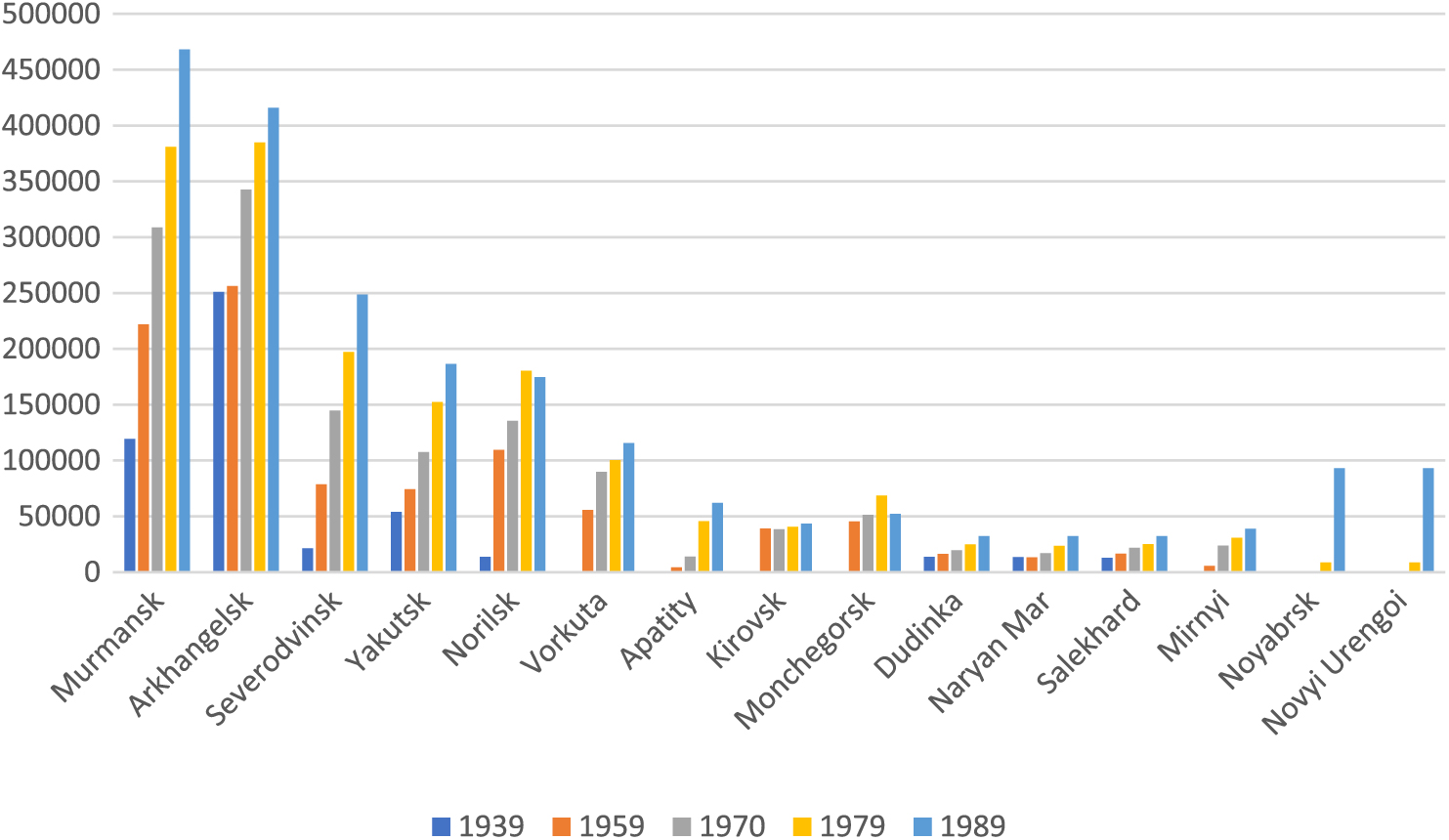
Severely lacking in manpower, the Soviet regime used the penitentiary industry as the engine for Arctic development. The Gulag was the core driver of Arctic urbanisation, from the Gostroy project that built the city of Norilsk from scratch to the infamous Dalstroy − the Main Administration for the Construction in the Far North − of the Kolyma (Applebaum, Reference Applebaum2004; Gregory & Lazarev, Reference Gregory and Lazarev2003). While rapid urbanisation was a feature of the government’s policy across the Soviet Union − the urban population grew over 6% per year between the 1920s and 1941 (Goskomstat, 1998, pp. 32−33) − the trend was particularly impressive in the Far North and Siberia: the Krasnoyarsk krai, for instance, experienced 75% population growth between 1940 and 1945 (Shabad & Mote, Reference Shabad and Mote1977). This trend continued in the post-war era: in the 1950s and 1960s, the rate of population increase in the Murmansk region was far higher than the average for the Russian Federation (RSFSR), with a natural rise of 24,000 people per year, of whom around 8,000 were new arrivals from other regions (Laruelle, Hohmann, & Burtseva, Reference Laruelle, Hohmann, Burtseva and Laruelle2016). Norilsk grew from more than 100,000 inhabitants as of the 1959 census to more than 250,000 in the 1979 one. As Fig. 3 shows, the growth of Soviet Arctic cities between the 1930s and the 1980s was impressive.
The rapid growth of Soviet Arctic cities, 1939−1989. Source: author’s compilation based on Soviet census data from 1939, 1959, 1970, and 1989.

Arctic company towns’ populations declined when the Gulag system was dismantled. The majority of prisoners left as soon as possible, although some decided to stay, forming a social constituency always marginalised during Soviet decades. The legacy of this massive and rapid industrialisation was a demand for far higher numbers of workers than the market would have dictated (Hill & Gaddy, Reference Hill and Gaddy2003). Stabilising the workforce therefore became one of the main headaches of the Soviet regime in its quest to develop the Far North in a post-Gulag age. To attract a voluntary labour force to the area, the regime had to develop financial incentives: the “Northern Shipment” of so-called Northern benefits. Pay rates could be as much as two-and-a-half times higher than the Soviet average, and workers also enjoyed an earlier retirement age, higher pensions, priority for rehousing, and large subsidies for transportation and basic economic needs.
This extremely costly approach, which was sucking up as much as 6% of Soviet GDP by the 1980s, was never totally efficient. In the early 1960s, labour turnover in eastern Siberia was reported to exceed the Soviet average by 70%, and in the neighbouring Yakut Autonomous Republic by almost 50% (Bond, Reference Bond1985). While 1.4 million people moved to Siberia between 1956 and 1960, between 1.4 and 2 million people left the region during the same period (Prociuk, Reference Prociuk1967). Concerned by the cost of this endless stream of transient workers and the need to increase production and human capital in this remote region, Soviet authorities came to understand that improving the liveability of northern cities was vital. Thus, in the 1970s and 1980s, living conditions (housing, products delivery, cultural activities) in Arctic cities improved dramatically, helping to create a “golden age” for their inhabitants (Laruelle, Reference Laruelle2017). This state investment first began to slow in some Soviet Arctic cities in the 1980s, leading to increased human mobility away from the region, but it was only in the 1990s, with the collapse of the Soviet regime, that the urban fabric of the entire Far North was shaken and began to shrink.
The “globalization” wave: Urbanisation’s new drivers
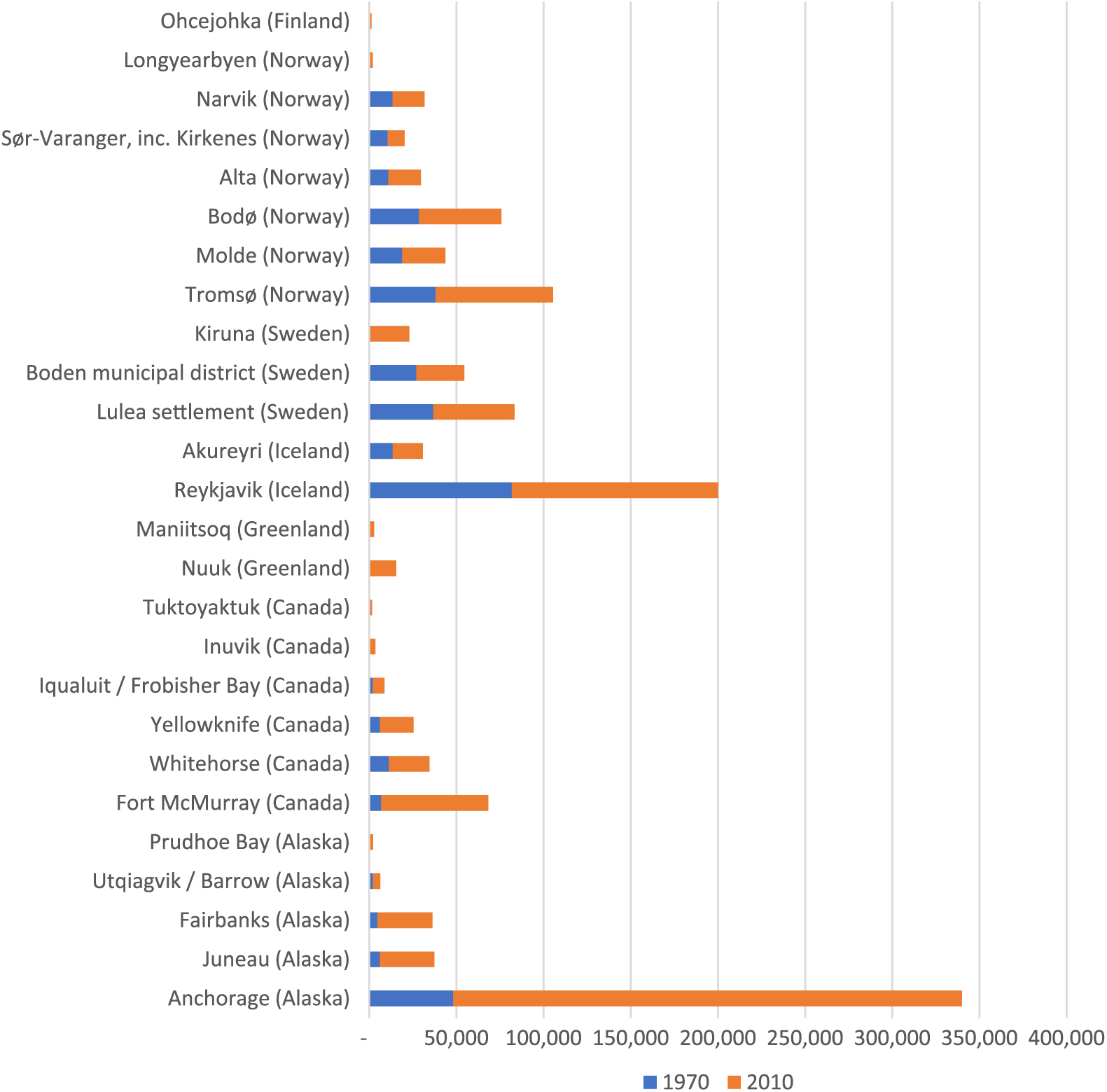
Other Arctic countries did not pursue large-scale urbanisation until the 1950s and 1960s. Since then, most of the population growth in the Arctic has occurred in urban centres, both because of in-migration and because of natural increase via high birth rates (Rasmussen, Reference Rasmussen2011; see also Northern Forum, n.d.). This urbanisation has been uneven since the 1980s−1990s: small settlements are tending toward depopulation, while large urban centres such as Anchorage, Whitehorse, Nuuk, Reykjavik, Akureyri, Tromsø, Bodo and Luleå have been growing rapidly (Weber, Reference Weber, Fondahl and Wilson2017), as shown in Fig. 4. Today, only in the Faroe Islands, based on a more dispersed (mostly fishing) economy, are rural inhabitants still in the majority, at 58%; the rest of the Arctic regions have between two-thirds and three-quarters of their populations residing in urban areas. Average urbanisation is highest in Russia (88% at the 2010 census, with the Murmansk region reaching a peak at 93%) (Larsen & Fondahl, Reference Larsen and Fondahl2014). Yet if one looks at the regions in more detail, the Canadian Arctic appears to feature several different trends in parallel: the Yukon territory is mostly urban, while the Northwest Territories and Nunavut are still predominantly rural. On the Russian side, Chukotka is the only region that has seen a decline in the urbanisation of the population, from 73% at the 1989 census to 65% at the 2010 census (Heleniak, Reference Heleniak, Laruelle and Orttung2017a).
Population growth of the main Arctic cities (excluding those in Russia) between 1970 and 2010. Source: author’s compilation based on Wikipedia data; citypopulation.de; http://www.scb.se/statistik; and https://www.ssb.no.

The three drivers of today’s urbanisation
We can identify at least three main drivers of the most recent wave of urbanisation: industrial activities, the militarisation of the Arctic, and the development of regional administrative centres.
Contrary to more southern located centers, in which post-modernity has seen a move away from industrial production to a service and information economy, in Arctic regions, as in the majority of developing countries, resources may still be the conduit of modernity. The most obvious driver of urbanisation has been the growth in industrial activities, mostly large-scale fishing, forestry, energy and mineral extraction. Yellowknife, founded in 1934 around gold extraction and river navigation, became the capital of the Northwest Territories in 1967, and the recent discovery of diamonds north of the city could give a new impulse to industry. Prudhoe Bay, North America’s largest oil field (discovered in 1968), gave birth to a small city of the same name, now populated by just over 2,000 people, most of whom are engaged in supplying the 1,000 transient workers employed in the neighbouring oil field with infrastructure and goods.
Further south, in the middle of the Athabasca oil sands, the fate of Fort McMurray epitomises the “booming city” model reminiscent of the Gold Rush: it grew from a few hundred inhabitants in the early twentieth century to 7,000 in 1971, 31,000 in 1981 and 66,000 in 2016. Its 80% population growth between 2000 and 2010 has made Fort MacMurray an case for studying the challenges that a fast-growing urban infrastructure in a boreal environment can face (Keough, Reference Keough2015). This is also the case (albeit on a smaller scale) of Fjarðabyggð, a coastal municipality in East Iceland created in 1998 by the merging of three small townships, that has been booming thanks to the arrival of an aluminium smelter and whose inhabitants seem happy to finally have access to an industrial modernity presumed to be on the wane (Benediktsson, Reference Benediktsson, Viker and Nyseth2009).
Cities can also reinvent themselves through resources. Kiruna, born in the early twentieth century from mining activities and depressed in the 1970s, has recently been revived and transformed by the prospects for new mining activities beneath the town, forcing the relocation of about one-third of the built infrastructure, including the city centre. These unique circumstances have suddenly allowed Kiruna, formerly a company town, to re-imagine itself as a sustainable and ecological city (Nilsson, Reference Nilsson, Viker and Nyseth2009). At the same time, cities based on natural resources may also shrink: outside of Russia (discussed below), the example of Maniitsoq, which was the most important fishing town in West Greenland until the big cod fishery collapsed in 1980, illustrates well the urban decline that can be precipitated by resource depletion.
A second driver has been the militarisation of the region, boosted during the decades of the Cold War, when the Arctic was seen as a potential theatre of conflict between the Soviet Union and NATO countries. This military modernisation played a particular role in urbanising the Canadian North: the new towns of Inuvik and Frobisher Bay (now Iqaluit, the Nunavut capital), planned extensively in the 1950s and 1960s, combined Canada’s Cold War strategies of controlling its Arctic region (in which the Navy played a prominent role) with the idea of bringing modernity to the local population (Farish & Lackenbauer, Reference Farish and Lackenbauer2009). Tuktoyaktuk, on the shores of the Beaufort Sea, emerged in the 1950s, when radar domes were installed to detect possible Soviet intrusions, and became a key point for the Air Force personnel working on the Distant Early Warning (DEW) Line. The discovery of oil in the Beaufort Sea complemented the city’s military function and transformed it into a base for oil companies and workers (Andrachuk & Smit, Reference Andrachuk and Smit2012).
The same can be said for the US military bases of Fort Wainwright and Eielson Air Force Base in Fairbanks, which play an important role in local urban economies to this day. In Sweden, Boden remains a military stronghold, housing the country’s largest army garrison: the military was long the city’s largest employer, along with the municipality. In Iceland, Keflavík and Akureyri airports were built by the US and UK, respectively. The infrastructure investments that accompany military installations, now sometimes converted to perform emergency and search and rescue functions, have contributed to urban development. The revival of tensions between Russia and NATO countries in the past decade has been a push factor for Canada, Alaska, and, above all, Russia to reinvest in their Arctic military infrastructure, such as border guard bases (Flake, Reference Flake2017).
A third driver of urbanisation − and now the main force behind it − has been the development of social services, public administration, and tourism. Greenland has been a textbook case of this: in the 1960s, the Danish state imposed forced modernisation and centralisation, turning the island’s small fishing villages into industrialised towns with factories, roads and concrete apartment buildings. Since then, the push factors of urbanisation have been administrative and political rather than commercial and economic. Nuuk is probably the best example of an Arctic city that is growing due to its administrative nature and a conception of centralisation that comes from the European tradition and is dependent on imported Danish designs, materials, technologies, policies and labour (Grydehoj, Reference Grydehoj2014). The city has become the main centre for all corporate offices, administrations and higher education institutions, with an economy mainly dependent on public-sector jobs and social support and with limited export-oriented value creation (Hendriksen, Reference Hendriksen2014). Another example is Longyearbyen, the capital of Svalbard, which has grown from a bedroom community for Store Norske’s miners into a small city (around 2,000 inhabitants) oriented toward tourism. It now has a diverse economy, with developed accommodation, dining, and shopping facilities, as well as the University Centre in Svalbard (UNIS). Finland, Sweden and Norway have followed a similar path: in the 1960s, the authorities, guided by the logic of the welfare state, decided to provide equal living standards to all citizens whatever their ethnic background and pushed for centralised settlements in traditionally Sámi regions, giving birth to small cities such as Ohcejohka in which the Sámi have familiarised themselves with the urban environment (Muller-Wille, Reference Muller-Wille2010).
The Russian case: Both urbanisation and de-urbanisation
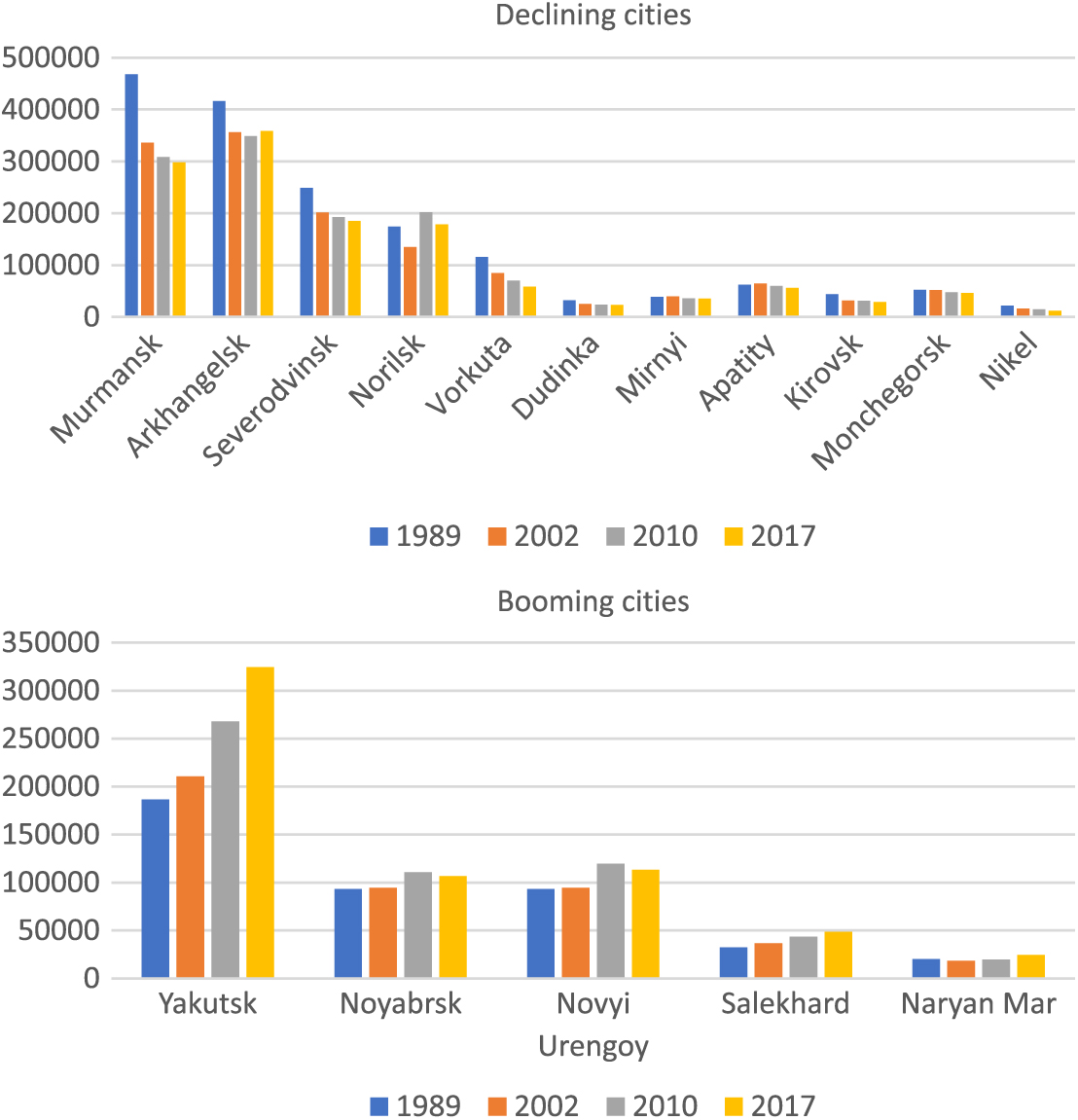
Russia has been facing a more complex situation, dealing with two contradictory trends: the decline of Arctic cities established during the second wave of urbanisation and the growth of new Arctic cities based on the drivers of the third wave (see Fig. 5). A vivid illustration of how these contradictory trends overlap in the Russian Arctic is the case of Vorkuta and Salekhard, two cities separated by only 150 km (but 11 hours by train). Vorkuta, a former Gulag based on coal exploitation, has seen its population nearly halve, going from 115,646 in 1989 to 58,133 in 2017. On the other side of the Urals, meanwhile, Salekhard, one of Gazprom’s administrative capitals for its Yamal gas megaproject, grew from 32,000 people in 1989 to 48,000 in 2016.
Booming and declining Russian Arctic cities, 1989−2017. Source: author’s compilation based on the Soviet census from 1989, Russian censuses from 2002 and 2010, and population data from 2017.

Cities that developed in the second phase of urbanisation were hit hard by the collapse of the Soviet Union, the partial discontinuation of Northern Shipment benefits, and the disappearance of local economies. This resulted in an impressive depopulation and de-urbanisation process that has seen the loss of one-third of the Arctic population over the past thirty years. Between the 1989 and 2002 censuses, one in six inhabitants emigrated from the Far North. The regions of Magadan and Chukotka lost more than half of their populations, Taimyr 30%, Yamalo-Nenets 25%, and even the Murmansk region more than 20%. (For more details, see Heleniak, Reference Heleniak1999, Reference Heleniak, Laruelle and Orttung2017b). Yakutia got off relatively lightly, with a depopulation of only 12%. Several single-industry cities (monogorody) transformed into depressed, if not dying, places (see Crowley, Reference Crowley2016; Didyk, Reference Didyk, Laruelle and Orttung2017 and Suutarinen, Reference Suutarinen2013), while some military bases were closed in the span of a few months. The port towns of Igarka and Tiksi lost about half of their inhabitants between 1987 and 2005, while Dikson lost four-fifths of its population. In the Magadan region, more than 40 settlements were declared “without inhabitants” in the 2002 census. The emergence of these ghost towns has created poverty gaps that have made the remaining inhabitants unable to migrate. In the 2000s, although the overall rate of depopulation slowed, the cities of Vorkuta and Igarka, as well as those in northern Yakutia and Chukotka, continued to face population declines of more than 20% (Heleniak, Reference Heleniak and Rowe2009, Reference Heleniak2010).
At the same time, Russia has experienced a third wave of urbanisation similar to that of its neighbours. Since the 1970, energy discoveries in the Khanty-Mansi autonomous district and then in the adjacent Yamalo-Nenets district to the north have given rise to a new urbanisation dynamic, embodied by the birth of new cities such as Nefteyugansk (1967), Nadym (1972), Novyi Urengoy (1975), Noyabrsk (became a settlement in 1975; gained city status in 1982), Muravlenko (1984), and Gubkinsky (1986). These new cities reproduce the pioneering atmosphere of the Soviet “Golden Age” and have preserved part of the epic of the conquest of new territories. The history of Noyabrsk, for instance, began with engineers landing helicopters to develop the Kholmogorskoye oil field, followed by the arrival of railway builders. All of these explorers lived in harsh conditions in very basic barracks before the first concrete structures were built. In its first years, an average of 15,000 people arrived annually, and the rate of population increase hit its zenith in 1977−1978 at a mighty 224% (Vaguet, Reference Vaguet, Hansen, Rasmussen and Weber2013). Today, with 100,000 and 116,000 inhabitants, respectively, Noyabrsk and Novyi Urengoy are prime examples of very young cities that display all the attributes of urban life.
This third wave of urbanisation is personified by a relatively young and mobile population that moves to the Far North to accumulate capital and experience. The arrival of younger cohorts also means a significant natural increase in the population, as these generations are of childbearing age. To stabilise the population, Russian Arctic regional and municipal authorities have been more generous than average in allocating state revenues for families with a second and third child. (For more details, see Sophie Hohmann’s ongoing research on social and health transformation in the Russian Arctic.)
As in the rest of the Arctic, cities with administrative functions have also been growing rapidly. Yakutsk, the capital city of the autonomous republic of Sakha (Yakutia), attracts the rural indigenous population on account of its educational opportunities − between 1989 and 2017, the city’s population grew by more than 45%, going from 186,000 to 324,000 inhabitants (Kuklina, Ignatieva, & Vinokurova, in press; Sukneva & Laruelle, in press). The same is true, to a lesser extent, of Naryan-Mar, capital of the Nenets autonomous district.
Which urban sustainability for Arctic cities?
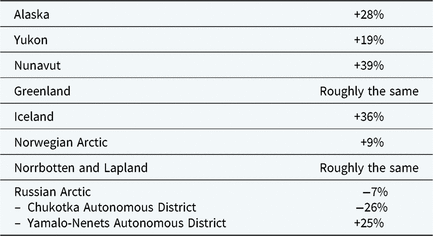
What is the sustainability of these Arctic cities? What kind of future seems to be taking shape for them? The Arctic population has slightly declined since the 2000s due to the exodus of populations from some depressed Russian cities and, to a lesser extent, the moderate decline in Lappi (Finland) and Norrbotten (Sweden). This decline is counterbalanced by rapid population growth in Alaska, Iceland, and the Canadian Arctic (especially Nunavut, which has seen almost 20% growth since 2000) and more moderate growth in the Faroe Islands (Larsen & Fondahl, Reference Larsen and Fondahl2014). The Arctic will continue to be increasingly populated, yet this growth is happening at a slower rate than global population growth: just 4% compared to a projected 29% worldwide between 2010 and 2040. The 2014 Arctic Human Development Report calculated a gentle rise from just over 4 million inhabitants in 2010 to 4.2 million in 2030, that is, about 150,000 people over two decades (Larsen & Fondahl, Reference Larsen and Fondahl2014, p. 100). While Russia currently hosts about two-thirds of the Arctic population (2.5 million in 2015, to which should be added about ten million people living in sub-Arctic conditions in Siberia), its share of the Arctic population will decline to only 42% in 2035 (Larsen & Fondahl, Reference Larsen and Fondahl2014, p. 101). All Russian polar regions will experience population decline, with the exception of the Yamalo-Nenets region, while the European Arctic (Scandinavia and Greenland) will stabilise and the North American Arctic and Iceland will grow at notable rates (see Table 1).
Projected population growth in the Arctic between 2014 and 2035. Source: Larsen & Fondahl (Reference Larsen and Fondahl2014, pp. 98−101).

While scientists may forecast the impact of climate change − from coastal erosion to permafrost thaw (Streletskiy & Shiklomanov, Reference Streletskiy, Shiklomanov and Orttung2016) − on circumpolar regions, for inhabitants of Arctic cities living in an anthropogenic environment, the impact has been rather minimal so far. Anecdotally, inhabitants may mention changes in seasons and the “greenisation” of the environment (that is, the arrival of more southerly vegetation patterns), but they do not yet feel threatened (Larsen & Fondahl, Reference Larsen and Fondahl2014, p. 91). While coastal erosion has already impacted some villages in Alaska, in Russia thawing permafrost is noticeable by scientists and engineers (Streletskiy, Sherstukov, Nelson, & Frauenfeld, Reference Streletskiy, Sherstukov, Nelson and Frauenfeld2015; Esau & Miles, Reference Esau, Miles, Laruelle and Orttung2017) but not by average citizens, at least in towns; indigenous people, better integrated into their environment, are more aware of even minimal evolutions. Yet climate change could deeply impact transport infrastructure, increase the challenges of delivering goods to cities, and limit residents’ ability to travel. The cost of large-scale deformation of both structural and infrastructural assets as well as of residential real estate due to permafrost thaw in the Russian Arctic has been estimated to hit US$248.6 billion by the middle of the twenty-first century (Shiklomanov, Streletskiy, Swales, & Kokorev, Reference Shiklomanov, Streletskiy, Swales and Kokorev2016; Streletskiy et al., Reference Streletskiy, Suter, Shiklomanov, Porfiriev and Eliseev2019).
Beyond climate change, one can discern two structural trends that will shape the sustainability − or unsustainability − of Arctic cities.
The first is the growing hierarchisation of cities. Urbanisation has accelerated concentration into larger urban settlements and the concomitant gradual decay of small provincial towns. Given infrastructure challenges and changing economic patterns, medium-size urban settlements have become less attractive to the population: only big cities offer the full spectrum of public services, such as schools, kindergartens, care for the elderly, a minimum level of administration, retail shops, and entertainment structures (Rasmussen, Reference Rasmussen2011). With their economic and educational opportunities, Arctic capitals gradually “centralise” the population: Nuuk’s share of Greenland’s population has been steadily rising over time, now amounting to 30% of the population, while Reykjavik accounts for 40% of Iceland’s (Larsen & Fondahl, Reference Larsen and Fondahl2014, pp. 94−95). In Yukon, 70% of the population live in Whitehorse; in the Northwest Territories, 48% live in Yellowknife (Northern Forum, n.d.). The Greenland case is an archetype of this centralisation: small, fishing-based settlements that were the dominant mode of urbanisation until the 1950s have gradually collapsed (Sejersen, Reference Sejersen2010). The Danish Greenland Administration encouraged people to move to major cities and even dismantled settlements to move people to the nearest town, including by closing, in 1972, the coal mining town of Kutdligssat (Qullissat), formerly Greenland’s third-largest city (Hendriksen, Reference Hendriksen2014).
In Russia, this trend was accentuated by the collapse of the Soviet welfare state: small settlements suffered much more than big cities and depopulated more rapidly. Rane Willersley (Reference Willersley2010) notes, for instance, that two Yugakir villages in Yakutia, Zyrianka and Ugelna, contracted fivefold from 10,000 to 2,000 inhabitants between 1993 and 1995. Igarka, along the Yenisei, saw its population shrink from 18,000 in 1989 to 6,000 at the 2010 census, prompting the authorities to forcibly regroup the remaining population into one neighbourhood and abandon the rest of the urban territory (author’s fieldwork, Igarka, July 2013). In the 1990s and 2000s, about one-third of Siberian settlements changed their official status from town to village in order to secure rural benefits for their residents and provide plots of land (Bezrukov, Reference Bezrukov2011).
This circumpolar trend will draw a new map of the Arctic, combining remaining small villages based on indigenous traditional ways of life with big, multicultural and economically diverse cities, while the intermediate level − comprised of medium-size urban entities − will slowly disappear. Arctic cities are progressively integrating neighbouring towns as suburbs due to the culture of dachas − countryside cottages − which is particularly pronounced in Russia (Stammler & Sidorova, Reference Stammler and Sidorova2015), and offer a larger united market for housing, medical services, labour and consumption. This will result in Arctic big cities being the main, if not the only, successful provider of a minimum urban standard of living − good public services and infrastructure, connectivity with the rest of the country and sufficient cultural life − in this harsh climate. They will be also the only settlements capable of boosting the Arctic’s human capital and investing in intellectual and innovation centres.
The second trend is more ambivalent, with two contradictory moves: one toward the “rootedness” of Arctic cities and the other toward the growing transience of their inhabitants.
“Rootedness” because some Arctic cities, which have existed for decades and in some cases for centuries, have their own local identity ready to be embraced by newcomers. Some of their inhabitants have family roots in the city dating back several generations, even if the majority of residents are relative newcomers and turnover remains high compared to more southerly cities. The sense of belonging to the “North,” of being on a pioneering front, is developed in all Arctic cities but particularly strong in the Russian case thanks to the memory of the Soviet conquest of the region and its resources. The term Severiane, “the people from the North,” is worn with pride: fulfilled in their work, Severiane are said to be not afraid of physical challenges as well as hospitable and sharing because Arctic conditions lead to solidarity. They carry the virtues of late socialism, such as personal fulfilment, and curb consumerism. The archetypal Severiane are geologists or specialised engineers − heroes of Soviet industrialisation who embody gender equality and women’s success in traditionally male-dominated professions. At a more official level, Arctic cities have been developing strong branding strategies that flag their polar or boreal identity, not only to attract tourists and foreign investors, but also to situate themselves in a context of renewed fascination with the region and to foster collective identity among their inhabitants.
Transience because a large number of inhabitants of Arctic cities stay only for a few years, seeing a job in the North as an upward mobility mechanism that will allow them to accumulate financial and symbolic professional capital to use later in other contexts. Some cities have high population turnover: 23% annually in Longyearbyen, for instance (Olsen, Reference Olsen2009). In Russia, the harsh working conditions mean that some of the big mineral extraction firms struggle to recruit a skilled workforce. Norilsk Nickel, present in Norilsk as well as in the Kola Peninsula, has to recruit outside Russia, in Ukraine and Kazakhstan, to compensate for the lack of qualified personnel, and offers attractive incentives for people to stay longer, such as hiring a worker’s spouse and adult children, co-financing the purchase of an apartment, co-funding a retirement plan for workers who stay at least five or ten years, etc. (author’s interviews with Norilsk Nickel representative in Norilsk and Talnakh, July 2013). The use of shift work and especially of long-distance commuters (LDCs) is increasingly a solution to high turnover and the lack of desire to build new infrastructure that would support permanent communities. Common in Alaska and Canada, shift work is a new phenomenon in Russia. During the Soviet decades, the Marxist−Leninist ideology asserted that socialist development must be spread equally across a country’s territory, leading to the reproduction of a European-centric pattern of urbanity and the rejection of new forms of non-permanent settlements (Koropeckyj, Reference Koropeckyj1967). Since the 2000s, several Russian firms, both small and large, have progressively seen shift work become their new modus operandi in remote regions: for mining jobs in the Khibiny mountains of the Kola Peninsula, for gold mining in northern Yakutia, and, on a larger scale (at least 10,000 people), for gas extraction in Yamal to reach the increasingly remote fields of the north. (See Saxinger, Reference Saxinger and Laruelle2017. On the challenges of adaptation for shift workers, see Rouillard, Reference Rouillard, Fondahl and Wilson2017.)
These two contradictory trends mean that existing Arctic cities will reinforce their “rootedness” − even if some, such as Vorkuta and Norilsk, will probably continue to shrink in the coming decades − while shift work will slow down the emergence of new cities per se and accentuate the transient nature of the Arctic population. How a sense of local identity characterised by impermanence and mobility can develop to make these cities more sustainable and inclusive remains to be studied in detail.
Conclusions
Each of the three waves of Arctic urbanisation has been deeply intertwined with the broader context, showing how much the circumpolar world has been interacting with the more southerly regions for centuries − albeit that the pace of this interaction obviously accelerated in the twentieth century. The colonial wave and the Arctic’s first trading outposts were products of Europe’s (including Russia’s) demographic and economic expansion at the end of the Middle Ages, and the first company towns were born of the search for resources of the end of the nineteenth century. The Soviet wave was the child of European Marxism’s interpretation of economic progress through forced industrialisation, as understood by Communist regimes. The third wave features the main characteristic of globalisation, with urban growth produced mostly − but not exclusively − by the rise of the tertiary sector, a more diversified and interconnected social fabric, and an insistence on integrating the city into its environment. Arctic urbanisation thus offers a unique theatre to study the genealogy of our developmentalist discourses and their major historical shifts.
Yet although intensely connected to the evolution of more southerly regions, the Arctic urban reality will retain specific features of a “frontier”: a harsh environment, infrastructure and communication challenges, high production costs, vast distances between communities, a small and mobile population highly sensitive to the transformations of the labour market and its sectoral niches, and interaction with the surrounding wilderness. This “frontier” status may be accentuated by climate change, which has the potential to create a more unstable natural environment that will challenge municipalities’ and citizens’ ability to plan and prepare for such transformations.
The sustainability of this urban reality is uncertain. Cities built on exploiting a local resource face the risk of not being able to reinvent themselves once the resource is depleted. In Russia, this is the case for all the Yamal cities based on gas exploitation (Vaguet, Reference Vaguet, Hansen, Rasmussen and Weber2013). Some cities, such as Gubkinsky, have begun encouraging a more diversified economy and the rise of the private sector to prepare for the post-oil and gas era, while others − such as Muravlenko − have not, and are now in slow decline (Zamyatina & Pilyasov, Reference Zamyatina, Pilyasov and Orttung2014). Cities with a more diversified economic profile that combines public services, higher education institutions, human capital production, mobile middle classes and some local economic niches such as tourism, have a better chance of adapting. This is the case of all the regional capitals in Alaska, Canada, Greenland, Iceland, and in the three Scandinavian countries, as well as a few of the Russian ones: first Yakutsk and to a lesser extent Murmansk and Arkhangelsk. Those able to integrate an increasing share of the indigenous population into the city and project a more “decolonised” identity based on a new indigenous urbanness and a new multiculturalism will also probably find it easier to succeed at building a new holistic modernity (Viker & Nyseth, Reference Viker and Nyseth2009; Olsen, Reference Olsen2003).
Author ORCIDs
Marlene Laruelle 0000-0001-8289-2695
Financial Support
This research was developed as part of the George Washington University initiative PIRE: Promoting Urban Sustainability in the Artic, supported by the U.S. National Science Foundation (NSF), grant 1545913, and as part of the “HIARC: Anthropogenic Heat Islands in the Arctic − Windows to the Future of the Regional Climates, Ecosystems and Society” project, coordinated by the Nansen Environmental and Remote Sensing Center and funded by the Belmont Forum and the National Science Foundation.
Conflict of Interest
N/A