Clostridium difficile infection (CDI) in the United States has been associated with increased morbidity and mortality especially in older persons, such as those cared for by the US Department of Veterans Affairs (VA).Reference Lessa, Mu and Bamberg 1 Rates of healthcare-acquired infections (HAIs) due to C. difficile now exceed those due to methicillin-resistant Staphylococcus aureus (MRSA) in VA acute care facilities.Reference Evans, Kralovic and Simbartl 2 , Reference Evans, Simbartl, Kralovic, Jain and Roselle 3 Therefore, a nationwide CDI Prevention Initiative was begun July 1, 2012. The Initiative, developed with expert input and patterned after the VA’s successful efforts to reduce MRSA HAIs,Reference Evans, Kralovic and Simbartl 2 included environmental management, molecular diagnostic approaches, and nationally recommended infection prevention and control strategies.Reference Cohen, Gerding and Johnson 4 The goal of the Initiative was to reduce overall system-wide hospital-onset healthcare facility–associated CDI case rates by 30% from baseline within 2 years of implementation of the program (see Online Supplementary File).
Recently the Centers for Disease Control and Prevention’s National Healthcare Safety Network began reporting HAIs using standardized infection ratios (SIRs), and a model was developed for the calculation of hospital-onset healthcare facility–associated CDI SIRs using data from National Healthcare Safety Network hospitals.Reference Soe, Gould, Pollock and Edwards 5 , Reference Dudeck, Weiner, Malpiedi, Edwards, Peterson and Sievert 6 A SIR accounts for risk factors found to be significantly associated with differences in infection incidence. It compares the number of HAIs observed with the number predicted, as calculated using a regression model derived from a baseline population. A SIR greater than 1.0 indicates that more HAIs were observed than predicted, whereas a SIR less than 1.0 indicates fewer HAIs were observed than predicted.
We previously reported nationwide CDI data from VA acute care facilities collected retrospectively for the 21-month period prior to implementation of the CDI Prevention Initiative.Reference Evans, Simbartl, Kralovic, Jain and Roselle 3 Here we report trends in clinically confirmed hospital-onset healthcare facility–associated CDI cases during the 33-month period after implementation of the Initiative using SIRs.
METHODS
CDI case definitions and data collection, evaluation, and reporting were performed exactly as described previously.Reference Evans, Simbartl, Kralovic, Jain and Roselle 3 CDI cases were identified by a positive diagnostic laboratory test (laboratory-identified [LabID] Event). Trends in clinically confirmed hospital-onset healthcare facility–associated CDI cases, defined as any nonduplicate/nonrecurrent positive LabID Event collected more than 48 hours after admission in a patient with diarrhea or histopathologic or colonoscopic evidence of pseudomembranous colitis,Reference Cohen, Gerding and Johnson 4 were evaluated using SIRs.
The model for calculating SIRs recommended by the National Healthcare Safety NetworkReference Dudeck, Weiner, Malpiedi, Edwards, Peterson and Sievert 6 did not fit VA data well, possibly because of differing facility and patient demographic characteristics, and an alternative model was developed on the basis of generalized estimating equations using data from the baseline period of October 1, 2010, through June 30, 2012, before implementation of the CDI Prevention Initiative.Reference Evans, Simbartl, Kralovic, Jain and Roselle 3 The model examined VA-specific explanatory variables, including CDI diagnostic test type (nucleic acid amplification test vs enzyme immunoassay vs other), facility admission prevalence rate, patient-days, and facility complexity. The last category ranked facilities on 7 variables defining the patient population, clinical services complexity, education programs, and research.Reference Rugs, Toyinbo and Patel 7 Model goodness of fit was determined by examination of the residuals and the estimated overdispersion parameter.
We analyzed prospective data from July 1, 2012, through March 31, 2015, that had been entered each month by each of the 127 VA acute care facilities into a centralized database housed at the Inpatient Evaluation Center in Cincinnati, Ohio. Quarterly pooled national SIRs were calculated using observed and model-predicted CDIs. CDI counts from October 1, 2010, through June 30, 2012, before implementation of the CDI Prevention Initiative, were used as the baseline.Reference Evans, Simbartl, Kralovic, Jain and Roselle 3 Trends were evaluated by linear regression. P values were based on 2-tailed tests and P≤.05 was considered statistically significant. All analyses were performed using SAS, version 9.3 (SAS Institute).
The process of reviewing deidentified national data sets was reviewed by the Cincinnati VA Medical Center Institutional Review Board (IRB 05-6-29-2).
RESULTS
During the 33-month analysis period, there were 1,404,088 admissions, 7,789,797 patient-days, and 6,360 clinically confirmed hospital-onset healthcare facility–associated CDI cases.
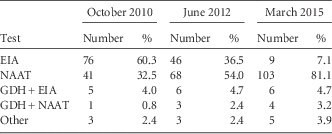
The use of nucleic acid amplification test for CDI diagnostic testing increased from 33.3% in 2010 to 84.3% in March 2015 among facilities (Table 1).
Laboratory Tests Performed by Veterans Affairs Facilities for the Diagnosis of Clostridium difficile Infection

NOTE. EIA, enzyme immunoassay; GDH, glutamine dehydrogenase; NAAT, nucleic acid amplification test; Other, cell culture cytotoxin, anaerobic toxigenic culture, or other test combinations.
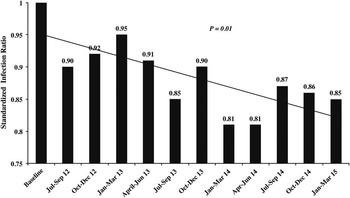
Quarterly pooled national SIRs decreased 15% by the final quarter of the analysis period (P=.01, for trend by linear regression) compared with the baseline period (Figure 1).
Quarterly change in the pooled national Veterans Affairs (VA)–specific clinically confirmed hospital-onset healthcare facility–associated Clostridium difficile infection (CDI) standardized infection ratios from baseline period (October 2010 through June 2012, SIR = 1.0) after implementation of the VA CDI Prevention Initiative in July 2012. The linear regression trend line is shown (P=.01).

During the analysis period, 98% of patients nationally with CDI were placed in contact precautions. Appropriate isolation signs were present in 96% of these, and gowns, gloves, and hand hygiene supplies were available upon entry to the patient’s room/area in 98% of cases.
DISCUSSION
Clinically confirmed hospital-onset healthcare facility–associated CDI SIRs decreased in VA acute care facilities compared with baseline with implementation of an initiative incorporating national recommendations,Reference Cohen, Gerding and Johnson 4 aggressive education, and assurances that basic elements of infection prevention and control were in place, including attention to environmental cleaning and disinfection. The decrease in VA acute care facilities is comparable with the 10% decrease reported by National Healthcare Safety Network facilities in 2013. 8
The decreases in VA CDI SIRs observed after implementation of the prevention initiative may be due to the simple application of basic infection control as evidenced by the high rate with which patients with presumed or diagnosed CDI were placed in contact precautions, and the almost universal use of appropriate transmission precautions (signage and availability of personal protective equipment and hand hygiene supplies). Moreover, the data presented here along with VA’s experience with MRSA in the acute care and long-term care settingsReference Evans, Kralovic and Simbartl 2 , Reference Evans, Kralovic and Simbartl 9 are consistent with the concept that healthcare facilities obtain better results controlling infections due to multidrug-resistant organisms and C. difficile when they cooperate on infection control.Reference Lee, Bartsch and Wong 10
Strengths of this report include identification of all CDI cases on the basis of a positive LabID Event rather than International Statistical Classification of Disease, Ninth Revision, Clinical Modification coding, which may be less optimal for tracking the incidence of hospital-onset CDI; the use of a multivariable regression model to account for important demographic variables, such as the increasing use of nucleic acid amplification tests for diagnosis that could affect rates; the use of a large national database spanning more than 4 years before and after implementation of the Prevention Initiative; and our focus on clinically confirmed cases rather than “hospital-onset” cases that are defined simply on the basis of timing and a positive LabID Event. This may be important since clinically confirmed cases may be a better indicator of actual C. difficile illness in our population.
Potential limitations include the fact that CDI data were gathered and entered into our national database by hand at each local facility, introducing the possibility of errors. However, careful facility-by-facility analysis of the database (data not shown) showed an outlier and potential error rate of only 1%. This and the large number of data points helped ensure that occasional errors would have minimal impact on the database as a whole. It is also possible that the results found with veterans may not be generalizable to other populations in the United States. However, since CDI tends to affect the elderly more than other age groups, and 40% of veterans are at least 65 years old, the data from this report may be relevant.
The CDI SIR data can now be used in a targeted assessment of prevention strategy with calculation of cumulative attributable differences allowing us to target facilities with the highest number of excess CDI cases.Reference Soe, Gould, Pollock and Edwards 5 Focusing prevention efforts in these facilities may have the most impact in achieving the goal of a 30% reduction of CDI nationwide.
ACKNOWLEDGMENTS
We thank the VA Under Secretary for Health, the Deputy Under Secretary for Health for Policy and Services, the VA MRSA/Multidrug-Resistant Organism (MDRO) Taskforce, the CDI Data Workgroup, the MRSA/MDRO Prevention Coordinators, infection prevention and control professionals, infectious diseases specialists, and clinical laboratory personnel at each facility for support of the MDRO Prevention Initiatives and their hard work and dedication toward improving the healthcare of America’s veterans. Thanks also to Linda Flarida, Judith Whitlock, and Brian McCauley of the MDRO Prevention Office for their help with data validation, cleaning, and review of the manuscript.
Financial support. None reported.
Potential conflicts of interest. All authors report no conflicts of interest relevant to this article.
SUPPLEMENTARY MATERIAL
For supplementary material/s referred to in this article, please visit http://dx.doi.org/doi:10.1017/ice.2016.27