Introduction
Kawasaki disease, an acute systemic small- and medium-vessel vasculitis, is mostly detected in children under 5 years old. It can lead to dysfunction of multiple systems, with cardiovascular system injury being the most common. Reference Sugahara-Tobinai, Inui and Metoki1 Over 20% children with Kawasaki disease may develop coronary artery diseases, which is a common factor for acquired heart diseases. Reference Kitano, Takeuchi and Suenaga2 In addition, coronary artery aneurysm may develop if not treated in a timely manner, potentially resulting in myocardial infarction, coronary thrombosis, or even sudden death. Reference Philip, Jindal and Krishna Kumar3
Standard intravenous immunoglobulin therapy is the first-line treatment approach for Kawasaki disease and can effectively reduce the risk of coronary artery aneurysm. However, about 10–20% of children with Kawasaki disease do not respond to standard intravenous immunoglobulin therapy and remain at high risk for coronary artery diseases. Reference Ahmed, Pal, Azad, Ghosh, Banerjee and Sarkar4,Reference Wang, Song, Mu, Shang, Wang and Ruan5 If children unresponsive to standard intravenous immunoglobulin therapy cannot be identified early, their condition may be aggravated steadily, raising the risk of coronary artery aneurysm. Therefore, it is crucial to early predict the efficacy of standard intravenous immunoglobulin therapy. In current clinical practice, symptoms such as enlargement of cervical lymph nodes, fever, and oral erythroplakia are used to diagnose and evaluate the efficacy of treatment on children with Kawasaki disease. However, these symptoms overlap with those of juvenile idiopathic arthritis, scarlet fever, and other febrile diseases, resulting in low specificity. Blood inflammatory markers have been employed to predict intravenous immunoglobulin resistance upon Kawasaki disease. Reference Liu and Wu6 Additionally, scoring systems, such as the Kobayashi score, have been used to predict immunoglobulin resistance. Reference Matsuura, Sugawara and Makita7 The indicators involved in the scoring system include neutrophil percentage, total white blood cell count, platelet count, haemoglobin, alanine aminotransferase, etc. However, due to differences in different countries, regions, and races, there is currently no scoring system that can perfectly apply to all Kawasaki disease groups.
Long non-coding ribonucleic acids and microRNA are both non-coding RNAs, playing vital roles in processes including transcription activation, transcription silencing, intranuclear transport, and chromosome modification. Besides, they can affect many gene expression pathways, participate in angiogenesis, vascular differentiation, cell proliferation, and apoptosis, and pose an impact on the growth and development of organisms at the individual or cell tissue level. Reference Kawasaki, Miyamoto and Oda8,Reference Kawasaki, Takeuchi and Ricciardiello9 The expressions of lncRNAs and microRNA show obvious differences between healthy children and children with Kawasaki disease, so they may be crucial for the onset and progression of Kawasaki disease. Reference Guo, Hua and Qian10,Reference Wang, Li and Qiu11
In this study, the predictive value of lncRNA small nucleolar RNA host gene 5 and miRNA-27a for the efficacy of standard immunoglobulin therapy on children with Kawasaki disease was investigated, aiming to provide a reference for the evaluation of treatment outcomes.
Methods
Collection of general data
This prospective study was approved by the ethics committee of our hospital (Approval No. 2022-L072), and written informed consent was obtained from the caregivers of all children. A total of 182 subjects were selected from children with Kawasaki disease treated with standard immunoglobulin therapy in our hospital from February 2021 to February 2023.
The inclusion criteria involved: (1) children meeting relevant diagnostic criteria for Kawasaki disease and any five of the following items: Reference Kainth and Shah12 1) with strawberry-like tongue or/and cracked lips, 2) with fever time of ≥5 d, 3) with polymorphic rash, 4) with bilateral bulbar conjunctival hyperaemia, 5) with acute-stage finger and toe end congestion, swollen hands and feet, or limb tip molting in the recovery period, and 6) with non-suppurative enlargement of cervical lymph nodes (>1.5 cm in diameter); (2) those with normal growth and development; (3) those with first onset; (4) those with complete clinical and follow-up data.
The exclusion criteria were set as follows: (1) children allergic to immunoglobulin; (2) those taking antiplatelet drugs (aspirin or clopidogrel) or anticoagulant drugs (warfarin or rivaroxaban) in the past month; (3) those administered with hormonal or antibiotic drugs in the past month; (4) those complicated with valvular heart disease, CHD, or cardiogenic shock; (5) those complicated with idiopathic thrombocytopenic purpura; (6) those complicated with blood system diseases or bleeding tendency; and (7) those complicated with acute infectious diseases or immune dysfunction.
Standard immunoglobulin therapy
After diagnosis, the children were provided conventional treatments such as fluid supplement, electrolyte correction, and liver and stomach protection. They were given a single intravenous infusion of immunoglobulin (Chengdu Rongsheng Pharmaceuticals Co., Ltd., China) at 2 g/kg. Besides, aspirin (Hunan Xinhui Pharmacy Co., Ltd., China) was taken orally at a dosage of 10 mg/(kg·d) to resist inflammation. On the 3rd day following abatement of fever, the dosage was reduced to 3–5 mg/(kg·d) for its antiplatelet effect. Aspirin was discontinued at 6–8 weeks after the platelet level, erythrocyte sedimentation rate, and C-reactive protein level returned to normal.
Main reagents and apparatus
Exosome RNA extraction kit and QuantiNova SYBR Green polymerase chain reaction kit were purchased from Qiagen (Germany). Reverse transcription kit and real-time quantitative RT-PCR kit were bought from Beijing Noble Ryder Technology Co., Ltd (China). Polymerase chain reaction primers were obtained from Genewiz (Suzhou, China). Polymerase chain reaction system was provided by Bio-Rad (USA). Nicomp 380 particle size analyser was purchased from PSS (USA).
Specimen collection
Fasting venous blood (4 mL) was collected into a coagulation-promoting tube within 24 h after admission, and centrifuged at 3,000 r.p.m. and 4°C for 10 min within 2 h. Next, the serum was harvested to an Eppendorf tube and stored at −80°C.
Measurement of lncRNA SNHG5 and miR-27a
(1) RNA extraction: Exosomes were extracted according to the instructions of exoRNeasy kit. Specifically, the sample was centrifuged (10,000 rpm, 4°C, 30 min) twice. Then the supernatant was collected into a new Eppendorf tube, added PBS diluent with a volume half of that of the supernatant, and then 1/20 volume of protease K solution, followed by 15 min of incubation at 37°C. Afterwards, an exosome separation reagent 3/10-fold the total volume of the test sample was added, incubated at 4°C for 2 h, and centrifuged at 10,000 r.p.m. for 20 min. Finally, the precipitate exosome was harvested.
(2) Reverse transcription reaction: RNA was reversely transcribed into cDNA in accordance with the kit’s instructions, and cDNA was then diluted 10-fold with DEPC solution and stored in a refrigerator at −20°C.
(3) Real-time quantitative polymeraser chain reaction: The forward and reverse primer sequences of lncRNA SNHG5 and miR-27a were 5’-TAGAGATGCAAAGATACACGAAA-3’ and 5’-CACACTCAGAACGCTGTTCAC-3’ and 5’-GGGTTCACAGTGGCTA-3’ and 5’-AACTGGTGTCGTGGAGTCGGC-3’, respectively. Besides, 33 cycles of annealing at 60°C were completed. For each well, 3 replicates were set up. With β-actin and U6 as internal references, the expression levels of lncRNA SNHG5 and miR-27a were calculated by the 2-∆∆Ct method.
Assessment of therapeutic effect
The children were followed up for 3 months, during which the clinical efficacy was evaluated according to relevant criteria. Reference Kainth and Shah12 Treatment was considered effective if fever resolved (body temperature below 37.5°C without recurrence), lymphadenopathy reduced by at least 50%, and rash markedly regressed, leading to overall clinical improvement. Ineffective treatment was defined by minimal change or worsening of these symptoms. The children were assigned into an effective group and an ineffective group according to the efficacy.
Evaluation of outcomes
Comparisons were conducted on the clinical data between the two groups, including gender (male or female), age, fever time, white blood cell count, platelet distribution width, platelet count, interleukin-6, C-reactive protein, procalcitonin, coronary artery lesion (yes or no), expression levels of lncRNAL SNHG5 and miRNA-27a, and Kobayashi score [duration from initial treatment ≤ 4 days (2 points), blood sodium ≤ 133 mmol/L (2 points), neutrophil ≤ 80% (2 points), aspartate aminotransferase≥100 U/L (2 points), age ≤ 12 months (1 point), platelet count ≤ 300 × 109/L (1 point); a total score of ≥5 points suggested a high risk of Kawasaki disease].
Statistical analysis
SPSS 23.0 software (IBM Inc., USA) was employed for data processing. Measurement data were expressed by mean ± standard deviation (x̅ ± s) and analysed by the t-test. Count data were represented by percentage [n (%)] and subjected to the χ2 test. Logistic regression analysis was carried out to determine the influencing factors for efficacy. The correlations of lncRNA SNHG5 and miRNA-27a levels with other indicators were explored by Pearson analysis. The receiver operating characteristic curve analysis was performed to determine the predictive value of lncRNA SNHG5 and miRNA-27a levels for the efficacy. The area under the receiver operating characteristic curve was calculated to evaluate the predictive performance. Then sensitivity, specificity, optimal cut-off values, and Youden index were determined. Using SPSS software, a new variable “combination” was generated by converting and calculating variables. The calculation formula for “combination” was lncRNA SNHG5+miRNA-27a. P < 0.05 meant a statistically significant difference.
Results
LncRNA SNHG5 and miRNA-27a levels in Kawasaki disease and control groups
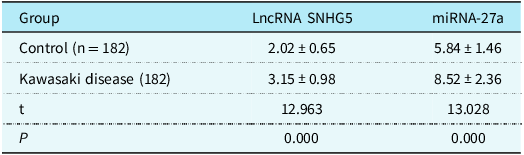
The Kawasaki disease group had significantly higher lncRNA SNHG5 and miRNA-27a levels than those of the control group (P < 0.05) (Table 1).
LncRNA SNHG5 and miRNA-27a levels in Kawasaki disease and control groups (x̅ ± s)

Therapeutic effect
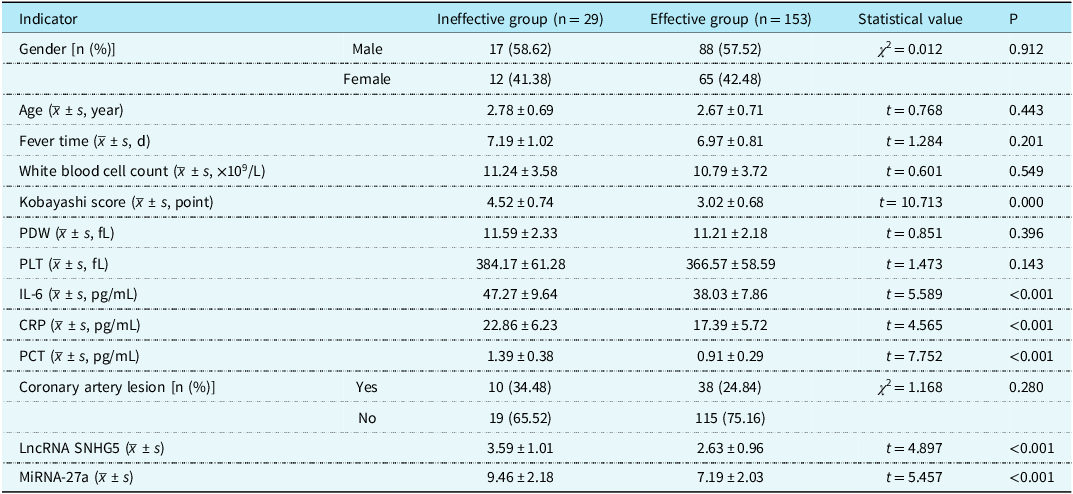
During the 3 months of follow-up, among the 182 children treated with standard immunoglobulin therapy, 153 (84.07%) responded to the therapy (effective group), while the remaining 29 (15.93%) were unresponsive to the therapy (ineffective group).
Clinical data
The levels of interleukin-6, C-reactive protein, procalcitonin, lncRNA SNHG5, and miRNA-27a and Kobayashi score were higher in the ineffective group than those in the effective group (P < 0.05), whereas the gender, age, fever time, white blood cell count, platelet distribution width, platelet count, and coronary artery lesion showed no significant differences between the two groups (P > 0.05) (Table 2).
Clinical data

Multivariate regression analysis results
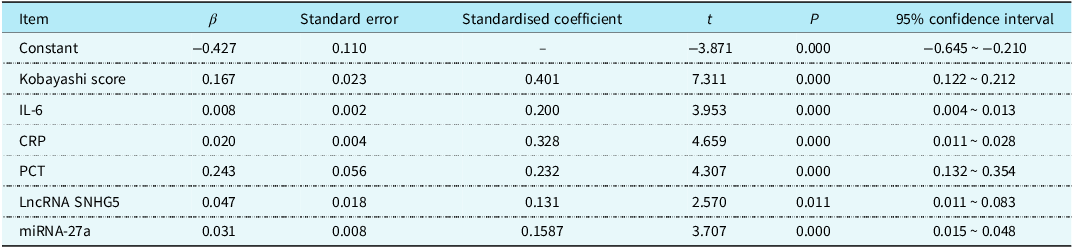
Multivariate regression analysis showed that Kobayashi score, interleukin-6, C-reactive protein, procalcitonin, lncRNA SNHG5, and miRNA-27a were associated with the treatment outcomes (P < 0.05) (Table 3).
Multivariate regression analysis results

Results of logistic regression analysis on influencing factors for efficacy on children
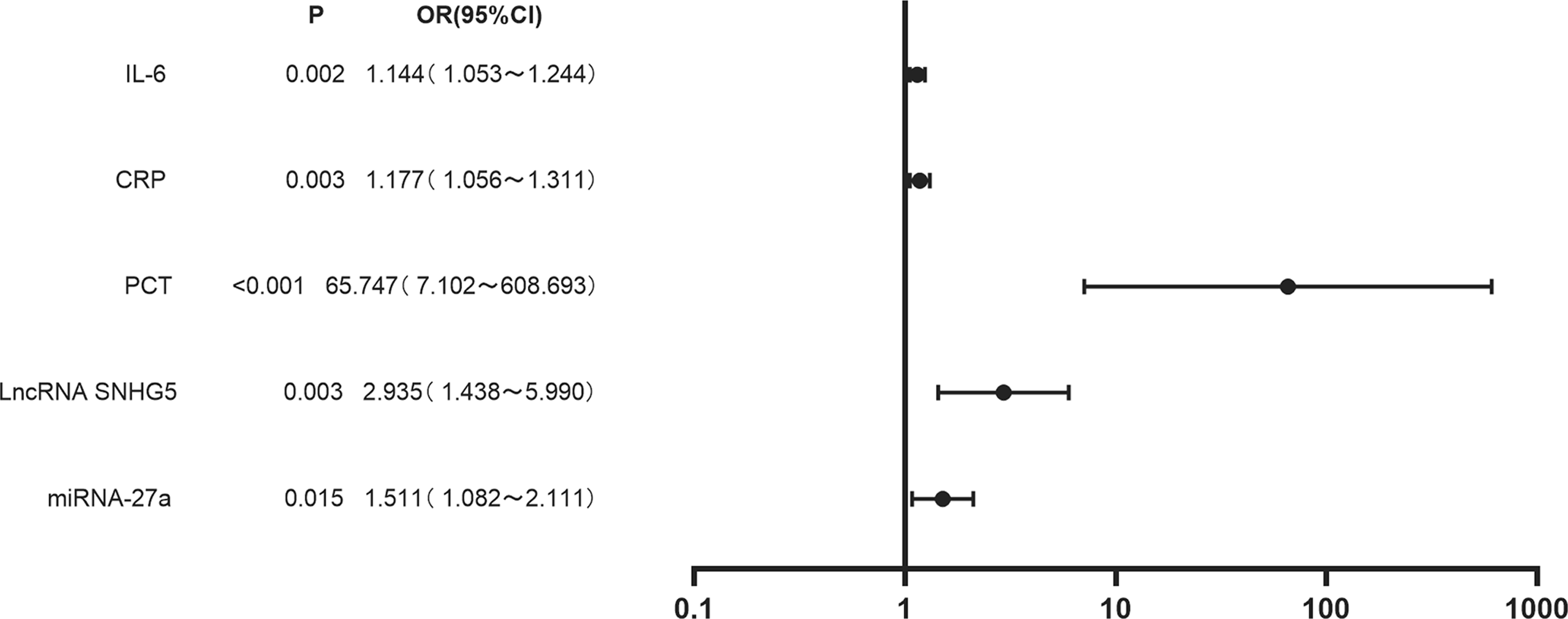
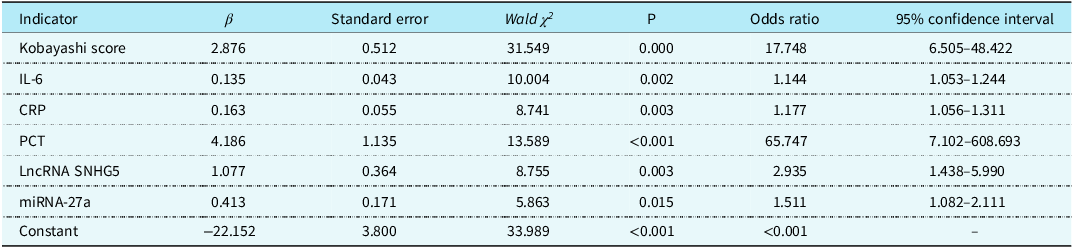
Logistic regression analysis was implemented with the indicators of differences as independent variables (all numerical variables) and the efficacy of standard immunoglobulin therapy as the dependent variable (1=ineffective, 0=effective). The results exhibited that high levels of interleukin-6, C-reactive protein, procalcitonin, lncRNA SNHG5, and miRNA-27a and Kobayashi score were influencing factors for the efficacy of standard immunoglobulin therapy on these children (odds ratio >1, P < 0.05) (Table 4 and Fig 1).
Forest plot for clinical characteristics based on multivariate logistic regression analysis.

Results of logistic regression analysis on influencing factors for efficacy on children

Correlations of lncRNA SNHG5 and miRNA-27a levels with other indicators
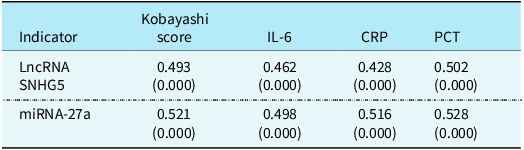
Pearson analysis exhibited that lncRNA SNHG5 and miRNA-27a levels were positively correlated with Kobayashi score, interleukin-6, C-reactive protein, and procalcitonin levels (r>0, P < 0.05) (Table 5).
Correlations of lncRNA SNHG5 and miRNA-27a levels with other indicators [r (P)]

Predictive value of lncRNA SNHG5 and miRNA-27a levels for efficacy on children
The receiver operating characteristic curves were plotted with lncRNA SNHG5 and miRNA-27a levels as the test variables and the efficacy of standard immunoglobulin therapy as the state variable (1=ineffective, 0=effective) (Fig 2). The areas under the receiver operating characteristic curves of lncRNA SNHG5, miRNA-27a, and their combination for predicting the efficacy of standard intravenous immunoglobulin therapy were 0.757, 0.766, and 0.831, respectively, all showing high predictive values (Table 6).
Predictive value of lncRNA SNHG5 and miRNA-27a levels for efficacy on children.

Predictive value of lncRNA SNHG5 and miRNA-27a levels for efficacy on children

Discussion
Kawasaki disease is mainly manifested as systemic vasculitis syndrome, which may involve many organs of the whole body, with coronary artery lesion as the main risk. Reference Watanabe, Ikeda and Watanabe13 The mechanism of coronary artery lesion caused by Kawasaki disease has not been clarified. Possibly, Kawasaki disease induces damages to the endothelial elastic fibres of coronary artery and other medium muscular vessels, destroying the vascular wall, resulting in vasculitis, and eventually causing coronary artery dilatation and aneurysm. Reference Kotoku, Aso, Yamada, Shimizu and Mimura14,Reference Tanaka, Inoue, Hoshina and Koga15 Currently, children with Kawasaki disease are commonly treated with standard immunoglobulin therapy. Immunoglobulin is capable of blocking/intercepting antibodies, interfering with cytotoxic secretion, impeding platelet clotting, repressing thrombosis, and preventing injuries of blood vessel walls from vasculitis and immune activation. Reference Yang, Yang and Wang16,Reference Ahn, Bae, Shin, Nam, Kim and Kim17 However, persistent high inflammatory responses are still observed in some children after standard immunoglobulin therapy, with unsatisfactory decline in their body temperature. In this study, children with Kawasaki disease undergoing standard immunoglobulin therapy were followed up for 3 months, and the therapy was ineffective in 29 (15.93%) of the 182 children. Such children may develop coronary artery diseases and acquired heart diseases, which is detrimental to the prognosis.
Crucial controlling elements can be embedded into the long non-coding ribonucleic acids genome, and its transcription activity can affect the activity of neighbouring genes, chromatin accessibility, and genome structure. Reference Wu, Lan, Chen, Dong, Liu and Peng18,Reference Li, Wang, Xu and Xiang19 Long non-coding ribonucleic acids are able to modulate gene expression pathways to participate in immune response, self-renewal of embryonic stem cells, endothelial function regulation, and other physiological or (and) pathological aspects. Reference Xie, Wang and Li20 LncRNA SNHG5, a 5’-oligopyrimidine family gene and a member of nonprotein coding small nuclear RNA host gene family, has recently been found to participate in the onset and progression of colon cancer, gastric cancer, renal clear cell carcinoma, breast cancer, and other tumours. Reference Xiang, Lv and Zhou21,Reference Li, Hu, Wang, Li and Chen22 Besides, lncRNAs play crucial roles in the development and pathological remodelling of the heart. Reference Chen, Wang, Yan, Cheng, He and Zheng23 The results of this study showed that the Kawasaki disease group had a significantly higher lncRNA SNHG5 level than that of the control group, and the lncRNA SNHG5 level was higher in the ineffective group than that in the effective group. Additionally, high lncRNA SNHG5 level was an influencing factor for the efficacy of standard immunoglobulin therapy. The Toll-like signalling pathway plays an important role in the development of Kawasaki disease under inflammatory vascular pathological conditions. Reference Kobayashi, Matsumoto, Ohya, Harada and Kanno24 LncRNA SNHG5 may act as a regulatory factor of Toll-like receptors, which elevates the level of Toll-like receptors and specifically combine with relevant molecular patterns to activate downstream signalling pathways, thereby promoting the fusion of lymphocytes, neutrophils and other inflammatory cells, facilitating the release of various inflammatory factors, and triggering innate immune and inflammatory responses. Reference Wang, Wei, Shang, Zang and Zhang25 Moreover, lncRNA SNHG5 can also modulate the expressions of multiple downstream microRNA, activate related signalling pathways and stimulate the expressions of various inflammatory cytokines. Reference Shen, Zheng, Wang, Hu, Jiang and Jiang26 Collectively, lncRNA SNHG5 may be implicated in coronary artery diseases and standard immunoglobulin treatment resistance by regulating immune and inflammatory responses through different signalling pathways.
microRNA can regulate gene expressions by binding the coding region or 3’ non-coding region of mRNA sequence of target genes through incomplete base pairing. Reference Yasmeen, Kaur, Mirza, Brodin, Pociot and Kruuse27 MiRNA-27a, a chain-like molecule with 22 nucleotides, can complement and pair with the mRNA sequence of target gene to suppress or degrade its translation process, thus inhibiting the expression of target gene and further affecting cell proliferation, apoptosis, and differentiation. Reference Deng, Ren and Fan28 In this study, the Kawasaki disease group had a significantly higher miRNA-27a level than that of the control group. The ineffective group had an elevated miRNA-27a level in comparison with that of the effective group, and the increase raised the risk of failure of standard immunoglobulin therapy. Immune activation plays a vital role in the pathogenesis of Kawasaki disease, which is significantly worsened by chemokines and inflammatory cytokines during acute fever. Reference Yeo and Ng29,Reference Pouletty, Borocco and Ouldali30 Under the stimulation of lipopolysaccharide, miRNA-27a can increase the levels of proinflammatory cytokines such as interleukin-6, C-reactive protein, and procalcitonin in fibroblast-like synoviocytes and speed up the progression of inflammatory diseases and cardiovascular diseases through different signalling pathways.
Finally, the results of ROC curve analysis in this study confirmed that the areas under the curves of lncRNA SNHG5 level, miRNA-27a level, and their combination for predicting the efficacy of standard immunoglobulin therapy were 0.757, 0.766, and 0.831, respectively, all displaying high predictive values. Besides, the levels of interleukin-6, C-reactive protein, and procalcitonin were higher in the ineffective group. Son et al. Reference Son, Gauvreau and Tremoulet31 reported that C-reactive protein ≥ 13 mg/dL at diagnosis was an independent risk factors for coronary artery aneurysms in Kawasaki disease in a north American population. Interleukin-6, C-reactive protein, and procalcitonin are common inflammatory factors, and the elevation in their levels indicates enhanced inflammatory response, which stimulates vascular endothelial cells, exposes basement membrane collagen, and triggers platelet adhesion, thereby producing a series of immunological responses and resistance to standard immunoglobulin therapy. Reference Nakamura, Muto and Masuda32
Nevertheless, this study is limited. The study population was from a single ethnic group, which may limit the generalizability of our findings to other populations. Further studies are ongoing in our group to confirm the results.
In summary, lncRNA SNHG5 and miRNA-27a are highly expressed in children with Kawasaki disease. These levels exhibit close correlations with the efficacy of standard immunoglobulin therapy in children with Kawasaki disease. Although these findings suggest that these markers may have potential predictive value, further studies in larger, more diverse cohorts and additional mechanism investigations are needed before they can be considered as reliable clinical predictors.
Financial support
None.
Competing interests
No potential conflict of interest was reported by the authors.