Introduction
Thalassocystis striata Taggart and Parker, Reference Taggart and Parker1976, was described as a noncalcified macroalga on the basis of material from the Llandoverian Schoolcraft Formation near the city of Manistique in the Upper Peninsula of Michigan (Taggart and Parker, Reference Taggart and Parker1976). Recently, LoDuca et al. (Reference LoDuca, Swinehart, LeRoy, Tetreault and Steckenfinger2021) reported the first occurrence of this species from a locality outside the general Manistique area, a quarry exposure of the Schoolcraft Formation ~30 km to the east of the type locality. Based on that better-preserved material, LoDuca et al. (Reference LoDuca, Swinehart, LeRoy, Tetreault and Steckenfinger2021) redescribed the taxon as a green alga belonging to the Order Bryopsidales with a siphonous, multiaxial thallus architecture broadly similar to that of living Codium Stackhouse, Reference Stackhouse1797, and Pseudocodium Weber-van Bosse, Reference Weber-van Bosse1896. In the present report, two additional occurrences of T. striata are described from newly discovered algal-Lagerstätten within the Llandoverian Earlton Formation in the Timiskaming outlier (Lake Timiskaming area) of Ontario, Canada, ~500 km to the east of the type locality. In addition, a new form within one of the Timiskaming occurrences is proposed herein as a new genus and species of noncalcified bryopsidalean alga. This taxon is characterized by a thallus architecture broadly similar to that of living Caulerpa Lamouroux, Reference Lamouroux1809, consisting of a creeping, runner-like stolon bearing numerous pinnate fronds and, as with T. striata, the specimens are preserved as carbonaceous compressions. Notably, the pinnate fronds of the new taxon show similarities to those of two macroalga genera previously described from the Ordovician and Silurian of North America.
Geologic setting and regional correlations
The specimens described herein were collected from two localities within the Timiskaming outlier in the Lake Timiskaming area of Ontario. One of these, the Dionne Concrete Products quarry, is located on the east side of Highway 11 ~10 km north of Earlton. The other, ~45 km to the south, is a shoreline exposure along the southern end of Wabi (Dawson) Point. In Bolton and Copeland (Reference Bolton and Copeland1972, fig. 1), these are localities 25 (= Macnamara quarry) and 8, respectively.
In the Dionne Concrete Products quarry, the 1–4 cm-thick alga-bearing slabs, which were collected by splitting blocks concentrated in spoil piles along a quarry road near the top of the pit, are composed of yellowish-brown to medium-gray dolomicrite. Apart from the algae, the specimen-bearing surfaces are largely barren. The few associated shelly taxa include spiriferid brachiopods and the encrinurid trilobite Rielaspis elegantula (Billings, Reference Billings1866). Rare horizontal burrows are evident on some surfaces (Fig. 1). Because the material described herein was not recovered in-situ, it cannot be definitively tied to a specific bed in the ~5 m-thick section exposed in the quarry. Spot excavations into the quarry wall during the course of this study identified several thin beds of alga-bearing dolomicrite in the middle part of the section, starting at ~1.5 m below the quarry top. These alternate with beds of biosparite and biomicrite. Since the alga-bearing intervals show exceptional preservation of nonbiomineralized macroalgae and are lacking in comparably preserved animal remains, they represent examples of algal-Lagerstätten (see review in LoDuca et al., Reference LoDuca, Bykova, Wu, Xiao and Zhao2017).
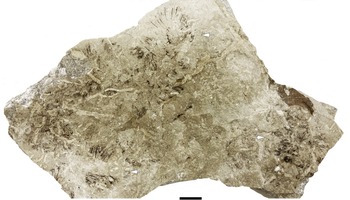
Earltonella fredricksi LoDuca, n. gen. n. sp., Earlton Formation (Llandoverian), Dionne Concrete Products quarry, Earlton, Ontario. Top arrow, holotype, ROMIP 66270.1; lower right arrow, 66270.2; lower left arrow, 66270.3. Scale bar = 20 mm.

The biosparite and biomicrite beds in the section are dominated by brachiopods and, especially in the upper part, corals, and include hardground surfaces at some levels (Copper and Armstrong, Reference Copper and Armstrong1999). Bolton and Copeland (Reference Bolton and Copeland1972, fig. 2) placed the quarry section within the lower part of the Thornloe Formation. Later, Russell (Reference Russell1984) mapped strata in this area as belonging to his newly defined Earlton Formation, which includes the lower part of the Thornloe Formation as originally defined, and this assignment was followed in Copper and Armstrong (Reference Copper and Armstrong1999). Conodonts recovered from this quarry are indicative of the celloni Zone and point to an early to middle Telychian age (Radcliffe, Reference Radcliffe1998). Association of the algal material with Rielaspis elegantula, specimens of which were collected during the present investigation, also points to an early to middle Telychian age, because this trilobite previously has been reported only from strata of this age in the uppermost part of the Jupiter Formation (Pavillon Member) on Anticosti Island (Chatterton and Ludvigsen, Reference Chatterton and Ludvigsen2004).
Algal material from the Wabi Point locality was recovered from blocks of fine-grained, thick-bedded dolomicrite that had fallen from the adjacent cliff face. These blocks appear to have originated about three-quarters of the way up the section, from the “lithographic stone” interval of Hume (Reference Hume1925, p. 35). The largest specimen-bearing block, ~2 m on a side, yielded Thalassocystis striata material from several distinct levels. Breakage of this block in most cases resulted in highly irregular surfaces, but smooth splits were produced across algal thalli, in some cases showing shallow conchoidal fracture. The associated fauna is sparse, but includes crinoids, brachiopods, nautiloids, dendroid graptolites, ostracodes, and trilobites, including Rielaspis elegantula and a scutelluid. As with the aforementioned Dionne quarry locality, the alga-bearing interval here qualifies as an algal-Lagerstätte. Russell (Reference Russell1984) mapped strata in this area as belonging to the Earlton Formation, and this assignment was followed by Copper and Armstrong (Reference Copper and Armstrong1999). Copper and Armstrong (Reference Copper and Armstrong1999) noted that the fauna is similar to that of the Fossil Hill Formation of the Bruce Peninsula and the Jupiter Formation (Pavillon Member) of Anticosti Island, both of which are early to middle Telychian in age.
Bolton and Copeland (Reference Bolton and Copeland1972, fig. 2) correlated the section at locality 25 (Dionne quarry, herein) with the middle part of the section at locality 8 (Wabi Point), but Colville and Johnson (Reference Colville and Johnson1982, fig. 3) regarded the base of the former to lie stratigraphically immediately above the top of the latter. Both reports considered the section at locality 8 to be equivalent to the upper part of the Schoolcraft Formation in Michigan, and correlated a thick interval of Pentamerus-bearing strata at the nearby dock, ~10–15 m below the alga-bearing interval, with the upper Pentamerus bed of this unit. Colville and Johnson (Reference Colville and Johnson1982, fig. 3), however, correlated the section at locality 25 with the Cordell Formation in Michigan, which immediately overlies the Schoolcraft Formation. The recovery of Thalassocystis striata from both of these sections during the present investigation lends support to the Bolton and Copeland (Reference Bolton and Copeland1972) correlation. In addition, the age of the interval at locality 25, as indicated by recently obtained trilobite and conodont data, is also consistent with the Bolton and Copeland (Reference Bolton and Copeland1972) correlation. As noted above, these data, which were obtained after the Colville and Johnson study, point to an early to middle Telychian age for this interval. A similar age is indicated for the Schoolcraft Formation in the northern shelf area of the Michigan Basin (Al-Musawi, Reference Al-Musawi2019), whereas the Cordell Formation is regarded as late Telychian to early Wenlockian, in part based on brachiopod and coral data (Colville and Johnson, Reference Colville and Johnson1982). Crucially, if the Bolton and Copeland (Reference Bolton and Copeland1972) correlation is correct, T. striata in the Lake Timiskaming area would be restricted to Schoolcraft-equivalent strata. This, then, suggests the possibility of high-resolution chronostratigraphic value for this alga-bearing interval over a regionally extensive area, spanning ~500 km, in a fashion akin to that known for the Medusaegraptus epibole, which is an algal-Lagerstätte that occurs in the slightly younger Lockport Group of western New York and has been traced for nearly 100 km across the outcrop belt (LoDuca and Brett, Reference LoDuca, Brett, Brett and Baird1997).
Material and methods
The material examined during this study comprises 41 slabs in total, many of which bear multiple algal specimens. Of these, 33 are from the Wabi Point locality and were collected, in part, by KB during the summers of 2018 and 2019. The other eight slabs are from the Dionne Concrete Products quarry and were collected by MM and MP during the summer of 2020.
Reflected light images were obtained using a Canon Rebel digital camera fitted with a macrolens. To enhance contrast, specimens were photographed in some cases using polarizing filters. SEM study of the material was conducted using a JEOL JSM-7800F at the Electron Microbeam Analysis Laboratory (EMAL), Department of Earth and Environmental Science, University of Michigan. All specimens were imaged uncoated, and backscattered electron (BSE) images were obtained using an accelerating voltage of 25 keV. Measurements were obtained from digital images using the open source program ImageJ (Schneider et al., Reference Schneider, Rasband and Eliceiri2012).
Morphological terminology applied herein is that for algae. Bryopsidales terminology follows Taylor (Reference Taylor1960).
Repositories and institutional abbreviations
Types, figured, and other specimens from the Timiskaming area examined in this study are deposited in the Royal Ontario Museum (ROMIP), Toronto, and the Musée de paléontologie et de l’évolution (MPEP), Montreal, Canada.
Systematic paleontology
Division Chlorophyta Reichenbach, Reference Reichenbach1828
Order Bryopsidales Schaffner, Reference Schaffner1922
Genus Earltonella LoDuca, new genus
Type species
Earltonella fredricksi LoDuca, n. gen. n. sp., by monotypy, from the Earlton Formation (Llandoverian) at the Dionne Concrete Products quarry near Earlton, Ontario.
Diagnosis
As for the type species by monotypy.
Occurrence
Silurian (Llandoverian, Telychian); Lake Timiskaming area, Ontario, Canada (Laurentia paleocontinent).
Etymology
In reference to the geographic origin of the material, near the town of Earlton, Ontario, Canada.
Remarks
Earltonella LoDuca, n. gen. shares key characteristics with the early Paleozoic noncalcified macroalga genera Buthograptus Hall, Reference Hall1861, and Menieria Wang et al., Reference Wang, Jin and Zhan2014. In particular, all three taxa are characterized by fronds consisting of a central axis bearing elongate pinnules. Buthograptus, which is known only from the Upper Ordovician Platteville Formation in southwestern Wisconsin and northern Illinois (LoDuca, Reference LoDuca2019; Kolata, Reference Kolata2021), includes the species B. laxus Hall, Reference Hall1861, B. gundersoni LoDuca, Reference LoDuca2019, and B. meyeri LoDuca, Reference LoDuca2019. Buthograptus was recently redescribed on the basis of new material and interpreted as a bryopsidalean alga with fronds similar to those of living Caulerpa (LoDuca, Reference LoDuca2019). The fronds of Buthograptus are characterized by the same basic architecture as those of Earltonella LoDuca, n. gen., these consisting of elongate pinnules in opposite to subopposite arrangement along the supporting central axis, with the vertical spacing between adjacent pinnules (0.2–0.4 mm for B. laxus; 0.7–1.8 mm for B. meyeri) overlapping with the range present within individual fronds of the new genus (0.3–0.8 mm). Earltonella LoDuca, n. gen. is distinguished from Buthograptus on the basis of pinnule morphology. Specifically, the pinnules of Buthograptus are comparatively robust (widths of 0.4–0.7 mm vs. 0.15 mm) and, crucially, these never show branching. Earltonella LoDuca, n. gen. also differs from Buthograptus in that no specimens attributed to the latter show a stolon (LoDuca, Reference LoDuca2019). The arrangement of multiple fronds in series on slabs that bear the holotypes of B. laxus and B. meyeri (see LoDuca, Reference LoDuca2019, fig. 1.1, 1.8) is, however, suggestive of such a structure. A further difference between the new genus and Buthograptus concerns the details of pinnule spacing within a given frond. Specifically, in the new genus, this decreases by a factor of nearly three from the base to the top of a frond, whereas in Buthograptus this spacing remains essentially uniform within a particular frond.
The monotypic genus Menieria was erected by Wang et al. (Reference Wang, Jin and Zhan2014) on the basis of M. minuta Wang et al., Reference Wang, Jin and Zhan2014, from the Silurian (Llandoverian, Aeronian) Gun River Formation of Anticosti Island. This taxon differs from Earltonella LoDuca, n. gen. in that the “central axis,” as described by Wang et al. (Reference Wang, Jin and Zhan2014, p. 361), is wider than the stolon of the new genus (1.0–1.6 vs. 0.7 mm) and bears fronds with highly irregular spacing. Differences are also evident with regard to the pinnules. Specifically, those of Menieria are larger in terms of both length (2.4–9.1 vs. 1.6–4.0 mm) and distal width (0.6–1.0 vs. 0.15 mm), with the latter difference being particularly pronounced, and show a different overall form, with a marked distal expansion, by roughly a factor of two. In addition, as with Buthograptus, the pinnules of Menieria never show branching. Menieria further differs from the new genus in the phyllotaxis of both the fronds and the pinnules. Although these give the appearance of having a distichous alternate arrangement, after careful observation, Wang et al. (Reference Wang, Jin and Zhan2014, p. 361) concluded that “lateral branches are attached to the central axis with a helical phyllotaxis” and determined the same arrangement for the pinnules. On the basis of the aforementioned differences, Earltonella LoDuca, n. gen. is regarded as distinct from Menieria. It must be noted, however, that the high degree of similarity in thallus morphology among Menieria, the new genus, and Buthograptus suggests that all three taxa share a very close evolutionary relationship.
Noncalcified stoloniform thalli somewhat similar to that of Earltonella LoDuca, n. gen. are also characteristic of Parallelphyton Wu and Zhao in Wu et al., Reference Wu, Zhao, Tong and Yang2011, from the Cambrian Kaili Biota of South China and an unnamed form with a similar thallus morphology from the Neoproterozoic of South China (Wu et al., Reference Wu, Zhao, Tong and Yang2011; Ye at al., Reference Ye, Tong, Xiao, Zhu, An, Tian and Hu2015; Bykova et al., Reference Bykova, LoDuca, Ye, Marusin, Grazhdankin and Xiao2020). These, however, develop markedly simpler thalli than Earltonella LoDuca, n. gen., with the erect parts consisting only of unbranched cylindrical elements (analogous to central axes without pinnules). The nonbiomineralized Cambrian taxon Margaretia Walcott, Reference Walcott1931, which had been considered as a stoloniform Caulerpa-like green alga (Conway Morris and Robison, Reference Conway Morris and Robison1988), has since been reinterpreted as the tube of an enteropneust hemichordate (Nanglu et al., Reference Nanglu, Caron, Conway Morris and Cameron2016). The same relationship has been proposed by Fatka and Vodička (Reference Fatka and Vodička2022) for the similar form Krejciella Obrhel, Reference Obrhel1968b, from the Ordovician of the Prague Basin, which was previously interpreted as an alga by Havlíček et al. (Reference Havlíček, Vaněk and Fatka1993). These taxa differ markedly from Earltonella LoDuca, n. gen. in having much wider axes (4–20 mm vs. 0.7 mm) and by the complete lack of pinnate fronds.
With regard to calcareous macroalgae, there are no taxa, living or fossil, similar to Earltonella LoDuca, n. gen. This is not surprising, given that heavy calcification in marine siphonous green macroalgae appears to be restricted to forms with densely packed side branches, particularly those that develop a cortex (Borowitzka, Reference Borowitzka, Leadbeater and Riding1986). Such an architecture produces, in the microenvironment between the branches, conditions conducive to the precipitation of calcium carbonate (Pentecost, Reference Pentecost and Riding1991). Calcareous bryopsidalean algae with complex thalli of this sort are known from the Silurian and include Palaeoporella Stolley, Reference Stolley1893, Dimorphosiphon Høeg, Reference Høeg1927, Maslovina Obrhel, Reference Obrhel1968a, Paralitanaia Mamet and Préat, Reference Mamet and Préat1985, and Vitinellopsis Vachard, Bucur, and Munnecke, Reference Vachard, Bucur and Munnecke2022.
Earltonella fredricksi LoDuca, new species
Figures 1–6
Holotype
ROMIP 66270.1 (Fig. 2.1) from the Earlton Formation (Llandoverian) in the Dionne Concrete Products quarry, Lake Timiskaming area, Ontario, Canada (47.744004°N, 79.818975°W).
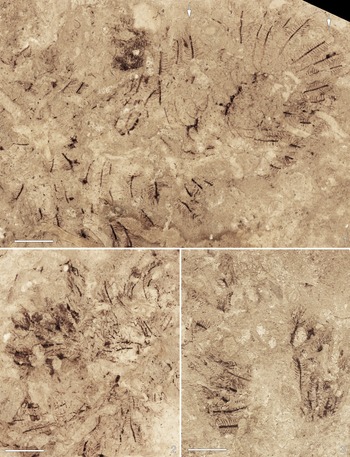
Earltonella fredricksi LoDuca, n. gen. n. sp., Earlton Formation (Llandoverian), Dionne Concrete Products quarry, Earlton, Ontario: (1) holotype, ROMIP 66270.1; arrows indicate detailed views in Figure 4.2, 4.3; (2) 66270.2; (3) 66270.3. Scale bars = 10 mm.

Diagnosis
Thallus noncalcified, comprising an elongate and creeping stolon (runner) bearing pinnate fronds at semi-regular intervals; stolon cylindrical; fronds consisting of a central axis (rachis) with delicate pinnules arrayed in opposite to subopposite fashion; pinnule form roughly cylindrical but slightly increasing in diameter distally, bifurcated at distal end, the resulting divisions being thin and hairlike; stolon, central axes, and pinnules without segmentation or serration.
Description
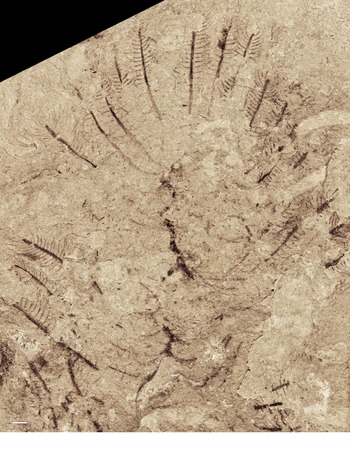
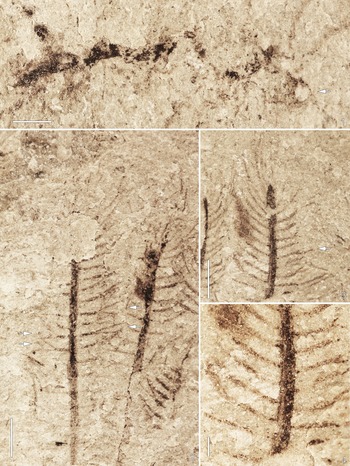
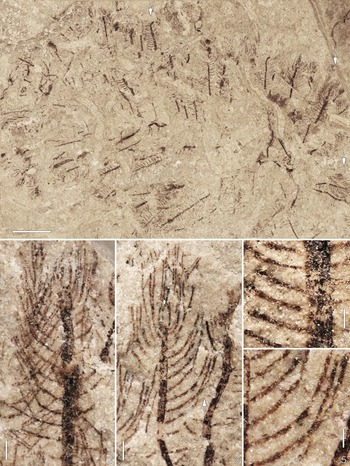
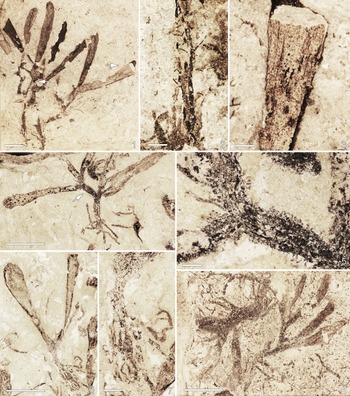
Thallus of holotype, ROMIP 66270.1, noncalcified, preserved as a carbonaceous compression on bedding plane surface, oval in gross outline, 110 mm in length, 48 mm in width, comprising an elongate and creeping central stolon (runner) bearing pinnate fronds typically 18–22 mm in length, the latter in the flattened specimen oriented at roughly right angles to the stolon in the central part of the thallus but at progressively smaller angles toward the inferred thallus end, with those at the extreme end running nearly parallel to stolon (Figs. 1, 2.1, 3). Stolon cylindrical with fairly smooth margins (glabrous), hollow, 0.7 mm wide, with a subtle zigzag form along its length, the inflections spaced at intervals of ~2 mm, with fronds extending from both sides in a roughly distichous alternating pattern (Figs. 2.1, 3, 4.1). Fronds consisting of a central axis (rachis) with pinnules arrayed in opposite to subopposite fashion (Fig. 3, 4.2. 4.3). Central axis cylindrical, with a width of 0.3 mm proximally, expanding to a width of 0.4–0.5 mm along most of its length, rounded at tip, margin smooth, lacking cross-walls or other evidence of segmentation (Fig. 4.2–4.4). Pinnules continuous with central axis, without evidence of cross-walls at junctions (Fig. 4.4), in lower and middle parts of frond meeting central axis at an angle of ~80°, this angle progressively decreasing along upper part of frond, reaching a minimum of 40–50° along uppermost part of frond (Fig. 4.2, 4.3); vertically adjacent pinnules separated by intervals of 0.8 mm in lower part of frond, this distance decreasing to 0.3 mm in uppermost part of frond. Primary pinnule element roughly cylindrical, without pronounced basal constriction, increasing slightly in diameter from 0.11 mm at base to 0.15 mm at distal end and with a length of 1.1–1.3 mm (Fig. 4.2–4.4), distal end bifurcated, secondary elements hairlike, with a width of 0.08 mm and having a length roughly comparable to that of primary element or slightly longer, diverging at an angle of 20–40° (Fig. 4.2–4.4); primary elements in lower and middle part of frond fairly straight along their length but with subtle upward curvature, those along uppermost part of frond show strong upward curvature and extend well above tip of central axis (Fig. 4.3); pinnule margins fairly smooth, without serrations (Fig. 4.2–4.4). ROMIP 66270.2, 66270.3, and 66271 generally similar to holotype, but overall thallus form for 66270.2 and 66270.3 less elongate (Figs. 1, 2.2, 2.3, 5.1–5.5). SEM images of fronds show ‘mudcracked’ texture on central axes (Fig. 6.1, 6.2, 6.6) and, more subtly, on pinnules (Fig. 6.4), fairly smooth margins for both central axes and pinnules (Fig. 6.1–6.4), a rounded form for central axis tip (Fig. 6.6), and an expanded region at or near the base of some, but not all, pinnules (Fig. 6.7, 6.8), this appearing in reflected light images as a distinctly darkened area (Fig. 6.5, 6.9).
Detail of part of the holotype of Earltonella fredricksi LoDuca, n. gen. n. sp., Earlton Formation (Llandoverian), Dionne Concrete Products quarry, Earlton, Ontario, ROMIP 66270.1. Scale bar = 2 mm.

Details of holotype of Earltonella fredricksi LoDuca, n. gen. n. sp., Earlton Formation (Llandoverian), Dionne Concrete Products quarry, Earlton, Ontario, ROMIP 66270.1: (1) stolon, ring-shaped cross-section at far right (arrow) indicates hollow structure; (2) fronds at right arrow in Figure 2.1, arrows mark well-preserved pinnules that show bifurcated tips; (3) frond at left arrow in Figure 2.1; (4) enlargement of area indicated by arrow in (3) showing pinnules in continuity with central axis. Scale bars are (1–3) 2 mm; (4) 0.5 mm.

Earltonella fredricksi LoDuca, n. gen. n. sp., Earlton Formation (Llandoverian), Dionne Concrete Products quarry, Earlton, Ontario, ROMIP 66271: (1) complete thallus; (2) detail of frond at upper right arrow in (1); (3) detail of frond at lower right arrow in (1); (4) detail of frond at left arrow in (1); (5) detail of frond at arrow in (3) showing pinnules with bifurcations. Images in (2–5) obtained using cross-polarized light. Scale bars are (1) 10 mm; (2, 3) 1 mm; (4, 5) 0.5 mm.

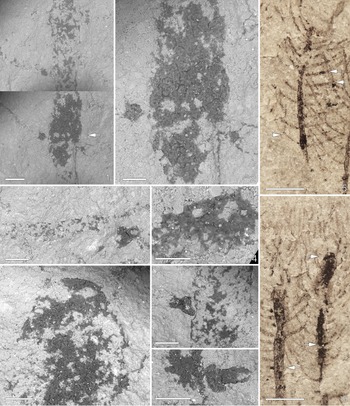
Fronds of Earltonella fredricksi LoDuca, n. gen. n. sp. from the holotype slab, ROMIP 66270: (1) composite SEM-BSE image of area at left arrow in (5); (2) detail of area at arrow in (1) showing mudcracked texture on central axis; (3) SEM-BSE image of pinnule at lower right arrow in (5); (4) SEM-BSE image of pinnule at upper right arrow in (5); (5) reflected light image of distal part of frond, 66270.4; (6) SEM-BSE image of area at upper right arrow in (9); (7) SEM-BSE image of area at left arrow in (9); (8) SEM-BSE image of area at lower right arrow in (9); (9) reflected light image of distal parts of two fronds, 66270.5. Scale bars are (1, 3, 6–8) 0.2 mm; (2, 4) 0.1 mm; (5, 9) 2 mm.

Etymology
Named in honor of Dr. Walter Fredricks, Professor Emeritus of Biology at Marquette University, and his clan.
Materials
ROMIP 66270.1–66270.5, 66271.
Remarks
This form is known only from the Dionne Concrete Products quarry and, with specimens known from only two slabs, is much less abundant at that locality than Thalassocystis striata. One of these slabs bears a single specimen (Fig. 5.1), the other appears to show several separate thalli (Figs. 1, 2.1–2.3). On the latter, however, the distribution of the material, together with the potential for concealment of some parts beneath matrix, leaves open the possibility that all or much of this material belongs to a single large thallus. Rhizoidal features were not observed among any of the material. It is possible, however, that this aspect of thallus morphology is also concealed by matrix.
SEM images show a distinctive ‘mudcracked’ surface texture on the central axes and, to a lesser extent, on the pinnules (Fig. 6.2, 6.4, 6.6). A similar surface texture was reported for Buthograptus laxus (LoDuca, Reference LoDuca2019, fig. 3.3). SEM images also clearly reveal the presence of an expanded region at or near the base of some, but not all, pinnules (Fig. 6.7, 6.8). This, too, has been reported for specimens of B. laxus (Whitfield, Reference Whitfield1894, pl. 1, fig. 3; LoDuca, Reference LoDuca2019, fig. 3.3), and it is evident in specimens of Buthograptus meyeri (LoDuca, Reference LoDuca2019, fig. 1.8). For all of these taxa, however, it is not evident on all pinnules, including those on a given frond, and it is entirely absent on Buthograptus gundersoni and Menieria minuta. The significance of this feature remains unclear.
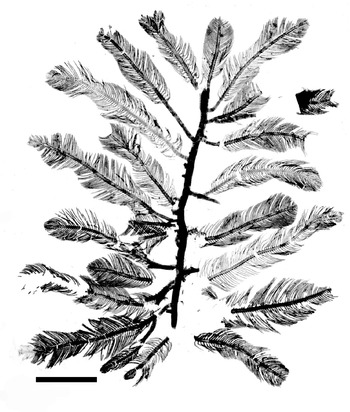
The thallus of Earltonella fredricksi LoDuca, n. sp., in broad terms, resembles those produced by the living bryopsidalean alga Caulerpa. In particular, as with the well-known extant taxa C. sertularioides Howe, Reference Howe1905 (Fig. 7) and C. taxifolia Agardh, Reference Agardh1817, the thallus consists of an elongate creeping cylindrical stolon that bears a series of pinnate, complanate fronds. In addition, as with all bryopsidalean algae, the new species appears to have had a siphonous thallus organization. For the stolon, this is indicated by its hollow nature, as conveyed by the ring-like form of this feature in cross-section view (Figs. 3, 4.1), and for the entire thallus this is indicated by a lack of evident cross walls or segmentation. Trabeculae (i.e., irregular, strut-like cell wall ingrowths), which are ubiquitous for living Caulerpaceae and traverse the cell wall lumen to provide structural support, have not been observed in the new species, but it is doubtful that such internal structures would be evident in compressed fossil specimens. In terms of pinnule morphology, the new species shows pinnules with bifurcated tips, and pinnules of this nature are known for Caulerpa, including C. taxifolia. Key morphometric aspects also fall within the range known for Caulerpa, with width values for the stolon, central axes, and pinnules, as well as frond lengths, being comparable to those displayed by smaller species within the genus, albeit only about one-half to one-third those observed in the aforementioned C. taxifolia and C. sertularioides. In addition, the fairly wide pinnule spacing is comparable to that known for C. ashmeadii Harvey, Reference Harvey1858. No species of Caulerpa, however, shows pinnules with an overall shape that precisely matches that of the new species, particularly with regard to the relatively long secondary elements. Earltonella fredricksi LoDuca, n. sp. also appears to differ from all known Caulerpa species in the manner in which the fronds are arranged along the stolon. In Caulerpa, these are arranged in a single row along the top. In the new species, by contrast, the fronds seem to emerge from the sides of the stolon, in an alternating pattern. Such an arrangement for the new species must, however, be regarded as equivocal, owing to the flattened condition of the fossil thalli. In this regard, if the fronds were arranged largely upright in a single row along the top, but were tilted relative to perpendicular in an alternating pattern down the length of the stolon, a rapid influx of mud from above could have produced the pattern of frond distribution shown by the specimens. The orientation of some of the associated specimens of Thalassocystis striata is consistent with burial dynamics of this sort (e.g., Fig. 8.2). Moreover, flattening in this manner could have distorted the stolon into the zigzag form evident in the specimens (Figs. 3, 5.1). Some herbarium specimens of Caulerpa would appear to be comparable in these regards (Fig. 7).
Herbarium specimen of Caulerpa sertularioides Howe, Reference Howe1905, University of Michigan Herbarium, 682353. Scale bar = 20 mm.

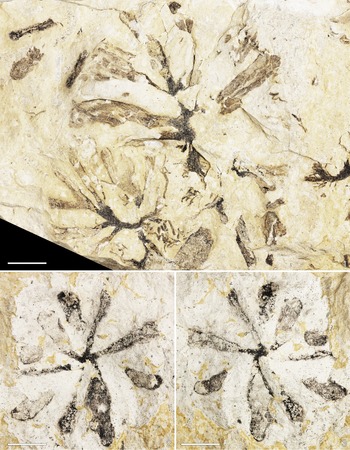
Thalassocystis striata Taggart and Parker, Reference Taggart and Parker1976, Earlton Formation (Llandoverian), Dionne Concrete Products quarry, Earlton, Ontario: (1) two thalli preserved in lateral view, ROMIP 66272.1 (top) and 66272.2 (bottom); (2) thallus preserved in overhead view, ROMIP 66273A; (3) counterpart of specimen in (2), ROM 66273B. Scale bars = 10 mm.

The gross morphology and carbonaceous composition of Earltonella fredricksi LoDuca, n. sp. also invite comparisons with hydroid colonies, particularly those produced by extant aglaopheniids (feather hydroids), and with the pinnule-bearing arms of crinoids. With regard to a hydroid affinity, the hydrocladia of living hydroids can resemble the general form of the pinnules in the new species, including the development of distal bifurcation (e.g., Henry and Kenchington, Reference Henry and Kenchington2004, fig. 1), and fossils of early Paleozoic age with a form somewhat resembling the pinnate fronds of the new species have been described as hydroids. Among these are the Ordovician taxon Webbyites Kraft, Kraft, and Prokop, Reference Kraft, Kraft and Prokop2001, and Plumalina Hall, Reference Hall1858, the latter known mainly from the Devonian but also reported from the Silurian (Wenlockian) of New York (Muscente and Allmon, Reference Muscente and Allmon2013). Nonetheless, a hydroid affinity for the new species is regarded as unlikely for several reasons. First, specimens of the new species show no evidence of hydrotheca, including in SEM images. Specifically, the pinnule margins appear fairly smooth and continuous, and their surfaces lack sculpture or patterning that might point to the presence of such structures (Fig. 6.3, 6.4). Second, the hydrocladia of Plumalina, although lacking preserved hydrotheca or polyps, show in some cases distinctive box-like modules with a central pore or groove, which have been interpreted as polyp bases (Sass and Rock, Reference Sass and Rock1975; Muscente and Allmon, Reference Muscente and Allmon2013). The pinnules of the new species, however, do not show features along these lines. Finally, the strongly upcurved nature of the distal (uppermost) pinnules and the lack of internodes on the central axes would seem to be inconsistent with a hydroid affinity (LoDuca, Reference LoDuca2019; Song et al., Reference Song, Ruthensteiner, Lyu, Liu, Wang and Han2021). With regard to a crinoid affinity, decalcified examples of pinnule-bearing crinoid arms preserved as carbonaceous material that occur in direct association with a rich, noncalcified macroalgal flora in the Llandoverian (Aeronian) of Estonia (Tinn et al., Reference Tinn, Meidla, Ainsaar and Pani2009; Ausich et al., Reference Ausich, Wilson and Tinn2020) have a gross morphology somewhat similar to the individual fronds of the new species. The pinnules of crinoids, however, are not known to show distal bifurcation. In addition, the new species lacks key crinoid features (e.g., a calyx or a stem constructed of columnals).
A terrestrial habitat for the new species can be excluded by its direct association with marine taxa, including trilobites and brachiopods, and by its general lack of disarticulation and fragmentation, indicating that the material was buried in situ or very nearly so. This, then, serves to effectively eliminate the possibility that it represents an early non-vascular land plant, such as a liverwort.
In consideration of the foregoing, together with co-occurrence with the noncalcified bryopsidalean alga Thalassocystis striata and broad similarity to the noncalcified Late Ordovician–Early Silurian macroalga taxa Buthograptus and Menieria, it is concluded that Earltonella fredricksi LoDuca, n. sp. is best regarded as a bryopsidalean alga with a stoloniform thallus (sensu LoDuca et al., Reference LoDuca, Bykova, Wu, Xiao and Zhao2017) roughly comparable to that of frondose forms of Caulerpa, such as C. taxifolia, although it must be noted that an animal affinity cannot be entirely excluded on the basis of the available data. Given the uncertainties regarding precise arrangement of the fronds along the stolon, and in consideration of the considerable age of the material, the new species is not assigned to Caulerpa. In this regard, molecular studies cast doubt on a close phylogenetic affinity between the new species and Caulerpa. According to the chronogram provided in Draisma et al. (Reference Draisma, Prud'homme van Reine, Sauvage, Belton, Gurgel, Lim and Phang2014), Caulerpaceae did not diverge from the sister-clade Pseudochlorodesmis until sometime after the Devonian, between the late Carboniferous and Late Triassic. Molecular clock analyses do, however, readily accommodate a bryopsidalean affinity for Earltonella fredricksi LoDuca, n. sp. (Verbruggen et al., Reference Verbruggen, Ashworth, LoDuca, Vlaeminck, Cocquyt, Sauvage, Zechman, Littler, Littler, Leliaert and De Clerk2009; Draisma et al., Reference Draisma, Prud'homme van Reine, Sauvage, Belton, Gurgel, Lim and Phang2014; Del Cortona et al., Reference Del Cortona, Jackson, Bucchini, Van Bel and D'hondt2020) and, as noted above, both calcified and noncalcified bryopsidalean algae with diverse and complex forms have been described from Ordovician and Silurian strata.
Considered as a bryopsidalean alga and in view of the molecular evidence, it is conceivable that Earltonella fredricksi LoDuca, n. gen. n. sp. belongs to an extinct lineage within this group, together with Buthograptus and Menieria and, perhaps, Parallelphyton. A similar scenario was raised in regards to the Silurian Codium-like taxa Thalassocystis and Inocladus (LoDuca et al., Reference LoDuca, Swinehart, LeRoy, Tetreault and Steckenfinger2021). The possibility of such a scenario, in general, is supported by well-documented examples of convergent evolution of complex thallus form among extant Bryopsidales, including between Codium and Pseudocodium and even within Caulerpa itself in terms of frond morphology where, as noted by Draisma et al. (Reference Draisma, Prud'homme van Reine, Sauvage, Belton, Gurgel, Lim and Phang2014, p. 1029), “Vesiculate, terete, and flattened ramuli [pinnules] all evolved multiple times” (see also Famà et al., Reference Famà, Wysor, Kooistra and Zuccarello2002).
Considered in broader terms, the appearance of complex Caulerpa-like thalli within Bryopsidales during the Late Ordovician–Early Silurian is part of a major revolution in macroalgal thallus morphology during this time documented by LoDuca et al., Reference LoDuca, Bykova, Wu, Xiao and Zhao2017. As suggested by that study, the Ordovician macroalgal revolution may signal a defensive response to intensified grazing pressure by meso-herbivores that arose as an outcome of the Great Ordovician Biodiversification Event (GOBE). Specifically, ‘complicating’ a simple siphonous thallus, consisting only of an unbranched cylindrical siphon, by developing dense outgrowths of lateral appendages (secondary elements) yields benefits by providing (1) a physical barrier (‘palisade’) between grazers and critical central parts of the thallus, and (2) a measure of anatomical compartmentalization, which in turn allows the cell walls of the secondary elements to be relatively thin for enhanced assimilation efficiency without incurring marked costs in survivorship (LoDuca and Behringer, Reference LoDuca and Behringer2009). Numerous variations on this theme originated among siphonous green macroalgae during the GOBE, of which complex Caulerpa-like thalli are but one example, along with a proliferation of heavily calcified thalli (LoDuca et al., Reference LoDuca, Bykova, Wu, Xiao and Zhao2017).
Genus Thalassocystis Taggart and Parker, Reference Taggart and Parker1976
Type species
Thalassocystis striata Taggart and Parker, Reference Taggart and Parker1976, by monotypy.
Thalassocystis striata Taggart and Parker, Reference Taggart and Parker1976
Figures 8–11
Holotype
FMNH 43982 from the Schoolcraft Formation (Llandoverian) in an exposure along the Lake Michigan shoreline two miles east of Manistique, Michigan, U.S.A (Taggart and Parker, Reference Taggart and Parker1976, fig. 1).
Description
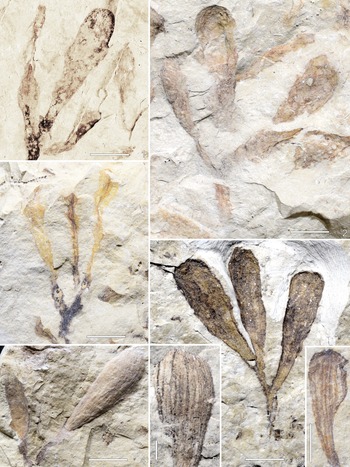
Thallus of ROMIP 66272.1 noncalcified, unsegmented, extending 46 mm above holdfast, comprising dichotomously branched axes; branching highly irregular (anisotomous); individual axes with a length of 22–27 mm, these in some cases narrow, with a maximum width of 3 mm, but in other cases broad and obovate with a maximum width of 7 mm; proximal parts of axes with a width of 1–3 mm; axis terminations obtuse; angle between axes at bifurcation typically between 30–40°; medullary tubes with a width of 0.16 mm, poorly preserved; cortical tubes not evident; holdfast small relative to thallus, 7 mm wide, 11 mm long, consisting of a loose array of thin filaments, each having a width of 0.3–0.4 mm (Fig. 8.1). Thalli of ROMIP 66272.2 and 66273 generally similar to 66272.1, but 66272.2 somewhat smaller, with a height of 32 mm (Fig. 8.1), and 66273 preserved in overhead as opposed to lateral view (Fig. 8.2, 8.3). ROMIP 66274 (Fig. 9.1) shows only relatively narrow axes, some with a papillate surface texture, others with well-preserved medullary and cortical tubes (Fig. 9.2); some axes show a strong degree of 3D preservation (Fig. 9.3). ROMIP 66272.3 shows in lower part of thallus well-preserved cortical tubes with a cylindrical form, a length of 0.5–1.0 mm, and a width of 0.1 mm, these arrayed along the supporting medullary tube in a single row and oriented to it at an angle of ~90°, with spacing between adjacent tubes of less than one tube width (Fig. 9.4, 9.5). ROMIP 66272.3 and 66275 show well-preserved holdfasts (Fig. 9.4, 9.6, 9.7). ROMIP 662726 appears to show a greater amount of decay relative to the other specimens (Fig. 9.8). Thalli from Wabi Point (Figs. 10.1–10.7, 11) generally similar to aforementioned Dionne quarry thalli in terms of branching details, surface texture, and internal features, and with a comparable range of thallus sizes and axis forms. Some show a pronounced degree of 3D preservation (Fig. 10.4).
Thalassocystis striata Taggart and Parker, Reference Taggart and Parker1976, Earlton Formation (Llandoverian), Dionne Concrete Products quarry, Earlton, Ontario: (1) complete thallus, ROMIP 66274; (2) detail of area at lower arrow in (1) showing medullary and cortical tubes; (3) detail of area at upper arrow in (1) showing axis with strong degree of 3D preservation; (4) thallus with well-preserved holdfast, ROMIP 66272.3; (5) detail of area at arrow in (4) showing medullary and cortical tubes; (6) thallus with sparse branching, ROMIP 66275; (7) detail of thallus in (6) showing holdfast; (8) complete thallus, ROMIP 66276. Scale bars are (1, 4, 6, 8) 10 mm; (2, 5) 1 mm; (3, 7) 2 mm.

Thalassocystis striata Taggart and Parker, Reference Taggart and Parker1976, Earlton Formation (Llandoverian), Wabi (Dawson) Point, Ontario: (1) nearly complete thallus, ROMIP 66277; (2) nearly complete thallus, MPEP 1501.2a; (3) nearly complete thallus, MPEP 1501.9a; (4) nearly complete thallus showing a single dichotomy and a strong degree of 3D preservation, MPEP 1501.20; (5) an axis showing medullary tubes, MPEP 1501.14a; (6) nearly complete thallus, MPEP 1501.30b; (7) an axis showing medullary tubes, MPEP 1501.16a (images in 2–7 courtesy of Mario Cournoyer). Scale bars are (1–4, 6, 7) 10 mm; (5) 2.5 mm.

Materials
ROMIP 66272–66277; MPEP 1501.1–1501.33.
Remarks
This species is locally abundant at both of the Timiskaming localities, with dozens of thalli having been collected from each. In all key morphological respects, the Timiskaming material is entirely consistent with Michigan material, as described by LoDuca et al. (Reference LoDuca, Swinehart, LeRoy, Tetreault and Steckenfinger2021). This includes (1) thallus branching pattern; (2) axis shape, size, and surface texture; (3) details of the medullary and cortical tubes, including shape, size, and arrangement; and (4) holdfast configuration and size. In addition, all key variations among Michigan specimens are fully represented among the Timiskaming material. In this regard, as with all of the Michigan localities, some of the individual thalli from both of the Timiskaming localities show a mix of narrow axes and wider, distinctly bulbous axes (compare Figs. 8.1, 10.2 with LoDuca et al., Reference LoDuca, Swinehart, LeRoy, Tetreault and Steckenfinger2021, fig. 15.8), whereas others comprise only narrow axes (compare Figs. 9.1, 10.3 with LoDuca et al., Reference LoDuca, Swinehart, LeRoy, Tetreault and Steckenfinger2021, fig. 15.1). In addition, thalli with limited branching, in some cases comprising just a single dichotomy, are known from all occurrences (compare Fig. 9.6 with LoDuca et al., Reference LoDuca, Swinehart, LeRoy, Tetreault and Steckenfinger2021, fig. 16.2, 16.6).
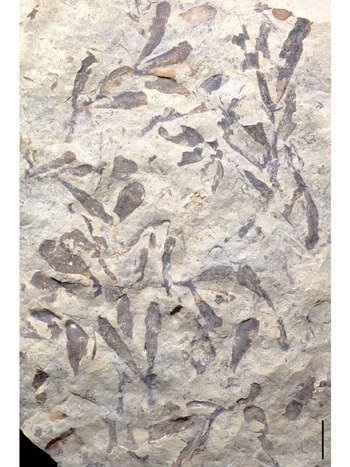
Taphonomic details are also comparable between the Timiskaming and Michigan material. In particular, specimens in both areas usually show the thallus in lateral view, although overhead views are known (compare Fig. 8.2 with LoDuca et al., Reference LoDuca, Swinehart, LeRoy, Tetreault and Steckenfinger2021, fig. 16.10), and they tend to be fairly flat, although examples with a strong degree of 3D preservation are occasionally encountered (Figs. 9.3). The latter characteristic is particularly well developed among thalli from the Michigan type locality as well as the Wabi Point locality (Fig. 10.4). Specimens from the Michigan type locality are also similar to those from the Wabi Point locality in that detached axes (Figs. 10.4, 10.5, 11) are not uncommon, whereas specimens from the other localities tend to be complete or nearly so. Finally, as with the Michigan material, some of the Timiskaming specimens show only surficial details of the axes, including in some cases a distinctive papillate texture (Figs. 8.2, 8.3, 9.1, 9.6, 10.6), whereas others show internal details pertaining to the siphons (Figs. 9.2, 9.4, 9.5, 10.3, 10.5, 10.7). With regard to preservation of internal features, the Timiskaming specimens are more similar to those from the Manistique area than they are to those from the Carmeuse quarry near Gulliver, Michigan, in that the best specimens from the latter show these features in greater detail compared to specimens from all of the other localities.
Thalassocystis striata Taggart and Parker, Reference Taggart and Parker1976, Earlton Formation (Llandoverian), Wabi (Dawson) Point, Ontario. Large slab bearing complete and partial thalli, MPEP 1501.32 (image courtesy of Mario Cournoyer). Scale bar = 20 mm.

Conclusions
Lagerstätten bearing an abundance of exceptionally preserved noncalcified macroalgae, or algal-Lagerstätten, are known from a number of locations and stratigraphic levels within the Silurian of North America, including localities in Michigan, Wisconsin, New York, Ontario, Nunavut, New Brunswick, and Quebec (LoDuca et al., Reference LoDuca, Bykova, Wu, Xiao and Zhao2017). Here, algal-Lagerstätten are reported for the first time from the Silurian of the Timiskaming outlier in eastern Ontario. These alga-bearing deposits, which occur within the Llandoverian Earlton Formation in sections exposed near Earlton and at Wabi Point, are separated geographically by a distance of 45 km and are characterized by an abundance of the Codium-like bryopsidalean green alga Thalassocystis striata. This noncalcified taxon was known previously only from the Llandoverian Schoolcraft Formation in northern Michigan, and these new occurrences provide additional key evidence that the alga-bearing intervals within the Earlton Formation at both Timiskaming localities correlate with the Schoolcraft Formation in the Michigan Basin. Notably, the Timiskaming specimens compare closely in all respects, including within-assemblage variation, with material from Michigan, including the type locality. The Earlton-area section also contains a new form of noncalcified bryopsidalean alga, Earltonella fredricksi LoDuca, n. gen. n. sp., which is characterized by a stoloniform thallus architecture similar to that of Caulerpa, a common extant bryopsidalean alga, and its distinctive pinnate fronds resemble those of the macroalgal taxa Buthograptus and Menieria from the Upper Ordovician of Wisconsin and Lower Silurian of Quebec, respectively. In broader evolutionary terms, this new taxon adds to the diversity of morphologically complex macroalgae that originated during and shortly after the Great Ordovician Biodiversification Event (GOBE).
In a paleoenvironmental context, these new algal-Lagerstätten indicate that, for a brief time during the late Llandoverian, as with other times during the Silurian, unusual conditions conducive to both the proliferation and preservation of expansive ‘seaweed meadows’ were established across regional-scale areas of the Laurentian epeiric sea. Further study of these and other Silurian algal-Lagerstätten, particularly in a sequence stratigraphic framework and aided by stable carbon isotope analyses, should help to increase understanding of the broad-scale causal mechanism(s) behind their formation, including possible relationships to climate change.
Acknowledgments
Assistance with museum specimens and collections was provided by J.-B. Caron and M. Akrami (ROM), and by M. Cournoyer (Musée de paléontologie et de l’évolution). O. Neill (UM) assisted with SEM work. B. Sansfaçon accompanied KB in the field and contributed significantly to the collection of specimens from the Wabi Point locality. B. Dionne kindly provided permission to access the Dionne Concrete Products quarry, and we are grateful to B. Hayes for his assistance at this site. This manuscript was improved by comments provided by the reviewers, B. Granier and K. Maloney, Associate Editor A. Sagasti, and Editor E. Currano.