How people got housed – despite its considerable social import, and its substantial impact on the local economy and urban morphology – has received comparatively short shrift for London at the outset of England's early modern history, especially prior to 1650. There are three main facets: the supply side, the primary emphasis here; the demand side, only lightly touched on here; and the interaction of households with the standing stock of housing, mediated and complicated by landlords who supplied most of London's housing services.Footnote 1
There were a large number of houses built in London during this period because the City, its Liberties and the suburbs beyond grew from about 70,000 persons in 1550 to perhaps 200,000 by 1600, and then to some 400,000 by 1650.Footnote 2 At least 330,000 people – net – were added over these 100 years, and they needed additional housing to be built. Even more housing was required to replace the considerable annual losses to the existing stock from fire, the elements, deterioration and decay. Few households self-built shelter for themselves, neither could most afford to contract for its construction. They looked to others to provide new housing. In this regard, London did not just spontaneously ‘grow’ to meet all this housing need; it expanded after forethought and deliberate action by a great many men and women acting as speculators and building projectors (though not necessarily equipped with manual trade skills themselves). These particular persons, men and women, are the main topic here.
Furthermore, most new construction was forbidden in any event. Royal prohibitions on building on new foundations (i.e. allowing an expanded London) had been in effect since 1580, and even after exceptions were made in 1607, builders were then required to obtain a licence to build.Footnote 3 Such prohibitions and restrictions were somewhat erratically enforced, but when apprehended, violators were subject to fines (often equivalent to the house's first year's rent); sometimes ordered to re-build with brick or else have the house pulled down; even occasionally gaoled until they could post bond for their house's destruction.Footnote 4 Save for robbing, pick-pocketing and purse cutting, what other major activity in London occurred under such stress? It took especially determined persons to build houses speculatively and get them sold or leased despite this daunting environment.
For instance, Richard Wright was committed to prison in 1616 for building contrary to proclamation, but released upon his promise to cease. He did not, and then fortified his house so that the Commissioners for Building could not break in to apprehend him. A riot ensued, the sheriff raising a posse, but the Wrights escaped out the rear. After things quieted down, Wright again began building, later winning a law suit about it.Footnote 5 Arthur Cundall, a carpenter, was a repeat offender, several times building on Charles I's own grounds, and once using stones dug up from the ancient foundation of one of Charles I's houses. A year before the Civil War, even the House of Lords stepped in to stop Cundall's building, apparently to little avail.Footnote 6
These stories could not have happened in the second half of the century, about which more has been written, because building circumstances were different. There were no longer enforced housing prohibitions, so builders proceeded openly, sometimes with much larger projects. Unfortunately, historians’ preoccupation with these larger, showier developers, often building famous squares and other ensembles of housing for the middling sort and the wealthy, has perhaps left the false impression that they dominated housing production.Footnote 7 They did not. Even after the Restoration, more London households of lesser wealth lived in lower-quality housing including tenements and dwelling sheds produced by virtually unknown smaller-scale builders. It was these people who made up the great majority of all builders. This aspect was even truer in the first half of the century.Footnote 8
The indirect approach taken here is necessitated by our lack of core data. Despite great population growth and the considerable numbers of houses built in response, comparatively few records remain that were directly created by builders in the building process. First, there was lack of a land register to provide a central source for property dealings, or to record land subdivisions prior to building until 1709.Footnote 9 Second London had no separate guild or company of ‘builders’ collecting records in a central place that might reveal their endeavours. Up to the second half of the seventeenth century, being a builder-as-developer was rarely thought a primary trade (Cundall, and William Newton, discussed later, perhaps exceptions) much less a profession or calling. For most such builders, constructing a house was only a supplemental source of income, not necessitating detailed records. While there were companies of carpenters, bricklayers, joiners, paint-stainers, tilers, glazers, etc., and most of their work was on both old and new houses, they did not think of themselves in terms of the larger product that they jointly constructed or repaired, but rather in terms of their separate ‘mysteries’ and particular trades or tasks. The records of each company provide scant evidence about the larger undertaking of house building. The resulting haphazard record keeping (much less record retention) by numerous small-scale enterprises thwarts historians’ easy access to pertinent data.Footnote 10 Even C.W. Chalklin failed to turn up complete evidence about building from any one private source in urban England in the later, more data-rich late eighteenth and early nineteenth centuries. He had to piece together assorted accounts from different communities.Footnote 11 We too must piece together a picture from assorted evidence.
Fortunately, we have considerable indirect evidence. Accounts of conceptual advice and practices for builders began appearing in print in the second half of the century. These throw light on techniques and processes apparently used in the first half as well.Footnote 12 We also have records about builders from court cases, privy council minutes and Certificates of Offenders and Compounders stemming from Elizabeth's and the early Stuarts’ policies to prohibit London's growth within three miles of the gates. Though not comprising uniform or specific checklists, these records, besides showing the names of offenders and the unit cited, occasionally revealed builders’ primary occupations, and details on their houses. Often pertaining to mere dwelling sheds, tenements and lower-cost housing, they provide depictions unnoticed by architectural historians, who tend to report on housing for wealthy merchants and the aristocracy.Footnote 13 However, these records may not always carefully distinguish the builder as projector, from a master craftsman working on site and contracting by the great (explained below), or from, occasionally, the current holder of the property who had acquired the ‘offending’ house from the builder before it was detected by the authorities.
The housing market, ‘builders’ origins and where they built
The housing market was intimidating to builders, due to building prohibitions, but not hopeless, due to their erratic enforcement. Nor was it all about new houses. Maintenance, repair and remodelling were also important. The comparatively low quality of houses meant that maintenance was a major activity for the building trades. At that time, tenants customarily directly paid this cost. James I had complained of builders repairing ruinous old buildings with new brick walls, chimneys and staircases, thrusting out dormers and ‘knitting and fastening together the sayd new Additions unto the olde . . . whereby the old deformitie is not only continued, but encreased’.Footnote 14 Later in the century, William Petty had described the economic dilemma old buildings caused: an older house, while perhaps decrepit, was still too expensive to acquire, tear down and build anew, he pointed out. So property holders made do, cobbling up old houses ‘until they become fundamentally irreparable at which time they become either the dwelling of the Rascality [slum housing], or in process of time return to the waste and Gardens again, examples whereof are many even about London’. Footnote 15 Even at the outset of the 1700s, with generally better-constructed and presumably longer-lasting houses, Richard Neve described what the natural aging processes offered the building trades: ‘few Houses, at the common rate of Building, last longer than the Ground Lease, and that is about 50 or 60 years’. Therefore, the relevant building trades ‘never want Work in so great a City, where Houses here and there are always repairing or building up again’.Footnote 16
Finally, we must be mindful of who the new (and relatively expensive) construction was intended for. As London's ‘Great Builder’, Nicholas Barbon, later in the century had observed (and echoed by twentieth-century housing analysts) technically, builders do not respond to raw population growth so much as they build new houses in response to household formation rates, i.e. in the main – marriages.Footnote 17 Since in-migrants to London who swelled London's numbers were mostly young and single, with little training or capacity to earn a living, they could not afford much rent. Some crowded into low-quality, filthy quarters in London's alleys; others ‘were forced to leigh in victualinge howses’ or in ‘Ale-howses, Gaming-howses, [and] Brothell-howses’, in the suburbs.Footnote 18 The more fortunate, however, lived in their masters’ quarters, filling the roles and habitations of those earlier in-migrants who were now coming out of their time, moving on in their lives, marrying and setting up their own household. Some of these latter were among those able to afford new housing.
Given this backdrop, where did builders come from; what was their training; indeed, what were they? Carpenters and bricklayers working for themselves? Speculators? Investors? All three? Their backgrounds were varied and need not have been in the building trades. For instance, a major builder in the early 1620s was Robert Baker, a tailor from Tauton, who trekked to London in the 1590s, and soon set his young wife up in a flax shop for linens and piccadills on the Strand, while locating his own shop further west nearer the court. With Elizabeth's death, James I had ascended to the throne in 1603, and brought his ‘accompanying Scots’ who sought to reside near the court.Footnote 19 Soon after, in 1609, Robert Cecil, earl of Salisbury and lord high treasurer, developed the New Exchange immediately to Baker's east. Cecil intended for the exchange to rival the shops at the Royal Exchange.Footnote 20
This new commercial development and demand for more houses nearby meant that Baker's locale became an attractive place for the growing numbers at court to reside and to shop. Baker's business boomed, but rather than expanding his shop, he put his money into buying land (about 22 acres in the path of London's westward expansion) and building houses. Footnote 21 He was also encouraged in this action by his second wife, Mary, already a landlady from her previous marriage, and who continued with building after Baker's death in 1623. Then, in 1636 she contracted plague. She survived but shortly thereafter was successfully prosecuted for her building nuisances. Apparently, her various houses were polluting the springs of water that flowed through her land and also served the Palace of Whitehall. She was fined the remarkably high sum of £1,000 for her housing ‘annoyances’, and ordered to pull down her houses along with some stables, to stop the pollution. Mary paid the fine (she must have enjoyed a substantial rent from all her houses to afford the penalty), but successfully petitioned that, in lieu of pulling down her houses, she be allowed to build and pay for a brick culvert to convey safely the waters to Whitehall. It was a large investment in rudimentary public infrastructure, but apparently cost less than would the loss of her houses.Footnote 22
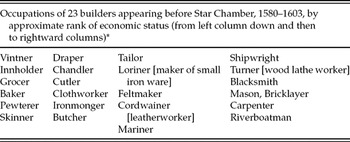
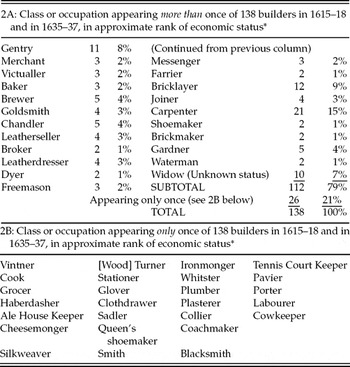
The story might seem to be an outlier in accounting for the types of people who became builders. Tailors and landladies were not normally housing developers. What was the ‘normal’ route? They were various in Elizabeth's times as revealed in Table 1. It shows 24 builders’ backgrounds as expressed by their different primary trades. The number is insufficient to reveal proportions, only the considerable range of backgrounds involved. It also suggests their approximate economic status, varying from wealthy to quite poor. Clearly, there was no ‘normal’ background to becoming a builder; a considerable variety existed. Indeed, this same diversity existed during the early Stuarts’ reigns. Justices of the peace provided Certificates of builders and sometimes their primary occupation. Combined, and adjusting for name overlap of repeat offenders, selected Certificates between 1615 and 1638 showed about 650 different builders (or, sometimes, current holders of the property). Of these, 139 appeared on lists that in most instances reported primary occupations. These are shown in Table 2. The same diversity of backgrounds is revealed for the latter dates, but here, with a larger sample, we learn their relative importance. Widows were responsible for 7 per cent of builder-holders (though we do not know their socio-economic status).Footnote 23 Gentry were about 8 per cent on these Certificates, but in fact were probably more frequent as builders, being more able to finagle or pay for a licence to build, or more apt to build with brick as was required by James’ and Charles’ proclamations, and perhaps less likely to be listed in the Certificates.
Diverse occupations of builders appearing before Star Chamber, 1580–1603

* Status approximated from W.C. Baer, ‘Housing the poor and mechanick class in seventeenth-century London, London Journal, 25 (2000), 25, Figure 2.
Source: T.G. Barnes, ‘The prerogative and environmental control of London building in the early seventeenth century: the lost opportunity’, California Law Review, 58 (1971), 1338 n. 21.
Diverse occupations of offenders appearing in Certificates of Offenders, 1615–18 and 1635–37

* Status approximated from Baer, ‘Housing the poor and mechanick class’, 25, Figure 2.
Source: Acts of the Privy Council, James I (Aug. 1616 – Dec. 1617), 16, 52 (Jan. 1618 – Jun. 1619), 171–2, 209–10, 238, 245, 254; State Papers Domestic (microfilm) (SP)14/98/106–7, James I (4 Aug. 1618); SP14/98/111, James I (6 Aug. 1618); SP14/122/230, 346, James I (22 Sep. 1621); SP16/305/87, Charles I (23 Dec. 1635); SP16/345/92, Charles I (30 Jan. 1637); SP16/355/348, Charles I (10 May 1637); SP16/370/80, Charles I (23 Oct. 1637); and SP/16/408/139, Charles I [late 1638].
Most surprising, and contrary to expectation, was the percent directly in the building trades. They were indeed the most common, but still only a minority – about one quarter – of all builders.Footnote 24 Within these, carpenters were the most common followed by bricklayers. That comparative likelihood is in part explained by looking to each trade's proportionate cost in building a new house. Carpenters and bricklayers overwhelmingly predominated, each accounting for 40 per cent of the total cost.Footnote 25
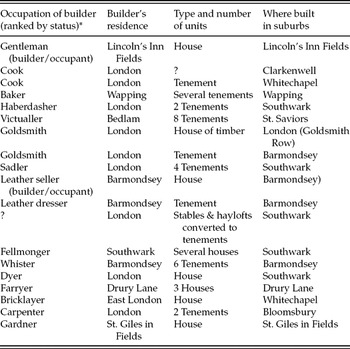
To develop the suburbs, and construct in-fill development, would require a considerable amount of finance and builder expertise. From the limited evidence that others have reported, it appears as if the suburbs (generally housing lower-income households) largely developed with ‘outside’ money and experts, not indigenously.Footnote 26 The Certificates of Offenders in 1618–19 support this tentative finding. They provide some indicators of who financed and built the housing in London's outskirts and where they resided. This is shown in Table 3. Slightly over half of the builders lived in London but built in the nearby suburbs. The great majority of their units were rental tenements, but in two cases the builders themselves intended to live in the finished structure.
Occupation and residence of builders, type of unit and where located as cited in Certificates of Offending Houses, 1618–19

* Status approximated from Baer, ‘Housing the poor and mechanick class’, 25, Figure 2.
Source: Acts of the Privy Council, James I (Jan. 1618 – Jun. 1619), 171, 172, 238, 246, 283.
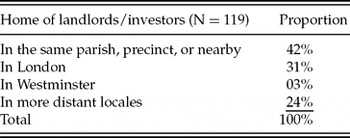
The Returns of Divided Houses, undertaken in 1637, are another source for where builders tended to live.Footnote 27 The churchwardens in the wards located within the walls or immediately outside, in writing up the Returns for their parish, occasionally mentioned the landlord of the divided house by name, but nothing else about them. Yet out in the further suburbs – in the parishes south of the Thames, in St Thomas and St Saviours in Southwark, and in Clink Liberty, the Liberty of Paris Garden, the Lord Archbishop's Liberty, and Lambeth – the churchwardens sometimes provided considerably more detail. Table 4 provides this information in broad-brush detail, but with a large sample. The table reveals that while 42 per cent of these builders or landlord-investors lived nearby the development in the suburbs, London and Westminster were also important locales, accommodating one third of all freeholders or long-term leaseholders. Surprisingly, investors residing outside London and its suburbs in other areas in central and southern England – some 24 per cent of the total holders – also looked to these suburbs as a place to build and invest. Moreover, the number of units reported for each locale suggests (though absent rent amounts cannot demonstrate) that the larger and more valuable of these, in general modestly valued properties, tended to be developed by investors from outside those particular suburbs.
Home of builders or landlord investors in 1637 Southwark and its suburbs*

* St Thomas and St Saviour parishes, Southwark; Clink Liberty, the Liberty of Paris Garden, Newington, the Lord Archbishop's Liberty, the Princes’ Liberty, Lambeth Marsh and Lambeth Dean, Surrey.
Source: Rev. T.C. Dale (ed.), Returns of Divided Houses in City of London 1637 (1 Jun. 1937), typescript from SP16/359, Charles I, vol. entitled, ‘1637 May Returns of Divided Houses in City of London’ (microfilm, the Church of Jesus Christ Latter Day Saints, 1965), 184–258.
This diversity demonstrates the amorphous and protean nature of ‘builder-as-developer’ but does not yet explain why they were able to come from so many backgrounds without common training. One explanation pertains to building prohibitions. In theory, they would constrain housing production, pushing prices up as London continued to grow. Court connections regardless of training background would seem to give such builders a competitive advantage in escaping severe punishments. For instance, Thomas Burton, shoemaker to Queen Anne in James’ reign, built an offending house in St Giles in the Fields yet as to pulling it down the sheriffs’ list of forthcoming demolitions cryptically noted: ‘we are willed to forbear it’ (emphasis added).Footnote 28
We have two pertinent instances for Charles’ court, one with the expected outcome, the other not. David Mallard was a shoemaker to Charles I, as well as a frequently cited building offender. A ‘presentment’ to the privy council brought by Inigo Jones and other Commissioners for Building described how from a modest start Mallard could grow great nuisances. In the early 1630s, he built a shed that he claimed was only for garden tools. It eventually became a tippling house of low quality covered with pan tiles, with accompanying houses of office, a sink-hole and some vaults. He also built a substantial brick house near Charing Cross ‘to the great defacing of the prospect of his Majesty's house’. Charles must have liked Mallard nonetheless, for the shoemaker only paid a fine for his offences (a year's rent was often the fine amount, and £25 would be a fair rent for a good brick house at the time).Footnote 29
A more exalted court connection was held by John Moore, Esq., as one of the four clerks of the signet. He personified the brash side of builders, and was apparently widely despised at court for it.Footnote 30 Moore earned between £200 and £300 annually, but aspired to higher income, if not to higher office. In 1615, he acquired an old, ‘infruitful’ orchard between Covent Garden and St Martins in the Field, already being built upon. Defying James’ numerous building proclamations, Moore constructed 13 stables and 17 coach-houses, and later built seven dwellings, justified as being partly built on old foundations. The parishioners of St Martins in the Field complained that these structures abutted the church, with its light obscured and its air polluted with ‘unwholesome and unsweet smells from the laystalls’.Footnote 31 He apparently was prosecuted, but James I had interceded on his behalf. Around 1630, he built five more dwellings, of brick, again partly on old out-building foundations, accruing in all some £258 in annual rent.
Summoned to Star Chamber in 1634, Moore offered numerous wily defences.Footnote 32 For instance, he claimed that Charles I's coronation pardon extended to houses built contrary to proclamation (an objection the attorney-general and privy council had earlier privately acknowledged and wrestled with without clear resolution).Footnote 33 Moore's most bumptious claim was to brag of his personal moderation in light of the temptation before him, arguing that he had restrained his appetite, leaving un-built more old foundations than he had built upon. The privy council would have none of it. Moore was fined £1,000, with £1,000 more if the annoyances were not abated by Easter. Not only did he face a high fine compared to most, the sheriff, in tearing down Moore's 42 offending structures, seems to have (accidentally?) overreached and torn down part of Moore's own dwelling, to the court's great delight.Footnote 34
Court connections might help against the competition, but they were not a panacea. Nor do court connections explain how one gained sufficient knowledge to capitalize on building opportunities. Being in the building trades was surely a way to gain familiarity, but the building trades were not the whole of the building process. Based on evidence in A.L. Beier, we know that the trades most closely connected to building (carpenters, stonemasons, bricklayers, glaziers, painters and stainers, plumbers and joiners) comprised between 6.5 and 8.4 per cent of the total labour force between 1550 and 1650, while those related to house decorating and furnishings were another 2 per cent.Footnote 35 The construction trades were the seventh largest in London, but there were more people involved than that.
Housing has ‘backward’ or ‘upstream’ linkages (employment in securing the raw materials) and the ‘forward’ or ‘downstream’ linkages (employment in manufacturing house furnishings for completed dwellings) that must be considered. Nicholas Barbon was the first to discuss these housing linkages:
Building is the chiefest Promoter of Trade; it Imploys a greater Number of Trades and People, than Feeding or Cloathing: the Artificers that belong to Building, such as Bricklayers, Carpenters, Plaisterers, &c. imploy many hands; Those that make the Materials for Building, such as Bricks, Lyme, Tyle, &c. imploy more; and with those that Furnish the Houses, such as Upholsterers, Pewterers, &c. they are almost Innumerable.Footnote 36
Barbon's point can be amplified by enumerating all the stages in building to account for the various people and activities involved. There was, for instance, the labour and cost in securing the considerable amount of heavy, bulky and expensive raw building materials like wood from other parts of the realm or overseas. Upon arriving in London, it was then transported by wagon and cart to yards all about the city. There it was stored, and when needed was then hewn or sawed into scantling and timber, or fashioned off-site for interior work like mouldings and stairs. So also brick, dug from London brickearth, moulded and fired by brickmakers, required coal and brickyards. Lime-making also required coal and places for lime's firing, and sand had to be secured.
In the meantime, individual builders had to line up land for building sites by sale, or, more usually, by long-term lease. Freeholders themselves at the time rarely built, rather, they sought cash from land leases, and here an ‘intricate system of assignments, sales, and mortgages proved an effective means of raising the necessary finance from layers of relatively small-scale investors’.Footnote 37 A typical land lease rent was for a few pepper-corns for the first two years while the houses were being built, allowing builders to concentrate their limited funds on construction. When completed, a portion of the house rent went to pay the full ground lease amount. At the end of the sixteenth century, building leases durations were only 20 or 30 years, after which the ground lease landlord received rent for both the buildings and the land. In consequence, builders did not construct good-quality housing on this leased land (recall the high frequency of maintenance), hoping it would have effectively worn out at lease expiry and that they (not the landholder) would have recouped most, if not all, possible profit. Only later in the century did landholders come to understand that while a longer lease (say, 40 to 60 years) substantially delayed when they received full value from the improved property, it enticed builders to place more expensive houses on it. Builders could now amortize these increased costs over a longer period, satisfying their needs, yet, some quality might remain at expiry, the higher rents from the better houses now going to the landholder.Footnote 38
Funds for supplies and labour often had to be borrowed, perhaps from several investors for the total required, and they, in turn, had to be aware of the time value of money for financing a durable object like housing.Footnote 39 Builders and lessees also used ‘lawyers who could draw up contracts and understood how to manipulate the labyrinth of seventeenth-century property legislation; and scriveners who could provide finance and arrange transfers of money between parties to employees’.Footnote 40 Like the trades related to building, there seems to have been federations or constellations of lenders, often organized by lawyers or scriveners, welcoming builders with their proposals for development, ready to syndicate to under gird the project financially.Footnote 41
With the sites secured, and funding lined up, building materials were acquired in part through cash, and also credit extended by building suppliers. Then, timber, brick and tiles were hauled again by cart and wagon, along with sand, lime and water, to the building sites spread throughout London. Considering the bulk, weight and quantity of these supplies, a seemingly endless stream of carts (and occasionally wagons) must have gone to and from the separate building sites during the typical six- to nine-month construction period. Carts could only carry about one ton (400 bricks, say, at 5 lbs per brick) per trip (wagons could haul up to 3.5 tons but were discouraged because they caused deep ruts in the roads).Footnote 42 Once on site, these heavy materials were initially off-loaded by unskilled day-labourers. Then, ‘little masters’ in the building-related trades with their helpers used these materials to construct a foundation; erect a frame (often of several storeys) and put on a roof; and with still other trades – glazers, plumbers, painters and so on – to do the finish work outside and in.
Successful construction then required quickly finding a buyer able to afford the price (most likely an investor intending to act as a landlord, see below), or tenant directly leasing from the builder as landlord. Housing, even then, was comparatively expensive, and in the main built with other people's money, so builders had to begin paying off the considerable debt upon a unit's completion.Footnote 43 The occupants making these payments then had to see about house furnishings, requiring still more cart trips to the site.
A conceptual framework for explaining the variety of builder backgrounds
How, then, were moves from one of these stages in building to becoming a builder per se easily made? The answer requires a conceptual framework, in the main still lacking. Building accounts tended to begin with the eighteenth century or later, or taking a prelude and ‘postlude’ bias for the seventeenth century. Its building industry was usually viewed as only the prelude to the eighteenth – an embryonic manifestation of what later produced Georgian London. Alternatively, the industry was characterized as the ‘postlude’ to the medieval period – implicitly typed and explained as derivative from demands and forces of those earlier centuries. More recently, Elizabeth McKellar presented a detailed description of how the London trades were organized for speculative housing during the second half of the seventeenth century, but still lacked a conceptual framework for why the industry organized in the way it did.Footnote 44 I provided a start in an earlier piece in this journal. There, I implicitly argued that any prelude/postlude biases in past accounts were inconsequential, that the building industry's organization was basically the same from medieval times to the end of the nineteenth century.Footnote 45 Here, I elaborate on some of those points.
‘Modularity’ is a conceptual basis for the industry's organization. The housing production sector employed inputs of relatively standardized work groups (a trained master and his crew), who in turn used relatively standardized materials to produce relatively standardized intermediate outputs of modules of work effort like a rod of brick (see below). All these were produced at relatively standardized costs because bidding on a project was not yet the practice. Instead, third parties measured the work done in standardized increments, and determined the cost to be paid to the contractor. These combined intermediate outputs together resulted in a final output, a house or tenement, say. Despite the relatively standardized modularity of input and output, each house might be different, the totality of the standing stock considerably heterogeneous, meeting demands of households with quite different needs, tastes and pocketbooks.
In other words, and to provide concrete examples for this abstract explanation, the world of building from an early time was characterized by measurements. Although carpenters’ manuals were not published until the late sixteenth and early seventeenth centuries, they were largely oriented to educating builders and the trades on the importance of measurement in construction, and how to do it correctly.Footnote 46 Measurement allowed standardization, and standardization allowed rationalization of production processes in terms of modules of work effort. Bricks, for instance, were standardized by royal building proclamation in 1625 at 9 × 43/8 × 21/4 inches, and required to sell for no more than 8d/1,000 at the kiln.Footnote 47 Bricklayers used the measure of rods of brick as their unit of accounting (about 4,500 bricks), such a rod of work generally taking 3.5 days for a craftsman and his helper to complete as part of, say, a wall. Carpenters used the ‘square’, a 10 ft by 10 ft measure of work, about two of which could be built in a day by a single craftsmen. Roofers applied 665 plain tiles to cover a 10 ft x 10 ft square, and one bundle of laths, where ‘one Bundle of Laths; and one Tyler in a day, will cover such a Square’. Shortly after the great fire in 1666, a single modest 16.5 ft by 33 ft house of the ‘Third Sort’ (a standardized quality level denoted by parliament's Re-Building Act of 1667) fronting a ‘high’ street contained over 80,000 bricks and 3,590 roof tiles, and who knows how many board feet of timber and wood by these reckonings.Footnote 48
Stephen Primatt and William Leybourn in the 1660s, in providing lengthy descriptions of measures of materials, workmen and the time it would take to accomplish a specified task, in effect reduced building to that modern accounting grail – unit costs of factor inputs. It is not clear, however, that such an advanced conceptualization was widely used across the trades. James Nisbet illustrated the lack of mathematical training by most workers, even in the second half of the century when a rudimentary education was more common, by showing their preference for crude empirical short-cuts over more precise but abstract reasoning. The trend toward greater precision was a slow process, and there was still considerable slack in the building system and indifference to the lack of what today would seem fundamental necessities in building (official permits to build, but with stipulations; site plans; complete drawings or ‘blueprints’; and, perhaps, construction schedules).Footnote 49
The housing construction process so described might have been responded to – counterfactually – by firms that were large, and vertically integrated along the chain of building. Such firms would be extensive enough to encompass processes and directly employ people that acquired raw materials like timber from afar, and brickearth close by, and its firing, as well as the funds for the construction period and perhaps the ‘permanent’ financing. The same firm would then convert these raw materials to building components like scantlings and bricks, and then fabricate and assemble them into housing on site that they had previously arranged for. Indeed, the same firm might even do advance advertising of the coming development, so as to line up prospective purchasers or lessees. Vertically integrated operations for construction were sometimes used. The medieval church and various monarchs occasionally organized massive but, administrative, not market-organized building projects that were somewhat vertically integrated.Footnote 50 Gilbert van Schoonbeke, the largest developer in sixteenth-century Antwerp owned ‘15 brickyards, a 69 hectare peat bog, limekilns and a timber operation’; Nicholas Barbon for a time owned a brickyard; and a few other builders owned timber yards in the last part of the seventeenth century.Footnote 51 Even so, such ‘private’ firm sizes and internal ‘vertical’ undertakings existed in London at our earlier time, though not for housing. The East India Company, for instance, was a large, vertically integrated firm in the early 1600s. It built its own dockyards so that it could then build and equip its own ships. It next organized voyages for these ships, saw to manning them and finally conducted the actual trade overseas and then back in England before any revenues were received. It was able (as a joint stock company) to cope with the large expenditures required for such undertakings, where a moderate ship cost about ten times as much as a moderate house to build, but then had the expense of paying for the, say, 100-man crew to sail it.Footnote 52 Had several such firms arisen for London's house-building, even if they could not obtain an outright grant of monopoly to build as did the East India Company for eastern trade, their large initial start-up expenses before any revenue was received, were they financially successful, would make subsequent entry into the house-building business by others extraordinarily difficult, thereby limiting competition and reinforcing their pre-eminence.
In fact, there were no such house-building firms in London, and there was considerable competition between builders because of low capital costs to get started. Large building firms would have been too inflexible, encumbered by too much overhead to survive the inevitable booms and busts in real estate development and even seasonal variation. (Winter months’ shorter days and inclement weather reduced or eliminated construction for many kinds of workers, e.g. bricklayers, much of their time during these months reputedly being taken up with drinking).Footnote 53 Instead, most of these building processes were undertaken by small, adaptable, independent builders often completing only a few units a year, hiring independent work groups for limited amounts of measurable work. In effect, they performed the elaborate ‘vertical’ integration by co-ordinating and binding the work groups and building materials together with a myriad of separate contracts.Footnote 54 The comparatively standardized features in the process that have been described above allowed relatively unambiguous contracts for the hire of small increments of relatively well-specified and standardized work products, completed in a short time to ensure control and low risk in stages within the larger building process. The considerable variety of modules allowed any number of permutations in the contracts – whatever the parties agreed upon. It was a process prevalent in medieval times and remained centuries afterward, albeit often at larger scales, over the centuries.Footnote 55
Speculative housing development merely re-enforced and emphasized these proclivities. A series of builders employing various combinations of masters and their crews nevertheless could, via piecemeal construction ‘over a few decades, produce long rows of relatively uniform shop or cottage housing as the unplanned outcome of the housing market’.Footnote 56 Maintenance was another reason for the existence of small, independent firms. Repairs were too small and individualized for a large firm to realize economies of scale from long production runs. In other words, the construction industry was decentralized to a series of building sites scattered throughout the metropolis, and was ‘a set of temporary enterprises on individual sites that nevertheless sustained a permanent industry’.Footnote 57
Accordingly, builders came from all classes, sometimes even the poor, as shown in Table 2. Builders did not need a high degree of special skill sets and knowledge. Rather, it helped if they had a variety of skills and knowledge, at least at a minimum level, because they had to deal with and co-ordinate the actions and timing of many people with a variety of special trades and skills. And since these trades ultimately dealt in measurable products, not ‘mysteries’ (though the processes and ‘tricks of the trade’ for any particular practice to produce these products might not be widely known), builders could readily master the rudiments sufficiently to make contracts. Moreover, the use of set prices for a quantity of production without bids further simplified the builder's cost-estimating tasks in planning the venture.
By builder, therefore, I mean project ‘instigator’ or ‘Undertaker in Building’ as R. Campbell called them.Footnote 58 They were the projectors, promoters and leaders who conceived and initiated the project, lined up land and financing and oversaw it to completion. Builders could hire the variety of special trade or craft functions and professional skills that they could not perform themselves. That is one reason why carpenters and bricklayers were the most prevalent among builders – their relative importance to house construction's total cost meant they could better control some of its larger expenses.
The building projector as ‘builder’ was often – but not always – different from the master craftsmen as builder, e.g. Nicholas Barbon, trained as a physician, probably never touched hammer to nail, sawed timber or scantlings or mortared a brick in place. A master craftsman on site might have contracted ‘by the great’ with the projector, to arrange all the physical construction on site, but not other parts of the building chain, e.g. finance, land, etc. Contracting by the great meant contracting to provide the materials, to arrange for their delivery on site and to be in charge of contracting with other trades, instead of only contracting for, say, constructing the frame or doing the bricklaying, but master craftsmen in those instances were not the ‘builders’ as meant here. Ultimately, the projector paid the master craftsman based on amounts calculated by third parties. There was always some risk that the craftsmen would not be fully paid, or fully paid on time, but it was the projector who was taking the larger risk. He or she would only be fully paid if and when the house was sold or leased, and even that might not be at the amount of profit built into craftsmen's contracts.Footnote 59 Put another way, a contract by ‘the great’ or for lesser amounts of work meant that the workers were paid by the supply side of the housing equation; projectors, by contrast, received their money from the demand side. This distinction in roles was not always obvious to the outside observer, and they might be confused or mislabelled in official records.Footnote 60
Holders of vacant land might tempt otherwise hesitant builders by making building sites easy to acquire. For example, in 1608–10 the 1st earl of Salisbury bought 9 acres of land on the west side of St Martin's Lane. He then promptly divided and let it at a rent of 1s a foot frontage on thirty-one-year leases, the tenant to build in timely manner.Footnote 61 In another example presented shortly, landholders enticed would-be-builders by advertising the availability of land, even ‘dangling’ building supplies already delivered on-site before their eyes.Footnote 62
Landlord investors were the usual buyers, because most London households had not the wherewithal to acquire even the leasehold outright. Instead, they rented from a landlord. It has been conventionally assumed that the companies, parishes and other institutions were holders of a great many properties in London, perhaps holding some 30 per cent of all rental properties in the City.Footnote 63 Typically, however, institutions would not be the instigator-builder; they would merely buy or lease the finished property for its rental income as an investment.
Transitioning from the first half to the second half of the century
The early Stuarts initially imposed higher building standards than builders desired, because the finished house would cost more, requiring the rent to be set too high. By mid-century, rising incomes had made the higher standards more affordable. The early Stuarts had merely been ahead of their time aesthetically, and ahead of London's growing prosperity economically. Indeed, the higher standards now made some former building practices objectionable to the public. Just prior to the Civil War, parliament was beginning to respond to citizen complaints about new buildings’ disorderly intrusions on urban life, complaints that perhaps influenced the better-planned residential squares and ensembles following the Restoration, a process also encouraged by Charles II who had made Christopher Wren his surveyor of works. He charged Wren with improving London's housing by checking the plans of most large developments and requiring changes where necessary before construction began, rather than, like James, having objectionable buildings pulled down after their construction.
William Newton got caught up in this changing public attitude just before the Civil War. One of the larger builders in the 1630s and 1640s, he was licensed by Charles and willing to follow Inigo Jones-influenced building requirements. Newton had laid out and built Great Queen Street near Lincoln's Inn Fields, a well-designed development. He next built 32 houses in portions of Lincoln's Inn Fields, despite strenuous protest by the Society of Lincoln's Inn. Finally, Newton applied for another licence in 1638–39 to supplement his original work with 14 more houses ‘tuck[ed] in nooks and angles’ nearby.Footnote 64 Again, the Society argued that Newton's proposed development would be no ‘ornament’; quite the contrary, it would be an annoyance, and it vigorously attempted to stop him.Footnote 65
First, the court of aldermen in 1639 ordered London's Remembrancer to petition the king to restrain Newton's building. That action failed. The next year, the ‘Long Parliament's’ first bill was for ‘preventing the erection of new buildings in and about this City and fore the provision of the poor in cottages new erected’.Footnote 66 In May 1641, the House of Lords convened a committee ‘to consider of the great Increase of Buildings in and near the Cities of London and Westminster, and the Suburbs thereof’.Footnote 67 This effort got pushed aside in the press of a looming Civil War; a committee report was never delivered. In 1642, ‘an act to prevent and suppress the increase of new buildings in and near the cities and suburbs of London and Westminster (or within one mile)’ was referred to the same parliament committee that was going to hear Newton's petition to build in Lincoln's Inn's Fields.Footnote 68 That bill failed to pass. Soon after, London's common council petitioned parliament to make an order ‘that no houses be built on new foundations within three miles of the City, and that no houses either in the City or without be built of timber or be subdivided’.Footnote 69 That petition failed as well. Newton's petition then emerged from committee, but the Lords, after debate, voted it down, deciding that Newton's houses would be nuisances (not ornaments). The House of Commons also attempted to stay the houses from being built.Footnote 70
The Civil War that followed in 1642 left a local power vacuum, which Newton filled by building, its aftermath complained of in a petition to parliament in 1645.Footnote 71 Our next record is a petition to the lord protector in 1656 from the Society of Lincoln's Inn Fields (with six pages of signatures attached). It complained that Newton had proceeded to build upon a part of the fields by patent from the late Charles I, that he had pretended to lay open and beautify the rest, although the houses were prohibited by proclamation, and in fact had become ‘the very pest of the city’. More recently, the petition continued, two others claiming under Newton (who had died in 1643) had laid in a great store of bricks and other materials for building, and posted bills inviting men to take leases of the fields and build upon them (taking advantage of the absence of judges on their circuits). A stay of building was granted until the judges returned.Footnote 72 We do not directly know that outcome, but an interesting proviso in parliament's 1657 Building Act passed the next year shows that the Society of Lincoln's Inn Fields had by then struck a bargain with the builders; only certain areas would be developed, the remainder to be left as fields or laid out in ‘walks for common use’.Footnote 73
Conclusion
In the main, it was small builders who met London's surging demand for housing from 1550 on, and by 1580, were doing so against royal wishes. These projectors came from many walks of life, though carpenter and bricklayer were clearly predominant. Most were from a seemingly powerless social class, but individually possessed remarkable single-mindedness and determination. The lure of profit from building houses for a seller's market encouraged them to keep building in the face of erratic royal efforts to stop them. They were enabled to become builders despite their various backgrounds due to the decentralized nature of the building industry. It allowed easy entry into the field of building, an ease accentuated by the industries’ penchant to organize small work groups to perform standardized units of work, the projector binding together parts of the whole undertaking by small contracts for limited amounts of work.
Since all this new construction contributed to denser development, by the mid-seventeenth century, those already living in London began to agree with the early Stuarts that new development was ever more detrimental and required some kind of control. That impetus, along with slowly increasing prosperity to afford better-designed housing, may be a major reason why the second half of the seventeenth century saw construction of a number of squares and other ensembles of attractive housing.