I. INTRODUCTION
This paper concerns choice of law with regard to the voluntary assignment of contractual obligations, a topic which may seem arcane, but which has become increasingly important in the financial-services industry, since it plays a key role in transactions such as securitization and factoring. Although neglected by academic writers for many years, it is now beginning to generate a significant literature.Footnote 1 This is partly because of its increasing importance and partly because the relevant choice-of-law rules have been the subject of continuing debate in the European Union in the context of article 14 of the Rome I Regulation,Footnote 2 which covers voluntary assignment and contractual subrogation. The Regulation was adopted in 2008, but article 14 will soon be subject to revision,Footnote 3 so the debate has been heating up again.
We start with the basic set of legal relationships. Since we are discussing this question in a European context, we will avoid an exclusively English viewpoint. The Rome I Regulation will be interpreted (in the final instance) by the Court of Justice of the European Union. Only one of its members is from the United KingdomFootnote 4 and most of its members are not even from common-law countries; so in determining the meaning of the Regulation, common-law ideas are unlikely to carry special weight.Footnote 5 Where possible, therefore, terminology specific to English law will be avoided.
A. Parties
Assignment is concerned with the transfer of claims. At its most basic, it involves three parties:
• the debtor (D)
• the creditor/assignor (C)
• the assignee (A).
These three parties will henceforth be referred to as the ‘primary parties’. Other parties may come into the picture as well—indeed, the most challenging problems would not arise without them—but they are not necessary for an assignment to take place. However, it is not possible to have an assignment without the three primary parties.
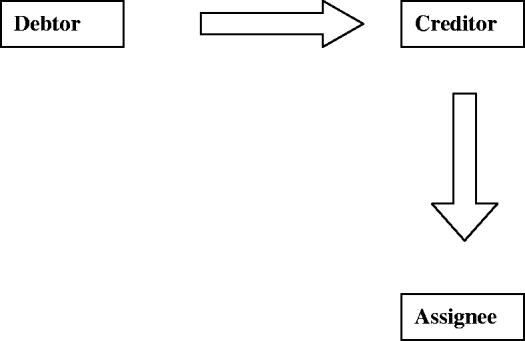
The first requirement for an assignment is that there must be an obligation. The person who owes the obligation (the obligor) is called the ‘debtor’. The person to whom he owes it is called the ‘creditor’ (obligee). An assignment takes place when the creditor transfers the benefit of the obligation (the claim) to a third person, the assignee. The contract as a whole is not transferred. The assignee does not become a party to the contract: it is only a claim under the contract that is transferred. Many legal systems regard this claim as intangible property (in English law, a chose in action), which may be transferred from assignor to assignee in essentially the same way as tangible property—for example, goods—may be transferred from one person to another.Footnote 6
The transaction may be represented diagrammatically as follows :
Obligations.
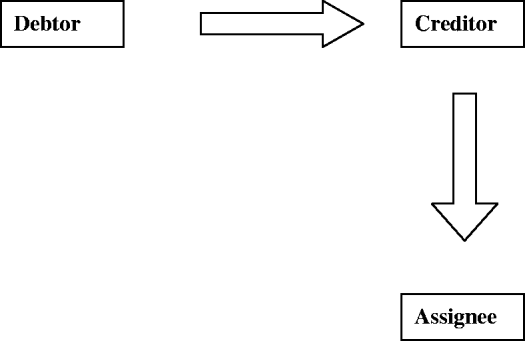
The arrows represent the obligation. It will be seen that C has a double role: with regard to D, he is a creditor (obligee); with regard to A, he is the assignor (obligor).
Though an assignment may be intended as an outright transfer, it may also be used for the creation of a security interest in the claim. Article 14 of the Rome I Regulation expressly covers both possibilities. Paragraph 3 of article 14 states:
The concept of assignment in this Article includes outright transfers of claims, transfers of claims by way of security and pledges or other security rights over claims.
This makes the position clear.
B. Relationships
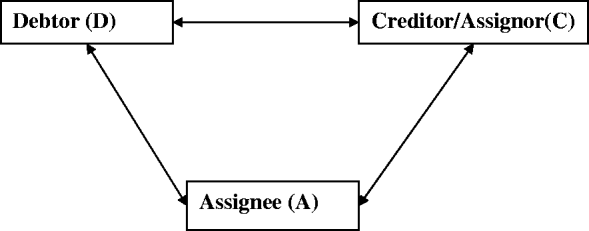
In an assignment, we have to consider three relationships.
Relationships.
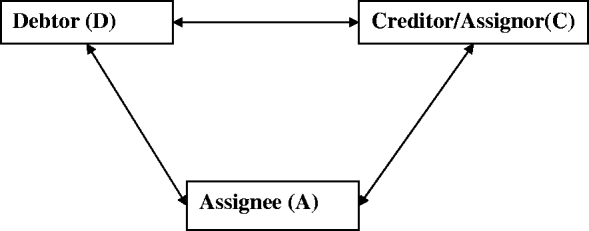
The relationship between D and C is governed by the law that created the obligation. This may arise in a number of different ways. Most often, it will have been created by contract, but it may also be non-contractual—for example, under the law of tort or restitution. It may even be an obligation of some other kind.Footnote 7 If the obligation is contractual, it will probably fall within the scope of the Rome I Regulation. If it does, that Regulation will determine the law applicable to it. If the obligation is non-contractual, it will most likely be covered by the Rome II Regulation,Footnote 8 which deals with choice of law regarding tort and other forms of non-contractual liability (unjust enrichment, negotiorum gestio and culpa in contrahendo).
Before moving on to conflict of laws, it is desirable to distinguish assignment from two other transactions that are similar to it.
C. Assignment Distinguished from Novation
Novation is a contract to which D, C and A are all parties, in which they agree that A will take the place of C in his relationship with D. It differs from assignment in that the assent of D is necessary. Since the new contract replaces the old one, the parties are free to agree whatever terms they wish; normally, however, A will take over C's liabilities towards D as well as C's claims against him. As far as conflict of laws is concerned, the normal choice-of-law rules will apply to determine the validity of the new contract. Article 14 is not relevant.
D. Assignment Distinguished from Subrogation
Under an assignment, a claim arising from a legal relationship between D and C is transferred to A. Under a subrogation, on the other hand, A will step entirely into the shoes of C in his relationship with D: he will gain his rights under the original obligation and be subject to his liabilities.Footnote 9 Subrogation differs from novation in that the assent of D is not necessary. It may take place either by contract or by operation of law; the former is covered by article 14 but not the latter. This paper will not deal with subrogation.
II. ARTICLE 14 OF THE ROME I REGULATION: STRUCTURE
At present, there are two operative paragraphs to article 14.Footnote 10 However, the Commission is considering the addition of a third operative paragraph to cover matters not covered by either of the existing operative paragraphs. Before we analyse them, we must first consider the general structure of article 14.
A. Paragraph 1
The first paragraph provides that the ‘relationship’ between the assignor (C) and assignee (A) is governed by the law that applies to the contract between them (the contract by which the claim is assigned).
Article 12(1) of the Rome ConventionFootnote 11 (the predecessor to the Rome I Regulation) used slightly differently language. It spoke of the ‘mutual obligations of assignor and assignee’. Is there a difference between ‘mutual obligations’ and ‘relationship’? It seems that it was intended that there should be. Recital 38Footnote 12 states:
In the context of voluntary assignment, the term ‘relationship’ should make it clear that Article 14(1) also applies to the property aspects of an assignment, as between assignor and assignee, in legal orders where such aspects are treated separately from the aspects under the law of obligations. However, the term ‘relationship’ should not be understood as relating to any relationship that may exist between assignor and assignee. In particular, it should not cover preliminary questions as regards a voluntary assignment or a contractual subrogation. The term should be strictly limited to the aspects which are directly relevant to the voluntary assignment or contractual subrogation in question.
The drafting of this recital is poor. The first sentence is clear enough, though it would have been better if it had said ‘the term ‘relationship’ is intended to make it clear'. The second sentence is easy to misunderstand. The phrase ‘any relationship that may exist’ is rendered in French as ‘toute relation pouvant exister’—in other words: ‘every relationship that might possibly exist.’ This is confirmed by the versions in other languages.Footnote 13 The idea is that paragraph 1 applies only to aspects of the relationship that are ‘directly relevant’ to the assignment, not to other aspects.
An improved version of Recital 38 might read as follows (proposed new text is italics):
In the context of voluntary assignment, the term ‘relationship’ is intended to make it clear that Article 14(1) also applies to the property aspects of an assignment, as between assignor and assignee, in legal orders where such aspects are treated separately from the aspects under the law of obligations. However, the term ‘relationship’ should not be understood as relating to every relationship that might possibly exist between assignor and assignee. In particular, it should not cover preliminary questions as regards a voluntary assignment or a contractual subrogation. The term should be strictly limited to the aspects which are directly relevant to the voluntary assignment or contractual subrogation in question.
In other words, paragraph 1 covers not only the contractual aspects of the assignment, but also the property aspects. However, it does this only as between the assignor and the assignee. Moreover, it does not cover aspects that are not directly related to the assignment; in particular, it does not apply to preliminary (or incidental) questions.
A preliminary question is a question that has to be answered before the main question can be answered. An example would be the validity of the obligation assigned. If D does not owe C anything—if no obligation exists—C cannot assign it. So to determine the validity of the assignment, the court must first decide the preliminary question of whether the obligation exists. If the obligation is contractual, it must decide whether the contract between D and C is valid. This question would not fall within the scope of paragraph 1.
To give another example, if C dies and X, who purports to have inherited the claim, assigns it to A, the question whether X has indeed inherited the claim would also be a preliminary question. In litigation concerning the assignment between X and A, the question whether X had inherited the claim would not be decided by the law governing the contract between X and A, but by the law governing succession to C.
B. Paragraph 2
The second paragraph provides that the law governing the assigned claim (‘the law of the obligation’) determines:
• its assignability;
• the relationship between the assignee and the debtor;
• the conditions under which the assignment or subrogation can be invoked against the debtor; and
• whether the debtor's obligations have been discharged.
Thus, the law of the obligation governs the legal relationship between the debtor (D) and the assignee (A).
In general, then, the three relationships set out in Figure 2 are governed by the following:
• the relationship between D and C, by the law that creates the obligation between them (for example, the contract between them);
• the relationship between C and A, by the law governing the contract by which the claim is assigned;
• the relationship between D and A, by the law governing the obligation assigned (the same as that governing the relationship between D and C).
C. Proposed Paragraph 3
In the negotiations leading up to the present text of the Rome I Regulation, it was assumed that the first and second paragraphs did not cover the whole field. It was, therefore, proposed to have a third paragraph. Agreement on this was not possible within the time available; so it was omitted. However, article 27(2) of the Regulation provides:
By 17 June 2010, the Commission shall submit to the European Parliament, the Council and the European Economic and Social Committee a report on the question of the effectiveness of an assignment or subrogation of a claim against third parties and the priority of the assigned or subrogated claim over a right of another person. The report shall be accompanied, if appropriate, by a proposal to amend this Regulation and an assessment of the impact of the provisions to be introduced.Footnote 14
This means that the third paragraph (if adopted) would cover:
• the effectiveness of an assignment of a claim against third parties;
• the priority of the assigned claim over a right of another person.
It is not entirely clear who counts as a ‘third party’ for this purpose, though D cannot: his position is regulated by paragraph 2. The position of other persons will be considered below.
D. The Problem of ‘Relativity’
We must now confront a major problem. As indicated, article 14 lays down different rules for different relationships. The problem is: should the choice-of-law rules applicable to decide a given question be different, depending on the parties to the proceedings in which the question arises? If a given question is decided by one law in proceedings between C and A, could it be decided by a different law in proceedings between D and A? This is the problem we have called ‘relativity’.
As a general principle, it is suggested that in law (as in other things) one should adopt the simplest solution that produces the desired result. Other things being equal, a simple solution should be preferred to a complex one. On this ground, one should apply the same law to decide the same question whenever it arises—unless there is a good reason for doing otherwise.
If this sounds all rather abstract, we can bring it down to earth by considering the concrete situations in which the question arises.
1. The validity of the assignment
We have already seen that paragraph 1 lays down the general rule that, as between C and A, the validity of the assignment is governed by the law of the assignment. What if the validity of the assignment arises in proceedings between A and D?
Assume that A demands payment from D. Now, if D resists payment on the ground that the assignment cannot be invoked against him, perhaps because he was not notified, that question must be decided by the law of the obligation. Paragraph 2 says so. Likewise, if D argues that the obligation was not assignable, the law of the obligation will decide this too. However, let us assume that D was properly notified and that the obligation was assignable. D may nevertheless contest the claim on the ground that the assignment itself was invalid. A might have lacked capacity to contract; or the assignment might have been invalid as to form. What law should decide these questions?
To make the matter more concrete, assume that D and C are English and that the obligation is governed by English law. A is Mexican and the assignment is governed by Mexican law. In proceedings between C and A, the question whether A had capacity to contract is clearly governed by the law applicable to the assignment. It would probably be Mexican law.Footnote 15 Now assume that the same question arises in proceedings between A and D. Should it be governed by the law applicable to the obligation? It seems clear that it should not.
Now, let us change the scenario slightly. Assume that A has capacity, but an issue arises whether the assignment is valid as to form. Let us assume that it was not in writing and that, in the circumstances of the case, it had to be in writing under English law but not under Mexican law. If the issue arises in proceedings between C and A, the applicable law is that of the assignment—Mexican law. So the assignment will be valid. What if the question arises in proceedings between A and D? Is it not equally clear that the assignment must still be regarded as valid? There would be no reason to apply the law of the obligation just because D was a party to the proceedings.
Thus, despite the fact that the relationship between A and D is in principle governed by the law of the obligation, preliminary (incidental) questions which have their own choice-of-law rules, such as those discussed above, should still be decided by those choice-of-law rules, even when they arise in the context of proceedings between A and D.Footnote 16 Exceptions should apply only where there is a special reason. There does not appear to be any such reason.
2. Assignability
We now consider the reverse situation. Under paragraph 2, the question of assignability is governed by the law of the obligation. If A sues D, and D wishes to resist A's claim on the ground that the obligation was not assignable, the applicable law is that of the obligation. What happens if A sues C? Do we still apply the law of the obligation, or do we say that, since the relationship between A and C is governed by the law of the assignment, that law must decide the question of assignability?
The answer to this question may be less obvious; nevertheless, it is suggested that it should be the same. An obligation may be non-assignable for various reasons. One reason is to protect C. A rule that future salary cannot be assigned would fall into this category. In a moment of desperation, an employee might assign his future salary to pay off a debt. He might then end up destitute. To protect him, some legal systems provide that future salary cannot be assigned. In this situation, it seems clear that the law of the obligation—the law governing the contract of employment under which the salary is payable—should decide whether it is assignable. This should apply not only when the assignee (A) is suing the employer (D), but when the assignee is suing the employee (C).Footnote 17
It is also possible that the contract creating the obligation might contain a clause stating that it is non-assignable. This will normally have been inserted by D. In proceedings involving D, the validity and effect of such a clause should be governed by the law of the obligation. What if the question arises in proceedings between C and A? Here the application of the law of the obligation is less clearly right; nevertheless, it would not be unfair to A to apply that law.Footnote 18 If you conclude a contract under which a claim is assigned to you, it is not unreasonable that you should be expected to ensure that the claim is assignable under the law governing it.Footnote 19
3. Who Counts as a ‘Third Party’?
Our final question concerns the proposed paragraph 3. We have seen that this would cover the effectiveness of the assignment of a claim against third parties. When would this apply? Who constitutes a ‘third party’ for this purpose?
Let us assume that C becomes insolvent and the liquidatorFootnote 20 argues that the claim should fall into the insolvent estate. A argues that it should not. Here the issue is the effectiveness of the assignment against the liquidator and, ultimately, C's creditors. Do they count as third parties? If they do—and if paragraph 3 is adopted—this question would not be decided by the law governing the assignment but by the law applicable under paragraph 3, whatever it may be.
It is suggested that the answer should depend on the nature of the liquidator's claim to the obligation assigned. If he is arguing simply that he is entitled to step into the shoes of C—that he is entitled to no more than what C was entitled to—then the question whether the assignment is effective so as to divest C of ownership of the obligation should be answered in exactly the same way as it would be in proceedings between C and A: by the law governing the assignment. In this situation, the liquidator and the creditors should not count as ‘third parties’ so as to trigger the application of paragraph 3.
However, it is possible that the liquidator may claim greater rights than C would have been entitled to. He may claim that he can override A's rights. For example, the law applicable under paragraph 3 may provide that an assignment is not effective against the creditors on the assignor's insolvency unless it was registered. In such a case, the liquidator will be claiming greater rights than C. Here he should count as a third party. Similar principles should apply to other persons (such as attaching creditors) claiming to be ‘third parties’ for the purpose of the proposed paragraph 3.Footnote 21
This way of approaching the matter gives the proposed paragraph 3 a more restricted scope than it might otherwise have had. Perhaps this will make it easier to reach agreement in the forthcoming negotiations.
Having considered these preliminary matters, we are now in a position to discuss each paragraph in detail.
III. PARAGRAPH 1: ASSIGNOR AND ASSIGNEE
We have already seen that the legal relationship between C and A is governed by the law applicable to the contract between them (the law of the assignment).
A. What Law Governs the Assignment?
The law governing the assignment will be determined by the Rome I Regulation. Under article 3 of the Regulation, a contract is governed by the law chosen by the parties. This choice may be express or implied.Footnote 22 If there is no choice of law, article 4 determines the applicable law. Article 4(1) lays down a number of rules applicable to different kinds of contracts. Under article 4(1)(b), a contract for the provision of services is governed by the law of the country where the service provider has his habitual residence. So, if A is providing a service to C (factoring, for example), the applicable law would be that of the country where A (the assignee) has his habitual residence.Footnote 23 Where none of the rules in article 4(1) applies, the problem is more difficult. The contract would probably be governed by the law with which it was most closely connected.Footnote 24
In addition to these general rules, there are a number of special provisions that apply to particular issues. Under article 11, a contract is valid as to form if it complies with the formal requirements of either the law that governs it in substance or the law of the place of conclusion.Footnote 25 Exceptions exist for consumer contracts and contracts concerning rights in rem in immovable property.Footnote 26 The Regulation does not (in general) cover the capacity of natural persons. There are further provisions concerning mandatory rulesFootnote 27 and consent.Footnote 28
B. What is Covered by the Law of the Assignment?
The law governing the contract of assignment determines the contractual rights of C and A with regard to each other; it also determines their property rights with regard to each other: except with regard to assignability, it decides whether the assignment is valid as between C and A as a transfer of property.Footnote 29 A's rights against D, on the other hand, are governed by the law of the obligation.
In order to understand the position more clearly, it is desirable to give separate consideration to the position where the debtor has not, or has, paid the debt.
1. Debt Not Paid
Let us first assume that D does not pay the debt. If A has no right against D under the law of the obligation, his only remedy will be against C. If the law of the assignment so permits, A may be able to require C to demand payment from D on his (A's) behalf and hand the proceeds over to him. If this is not possible, an action for damages (if available under the law of the assignment) will be A's only remedy.
2. Debt Paid to C
We now consider the situation where D pays C. The question of who the debtor must pay is governed by the law of the obligation. If that law says that D should have paid A, the latter will be entitled to sue D and demand payment of the debt: payment to C will not give D a good discharge. On the other hand, the law of the obligation may provide that D should pay C. In this case, A will have no rights against D. D will obtain a discharge and not be subject to any further liabilities. If A wants a remedy, he will have to turn to C.
The question whether D has a remedy against C will depend on the law of the assignment. If that law says that C must give A the money he received from D, he will have to do so. It is possible that, in some legal systems, the question whether C must hand over the proceeds of the debt is not a question of contract but of restitution. However, the fact that it is a question of restitution under the relevant Member-State law will not mean that it will not be decided under article 14(1) of the Rome I Regulation.
The interpretation of EU measures is (in the final instance) a matter for the Court of Justice of the European Union, which is notoriously reluctant to allow such questions to depend on Member-State law. If at all possible, it will seek to apply an independent, EU solution. By this is meant a solution that is always the same, irrespective of the law of the Member State involved. This has been the position under the Brussels ConventionFootnote 30 and the Brussels I Regulation,Footnote 31 both of which are concerned with the jurisdiction of courts within the European Union. Under these measures, the Court of Justice has always given an EU interpretation to concepts relevant to the scope of the Convention and Regulation;Footnote 32 it has also given such an interpretation to most of the other concepts used in the Convention and Regulation.Footnote 33
An example will show how the Court of Justice approaches such matters. In Handte v TMCS,Footnote 34 a German company, Handte Germany, manufactured goods and sold them to a French company, Handte France. The latter resold them to a second French company, TMCS. The goods were allegedly defective and the question arose whether the sub-purchaser (TMCS) could bring an action in the French courts directly against the German manufacturer, Handte Germany. In most legal systems, such a claim, if possible at all, is in tort. Under French law, on the other hand, it could be brought in contract, and it seems that the claimant in the French court had framed his claim in contract. The Court of Justice had to decide how the claim should be characterized for the purpose of determining the jurisdiction of the French court before which proceedings had been brought. If the action was regarded as being in contract, it would fall under article 5(1) of the Brussels Convention; if it was in tort, it would fall under article 5(3).
The Court of Justice held that the meaning of ‘matters relating to a contract’ in article 5(1) of the Convention had to be given an independent interpretation, rather than one based on Member-State law: it held that article 5(1) does not cover a claim by a sub-purchaser against the manufacturer of goods where there is no direct contractual relationship between the two parties. So, even though the claim was contractual under French law, it was not to be so regarded for the purpose of the Brussels Convention. This did not of course mean that the French courts, if they had jurisdiction, were precluded from deciding the substance of the case on the basis of contract. It simply meant that, for jurisdictional purposes, the claim could not be characterized as contractual.
One cannot be certain how the Court of Justice will interpret the Rome I Regulation; nevertheless, it is probable that it will adopt a similar approach. Consequently, for choice-of-law purposes, it might well characterize A's claim against C for the proceeds of the debt as contractual, and consequently covered by article 14(1) of the Rome I Regulation. Once the applicable law has been determined, the court hearing the case will of course be perfectly free, if the applicable law so requires, to treat the claim as based on restitution.
Even if the Court of Justice did not adopt this approach, the result would be the same. Choice of law regarding restitution (‘unjust enrichment’ in EU terminology) is governed by article 10 of the Rome II Regulation. Paragraph 1 of this reads as follows:
If a non-contractual obligation arising out of unjust enrichment, including payment of amounts wrongly received, concerns a relationship existing between the parties, such as one arising out of a contract or a tort/delict, that is closely connected with that unjust enrichment, it shall be governed by the law that governs that relationship.
If we apply this to the situation where A claims, on the basis of unjust enrichment, that C must hand over money received from D, we can see that there is indeed a relationship between the parties (A and C) which arises out of a contract (the contract to assign the obligation). This relationship is closely related to the unjust enrichment: the enrichment of C is unjust precisely because he assigned the claim to A. Consequently, the law governing the obligation to make restitution is the law governing the contract to assign the claim: the same result is reached by both routes.
3. Insolvency
What is the position where, after the claim has been assigned but before A receives payment, C becomes insolvent? In this situation, it is important to know whether the claim falls into C's insolvent estate. If it does, A may find that he is merely an unsecured creditor in the insolvent estate; if it does not, he may be able to gain payment in full.
This question came before the Hoge Raad (Dutch Supreme Court) in Brandsma qq v Hansa Chemie AG.Footnote 35 In that case, a German company, Hansa Chemie AG, had sold chemical products to a Dutch company, Bechem Chemie BV. The latter was going to resell the products to sub-purchasers in the Netherlands. The sale between Hansa and Bechem was for credit, and Hansa wanted security for the price. So Bechem assigned to Hansa claims it might have in the future against the sub-purchasers. Bechem subsequently became insolvent, and both Hansa and Bechem's liquidator (Brandsma) claimed money payable by a sub-purchaser. The money was paid into court, and the Dutch courts had to decide who was entitled to it.
In this situation, the obligation assigned was the sub-purchaser's obligation to pay for the goods. This was governed by Dutch law. The sub-purchaser was the debtor (D); the creditor (C) was Bechem; and the assignee (A) was the German company, Hansa.Footnote 36 The assignment was made under the contract between C (Bechem) and A (Hansa). The Hoge Raad held that this contract contained an implied choice of law in favour of German law. Consequently, the law of the obligation was Dutch law, and the law of the assignment was German law. The assignment was valid under German law, but invalid under Dutch law. It is possible under Dutch law to assign or charge future debts, but various requirements of Dutch law applicable in such circumstances had not been satisfied.
The Hoge Raad had to decide whether the claim fell into Bechem's insolvent estate. To do this, it had to decide whether the validity of the assignment was governed by Dutch or German law. This in turn required it to decide whether the matter was governed by the Rome Convention (in force at the time) and, if it was, whether it came under paragraph 1 or paragraph 2 of article 12 (the equivalent of article 14 in the Regulation).
The Hoge Raad held paragraph 1 of article 12 of the Rome Convention covered not only the contractual aspects of an assignment, but also the property aspects. (Dutch law is one of the legal systems where a distinction is made between the two.) So it decided that the validity of the assignment as a transfer of property was governed by paragraph 1, even against Bechem's liquidator. Under paragraph 1, German law was applicable; so the assignment was valid and the claim did not fall into the insolvent estate.
It is not proposed to consider whether this decision was correct under the Convention.Footnote 37 However, it is worth considering whether it would be correct under the Regulation. As we have seen, it has now been establishedFootnote 38 that paragraph 1 does indeed cover the property aspects of an assignment, though only as between assignor and assignee. So ownership of the claim was transferred from Bechem to Hansa. It was not, therefore, part of Bechem's estate when the latter became insolvent. If the suggestion put forward above regarding the meaning of ‘third party’ in the context of the proposed paragraph 3 is correct, and if Bechem's liquidator was claiming entitlement to no more than what Bechem had immediately before the insolvency, then the Hoge Raad's judgment would indeed be correct under the Regulation.
On the other hand, if the liquidator counted as a ‘third party’ (either because the suggestion put forward above is wrong or because he was claiming overriding rights), the matter would fall under the proposed third paragraph. As things stand at present, this would mean that the question would not be covered by the Regulation. If the proposed third paragraph were adopted, the outcome would depend on what law was applicable under it.
IV. PARAGRAPH 2: THE DEBTOR
The leading case in England on paragraph 2 is the decision of the English Court of Appeal in Raiffeisen Zentralbank Österreich AG v Five Star Trading LLC,Footnote 39 a case that was actually decided under article 12 of the Convention. Five Star was a Dubai company that wanted to purchase and scrap a ship called the Mount I. To finance the operation, it obtained a loan from an Austrian bank, Raiffeisen Zentralbank Österreich (‘RZB’), which was secured by a mortgage over the ship. In addition, Five Star insured the ship with a group of French insurers and assigned its interest in the insurance to RZB. The insurance included collision-liability coverage. The insurance policy was governed by English law, as was the assignment. The assignment was notified to the insurers.Footnote 40 The method of notification (by fax) was valid under English law but not under French law.Footnote 41 This meant that the assignment was binding on the insurers under English law, but not under French law.
Subsequently, the ship was involved in a collision, as a result of which various claims were brought against Five Star in Malaysia. Some of the claimants (the cargo owners) took proceedings before a French court to attach the insurance policy. They argued that Five Star's interest in the policy was an asset out of which they could satisfy any judgment they might obtain against Five Star in Malaysia. Shortly after the insurers were notified by RZB of the assignment, the cargo owners were granted a provisional attachment by the French court. RZB responded by bringing proceedings in England against Five Star and the insurers for a declaration that it, rather than Five Star or Five Star's creditors, was entitled to the proceeds of the insurance. Subsequently, the cargo owners were joined to these proceedings. All the parties accepted the jurisdiction of the English courts. The French court stayed the attachment proceedings to await the outcome of the English action.
If we analyse the situation in the terms we have been using in this paper, we see that the claim assigned was Five Star's right under the insurance policy: the insurers were the debtors (D); Five Star was the creditor (C); and RZB was the assignee (A). The cargo owners were C's creditors.
RZB and the cargo owners viewed the situation in different ways. According to RZB, the issue was whether the claim under the insurance contract was effectively and validly assigned by Five Star to RZB. This, they maintained, was a contractual matter, governed by article 12 of the Convention. Since both the law of the obligation and the law of the assignment were English, this would have entailed the application of English law.
The cargo owners, on the other hand, considered that they constituted third parties, and that the issue was the validity of the assignment against third parties. They saw this as a property issue, which fell outside the scope of the Convention. If correct, this would have meant that the claim was governed (under English common law) by the lex situs of the debt—French law.Footnote 42 They said that under French law their attachment prevailed over RZB's assignment because the latter had not been notified to D in the form required by French law.
The judgment of the Court of Appeal was given by Mance LJ (as he then was). He adopted a chronological approach. The first issue to consider, he held,Footnote 43 was whether, immediately prior to the attachment, the claim against the insurers belonged to Five Star or to RZB. If it belonged to Five Star, that was the end of the matter: the cargo owners could attach it. This was the first issue. However, he considered that a second issue might conceivably arise: even if ownership of the claim had been transferred to RZB prior to the attachment, did the cargo owners' attachments override RZB's title to the claim? In other words, were the cargo owners obliged to recognize the transfer of Five Star's title to RZB? This second issue concerned the effect of the attachments; the appropriate law to decide it was almost certainly French. It seems, however, that the French attachments were obtained on the basis that any claims against the insurers belonged to Five Star. There was no evidence before the English courts that, under French law, the attachment would be valid if this were not the case.
In the end, the Court of Appeal decided only the first issue. It held that this was a contractual matter falling within the scope of paragraph 2. English law was applicable, and the assignment was binding on the insurers. So RZB owned the claim prior to the attachment: the insurers were obliged to pay RZB, not Five Star. A declaration was made accordingly.Footnote 44 It seems that no further proceedings took place in the English courts. Although the declaration would have left open the question whether the French attachment could give the cargo owners an overriding right,Footnote 45 it appears that French law did not give them such a right. If the French courts had required the insurers to pay the cargo owners, the possibility would have arisen that they might have had to pay twice, since their obligation to pay RZB had already been established by the English judgment.
The approach taken by the Court of Appeal in this case is consistent with that suggested in this paper regarding the scope of the proposed paragraph 3. Even with regard to attaching creditors, the question whether the debtor is obliged to pay the debt to the assignee is governed by the law designated by paragraph 2. It is only to the extent that the attaching creditors claim overriding rights that the matter would come within the proposed paragraph 3.
V. PROPOSED PARAGRAPH 3: THIRD PARTIES AND PRIORITIES
We now consider the proposed paragraph 3. What would it cover and what law should it designate?
A. When Would Paragraph 3 Apply?
We have already seen that it would cover:
• the effectiveness of the assignment of a claim against third parties;
• the priority of the assigned claim over a right of another person.
These problems could arise in three situations: the first is where a creditor of C, or possibly A, attaches the claim by service of process on D; the second is where C (or possibly A) becomes bankrupt and the question arises whether the claim falls into the bankrupt estate; and the third is where the same claim is assigned twice to different assignees. The first two situations would concern the rights of third parties and the third would raise issues of priorities.
The meaning of ‘third parties’ has already been discussed. It was suggested that attaching creditors and liquidators should be regarded as third parties only to the extent to which they claim overriding rights. Claims to overriding rights should be decided by the law applicable under paragraph 3, but that law should not decide the rights of the primary parties (D, C and A), even if they arise, as preliminary issues, in proceedings involving a third party.
1. Attachment
Let us assume that X, a creditor of C, wishes to attach the claim. In English law, X must first obtain a judgment against C in order to establish that he has a claim against him; then he can bring proceedings to obtain a third-party debt order (formerly called a ‘garnishee order’) against D.Footnote 46 If this is granted, D will have to pay X what D owes to C, up to the amount of C's debt to X. The procedure may differ in other countries, but the principle will always be that X cannot obtain from D what D does not owe to X's debtor (C, in the example we are considering). If C's claim against D has been assigned to A, the latter will object that the claim no longer belongs to C. If this is correct, X's attempt to attach the claim will fail. Since paragraph 2 of article 14 provides that the law governing the claim determines the relationship between D and A, this law must decide whether D owes the obligation to C or to A—in other words, whether the claim has been validly assigned. Generally speaking, therefore, X's right to attach the claim depends on D's relationship with A, which is governed by the law of the claim.
However, the law governing the attachment may allow the attaching creditor (X) to override A's rights. This could occur if, for example, there is a provision to the effect that assignments will not bind creditors of the assignor (C) unless they are registered. It is only in such a situation that the proposed third paragraph comes into play. The question is: what law should decide whether the attaching creditor (X) has overriding rights? Should it be the law of the obligation or should it be some other law? In this situation, the problem is to ensure, on the one hand, that A is not unfairly deprived of his claim and, on the other hand, that D does not have to pay twice.Footnote 47 Perhaps the only way of ensuring this would be to apply the law of the obligation here as well.
2. Insolvency
In the European Union, insolvency in conflict of laws is governed by the Insolvency Regulation.Footnote 48 The basic provision in the Insolvency Regulation is a rule of jurisdiction: article 3(1) gives jurisdiction to open insolvency proceedings to the courts of the Member State within the territory of which the centre of the insolvent'sFootnote 49 main interests is located. However, article 3(2) allows the courts of another Member State to open secondary proceedings if the insolvent has an establishment within the territory of that other Member State. Secondary proceedings may deal only with assets located within the territory of the Member State concerned.
Choice of law is dealt with in article 4(1), which provides that the law applicable to insolvency proceedings is the law of the Member State within the territory of which the insolvency proceedings are opened, the lex concursus. This will most often be the law of the centre of the insolvent's main interests, but, in the case of secondary proceedings, it could be the law of another country. Under article 4(2), the lex concursus governs a range of issues, some procedural and some substantive. One issue is the assets which form part of the estate.Footnote 50 This is mainly concerned with such insolvency-specific questions as whether the following form part of the estate:
• assets acquired after the opening of proceedings;
• property needed by the insolvent for his personal use, domestically or in his employment;
• his interest in his home; and
• property held on trust for another person.
The lex concursus would normally decide these issues without having to refer to another system of law.
In some situations, however, it is likely that, under the lex concursus, the question whether a particular asset falls into the estate may depend simply on whether the asset belongs to the insolvent. This could raise the issue whether title was validly transferred to or from the insolvent as a result of a particular transaction. Such an issue would constitute an incidental question (explained above), which might have to be decided by another legal system. For example, in the case of a tangible movable, the lex situs of the movable at the time of the transaction should decide whether title was transferred to (or from) the insolvent. The application of the lex situs in this situation would be consistent with article 4, since the lex concursus is not intended to deal with issues of this kind.
In the context of assignment, the question whether ownership of the claim has passed from the assignor (C) to the assignee (A) is, as we have seen, governed (as between C and A) by the law of the assignment. If C becomes insolvent, the question whether the claim falls into the insolvent estate may, under the lex concursus, depend on whether the assignment was valid as a transfer of property. Unless the liquidator is entitled to overriding rights, this would be decided by the law of the assignment. If he does claim overriding rights—if he claims that the assignment (though valid as between C and A) does not bind him (perhaps on the ground that the assignment was not registered, or that the debtor was not notified)—the proposed paragraph 3 of article 14 of the Rome I Regulation would come into play.
There are a number of laws that might conceivably apply. The lex concursus is one, but it suffers from the drawback that, since it depends on which Member State the insolvency proceedings are opened in, it cannot be known in advance. A second possibility is the law of centre of the insolvent's main interests. This will often be the same as the lex concursus, but will not necessarily be so, since secondary proceedings may be opened in another State. A third possibility is the habitual residence of the insolvent. This will often be the same as the centre of the insolvent's main interests, but this will not always be the case: the habitual residence of a company is the place of its central administration (unless a branch is involved),Footnote 51 while the centre of its main interests is presumedFootnote 52 to be the place of its registered office.Footnote 53 A fourth possibility is the law of the obligation: the application of this law would protect the interests of the assignee, since he will look to it in any event to ascertain his rights against the debtor. A fifth possibility is the law of the assignment: since this will decide the question in the absence of overriding rights, it might be convenient to apply it in the latter case as well. It will also protect the interests of the assignee, since he will have to look to it to ascertain his rights against the creditor. However, it could be objected that since it can be chosen by the creditor (assignor) and assignee, they might deliberately select a law that was unfavourable to creditors.
3. Competing Assignments
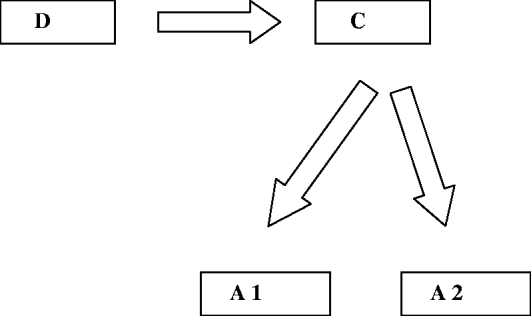
The question of priorities will normally arise where there are competing assignments. This will occur where C (wrongfully) assigns the same claim twice to different assignees (A1 and A2), who are unaware of what he has done. This is illustrated diagrammatically in Figure 3.
Competing assignments.
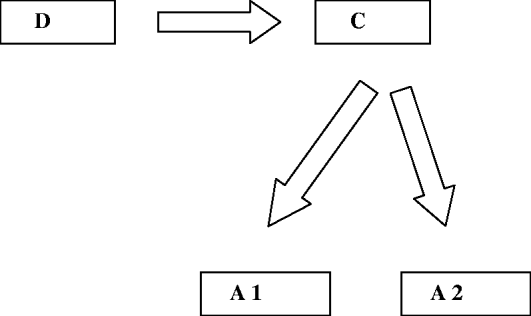
The question whether A1 or A2 has the right to demand payment from D is not covered by the proposed paragraph 3: it falls under paragraph 2. The question whether either of them has a remedy against C is also not covered by the proposed paragraph 3: it falls under paragraph 1. The only issue that falls under the proposed paragraph 3 in this situation is the relationship between A1 and A2. The law designated by this paragraph would decide whether A1 has any rights against A2 and vice versa.
This could arise if one assignee sues the other; if they both sue D and he interpleads; or if they both sue C, demanding that he should claim the debt from D on their behalf, and C interpleads. The procedural mechanisms would depend on the legal system involved, but the principle is that the rights inter se of A1 and A2 would fall under paragraph 3, while the rights of each one individually against C would fall under paragraph 1 and against D under paragraph 2.
What if D pays the debt? If he pays C, and one assignee claims the money from C, paragraph 1 would apply; but if they both claim it and C interpleads, paragraph 3 would apply. Likewise, paragraph 3 would apply if D pays C, C hands the money over to one assignee and the other claims it from that assignee. Paragraph 3 would also apply if D pays one assignee and the other claims it from that assignee.
Depending on the legal system involved, some or all of the claims would be for unjust enrichment (restitution), since there would be no direct contractual nexus between the two assignees. As things stand at present, this might bring art 10 of the Rome II Regulation into play.Footnote 54 It is unclear exactly how art 10 would apply in such a case. There would be a relationship between the two assignees, based on the fact that the same claim had been assigned to each of them. The law governing that relationship could only be that of the claim assigned, since this is the common factor. If the new third paragraph of article 14 of the Rome I Regulation were intended to apply to this issue (as is the intention), it would have to be made clear that it would apply even if the claim was based on unjust enrichment.
It should finally be said that the question of priority can arise only if both assignments are valid. The validity of an assignment is, as we have seen, governed (under paragraph 1) by the law applicable to that assignment. This applies even in proceedings between the two assignees. Thus, if A2 claims that he is entitled to priority because the assignment to A1 was invalid—perhaps because of lack of capacity or fraud—this question must be decided by the law governing that assignment.
In some legal systems, priority is decided by the rule, ‘Nemo dat quod non habet.’ This means that the first assignee will prevail, provided that the assignment to him was valid. In English law, on the other hand, priority does not go to the person to whom the claim was first assigned, but to the person who first informed the debtor. This is subject to a proviso: if the second assignee was the first to inform the debtor, he will gain priority only if he was unaware of the first assignment.Footnote 55
The best known decision on priorities is that of the Bundesgerichtshof (German Federal Supreme Court) of 20 June 1990.Footnote 56 In this case, a German shipbuilder agreed to build a ship for an English customer. Payment was to be made in instalments. The shipbuilder assigned his claim to payment twice, first to the supplier of the ship's rudders and then to a bank. The Bundesgerichtshof ruled that priority was to be decided by the law of the obligation. This case was decided prior to the coming into force of the Rome Convention, but the Bundesgerichtshof considered that the result would be the same under it.
B. What Law Should Apply?
We now come to the most controversial question: what law should apply under paragraph 3? As already mentioned, the present position under English common law is that paragraph 3 issues would be regarded as raising questions of property and would be governed by the lex situs of the claim. Subject to limited exceptions,Footnote 57 this is the residence of the debtor. However, the United Kingdom has not proposed that this rule should be adopted under the Rome I Regulation; nor has this been proposed by any other Member State. So it does not appear to be in the running.
The application of the law governing the assignment was proposed by the Netherlands in the original Rome I negotiations but did not receive widespread support. If the same debt is assigned twice, the assignments might be governed by different laws and there is no justifiable reason why one should be preferred to the other.Footnote 58 So, at least in the case of competing assignments, it would not operate satisfactorily.
The two main contenders appear to be the law of the habitual residence of the assignor (initially proposed by the Commission in the negotiations leading up to the Rome I Regulation) and the law of the obligation (proposed by the United Kingdom). As previously explained, neither was adopted in the end: the matter was left over for later consideration. The time for that consideration is now getting closer. In some quarters, feelings on the issue are running high, not least because two major financial-service industries appear to be at loggerheads: the factoring industry favours the application of the law of the habitual residence of the assignor;Footnote 59 while the securitization industry, at least in the United Kingdom,Footnote 60 supports the law of the obligation.Footnote 61
Before we consider the merits of the proposals, some preliminary points should be made. First of all, it should be mentioned that an international convention on the assignment of receivables was concluded about ten years ago, though it is not in force. This is the 2001 UN Convention on the Assignment of Receivables in International Trade, Article 22 of which provides that ‘the law of the State in which the assignor is located governs the priority of the right of an assignee in the assigned receivable over the right of a competing claimant.’ If the European UnionFootnote 62 wanted to become a Party to this Convention, the proposed paragraph 3 of article 14 of the Rome I Regulation would have to be brought into line with it. However, there is no sign that the UN Convention will come into force in the near futureFootnote 63 and it is debatable whether it would be desirable for the Union to become a Party to it.
Secondly, it was generally recognized in the original Rome I negotiations that the applicable law under the proposed paragraph 3 for bank accounts and financial instruments should be the law of the obligation. Although the 2001 UN Convention applies the law of the habitual residence of the assignor, article 4(2) excludes the following from the scope of the Convention:
(a) Transactions on a regulated exchange;
(b) Financial contracts governed by netting agreements, except a receivable owed on the termination of all outstanding transactions;
(c) Foreign exchange transactions;
(d) Inter-bank payment systems, inter-bank payment agreements or clearance and settlement systems relating to securities or other financial assets or instruments;
(e) The transfer of security rights in, sale, loan or holding of or agreement to repurchase securities or other financial assets or instruments held with an intermediary;
(f) Bank deposits;
(g) A letter of credit or independent guarantee.
These instruments, at least, should be governed by the law of the obligation.Footnote 64
The third preliminary point is that the law of the obligation is already applicable under paragraph 2; so if it were also applied under paragraph 3, no new system of law would be involved. The law of the habitual residence of the assignor, on the other hand, finds no place at present in article 14. Its introduction would, therefore, raise the level of complexity of an already complicated provision. This, in turn, could cause characterization problems: courts and practitioners would have to decide whether particular issues fell under paragraph 2 or paragraph 3.Footnote 65 If the law of the obligation were applied, it would not be necessary to decide this question. In this rather basic sense, therefore, there is an advantage in applying the law of the obligation.Footnote 66
We are now in a position to consider the relative merits of the proposals. This will be done under a number of heads.Footnote 67 The first five relate to problems that could arise in particular situations; the sixth deals with convenience and ease of application.
1. Bulk Assignments
The first problem concerns the situation in which two or more separate claims are transferred together in one assignment. This happens in the factoring industry. Since the applicable law could be different for different claims, it would be inconvenient if the law of the obligation were applied. In a situation involving competing assignments, for example, it would complicate matters if the issue of priorities were decided separately with regard to each claim. Since there is one assignment, questions of priority should be decided together for all claims. This is easy to do if we apply the law of the habitual residence of the assignor, but not if we apply the law of the obligation.Footnote 68
2. Assignment of Future Claims
If future claims are assigned—the extent to which this is possible depends on the system of law involved—the law of the obligation may not be known at the time of the assignment. If, on the other hand, the law of the assignor's habitual residence was applied, the relevant time would probably be that of the assignment;Footnote 69 so the applicable law for paragraph 3 issues would be known when the assignment was made. This too is an argument in favour of the law of the habitual residence of the assignor.
3. Change of Habitual Residence
Where there are competing assignments, the law of the habitual residence of the assignor would not function satisfactorily if the assignor changed his habitual residence after the first assignment but before the second. It might be thought that this would be unlikely in the case of corporate assignors (the most likely protagonists), but in fact it could easily happen. The rules for determining habitual residence are set out in article 19 of the Regulation. The general rule is that the habitual residence of a company is the place of its central administration.Footnote 70 However, an exception is laid down in paragraph 2:
Where the contract is concluded in the course of the operations of a branch, agency or any other establishment, or if, under the contract, performance is the responsibility of such a branch, agency or establishment, the place where the branch, agency or any other establishment is located shall be treated as the place of habitual residence.
This means that if the first assignment is made by the head office and the second by a branch, or they are made by different branches, the habitual residence of the company will be different for each assignment.
The following is an example. The assignor is a company which has its central administration in Germany. It has two branches, one in Sweden and one in Italy. Due (perhaps) to a misunderstanding, the Swedish branch assigns the claim to A1, while the Italian branch assigns it to A2. Here the law of the habitual residence of the assignor would be different for the two assignments. Which one should decide priority? To say that the first one (Swedish law) should prevail would be arbitrary since (we assume) A2 is unaware of the first assignment. To apply Swedish law would mean that A2's rights would be decided by a law that he could probably not foresee. To apply Italian law would cause even more problems, since A1 could not possibly foresee it. In contrast, the law of the obligation would be fair to both assignees.Footnote 71
4. Joint Assignors
A problem also arises where there are two or more joint creditors. Assume that three banks, C1 (habitually resident in Belize), C2 (habitually resident in Luxembourg) and C3 (habitually resident in France), jointly make a loan to D. The loan is governed by the law of England. They jointly assign the claim first to A1 and then to A2. Both assignments are governed by English law. If we apply the law of the obligation, there is no problem; but if we apply the law of the habitual residence of the assignor, what law do we apply—that of Belize, Luxembourg or France? This is another argument in favour of the law of the obligation.
5. Successive Assignments
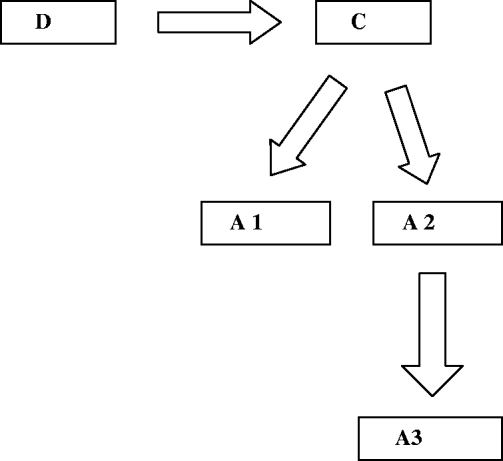
We now consider the situation where one assignee makes a second assignment. In order to bring the question within the scope of the proposed paragraph 3, we must also have competing assignments. We thus assume that C assigns the same debt to both A1 and A2, and A2 assigns it to A3. This is illustrated as follows:
Successive assignments
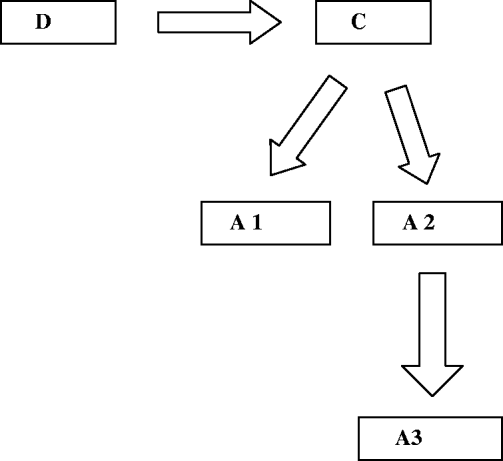
The question we must consider is priority between A1 and A3. There is no difficulty if we apply the law of the obligation, but if we apply the law of the habitual residence of the assignor, should we look to C's habitual residence or that of A2? If we opt for the former, it would mean that A3's rights would be decided by a law that would have very little to do with him and which he might not be in a position to ascertain. If, on the other hand, we look to A2's habitual residence, A1's rights would be decided by a law that would have no connection with him and that he might well be unable to ascertain.
6. Ease of ascertainment and convenience of the Parties
If the obligation assigned is contractual and if there is an express choice of law, the law of the obligation is easy to ascertain: you just read the contract. The law of the habitual residence of the assignor, on the other hand, is less easy to ascertain. As we have seen, the habitual residence of a company is in principle the place of its central management. While the registered office of a company can be discovered from public registers, this is not usually the case with the place of its central management. An off-shore financial-services company might have its registered office in a place like Panama or the British Virgin Islands, but it may be hard to discover where its place of central management is. Moreover, it might be unclear whether the assignment will be carried out by a branch or by the head office.
If there is no express choice of law in the contract creating the obligation assigned, it might be difficult to know for certain what the applicable law is. If the obligation is to pay for goods sold or services provided, the applicable law in the absence of choice would usually be that of the habitual residence of the creditor/assignor; so in this situation, the two rules would lead to the same result.
We can see, therefore, that as far as ease of ascertainment is concerned, the law of the obligation has the advantage where, as is usually the case with regard to securitization agreements, the obligation is contractual and there is an express choice of law. Where this is not the case, the law of the assignor's habitual residence might be easier to ascertain.
VI. CONCLUSION
No attempt will be made to propose a solution. Neither proposal is perfect, and the negotiators will just have to find a compromise. In doing so, they should try to find the solution that works best is practice. Clarity and simplicity are important considerations. There is no reason why the same law should apply in each of the three situations discussed above—attaching creditors, insolvency and priorities. Since these are clearly distinguishable, each could be governed by its own law.
In some ways, deciding what law will apply is less important than ascertaining the situations in which the new paragraph will operate—exactly what issues will be covered by it and what issues will fall under the two existing paragraphs. Both in this regard, and with regard to the relative merits of the proposals, the above analysis will, it is hoped, contribute to the finding of a solution.