1. Introduction
Sphygmograph is the generic name of any instrument designed, as the Oxford English Dictionary puts it, to record “the movements of the pulse by means of tracings.” According to the same dictionary, Anglophone speakers were also using “pulse register” as an equivalent term as early as 1860. The name seems to have been coined by the German physician and physiologist Karl von Vierordt in 1852 or 1853 approximately.Footnote 1
When historians of science and other experts deal with sphygmographs, they refer more often than not to the instrument extensively described and advertised by Étienne-Jules Marey in the 1860s and 1870s. Other sphygmographs of that period have only rarely, if ever, received due attention. This holds in particular for the sphygmograph designed by Ernst Mach in Vienna.
Mach's sphygmograph resulted from a thorough examination of Marey's instrument from the point of view of theoretical and applied physics – it should be added here: of physics only! Indeed, the young scholar at the beginning of his scientific career did not analyze Marey's sphygmograph from the point of view of medical and physiological experience.
Mach's new instrument came to be evaluated and compared with Marey's instrument twice in public meetings – in a regular session of the Imperial Academy of Science in Vienna and then during a regular meeting of the Viennese medical association. As a result of these comparative examinations made in front of trustworthy expert witnesses, Mach's sphygmograph was judged to be more reliable than Marey's instrument. It is thus no surprise that the instrument of the same name designed by two scientists could become the subject matter of a comparative historical reconstruction.
Yet, since the history of Marey's sphygmograph has already been dealt with in various scholarly contributions,Footnote 2 whereas that of Mach's follow up instrument has never been examined up to now,Footnote 3 the focus of the present contribution lies (a) on Mach's physicalist approach to the pulse register designed by Marey and (b) on the sphygmograph designed by Mach and constructed by two Viennese instrument craftsmen. For the sake of convenience this latter instrument may in retrospect be referred to as “Mach's sphygmograph.”
The analysis of the events having taken place around both Marey's and Mach's sphygmographs encounters some difficulties. Unlike Marey, who couldn't get away without a minute description of his sphygmograph when applying for patent letters on December 31, 1860,Footnote 4 Mach did not request any such protection;Footnote 5 nor did he (or anyone else) publish anything on the “inner details” of the instrument of his invention.
The scarcity of specific information, however, does not condemn the narrative of the Viennese events to failure from the outset. Complementary information stemming from both published and unpublished sources, concerning in particular Mach's painstaking examination of Marey's instrument, is sufficiently helpful for an understanding of the critical reception and assessment of Marey's sphygmograph in Vienna in the early 1860s.
I argue here that Marey's approach to his instrument, i.e. to the issues of standardization of the precision of the measurement of the human pulse, of the faithfulness of the tracings of blood measurement on paper, and so on, differed in many respects from Mach's physicalist’ approach. To oversimplify, and merely for the sake of anticipating the thrust of the narrative to follow: Marey's approach was all in all empirical (and informed by medico-physiological research practices), Mach's approach, in contradistinction, was all in all experimental (and informed by the research practices of a physicist who had already done some promising work on various topics of his discipline).
My argument will comprise four steps. I shall first give a summary of Marey's creation of a portable, easy to handle sphygmograph. Then, I will analyze Mach's examination of Marey's sphygmograph from a theoretical point of view. This analysis will be followed by the reconstruction of Mach's experiments relating to Marey's sphygmograph. In a further step, the institutionally based comparison between Marey's and Mach's sphygmographs will be narrated. And in conclusion, I shall briefly outline the main consequences which were drawn mainly by Marey from the results of Mach's successful presentation of his instrument.
In an autobiographical sketch drafted upon request of Wilhelm Ostwald in 1913, Mach very briefly alluded to his research on the theory of kymographs. In this sketch, in which the personal pronouns of the first and the third person alternate unsystematically, the author depicted himself as a physicist trying in the early 1860s to earn a modest living by privately lecturing on mathematics and physics. This put him in touch with two “important physiologists, Brücke and Ludwig” (Mach Reference Mach, Hoffmann and Laitko1991, 435). His work, he added, oriented itself upon the needs of the medical profession, so that “I was led to deal with the theory of the kymograph, the sphygmographs, and registering apparatuses” (ibid.). More than this not all too informative statement on sphygmographic matters is not available, neither in Mach's autobiographic documents nor in the literature on the early Viennese period of this scholar. The present essay is an attempt to show how Mach approached the instruments just mentioned and which manual work he was engaged in when he was assessing Marey's as well as his own sphygmograph.
2. Marey Invents a Sphygmograph
Marey decided at one point of his career as a physician to design a sphygmograph for medical (i.e. primarily for diagnostic) purposes. When reaching this decision, he had been doing yearlong and extensive, mostly experimental research on various aspects of animal haemophysiology. The shift from haemophysiology to sphygmography involved various more or less complex steps.
Instruments registering organic processes and inscribing traces of these processes on paper so that these traces might be available for several observers over time were regarded as paradigmatic for the most advanced physiological research of (roughly) the mid-nineteenth century and a few decades later.Footnote 6 “Graphic methods” (see Marey Reference Marey1878) were modern, reliable, and opened up new horizons for research, thus promising great advances in the exploration of a whole range of vital functions (such as breathing, muscular activity, sensory perception, processes of the nervous system as well as of the heart, etc.).
The instruments producing traces of the said sort on paper had one common property. They had, as one could say, machine parts that could sense movements (blood flow, muscular contraction and relaxation, the play of agonists and antagonists, nervous impulses on the way from one point to another point of the nervous system, etc.), and other machine parts that could transform mechanically the sensed input into movements of a writing device (e.g. a stylus writing curves). But each such device had to adapt to the features of the organic process at stake. Studying the beating heart of a horse, e.g., forced one to resort to in vivo application of some tube that could be introduced into the organism so that its “sensing” end would be located close to the heart. Furthermore, the device at stake had to be able to transmit the input stemming from the heart to the trace-producing part of the entire ensemble of interrelated machine parts (see e.g. Chauveau & Marey Reference Chauveau and Marey1863). Marey's sphygmograph, in contradistinction, had to adapt its sensing parts to the properties of the radial artery beneath the skin and the flesh of the forearm and its writing parts to the possibilities of a very small but highly reliable instrument allowing the observer to see the pulse of his subjects (experimental subjects or patients) as curves on paper.
In short, Marey's sphygmograph was an invention from scratch, in spite of the fact that its design was inspired by previous first-hand in vivo experimental practices. The differences between in vivo haemophysiological experimentation and medical sphygmography may be encapsulated in a brief list of contrasts:
-
(a) Haemophysiology was carried out mostly on experimental animals by way of invasive tools. Sphygmography was intended to be used as a diagnostic instrument in medicine by applying it non-invasively to the surface of the human forearm.
-
(b) Haemophysiology studied the behavior of the blood pump (the heart) by way of de visu et de tactu observations of the heart itself and/or by way of analyses of the behavior of blood flowing through vessels. Sphygmography was intended to facilitate the observation of the human heart under normal and/or pathological conditions by way of analyses of pulse traces written on paper.
-
(c) Haemophysiological instruments were meant to enhance human sensory capacities of several modalities, i.e. to improve the overall sensorium of expert observers. Sphygmography was intended to replace uncertain and unsteady tactile (and in some cases acoustic) impressions of human agents by paper-fixed visual data.
The shift from the regime of experimental animal haemophysiology to the regime of making a precision measuring instrument turns out to have been crucial in the development of Marey's sphygmograph. To wit:
Horses, donkeys, and mules were subjected to massive in vivo research on haemodynamics in the eighteen-fifties. After having served as living motors for years (doing daily work and enduring various sufferings inflicted upon them mostly by humans), these animals could be used as subjects for free just before their life was terminated by slaughter and their bodies cut up into edible parts. Introducing the appropriate tools into blood-vessels or into the hearts of horses, e.g., was considered to be harmless for the animal subjects, but rewarding for the advancement of physiology in general and for the acquisition of scientific expertise in haemodynamics in particular, not to speak of the fame to be expected by experimenters involved in such research. In addition, horses, donkeys, and mules were very suitable subjects. Their blood vessels were large (much larger than those of dogs, cats, or frogs), the dimensions of horses’ bodies made it easy for humans to handle the proper tools of haemodynamic investigations; the animals could easily be kept in a required position whatever the amount of their pain; once the experiments were concluded, one didn't need to take care of the no longer usable animals since their deadly fate was to be slaughtered anyhow (cf. Chauveau & Marey Reference Chauveau and Marey1863, 268–271, n. 1).
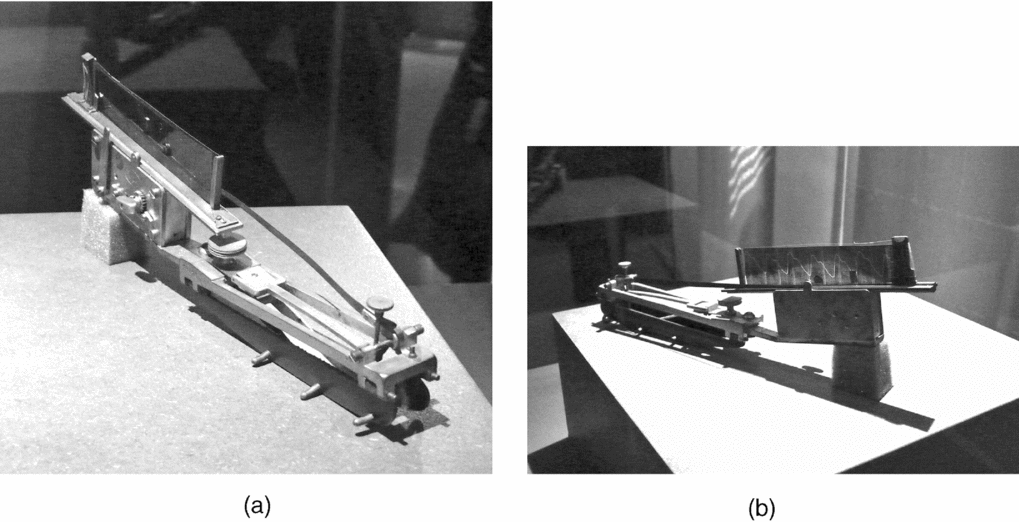
As published sources indicate, analyzing haemodynamic phenomena in vivo necessitated a large scale instrument – in comparison with Marey's extremely small sphygmograph (see fig. 1a and 1b). On the one hand, appropriate tools introduced into the large body of an animal “sensed” changes occurring within the organism. These “sensed” changes had to be transmitted outside the experimental subject. The physiological output had then to be transmitted to another tool so that it could diagrammatically fix the effects received from the tools introduced into the animal's body (see Marey Reference Marey1863, 50–53).
Marey's sphygmograph, photographed at an exhibition in Zürich, Switzerland, Fall 2008.

The shift from invasive haemophysiological experimentation to non-invasive sphygmographic registration could quite easily be achieved by Marey on the intellectual level. It was, as it seems, easy for him to mentally conceive a plate moved by some mechanism so that sphygmographic tracings could be written on a piece of paper fixed on that plate instead of a rotating cylinder covered with paper ready to receive the curves written by a stylus as in cardiaographic instruments used for fixing the data obtained in haemophysiological experimentation. And it was likewise easy for him to mentally conceive a device which, rather than “sensing” in vivo processes such as the flow of blood, would replace the physician's fingertips sensing the pulse on the patient's forearm.
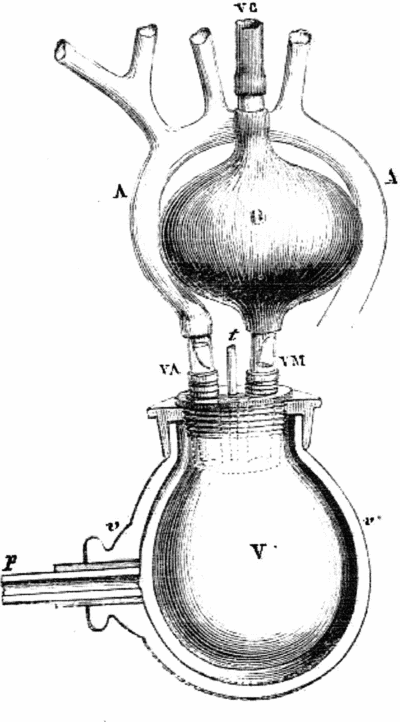
The gap between the instruments producing haemophysiological data and the sphygmograph measuring the pulse at the surface of a living body was bridged by the procedure Marey called “synthetic validation” (contre-épreuve synthétique; see ibid., 39). This validation was achieved by means of a model both of the human heart and the arterial circulation system. An artifical heart made of glass, rubber and some other material and suitable to be manipulated in ways that imitated the behavior of the human heart (see fig. 2) (see ibid., 192–193) was connected to an ensemble of rubber conduits representing the arterial circulation system (see ibid., 164).Footnote 7 The various patterns of the circulating “blood,” i.e. the liquid in the model, were then “sensed” and measured by cardiographic and sphygmographic methods, and compared (see ibid., 126–168).Footnote 8
Model of the human heart, created by Marey (from: Marey Reference Marey1863, p. 39).

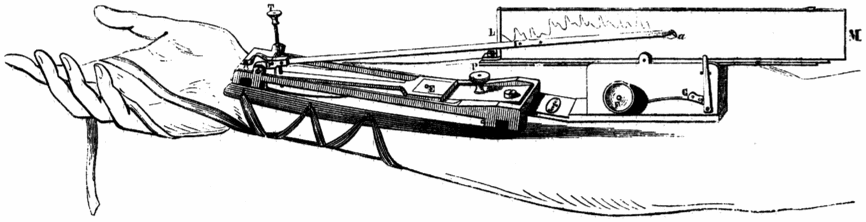
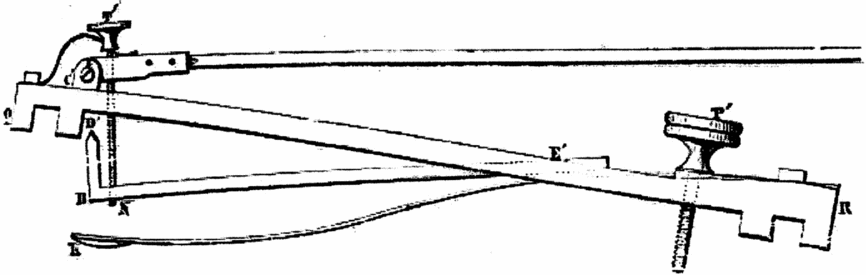
The testing of the sphygmograph took place under laboratory-like conditions. Yet it closely adhered to the precepts of physiological analysis and thus resorted to the application of methods used in physiology to materially inert, but functionally equivalent models. The elasticity of the spring, i.e. of the instrument part in contact with the forearm (see fig. 4 and 5), was gauged via the shape of the tracing it enabled the instrument to produce; the conjunction of the principal parts of the sphygmograph and of the other instrument parts was similarly tested. In short, Marey adapted the pieces of the instrument to the body parts via the model parts, which were thereby guided by the tracings that were compared to the tracings obtained in in vivo haemaphysiology. The tracings therefore turned out to constitute the basic data upon which ultimately rested the technique of how to read and interpret the sphygmographic output. But diagrammatical information, though close to experimental physiology, is far from being physical information.
The shift from experimental haemophysiology to sphygmography proper yielded a device that looked to the eyes of the post-1860 beholders like the image representing it in more or less standard manner in innumerable printed sources authored by Marey and other persons (scholars, instrument makers, doctors, etc.) (see. fig. 5).
The comparison between the main devices used by Marey in haemophysiological experimentation, on the one hand, and the sphygmograph, on the other hand, shows which parts of the former were substituted by those of the latter while functional identity of the corresponding parts was secured. The lengthy metal tubes marked c and v in figure 3, designed for the “sensing” in vivo of the circulating blood close to the animal subjects’ hearts, were transformed into the spring hidden beneath the screw T in figure 4, but clearly visible as K in figure 5, expected to “sense” the pulse of the radial artery instead of the physicians’ fingertips. The rubber tubes connecting the metal tubes to the drums marked te, tv , and tc in figure 3 were transformed into the parts connecting the spring to the lever of the sphygmograph marked E, P, and T in figure 4 and marked E', N, B, D, P' t, R, and T' in figure 4. And finally, the writing devices marked le, lv, lc, R, and M in figure 3 were redesigned as both the stylus, i.e. the lever, and the clockwork (marked a, L, and M in figure 4, and unmarked, but visible as to uppermost horizontal part fixed at the upper end of R in figure 5) causing the plate on which paper is fixed to receive the traces of the sphygmograph.
Marey's sphygmograph (from: Marey Reference Marey1863, p. 180).

Cardiographic instruments (from: Marey Reference Marey1863, p. 54).

Schematic illustration of Marey's sphygmograph (from: Marey Reference Marey1863, p. 181).

One of the most detailed descriptions of Marey's instrument not accompanied by any illustration can be found in the Galveston Medical Journal of 1867. It reads thus:
Marey's instrument may be briefly described as consisting of a steel spring, whose free end, covered with a convex plate of ivory, rests upon the artery to be examined, and by virtue of its elasticity exerts a certain degree of pressure upon the vessel. Each pulsation slightly raises the spring, at its distal extremity, and the multiplication of the movement is obtained by means of a very light lever, which moves upon a pivot, the rise of the spring being transmitted to the lever, very near to its centre of motion, by a bar of metal, bent at right-angles, so as to form two limbs of unequal length, the horizontal one being two-thirds longer than the vertical one, which latter terminates in a point. The vertical arm of the bar is pierced by a screw, which, when it acts, establishes a connection between the spring and the bar, and the movements of the former are transmitted to the latter, and through its vertical arm to the lever. To insure the transmission of the movement, the short arm of the bar must be in contact with the under surface of the lever, and this is effected by means of the screw, which also regulates the interval between the point of the short arm and the under surface of the lever, as well as the amount of pressure exercised upon the artery by the spring. The lever carries at its free extremity a little pen, which, filled with ink, registers its movements upon the paper, covering a plate, and this plate is moved, at a uniform rate, forwards by means of watch work, placed beneath in the case. The passage of the plate takes ten seconds; the watchwork is wound up by a button, and a small regulator starts and stops the plate. The instrument is applied to the arm, when the radial pulse is to be explored, by elastic bands, a pad being previously placed on the under surface of the limb for the greater comfort of the patient, and to take off the pressure of the bands. (Clymer Reference Clymer1867, 591–592)
There is a parenthetical note that Marey's sphygmograph was exhibited at the London World's Fair of 1862 among the then outstanding new inventions (see Exposition universelle 1863, 726–728).
3. Ernst Mach's Painstaking Examination of Marey's Sphygmograph
Alexander Rollett, Ernst Brücke's assistant, was the first in all likelihood to present Marey's sphygmograph to the Austrian medical (and, more broadly speaking, medico-scientific, i.e. physiological, cardiological, etc.) profession. His informative report, based on one of Marey's illustrated essays on sphygmography (Reference Rollett1861), was published in the yearbook of the Viennese medical association covering the association's scholarly and social activities of 1861. It is unknown whether Brücke asked Rollett for a report, or whether Rollett, who was then doing physiological research on the nature of the human blood, suggested that Marey's sphygmograph be reviewed.
Rollett's report briefly described the workings of the sphygmograph. One thus learned that the instrument ought to be applied to the forearm by means of an armlet onto which the “two most important parts of the apparatus are fixed, viz. the lever and the plate which, moved by a clockwork, glides along a groove” (Rollett Reference Rollett1861, 308–309). Rollett then considered more closely the lever. It consists of wood, its endings being made of metal. The lower end is fixed on a pivot around which it moves, the opposite end carries a very thin lamella ready to translate the lever's movements into curves registered on the plate. Hence, the lever is such that it performs perpendicular movements. The magnitude of these movements is determined by the movements performed by a small bar (or arm) which, in turn, is moved vertically by a spring. Thus, the lever moves up and down following the impulse it receives from the spring which, in turn, moves according to the movements received by an artery on which the spring is both fixed and pressed.
The curves (or tracings) “are best obtained on glossy paper covered by soot applied to the writing plate of the apparatus. The curves are fixed by means of varnish” (ibid., 309). And Rollett added:
This much [is to be remarkedFootnote 9 ] on the structure of the sphygmograph. It would be easier to represent this structure by means of a drawing, yet one may infer from the description above that operating the instrument is made most easy and that the apparatus, as far as its use is concerned, is likely to enrich diagnostic expedients in our wards. (Ibid.)Footnote 10
The subsequent sections contained further remarks on Marey's sphygmograph. Rollett asserted that it would register three characteristic properties of the pulse: the frequency, the form, and the size. Marey's instrument was able to achieve this more accurately than even the most experienced physicians sensing the pulse on the radial artery, and the sphygmograph's tracings would make interpretations of perhaps delicate, and at any rate hardly communicable sensory impressions meaningless (see ibid.).
Rollett then drew attention to some controversial aspects of sphygmography. The report stated that each pulsation was rendered (i) by an ascending line, which visualizes the diastole [sic! Rottet should have mentioned ‘systole’ rather than ‘diastole’.], (ii) by an apex of varying shape (either slightly inclined upwards, or slightly inclined downwards, or angular), which visualizes the onset of the systole [sic! Rollet should have mentioned ‘diastole’ rather than ‘systole’.], (iii) and by a descending line, which visualizes the decreasing pressure exerted on the vascular wall by the blood while flowing towards the heart during this phase of the pulsation.
It was the descending line (iii) which gave rise to controversies. In Marey's curves, most descending lines displayed undulations, whereas other instruments yielded ascending and descending lines of very similar outlook (the tracings of pulsations therefore resembled sine-shaped waves of a tone of constant pitch). According to Rollett, Marey was convinced that the descending lines truly represented (or visualized or expressed) the phenomenon of dicrotism, while smooth sinusoidal waves were biased, their shape resulting from the inertia of the parts of instrument (cf. ibid., 310).
In spite of its brevity, Rollett's contribution was historically significant on several counts. It documented an early reaction to Marey's sphygmograph several months before Mach began his sphygmographic research. Because it was published by a journal of considerable distribution, it was likely to reinforce the interest of physiologists and practicing physicians in the instrument. In addition, the report mentioned two physicians/physiologists who were already using Marey's sphygmograph: Carl Wunderlich at Leipzig, who was favorably impressed by the instrument, and a physician called Meissner who denied any merit to the instrument.
Such second-order remarks on opinions published here and there are indeed indicative of the fact that Marey's instrument became known outside Paris within a relatively short period of time. But it also shows that its reception was far from being unanimously favorable.
The concluding sentences of Rollett's report made it clear that Marey's instrument was in need of some rigorous examination. Did the tracings reliably represent (or express or visualize) the physiological events taking place in a living organism, or were these tracings more or less distorted due to mechanical imperfections of some part (lever or spring or clockwork) of the instrument?Footnote 11
Marey had been strongly promoting his invention. He had repeatedly assured the medico-scientific profession that his instrument would yield impeccable data. Yet, it remained unclear to at least some observers of the early 1860s whether the instrument as a whole, whether some of its parts, whether a faulty handling, or a misreading of the curves had to be blamed for the uncertain and therefore somehow controversial status of this instrument.
Concerns relating to the proper functioning of Marey's sphygmograph were frequently uttered in later years by other authors as well. Thus, on March 30, 1867, a certain Thos. Hawksley sent the following note to The Lancet:
I have been using the sphygmograph de Marey at the Infirmary for Consumption, Margaret-street, and when my observations are more complete shall be glad to lay the result before the profession. Meantime, will you allow me to communicate a little alteration in the instrument, which has for me much facilitated its employment, and which may be useful to others. It is, that instead of using a slip of paper or cardboard, and india ink placed on the indicator, I have adopted a slip of glass blackened with lamp-smoke. By this I obtain two advantages—1st. A saving of friction, and therefore of impediment to the movement of the delicate indication. 2nd. Freedom from the uncertainties and the trouble of ink applied to the indicator. (Hawksley Reference Hawksley1867)
Later on, the physician Francis Anstie published in The Lancet a note relating the modifications to which Marey's instrument was subjected in Great Britain. These modifications were said to be necessary since “ingenious and beautifully manufactured as the original French instrument was, it possessed certain faults which rendered its employment by anyone, except an adept, worse than useless, so many were the fallacies to which its indications might lead when it was applied in an improper manner” (Anstie Reference Anstie1868, 783). This author then listed the modifications suggested by Sanderson, Meyer, Hill, and others (ibid., 783–784).Footnote 12
In the late 1860s, sphygmography was already widely promoted in France. But reservations and warnings were also voiced more often than not. For example, Paul Lorain's monograph on the human pulse described some precautions to be taken in the use of sphygmographic instruments (Lorain Reference Lorain1870, 106–112) and listed errors that occur with the improper handling to the apparatus (ibid., 113–115). Note Lorain's significant remark on his yearlong acquaintance with the sphygmograph:
I conclude by saying that if I had to recommend a sphygmograph, I would prefer a large instrument that is endowed with a light lever and sufficiently long to amplify the graphic image; and that the instrument be endowed with a fast rather than slow plate, for when the latter moves fast, the later or descending part of the tracing offers a cleaner unfolding. I shall finally add that I have used the same instrument seven years and that therefore the tracings which I show are neatly comparable with one another. (Ibid., 114–115)Footnote 13
The more or less outspoken, more or less detailed appraisals of the instrument focused either on manual work done by physicians (correctly fixing the sphygmograph on patients’ forearms or such matters), the handling of the clockwork, or some mechanical issue to be corrected by a slight modification of the apparatus.Footnote 14 To put it differently, these assessments were empirical througout. The findings reported were empirical; the means for balancing out the errors recognized in the use of the instrument were empirical; and the advice on how to apply the sphygmograph so that the blamed errors be avoided were empirical. None of the criticisms that materialized between 1861 and the late 1860s addressed the physical properties and the mechanical workings of Marey's sphygmograph as such.
It is not known when (exactly) and why (exactly) Ernst Mach got involved in experimental research with the aim of assessing the reliability of Marey's sphygmograph. But it is undeniably a fact that Mach got seriously involved in research on sphygmographs, whereas Marey was intensively involved in research with his sphygmograph.
Thoroughly checking Marey's sphygmograph as a whole and likewise checking its single parts was Mach's key aim. The intention to examine this instrument must have developed shortly after the new instrument had become known in Vienna. The outcome of his analysis, however, was another instrument, up to the present day never fully appreciated, which came to be conventionally named as “Mach's sphygmograph.”Footnote 15
Mach published all in all six contributions on issues directly referring to sphygmography (Reference Mach1862, Reference Mach1863a, Reference Mach1863b, Reference Mach1863d, Reference Mach1863e, Reference Mach1870). Three of them (Mach Reference Mach1862, Reference Mach1863b, Reference Mach1863d) addressed the physical workings of the instruments; one (Mach Reference Mach1863a) dealt with the properties of oscillating masses embodied, among other things, in devices for the registration of pressure such as barographs or Carl Ludwig's writing haemometer (see Ludwig Reference Ludwig1847); another one dealt with the waves in tubes (Mach Reference Mach1870) and the handbook of physics for physicians, in which Mach summarized what people of the medical profession ought to know about the physics of liquids, instruments used in medical observations such as kymographs, etc. (Mach Reference Mach1863e).
The various experiments were performed by Mach in Adalbert Duchek's laboratory (see Mach Reference Mach1862, 174). Duchek acted at that time as chief physician of the garrison hospital in Vienna, specialist of heart diseases, and co-editor of the journal of the Viennese medical association.Footnote 16
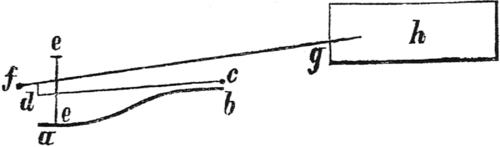
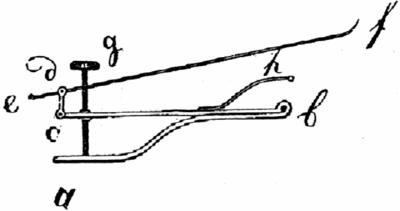
After having succinctly described Marey's sphygmograph, Mach drew a general schema of this instrument (1862, 159). This schema was meant, as it were, to be applicable to any similar device, whatever its design, the materials used for its construction, etc. In order to make the reading of the following slightly easier, I reproduce this one schema together with a much less abstract schema of Marey's sphygmograph to be seen some pages later in Mach's essay. (I thereby qualify the first schema as ‘general’, ‘gS’ for short, in contradistinction to the schema of Marey's instrument, ‘mS’ for short.) (see figs. 6 and 7).
General schema of any sphygmograph (gS) (from: Mach Reference Mach1862, p. 159).

Schema of Marey's sphygmograph (mS) (from: Mach Reference Mach1862, p. 168).

Mach postulated that Marey's instrument as well all other sphygmographic devices be considered as the sum of two masses. On the one hand, a sphygmograph (whatever its architecture) needs to “take” the pulse by physical contact with the radial artery mediated by the flesh in between the artery and the instrument. All parts of any sphygmograph brought in contact with the radial artery constitute one mass (A in gS). An example or instance of mass A is given by the sum of the parts ab, cd, and ee in mS.
Any sphygmograph whatever its architecture needs to have a writing device. Mach postulated that this writing device be considered as mass B in gS, which corresponds to the schematically drawn lever, i.e. stylus, fg in mS. (Hereafter, I shall use both terms as synonyms.)
In order to yield curves, mass B needs to be moved by mass A. Hence, A and B may be taken to form one single mass if, and only if, the movements of A translate without loss into equivalent movements of B.
Mach first considered the behavior of A and B from a purely theoretical point of view. He thereby had to work on the following points:
-
(i) Given that the masses A and B at time t0 are assumed to be in a state of equilibrium (in 0 in gS), and that A and B be moved by some vessel (i.e. that A and B be lifted and then return to a state of equilibrium, and be lifted again only to return to their initial state, and so on; hence oscillating around 0 towards x and towards x’ respectively in gS), do A and B, when oscillating from one state at t0 to the next state at t1 and back to the initial state at t2 =t0 really follow the movements of the pulsating vessel? Or do A and B rather move under the influence of the modifications within the vessel, on the one hand, and also, independently from these modifications, due to a momentum of their own, on the other hand? If so, the outcome of the sphygmographic measurement would be biased, since the traces, curves, lines, or inscriptions would show something that is not entirely caused by the object itself to be measured.
-
(ii) Given that B in turn is moved by A (in gS; this corresponds to fg being moved by ab, c, d, and ee in mS), does B oscillate in total accord with A or is it likely that its oscillating movements deviate due to some momentum of its own from the oscillating movements of A? In addition, do the oscillatory movements of B impinge upon the movements of A? To put it differently, if the movements of A are taken to be wavelike, and if the movements of B are also taken to be wavelike, do these waves interfere with one another, or are they under certain circumstances such that, theoretically speaking, no interference is taking place at all?
The behavior, considered from a purely mechanical point of view, both of A and B considered separately and in relation to one another depended, as Mach showed, on a variety of factors, such as the amount of mass of A and B, the elastic modulus of both A and B, the resistance A has to overcome when moved by the vessel, the resistance B has to overcome when being moved by A.
The theoretical formulation of the laws governing the behavior of M (i.e. of A and B) on the one hand, and of the laws governing only B, on the other hand, permitted Mach to establish the ideal material (and physical) conditions of any instrument designed, as was Marey's sphygmograph, to measure and put on paper phenomena of any pulsating liquid contained in an elastic vessel.
It resulted from these considerations that the movements of the vessel will translate with the least loss and thus produce tracings of maximal similarity if M’s flexibility is chosen close to 0 while its mass is minimal. However, under such conditions, the oscillatory movements performed by M (i.e. by A and B) are extremely small. But even these minimal movements of M are made visible by a lever (i.e. B in gS, and fg in mS) which translates these movements into larger movements in h (according to mS, i.e. the slender piece which is destined to imprint its movements on paper).
All this rests on the assumption that mass B as such (the whole stylus) be of minimal weight and minimal flexibility. However, if it possesses too little mass, while being minimally flexible, the upper end g of mass B (fg in mS) would either move beyond a theoretically existing limit, given the behavior of A, and/or not undergo descending movements in accordance with the oscillating mass A.
Mach considered from the theoretical point of view the sphygmographic procedure in reverse. This is to say that, instead of unfolding the measurements of throbbing vessels by means of any abstractly considered device capable of inscribing curves onto paper, he raised the following question: how does the liquid contained in the vessel behave from a purely theoretical point of view if inferred from the shape of curves inscribed on paper? In other words, what can one know of the vessel's content when considering the shape of curves drawn by the stylus, if, and only if, the stylus translates without loss the oscillating movements caused in A and B by the input movements of the vessel?
The latter theoretical considerations showed that the visible curves written by the stylus on the paper fixed on h (in mS) would theoretically come closest to the dynamic processes taking place within the vessel, if one were able to determine at the outset the law of resistance under which the instrument (i.e. A and B according to gS) is working. In other words, if one knew the law of resistance proper to an instrument (whatever its architecture), one could deduce the measurement of the object of investigation (the vessel as container of moving liquid) from the shape of the curves produced by the instrument (cf. Mach Reference Mach1862, 166).
Mach asserted that he did not measure the resistance of the instruments available to him, and Marey's instrument did not lend itself to such measurement, for its construction was faulty – whatever this may have meant in particular (were the parts of the sphygmograph at hand too loosely fixed to one another, and/or did the stylus rub incoherently paper of quality q1 rather than doing it with paper of quality q2 , or possibly both?) (ibid.). Thus, pulse-traces recorded on paper would, theoretically speaking, have allowed one to deduce haemodynamic processes taking place at the time of the measurement in the radial artery. Granted, such a deduction would have been feasible merely under conditions of an exact measurement of the law of resistance holding true for the instrument under test conditions. And thus any physiologist or medic could have been able to determine the haemodynamic processes even if the curves had been slightly biased, since instruments whose spring would have been rigid (endowed with a strong p2 , as Mach put it) and would have been neatly fixed upon the radial artery, would have been much more reliable than instruments with a flexible spring loosely applied to the radial artery. Marey, in contrast, never approached the pulse-traces as candidates from which to deduce haemodynamic processes taking place in an organism. Precision, for him, rested upon analogies or similarity of shapes of traces collected from organisms of various species as well as from physical models of the heart and of the network of blood vessels.
4. The Experiments Reconstructed
One may also infer from Mach's contribution to the theory of kymographs (note again that sphygmographs were particular instances of a generic instrument, the theoretically ideal kymograph) that one part of his program – thoroughly checking Marey's instrument – ended up in partial failure because he couldn't determine its resistance. But he experimentally checked this instrument as far as possible. What follows is a summary of Mach's experiments.
-
(i) In view of “reaching a rough judgment of the accuracy with which the sphygmograph registers fluctuating pressures” (ibid., 168), Mach applied the instrument to a short rubber tube filled with water. After having firmly closed one end of the tube, a syringe was used in order to change the pressure inside the tube. The action of the syringe and the fluctuating water pressure were registered at the same time on the plate of the sphygmograph (marked h in mS, see above p. XX), the syringe's beats being registered on the backside of that plate. The sphygmograph translated the varying input into curves, whereas the writing device attached to the syringe produced straight lines. It was found that there existed a significant correspondence between these tracings. But when the syringe was forcefully set in motion at high rate, the sphygmograph's registrations no longer matched those of the syringe (cf. ibid., 168–169).
-
(ii) In order to determine the causes of the lack of equivalence noticed in the data of this first series of experiments, Mach examined one by one the various parts of the instrument, beginning with the lever (according to the narrative given in his report submitted to the Academy of Science, the lever marked f and g in mS above, see p. XX). The lever was “long, thin, and elastic,” thus it could undulate according to a momentum of its own and therefore mix, as one could say, its own oscillations with those caused by the varying pressure to be registered.Footnote 17
While the clockwork was running, Mach lifted the lever and then let it fall, so that its proper oscillations were registered according to the procedure indicated above in (i). He discovered that the lever oscillated with high frequency. The duration of these oscillations could be extended by way of increasing the lever's gravity; Mach achieved this modification by suspending some small object of modest weight fixed on a thread. Hence, “the oscillations caused by the lever's fg elasticity are of noticeable duration only when the gravity is made to increase artificially” (ibid., 170).
When performing the experiments of this series, Mach found out that irregularities occurred. It seems that these irregularities were not expressed in numbers, but rather were noticed when the researcher compared the tracings. Yet, the tests and the data on paper made evident that these irregularities could not be caused by the lever's oscillations.
-
(iii) Mach also found out that the spring (ab in mS) oscillated with 300 Hz, i.e. faster than even the fastest pulse (cf. ibid.). Moreover, the duration of such oscillations was very small, especially when the spring was forcefully hit, a circumstance of no importance for the application of the sphygmograph in medical diagnostics or in physiological research, since such concomitant oscillations would not happen then.
-
(iv) The sphygmograph was then applied again on rubber conduits, this time, however, on conduits of various length (from 3.4 m down to 0.06 m). Mach was keen to determine whether the instrument's oscillations would reverberate in the hermetically closed water conduit and thereby bias the registration of the pulse. He observed that such effects did not occur, except when a piece of metal of 6 grams was added to the stylus), but such an artificially created situation did not correspond to the conditions under which the pulse ought to be registered.
-
(v) The instrument was applied again at one end of tubes of various length, and a wave was initiated at the other end of the conduit either by way of its being hit or by some other way of modifying the shape of the conduit. This time, however, effects of reverberating waves did occur. But according the data obtained in (iv), they could not be caused by the instrument itself (cf. ibid., 171). According to the findings thus obtained, Mach stressed in a later passage of his contribution that “due to the application of the instrument, the waves of the pulsating blood in the arteries may suffer small alterations” (ibid.). Further experiments would have to find out in which way and to which degree such secondary effects may happen. But the research on this topic “would by necessity resort to means independent of the sphygmograph” (ibid., 173).
-
(vi) A final series of experiments concluded Mach's investigations as far as they were reported in his contribution. He fixed the instrument on a material support so that the spring (ab in mS) could move freely. A piece of metal (of unknown weight, since Mach simply called it p without further mention) was attached to the spring. When the clockwork was set in motion, and the experimenter's hand suddenly lifted p, the pressure exerted on ab reduced itself accordingly by the amount of p. It turned out that the sudden decrease of pressure was adequately registered by the instrument in each instance.
Mach's assessment of Marey's sphygmograph was all in all positive, so that he could recommend the instrument to practitioners in the medical profession. But he added that it would still “be premature to deduce from kymographic curves the curves of the blood” (ibid., 173–174).
Mach's contribution dealt with above was completed towards the end of March 1862 at the latest, but most probably earlier, since it was submitted to the meeting of the Academy of Science held on April 3 of that year (these meetings were prepared more or less in advance; since Mach was not a member of the Academy yet, his contribution had to be presented by some “patron,” a full member of the illustrious body). But both theoretical and experimental work on the sphygmograph went on beyond April 3, 1862. Witness Mach's memoir on oscillating bodies submitted to the Academy of Science read on December 11 of that year, as well as a contribution dealing with the sphygmograph of his invention that was made public at the regular meeting of the Academy on January 7, 1863.
Mach divided this latter contribution into two distinct parts (cf. Mach Reference Mach1870). The first part was devoted to the experimental findings reported in the examination reconstructed above; the second part presented one suggestion on how to improve Marey's sphygmograph.Footnote 18 It turns out that this suggested improvement motivated Mach to design an instrument of his own and to have it made by the Viennese clockmaker Jacob Thoma.
In sum, the experimental testing of Marey's sphygmograph yielded one result: the instrument could be recommended for medical use. But Mach's findings suggested that, if the spring were, as one might say, “stimulated” by some regular traveling wave, the lever would produce adequate tracings. When, however, the spring was first sharply and then less sharply moved in an upward direction, it was likely that due to gravity, the lever lost contact with the paper on which it was supposed to write. And when the spring moved rapidly in a downward direction, the lever would lose contact with the spring, due to the friction caused by the paper on which the tracings were to be written. This meant that, under some not too irregular conditions, the physical contact either between the lever and the clockwork (fg and c in mS), or between the spring and the lever (ab and fg in mS) was lost. In both cases, the lever behaved as it could, not as it should. Mach also provided a graphic illustration for the second case (see fig. 8). Mach could now argue as an expert of experimental physics against “certain peculiarities of the curves due to a bias of the instrument not be ascribed to the pulse” (ibid., 55).
Mach's schematic illustration of the revision of Marey's sphygmograph (from: Mach Reference Mach1863, p. 55).

It seems that the loss of physical contact between spring and lever was the key to the suggested revision of Marey's instrument as well as to the design of another, new sphygmograph:
As early as April 1862, I expounded the shortcomings of Marey's instrument to Mr Sedlaczek, an expert in mechanical instruments at Vienna. I put forward the idea of modifying the sphygmograph so that the lever de [in Mach's schematic illustration, see fig. 8] followed most closely the movements performed by the spring ab. This would easily be achieved with the help of a piece directly connecting ab with de. For the construction of the modified instrument, Mr Sedlaczek sought the cooperation of Mr Thoma, clockmaker at Vienna. However, due to various troubling circumstances, the instrument could not be finished, so that the experiments are to be regarded as tentatively concluded only now. (Mach Reference Mach1863b, 55)
Further experiments were therefore planned or at least not excluded given the possibility that other issues relating to either Marey's sphygmograph or Mach's own instrument could be faced. I have not been able to find any document concerning the experimental procedures to which this new instrument may have been subjected either before January 1, 1863, or after.
Mach concluded the presentation on his instrument in some historically significant lines:
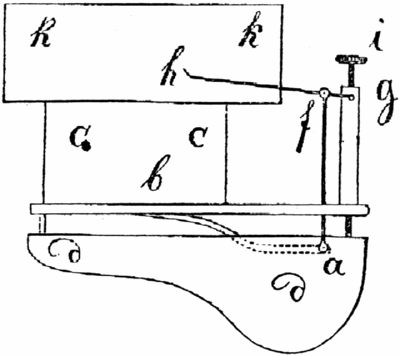
Another form of my improved sphygmograph is to be seen in fig [9], which is neatly graspable by anybody knowledgeable of Marey's instrument. The spring ab adheres firmly to the clockwork cc, which is also used as support to which two plates of metal stick firmly. These plates function as a device for applying the instrument upon the arm. The connection between the spring ab and the lever gh, which rotates around g and writes upon the plate kk, is established by means of a little stick, made of metal and provided with joints at a and f. The axis g can be lifted or moved downward thanks to the screw i.” (Ibid.; emphasis added)
Schematic illustration of Mach's sphygmograph (from: Mach Reference Mach1863, p. 56).

And after having added some advice concerning the handling of ink drops at the upper end of the lever (h), he asserted:
In many respects, this second form [i.e. version] appears to be more favorable than Marey's instrument. One may be assured
-
1 that the stylus without exception follows the movements of the spring;
-
2 that the instrument is very easy to handle and that it is applicable to nearly every artery; and
-
3 that the design is simpler since all superfluous pieces have been removed and that the instrument can be made at a significantly lower price. (Ibid.)
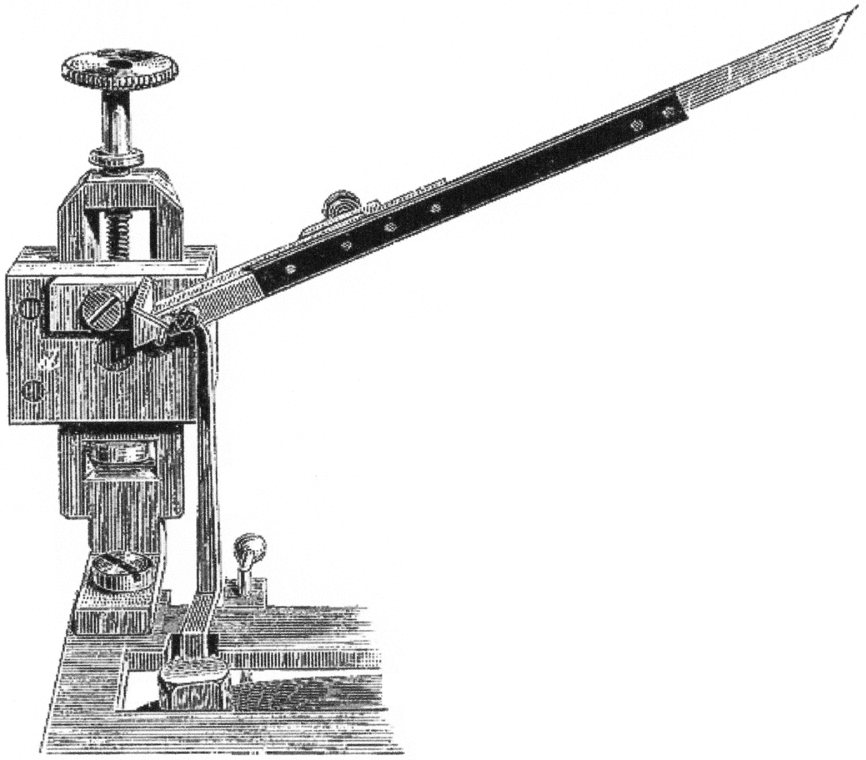
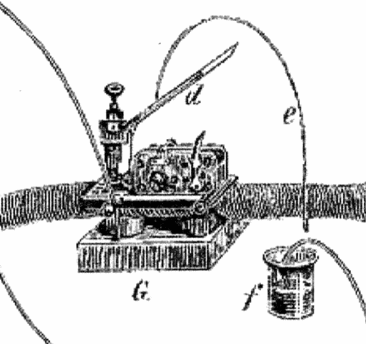
In spite of much research, I did not come across a document telling at what price Mach's sphygmograph was sold by Mr Thoma. And there remains no trace whatsoever of both Mr Thoma's and Mr Sedlaczek's contribution to the design and the proper construction of the instrument. The only less than schematic representation of the new device has been provided by Elie Cyon (see figs. 10a and 10b). In hindsight, one may infer from the documentation that Mach's sphygmograph, though less expensive than Marey's, experienced by far no comparable distribution, its use was rather scarce in comparison, and unlike Marey's instrument, it hardly ever received much public attention – except in Vienna.
Representation of Mach's sphygmograph (from: Cyon Reference Cyon1876b, table 11, n° 6).

Representation of Mach's sphygmograph applied to a rubber tube (from: Cyon Reference Cyon1876b, table 11, n° 4).

The fate of Mach's extensive studies of the sphygmograph as one particular instance of kymographs can be reduced to three aspects: to Mach's use of his instrument, to the (as one might say) institutionally organized comparison between his and Marey's sphygmograph at both the Academy of Science and the medical association, and to Marey's modifying his own instrument according to Mach's suggestion relating to the solid piece af mentioned above.
In 1870, Mach published yet another article which was loosely related to the examination of Marey's sphygmograph. But rather than the instrument and its properties as such, this article addressed the physics of vessels filled with liquids. It thus addressed, to put it less broadly, the physical features of arteries as one instance of conduits containing or transporting liquids. This contribution was partly a latecomer. Indeed, it reported experiments which had been performed in 1862 – exactly at the same time as the experiments dealt with in the earlier articles written and published in the narrowly sphygmographic context.
Mach confessed from the outset that he hesitated to make even some results of these experiments public. The results had not given full satisfaction, in spite of the impressive number of experiments he had made; in addition, the means at his disposal were such that they did not provide “sharp results” [scharfe Resultate] (Mach Reference Mach1870, 71). “But since, as I believe, this subject matter is still not taken into account with full consideration even in the most recent publications, I feel compelled to make some observations” (ibid.).
Mach did not convey ample information on the experimental design(s). The detailed reconstruction of the experiments is therefore hardly possible. A rough summary must suffice.
-
(i) Once waves in conduits filled with liquid were produced by beats, the propagation of these waves usually reached such a speed that it could not be measured by Mach's own instrument – as he now put it: by “Marey's sphygmograph as improved by myself” (ibid., 72). Since the article reported experiments performed a long time before Marey had patented his improved instrument in 1869, the expression to which Mach resorted denoted his own, i.e. the new instrument. He even seems to have made use of two or more exemplars. At the end of the article, he made reference to “a system of sphygmographs” (ibid., 74). Had he used merely one instrument, he could not possibly have concluded from the measurements obtained that the speed of the said waves usually was beyond measurement. This implied that there were two sphygmographs at stake applied to the conduit, one located close to one end where the impulses were produced, the other at any other point along the tube. Since Mach had tested his sphygmograph and even had deemed it to be more reliable than Marey's, one may assume with confidence that the test under discussion relied on two sphygmographs working in parallel.
-
(ii) But the results summarized in (i) need to be qualified. Mach observed that the speed of waves in vessels containing mercury was comparatively slow, so much so that it could even be seen. The speed of waves depended not upon the viscidity of the liquid or upon the rigidity of the containing conduit(s), but only upon the specific weight of the liquids at stake.
-
(iii) Since the measurements yielded “inconsistent results” (ibid., 72), Mach doubted that the propagative speed of waves might be declared a constant independent of the waveform and of the intensity of waves. Notwithstanding this inconsistency, he concluded that “the speed of propagation is so great that it can be assumed to be infinite in all physiologically relevant cases,” which is to say that it was nevertheless, but tacitly introduced as a physical constant applying to physiological measurements of waves in conduits, i.e. of bloodstreams in organisms of various species, and applying to pulse and to other parameters of blood circulating in a closed system of interrelated vessels.
-
(iv) Next, Mach examined the shape of waves at points more and more distant from the point where the liquid received one or more beats. “If we initiate the movements at one point of time at one place of the tube, the tube as such will soon be moving; the movement will then depend in part on the irritation [Erregung], and in part upon its initial state. Given that there are various factors of resistance, the impact of the initial state rapidly vanishes” (ibid., 76). In other words, the physical properties of liquid determined its behavior once it was, as one may now say, “irritated.” It should be noted that Mach's examination made use of a pump which produced rhythmic movements at one end of extended conduits. The test also showed that the waveform remained the same whatever the distance from the pump.
-
(v) However, it also became clear that both the propagation of waves in closed vessels and the waveforms were subject to the law of coexisting movements. This is to say that Mach inferred from his data that waves undergo deformations. The latter depended upon the degree of viscidity of the liquids contained in the experimental conduits.
5. The Comparison
Sometime in late winter 1861, Duchek also had begun with his tests of Marey's instrument. There is firm evidence that he presented a series of results of his examination to the Viennese medical association at its meeting of May 9, 1862.
Professor Duchek talked of Marey's sphygmographion [Pulszeichner], described the structure of the instrument and demonstrated its practical application. He also showed a considerable number of sphygmographic tracings which he had collected in his clinic. These tracings constitute the primary material of extended research on the clinical use of the sphygmograph; the speaker promised to report on further results in due time to the association. (Widerhofer Reference Widerhofer1862)
At the time of Duchek's presentation, Mach had already got in touch with Sedlaczek and Thoma in view of creating his own sphygmograph. Which is to say that Duchek and Mach were working at the same time at the garrison hospital – one on the wards and possibly in his laboratory, the other most likely only in the laboratory. One may also expect that both men had several conversations relating to sphygmography in general as well as to Marey's instrument. Duchek eventually published his own sphygmographic research in early 1863. The publication made evident that he was well informed of Mach's endeavors, for he stated in that article:
I believe to be allowed to dispense here with the theory and the construction of the instrument [i.e. Marey's sphygmograph], since Mr Mach has communicated the results of his research done with this instrument in part in the preceding article, and in part in earlier academic contributions. In what follows, I shall therefore report merely on the observations made by means of the instrument on healthy as well as ill persons. (Duchek Reference Duchek1863, 50)Footnote 19
It is, indeed, hardly imaginable that the two men would not have discussed various matters concerning their research, while Mach was granted the help of one of Duchek's collaborators, and while Mach was performing experiments which were intended to complement, from the point of view of physics, the tests performed by Duchek from the (broadly speaking) physiological point of view. But it remains still unclear who introduced Mach to Duchek, whose incentive it was that led Mach to envisage doing thorough physical checks of Marey's instrument, and who acted as the maître d'oeuvre at backstage.
I suspect it was Ernst Brücke – but I have no evidence to offer. The famous physiologist was at that time both the chairman of the medical association and an esteemed member of the Academy of Science. Due to the vast range of interests (from micro-botanical experimentation on Mimosa pudica to general physiology, visual perception, and experimental phonetics), his personality resembled more an eighteenth-century polymath than a scholar expert in just one discipline or even in one field of research. He could easily appreciate what Mach would contribute to the improvement of cardiological diagnostics as well as to non-invasive physiology of the human pulse; he could also easily appreciate what the connection between Duchek (who was recognized as a major specialist of heart diseases) and Mach, the promising young physicist, was likely to promote.
It also seems to me that Brücke's approval was necessary for Mach's being invited to present his instrument before the medical association on the January meeting. Hence, either Brücke was advised by someone to initiate the public demonstration of the new sphygmograph, or it was Brücke himself who took the initiative – then, however, for both demonstrations on January 8 and January 9.
Mach must have known what kind of expectations had arisen and what he would have to do in view of satisfying these expectations around mid-December 1862. In a letter dated December 24, he wrote to Rollett (the letter was posted from Schönkirchen):
Thursday, January 8, and Friday, January 9, I demonstrate my modified sphygmograph at the Academy of Science and at the medical association; please, be so good and announce my lecture for the latter meeting.
I'd truly appreciate if you found time for something like an hour on that evening, so that I could receive your kind advice on several issues.
I wish you, dear doctor Rollett, very enjoyable holidays, sincerely your obedient servant
E. MachFootnote 20
There remains no report from the meeting of January 8 at the Academy of Science. The report on the meeting of the medical association of January 9 reads thus:
Docent Dr Ernst Mach demonstrated two new sphygmographs that are to be regarded as modifications of Marey's sphygmograph. These modified sphygmographs have been made according to the principles based on Dr Mach's theoretical and experimental researches by Mr Jakob Thoma, clockmaker at Vienna. The instruments display several advantages over Marey's instrument. The link between the spring moved by the pulse and the stylus is such that the movements of the latter strictly follow the movements of the former. The new instruments are very easy to handle and are applicable, thanks to their length (of only 8,5 cm), to nearly every artery; in addition, and thanks to the fact that all superfluous parts have been discarded, the production of the instrument is very easy to achieve, hence the price has been lowered. Marey's and Mach's instruments were finally subjected to a practical demonstration. The chairman [i.e. Brücke] voted according to the majority for Mach's sphygmograph, which received much interest and a favorable opinion by the members present at the meeting. A detailed description of Mach's sphygmograph will be published in this journal. (Anon. 1863)Footnote 21
6. Conclusion
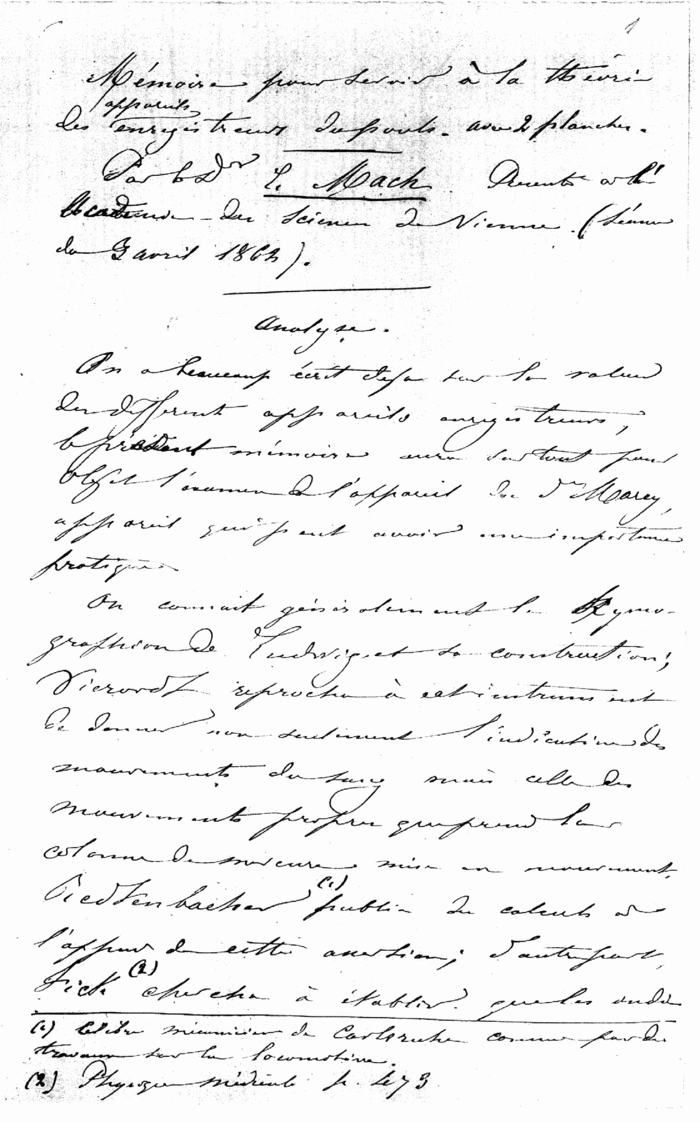
There is no doubt that Marey became aware of Mach's assessment concerning his (Marey's) sphygmograph. Indeed, amongst the papers left in 1904 (many of them have been deposited in the archives in Beaune), there was the fragment of a translation of Mach's article of 1862 (i.e. Mach Reference Mach1862). The text bears Marey's handwriting throughout (see fig. 11).
Marey's handwritten translation of Mach's article on the theory of sphygmographs. Marey Archives, Beaune.

This fragmentary translation has not received due attention in Marey studies, although it is a key document of historical sphygmography in spite of its fragmentary character.
(i) The French-speaking translator is unknown. Marey was not all too fluent in German. In 1860s, he may still have been in possession of linguistic skills that diminished later on. In a letter dated July 19, 1880, to the Hungarian painter Bertalan Székely and mailed to Budapest in response to the latter having sent to Paris an essay, written in German, on the methods of truthfully depicting various horse gaits, Marey admitted to be unfit at understanding what the artist had conveyed in the handwritten piece of German prose.Footnote 22 He could, indeed, decipher Székely's handwriting, but was unfit to understand the artist's German prose. At that time, Marey was obviously forced to rely on someone more fluent in German than he was.
Similarly, he could have felt the need to ask someone for help for the translation of Mach's article. Thus, if one could assume that he was still more fluent in German in 1865 than in later years, he could have worked on the translation himself up to the point where he lost interest in Mach's further developments, or may have put on paper what someone dictated to Marey while translating the German text.
(b) Marey may also first have had the intention to submit Mach's article to some scientific society in Paris or elsewhere in France and then finally decided not to do so. Indeed, he could have read Mach's article and then have dropped the plan to have it published in a decent French translation.
Mach's suggested revision was finally implemented in the second, revised version of Marey's sphygmograph that sold as well as the first version from 1870 on.Footnote 23 Mach's judicious amendment of the design of the sphygmograph thus materially survived in Marey's instrument rather than in the new instrument of the physicist's own invention.
One could also say that the physicalist approach to the instrument's workings had brought about a methodologically relevant and metrologically decisive advance that the empirically oriented, physiologically based approach of Marey could not have provided.
Acknowledgments
The author thanks two anonymous referees for suggestions and critical remarks relating to a previous version of this essay. Thanks also to Moritz Epple for encouragement and help. And wholehearted thanks to my friend and colleague Christoph Hoffmann who, in dozens of conversations over the years, did not show too many signs of impatience, but rather incited me to move on with Mach and Marey.