INTRODUCTION
Livestock water productivity (LWP) is the ratio of water depleted versus the amount of livestock products and services obtained (Peden, Reference Peden, Tadesse, Misra and Molden2007; Van Hoeve and Van Koppen, Reference Van Hoeve and Van Koppen2006). Both LWP and animal production are low in semi-arid areas. Yet, livestock keeping is a potential pathway out of poverty especially for women and because most farmers depend on domestic animals for their livelihoods (Homann et al., Reference Homann, Van Rooyen, Moyo and Nengomasha2007). As the human population grows, livestock numbers and pressure on scarce natural resources, including water, increase, but per capita livestock ownership often declines (Sandford, 2007; Thornton et al., Reference Thornton and Gerber2009). Livestock mortality (>20%/year) is a major constraint to small-scale livestock production (Homann et al., Reference Homann, Van Rooyen, Moyo and Nengomasha2007). Mortality has a detrimental effect on LWP as livestock that have died have depleted considerable amounts of feed and water prior to death but yield little or no benefit. Improved livestock health, feed and fodder production, and management are effective mechanisms for increasing LWP (Peden et al., Reference Peden, Tadesse, Misra and Molden2007). Technologies and management interventions that enable the production of more livestock products and services using less water enhance the water productivity of crop-livestock systems.
Interventions aimed at increasing LWP require more attention to gender (Waters-Bayer and Bayer, Reference Waters-Bayer and Bayer2009). Women constitute the majority (70%) of the rural poor (UNDP, 1995 cited by Van Hoeve and Van Koppen, Reference Van Hoeve and Van Koppen2006). Traditionally women have restricted access to information, technologies, inputs and markets because of their traditional gender-specific roles in livelihood activities such as female responsibility for domestic needs and small stock. In contrast, men control business and large stock. De jure female-headed (single or widowed female) households are the most disadvantaged members of communities and economically the most vulnerable (Rohrbach and Alumira, Reference Rohrbach and Alumira2002). The contribution of women to agricultural activities increases as men increasingly seek off-farm income. Women consequently assume responsibility (feminization of agriculture) for agricultural production, including sale of livestock products (Bruinsma, Reference Bruinsma2003).
Gender relations are local, specific and dynamic. They differ among livestock production systems and change over time (Tangka et al., Reference Tangka, Jabbar and Shapiro2000). Increasing human population densities influence gender relations as they induce more intensive production and offer new market opportunities but impose shifts in labour costs between men and women. (Malmberg and Tegenu, Reference Malmberg and Tegenu2007). Workloads for women in both male- and female-headed households increase while control over outputs and decision-making power decreases (Van Hoeve and Van Koppen, Reference Van Hoeve and Van Koppen2006). Attempts to improve the LWP in crop-livestock systems therefore requires an understanding of specific gender relations and dynamics in order to come up with appropriate recommendations and entry points for technical solutions (Amede et al., Reference Amede, Geheb and Douthwaite2009; Cleaver, Reference Cleaver1998).
The overall objective of this study was to contribute to a better understanding of the impact of gender relations in mixed crop-livestock systems in Nkayi District, Zimbabwe, and how this knowledge can help develop technology and management that increases LWP with equitable gains. The specific objectives of the study were: (i) to identify the different livelihood capitals and to analyse whether gender influences capital distribution within and between households, (ii) to identify livelihood activities and analyse the role of men and women in decision making and management and (iii) to identify means by which LWP interventions can apply a gender perspective.
This study makes use of the gendered sustainable livelihood framework by Van Hoeve and Van Koppen (Reference Van Hoeve and Van Koppen2006) to assess the distribution of households' livelihood capitals (social, human, physical, financial and natural) between male- and female-headed households. It then investigates the role of men and women in livestock ownership, decision making and management within households.
MATERIAL AND METHODS
The study site
The study was carried out in Nkayi District of Matabeleland North province of Zimbabwe. Nkayi has high potential to improve LWP because of the significant biomass production of fodder and crop residues that can be used to feed livestock during the dry season (Homann et al., Reference Homann, Van Rooyen, Moyo and Nengomasha2007).
The agro-ecological conditions in Nkayi are characterized by unreliable rainfall, between 450 and 650 mm per year, and periodic drought spells (Cleaver, Reference Cleaver1998; Homann et al., Reference Homann, Van Rooyen, Moyo and Nengomasha2007). The soils are largely Kalahari sands with low natural fertility. The human population density is relatively high with 30 to 40 people per square kilometre. Semi-extensive farming based on livestock production is the recommended form of land use.
Various external events influenced the social and economic situation and gender arrangements in Nkayi. During the 1950s the government racial and land division strategy was implemented and has endorsed a massive resettlement of households to Nkayi (Cleaver, Reference Cleaver1998). At independence in 1980 the anti-colonial war had contributed to fragmentation of families and disrupted agricultural activities. Since 2000, Zimbabwe's economic crisis led to massive labour migration, particularly men, to work in nearby cities and countries. The spread of HIV-AIDS during the same period has destroyed large parts of the productive population.
The roles and responsibilities of women have also changed substantially in the recent past. Traditionally women were very restricted in their activities. Until the mid 1980s women were not allowed to speak in public. They were disadvantaged in education and could not own and manage livestock. In the past 10 years, Zimbabwe has put strong emphasis on women's empowerment. More women assumed positions of formal authority up to provincial governance. They now play a role as traditional authorities including village heads (Nosizi Dube, District Administrator and Lincon Ncube, Local Councilor, personal communication). Every district has a women's league to support women in their economic activities and welfare. Women's empowerment is also supported by various non-governmental programmes.
Livestock ownership is defined by the family member whose name is attached to the animals. Decision making refers mainly to the responsibility and planning for how livestock products are used (for sale, slaughter or herd growth) and which management activities are to be implemented. Management refers to the actual undertaking of activities like feeding, livestock health control, herding, watering and penning. Livestock ownership, decisions and management activities can be implemented by men or women alone or jointly when men and women exercise the same rights over livestock and plan the activities together.
To compare implications of gender in household headship, households are classified into male-headed, de jure female-headed (single, divorced or widowed women) and de facto female-headed (where the husband is mostly away but contributes actively to livelihood activities and decision making). The de jure female-headed households tend to be economically the most vulnerable, while the de facto female-headed households can be cash rich (Rohrbach and Alumira, Reference Rohrbach and Alumira2002). A baseline study in Zimbabwe found that the majority of livestock keeping households are male-headed (70%) and 30% of the households are either de facto or de jure female-headed (Homann et al., Reference Homann, Van Rooyen, Moyo and Nengomasha2007).
Sampling procedure
The surveys combined qualitative participatory rural appraisal (PRA) tools and quantitative household surveys, implemented between September and October 2008. Four villages were selected, two in northern and two in southern Nkayi District. The PRAs were implemented as one-day workshops in each village. Farmers of different ages, gender and wealth groups were invited. About 30 people attended each workshop. The main purpose of the PRAs was to assess livelihoods situations and how men and women participate in different livelihood activities. The household surveys were implemented in the same villages with random sampling of 35 households per village. The purpose of the household surveys was to assess the livelihood capitals and activities and describe gendered differences in ownership, decision making and management for household heads.
Data analysis
The data were analysed through a combination of qualitative and quantitative methods. The qualitative data were used as contextual information for interpretation of the quantitative information. The quantitative analysis was done by using frequencies, cross-tabulation and chi-squared tests, as well as general linear models (SPSS 13.0 for Windows Release 13, 2004).
A number of variables to characterize households were transformed into categories. The categories reflect relative differences according to local criteria: Age: family building phase (<40 years old), main production phase (40–50 years old) and retirement phase (>50 years); Education: no education (0 years), low education (1–3 years), medium education (4–7 years) and high education (>7years); Monthly income: <Z$1000 = US$ 1, Z$1000–2000 = US$ 1.1–2, Z$2000–5000 = US$ 2.1–5, Z$>5000 = >US$5. The parallel market exchange rate at the time of the time the survey was $ZW1000 = US$1 (FAO, 2008).
RESULTS
Household characterization and livelihood capitals
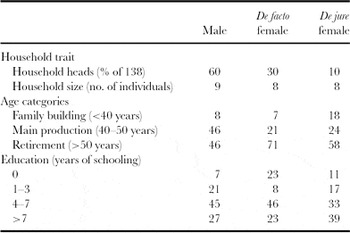
Survey results show that 60%, 30% and 10% of households are male, de facto female, and de jure female headed (Table 1), respectively. Household sizes were 9, 8 and 8 respectively. Most households in all categories were headed by men or women in upper age groups. Householder's assets fall into five major classes: natural, physical, social, human and financial capital. The following description focuses on those most relevant to livestock and water resources management.
Basic characteristics of households headed by males, de facto females and de jure females.

Natural capital
Natural capital consists of the peoples' natural resource endowment including land, water and livestock. Cropland areas available to households ranged averaged 2–3 ha for men and women.
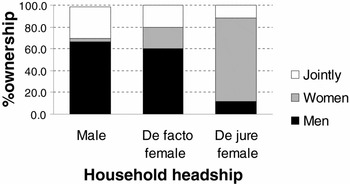
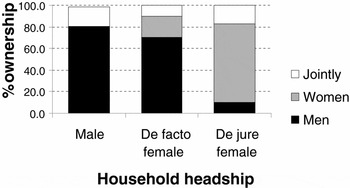
Among male- and de facto female-headed households mostly men own the land, whereas in de jure female-headed households' women ownership and joint ownership are most common. The areas allocated to different crops are similar across all household types.
All farmers rely on rivers, temporary pools, and constructed boreholes, dams and wells for domestic purposes (drinking, cooking and bathing), livestock and gardening. Boreholes are favoured for domestic use because they provide better water quality. The distance to domestic water sources is less than 1 km indicating that most households have relatively good access to water. For cattle, farmers mainly use rivers and during the dry season also dams. Temporary surface water suffices during the rainy season. Trekking to water requires extra time and distance when they rely on permanent water sources. Goats access drinking water from boreholes in dry seasons.
Essentially all households keep at least one species of livestock. Cattle, goats, donkeys and poultry are most important with overall ownership per household being 77%, 70%, 35% and 94% respectively. However, gender differentiated ownership of cattle and goats is one of the most important differences between male- and female-headed households (Figures 1 and 2). In general, men tend be livestock owners even in female-headed households. Animal ownership by women is greatest only in de jure female-headed households. Women are also more likely to own goats than cattle. In many households, male and female headed, de facto and de jure, both cattle and goats are jointly owned. Livestock have multiple purposes. Cattle are most important for draught power, followed by meat, milk and cash income while goats are most important for cash income, followed by meat, milk and manure. Herd sizes are generally small, with an average of six cattle, five goats, and four donkeys and nine chickens. These herd and flock sizes are similar across all three types of households, except that de facto female household heads have more donkeys than both male- and de jure female-headed households (six, four and two respectively).
Goat ownership by household headship and within households (% of 106 responding households).

Cattle ownership by household headship and within households (% of 97 responding households).

Physical capital
Male- and female-headed households had relatively equal access to most physical assets including a dusty road network, access to veterinary services (11 km) and extension agencies (6–13 km). Seventy percent of both men and women walk to these facilities, but some use bicycles (10%), scotch carts (5%) and other means (5%) respectively. About 60% to 65% of households visit the veterinary service 2–3 times per year and extension services agents 3–4 times per year. Farmers do not pay for these services. Market access for large animals ranges from 5–15 km from farmers' homesteads. Facilities for small stock do not exist. Schools exist for all villages, although in some areas children walk for long distances. In general, differences in women's and men's access to physical capital were not great.
Human, social, and financial capital
Most male and female household heads are literate and about 70% have at least four years of formal education (Table 1). Equal access to education and health care prevails.
Membership in farmers' associations is generally low, with more farmers engaging in crop associations (28%) than in livestock associations (3%). Only men are members. Despite low enrolment in livestock associations more than 90% of the households believe they are important especially for aiding in animal health management and rebuilding flocks and herds.
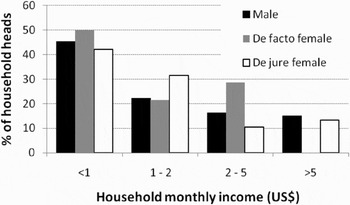
Households have very low cash income. Forty-five percent have monthly incomes of less than US$ 1, 25% between US$ 1 and US$ 2, 16% between US$ 2 and US$ 5, and 13% more than US$ 5 (Figure 3). Incomes reported here appear to be extremely low compared to typical poverty indicators of a dollar or two day. However, this apparent distortion reflects the hyperinflation that overwhelmed Zimbabwe during the study period. The few households with monthly income of more than US$ 5 are male and de jure female headed. Cash remittances are an important source of alternative income which was obtained by 18% of the households. More de facto female-headed households receive remittances (36%) than de jure (21%) and male-headed (14%) households. Some households are members of saving schemes (27%). Most of these savings focus on funeral insurance (71%), and thus are not available for productive purposes. Twenty percent of the households in saving schemes belong to formal saving institutions. Of the households belonging to saving schemes, 36% are de facto female headed, 26% are de jure female headed while 26% are male headed.
Cash income categories (US$) by household headship (% of 136 responding households).

Very few households have access to loans (9%), and these are either male headed or de facto female headed. Not getting loans is due to lack of credit facilities (55%), fear of not being able to repay (17%) and lack of awareness of services (13%).
Decision making and activities related to livelihoods
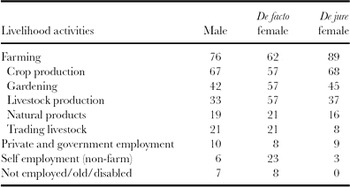
Livelihood activities are a set of actions or strategies in which households engage as a source of their livelihoods. Most households derive their livelihoods from farming (76%). De jure female-headed households are most likely to farm as a primary activity; by contrast de facto female-household heads are least likely to do so. Other activities include private sector employee, self employment and government employment. De facto female-headed households are more often self employed. Farmers' most important activities are crop production, gardening and livestock production (Table 2). Some farmers also practice crafts, collect natural products, and trade livestock and other products.
Percent of male, de facto female and de jure female household heads engaged in major livelihood generating activities.

The major gender differences are that male-headed households practice more crafts work, using men's advantages in physical strength and de jure female-headed households trade less livestock, as they are probably less mobile. Across all household types both men and women often provide labour for crop and livestock production and gardening activities. For livestock-related activities most often men and women provide labour jointly (54%), for both cattle and goats, and in many households men alone provide labour (46%). The PRA discussions show that although women are involved in livestock production they are more involved in activities related to goats than cattle.
Women strongly engage in activities related to domestic drinking water. Across all household types they collect water jointly with men (51%) or alone (42%) in both dry and wet seasons. Watering of livestock is more a male domain. Men alone water cattle (63%) and goats (50%) in both the dry and wet season. In some households women fetch water jointly with men for cattle (35%) and for goats (30%).
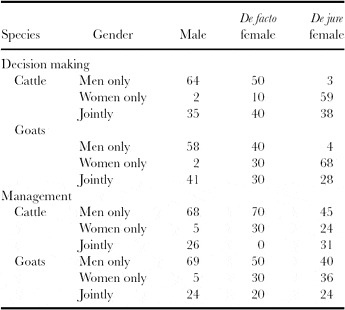
Apart from gender specific differences in activities, variation in decision making is also important. Women have considerable influence on decision making and management in livestock-related activities. Although in male- and de facto female-headed households most often men alone make decisions, in more than 30% of these households' decisions are made jointly by women and men (Table 3). In de jure female-headed households, women make most decisions alone. Although the patterns are similar, it seems that women more often decide about goats than about cattle.
Decision making and management mandates of male, de facto and de jure household heads for cattle and goat management (% of households).

The day to day management of both cattle and goats is most often done by men across all household types, including the de jure female-headed households. In many households women and men engage jointly in the management activities. Women only engage rarely in management activities in male-headed households, but more so in female-headed households. Women are more often involved in the management of goats than of cattle.
Livestock health management
Farmers identified improved livestock health management as a key strategy to reduce livestock mortality and improve productivity. All farmers use traditional and non-conventional methods, applying locally available inputs such as residual motor oil or herbs. Across all household types men are often involved in preventing and treating cattle and goat diseases. Women participate either jointly with men or alone in 30% of the households. Limited access and availability of veterinary inputs and a lack of knowledge about how to diagnose, prevent and treat livestock diseases are major constraints to improving animal health.
Feeding management
Farmers recognize improved dry season feeding of livestock as another important strategy to improve production. Even though livestock rely extensively on rangelands, all farmers increasingly use crop residues to supplement dry season nutrition. No farmers invested in fodder production or purchased commercial feeds. Farmers use crop residues mainly to maintain body condition and survival of the livestock. Most farmers (64%) let animals graze residues in the fields and 36% collect and store the residues and feed them to their livestock at home. However, only 20% of the households invest in improving the nutritional quality of these crop residues, by treating crop residues with salty water. More households do so for cattle (21%) than for goats (11%). Across all household types, women often engage in crop residue treatment, either jointly (40%) or alone (20%), and in 40% of the households this is done by men only. Major constraints associated with crop residue treatment are lack of adequate knowledge and affordability of inputs, such as urea.
DISCUSSION AND CONCLUSION
The purpose of this study is to augment understanding of opportunities to increase LWP in Nkayi District, Zimbabwe, by taking into account key differences in the capacities, opportunities, and needs of women and men. The results from this study raise two important points.
First, male-headed and de facto and de jure female-headed households share much in common. They all had similar areas of cropland and access to education, finances, and veterinary and extension services, and transportation and markets. Households of all types had similar herd sizes. All were desperately poor with incomes much less than a dollar a day. To rise out of poverty, the knowledge, skills, and effort of all household heads will be need. In spite of severe poverty, household heads of all types are literate and have sufficient education that can help enable adoption of intervention options that can lead to increased agricultural production and improved livelihoods.
Second, the results show that major differences exist in terms of the roles of men and women in ownership, management and decision-making related to livestock keeping and animal production. Men clearly dominate in both ownership and decision-making even though women play a major role in animal management. Only in de jure female-headed households were women more likely than men to own cattle and goats (Figures 1 and 2). They were also more like to be involved in farming as a primary livelihood activity. Surprisingly, men were more likely to be involved in animal management in these de jure female-headed households. Women were also excluded from water users' and livestock producers' associations although a minority of men were members.
Research undertaken in the Nkayi District aimed at increasing LWP and production identified a number of promising intervention options requiring technical, policy and organizational entry points (Clement et al., Reference Clement, Haileslassie, Ishaq, Blümmel, Murty, Samad, Dey Hiamangshu and Khan2010). In principle, this implies effective sourcing of feed, improved animal husbandry and marketing of animal products, and conservation of water resources (Peden et al., Reference Peden, Tadesse, Misra and Molden2007). Increasing LWP can enhance the livelihoods of resource-poor farmers primarily because domestic animals make important contributions to incomes, food security and farmers' wealth base. Earlier studies in Nkayi show huge potential to improve livestock health and nutrition and market access (Homann, et al., Reference Homann, Van Rooyen, Moyo and Nengomasha2007). Explicit consideration of gender is important for increasing LWP.
This study indicates that women influence livestock production although they are marginalized in terms of both ownership and decision making. Where women are involved in animal management, performances are similar to households where men dominate. Women are often the end users of livestock, because the cash from livestock sales is most often spent on food and education (Homann, et al., Reference Homann, Van Rooyen, Moyo and Nengomasha2007). Involving women in LWP enhancing interventions may increase chances for their adoption of technology and market development and help achieve poverty reduction and food security. Moreover, livestock keeping is one of the most important gendered livelihood strategies for the area.
Opportunities
Several opportunities for strengthening women's participation in livestock production and management were found. Women are aware of the contribution of livestock production to their livelihoods. Goat production was identified as a special opportunity to increase women's benefits from livestock. Women strongly engage in decision making and management of goats. Many sellers of goats are women at the well-developed goat marketing facilities in Gwanda District (AndrÉ F. Van Rooyen, ICRISAT, and Joseph Sikosana, Matopos Research Station, personal communication). Goat production and marketing support, however, has been poor and started only recently to gain the attention of support organizations. Knowledge of goat water productivity is lacking.
Both men and women have high literacy levels in Nkayi District and both have similar access to education, unlike in many other countries where men usually have better access to education (Peden et al, Reference Peden, Tadesse, Misra and Molden2007). Women are also heavily involved in agricultural training programmes and get more public support than in the past. Women in Zimbabwe are thus in a much better position to take up improved technologies as compared to many other countries such as in Sudan where women did not participate in livestock health training because they were viewed as incapable and with no experience in livestock husbandry (Amuguni, Reference Amuguni2000). Male- and female-headed households are of similar size. Neither appears better off in terms of labour. However, both male- and female-headed households increasingly lack sufficient labour due to migration and the impact of HIV/AIDS. Livestock water productivity related interventions requiring little labour are needed, and both male and female households appear equally able to respond.
On one hand, most household heads are more than 50 years in age and in retirement. They indicated that they were born in the area and know it well. Thus, interventions to improve LWP can tap into exiting contextual knowledge. On the other hand, older heads of households are often more risk averse, thus introducing new technologies might be more difficult for them (Adato and Meinzen-Dick, Reference Adato and Meinzen-Dick2002). Testing new approaches might be more successful with younger farmers, but they need to realize benefits quickly; otherwise, they emigrate. This means that efforts to improve LWP should include older and younger generations.
Collective action is critical to empower farmers in developing technologies that meet their requirements (Meinzen-Dick et al., Reference Meinzen-Dick, Brown, Feldstein and Quisumbing1997). Since few livestock associations exist and membership excludes women, demonstrating the benefits from collective action is extremely important. Livestock associations could be used to introduce and promote animal health and feeding technologies and serve as a forum to address the local constraints, including training, input delivery, and linkages to extension and other external agents. These associations need to emphasize and encourage participation of women so that their interests and capabilities are represented. Aligning the mandates and goals of both water users' and livestock associations may become essential to effective integration of livestock and water management and efforts to increase LWP.
Most farmers are resource poor. Livestock keeping is one of the most important livelihood activities, but herd sizes are very small (on average six cattle and five goats). Farmers derive multiple benefits from livestock production and use animal power and manure to support crop production. These farmers are continuously forced to sell animals to cover basic livelihood needs, particularly food and education. These benefits from animals help increase LWP. However, this use of livestock products and services prevents them from building sufficiently large herds that would allow them to invest in agricultural inputs. The de jure female-headed households are more cash limited and therefore more restricted in improving livestock productivity and production, while de facto female-headed households have absent husbands and thus more likely to receive support through alternative income. Nevertheless, all households lack access to credit.
Even though farmers depend on their livestock for their daily needs, livestock annual mortality reaches 20%, a major reason for low LWP. High mortality results from poor animal management, an impact aggravated by feed shortages and poor health. Rangelands are often degraded and do not serve as a sufficient alternative crop residues for feed, particularly during the dry season. Farmers also lack the knowledge to diagnose, prevent and treat diseases (Homann et al., Reference Homann, Van Rooyen, Moyo and Nengomasha2007) and cannot afford veterinary and feed inputs. Improving animal nutrition and animal health are key entry points for increasing LWP.
CONCLUSIONS
Women in Zimbabwe have made great progress in contributing to and participating in livestock keeping. Female and male household heads both face many similar challenges and opportunities. Often, they decide and manage their livestock jointly. For LWP interventions to have positive impact, they must improve animal nutrition and health through locally available technologies. This implies need for necessary training that enables farmers to adjust them to their own contexts. Women and men need to be engaged in testing and developing these technologies further. They equally need to be engaged in the development of improved marketing systems, so that they realize the benefits from their investment in improving livestock water productivity.
Acknowledgements
We appreciate the time and contributions of Nkayi farmers during both the PRAs and household surveys. We would like to also thank Bundesministerium fuer Wirtschaftliche Zusammenarbeit (BMZ) together with the International Livestock Research Institute (ILRI), International Water Management Institute (IWMI) and International Crops Research Institute for the Semi Arid Tropics (ICRISAT) for funding the work. Special thanks go to the students attached in the project: Daniel Nkomboni, Munyaradzi Mativavarira, Albert Chirima, Patricia Masikate and Andrew Sibanda for assisting in the data collection. Professor L. R. Ndlovu and Dr E. Mapedza, we appreciate your comments.