INTRODUCTION
This study aimed to investigate the effects of narrow reading plus listening on learning multiple dimensions of vocabulary knowledge. The concept of narrow reading was first introduced by Krashen (Reference Krashen1981); it refers to learners focusing on the same theme or the same author’s works systematically and consistently over a period (Schmitt & Carter, Reference Schmitt and Carter2000). It can be considered a subset of extensive reading because both require learners to do massive amounts of reading. There are several advantages to the practice of narrow reading in L2 learning. Firstly, topical familiarity has been found helpful for comprehension because it enhances background knowledge. If learners are exposed to the same topic, they will become familiar with that topic and will have better background knowledge, thus improving comprehension. Secondly, research on frequency of word occurrence and distribution has demonstrated that learners need multiple exposures to acquire a word (e.g., Webb, Reference Webb2007). To this end, in narrow reading key words and proper nouns related to shared topics will recur more often than in unrelated texts, so learners will have multiple exposures to the same words and will be more likely to become familiar with these words, thus easing the lexical burden (Gardner, Reference Gardner2008; Hwang & Nation, Reference Hwang and Nation1989; Schmitt & Carter, Reference Schmitt and Carter2000). Finally, from an input-processing perspective, the possession of better background knowledge of a topic may afford learners more attentional resources for processing other elements such as unknown words or phrases. For these three reasons, narrow reading can be expected to be very helpful for L2 learners in acquiring new vocabulary.
LITERATURE REVIEW
The majority of L2 vocabulary studies have explored the extent to which vocabulary knowledge can be acquired through reading (e.g., Brown, Waring, & Donkaewbua, Reference Brown, Waring and Donkaewbua2008; Hatami, Reference Hatami2017); a small number of studies, however, have shown that L2 learners can improve vocabulary knowledge through listening (Hatami, Reference Hatami2017; van Zeeland & Schmitt, Reference van Zeeland and Schmitt2013; Vidal, Reference Vidal2011). More recently, another line of research has found learning vocabulary through simultaneous reading and listening (bimodal input) to be more efficient than through reading or listening alone. This study adopts bimodal input in the process of narrow reading. Some recent relevant studies are reviewed in the following text.
LEARNING L2 VOCABULARY THROUGH SIMULTANEOUS READING AND LISTENING
Recent research has demonstrated a higher vocabulary learning rate through simultaneous reading and listening (Brown, Waring, & Donkaewbua Reference Brown, Waring and Donkaewbua2008; Teng, Reference Teng2018; Webb & Chang, Reference Webb and Chang2012, Reference Webb and Chang2015b). For example, Brown et al. (Reference Brown, Waring and Donkaewbua2008) investigated the differences in vocabulary learning gains through three different input modes: reading, listening, and reading while listening. Thirty-five Japanese university students were asked to read three level-one graded readers, and the target words were substituted with nonwords. Their study consistently showed that the EFL learners gained more word knowledge through the reading while listening mode and the least in the listening mode. In the immediate posttests, the students demonstrated knowledge of 48%, 45%, and 29% on a multiple-choice test and 16%, 15%, and 2% on a meaning recall test. A similar pattern of gains was shown in the three-month delayed posttest, in which the students retained knowledge of 43%, 41%, and 36% on the multiple-choice test and 4%, 3%, and 1% on the meaning recall tests. A posttest follow-up survey indicated that a large proportion (72%) of the students preferred reading while listening to reading or listening-only modes.
A more recent study by Teng (Reference Teng2018) compared the effects of reading only versus reading while listening on acquiring four dimensions of vocabulary knowledge. Some 60 university students read a graded reader, The Love of a King, and were tested with 24 pseudowords. The results showed 65%, 43%, 30%, and 20% gains in form recognition, grammar recognition, meaning recall, and collocation recognition, respectively, in the reading plus listening input mode, compared to only 53%, 34%, 17%, and 13% in the reading-only condition.
It has to be noted that nonwords rather than real words were used in the previously mentioned two studies. Using nonwords may ensure that no words are known by the students, but this does not take into consideration L2 learners’ partial knowledge of the target words. Another study by Webb and Chang (Reference Webb and Chang2015b), however, used real words. They investigated 60 EFL students reading while listening to 20 graded readers over a two-term period. The students were divided into three level groups based on their prior knowledge of the target words. Two sets of 100 target words, one set in each term, were selected from the graded readers. The results showed that students’ prior knowledge had a significant effect on their learning rates. In the first term, the immediate relative learning gains were 63%, 45%, and 28%, while gains of 59%, 37%, and 21% were reported in the three-month delayed posttest for the high, intermediate, and low groups, respectively. In the second term, the learning gain patterns were similar to those in the first term.
The studies reviewed in the preceding text reported very consistent results, in that reading while listening led to higher levels of learning rates than reading and listening alone, regardless of whether pseudowords or real words were measured. Random texts or a single text, however, were used in these studies; it is unknown whether the effects would be different if learners focus on texts by one author or on one related theme (i.e., narrow reading).
LEARNING VOCABULARY THROUGH NARROW READING
The advantages of reading related texts have been demonstrated in various studies. Corpus-driven studies from analyzing newspapers (Schmitt & Carter, Reference Schmitt and Carter2000), textbooks (Sutarsyah, Nation, & Kennedy, Reference Sutarsyah, Nation and Kennedy1994), narrative texts (Gardner, Reference Gardner2004), and television programs (Rodgers & Webb, Reference Rodgers and Webb2011) have provided consistent evidence that texts on the same or related topic are more likely to offer more encounters with the specialized English vocabulary of that topic than unrelated texts do. Some empirical studies also provided support for the corpus-driven research. For example, in a small but in-depth study, Cho & Krashen (Reference Cho and Krashen1994) asked four ESL adults to read the Sweet Valley series for pleasure in their free time. Individualized form-meaning vocabulary tests were developed to measure their vocabulary learning rates. The results showed an average score of 62% on meaning recall. The learning rates in this study were inspiring, and it sheds light on how much vocabulary readers are able to gain through a series of related texts. Narrow reading also works well with much younger learners. In their later study with young L2 Korean elementary school pupils reading the Clifford book series (Cho, Ahn, & Krashen, Reference Cho, Ahn and Krashen2005), the previous positive findings were confirmed. More recently, Kang (Reference Kang2015) worked with 61 Korean senior high school students who were divided into a narrow reading group and a control group. The narrow reading group read four articles related to second-hand smoking; the control group, however, read four articles on random, unrelated topics. Some 15 target words were tested in context or in isolation. The study showed that the narrow reading group consistently performed better across vocabulary tests than the random reading group.
If a bimodal input mode is used in narrow reading, higher learning rates can be expected. Up to the present, however, there have been no studies investigating a combination of these two approaches. In addition, most studies have looked only at the meaning of individual words and not at other dimensions of vocabulary knowledge. It is likely that learners may learn other aspects of vocabulary knowledge, such as spelling or the use of a word. A few studies have found that L2 learners acquired different degrees of different aspects of vocabulary knowledge, and that each aspect varies in its rate of decay over time. For example, studies by Pigada and Schmitt (Reference Pigada and Schmitt2006) and Teng (Reference Teng2018) showed that their participants acquired significantly more knowledge of spelling than of grammar and meaning.
FREQUENCY OF WORD OCCURRENCE, GLOSSES, AND WORD FREQUENCY LEVEL ON VOCABULARY LEARNING
There are a number of factors that may affect the extent to which a word is learned apart from the two aspects reviewed in the preceding text, that is, input modes (reading, listening, a combination of both) and text selections (random or organized). In the present study, three other factors will also be considered: frequency of word occurrence, glosses, and word frequency level.
Frequency of Word Occurrence
Frequency of word occurrence is an interesting area that has received a great deal of attention from researchers; however, there is no general consensus regarding the optimal number of occurrences that can guarantee acquisition. Different dimensions of word knowledge may require different numbers of encounters. For example, spelling tends to require fewer exposures than knowing the meaning of a word. Knowing how to use a word properly may require more encounters than any other dimension (Pigada & Schmitt, Reference Pigada and Schmitt2006; Webb, Reference Webb2007).
More recently, some scholars have used eye movement detection to ensure that readers did look at the target items and then measured their acquisition. For example, Pellicer-Sánchez (Reference Pellicer-Sánchez2016) asked L2 English learners to read a story online and recorded their eye movements. Six nonwords on three dimensions were tested at the immediate posttest and two-week delayed posttest. She found that after eight exposures, L2 readers could recognize 86% of the form and 75% of meaning, and recall 55% of the meaning. The longer the time L2 readers spent on target items, the higher the vocabulary recall test scores were. Another study similar to Pallicer-Sánchez’s was conducted by Mohamed (Reference Mohamed2018), who asked 42 advanced ESL learners to read a level-one graded reader. Some 20 psuedowords and 20 known words ranging from 1 to 30 exposures were tested on three dimensions after the treatment. The results showed that the highest gain was in form recognition (42%), followed by meaning recognition (30%), and meaning recall (13%). Using generalized linear mixed models (GLMMs) analysis, Mohamed’s study demonstrated that the frequency of exposure was a significant predictor for the three dimensions of vocabulary learning, but each dimension differed to some extent; each additional exposure increased the odds of correct responses for form recognition by 21%, meaning recognition by 29%, and meaning recall by 43%. The improvement of meaning recall was greater than form and meaning recognition; however, Mohamed’s study did not look at the extent to which knowledge of these dimensions was retained after a period without further encounter.
In addition to those mentioned previously, other factors that may come into play and affect the learning outcome include the context (Teng, Reference Teng2018; Webb, Reference Webb2008), word form variation (Reynolds, Reference Reynolds2015), background knowledge (Pulido, Reference Pulido2004), audio support, the use of dictionaries, noting down unknown words (Webb & Chang, Reference Webb and Chang2015b), and glossing (Hulstijn, Hollader, & Greidanus, Reference Hulstijn, Hollander and Greidanus1996). With so many relevant factors, it seems difficult to synthesize the findings from previous studies and point to a precise number of repetitions that will guarantee vocabulary acquisition.
Glosses
Glosses are brief explanations of some difficult or technical words within a text, and are generally found at the end or in the margin of the text. The main purpose of including glossing in a text is to enhance reading comprehension (Ko, Reference Ko2012; Lee, Wanschauer, & Lee, Reference Lee, Warschauer and Lee2017) because glosses provide more accurate meanings instantly without interrupting the flow of the reading, and they also increase the potential for vocabulary learning (Cheng & Good, Reference Cheng and Good2009; Hulstijn, Hollander, & Greidanus, Reference Hulstijn, Hollander and Greidanus1996; Jacobs, Dufon, & Fong, Reference Jacobs, Dufon and Fong1994; Ko, Reference Ko2012) because they may raise learners’ consciousness of the target words and connect the meaning and form of a word. Findings from research into the effects of glosses on vocabulary gain, however, have been inconsistent.
Some studies have compared the effectiveness of vocabulary L1 and L2 glossing, while others have compared learning from texts with and without glossing. In general, words with glosses, regardless of whether they are L1 or L2, are better learned than words without; but whether L1 glossing or L2 glossing is more helpful has not yet been confirmed. For example, Ko (Reference Ko2012) compared the effect of three conditions on 90 Korean university students’ vocabulary learning: L1, L2, and no glossing,. A 16-item multiple-choice vocabulary test was used to measure the students’ receptive knowledge of the target words, both immediately and four weeks after the treatment. The results indicated a significant difference between the no-gloss and glossed conditions, but no significant differences between texts with L1 glosses and L2 glosses on the immediate vocabulary test. A similar pattern was shown on the four-week delayed posttest. In their study of four groups of Taiwanese undergraduate students who read under one of the four conditions (L1-gloss-L2-example, L1-in-text-gloss, L1-marginal-gloss, no-gloss), Cheng and Good (Reference Cheng and Good2009) had a similar finding that not all L1 glossing conditions substantially enhanced reading comprehension; however, all gloss conditions helped the participants to acquire vocabulary. Interestingly, they found a decline between the immediate and first delayed posttest and a slight increase between the first and the second delayed posttests. The slight increase might be due to the practice effect because the learners were tested four times on the same words. Contrary to Cheng and Good’s findings, other researchers (Eckerth & Tavakoli, Reference Eckerth and Tavakoli2012; Jacobs, Dufon, & Fong, Reference Jacobs, Dufon and Fong1994) reported that the effect of glossing on vocabulary learning may not last for very long. In their studies, glossing improved immediate posttest scores significantly compared to nonglossing, but this trend was not seen in the delayed posttests.
The effect of glossing might have to do with the frequency of word occurrence. Hulstijn et al. (Reference Hulstijn, Hollander and Greidanus1996) asked their Dutch students to read a short French story under three conditions: L1 glossing, using a dictionary, or neither of the two aforementioned conditions, and 16 target words with one to three encounters were selected to be tested. They found that providing the target words with L1 glosses in the margin plus giving additional exposures is an effective combination for learning words. Future research may expand the word encounters to a larger range of frequencies to see what effects the two variables have on vocabulary learning.
Word Frequency Levels
In most texts, whether spoken or written, more than 90% of the words come from the most frequent 1,000 and 2,000 words. Taking spoken texts for example, Webb and Rodgers (Reference Webb and Rodgers2009a) found that approximately 85%, 4%, and 2% of the vocabulary in 88 television programs was from the first, second, and third thousand families in the British National Corpus, respectively; similar proportions were found in their study on a movie program (Webb & Rodgers, Reference Webb, Newton and Chang2009b). In written texts, Nation’s (Reference Nation2006) analysis of Lady Chatterley’s Lover showed that more than 91% of the words in the book were from the first 3,000 word families. Given the preceding, there is greater value in learning the most frequent words first; however, little research investigates whether EFL learners learn the high-frequency words first or if they randomly learn any words they encounter.
Empirical studies that examine whether L2 learners acquired more high-frequency words than lower-frequency words are few and far between (Chang & Hu, Reference Chang and Hu2018; Horst, Reference Horst2005; Suk, Reference Suk2016). In an extensive reading program with 21 international students, Horst (Reference Horst2005) examined L2 learners’ vocabulary learning at the second 1,000 level (1,001–2,000) and beyond the second 1,000 level (termed off-list). Fifty target words from each level were selected and tested through a vocabulary knowledge confidence level test using a three-option scale (know, not sure, do not know). The learning rates were found to be 76% for the 1,001–2,000 level words and 62% for the off-list words, with an average of 69%. Suk (Reference Suk2016) also selected different word levels (2,000, 3,000, and 4,000) to test her Korean EFL university students in an extensive reading program, and she found that her students improved from 51.63/120 to 64.70/120; however, she did not specify from which level(s) the gains were made.
More recently, in an extensive reading (ER) program Chang and Hu (Reference Chang and Hu2018) found that their students attempted to learn any words they encountered. Some 31, 36, and 33 words were selected from the 1,000, 2,000, and 3,000 plus off-list words (words beyond the 3,000 word levels) from 10 graded readers read by their student participants, who were divided into high- and low-proficiency levels based on the vocabulary levels test. The results show that there were no significant differences in gain rates between word levels within each language proficiency level. From the pretest to the immediate posttest, the higher-level students’ gain rates were 68%, 71%, and 69%, while low-level students gained 20%, 19%, and 21%, respectively, in the 1,000, 2,000, and 3,000 plus off-list levels. Consistent patterns for attrition rates were similar in the two language proficiency levels. The attrition rates for each word level were 7%, 11%, and 22% in the higher-level group and 31%, 34%, and 36% in the lower-level group. The study apparently showed that the first 1,000 word level decayed the least, while the 3,000 word level plus off-list words decayed the most.
THE PRESENT STUDY
Although many corpus-driven studies have shown the advantages of reading related texts, the empirical evidence on how it benefits L2 learners is still limited. This study therefore aimed to look at how much vocabulary knowledge students gain from narrow reading through the simultaneous reading and listening input mode. Four aspects of vocabulary knowledge were measured: the correct written forms (spelling), the spoken-form meanings, the written-form meanings, and the correct use of target words. The reason for choosing the four basic aspects of vocabulary knowledge to be tested was that, in reading, knowing the meanings and knowing the forms were the most fundamental forms of knowledge for comprehending a text, and if a word can be used in the proper context, the word should be more memorable. In this study, one group read three same-title graded readers published by different publishers, while the other group read three graded readers containing Sherlock Holmes stories. The study sought answers to the following four questions:
1. To what extent were different dimensions of L2 vocabulary knowledge acquired and retained through narrow reading and listening (spelling, spoken form meaning, written form meaning, and correct use of the target words)?
2. How did the frequency of word occurrence affect the way L2 learners acquired and retained L2 vocabulary at different periods?
3. Did the vocabulary frequency levels have different effects on L2 learners’ acquisition and retention of L2 vocabulary at different periods?
4. Did glossing have significant effects on the way L2 learners acquired and retained L2 vocabulary at different periods?
METHODOLOGY
PARTICIPANTS
The participants were 60 Taiwanese college students from two classes, whose ages were from 18 to 20 years and who had been learning English as a foreign language in school for nearly 10 years by the time the study was conducted. The students had little experience in reading English materials beyond their prescribed content, hence their English knowledge was mainly from formal instruction. To ensure that the materials selected for the study were suitable for the participants, all the participants’ sight and aural vocabularies were assessed before the study began. Due to limitations on using the computer room, the paper version of the first 1,000 word level developed by Nation1 and the second 1,000 level taken from Schmitt, Schmitt, and Clapham (Reference Schmitt, Schmitt and Clapham2001) were used to measure the participants’ sight vocabularies. The results indicated that most of the students were familiar with the first 2,000 words, with an average score of 27/30 (90%) and 23/30 (77%). Aural vocabulary knowledge was measured through the LVLT (listening vocabulary levels test) developed by McLean, Kramer, and Beglar (Reference McLean, Kramer and Beglar2015). The results showed students answered 96% (23/24) and 88% (21/24) correctly for the first 2,000 aural word levels.
STUDY MATERIALS
Both groups studied three graded readers, one at each level. The materials had been previously used by former students for developing reading fluency, and the students reported that they were able to move from one level to the next without difficulties because the texts were related to each other to some degree.
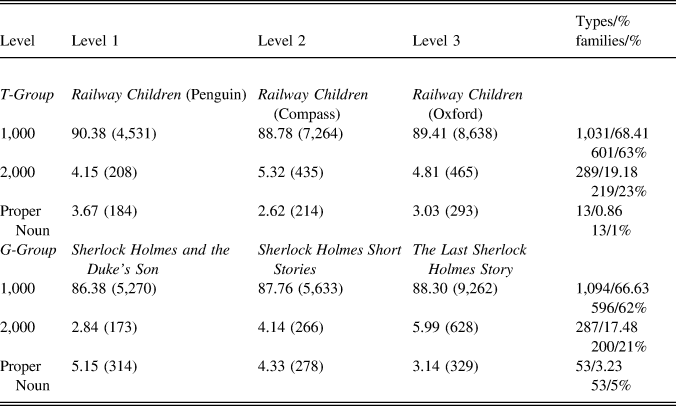
The group that read three same-title books was termed the T- Group. The T-Group read versions of The Railway Children, published by Penguin, Compass, and Oxford Bookworms, and rewritten by Holmes (Reference Holmes2008), Methold (Reference Methold2009), and Escott (Reference Escott2000), respectively. The books have 5,016, 8,182, and 9,661 words, respectively. The total word count was 22,850. The other group, reading three graded readers related to Sherlock Holmes, was termed the G-Group. The three books were Sherlock Holmes and the Duke’s Son (Bassett, Reference Bassett2008), Sherlock Holmes Short Stories (West, Reference West2000), and The Last Sherlock Holmes Story (Kerr, Reference Kerr2002). These titles have 6,101, 6,419, and 10,489 words, respectively, and the total word count was 23,009. The lexical profile of the study materials (Table 1) was analyzed using the British National Corpus and the Corpus of Contemporary American English (see Nation, Reference Nation2012). As shown, 95% of each text across levels was made up of the first 2,000 words plus proper nouns; and the percentages of word types in the first 2,000 word level in both groups were about the same. This profile indicates that the materials would not have been difficult for the participants according to the results of the vocabulary levels test (VLT) and the LVLT, and that the vocabulary levels in the reading texts in the two groups were comparable.
Text analysis of the study materials

TARGET WORDS
Forty words were selected from each group, and 10 words were excluded from data analysis because they were easier and used as motivators. The purpose of including easier words was to encourage students to finish the whole test rather than giving up upon seeing that most of the words were unfamiliar. The frequency of occurrence of the 60 target words was from 1 to 56 times, and word levels ranged from the 1,000 to the 14,000 word levels. Four words beyond the 14,000 word level were put in the off-list. In addition, 35 target words were glossed at the end of the texts, and 25 target words were not. Because the study adopted natural texts, the author did not manipulate the frequency of word occurrence, word levels, and words with or without glosses (see Appendix).
DEPENDENT MEASURES
Two tests (Form A and Form B) were developed to measure the four dimensions of vocabulary gains from reading and listening to graded readers. Each form contained 40 items, of which only 30 items were the target words. The reason for assessing aural meaning, spelling, use, and written meaning was that meaning and spelling constitute the most fundamental knowledge required for learners to comprehend the texts. The details of the two forms are described in the text that follows.
Form A was used to test the participants’ spelling and aural meaning recall. The participants heard a sentence read to them once, and the target word was then repeated once. No sentence revealed the meaning of the target word. For example, the participants heard the sentence, “The snake is big,” and the word snake was repeated once. The participants had to spell S-N-A-K-E, and write its Chinese equivalent (蛇). Form B aimed to measure the participants’ knowledge of written-form meaning and use. The participants were given a sheet containing 40 individual words. The participants had to translate each target word into Chinese and make a sentence using that word if they could. For example, “snake: 蛇; the snake was poisonous.”
Although the same item tests were used on the pretest, the posttests, and the delayed posttest, the item order was rearranged each time, Form A and Form B were given three days apart, and no test papers were taken away by students. The participants had never taken that kind of test previously, so they were unaware that the same test would be repeated.
SCORING
The spelling and sentence making were marked by three English teachers—an American and two native Chinese speakers; one of the teachers served as an examiner and arbiter to check whether the scoring was consistent between the two raters. If there was disagreement in scoring, the arbiter had to make the decision and gave a score for the item. The aural meaning and the written meaning recall were marked by two Chinese teachers of English. One point was awarded for each correct item; the maximum score was 30. For the spelling, no points were given for partially correct spellings, for example, spelling lodge as “ladge.” As for sentence making, strict marking was adopted because GLMMs allow only whole numbers. The meanings of the target words had to correspond with the content the students had read; for example, fixed had to be used as an adjective instead of a verb, and stable had to be used as a noun rather than an adjective. Thus, the sentence, “The bed is fixed to the floor,” was considered correct, but not the sentence, “John fixed the bed.”
PROCEDURE
The whole study lasted a total of 11 weeks. Before the study began, all participants were tested on their knowledge of the first 2,000 VLT and LVLT, and they were also given a pretest on their four dimensions of vocabulary knowledge. From week two to week four, all participants read while listening to one graded reader per week in class. The participants met with the researcher twice a week, for 90 minutes each time. No instructions concerning the unknown words were given. A short comprehension test, with tasks such as putting events in order or identifying who said or did something in each event, was given after students had finished reading each book. After finishing the three related graded readers, all students were given a posttest on Form A first, and then on Form B three days later. The reason for giving Form A first was that Form A revealed very little information about vocabulary words. No words were shown on the paper, and students had to rely on aural input, which is normally fleeting. After the posttests, a five-week vacation followed. When they returned, an unexpected delayed posttest was given during the first meeting. The summary of the research procedure is shown here:

DATA ANALYSIS
SPSS version 25 for Windows was used to analyze the data. All data were checked to ensure that they were entered correctly. To answer the four research questions, GLMMs were performed. The data were entered in the long format. The dependent variable was the score for each dimension of the target words at three different occasions (Time 1, Time 2, and Time 3), and each score was binary (0 for an incorrect answer and 1 for a correct answer). The random factor was the student participants, and the fixed factors included the following: frequency of target word occurrence (continuous variable), target word frequency levels (continuous variable), dimensions of word knowledge tested (spelling, aural meaning recall, written meaning recall, and use), and glossing (yes, no). The main purpose of the study was to measure the role of the fixed variables in the acquisition of different dimensions of vocabulary knowledge over time.
RESULTS
VOCABULARY GAINS IN FOUR DIMENSIONS
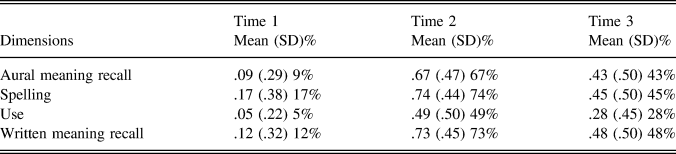
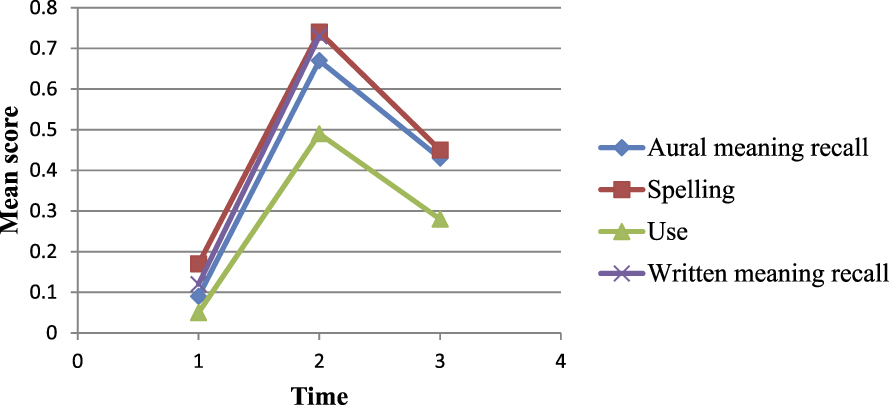
The descriptive statistics are presented in Table 2. As shown, at Time 1, the students scored highest on spelling (17%) followed by written meaning (12%), aural meaning (9%), and use (5%). The same-order pattern could be seen at Time 2, with scores of 74%, 73%, 67%, and 49%, respectively; however, the order changed at Time 3, when the score of written meaning recall was the highest (48%), followed by spelling (45%), aural meaning (43%), and use (28%). A consistent pattern was that the knowledge of vocabulary in use scored the lowest throughout; however, the scores from Time 2 to Time 3 showed that the knowledge of use decayed the least, by 21% (from 49% to 28%); spelling decayed the most, by 29% (from 74% to 45%); and written and aural meaning recall straddled those two dimensions (see Figure 1).
Means, standard deviations (SD), and percentages (%) of four dimensions of vocabulary knowledge at three different times

Mean scores of aural meaning recall, spelling, use, and written meaning recall at Time 1, Time 2, and Time 3.

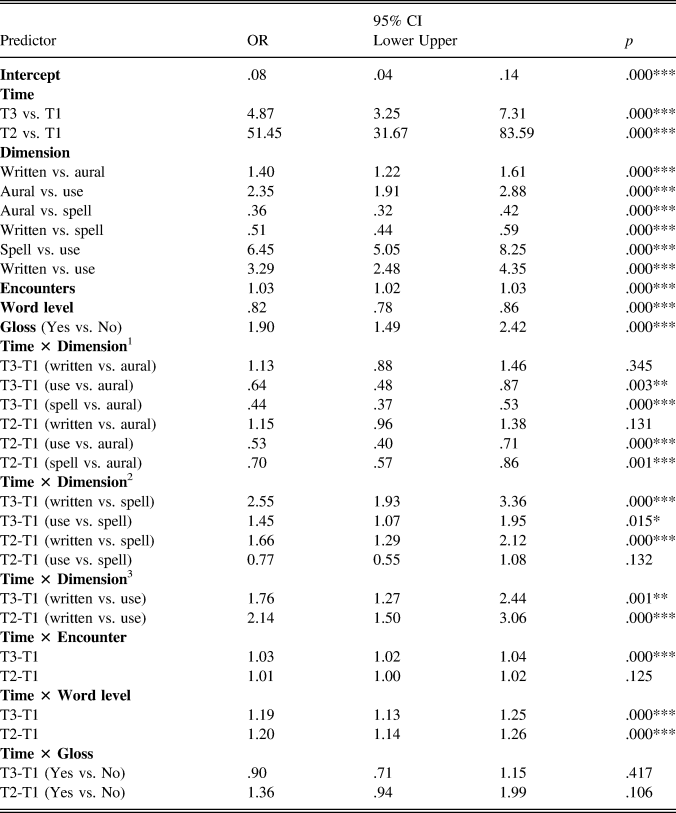
To take into account the possible variables that might have affected the overall outcome, GLMMs were performed. The results of GLMMs showed that there were main effects for all the fixed variables: times, vocabulary dimensions, word frequency of occurrence, glosses, and word levels. Although main effects were found, the main focus of this study was whether the learning lasted after a period without further exposure. For this reason, the interaction terms between all fixed variables and Time were examined. The analysis results of GLMMs are summarized and presented in Table 3.
Summary of GLMMs: Coefficient for Exp and 95% CI, and significant levels for all fixed factors across three times

1 Aural as ref.
2 Spell as ref.
3 Use as ref.
The first research question investigated the extent to which different word dimensions were acquired and retained through narrow reading at three different times. Taking aural meaning recall as a reference dimension, Table 3 shows that from Time 1 to Time 2, the odds ratios (ORs) are statistically significant for the following: spelling versus aural (OR = 0.70, 95% CI = [0.57, 0.86], p < .001) and use versus aural (OR = 0.53, 95% CI = [0.40, 0.71], p = .001), which means that the odds of improvement in knowledge of spelling and use were lower than aural meaning recall by 30% and 47%, respectively; however, the odds ratio was not significant for written versus aural (OR = 1.15, 95% CI = [0.96, 1.38], p = .13), although the odds of improvement for written meaning recall were 15% higher than for aural meaning recall. The result pattern from Time 1 to Time 3 is the same as from Time 1 to Time 2, so we can see that the odds ratios are again significant for spelling versus aural (OR = 0.44, 95% CI = [0.37, 0.53], p < .001) and use versus aural (OR = 0.64, 95% CI = [0.48, 0.87], p < .001), which means that students’ performance in recalling aural meaning was significantly better than for the dimensions of spelling and use, but there was no significant difference between written and aural meaning recall (OR = 1.13, 95% CI = [0.87, 1.46], p = .37).
If we take knowledge of spelling as the reference dimension, from Time 1 to Time 2 (T2-T1), the odds ratio between use and spelling (OR = 0.77, 95% CI = [0.55, 1.08], p = .13) is not significant; however, the odds ratio is significant between written and spelling (OR = 1.66, 95% CI = [1.29, 2.12], p < .001), which indicates that the odds of correct response in spelling are associated with an increase of 66% in successful written meaning recall. This pattern was also carried over to the delayed posttest. As can be seen from Time 1 to Time 3 (T1-T3), the odds ratio is significant and much larger than that from Time 1 to Time 2 between written recall and spelling (OR = 2.55, 95% CI = [1.93, 3.36], p < .001); the improvement in knowledge of correct use was also greater than that of spelling (OR = 1.45, 95% CI = [1.07, 1.95], p = .015). Finally, taking knowledge of use as the reference dimension, we found that the odds ratios are significant between written and use, from Time 1 to Time 2 (T2-T1) (OR = 2.14, 95% CI = [1.50, 3.06], p < .001], and from Time 1 to Time (T1-T3) (OR = 1.76, 95% CI = [1.27, 2.44], p < .001). The odds for improvement in word use were associated with an increase in correct response on written meaning of 114% and 76% from Time 1 to Time 2, and from Time 1 to Time 3, respectively.
Taken together, after comparing the odds ratios between each dimension at different times, improvements for written meanings and aural meanings are comparable and are much greater than for knowledge of how to use or spell words correctly. The improvement for correct use and spelling of the target words varied at different times. The odds ratio for acquiring the knowledge of use and spelling, however, was not significant from Time 1 to Time 2. As for retention (T3-T1) of the four dimensions of word knowledge, the pattern was similar to that of T2-T1, with an exception in the case of use and spelling, where more improvement was made in the knowledge of “use.”
FREQUENCY OF WORD OCCURRENCE AND VOCABULARY GAIN
With respect to the second research question that addressed the interaction effect between Time and Frequency of encounters, Table 3 shows that from Time 1 to Time 2 (T2-T1), the odds ratio for frequency occurrence was not significant (OR = 1.01, 95% CI = [1.00, 1.02], p = .13). Significant improvement, however, was confirmed at the delayed posttest (T1-T3). As shown, the odds ratio was significant (OR = 1.03, 95% CI = [1.02, 1.04], p < .001). The preceding results provided an answer to the second research question, namely that one extra encounter was associated with an increase of 3% in the odds of a correct response.
WORD LEVELS AND VOCABULARY GAIN
The third research question examined the influence of words levels on vocabulary gain at different times (Time × Word Level). The word levels ranged from the 1,000 level to the 14,000 level and off-list (words beyond the 14,000 level). Table 3 indicates that the odds ratio was significant from Time 1 to Time 2 (T2-T1) (OR = 1.20, 95% CI = [1.14, 1.26], p < .001), and a similar result was found from Time 1 to Time 3 (T1-T3), where the odds ratio was also found to be significant (OR = 1.19, 95% CI = [1.13, 1.25], p < .001). The preceding results show that the gain was more substantial for lower level words; each unit increase in word frequency level predicted a 20% and 19% success in the odds of improvement for the target words at the two different times.
GLOSSES AND VOCABULARY GAIN
The last research question explored the extent to which words with glosses versus those without glosses were learned. As shown in Table 3, there was no significant interaction effect between time and glossing, but a significant main effect for glossing on vocabulary gain (OR = 1.90, 95% CI = [1.49, 2.42], p < .001) indicated that vocabulary gain was significantly predicted by glossing at Time 1; providing words with glosses increased the probability of overall vocabulary gain by approximately 90%.
DISCUSSION
THE EFFECTS OF TIME ON FOUR DIMENSIONS OF VOCABULARY LEARNING IN NARROW READING AND LISTENING
The results of GLMMs indicated that after taking into account the fixed variables—time, encounters, word levels, and glosses— the order of improvement in the four dimensions from Time 1 to Time 2 was written meaning recalls > aural meaning recalls > spelling > use. To be more specific, the odds of improving written meaning knowledge were 15% more than the odds of improving knowledge of aural meaning, 66% better than for spelling, and 114% higher than for use; the odds of acquiring knowledge of aural meaning were 30% higher than the odds for knowledge of spelling, and 47% more than for use; and the odds of gaining knowledge of spelling were 23% better than that the odds of gaining knowledge of use. The order of improvement from Time 1 to Time 3 was written meaning recall > aural meaning recall > use > spelling; in other words, the odds of recalling written meaning were 13% higher than the odds of recalling aural meaning, 155% higher than for recalling spelling, and 76% better than for recalling use; the odds of recalling aural meaning were 56% higher than for recalling spelling and 36% better than for recalling use; and the odds for how to use the target words were 45% higher than those for correct spelling of the target words.
From the preceding results, we can see that both written and aural meaning recall improved more substantially than recall of forms and knowledge of how to use words correctly. The results were similar to the results of the study by Mohamed (Reference Mohamed2018), who also used GLMMs to analyze vocabulary gains in relation to frequency of occurrence. Mohamed found an increase in additional exposure raised the probability of meaning recall by 43%, which was greater than increases in meaning recognition and form recognition. The results, however, were different from those in previous studies, for example, Webb (Reference Webb2007) and Pigada and Schmitt (Reference Pigada and Schmitt2006), in which written forms were found to be easier to acquire than meanings. There are several possible explanations for the different outcomes. Firstly, different analyses and statistical techniques were used. In the present study, GLMMs were performed to examine how the change of each dimension affected other dimensions from one time to another while also taking into account the fixed variables and the random variable (the participants). Secondly, the present study adopted narrow reading; students read three relevant texts rather than a single text or random texts, which was likely to have greatly enhanced students’ comprehension. If readers have better background knowledge, it is assumed that they will have more attention available for decoding unfamiliar linguistic items (Pulido, Reference Pulido2004). Thirdly, that knowledge in the dimensions of written meaning and aural meaning recall improved more than spelling and use could be due to the fact that students focused on comprehending the text, so they would have paid more attention to decoding word meaning, in particular the written form meaning. Fourthly, while the students were reading, they also listened to the corresponding aural texts; therefore, they improved their knowledge of aural meaning nearly as well as of written meaning. These effects have theoretical implications for learning vocabulary. Reading while listening helps L2 learners to match the written form with the aural form, and the prosodic features of the aural input may also improve comprehension by segmenting the text into meaningful chunks rather than students reading the text word by word, like most L2 learners do. Many previous studies have demonstrated that simultaneous reading and listening to texts leads to higher vocabulary gains than reading only or listening only (Brown, Waring, & Donkaewbua, Reference Brown, Waring and Donkaewbua2008; Vidal, Reference Vidal2011). Although the present study did not involve the input modes of reading only or listening only, the results demonstrated that bimodal input did promote the acquisition of both aural and sight vocabulary.
When it comes to the improvement of spelling, which has been often considered the easiest dimension to acquire, we found that the knowledge of spelling was highly volatile; it may be easy to acquire but it is also easy to forget. The absolute gain in spelling reached 57% from Time 1 to Time 2; however, half of the knowledge (29%) decayed after five weeks. Despite the faster decay rate, the acquisition and retention rates were encouraging. A major reason for the higher learning rates could be due to the fact that the present study used real words, not psuedowords. Using real words to measure learning gain takes account of learners’ partial knowledge of a target word because L2 learners may encounter some partially known words; after reading they may consolidate their knowledge to a greater extent. For example, many participants had acquired the word fix used as a verb, but in the reading context, fixed was used as an adjective, meaning “immovable.” This might have helped them to acquire the form more easily than when they were learning a completely unknown word, such as speckled.
This study partially supports Waring and Takaki’s (2003) claim that form recognition might require more encounters than meaning recognition, but contrasts with studies by Teng (Reference Teng2018) and Pellicer-Sánchez and Schmitt (Reference Pellicer-Sánchez and Schmitt2010), who found form recognition was easier to acquire than meaning. There were a number of differences among these studies. A major one is the differences in test methods. For example, in Teng’s study, form recognition was measured through multiple-choice items whereas the present study adopted a recall test, in which students had to spell the words. A test that requires testers to produce the correct answer is always more difficult than one that simply involves recognizing a correct one (see Brown, Waring, & Donkaewhua, Reference Brown, Waring and Donkaewbua2008).
Correct use of the target words improved the least as compared to the other three dimensions from Time 1 to Time 2. The result, though, was not surprising and corroborated previous studies; however, one interesting finding from the present study was that knowledge of use is longer-lasting than in the other three dimensions. If we look at the differences in absolute gains from Time 1 to Time 2, and from Time 1 to Time 3, we find that the decay rate for knowledge of use is the lowest compared to the other three dimensions. The results indicate the importance of production (Swain, Reference Swain and Hinkel2005); that is, if L2 learners know how to use a word, their word knowledge will be more sustainable than if they simply know the meaning or form. Another interesting finding regarding using the target words was that in the immediate posttest, most of the sentences that students made were related to the content they read. Take these sentences for example: The old man waved to the children every day. Peter stole some coals from the station. After five weeks, the number of sentences that were related to the content diminished substantially.
On the whole, the present study further confirms that substantial vocabulary knowledge can be acquired through simultaneous reading and listening. Although previous research has shown that L1 and L2 vocabulary knowledge is mainly acquired through reading, L1 children gain a considerable number of words through listening before they can read. The value of acquiring L2 vocabulary knowledge through aural input evidently cannot be ignored. Accordingly, L2 learners should be provided with as much aural input as possible to assist their language and vocabulary growth.
THE EFFECTS OF FREQUENCY OF WORD OCCURRENCE ON VOCABULARY LEARNING
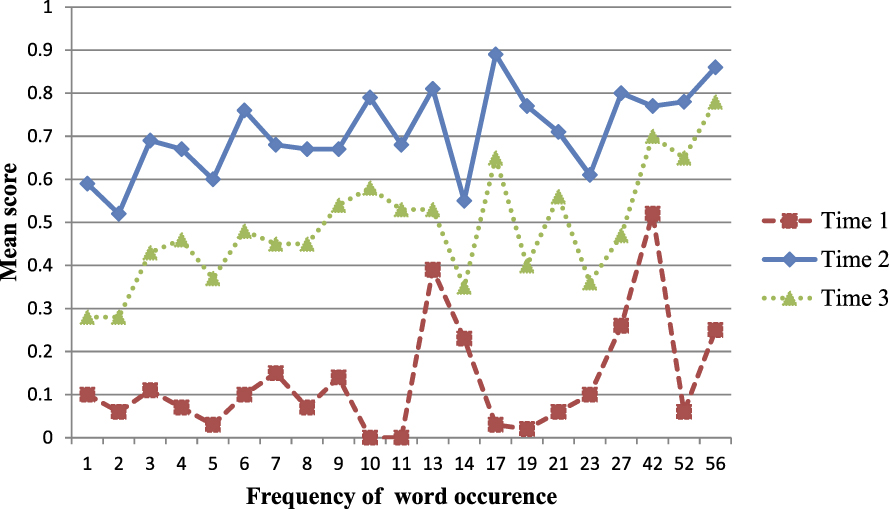
In answer to the second research question, the results revealed that from Time 1 to Time 3, for each additional encounter with a word, the correct response rate increased by 3%. Figure 2 shows that the changes in mean scores rose as the frequency of occurrence increased, despite there being some dips in frequencies 14, 19, and 23. Some words were quickly picked up by the students after multiple encounters and also well retained after five weeks without further practice. Those words were coal, wave, tunnel, porter, pram, petticoat, and pip; they were encountered 52, 42, 56, 21, 10, 11, and 17 times individually. The first three words were particularly interesting because they were key words in The Railway Children, and more importantly they appeared across all three readers published by Penguin, Compass, and Oxford bookworms, while porter, pram, and petticoat also appeared in two readers by Compass and Oxford Bookworms. These few words indicate that repeated encounters with the same words in more than one text increased the odds of those words being learned. To the author’s knowledge there have been few studies looking at the distribution of occurrence across texts and vocabulary gain except for one conducted by Webb and Chang (Reference Webb and Chang2015a), in which a low correlation was found. The low correlation in the study might be due to the fact that those students read random texts or that the words might not have been key words in the texts. Nonetheless, from the increase in the mean scores of these few words, it may be worthwhile to carry out further research to investigate the different effects of frequency of occurrence and frequency of distribution on vocabulary learning.
The effect of frequency of word occurrence on vocabulary learning at Time 1, Time 2, and Time 3.

Some other words—track, barge, rip, and criminal (encountered 27, 23, 23, and 14 times, respectively)—were quickly picked up but also decayed quickly. One reason might be that these words appeared in only one text; however, pip seems to contradict this explanation. Pip also appeared in one text, but 90% of the students learned the word and 65% of them retained the word after five weeks. The main reason might be that pip is one of the title words of a story, “The Five Orange Pips,” which makes the word stand out, and every student must have seen the word before beginning the story. From the preceding results, we have seen that most words were learned to some varying extent immediately after the reading, but while some words were easily forgotten, words appearing across texts were found to be remembered better. In general, the more encounters a student had with a word, the higher the probability of its being learned.
The pattern of change in mean difference over the three periods indicates that the L2 students acquired and retained more of the words that had more repetitions. The result of the study was consistent with many previous studies on the effects of word exposure frequency on single-word meanings (Brown et al., Reference Brown, Waring and Donkaewbua2008; Eckerth & Tavakoli, Reference Eckerth and Tavakoli2012; Pellicer-Sanchez, Reference Pellicer-Sánchez2016; Webb, Reference Webb2007) and multiword meanings (Webb, Newton, & Chang, Reference Webb, Newton and Chang2013). This study, however, differed from the previous studies in that it took into account several other variables and found that every increase in the frequency of exposure increased the chance of a word being learned by 20%. Research up to the present shows that there is no general consensus about the optimal number of repetitions that could guarantee acquisition because frequency of encounters alone is not the only factor that influences learning gain; it interacts with many other variables, such as dimensions of vocabulary knowledge (Mohamed, Reference Mohamed2018; Pellicer-Sanchez, Reference Pellicer-Sánchez2016; Teng, Reference Teng2018; Waring and Takaki, Reference Waring and Takaki2003), test methods (Brown et al., Reference Brown, Waring and Donkaewbua2008), the context surrounding the target vocabulary (Webb, Reference Webb2008), total time spent on each encounter (Mohamed, Reference Mohamed2018), and task types (Laufer & Rozovski-Roitblat, Reference Laufer and Rozovski-Roitblat2011). These factors, however, are beyond the scope of the present study.
This study also provides more evidence that “spaced learning is much more effective for long-term recall than massed learning” (Webb & Nation, Reference Webb, Nation and Chappelle2013, p. 5673); it has shown that a word repeatedly appearing in multiple texts tends to be better learned than one appearing many times in a single text. This phenomenon implies that while it is worthwhile counting the number of encounters, it might also be important to examine how these target words are distributed in a text or across texts (Webb & Chang, Reference Webb and Chang2015a). Repeated encounters of the target words in different contexts will consolidate previous knowledge. Given this, perhaps doing narrow reading or series reading will provide L2 readers with better opportunities to encounter the same words at different intervals. Future research into this area is certainly warranted.
THE EFFECTS OF WORD FREQUENCY LEVELS ON VOCABULARY LEARNING
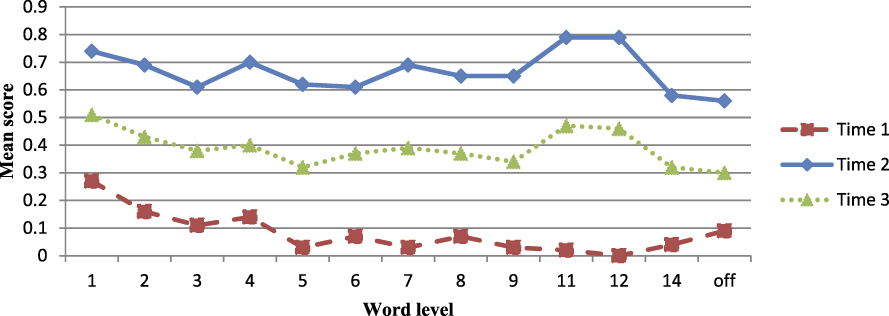
The third research question investigated the extent of word levels on L2 learners’ acquisition of and retention of word knowledge at different times. The ORs for the interaction effect between Time and Word levels were significant from Time 1 to Time 2 (OR = 1.20), and from Time 1 to Time 3 (OR = 1.19). The results in Table 3 indicate that the students gained more knowledge of words from the lower-frequency word levels. An increase of one level in word frequency level can increase the odds of correct responses by 20% in the immediate posttest and 19% in the delayed posttest. As shown in Figure 3, at Time 1 (the pretest) the mean scores for words beyond the 4,000 level had a tendency to be lower than those words from the 1,000 to 4, 000 levels. Immediately after the reading, students made substantial improvement on the lower-frequency words, such as pip (level 11), petticoat (level 11), pram (level 12), and speckled (level 9). Although students also made substantial improvements on high-frequency word levels (1,000–3,000), the rate of acquisition for the lower-frequency word levels was significantly larger than for the higher-frequency word levels. If we divide the 60 target words into two groups, the first including those at the first 3,000 word levels, and the second including those at the 4,000 word level and beyond (30 words in each category) (as shown in Table 4), we find that from Time 1 to Time 2 students improved an average of 59% on words from the low-frequency word level (.06→.65) and 51% on words in the high-frequency level (.16→.67). From Time 1 to Time 3, the participants made an average progress rate of 28% at the high-frequency word level, and of 32% at the low-frequency word level. Comparing the differences between the two category levels, it is 8% (59–51%) at the immediate posttest and 6% at the delayed posttest (32–28%). It seems that the participants acquired significantly more word knowledge from the low-frequency word levels immediately after the treatment; however, word retention at the low-frequency level decayed slightly faster after five weeks without further practice. Despite the slightly faster decay, the increase in knowledge for lower-frequency word levels was still higher than that for higher-frequency word levels.
The effect of word frequency level on vocabulary learning at Time 1, Time 2, and Time 3.

Means, standard deviations and percentages (%) for word frequency level on vocabulary learning at Time 1, Time 2, and Time 3

Two important factors that may explain why students made a larger improvement on the words that were in the lower-frequency levels were the importance of these words in the text and multiple encounters (also see the earlier section). For example, the children in The Railway Children used petticoats (level 11) to stop the train from getting into danger; porter (level 7) was one of the main character’s (Perk’s) jobs; and pram (level 12) was used by the children to collect birthday gifts for Perk. They appear 11, 21, and 10 times, respectively, in The Railway Children. “Pip” (level 11) is one of the title words in Sherlock Holmes short stories, and it appeared 17 times. These words played an important part in comprehending the story, even though they belong to lower-frequency word levels. Some other mid-frequency words (4,000–8,000) seemed to be learned quite readily if they were encountered five to nine times (also see Figure 2); those words include parcel, attic, hound, kidnap, moor, and duchess. However, some abstract words in the high-frequency word level, such as equality, royal, and evidence were difficult to acquire and retain. For example, none of the students made a correct sentence using equality. The reasons could be that these words do not stand out in the texts, appearing only two times throughout, and they are abstract words. Abstract words have been found to be more difficult to learn than concrete words (De Grout & Keijzer, Reference De Grout and Keijzer2000; Ellis & Beaton, Reference Ellis and Beaton1993; van Hell & Candia Mahn, Reference van Hell and Candia Mahn1997). Finally, before the treatment the words in the higher-frequency levels (1,000–3,000) were known by more students (M = .16); therefore, the room for them to improve was smaller as compared to that of the lower-frequency word levels (M = .06). For example, none of the students knew the word pram, which is a word from the 12,000 word level. These reasons may explain why students acquired more words in the lower-frequency levels than those in the higher-frequency levels.
The results of the present study were different from Horst’s (Reference Horst2005) study, in which she found that L2 students acquired more words from the high-frequency words (1,001–2,000) than from the off-list words. The acquisition rates were 76% for the high-frequency word level and 62% for the low-frequency level. In the present study, it was approximately 51% for the words up to 3,000 level and 59% for words beyond the 3,000 level. The lower learning rates for the high-frequency word levels in this study were understandable because the test methods were more difficult and knowledge dimensions were broader than those used in Horst, where a three optional scale (know, not sure, do not know) was used. The results of the present study were also different from the study by Chang and Hu (Reference Chang and Hu2018), who found that students learned any words they came across without considering the words’ level, with no significant differences found in recognizing the word meanings among the first 3,000 word levels. From the evidence of these three studies, we may conclude that the extent to which words can be learned may vary according to various factors, for example, students’ language proficiency, test methods, and the vocabulary dimensions being tested.
In sum, according to this study both high- and low-frequency levels are likely to be learned immediately after reading; however, word frequency level alone cannot determine whether a word is acquired. Because some low-frequency words are technical words or key words for comprehending a particular content, for example, petticoat in The Railway Children, the repetition of these words is high, so a substantial number of the low-frequency words were acquired through reading. Learning lower-frequency words, such as petticoat, however, may not have as much value as learning the word evidence. Many students normally do not know that words can be classified into varying frequency levels and that the highest-frequency words, such as the first and the second 1,000 words have greater value for comprehension and use. Some abstract words in the highest-frequency levels are, in effect, difficult to learn, for example those mentioned previously, evidence, equality, and royal. Some learning strategies or direct teaching (using collocations, sentence making) may be helpful for remembering the words (Webb & Nation, Reference Webb, Nation and Chappelle2013). Take the word evidence, for example. Teachers may show students what other words can be placed before or after a word such as no evidence, strong/medical/clear evidence, and give/provide evidence. By doing so, it would be easier for students to remember and use the word. Some vocabulary enhancement activities can be included after reading, and these activities have been found to be more effective for vocabulary learning than reading alone (Lu, Reference Lu2013; Zhao & Guo, Reference Zhao and Guo2012).
THE EFFECTS OF L2 GLOSSING ON VOCABULARY LEARNING
In answer to the fourth research question, the study found no significant interaction effect between glossing and time on overall vocabulary gain. Table 5 shows that words with glosses are more likely to be learned than those without. The results also found that words more often encountered are more likely to be glossed at the end of the readers. This is very interesting because the texts are natural, and not written particularly for research purposes. If the 60 target words are divided into two category bands: words occurring one to four times (cf. Pellicer-Sánchez & Schmitt, Reference Pellicer-Sánchez and Schmitt2010), and words occurring five or more times (see Table 5), then there are 31 words in the one to four bands, and 29 words in the five-plus band. Among the five-plus band words, 20 (69%) words were in the glossary; however, in the one to four band, only 14 (45%) words were glossed. Given this, we may assume that words that are listed in the glossary might be of more importance, and therefore, words in the glossary that are encountered more often should be more likely to be learned than those words that are not in the glossary and are encountered less frequently. The finding was consistent with that of Hulstijn et al. (Reference Hulstijn, Hollander and Greidanus1996) in showing that multiple encounters plus glosses facilitate vocabulary learning, and it also supports the noticing theory that attention is a prerequisite for word learning (Schmidt, Reference Schmidt1992), and is crucial for the first stage of form-meaning mapping.
Means, standard deviations, and percentages (%) for the effect of glossing on word gains

Some previous studies have shown that the effect of glossing was not durable. Some effect was shown only on the immediate posttest (Eckerth & Tavakoli, Reference Eckerth and Tavakoli2012; Jacobs, Dufon, & Fong, Reference Jacobs, Dufon and Fong1994). In the present study, although there was no significant interaction effect between time and glossing, the values of OR (= 1.36) from Time 1 to Time 2 might partially support Jacobs et al. (Reference Jacobs, Dufon and Fong1994) and Eckerth and Tavakoli (Reference Eckerth and Tavakoli2012), which means that the odds of acquiring the words with glosses were 36% higher than for acquiring the words without glosses. The small effect of glossing, however, diminished after five weeks. This finding might imply that the attention raised by glossing is ephemeral, so it has only an immediate effect during the reading process. Despite this, glossing does quickly provide learners with accurate meanings with a minimal interruption to reading; better still, glossing draws learners’ attention to words and hence may improve learning. According to Watanabe (Reference Watanabe1997), glossing might increase the encounters by a factor of three because learners encounter the word in the text, then go to look at the meaning in the gloss, and then go back to look at the word in the text again. To increase the enduring effect, learners may have to meet the words again by reading more or reviewing the words before forgetting them (Nation & Wang, Reference Nation and Wang1999).
Because the texts were not read online, it was not possible to track how often the students turned to the end of the text to consult the glossary and how long the students looked at each item. To more accurately investigate the effect, eye tracking is a useful tool to examine whether readers pay attention to the words with glosses. According to a study by Pellicer-Sánchez (Reference Pellicer-Sánchez2016), the longer the gazing time, the higher the vocabulary test scores. In this study we found that glossing, together with increases in the frequency of vocabulary word encounters seemed to be an effective combination for vocabulary learning in reading.
PEDAGOGICAL IMPLICATIONS
The results of the present study demonstrated an encouraging level of acquisition for various dimensions of vocabulary knowledge through reading and listening to relevant texts and also took into account certain random and fixed variables. The results have some useful pedagogical implications for acquiring vocabulary through reading.
1. Among the four dimensions, spelling knowledge is easy to acquire but also easily decays, so the challenge is how to assist students in retaining the written form. Some simple form-focused activities after reading might be useful. One example might be asking students to fill in the more confusing letters, for example, br—ch (brooch), bl-nk (blank), and du—ess (duchess). Doing these simple activities does not take up much time, and it definitely helps students retain the forms better. Another way may be simply to ask students to do more reading, so they will have opportunities to repeatedly encounter many high-frequency words or specialized words.
2. The words that students knew how to use decayed more slowly. This implies the importance of production. If students have an opportunity to use the words they encounter during reading, the knowledge will not fade away so easily. Writing a short report using a few words after reading may provide students with practice opportunities to use the words.
3. That students’ improvements in both written and aural meaning recalls were comparable may imply that reading and listening can complement each other and make both kinds of input easier, thus further facilitating the acquisition of aural and sight vocabulary. Nowadays, nearly all texts are accompanied by their corresponding audio texts. L2 teachers and learners can make the most out of this convenience to improve the skills they intend to enhance. In addition, simultaneous reading and listening helps the learners to match the written forms and aural forms, and it may be particularly helpful for students to learn the pronunciation of some proper nouns such as Phyllis and some more difficult words such as canal.
4. Both multiple encounters and glossing play important roles in learning vocabulary through reading. The two combine naturally and effectively in reading. The former provides readers with multiple exposures to help them learn a word and the latter provides readers with quick and accurate assistance in comprehending the texts. Opportunities of encountering a word multiple times are not easy to find in short reading texts, for example, those used in intensive reading; therefore, the best way to ensure multiple exposures to a word is by reading multiple related texts. For novice second language learners, narrow reading may be a good way for them to encounter certain words multiple times, especially when accurate glosses are provided to aid comprehension.
5. Some abstract high-frequency words are important but not easy to acquire through reading. Direct teaching or doing some vocabulary enhancement activities may be necessary to assist L2 students in acquiring them more quickly.
CONCLUSION
This study examined how four dimensions of vocabulary knowledge were learned through narrow reading and listening. It was found that knowledge of written and aural meaning improved substantially more than the abilities to spell and use the target words correctly. Words that are encountered more frequently are retained better than those encountered fewer times. Words in the low-frequency levels are acquired and retained significantly more than those in the higher-frequency levels. Words with glosses are acquired significantly better than those with no glosses.
Before drawing any conclusions, one major limitation should be pointed out, namely that both forms of texts were organized either by the same title or by the same genre, and both texts led to quite successful outcomes. It is therefore unclear whether reading random texts would lead to different degrees of vocabulary acquisition. In addition, texts can be selected in different ways, such as choosing only texts written by the same author. Because graded readers are a great source of reading materials that enable L2 learners to read even at very low level of proficiency, it would be worthwhile exploring in more detail how these texts differ from each other, and how to group them so as to help L2 learners make a better start in reading. This line of research deserves more attention from researchers.
Compared to previous studies that looked at learning vocabulary through reading only or listening only, further confirmation was provided that simultaneous reading and listening leads to a high level of acquisition. Apart from vocabulary learning, which is usually considered a by-product of reading, some ER scholars have suggested that L2 learners should read several texts at one level before they move to a higher level, for example, five (Nation & Wang, Reference Nation and Wang1999) or even more (Webb & Chang, Reference Webb and Chang2015b). Narrow reading and listening seem to help students to transition smoothly from level one to level three by reading only one related text at each level during the treatment period, as few students complained that they had difficulties in comprehending the texts. A high level of comprehension might have contributed to a high level of acquisition of vocabulary knowledge. If narrow reading and listening is helpful, then more related texts should be organized for students to select their preferred themes, authors, and titles as they begin their reading journey. More research into this area is needed to observe these effects.
APPENDIX
THE FREQUENCY OF OCCURRENCE, GLOSS, AND WORD LEVEL OF THE TARGET WORDS