Introduction
The highlands of Eritrea are a rich source of leguminous, forage herbs and shrubs. About 120 species have been reported to occur at elevations between 1500 and 2500 m above sea level (masl) (Hedberg and Edwards, 1989). They range in habit from small herbaceous annuals in the genus Trifolium to the woody shrub Colutea abyssinica. Their habitats range from seasonally wet lowlands and valley flats to drier, rocky hillsides occupied by sparse stands of acacia. Most rain falls in July and August, defining a clear growing season for rain-fed crops and rangeland pastures (Anon, 1981). Most of the arable land in the highlands is reserved for food crops including barley, wheat, finger millet, teff, field pea, chickpea, and faba bean. Non-arable land on hill slopes and isolated wet, fertile valley floors are grazed by sheep, goats and cattle. There is no history of deliberate cultivation of native pasture species in the highlands of Eritrea, although it cannot be discounted. It is likely that a close association between pasture plants and grazing animals has been in place for centuries, resulting in a vast range of nutritious species adapted to varying niches in the landscape. As far as we can ascertain, no pasture collecting missions were undertaken either during the Ethiopian occupation between 1950 and 1991, or since Eritrean independence. Crop species were collected in Eritrea by researchers working at The International Livestock Centre for Africa (ILCA) for a decade beginning in 1977 (Demissie, Reference Demissie, Engels, Hawkes and Worede1991). Forage collecting was reported in Ethiopia, excluding Eritrea, between 1985 and 1991 with an emphasis on Trifolium (Hanson and Mengistu, Reference Hanson, Mengistu, Engels, Hawkes and Worede1991).
Australian interest in pasture plants from Eritrea is based on the reported occurrence of species belonging to the genera Biserrula, Trifolium, Lotus, Tephrosia, Indigofera, Crotalaria and Colutea. Breeding and plant improvement programmes exist in the former three genera (Ayres et al., Reference Ayres, Kelman, Wiedemann, Lane and McCorkell2008; Nichols et al., Reference Nichols, Loi, Nutt, Evans, Craig, Pengelly, Dear, Lloyd, Revell, Nair, Ewing, Howieson, Auricht, Howie, Sandral, Carr, de Koning, Hackney, Crocker, Snowball, Hughes, Hall, Foster, Skinner, Barbetti and You2007), and there is a new interest in Australian native species in three of the latter four genera (Bell et al., Reference Bell, Bennett, Ryan and Clark2010). Interest in Western Australia, in particular, is in early flowering annual species for short season regions in the wheat belt and drought-tolerant perennial species for recharge areas to tackle dryland salinity. The highlands of Eritrea may have species worthy of testing in southern Australia by virtue of its long dry season and plants' response in flowering to shortening day lengths in a low-latitude region. Eritrea has an interest in its native forage species primarily for animal production. A plant survey will be important both to identify species occurring at a low frequency and therefore at the possible risk of genetic erosion, and to consider whether and how rangeland species might be better utilized.
In October 2004, a collecting mission was undertaken in the southern highlands surrounding Asmara with a focus on forage legume species. Seeds were imported and evaluated in germplasm nurseries in Western Australia between 2005 and 2010. The aim of this work was to investigate the potential of native forage legume species for both the Eritrean highlands and southern Australia.
Materials and methods
Collecting mission
Permission to collect germplasm was obtained from Eritrea in 2004 after a material transfer agreement was signed between the Ministry of Agriculture, Asmara and the Centre for Legumes in Mediterranean Agriculture, The University of Western Australia. Pre-mission preparation involved consulting the Flora of Ethiopia to document the full range of pasture legume species likely to be encountered in the highlands of Eritrea at altitudes between 1500 and 2500 masl. Familiarization of site habitat, plant life form and growth habit, and taxonomic descriptions assisted in the identification of species collected during the mission. Earlier observations on the occurrence of species of interest (Hamli Gurunba, pers. commun.) as well as geographical, geological and climatic maps of Eritrea assisted in developing an itinerary for a 2-week collecting mission.
The mission was undertaken in October 2004 to coincide with the ending of the growing season when seeds had recently ripened. Areas accessible by motor vehicle between Keren to the north-west, Adi Quala to the south, and Senafe to the south-east of Asmara were selected for collecting. Sites were selected in order to ensure an even spread across each region. Suitable sites had at least one priority genus, and were often a combination of both a seasonally wet area and a dry hillside, in which case sub-sites were described. Seeds were collected by random sampling on multiple, independent transects. The low frequency of most of the species resulted in unequal seed numbers being sampled from each plant in order to maximize seed quantity. The number of plants sampled from each species was recorded and their abundance rated. Sites were described according to Snowball et al. (Reference Snowball, Hadas, Galili, Ur, Nichols and Kigel2008). Annual rainfall data were sourced from http://www.worldclim.org/ using DIVA-GIS version 5.2 software (http://www.diva-gis.org/) and rounded to the nearest 50 mm. Altitude was confirmed using Google Earth (http://www.google.com/earth/index.html). Attempts were made to collect root nodules from species growing in moist or friable dry soil. Where the soil was too hard or stony or where no nodules could be found on exposed plant roots, soil was collected from near the base of the plants for trapping Rhizobium.
Root nodules and soil were sent to the Centre for Rhizobium Studies (CRS), Murdoch University, Western Australia. Seed was hand-threshed, cleaned and conserved in cold storage in the genebank at the Hal Hale Research Centre. Seed of species permitted entry into Australia at the time of collecting were introduced to the Australian Trifolium Genetic Resource Centre (ATGRC), Department of Agriculture and Food, Western Australia. Several other species of interest were introduced into the ATGRC after detailed weed risk assessments had been undertaken and accepted by Biosecurity Australia.
Rhizobium culture
From nodules
Desiccated nodules were rehydrated by soaking in distilled water for 3–4 h. The nodules were surface-sterilized by immersing in 70% (v/v) ethanol for up to 1 min followed by up to 3 min in 4% (v/v) sodium hypochlorite, and then six rinses in sterile distilled water. The nodules were crushed aseptically and plated onto growth medium in a dilution series (Howieson et al., Reference Howieson, Ewing and D'Antuono1988). The plates were placed in a 28°C oven and checked daily for growth. Rhizobium colonies were then selected for purification, and once purified were preserved and stored for future use.
From soil
Rhizobia were trapped by growing host plants in free draining plastic pots filled with steam-sterilized sand (Howieson et al., Reference Howieson, Loi and Carr1995), and then adding some soil from around the root system of plants collected in Eritrea. If nodules were formed on the host plant, isolation using the method for fresh nodules was performed.
Climate match
The ‘CLIMATE’ program (Data Library and Information Sciences, Bureau of Rural Sciences, Australian Government) was used to assess the climatic similarities between the highlands of Eritrea and Australia. Four Eritrean locations were selected. Asmara (latitude 15.30°, longitude 38.90°, altitude 2325 masl), Adi Keyih (latitude 14.83°, longitude 39.33°, altitude 2490 masl) and Adi Ugri (Mendefera, latitude 14.88°, longitude 38.82°, altitude 2022 masl) are within the area of the seed collecting sites. Faghena (latitude 15.59°, longitude 38.93°, altitude 1760 masl) is just outside the area of collection located in the green belt zone of the southern highlands 30 km due north of Asmara. Compared with Asmara, Adi Keyih and Adi Ugri, Faghena receives a higher rainfall amount, spread over a longer growing season. The bioclimatic variables used by the ‘CLIMATE’ program concerned both rainfall (average annual amount, amount during the driest month, amount during the driest quarter, amount during the wettest month, amount during the wettest quarter, amount during the coolest quarter, amount during the warmest quarter and the monthly coefficient of variation) and temperature (mean annual temperature, minimum during the coolest month, maximum during the warmest month, mean during the coolest quarter, mean during the warmest quarter, mean during the driest quarter, mean during the wettest quarter and average range). Data for these bioclimatic variables were derived from monthly climate data from WorldClim – World Climate Data (http://www.worldclim.org/bioclim).
The three Australian towns having the closest climate match with Asmara, Adi Keyih and Adi Ugri were Coulta in South Australia (latitude − 34.39°, longitude 135.47°, altitude 80 masl), Georgetown in Queensland (latitude − 18.29°, longitude 143.55°, altitude 290 masl) and Geraldton in Western Australia (latitude − 28.80°, longitude 114.70°, altitude 38 masl). Average monthly rainfall, average monthly maximum temperatures and average monthly minimum temperatures were sourced for these three Australian towns from http://www.bom.gov.au/climate/data/ for comparison with their Eritrean equivalents (data sourced from http://worldclim.org).
Plant evaluation in nurseries
Seeds were scarified and planted in a commercial potting mix and allowed to grow in an evaporative air-conditioned glasshouse for between 6 and 12 weeks. Rhizobium cultures from the CRS were applied to the potting mix soon after seeds germinated. Seedlings were transplanted into white plastic mulch film secured on the soil surface as components of existing germplasm field nurseries established between 2005 and 2008 at the Medina Research Station, 40 km south of Perth, Western Australia (latitude − 32.217°, longitude 115.800°). Cultivars and germplasm of species selected from the ATGRC as comparisons were grown in germplasm nurseries at the same location between 1988 and 2007. The former included Casbah (Biserrula pelecinus), Yelbini (Ornithopus compressus), Cadiz (Ornithopus sativus), Prima (Trifolium glanduliferum), Bartolo (Trifolium spumosum) and SARDI 10 (Medicago sativa). The latter were selected from Trifolium fragiferum, T. pratense and Lespedeza juncea ssp. sericea. Plant numbers per accession (reflecting seed availability and viability) ranged from two plants of one accession of Tephrosia pumila to 60 plants of T. fragiferum and T. polystachyum accessions. Between 5 and 75 plants were established of the Australian comparison species. Plant spacing ranged from 0.2 to 1.0 m. All seedlings of each accession were planted together into a single unreplicated plot similar to the ‘hill-plot’ method (Freitas et al., Reference Freitas, Gananca, Nobrega, Nunes, Costa, Slaski and Pinheiro de Carvalho2011). Nursery plots were managed according to Snowball et al. (Reference Snowball, D'Antuono, Cohen, Gajda and Bennett2010). Only T. pumila seedlings were not transplanted into the field plots, but instead were transferred into 30 cm plastic pots, kept outdoors in semi-shade, and watered and fertilized frequently.
Flowering was assessed weekly on annual species and monthly on perennial species. Accessions were considered to be flowering when at least one plant was in flower. Seed was hand-harvested, cleaned and weighed directly from germplasm nurseries. Moderate nitrogen deficiency was inferred from chlorosis and a severe level from a combination of chlorosis and necrosis.
Statistical analysis
The standard error of the difference of two means (SED) was calculated for plant abundance at the collecting sites in Eritrea, and for flowering time, flowering duration and seed yield of plants grown in germplasm nurseries in Australia.
Results
Collection data
A total of 58 collecting sites were sampled for germplasm (Supplementary Fig. S1, available online only at http://journals.cambridge.org). Sites 5, 18, 22, 33, 38, 46 and 54 each had two sub-sites. Five sites were in open pasture land on dry flats, 15 in open pasture land on dry hillsides, five in shrub or woodlands on dry flats, 20 in shrub or woodlands on dry hillsides, 17 were in open pasture land on wet valleys or flats and three in cropland on dry flats or dry terraces (Supplementary Table S1, available online only at http://journals.cambridge.org). Site altitude ranged from 1540 masl at sites 52 and 53 near Elabereol north of Asmara to 2470 masl at site 46 near Keskese south-east of Asmara. The mean annual rainfall ranged from 450 mm at several sites north of Asmara and between Adi Keyih and Senafe to 650 mm at site 51 north of Asmara and sites 5, 6 and 8–13 south of Asmara towards Adi Quala. Acid soils occurred on 70% of the sites and soils with a pH below 6.0 were found at 31% of the sites. Most soils found on wet valleys or flats were loam or clay (15 out of 17 sites) and most soils found at dry sites were coarser in texture (23 out of 44 sites had a sand component).
A total of 238 accessions from 53 legume species were collected, of which 82 could not be definitively identified (Supplementary Table S2, available online only at http://journals.cambridge.org). Annual forages accounted for 61 accessions, annual or perennial forages 46 accessions, perennial forages 107 accessions and annual crop or fodder species accounted for 16 accessions. Eight accessions could only be identified to the genus level. Argyrolobium rupestre was the most frequently collected species from 26 sites. In total, 31 species were found at three or fewer sites. Frequently collected genera included Indigofera (38), Crotalaria (31), Trifolium (29), Medicago (23), Lotus (19) and Tephrosia (14). Species found only on dry hillsides included B. pelecinus, C. abyssinica, five species of Crotalaria (C. comosa, C. incana, C. podocarpa, C. pycnostachya and C. steudneri), three species of Indigofera (I. amorphoides, I. emarginella and I. vohemarensis), Lotus quinatus and Tephrosia interrupta. Eight species were found only on wet valley flats (Aeschynomene schimperi, Lotus schoelleri, Medicago lupulina, T. fragiferum, T. polystachyum, Trifolium rueppellianum, T. semipilosum and Trifolium tembense). The most broadly adapted species include A. rupestre, Indigofera vicioides, Medicago orbicularis and M. polymorpha.
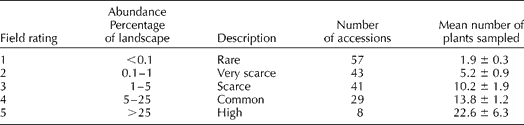
Accessions found to be rare or very scarce ( < 1% of the landscape) numbered 100 or 56% (Table 1). The mean number of plants sampled for rare, very scarce, scarce, common and highly abundant accessions were significantly different (P= 0.05). The number of plants sampled from rare accessions ranged from 1 to 10 with a mean of 1.9.
Plant abundance of species collected in Eritrea in 2004a
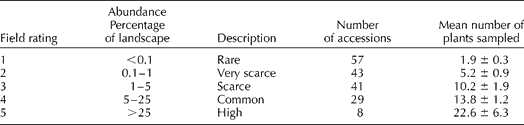
a Number of plants sampled are means ± 1 SED.
Climate match
Asmara had the best climate match at the 4th percentile and Adi Keyih at the 5th percentile with the central west coast of Western Australia between Badgingarra and Shark Bay, the Eyre Peninsula in South Australia, and an area surrounding Georgetown (Fig. 1). Adi Ugri had the best match at the 5th percentile with the central and lower west coast of Western Australia. Faghena located in the green belt zone of the Eritrean highlands had a much broader match at the 5th percentile with south and east coastal regions of Australia.
Climate match between Australia and Asmara (a), Adi Keyih (b), Adi Ugri (c) and Faghena (d) in the Eritrean highlands (decile 3, light shading; decile 4, intermediate shading; decile 5, dark shading).

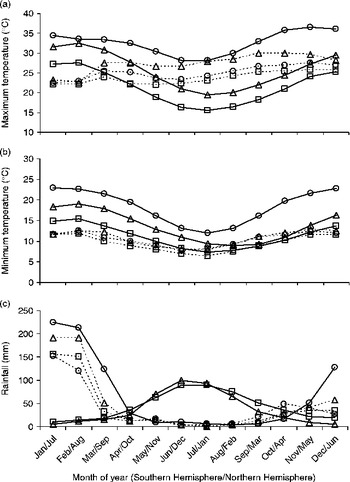
Maximum temperatures at the Eritrean sites vary less throughout the year than at the Australian sites (Fig. 2(a)). However, growing season temperatures between June and September are lower than growing season temperatures at Georgetown (November to April) and higher than at Geraldton and Coulta (May to September). Out-of-season temperatures are more similar between the sites. Minimum temperatures during the growing season are similar at the Eritrean and temperate (southern) Australian sites, but much warmer at Georgetown (Fig. 2(b)). Out-of-season temperatures at Geraldton and Coulta are higher than at the Eritrean sites. Rainfall quantity and distribution at the three sites in Australia match reasonably well with the three Eritrean sites in that they all experience a single, distinct rainfall season (Fig. 2(c)). However, most rain at the three Eritrean sites falls in a 2- to 3-month period compared with 4–5 months at the Australian sites.
(a) Average monthly maximum temperature, (b) average monthly minimum temperature and (c) average monthly rainfall for Asmara ( ), Adi Keyih (
 ) and Adi Ugri (
 ) in Eritrea, and Coulta (
 ), Georgetown (
 ) and Geraldton (
 ) in Australia.

Plant evaluations in Australia
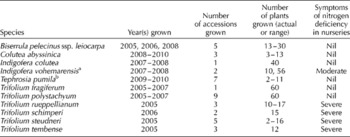
A total of 129 isolates of Rhizobium were cultured from the nodules of 18 species collected from 22 sites (Supplementary Table S3, available online only at http://journals.cambridge.org). Soil from nine sites was used to enable seedlings of five species to nodulate in a glasshouse. The resulting Rhizobium isolates were used to inoculate seedlings in germplasm nurseries. Eleven species were grown in germplasm nurseries between 2005 and 2010 as they were introduced into Australia (Table 2). Nodulation appeared to be effective in B. pelecinus ssp. leiocarpa, C. abyssinica, Indigofera colutea, T. pumila and two perennial clovers, T. fragiferum and T. polystachyum. Annual Trifolium species displayed severe symptoms of nitrogen deficiency.
Species collected from Eritrea in 2004 and grown at Medina, Western Australia between 2005 and 2010

a Collected as Indigofera trita.
b Grown in pots only.
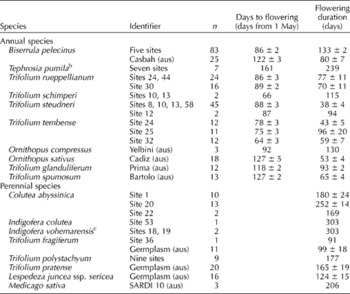
B. pelecinus ssp. leiocarpa and annual Trifolium species from Eritrea began to flower 64 ± 3 to 89 ± 2 d from a 1 May planting (Table 3). These were significantly less (P= 0.05) than the flowering times of four of the five annual legume pasture cultivars used in short seasons of south-western Australia, and similar to the earliest flowering cultivar of O. compressus, Yelbini. The duration of flowering varied greatly, nevertheless the means for the Eritrean and Australian accessions (81 and 84 d, respectively) were similar. T. pumila began to flower later in spring and flowered for a longer duration than the other annual species (Supplementary Table S4, available online only at http://journals.cambridge.org and Table 3). Flowering duration in perennial species from Eritrea varied from 91 d in T. fragiferum collected from site 36 to 303 d in the two species of Indigofera (Table 3). Cultivars or germplasm of four perennial species adapted to Australia had a similar range in flowering duration. However, Australian cultivars and germplasm flowered during the spring and summer while the Eritrean accessions flowered mostly in winter and spring (Supplementary Table S4, available online only at http://journals.cambridge.org).
Days to flowering in annual species and flowering duration per annum in both annual and perennial species of forage legumes collected from Eritrean and Australian cultivars or germplasm (aus) grown between 1988 and 2010 at Medina, Western Australia (n=sample size)a

a Data are means ± 1 SED if n≥ 10.
b Grown in pots only.
c Collected as Indigofera trita.
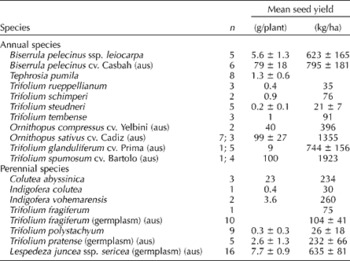
Seed yield ranged from 0.2 ± 0.1 to 100 g/plant, with the mean yield of 3.7 g for the Eritrean species and 43.4 g for cultivars and germplasm used in Australia (Table 4). Seed yield per unit area gave different results due to variations in plant size and plant density. The mean seed yields of the annual species from Eritrea and Australia were 169 and 1043 kg/ha, respectively. The mean seed yields of the perennial species from Eritrea and Australia were more similar (125 vs. 324 kg/ha, respectively). B. pelecinus ssp. leiocarpa was the best yielding species from Eritrea with 623 ± 165 kg/ha, and was not significantly different from the yield of cvs. Casbah and Prima (P= 0.05). C. abyssinica, I. vohemarensis and T. fragiferum from Eritrea also yielded well relative to T. fragiferum and T. pratense germplasm originating from the Mediterranean region, but less well relative to germplasm of the warm-season Australasian species L. juncea ssp. sericea.
Seed yield of Eritrean species grown between 2005 and 2010 and Australian cultivars or germplasm (aus) grown between 1988 and 2007 at Medina, Western Australia (n=sample size)a

a Data are means ± 1 SED if n≥ 5.
Discussion
Potential of Eritrean highland forage species in Australia
The direct use of Eritrean pasture germplasm in Australia might initially appear limited given the relatively poor climate match (best at the 5th decile). Nevertheless, a number of species performed well in germplasm nurseries in comparison with Australian cultivars and germplasm. Notable were the annual legume B. pelecinus ssp. leiocarpa and the perennial shrub C. abyssinica. The performance of the annual species of Trifolium could not be adequately assessed due most probably to a lack of effective nodulation. The performance of Eritrean germplasm in field conditions in Australia has yet to be determined. Species of Trifolium originating from Ethiopia, Kenya and Tanganyika (including T. polystachyum, T. rueppellianum, Trifolium steudneri and T. tembense) were field tested at Samford, Queensland (Mannetje, Reference Mannetje1964), and Armidale (Wen et al., Reference Wen, Hill and Blair1993) and Grafton (Wilson and Bowman, Reference Wilson and Bowman1993), New South Wales. Although some herbage yields at Armidale were high, few accessions produced seed at the dryland site due to inadequate precipitation, and no regeneration was observed. At Grafton, some accessions gave seed yields ranging between 600 and 700 kg/ha; however, again, there was little regeneration in the second year. Only perennial species grown in grass swards at Samford survived into the second year. The germplasm tested probably originated from high-rainfall (650–2000 mm) and high-altitude (1700–3500 masl) sites in the highlands of East Africa (ILCA Forage Germplasm Catalogue 1985). Consequently, it is difficult to extrapolate the performance of species from lower rainfall areas in the highlands of Eritrea. The climate match analysis suggests that Eritrean species are best suited to the central west coast of Western Australia where growing season temperatures are not dissimilar to those in the southern highlands of Eritrea. High growing season temperatures at Georgetown are likely to challenge the growth of Eritrean species. Growing season rainfall at the three Australian sites above is not dissimilar to that at the Eritrean sites. However, growing season rainfall at Georgetown falls in the warmer part of the year. Annual species require adequate soil moisture and suitable air temperatures during the growing season for plant growth, while seeds require appropriate soil moisture and temperature conditions to enable survival over future dry seasons. B. pelecinus ssp. leiocarpa may grow well on the central west coast of Western Australia; however, high summer soil temperatures during the dry season may have an impact on seed survival or cause suboptimal levels of seed softening.
The ability to flower and produce ample seed is crucial for the survival of annual species in particular. Mediterranean pasture legumes grown in southern Australia flower in response to increasing day length of 10–10.5 h in July to 11.5–12 h in September. In contrast, flowering of Eritrean species in the southern highlands corresponds with a decreasing day length of 12.8 h in August to 12.3 h in September (day length hours calculated from sunrise and sunset data sourced from http://aa.usno.navy.mil/). Assuming day length has a strong influence on the initiation of flowering, Eritrean species grown in southern Australia would have their short-day requirements satisfied for the entire period of the growing season. Flowering data from Medina, Western Australia support this, where most annual species flowered early in comparison with the cultivars of Mediterranean origin and continued flowering through to senescence. At Georgetown situated at − 18.29° latitude, day length in the second half of the growing season decreases from approximately 13 h in January to 12 h in March. Eritrean annual species growing at this location would be expected to flower and produce seed before the end of the growing season, provided that the relatively high ambient temperatures are not adverse.
Growth and survival of perennial species are challenged by year-round conditions. Temperature fluctuation throughout the year is small in the Eritrean southern highlands compared with most of Australia. Vast areas of both northern and southern Australia receive sufficient rainfall to support perennial species found in the Eritrean southern highlands surviving on 450–650 mm rainfall. Tolerance to high temperatures and frosts during the establishment of perennial species is likely to present the greatest challenge. C. abyssinica showed considerable drought and cold tolerance as mature plants when grown in these germplasm nurseries at Medina; however, seedlings were killed by frost in winter.
Significant areas in southern and eastern Australia receiving higher rainfall (>650 mm) over a longer growing season are likely to support the growth and survival of Eritrean species. This is illustrated in the climate match of Faghena in the green belt zone on the eastern escarpment in Eritrea. With respect to plant growth, this is supported by earlier work with Ethiopian species (Mannetje, Reference Mannetje1964; Wilson and Bowman, Reference Wilson and Bowman1993; Wen et al., Reference Wen, Hill and Blair1993).
Important insights come with the long history of plant introduction into Australia. Successful adaptation does not always result from classical climate and soil matching. For example, Kikuyu (Pennisetum clandestinum), which originates from the highlands of East Africa with a limited range in temperature, is successfully established on the south and west coasts of Western Australia (Moore et al., Reference Moore, Sanford and Wiley2006). Despite the poor climate match with Australia, Kikuyu tolerates frosts by producing rhizomes, drought by growing deep roots and high ambient temperatures through being a C4 grass.
Commonalities can be found in soil structure and pH from collecting sites in the Eritrean highlands and southern Australia. Low soil fertility coupled with low water-holding capacity on the poorest soils in south-western Australia may challenge Eritrean species. Nitrogen nutrition will almost certainly depend on the introduction of effective Rhizobium species. Soil conditions over summer are likely to challenge their survival. Native species of Rhizobium may be effective on pasture species common to both countries, for example, in I. colutea.
Effective nodulation was found in B. pelecinus ssp. leiocarpa using strains of Rhizobium sourced from Eritrean soil when grown in germplasm nurseries at Medina (Richard Snowball, unpublished data) and in a glasshouse (Kemanthie Nandasena, unpublished data). In addition, this species flowered very early, had a long flowering period and gave a good seed yield. The smooth margins of the pods of B. pelecinus ssp. leiocarpa will not cause contamination of sheep's wool commonly found with B. pelecinus ssp. pelecinus from the Mediterranean basin. Crossing the two subspecies should be attempted.
Potential of native forage legumes on the Eritrean highlands
The value of forage legumes for intensive production systems in East Africa was questioned by Sumberg (Reference Sumberg2002) and later defended by Lenné and Wood (Reference Lenné and Wood2004). Little has been claimed with regard to the value of legumes in extensive grazing and cropping systems in the East African highlands. Boonman (Reference Boonman1993) did postulate that legumes can improve the dietary value of extensively grazed and mature natural grasslands, and also when grown as fodder crops (‘protein banks’) or in association with fodder grasses (section 10.10, page 214). The value of legumes in extensive grazing and cropping systems in Australia and other countries is well documented (Batello et al., Reference Batello, Brinkman, Mannetje, Martinez and Suttie2007; Clements, Reference Clements1996). Maintaining legumes in natural grasslands depends on regular adjustments to the frequency and intensity of grazing. Intensively grazed areas low in the landscape of the Eritrean highlands appear productive and well represented with legumes, in particular the species of Lotus, Medicago and Trifolium. These legumes have well-developed tolerances to high grazing pressures. Legume abundance in the extensively grazed hillsides is much lower, except at conservation sites where grazing animals are often excluded (e.g. site 51 in this study).
Investigations into the potential of native and exotic pasture species in the highland regions of Kenya and Ethiopia began more than 50 years ago (Strange, Reference Strange1958). More recent research effort focused on the species of Trifolium native to the highlands of Ethiopia. Species including T. rueppellianum, T. steudneri and T. tembense demonstrated potential for hay or pasture production (Akundabweni, Reference Akundabweni, Haque, Jutzi and Neate1986; Akundabweni et al., Reference Akundabweni, Lazier and Lemme1991; Kahurananga and Tsehay, Reference Kahurananga and Tsehay1984; Kahurananga and Tsehay, Reference Kahurananga and Tsehay1991), and potential in a crop ley (Akundabweni, Reference Akundabweni, Haque, Jutzi and Neate1986) or for intercropping (Kahurananga, Reference Kahurananga1991). Native perennial species including T. burchellianum and T. semipilosum also showed potential (Kahurananga, Reference Kahurananga and Dzowela1987). The bimodal rainfall pattern characteristic of parts of the Ethiopian highlands poses a particular challenge for seedling survival in Trifolium (Dauro, Reference Dauro, Mohamed-Saleem and Gintzburger1997), similar to the false breaks experienced in some Mediterranean farming systems. The highlands of Eritrea generally do not experience a bimodal rainfall pattern; however, false breaks are common in the 3 months prior to the main rain that falls in July and August. Trifolium spp. found in Eritrea are likely to make a significant contribution to pasture production as they do in other parts of East Africa, particularly in wet areas where most of the species are well adapted. However, the lower annual rainfall of 450–650 mm over a short growing season in most of the Eritrean highlands would probably result in lower pasture yields compared with much of the East African highlands.
Trifolium schimperi and B. pelecinus ssp. leiocarpa are likely to perform well on dry slopes in rotation with cereal crops in the Eritrean highlands, similar to T. decorum in rotation with teff (Lazier and Mengistu, Reference Lazier, Mengistu, Engels, Hawkes and Worede1991) and T. bilineatum, T. quartinianum, T. decorum and T. rueppellianum in rotation with wheat (Kahurananga, Reference Kahurananga1991) in the Ethiopian highlands. Biserrula and the annual species of Trifolium including T. subterraneum and T. spumosum are used successfully in crop rotations in dry Mediterranean climates of southern Australia and elsewhere (Nichols et al., Reference Nichols, Loi, Nutt, Snowball, Revell and Huyghe2010). The dry hillside slopes visited during this collecting mission are a source of significant species diversity. Species of Indigofera, Tephrosia and Crotalaria have an upright growth habit and were found at a low frequency. Increasing their contribution to pasture production would require a more disciplined grazing management or the establishment of fodder banks protected from uncontrolled grazing. Species of Indigofera are cut and carried for dairy cattle feed in the Welayita awraja of Sidamo administrative region of Ethiopia (Lazier and Mengistu, Reference Lazier, Mengistu, Engels, Hawkes and Worede1991). Marejea (Crotalaria ochroleuca) is a multi-purpose fodder fed to dairy cattle in Tanzania (Sarwatt and Mkiwa, 1988). Native legume shrubs are poorly utilized in the highlands of East Africa. Nevertheless, Calliandra calothyrsus is used in high rainfall (>1000 mm) and long season (>8 months) areas of Kenya at altitudes up to 1900 m for grazing or cut-and-carry (Franzel et al., Reference Franzel, Arimi, Murithi, Franzel and Scherr2002). Species of Erythrina are used as browse hedges in the highlands of western Ethiopia at the beginning of the dry season (Lazier and Mengistu, Reference Lazier, Mengistu, Engels, Hawkes and Worede1991). While there are particular difficulties in establishing and managing an extensive grazing system that utilizes fodder shrubs, the value of out-of-season green feed is significant. C. abyssinica stands out as a native legume shrub with potential in the lower rainfall Eritrean highlands.
The successful development of native forage legumes for the Eritrean highlands will depend on a number of factors. Low phosphorus levels in the soil can severely limit legume growth. Moderate applications of P fertilizer result in large increases in nodulation and dry matter production of legumes (Kahurananga and Tsehay, Reference Kahurananga and Tsehay1984; Mugwira et al., Reference Mugwira, Haque, Lupwayi and Luyindula1997). Managing grazing in commonly grazed highland areas will be necessary to encourage legume growth and optimize the legume seed bank in the soil. In these areas where land tenure is uncertain, graziers are unlikely to adopt a conservative grazing strategy (Shelton et al., Reference Shelton, Franzel and Peters2005). Mechanization of seed production is essential to satisfy the economics of sowing new pastures (Akundabweni and Njuguna, Reference Akundabweni and Njuguna1996). Finally, there needs to be a clear demonstration of the benefits of native forage legumes. Is there a ‘logic of exotic legumes’ similar to the ‘logic of fodder legumes’ described by Sumberg (Reference Sumberg2002)? Do exotic legumes possess a ‘mantle of absolute goodness’? Evidence of this ‘logic’ comes from recent work by Wolfe et al. (2008) in the highlands of Eritrea who trialled 261 temperate species (mostly exotic legumes), 83 tropical legumes and six local genotypes. The vast majority of exotic temperate legumes failed to grow well and regenerate in subsequent years. There is a strong need to explore the potential of the large diversity of species native to the highlands of Eritrea that clearly are very well adapted to their local environments.
Acknowledgements
The authors wish to express their thanks to Kris Gajda, Ben Cohen and staff of the Medina Research Station for assisting with the germplasm nurseries in Western Australia. The authors also thank genebank staff at the Hal Hale Research Centre for assisting with the processing and cleaning pasture seed samples collected in Eritrea. Jens Berger of CSIRO, Western Australia is acknowledged for assisting with sourcing climate data for collecting sites. Special thanks go to Tesfaslassie Ghebremariam, Tsegai Tesfay and Asmerom Kidane for their support of the collecting mission in Eritrea. The Australian Grains Research and Development Corporation through the Future Farm Industries CRC (formerly CRC Salinity), Department of Agriculture and Food, Western Australia and Centre for Legumes in Mediterranean Agriculture University of Western Australia provided funding for this research.